
assistents.ai vs Moveworks: Which Is the Best AI Agent Building Platform for Enterprise in 2026?


Moveworks built its name on IT support automation. But enterprises scaling AI agents across finance, logistics, healthcare, and operations need something different. Here is how assistents.ai compares — and where each platform actually wins.
Quick verdict: If your primary goal is automating IT helpdesk tickets and employee support within a ServiceNow-first environment, Moveworks is a mature, proven option.
If you need AI agents that work across departments — finance, logistics, healthcare, retail, sales, customer support, and compliance — on a single governed platform with 300+ integrations and a 4-week deployment track record, assistents.ai is the stronger choice. Read on for the full breakdown.
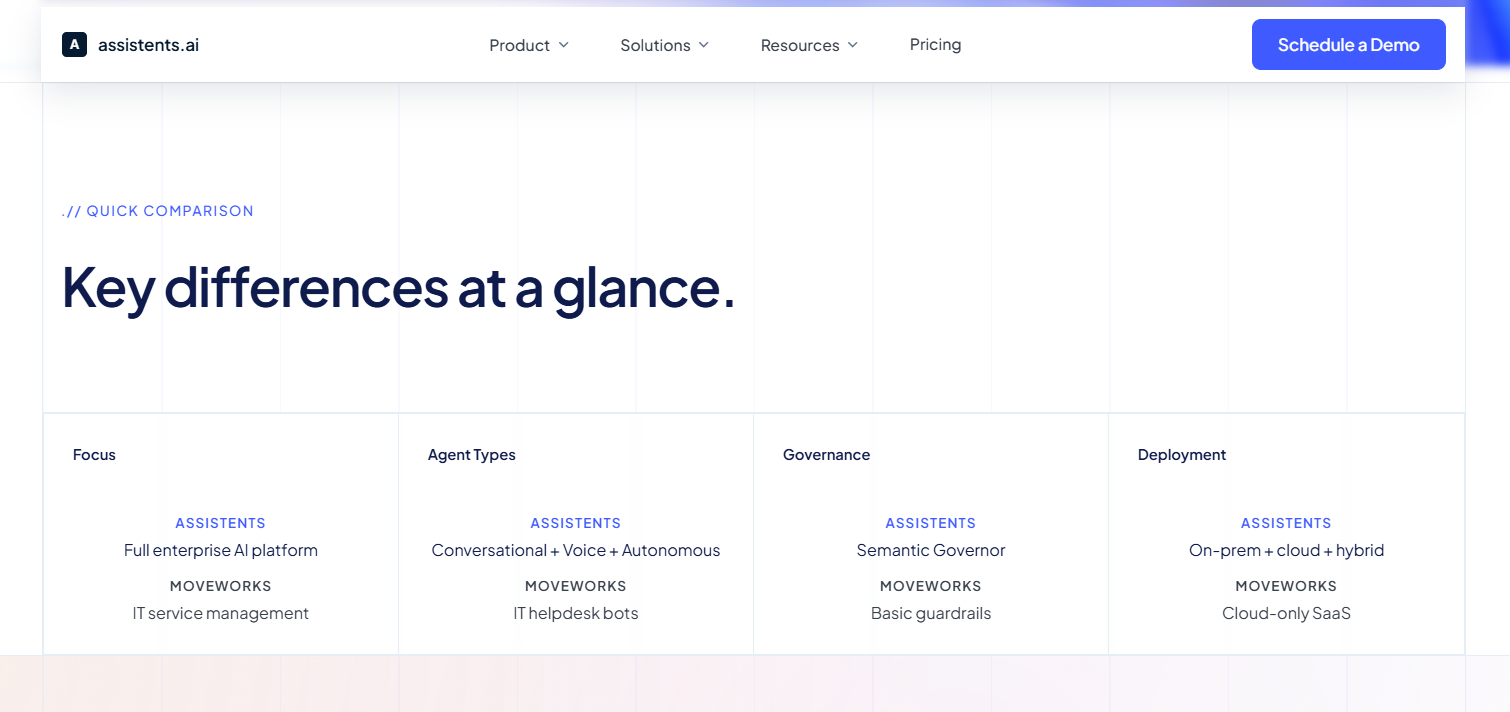
Key differences at a glance
What is Moveworks — and where does it stop?
Moveworks is an enterprise AI assistant platform designed to modernize employee support. It entered the market as an IT service desk automation tool and built a strong reputation by helping large companies reduce ticket volumes, automate password resets, and answer HR policy questions through a conversational interface in Slack or Microsoft Teams.
Its core strengths are real: natural language understanding that works across IT queries, deep native integrations with ServiceNow and Jira, and a Reasoning Engine that can interpret employee intent and route requests across connected systems. For organizations whose primary AI agent goal is IT and HR ticket deflection, Moveworks delivers.

The ServiceNow acquisition and what it means for your roadmap
In March 2025, ServiceNow agreed to acquire Moveworks. For enterprises evaluating AI agent platforms as long-term infrastructure, this creates a strategic question that every serious procurement committee should ask: as Moveworks becomes embedded in the ServiceNow ecosystem, will the platform remain accessible to organizations that are not deeply committed to ServiceNow? Will pricing, packaging, and roadmap priorities continue to serve enterprises that use diverse stacks — SAP, Salesforce, Oracle, and hundreds of other systems?
These are not hypothetical concerns. Enterprise software acquisitions routinely lead to tighter ecosystem lock-in, bundle-dependent pricing, and slower product velocity for capabilities outside the acquirer's core interests. For organizations selecting an AI agent platform today, that uncertainty is a real input.
Where Moveworks hits its ceiling
Moveworks is firmly centered on employee support automation — and even within that scope, independent analysts have noted that its ability to handle certain visual or non-text IT and HR issues is still developing. More fundamentally, Moveworks was not built as a cross-functional AI agent platform.
If your operations team needs an autonomous agent that processes SAP sales orders, your finance team needs agents monitoring cashflow and flagging anomalies, your retail team needs inventory intelligence at store level, or your logistics team needs AI agents orchestrating terminal and rail operations — Moveworks does not have a product for those use cases. It was not designed to.
This is not a criticism. It is a category boundary. The problem arises when enterprises select Moveworks expecting a universal AI agent platform and discover they need a separate solution for every non-IT workflow they want to automate.
What is assistents.ai — the best AI agent building platform for cross-functional enterprise?
assistents.ai is an enterprise agentic AI platform built to deploy, orchestrate, and govern AI agents across every function of an organization — not just the IT desk. Where Moveworks is an AI assistant optimized for a specific workflow category, assistents.ai is designed as an operating system for enterprise AI agents.
The distinction matters in practice. An AI assistant answers questions and helps with tasks within a defined scope. An agentic platform plans, executes, monitors, and adapts across multi-step workflows that span multiple systems, departments, and data sources — with governance embedded at every layer.
Agentic-first architecture vs. assistant-first architecture
assistents.ai is built around autonomous agents: systems that can take a business objective, break it into steps, execute those steps across connected enterprise systems, and surface outcomes to the right people at the right time. This is fundamentally different from an assistant that waits for an employee to ask a question and responds.
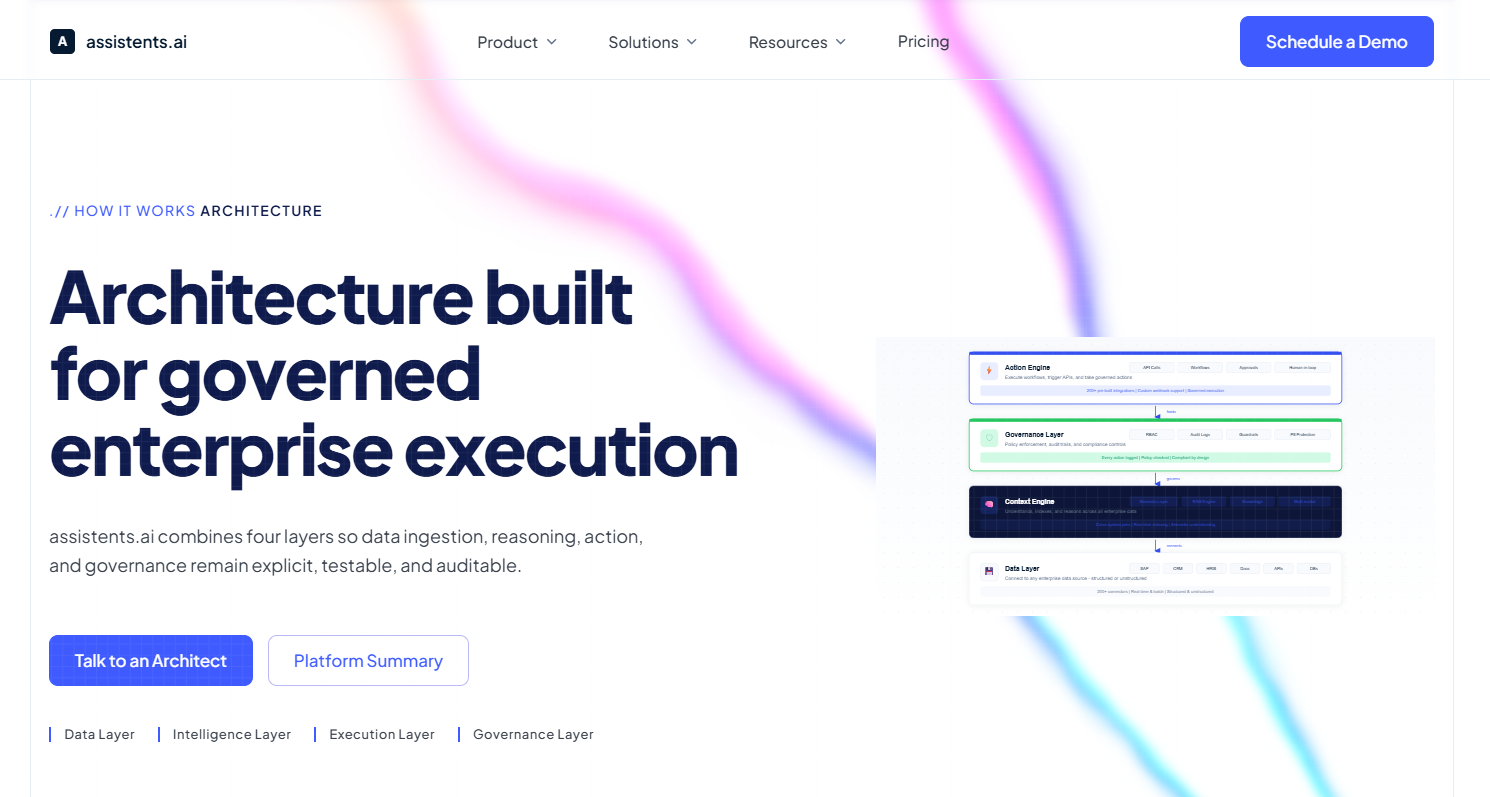
The platform combines conversational agents, voice AI agents, autonomous agents, a business intelligence layer, document AI, and a workflow builder — all governed through a Semantic Governor that enforces permissions, audit trails, and policy compliance across every agent action. This governance architecture is one of the most significant differences between assistents.ai and point-solution tools like Moveworks.
300+ integrations. 12 industries. One platform.
One of the clearest competitive advantages assistents.ai holds in this comparison is integration breadth. With 300+ enterprise integrations spanning SAP, Salesforce, ServiceNow, Oracle, and hundreds of domain-specific systems, assistents.ai can deploy AI agents across virtually any enterprise stack — not just the ITSM stack.
This matters enormously for enterprises evaluating total cost of ownership. An enterprise deploying Moveworks for IT and then seeking separate AI agent solutions for finance, logistics, customer support, and retail ends up managing multiple vendors, multiple governance frameworks, multiple integration layers, and multiple contracts. assistents.ai replaces that fragmentation with a single governed platform.
4-week deployment vs. 8–12 weeks
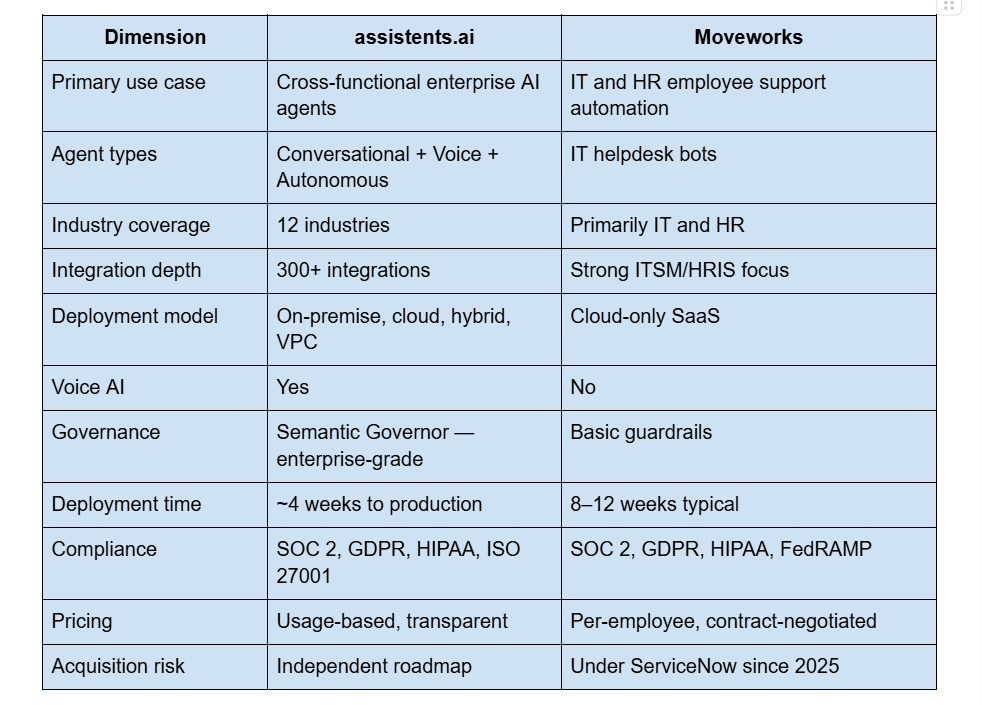
Deployment speed is one of the most underappreciated dimensions of enterprise AI platform selection. Internal AI initiatives stall most often not because the technology failed — but because implementation timelines stretched, IT resources were consumed, and business stakeholders lost confidence. assistents.ai has a consistent track record of deploying production-ready AI agents in approximately four weeks. Industry peers — including Moveworks — typically require 8 to 12 weeks for comparable deployments.
assistents.ai vs Moveworks: direct feature comparison
AI agent building capabilities
Moveworks offers no-code and low-code tools for building custom AI agents and workflows, primarily scoped to IT and HR service desk scenarios. Its Creator Studio enables developers to build integrations and extend the platform within its ITSM paradigm.
assistents.ai provides a full Agent Builder and Workflow Builder that enables both technical and non-technical teams to create, deploy, and govern AI agents across any enterprise workflow. Agents can be built for IT support, but also for financial reporting, supply chain orchestration, customer service automation, sales pipeline management, and compliance monitoring. The platform is not constrained to a single workflow category.
Integration depth and system coverage
Moveworks offers strong out-of-the-box integrations with ServiceNow, Salesforce, Microsoft Teams, Slack, and core HRIS platforms. For organizations whose entire enterprise stack revolves around these systems, Moveworks' integration depth is genuine.
assistents.ai offers 300+ integrations, including SAP, Salesforce, ServiceNow, Oracle, and deep connectors across logistics systems, retail platforms, energy management tools, healthcare data environments, and financial services infrastructure. For enterprises with heterogeneous stacks — which is most large organizations — assistents.ai's integration coverage is significantly broader.
Governance, compliance, and security
Both platforms carry SOC 2, GDPR, and HIPAA compliance certifications. assistents.ai additionally holds ISO 27001 certification. Moveworks holds FedRAMP authorization, which is a meaningful differentiator for US public sector deployments.
The more significant governance difference is architectural. assistents.ai's Semantic Governor enforces consistent rules, role-based permissions, audit trails, and explainability across every agent action across the entire platform. This is particularly important for enterprises in regulated industries — financial services, healthcare, energy — where governance cannot be an afterthought and must be embedded in how agents operate, not bolted on afterward.
Deployment flexibility
Moveworks is a cloud-only SaaS platform. assistents.ai supports on-premise, cloud, private cloud, hybrid, and VPC deployment — including self-hosted large language models. For enterprises in regulated industries or jurisdictions with strict data residency requirements, this difference is not minor. It is often a deciding factor.
Voice AI
Moveworks does not offer voice AI capabilities. assistents.ai delivers voice AI agents that can operate alongside conversational agents — enabling enterprises to deploy AI-powered voice interactions in customer-facing and employee-facing scenarios. For industries like retail, healthcare, logistics, and financial services where voice is a core interaction channel, this is a material capability gap.
Where assistents.ai wins: real enterprise deployments across industries
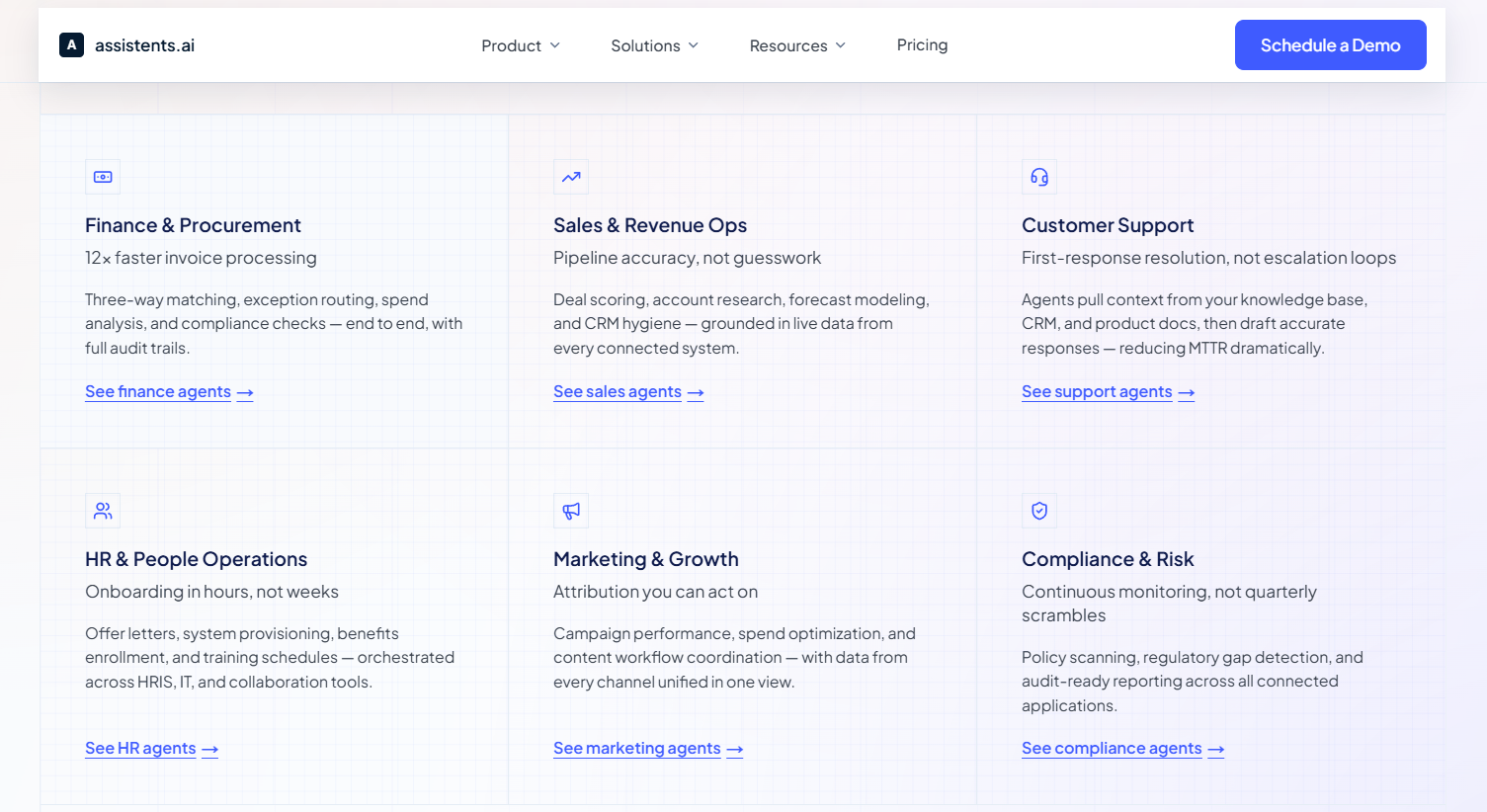
The most meaningful evidence for any enterprise AI platform is not a feature checklist — it is what has actually been deployed, in production, at scale, in environments similar to yours. The following reflects real deployments across assistents.ai's customer base. Client names are not disclosed, but industry, scale, and outcomes are.
Financial services: from cashflow intelligence to dispute automation
A global fintech provider serving banks and credit unions deployed omnichannel AI agents through assistents.ai to handle banking support workflows, dispute processing, and compliance automation. The agents operate across voice, chat, and email channels, with full audit trails and SLA monitoring built into every interaction. The outcome: faster case handling, reduced operational load on human teams, and compliance-ready audit documentation — all delivered through a single governed agentic platform.
A separate financial services deployment centered on an AI CFO agent, giving leadership teams continuous cashflow visibility, scenario forecasting, and anomaly alerts without adding headcount. This type of workflow — autonomous, multi-system, financially sensitive, and governance-critical — represents exactly the category where Moveworks has no product.
Logistics and supply chain: agents at port and rail scale
A global ports and logistics operator — one of the largest in the world by reported revenue — deployed assistents.ai agents for terminal and rail management, digitizing port-to-inland logistics operations with real-time executive dashboards, rail scheduling, yard visibility, and automated exception alerts. The agents consolidate operational data across systems that previously required manual monitoring and cross-referencing.
A separate supply chain enterprise deployed AI agents for analytics consolidation across multi-entity global operations, giving leadership a single view of performance across geographies and business units that had previously been siloed.
These are not IT helpdesk use cases. They are core operations. Moveworks does not compete in this category.
Healthcare: HIPAA-compliant agents for staffing, care programs, and patient operations
Two separate healthcare organizations deployed assistents.ai agents for clinical and operational workflows. A physician-led inpatient enterprise deployed agents for revenue management and operational performance analytics, improving visibility into revenue leakage drivers and staffing efficiency. A geriatric care services provider deployed agents for care-program performance monitoring and service delivery analytics.
Both deployments were built with HIPAA compliance embedded from day one — not added through a compliance checkbox, but architected into how the agents access, process, and surface patient and operational data. For healthcare enterprises evaluating AI platforms, this is a non-negotiable requirement that assistents.ai meets as a design principle.
Retail: AI agents across 700+ store operations
A national retail chain with more than 700 stores across hundreds of cities deployed a multi-agent system through assistents.ai including a voice support agent operating in two languages, an inventory intelligence agent providing real-time pricing and stock visibility at store level, and a knowledge and training agent built on retrieval-augmented generation over point-of-sale and standard operating procedure documents.
The result was a measurable reduction in manual helpdesk burden, improved store-level inventory visibility, and faster onboarding through on-demand training access — all coordinated through assistents.ai's agent orchestration layer. Deploying a Moveworks IT helpdesk agent in this environment would not have touched any of these outcomes.
Smart infrastructure and energy: agentic monitoring at grid and campus scale
A state power transmission utility deployed AI agents for transmission KPI monitoring, anomaly detection, and predictive maintenance indicators — converting raw grid data into operational dashboards and automated field alerts that previously required manual analysis. A premier research institute deployed energy management agents to monitor, forecast, and optimize campus energy consumption, reducing manual monitoring effort and improving visibility into inefficiencies.
These deployments operate in environments where reliability, data governance, and integration with specialized operational systems are non-negotiable. The assistents.ai platform's on-premise deployment option and Semantic Governor architecture make it a credible choice in these environments. Moveworks has no documented presence in smart infrastructure or energy utilities.
How to build an AI agent for enterprise with assistents.ai
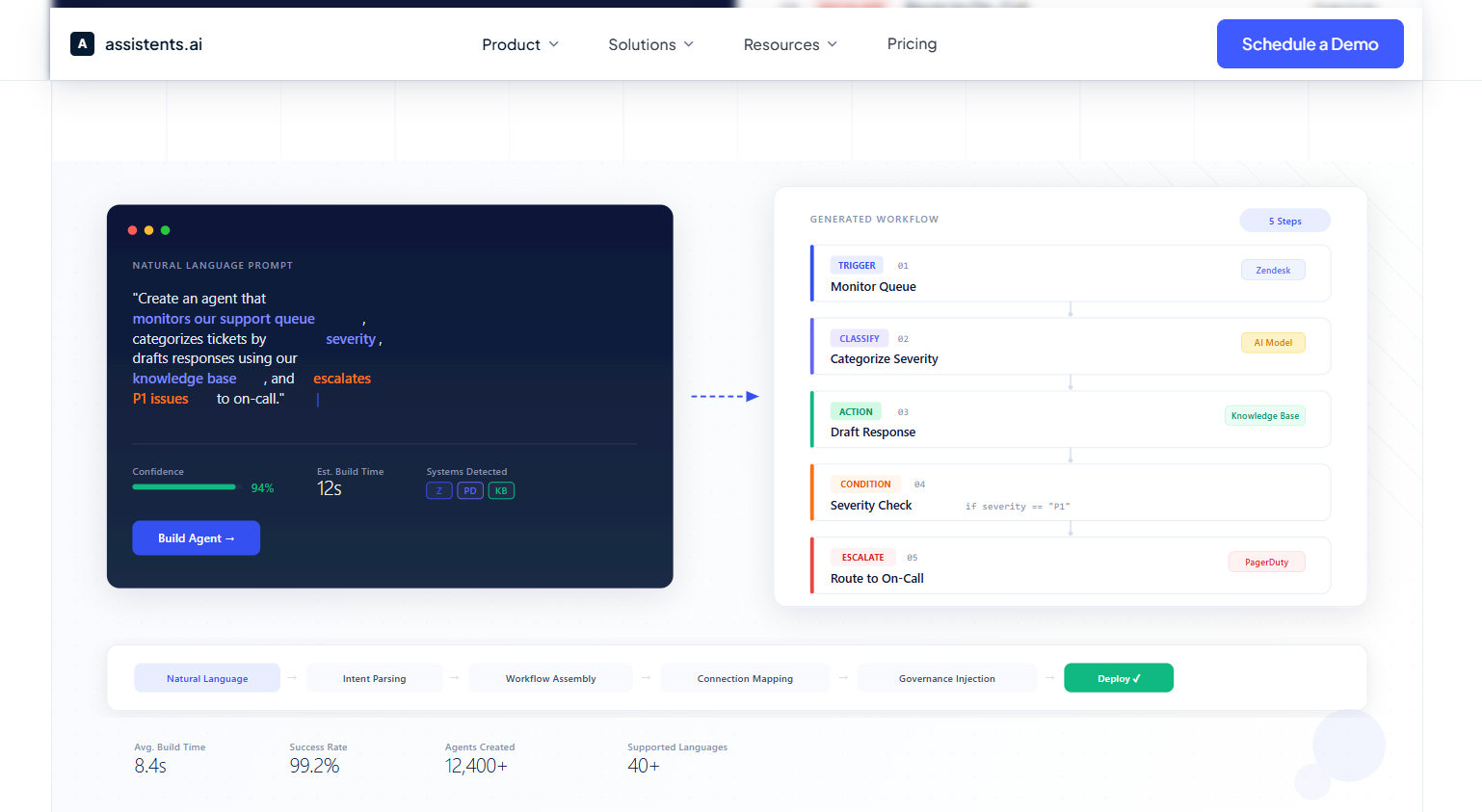
For enterprises evaluating how to create an AI agent for their first or next production deployment, assistents.ai's implementation approach is designed around speed to value rather than open-ended configuration.
Step 1: Map your highest-value workflow. Start with a single workflow that has measurable business impact — not the easiest workflow to automate, but the one where automation produces the clearest return. For financial services enterprises, this is often dispute processing or compliance reporting. For logistics, it is often exception management and operational dashboards. For retail, it is often inventory intelligence or store-level support.
Step 2: Select your integration layer. assistents.ai connects to your existing systems — SAP, Salesforce, ServiceNow, Oracle, or custom APIs — without requiring you to replace or restructure your stack. The integration layer is configured as part of the implementation, not as a separate project.
Step 3: Define governance rules and compliance scope. Before any agent goes into production, the Semantic Governor is configured with role-based access, permission boundaries, audit trail requirements, and escalation logic. For regulated industries, compliance scope — HIPAA, GDPR, ISO 27001 — is documented and embedded during this phase.
Step 4: Deploy and measure. The typical timeline from scoping to production is four weeks. Post-deployment, the platform provides continuous monitoring, performance dashboards, and the ability to iterate on agent behavior based on observed outcomes.
[Request a demo to see how this applies to your specific workflow → assistents.ai/contact]
Who should choose Moveworks?
Moveworks is the right choice if:
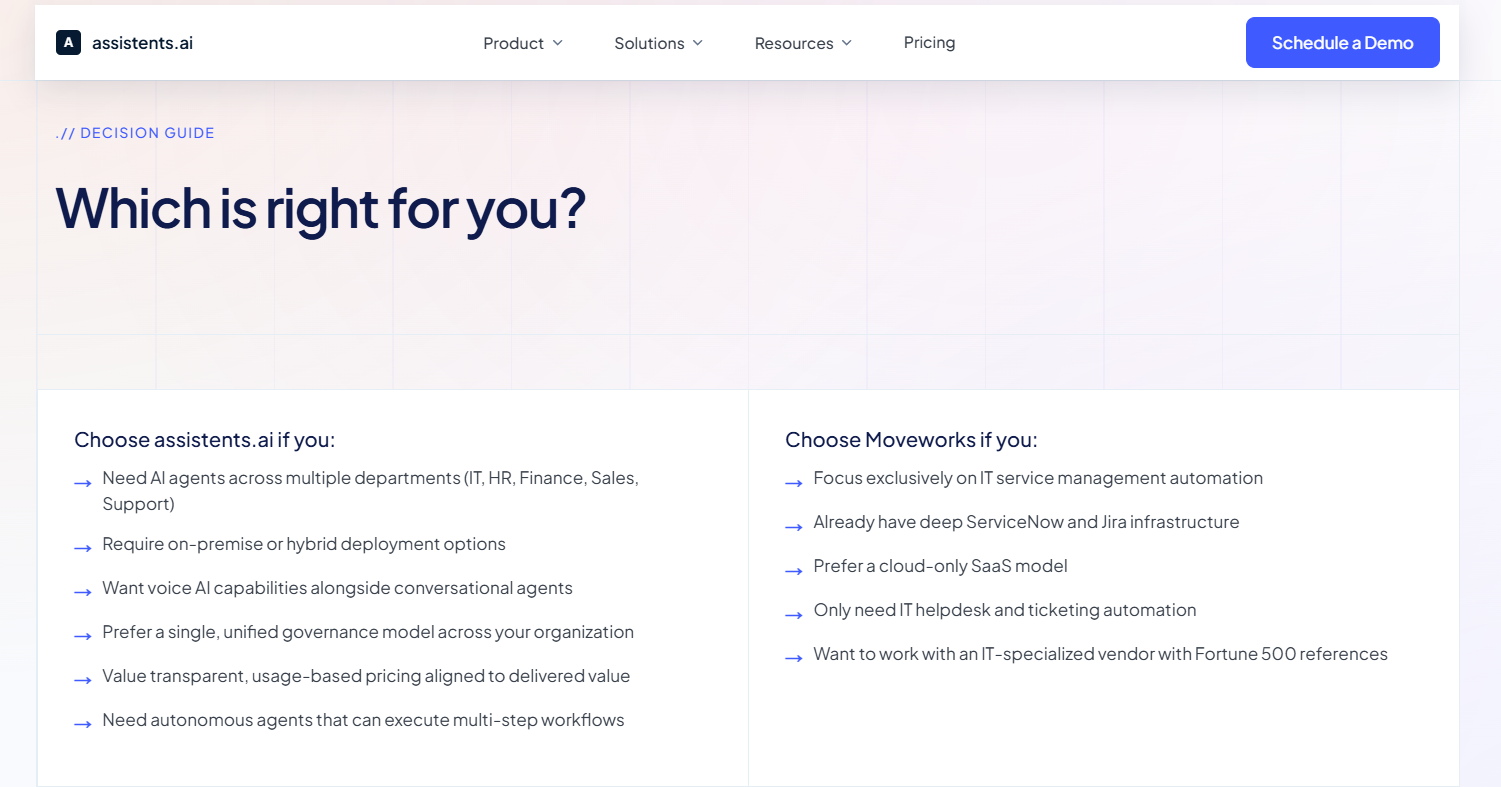
Your primary AI agent goal is IT and HR service desk automation within a ServiceNow-first or Jira-first environment, and you have no near-term plans to extend AI agents beyond internal support workflows. You are a US public sector organization that requires FedRAMP authorization, which Moveworks holds and assistents.ai does not currently list. You already have a deep Moveworks integration investment and the ServiceNow acquisition roadmap is acceptable to your strategic planning horizon.
Moveworks has a proven track record in enterprise IT automation with a mature install base. If those are your requirements, that track record is real.
Who should choose assistents.ai?
assistents.ai is the right choice if:
You need AI agents that operate across more than IT and HR — covering finance, logistics, customer support, sales operations, compliance, retail, healthcare, or energy. You require on-premise, hybrid, or private cloud deployment because of data residency, security policy, or regulatory requirements.
You want a single governed platform rather than multiple point solutions producing fragmented governance, integration overhead, and duplicate vendor management. You need voice AI agents alongside conversational and autonomous agents. You want a 4-week path to production rather than a multi-month implementation project. You are concerned about the long-term roadmap implications of Moveworks' ServiceNow acquisition and prefer an independent platform with a clear product trajectory.
The enterprises already deployed on assistents.ai include organizations in financial services, logistics, healthcare, retail, energy, smart infrastructure, education, and professional services — across geographies spanning India, the UAE, Australia, Europe, and North America. That deployment breadth reflects a platform built for cross-functional enterprise reality, not a specific workflow category.
[See assistents.ai in action — schedule a 30-minute demo → assistents.ai/contact]
The bottom line
Moveworks is a capable, well-established AI assistant for IT and employee support. If that is the entire scope of what your enterprise needs from AI agents, it is a credible choice — particularly if ServiceNow is already central to your infrastructure.
But the enterprises winning with AI agents in 2026 are not deploying them only at the IT desk. They are deploying autonomous agents in finance to monitor cashflow and flag anomalies before they become problems. They are deploying logistics agents that orchestrate port and rail operations in real time. They are deploying voice agents in two languages across hundreds of retail store locations. They are deploying healthcare agents that handle staffing, revenue management, and care-program analytics with HIPAA compliance built in from day one.
Moveworks does not have products for those deployments. assistents.ai has production deployments for all of them.
The question for your enterprise is not which AI agent platform is better in the abstract. It is which platform matches the scope of what you are actually trying to build — today and over the next three years. If that scope extends beyond IT support, the comparison here is clear.
[See assistents.ai's full feature comparison with Moveworks → assistents.ai/compare/moveworks]
[Calculate the ROI of your first AI agent deployment → assistents.ai/resources/ai-agent-roi-calculator]
[Schedule a 30-minute demo → assistents.ai/contact]
Frequently asked questions
Is assistents.ai a Moveworks alternative?
Yes — and more than that. Moveworks and assistents.ai overlap in their ability to deploy conversational AI agents for enterprise workflows. But assistents.ai covers a significantly broader scope: 12 industries, 6 departments, 300+ integrations, voice AI, autonomous agents, and on-premise deployment. For enterprises whose needs extend beyond IT and HR automation, assistents.ai is a direct Moveworks alternative. For enterprises focused exclusively on ITSM, both platforms merit evaluation.
What makes assistents.ai the best AI agent building platform for enterprises outside IT?
Three things: breadth, governance, and deployment architecture. assistents.ai is the only platform in this comparison that deploys production AI agents across logistics, energy, retail, healthcare, and financial services simultaneously, with a single Semantic Governor enforcing compliance and auditability across all of them. Most enterprise AI agent tools are optimized for one workflow category. assistents.ai is built to be the operating system across all of them.
How do I create an AI agent for enterprise workflows without a large engineering team?
assistents.ai's Agent Builder and Workflow Builder are designed for business teams and IT teams working together — not for engineering teams working alone. The platform supports no-code and low-code agent creation, with implementation support that typically brings a production agent live in four weeks. The deployment methodology is structured around your workflow, your systems, and your governance requirements — not around the platform's preferences.
Does assistents.ai work with SAP, ServiceNow, and Salesforce?
Yes. assistents.ai supports 300+ enterprise integrations including SAP, Salesforce, ServiceNow, Oracle, and a wide range of domain-specific systems across logistics, healthcare, energy, retail, and financial services. Integration with your existing stack is configured during implementation — you do not need to replace or restructure your systems to deploy AI agents through assistents.ai.
How does assistents.ai handle HIPAA and GDPR compliance?
Both HIPAA and GDPR compliance are embedded in the assistents.ai platform architecture, not added as optional compliance modules. The Semantic Governor enforces role-based data access, audit trails on every agent action, permission boundaries, and escalation protocols — all of which are configured to meet HIPAA and GDPR requirements during the implementation phase. assistents.ai also holds SOC 2 Type II and ISO 27001 certifications.
What industries have deployed AI agents on assistents.ai?
Verified production deployments span financial services, logistics and supply chain, healthcare, retail, energy and utilities, smart infrastructure, education, real estate, hospitality, professional services, and technology. This cross-industry breadth reflects assistents.ai's positioning as a universal enterprise AI agent platform rather than a workflow-category specialist.
How does assistents.ai compare to Moveworks on deployment time?
assistents.ai's typical time from scoping to production deployment is approximately four weeks. Moveworks deployments typically require 8 to 12 weeks for comparable scope. The difference reflects assistents.ai's structured implementation methodology, pre-built integration connectors, and deployment architecture optimized for fast time-to-value rather than extended configuration cycles.
Can assistents.ai replace Moveworks post-ServiceNow acquisition?
For enterprises whose AI agent needs extend beyond IT and HR support automation, assistents.ai is a complete replacement and a platform upgrade — covering all the workflows Moveworks handles, plus the cross-functional and industry-specific workflows Moveworks does not. For enterprises embedded in the ServiceNow ecosystem whose primary need is IT helpdesk automation, migration requires evaluating the ServiceNow bundle against the cost of maintaining Moveworks as a standalone investment. assistents.ai's team can provide a direct comparison for your environment — [request a conversation here → assistents.ai/contact].

Transform Your Business With Agentic Automation
Agentic automation is the rising star posied to overtake RPA and bring about a new wave of intelligent automation. Explore the core concepts of agentic automation, how it works, real-life examples and strategies for a successful implementation in this ebook.
Sarfraz Nawaz is the CEO and founder of Ampcome, which is at the forefront of Artificial Intelligence (AI) Development. Nawaz's passion for technology is matched by his commitment to creating solutions that drive real-world results. Under his leadership, Ampcome's team of talented engineers and developers craft innovative IT solutions that empower businesses to thrive in the ever-evolving technological landscape.Ampcome's success is a testament to Nawaz's dedication to excellence and his unwavering belief in the transformative power of technology.

More insights
Discover the latest trends, best practices, and expert opinions that can reshape your perspective







Contact us

