
AI Agents in Logistics & Supply Chain: Use Cases, ROI & Real Deployments (2026)


Supply chains in 2026 are not breaking because of a lack of data. They are breaking because the gap between data and action is still measured in days — sometimes weeks. A disruption hits a port. An inventory mismatch surfaces. A procurement exception flags in the system. And somewhere, a human is waiting for a report, cross-referencing a dashboard, and drafting an email.
AI agents close that gap. Not by generating better reports. By acting.
This guide covers what enterprise AI agents actually do in logistics and supply chain operations, where they deliver the highest return on investment, and what real deployments look like — including outcomes from live enterprise implementations across global ports operations, multi-entity supply chain companies, and complex pharma sourcing environments.
What makes an AI agent different from automation, RPA, and predictive analytics in logistics
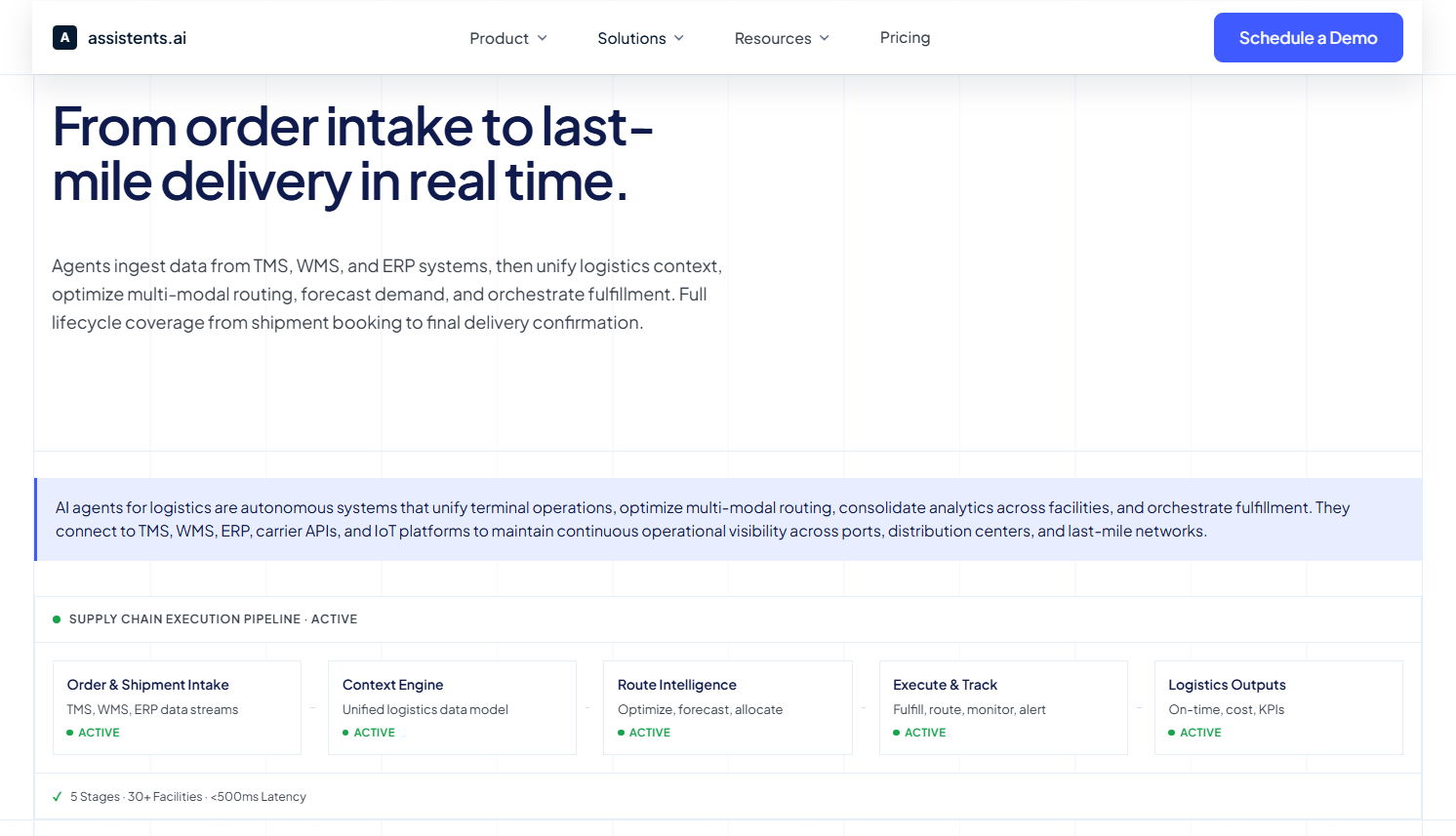
Before covering use cases, this distinction matters — because the term "AI" is being used to describe tools that operate in fundamentally different ways, and buying the wrong category is an expensive mistake.
Predictive analytics tells you what is likely to happen. A demand forecast, a delay probability score, a risk rating for a supplier. The output is insight. A human still decides what to do with it.
RPA (robotic process automation) follows fixed rules to execute repetitive tasks. It moves data from one system to another, fills in forms, runs scheduled reports. It breaks the moment something falls outside the script. It cannot reason, adapt, or handle exceptions.
Copilots and AI assistants reason — they can suggest a next step, draft a response, summarise a document. But they do not act. The human remains the bottleneck between recommendation and execution.
AI agents combine all three capabilities in a single system. They perceive data across multiple sources, reason through the right response, execute autonomously within defined governance boundaries, handle exceptions without human scripting, and generate a complete audit trail of every decision.
In a logistics context, the practical difference looks like this: a predictive tool tells you that a shipment will be delayed. An AI agent detects the delay, cross-references alternative carrier availability, re-routes the order, updates the WMS, notifies the customer, and escalates to a human only if the exception falls outside its approved decision scope.
That is not a faster dashboard. That is a different category of operational infrastructure.
The state of AI agents in logistics and supply chain in 2026
The numbers tell a clear story about where this market is heading.
The agentic AI segment tied specifically to logistics and supply chain is estimated at $8.67 billion in 2025, projected to reach $16.84 billion by 2030. The broader AI-in-supply-chain market is growing from $13.93 billion in 2025 to over $50 billion by 2032.
Gartner projects that by 2030, half of all cross-functional supply chain management solutions will use intelligent agents to automate decisions. In 2025, that number was below 5%. The separation between early movers and late adopters is already visible in operational benchmarks.
What is driving adoption is not technological novelty. It is the convergence of three pressures that traditional systems cannot absorb: supply chain volatility (tariffs, climate events, geopolitical disruption), rising coordination complexity across multi-entity global operations, and the unsustainable cost of manual exception management at scale.
The organisations that have deployed AI agents in logistics are not running experiments. They are running production systems. The question for every supply chain leader in 2026 is not whether to deploy — it is which workflow to start with.
Core use cases: where AI agents deliver the highest ROI in logistics

The highest-ROI AI agent deployments in logistics share two characteristics: they target high-volume, repeatable workflows where the cost of exceptions compounds across the chain, and they integrate directly into the operational systems where decisions already happen — ERP, TMS, WMS, procurement platforms, and customer-facing channels.
Here are the use cases where enterprise deployments are generating measurable results.
1. Terminal and rail operations management
Port and terminal operations involve an enormous volume of coordinated decisions — yard management, rail scheduling, cargo tracking, exception routing, and executive reporting — all running simultaneously across complex infrastructure.
In one enterprise deployment at a global ports and logistics operator reporting over $20 billion in annual revenue, AI agents were deployed to digitise and optimise the full terminal-to-inland logistics workflow. The scope covered terminal workflow digitisation, yard and rail operational dashboards, rail scheduling and visibility, exception management, and executive-level operational alerts.
The outcomes: higher predictability of terminal-to-rail throughput, more efficient coordination across terminal and inland logistics operations, and unified executive visibility into operational performance that had not previously existed in a consolidated format.
The key capability that drove these results was not better reporting — it was the agents' ability to monitor operational data continuously, detect exceptions in real time, and route them to the right team with context, rather than requiring a human to identify and triage each issue manually.
For port and terminal operators, AI agents address the core coordination problem: a very large number of moving parts, each generating data, that must be reconciled continuously to keep throughput predictable.
2. Procurement automation and RFQ processing
Procurement in complex supply chains is one of the most documentation-heavy, time-consuming workflows in the operation. Identifying suppliers, processing requests for quotation, managing quality and regulatory documentation, evaluating pricing and lead-time data, and maintaining vendor performance visibility — all of it has historically required dedicated procurement headcount for every transaction cycle.
In a deployment for a pharma sourcing platform managing over 1,800 rare excipients and 7,500 SKUs across a complex supply chain, AI agents automated the full procurement discovery and RFQ workflow. The agents covered RFQ automation with supplier matching, quality and regulatory document handling, and continuous analytics on price, lead time, and vendor performance.
The results: faster procurement cycles, significantly reduced vendor coordination overhead, and better price competitiveness through continuous market intelligence that the team could not have maintained manually at that SKU volume.
The broader pattern holds across industries. Wherever procurement involves high transaction volume, complex documentation requirements, and multiple vendor relationships, AI agents compress the cycle time and reduce the human coordination burden without compromising governance.
3. Multi-entity analytics consolidation
Large logistics and supply chain enterprises often operate across multiple legal entities, geographies, and business units — each running different systems, using different metrics, and reporting on different cycles. The result is that leadership cannot get a coherent operational picture without significant manual aggregation work.
In a deployment for a global logistics and supply chain company operating across India, the UK, Europe, and the US, AI agents consolidated analytics across the full multi-entity operation. The challenge was not data volume — it was visibility: operational variances that indicated a compliance or performance risk in one entity were invisible at the group level.
The agent deployment created consolidated dashboards across entities, automated variance identification, standardised the KPI definitions that leadership relied on, and reduced the time required for cross-entity reporting from days to near-real-time.
The outcome was a shift from reactive reporting — discovering problems after they had compounded — to proactive operational management, where exceptions were surfaced and addressed before they became incidents.
4. Exception management and supply chain disruption response
The single most expensive problem in most supply chains is not routine operations — it is exceptions. A delayed shipment. An inventory shortfall. A supplier failure. A customs hold. Each exception requires human identification, triage, decision-making, communication, and system update. At the scale of a large logistics operation, exceptions are not occasional. They are continuous.
AI agents change the economics of exception management by handling the full triage cycle autonomously for cases that fall within defined governance parameters, and routing only genuinely complex cases to human decision-makers.
In practice, this means an agent monitoring inbound shipments can detect a delay, identify the downstream impact on inventory levels, check available alternative sourcing options, draft a customer notification, update the relevant systems, and escalate to a logistics manager if the decision requires business judgment — all within minutes of the exception occurring.
The competitive advantage this creates is not marginal. Organisations with always-on exception management respond faster than competitors still running daily exception review meetings from yesterday's data.

5. SAP sales order automation and legacy system integration
One of the highest-friction operational workflows in enterprise logistics is the order-to-confirm cycle — particularly in environments where orders are triggered through external systems that must be interpreted, validated, and entered into core ERP platforms like SAP.
In a deployment designed to replace a high-licensing-cost legacy environment (end-of-life OpenText ECR), AI agents were implemented to interpret order triggers, validate them against business rules, create SAP sales orders autonomously, manage exceptions and approvals, and generate a complete audit trail for reconciliation.
The results: reduced manual order processing, faster order-to-confirm cycle times with fewer data-entry errors, improved auditability for sales order creation, and elimination of the legacy licensing dependency.
This use case is particularly relevant for logistics companies running complex order ecosystems where multiple systems, customers, and order formats must be reconciled into a single ERP workflow. The agent does not replace the ERP — it orchestrates the inputs into it, handling the translation and validation work that had previously required manual intervention at every touchpoint.
6. Inventory intelligence and demand signal monitoring
Inventory management in logistics is increasingly a multi-signal problem. Stock levels, demand forecasts, supplier lead times, promotional calendars, competitive pricing movements, and external disruption signals all affect the right inventory decision — and traditional systems only incorporate a fraction of those signals.
AI agents deployed for inventory intelligence continuously monitor pricing, stock levels, and promotional data across distribution points, generate demand signals from multiple source systems, and alert operations teams to exceptions — inventory shortfalls, overstocking risks, pricing gaps — before they require emergency intervention.
In a national retail deployment covering 700 or more stores across hundreds of cities, AI agents provided store-level inventory visibility, pricing and promotional intelligence, and on-demand training guidance to store operations teams — reducing the manual helpdesk burden and improving the speed of inventory decision-making at scale.
Real deployment results: what enterprise logistics operators achieved

Across the deployments referenced above, the operational outcomes cluster into three categories.
Speed improvements: Faster procurement cycles, faster order-to-confirm turnaround, faster exception detection and response, faster cross-entity reporting. In each case, the speed gain came from eliminating the human coordination steps in the middle of the workflow — not from running existing processes faster, but from removing the latency between signal and action.
Visibility improvements: Unified operational dashboards across entities that had never had a consolidated view before. Always-on monitoring that replaced periodic manual checks. Executive alerts for exceptions that previously required a human to identify and escalate. The consistent theme is the shift from episodic visibility — seeing the operation in snapshots — to continuous visibility.
Governance and auditability improvements: Every enterprise deployment referenced here included audit logging, exception documentation, and reconciliation reporting as core requirements. AI agents in logistics are not just faster than manual processes — they are more auditable, because every decision the agent makes is logged with the inputs, rules applied, and outputs, in a format that compliance teams and leadership can review.
Governance, compliance, and audit trails in logistics AI agents

Enterprise logistics operations run under significant regulatory requirements: ISO 9001 for quality management, ISO 27001 for information security, trade compliance requirements across jurisdictions, customs documentation obligations, and increasingly ESG reporting mandates that require supply chain transparency.
AI agents deployed in this environment must be built for governance from the start — not retrofitted with compliance features after deployment.
The governance architecture in a production logistics AI agent deployment typically includes:
Access controls that restrict which agents can access which systems and take which actions, aligned to the organisation's existing authorization structure. An agent that processes procurement documentation should not have write access to financial approval systems without a human-in-the-loop checkpoint.
Decision audit trails that log every agent action with the input data, the rules applied, and the output produced. This is not optional in a regulated environment — it is the mechanism by which the organisation demonstrates to auditors, regulators, and leadership that the system is operating within its defined boundaries.
Exception escalation pathways that route decisions outside the agent's approved scope to a human with the relevant authority. A well-governed logistics AI agent does not attempt to handle every case — it handles the cases it is authorised to handle and escalates the rest with context.
Governance rule encoding that translates the organisation's existing business rules, approval thresholds, SLA windows, and compliance requirements into the agent's operating logic. This is the work that separates a demo from a production deployment.
One often-overlooked benefit of AI agents in logistics is that they are more consistently compliant than human processes. A human processor under time pressure may skip a validation step. An agent does not. Every transaction goes through the same rules, every time.
Integration depth: connecting AI agents to your logistics tech stack

The value of an AI agent in logistics is directly proportional to the depth of its integration with the systems where operational data lives and decisions are executed. An agent that can read data but cannot write back to core systems is a sophisticated dashboard, not an autonomous operator.
The integration requirements for enterprise logistics AI agent deployments typically span:
ERP systems — SAP, Oracle, Microsoft Dynamics — for order management, procurement, and financial operations. The agent must be able to create records, trigger approvals, and update statuses, not just read data.
Transport management systems (TMS) — for route execution, carrier management, and shipment tracking. Real-time integration with TMS platforms is what enables the exception management use cases described above.
Warehouse management systems (WMS) — for inventory visibility, slotting, and fulfilment status. Agents monitoring inventory intelligence need continuous WMS integration to maintain accurate stock-level awareness.
Procurement and supplier platforms — for RFQ automation, supplier matching, and vendor performance analytics. In pharma sourcing and complex B2B procurement environments, this integration layer is where the most document-heavy automation happens.
Customer communication channels — email, WhatsApp, web — for outbound exception notifications, shipment updates, and query resolution. An agent that detects a delay should be able to communicate it to the customer, not just log it internally.
External data feeds — port congestion data, weather forecasts, trade regulation updates, supplier news — that provide the disruption signals agents need for proactive exception detection.
The enterprises achieving the strongest results from logistics AI agents are those that invested in integration depth from the start, rather than building a shallow connection to a single data source and expanding later. A platform with 300 or more pre-built integrations significantly compresses the deployment timeline and reduces the custom integration work required to reach production.
How to deploy an AI agent in logistics: a 4-week implementation path

One of the most common objections to enterprise AI agent deployment is timeline. Legacy automation projects take 12 to 18 months. Platform procurement processes take quarters. The assumption is that AI agent deployment follows a similar timeline.
It does not have to.
A production AI agent deployment in logistics, using a platform with pre-built integrations, governance infrastructure, and deployment frameworks, follows a four-week path.
Week 1 — Discovery and workflow mapping. Identify the single highest-value workflow to deploy first. Map the inputs, the decision logic, the exception conditions, and the integration touchpoints. Define what success looks like in measurable terms: cycle time reduction, exception response speed, manual processing hours eliminated.
Week 2 — Context engine and integration deployment. Connect the agent to the relevant operational systems. Build the context layer — the structured and unstructured data sources the agent needs to make accurate decisions. Define the governance rules that will govern the agent's authorised action scope.
Week 3 — Governance rule encoding and first-agent configuration. Encode the organisation's business rules, approval thresholds, and escalation pathways into the agent's operating logic. Run the agent in shadow mode — taking actions and logging them for human review, before switching to autonomous operation.
Week 4 — Live deployment and performance measurement. Switch to autonomous operation within the approved scope. Monitor performance against the baseline metrics defined in Week 1. Identify the next workflow to deploy.
The organisations that have moved fastest on logistics AI agent deployment are those that scoped their first workflow narrowly and governed it rigorously — not those that attempted to automate everything at once. A single procurement automation agent delivering measurable results in four weeks creates the organisational confidence and the operational data to justify expanding the deployment across the supply chain.
How to choose the right AI agent platform for logistics and supply chain
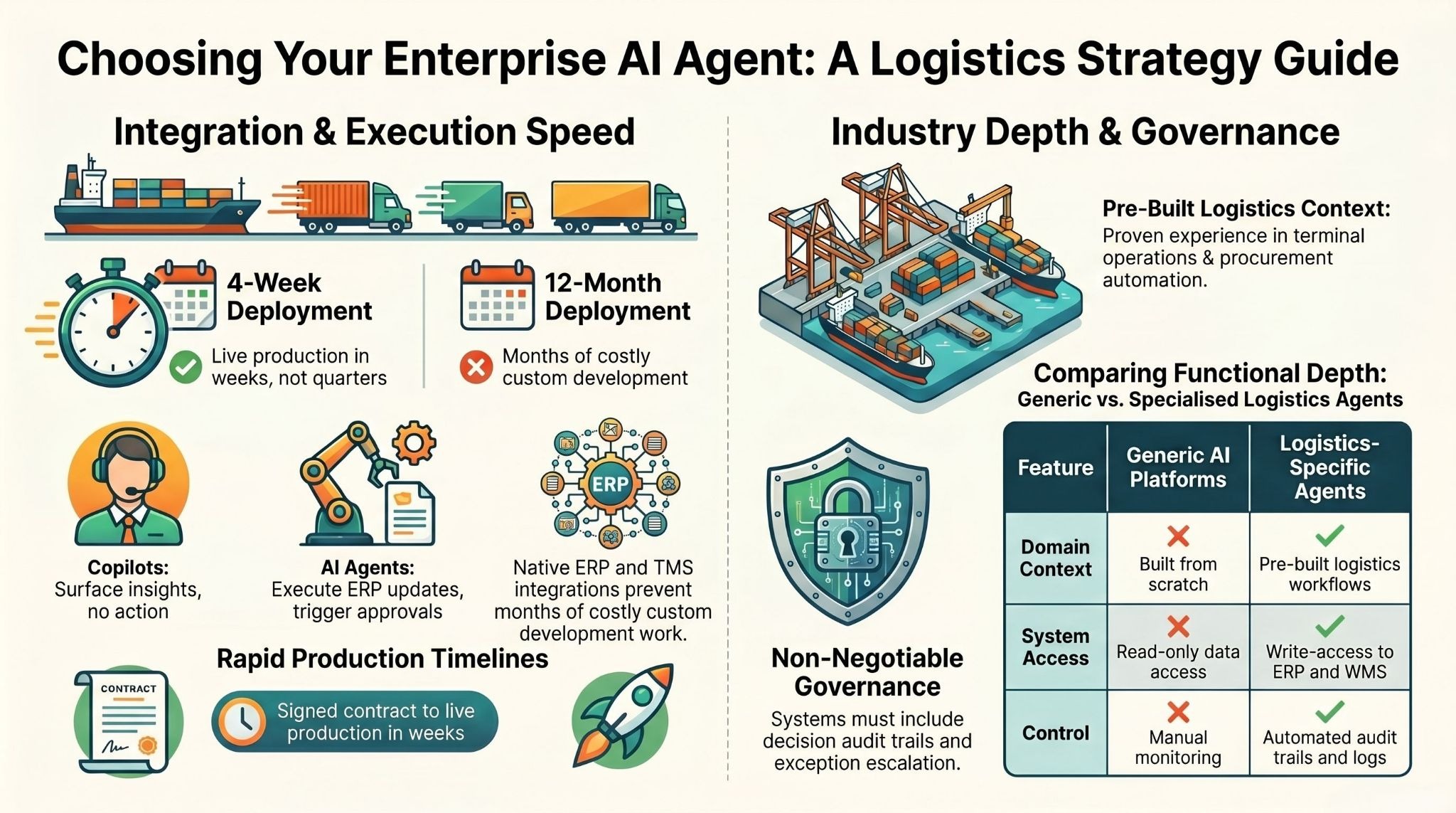
The enterprise AI agent market in 2026 includes many platforms, and the differences between them matter significantly for logistics deployments. Here is what to evaluate:
Integration ecosystem. A platform that connects to your existing ERP, TMS, WMS, and procurement systems without requiring months of custom development work is the difference between a four-week deployment and a twelve-month one. Evaluate the integration library before anything else.
Industry depth. Generic AI platforms require the logistics buyer to build the domain context from scratch. Platforms with logistics-specific deployment experience — terminal operations, procurement automation, multi-entity analytics — bring that context pre-built. Ask for evidence of live logistics deployments, not pilot projects.
Governance architecture. Any platform targeting enterprise logistics must include access controls, decision audit trails, exception escalation pathways, and compliance logging as core product capabilities. These are not optional add-ons. They are the mechanism by which the organisation maintains control over an autonomous system operating in critical infrastructure.
Deployment speed. A platform that requires months of professional services engagement to reach production is not built for enterprise logistics. Evaluate deployment timelines against real customer evidence, not sales claims.
Action scope. An agent that can read data and generate recommendations is a copilot. An agent that can write to ERP records, trigger approvals, update inventory systems, and notify customers — within governed boundaries — is an AI agent. Confirm that the platform you are evaluating can execute actions across your core systems, not just surface insights.
The enterprises in logistics achieving the strongest operational results in 2026 are not using the most well-known AI brands. They are using the platforms that go deepest into their specific operational workflows — with the integration coverage, governance infrastructure, and deployment speed to get from signed contract to production in weeks, not quarters.
The bottom line
The logistics operations running AI agents in production in 2026 are not running them as innovation projects. They are running them as core operational infrastructure — for the same reason they run ERP systems and TMS platforms. Because the coordination complexity of modern supply chains has exceeded what manual processes and traditional automation can manage reliably.
The gap between organisations that have deployed AI agents and those still evaluating them is widening every quarter. An always-on exception management system, a procurement automation agent that compresses cycle times, a multi-entity analytics layer that gives leadership real-time operational visibility — these are not incremental improvements. They are structural advantages that compound over time.
The path to that advantage is not complicated. It requires identifying the workflow with the highest combination of transaction volume, structured decision logic, and measurable exception cost. Deploying a governed AI agent against that workflow in four weeks. Measuring the results. And expanding from there.
The question for every logistics and supply chain leader in 2026 is not whether AI agents will become standard infrastructure in your operation. The question is whether you will deploy them before or after your competitors do.
Ready to see how AI agents perform in your logistics environment? Explore the logistics solution →
FAQ: AI agents in logistics and supply chain
What is a key benefit of using AI agents in logistics?
The primary benefit is the elimination of the gap between operational data and operational action. Traditional logistics systems — even advanced BI and analytics platforms — surface insights that a human must then act on. AI agents perceive the relevant data, decide on the appropriate response within their authorised scope, execute the action, and log the decision — all without requiring human coordination at each step. The result is faster exception response, lower manual processing overhead, and continuous operational visibility rather than periodic reporting.
How are AI agents different from RPA in supply chain?
RPA follows fixed rules and breaks when inputs fall outside the script. It cannot handle unstructured data, reason about exceptions, or adapt to changing conditions. AI agents can process structured and unstructured data simultaneously, apply reasoning to ambiguous situations, handle exceptions within defined governance parameters, and continuously improve based on operational feedback. In supply chain terms, RPA automates the predictable. AI agents manage the complex.
What is agentic AI in supply chain management?
Agentic AI in supply chain management refers to autonomous, goal-driven software agents that observe operational conditions across multiple data sources, reason through the appropriate response, execute actions across connected systems, and escalate to human decision-makers only when the situation falls outside their authorised scope. The "agentic" distinction means the system can initiate and complete multi-step workflows independently — not just respond to prompts or surface recommendations.
What supply chain workflows are best suited to AI agent deployment?
The highest-ROI workflows share three characteristics: high transaction volume, structured decision logic with clear rules, and a measurable cost for delays or errors. Procurement processing, exception management, order-to-confirm automation, inventory monitoring, and multi-entity reporting consistently deliver strong results across enterprise logistics deployments. The best starting point is the workflow where exceptions currently cost the most — in time, in money, or in customer impact.
How long does it take to deploy an AI agent in logistics?
With a platform that includes pre-built logistics integrations, governance infrastructure, and deployment frameworks, a production AI agent deployment can be live within four weeks. The timeline is determined by integration complexity and governance rule definition, not by the platform itself. Organisations that scope their first deployment narrowly — targeting a single, high-value workflow — consistently achieve faster time-to-value than those that attempt broad automation from the start.
What integrations do AI agents need in logistics?
Core integrations typically include the ERP system (SAP, Oracle, or equivalent), the transport management system, the warehouse management system, procurement and supplier platforms, and customer communication channels. The depth of these integrations — the ability to read and write, trigger and update, not just monitor — determines the operational leverage the agent can deliver. Platforms with large pre-built integration libraries significantly reduce the time from deployment start to production operation.
Are AI agents in logistics compliant with industry regulations?
Enterprise-grade AI agent platforms are built with compliance requirements as a core design constraint, not an afterthought. Production deployments in logistics include access controls aligned to the organisation's authorization structure, decision audit trails for every agent action, exception escalation pathways that route out-of-scope decisions to authorised human reviewers, and governance rule encoding that reflects the organisation's regulatory obligations. Platforms with ISO 27001, SOC 2, and GDPR compliance certifications provide the verified security baseline that enterprise procurement and legal teams require.

Transform Your Business With Agentic Automation
Agentic automation is the rising star posied to overtake RPA and bring about a new wave of intelligent automation. Explore the core concepts of agentic automation, how it works, real-life examples and strategies for a successful implementation in this ebook.
Sarfraz Nawaz is the CEO and founder of Ampcome, which is at the forefront of Artificial Intelligence (AI) Development. Nawaz's passion for technology is matched by his commitment to creating solutions that drive real-world results. Under his leadership, Ampcome's team of talented engineers and developers craft innovative IT solutions that empower businesses to thrive in the ever-evolving technological landscape.Ampcome's success is a testament to Nawaz's dedication to excellence and his unwavering belief in the transformative power of technology.

More insights
Discover the latest trends, best practices, and expert opinions that can reshape your perspective


.webp)




Contact us

