
AI Agents in Hospitality and Travel Industry: The 2026 Complete Guide


Every year, hospitality brands invest heavily in booking infrastructure. They build beautiful websites, train reservation teams, and optimise OTA listings. And yet, the same operational bottleneck persists: a guest sends an enquiry, it sits in an inbox, someone manually checks availability, writes a reply, waits for a response, goes back and forth on dates, and eventually — if the guest hasn't already booked elsewhere — a reservation is confirmed.
This is not a technology gap. It is an architecture gap.
The technology to close it exists. AI agents in the hospitality and travel industry are not a future concept. They are in production today — handling email intake, checking live inventory across multiple properties, negotiating alternative dates, creating itineraries, generating confirmation documents, and doing all of it without a human touching the thread.
This guide covers what AI agents in hospitality actually are (and how they differ from chatbots), the six highest-value use cases operating in live enterprise deployments, a real-world deployment breakdown from a luxury multi-property hospitality brand, and what it takes to move from proof-of-concept to production.
If you are a hotel GM, a digital transformation lead, or a CTO evaluating whether agentic AI belongs in your operations, this is the clearest picture available in 2026.
What Are AI Agents in Hospitality? (And What They Are Not)
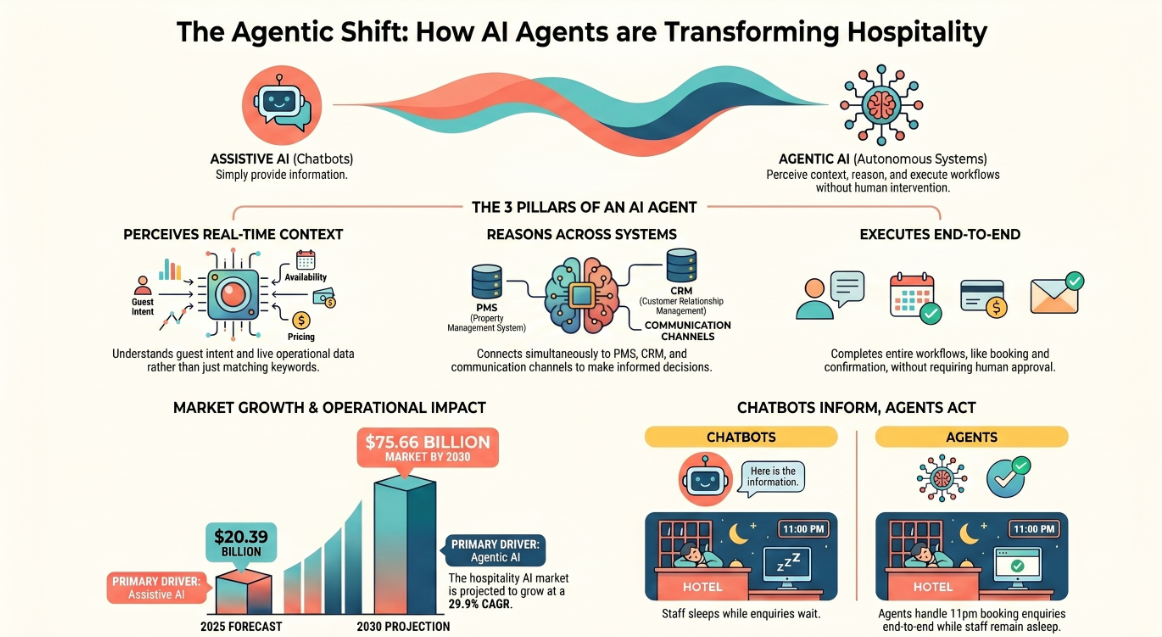
An AI agent in the hospitality and travel industry is an autonomous software system that perceives guest context, reasons across your connected operational systems, and executes multi-step workflows end-to-end — without requiring a human to manage each step.
That definition contains three capabilities that most AI tools in hospitality today do not have:
Perceive context. The agent reads live data — availability calendars, guest history, communication threads, pricing rules — and understands the operational situation it is operating in. It does not respond to keywords. It understands intent.
Reason across systems. The agent does not operate inside a single platform. It connects to your property management system, your CRM, your communication channels, and your document systems simultaneously. It reasons across all of them to decide what to do next.
Execute end-to-end. The agent takes action. It does not draft a suggestion for a human to approve and send. It classifies the enquiry, checks availability, captures missing details, generates the confirmation, and delivers the document — all within a single workflow, with every action logged and auditable.
This is architecturally different from a chatbot, a copilot, or an LLM wrapper on a knowledge base. The distinction matters operationally, not just technically. A chatbot answers "what time is check-out?" An AI agent receives a booking enquiry at 11pm, identifies that the requested dates have a one-night gap in availability, proposes two alternative configurations, captures the guest's preference, creates the reservation, and sends a branded PDF confirmation — without waking anyone up.
The global AI in hospitality and tourism market is projected to grow from $20.39 billion in 2025 to $75.66 billion by 2030, growing at a CAGR of 29.9%. That growth is not being driven by better chatbots. It is being driven by the shift from assistive AI to agentic AI — from systems that inform to systems that act.
Why Hospitality Is Uniquely Positioned to Benefit from AI Agents
The hospitality industry has two structural characteristics that make it exceptionally well-suited for AI agents.
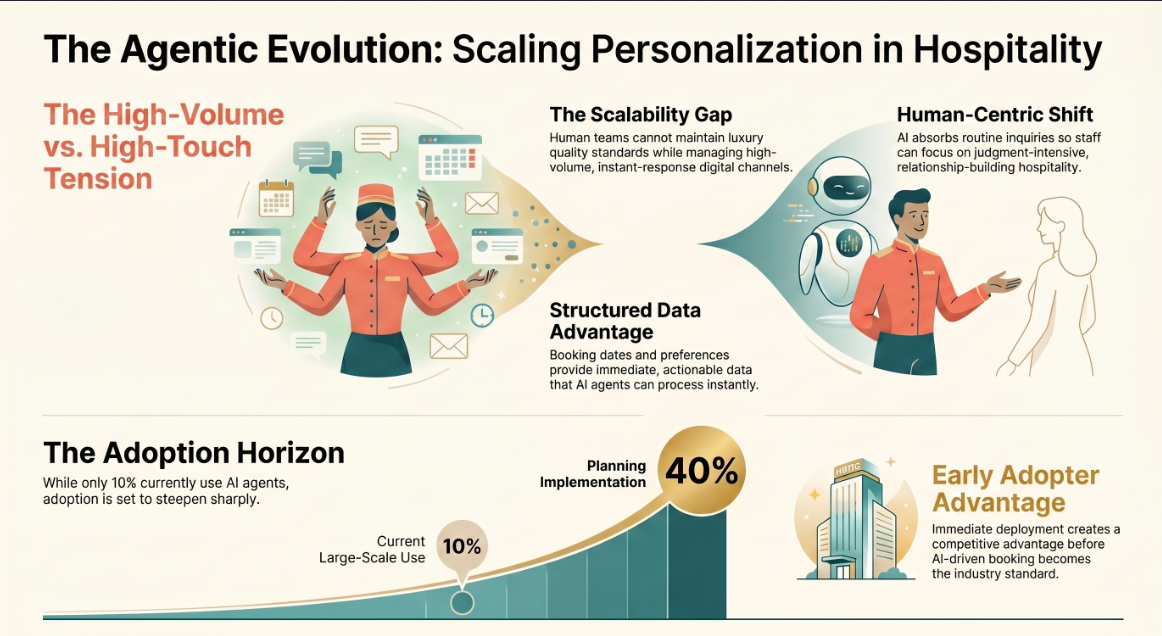
First: every guest interaction generates structured, actionable data. Booking dates, property preferences, group size, dietary requirements, spend history, communication channel — this is not messy unstructured text. It is decision-relevant data that an AI agent can act on immediately.
Second: hospitality operates at the intersection of high-volume transactions and high-touch service expectations. This creates a tension that human teams cannot resolve at scale. You cannot personalise every interaction, respond instantly on every channel, and maintain the quality standard a luxury guest expects — not with a human-only operation.
AI agents resolve that tension directly. They absorb the volume — the routine enquiries, the availability checks, the confirmation follow-ups, the document generation — so that human staff can own the judgment-intensive, relationship-intensive work that defines exceptional hospitality.
The numbers reflect this reality. According to IDC's 2026 Hospitality Predictions, agentic AI is fundamentally changing the distribution model for hospitality — with AI agents now evaluating options, applying preferences, and completing bookings on behalf of guests in real time. Only around one in ten hotel chains currently uses AI agents at scale, but 40 percent already plan to implement them, suggesting the adoption curve is about to steepen sharply.
For operators who deploy now, that gap is an advantage. For those who wait, it becomes a competitive liability.
The 6 Highest-Value AI Agent Use Cases in Hospitality and Travel
- End-to-End Booking Automation
This is the use case where AI agents deliver the clearest, most measurable value. The full workflow looks like this:
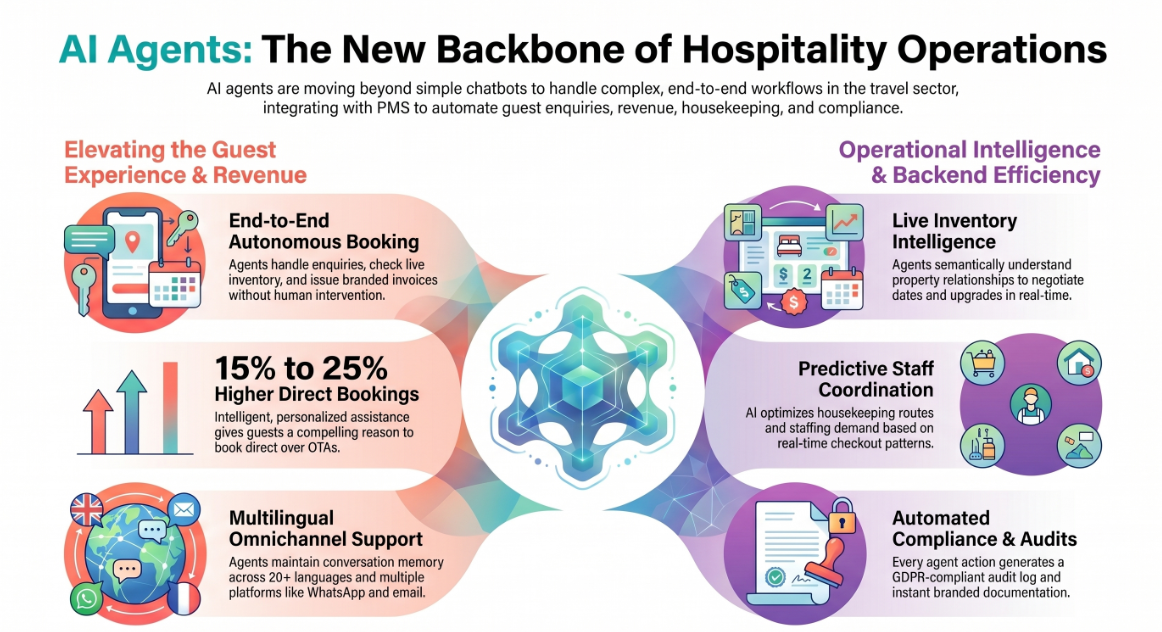
A guest sends an enquiry — by email, web form, WhatsApp, or voice. The AI agent classifies the intent, extracts all available booking parameters, and identifies what is missing. It opens a conversational loop to capture the gaps: dates, property preferences, group size, special requirements. It checks live availability across all relevant properties. If the requested configuration is unavailable, it proposes alternatives. Once the guest confirms, it creates the reservation, generates a branded invoice and PDF confirmation package, and delivers it — without a human touching the thread.
Human-in-the-loop handoffs are configurable. For complex multi-property itineraries, VIP guests, or requests that require judgment, the agent routes to a human — with full context transferred, so the handoff is invisible to the guest.
The result is not just speed. It is consistency. Every enquiry is handled with the same quality, at any hour, across any time zone.
- Live Inventory Intelligence and Availability Management
AI agents connect directly to your property management system and maintain a real-time semantic understanding of availability across your entire portfolio. This goes beyond a simple availability lookup.
The agent understands the relationship between properties, dates, rate categories, and guest preferences. It can negotiate alternatives — proposing a different lodge, an adjusted date range, or an upgraded configuration — based on live data and the guest's stated preferences. It can flag low-availability windows and trigger proactive outreach workflows. For multi-property groups, it provides a consolidated real-time inventory view that individual property systems cannot deliver.
- Guest Communications and Concierge Automation
AI agents handle omnichannel guest communications — web, email, WhatsApp, voice — with consistent quality across all channels. They support 20-plus languages. They maintain conversation memory across interactions, so a guest who mentioned a food allergy in their booking enquiry does not have to repeat it in their pre-arrival message.
Proactive workflows extend the value further. The agent triggers pre-arrival communications, personalised upsell offers based on booking history, and post-stay follow-up sequences — all governed by rules you define, all executed without manual intervention.
Escalation logic is built in. When a guest interaction requires human judgment — a complaint, a complex special request, a situation outside defined parameters — the agent escalates immediately, with full conversation context transferred to the human team member.
- Operational Intelligence and Staff Coordination
Beyond guest-facing workflows, AI agents generate operational value across housekeeping scheduling, predictive maintenance, and staffing demand forecasting.
Housekeeping route optimisation based on real-time checkout and check-in patterns. Predictive maintenance alerts triggered by sensor data anomalies before a fault occurs. Staffing demand forecasts derived from booking patterns and historical occupancy data. Exception-based alerting for leadership — not dashboards that require someone to check them, but proactive notifications that surface the right information at the right time.
For multi-property operations, this intelligence aggregates across the portfolio, providing a single operational view that was previously impossible without a full analytics team.
- Revenue Management and Direct Booking Optimisation
AI agents are reshaping the OTA dependency problem that has cost the hospitality industry billions in commission fees.
An AI agent that provides genuinely intelligent, personalised booking assistance — understanding guest preferences, offering relevant alternatives, answering questions immediately at any hour — gives guests a compelling reason to book direct. Research indicates that AI agents can improve direct booking conversion rates by 15 to 25 percent at properties where they are deployed.
Beyond conversion, AI agents capture guest intent data directly. Every interaction, preference, and decision is logged. That is data that OTAs currently monetise on your behalf. Agentic AI returns it to you.
- Document Generation and Audit Trails
This use case is consistently underestimated in hospitality AI discussions, and consistently valued by operators who deploy it.
Every confirmed booking should generate a branded confirmation document. Every group reservation should produce a clear invoice. Every special arrangement should be documented and filed. In practice, this documentation work consumes significant team time and is subject to errors and inconsistencies.
AI agents generate these documents automatically as part of the booking workflow. They are formatted to brand standards, accurate to the confirmed details, and filed with a full audit trail. For enterprise hospitality operations — especially those operating under GDPR for European guest data — the audit log of every agent action is a compliance asset, not just an operational convenience.
Real Deployment: How a Luxury Multi-Property Hospitality Brand Automated Bookings End-to-End
The following is drawn from a live production deployment. No client name is used.
The context
A luxury safari and boutique lodge collection operating 16 properties across iconic East African safari destinations. The brand serves high-expectation international travellers who require personalised, curated booking experiences — not generic itinerary templates.
This is a segment where the quality of the booking experience is part of the product. A slow, impersonal, or inconsistent booking interaction damages the brand before the guest arrives.
The operational problem
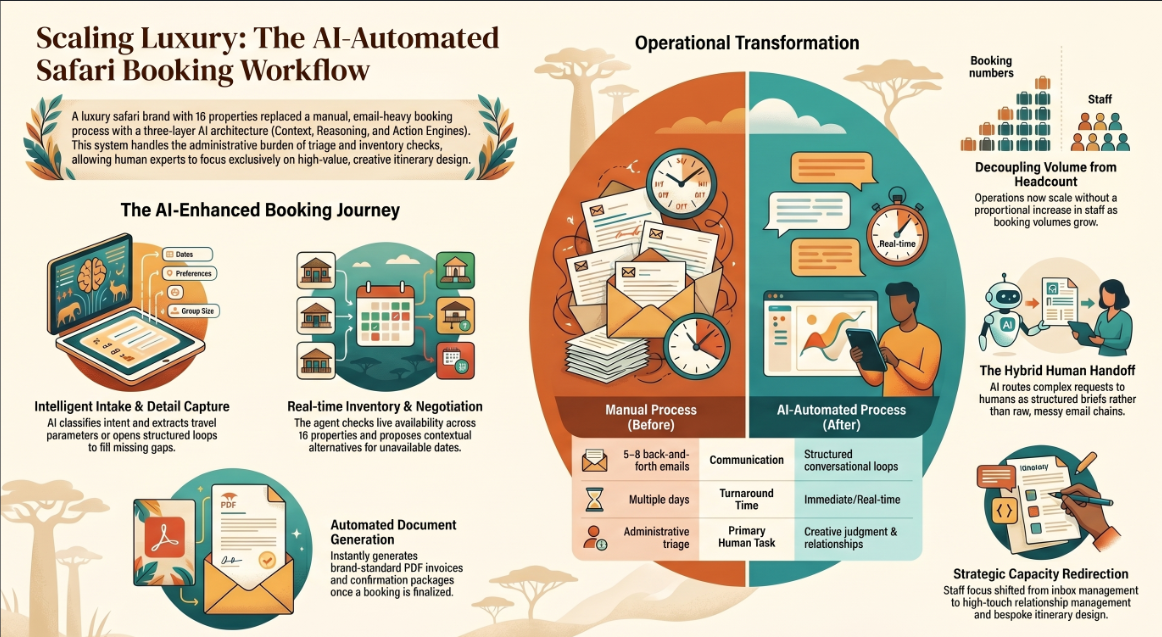
The reservation team managed enquiries primarily by email. Each enquiry required manual triage: reading the request, checking availability across multiple properties, writing a personalised response, waiting for a reply, capturing additional details, going back and forth on dates and configurations. For complex multi-lodge itineraries, this process could span multiple days and five to eight email exchanges per booking.
The team was skilled. The process was not scalable. As booking volumes grew and enquiries arrived across multiple time zones, response lag increased. Some enquiries were lost. Consistency — critical in luxury hospitality — was hard to maintain.
What was deployed
The deployment built on assistents.ai's three-layer architecture — a Context Engine, a Reasoning Layer, and an Action Engine — and covered the complete booking workflow:
Email intake and intent classification. The agent reads every incoming enquiry and classifies intent: new booking request, date change, general inquiry, special request. It extracts all available parameters — travel dates, property preferences, group size, special requirements — from the email content.
Conversational detail capture. Where parameters are missing, the agent opens a structured conversational loop to fill the gaps. It asks for what it needs, in a tone consistent with the brand's luxury positioning. No generic form. No robotic back-and-forth.
Real-time inventory checks and negotiation. The agent checks live availability across all 16 properties for the requested configuration. Where the exact request is unavailable, it identifies and proposes alternatives — different dates, different properties, adjusted group configurations — with contextual explanations for each option.
Hybrid human handoff. For curated multi-lodge itinerary creation — the creative, judgment-intensive layer that defines the brand's luxury positioning — the agent routes to the human reservations team with full context packaged and transferred. The human receives a structured brief, not a raw email chain.
Automated document generation. Once the booking is confirmed, the agent generates the invoice and PDF confirmation package automatically. Formatted to brand standards. Accurate to confirmed details. Delivered immediately.
The results
Booking turnaround time decreased significantly. The back-and-forth email chains that previously defined the enquiry process were replaced by a structured, efficient workflow that guests experienced as responsive and attentive.
Accuracy on complex multi-property requests improved. The agent's structured parameter capture eliminated the gaps and misunderstandings that had previously required correction mid-booking.
The reservation team's capacity was redirected. Instead of managing inbox volume, they focused on the curated itinerary design and relationship management that genuinely requires human expertise — and that defines the luxury experience they sell.
The operation scaled without a proportional increase in headcount. Booking volume could grow without the reservations team growing at the same rate.
The architectural insight
The goal was not to remove the human from the booking process. It was to remove the administrative burden from the human, preserving the judgment, creativity, and relationship quality that defines luxury hospitality. The agent handles what can be systematised. The human handles what cannot.
This is the correct framing for AI agents in any high-touch service industry.
AI Agents vs. Chatbots vs. Copilots: A Practical Breakdown for Hospitality
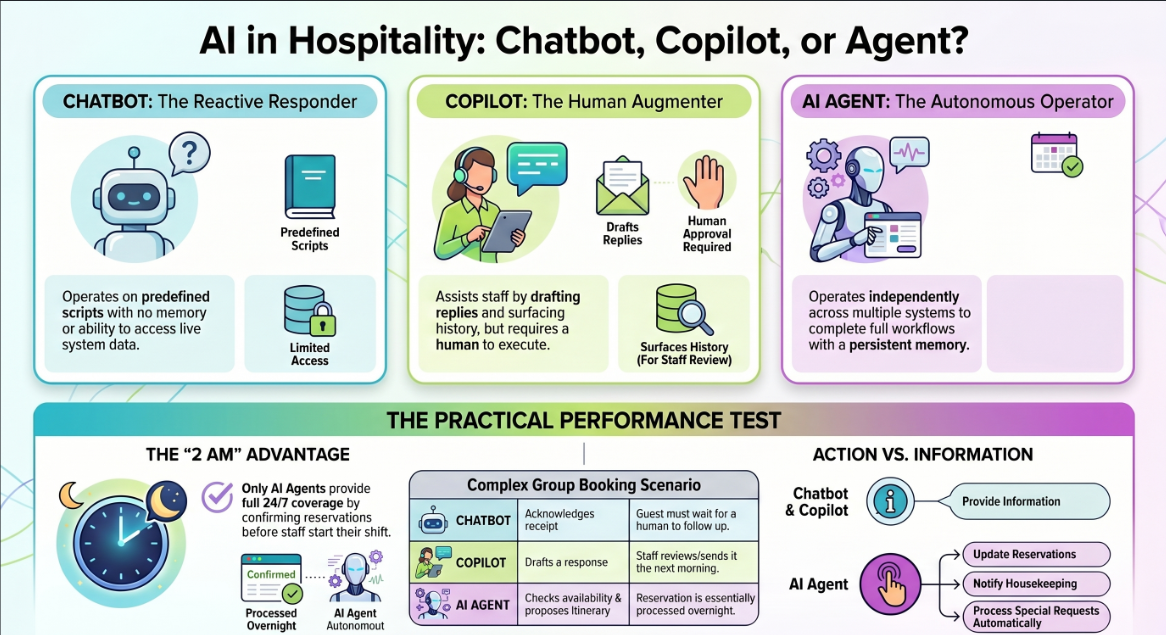
This distinction is not semantic. It determines what you can actually build and what results you can realistically expect.
Chatbot
A chatbot answers questions. It operates on predefined scripts or keyword matching. It has no memory between sessions. It cannot access live data. It cannot take action across systems.
In a hotel context: a chatbot can tell a guest that check-out is at 10am. If the guest asks whether they can extend, the chatbot might offer a phone number. It cannot check availability, confirm the extension, update the reservation, and notify housekeeping — all in the same interaction.
Copilot
A copilot augments a human. It drafts a reply for your reservations agent to review and send. It surfaces relevant guest history before a call. It suggests the next best action. The human still executes.
In a hotel context: a copilot helps your reservations manager respond faster and with better information. It does not operate independently. At night, when your manager is off shift, there is no coverage.
AI Agent
An AI agent operates autonomously across the full workflow. It reads live data. It holds persistent memory across the conversation. It takes action across multiple connected systems in a single workflow. It executes with a full audit trail.
In a hotel context: an AI agent receives a booking enquiry at 2am from a guest in a different time zone, captures all required details, checks availability across your property portfolio, proposes alternatives when needed, confirms the reservation, and delivers the branded PDF confirmation — before your reservations team starts their morning shift.
The practical test
Same scenario: a guest emails asking about a five-night stay across two lodges for a group of eight, with specific dietary requirements and a request for a private bush dinner.
- A chatbot acknowledges receipt and tells the guest someone will be in touch.
- A copilot helps your reservations manager draft a structured response when they arrive the next morning.
- An AI agent captures all parameters, checks availability across both lodges, flags the bush dinner as a special request for human confirmation, proposes the full configuration, and sends a preliminary itinerary — that night.
The difference is not sophistication. It is architecture.
What to Look For in an AI Agent Platform for Hospitality
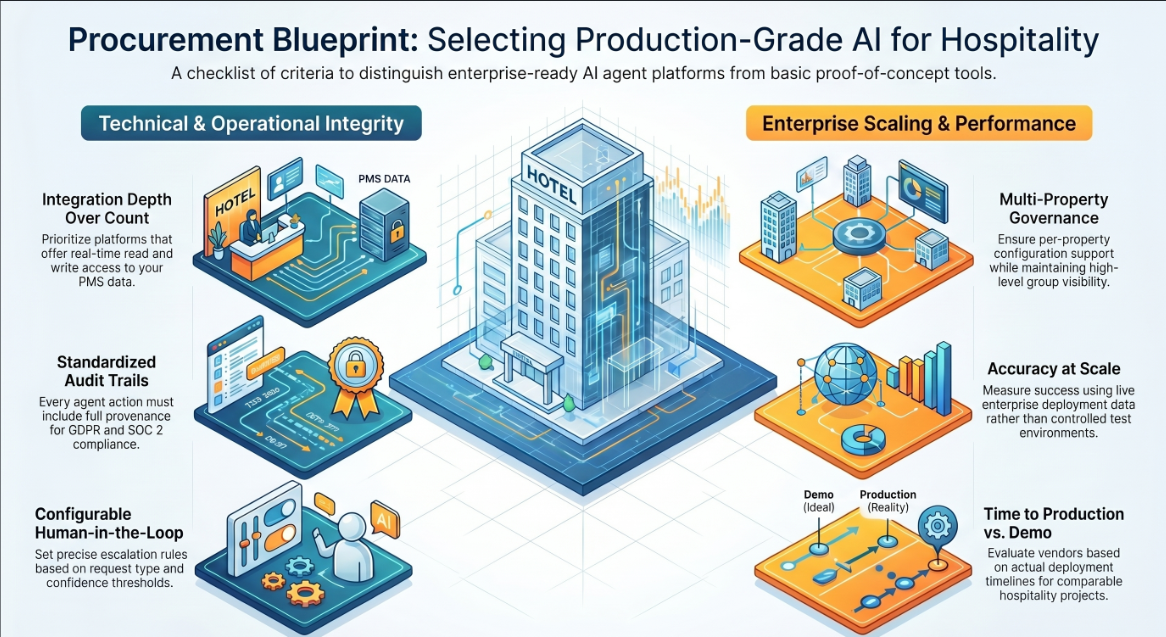
If you are evaluating AI agent platforms for a hospitality deployment, these are the criteria that separate production-grade platforms from proof-of-concept tools.
Integration depth, not integration count. A platform that lists 300 integrations but requires your PMS data to be exported manually before the agent can read it is not an integrated platform. Ask specifically: does the agent read live data from your PMS in real time? Does it write back to it — creating and modifying reservations — or only read from it?
Audit trail as a standard feature, not an add-on. Every agent action should be logged with full provenance — what the agent read, what it decided, what it executed, and why. This is non-negotiable for GDPR compliance on European guest data and for SOC 2 compliance in enterprise environments. If a vendor treats audit logging as a premium feature, that is a red flag.
Configurable human-in-the-loop design. The question is not whether your AI agent should involve humans. It is where. Production-grade platforms allow you to configure escalation rules precisely: which request types route to a human, at what confidence threshold, with what context package. Automation that is all-or-nothing is not enterprise-ready.
Multi-property, multi-entity governance. For hospitality groups operating multiple properties, the governance architecture matters as much as the agent capability. Each property may have different inventory rules, different brand standards, and different escalation paths. The platform should support per-property configuration with group-level visibility — not a single flat configuration applied uniformly.
Time to production, not time to demo. A demo can be built in a weekend. Production deployment — with live PMS integration, edge case handling, governance rules, audit infrastructure, and staff handoff workflows — takes longer and requires more rigour. Ask for the deployment timeline on comparable hospitality projects, not the demo turnaround.
Accuracy at scale. Agent task accuracy rates should be measured on live enterprise deployments, not controlled test environments. A 97% accuracy rate in a controlled demo with clean data is not the same as 97% accuracy across thousands of real booking enquiries with variant phrasing, missing information, and edge cases.
What Deployment Actually Looks Like: A Four-Week Model
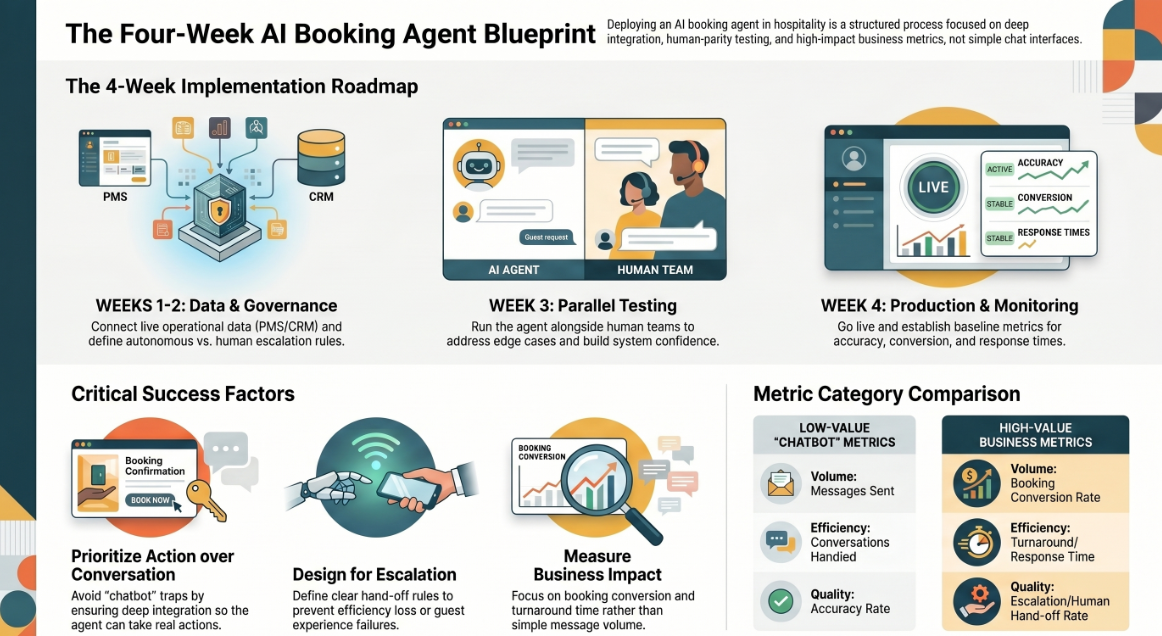
Deploying an AI booking agent in a hospitality operation does not require a multi-year digital transformation project. A production-grade deployment on a platform like assistents.ai follows a structured four-week model.
Week 1: Integration and context layer setup
Connect the agent to your core systems: property management system, availability and inventory data, email and communication channels, CRM, document generation layer. The goal of week one is not to configure agent behaviour — it is to ensure the agent has access to live, accurate operational data. Garbage in, garbage out applies here more than anywhere else in the deployment.
Week 2: Agent configuration and governance rules
Define the agent's operating parameters: which enquiry types it handles autonomously, which it routes to a human and why, what the escalation context package looks like, what tone and brand standards govern its communications, what documentation it generates and in what format. This is where the deployment is shaped to your operation — not the other way around.
Week 3: Parallel testing
The agent runs alongside your human reservations team. Every agent action is reviewed. Exceptions are identified and used to refine configuration. Edge cases that were not anticipated in week two are addressed. The human team builds familiarity with the system and confidence in its outputs.
Week 4: Production cutover and monitoring
The agent goes live. Monitoring dashboards track accuracy, escalation rates, booking conversion, and response time. The first two weeks of live operation generate the baseline metrics that define what "normal" looks like — and what deviation should trigger a review.
The most common deployment failures
Teams that treat an AI agent deployment as a chatbot project under-invest in integration depth and governance configuration. The result is an agent that can answer questions but cannot take action — which provides none of the operational value that justifies the investment.
Teams that do not define escalation rules upfront create an agent that either over-escalates (negating the efficiency gain) or under-escalates (creating guest experience failures on complex requests). The escalation design is as important as the agent capability.
Teams that measure the wrong metrics — conversations handled, messages sent — instead of booking conversion rate, turnaround time, and escalation rate fail to demonstrate the business impact that sustains the deployment long-term.
The Future of AI Agents in Travel and Hospitality
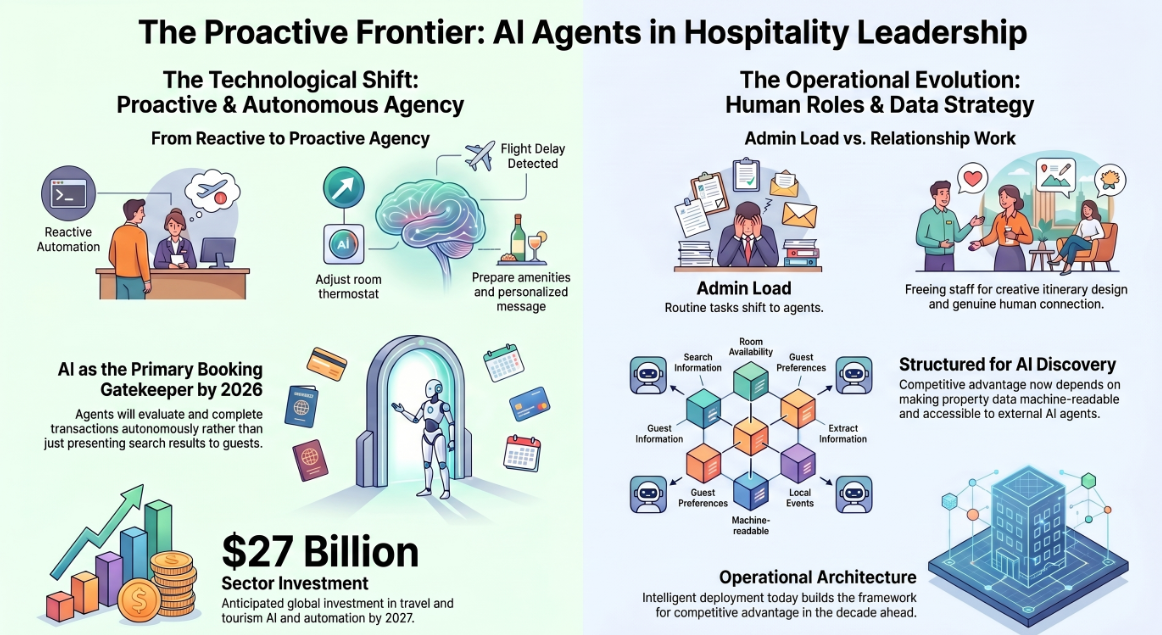
The deployment patterns described in this guide represent the current state. The direction of travel is toward something more fundamental.
Proactive agency
The highest-value evolution in agentic AI for hospitality is not smarter response — it is proactive action. An agent that detects a flight delay for an arriving guest and automatically adjusts room preparation timing, notifies the dining team, and sends the guest a personalised update — without anyone triggering it — is not responding to a request. It is eliminating a request that should never have needed to happen.
Gartner identifies proactive agent behaviour as the primary differentiator between first-generation hotel automation and genuinely agentic systems. The shift from reactive to proactive is the next deployment frontier.
AI as the new booking gatekeeper
IDC's 2026 FutureScape for Hospitality states it plainly: by 2026, discovery, comparison, booking, and service in travel and hospitality will increasingly be mediated by intelligent agents acting on behalf of guests. These agents will not search and present options. They will evaluate, select, and complete transactions.
For hotels, this changes the competitive landscape entirely. The question is no longer how to rank on Google or how to optimise OTA listings. It is whether your property is structured for AI discovery — whether your availability, pricing, and property data is machine-readable, accurate, and accessible to the AI agents that are increasingly making booking decisions for travellers.
The human role evolves, not disappears
Hospitality has always been fundamentally human. That does not change with AI agents. What changes is which human work is worth doing.
Administrative load — inbox management, availability checking, document generation, routine follow-up — shifts to agents. Relationship work, creative itinerary design, problem resolution, and the moments of genuine human connection that define exceptional hospitality remain with people. The outcome is not fewer staff. It is staff doing more valuable work.
Investment in AI and automation in the travel and tourism sector is anticipated to reach $27 billion by 2027. The brands that deploy intelligently now are not just buying efficiency. They are building the operational architecture that will define competitive advantage in the decade ahead.
About assistents.ai
assistents.ai is the enterprise agentic AI platform built by Ampcome. It deploys governed AI agents that connect to your operational systems, reason through your workflows, and execute with full audit trails — across Finance, Sales, Customer Support, HR, and Operations.
Production-proven across 12 industries, 6 continents, and 35-plus enterprise clients. 300-plus integrations. Four-week average time to production. Certified under SOC 2 Type II, GDPR, HIPAA, and ISO 27001.
The luxury hospitality booking automation deployment described in this guide was built on assistents.ai — an end-to-end AI booking agent handling email intake, live inventory management, conversational detail capture, itinerary handoff, and automated document generation for a 16-property safari and boutique lodge collection.
Ready to see how AI agents work in your hospitality operation? Visit assistents.ai to book a demo.
Frequently Asked Questions
What is an AI agent in the hospitality industry?
An AI agent in the hospitality industry is an autonomous software system that perceives guest context, reasons across connected hotel systems — including the property management system, CRM, availability data, and communication channels — and executes multi-step workflows end-to-end. Unlike chatbots that answer questions, AI agents take action: handling booking intake, checking live inventory, capturing missing details, generating confirmation documents, and routing to human staff when needed — all within a single governed workflow.
How are AI agents different from chatbots in hotels?
A chatbot follows predefined scripts and responds to keywords. It has no memory between sessions and cannot take action across systems. An AI agent reads live data, holds persistent memory across a conversation, makes decisions, and executes across multiple connected systems. A chatbot tells a guest when check-out is. An AI booking agent receives an enquiry, checks availability across multiple properties, proposes alternatives, confirms the reservation, and delivers the PDF confirmation — autonomously, at any hour.
Can AI agents fully automate hotel bookings?
AI agents can automate the full operational layer of hotel booking: enquiry intake, intent classification, availability checking, alternative date negotiation, detail capture, reservation creation, and document generation. Human-in-the-loop handoffs are configurable for complex itineraries, VIP guests, or special requests where human judgment adds value. The most effective deployments combine autonomous agent operation for routine workflows with structured human escalation for judgment-intensive interactions.
How long does it take to deploy an AI booking agent for a hospitality operation?
Enterprise-grade deployments on platforms like assistents.ai typically reach production in four weeks: system integration in week one, agent configuration and governance rules in week two, parallel testing in week three, and live production cutover in week four. The deployment timeline depends primarily on the complexity of the systems being integrated, not the capability of the agent itself.
What systems does a hotel AI agent need to integrate with?
At minimum: the property management system (for live availability and reservation creation), email or communication channels (for enquiry intake), and a document generation layer (for confirmations and invoices). Production deployments also connect CRM systems, loyalty data, and revenue management platforms to enable personalised responses and direct booking optimisation.
Will AI agents replace travel agents and hotel reservations teams?
No. AI agents replace administrative tasks, not people. The operational work that can be systematised — inbox management, availability checking, routine follow-up, document generation — shifts to agents. Reservations teams refocus on judgment-intensive work: complex itinerary design, relationship management, problem resolution, and the high-touch interactions that define exceptional hospitality. In live deployments, the result is typically the same team handling higher booking volume with less administrative burden — not a smaller team.
What is the difference between agentic AI and generative AI in hospitality?
Generative AI produces content — it writes a reply, drafts an itinerary, summarises a guest profile. Agentic AI acts — it sends the reply, creates the reservation, generates and delivers the document. In hospitality, generative AI improves the quality of individual outputs. Agentic AI changes the operational model, enabling end-to-end workflow automation that was previously only possible with human labour.

Transform Your Business With Agentic Automation
Agentic automation is the rising star posied to overtake RPA and bring about a new wave of intelligent automation. Explore the core concepts of agentic automation, how it works, real-life examples and strategies for a successful implementation in this ebook.
Sarfraz Nawaz is the CEO and founder of Ampcome, which is at the forefront of Artificial Intelligence (AI) Development. Nawaz's passion for technology is matched by his commitment to creating solutions that drive real-world results. Under his leadership, Ampcome's team of talented engineers and developers craft innovative IT solutions that empower businesses to thrive in the ever-evolving technological landscape.Ampcome's success is a testament to Nawaz's dedication to excellence and his unwavering belief in the transformative power of technology.

More insights
Discover the latest trends, best practices, and expert opinions that can reshape your perspective







Contact us

