
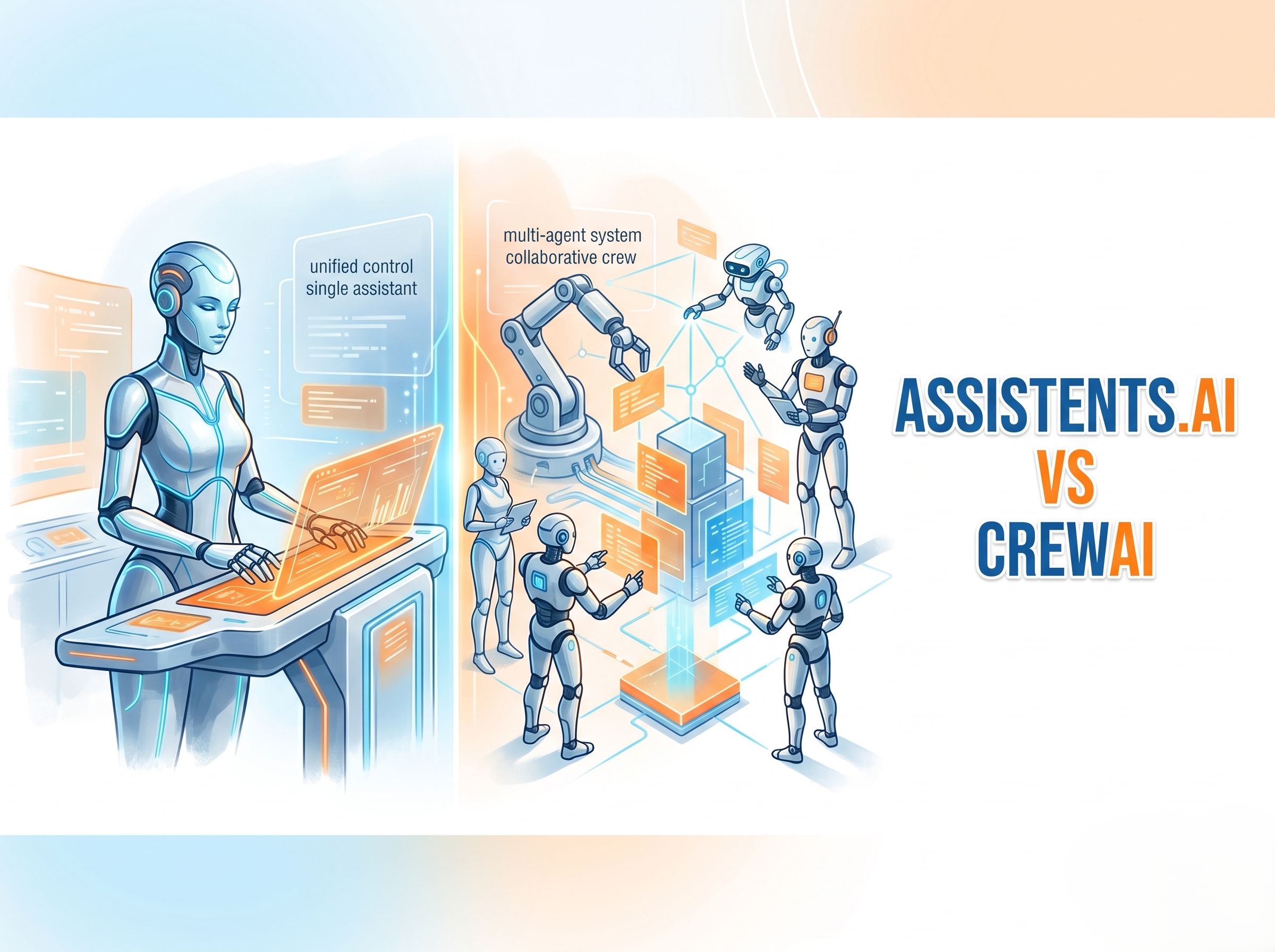
assistents.ai vs CrewAI: Which Is the Right Enterprise AI Agent Platform for Your Business?


If you are evaluating the top enterprise AI agent platforms in 2026, you have almost certainly come across both assistents.ai and CrewAI. They both sit under the "AI agent" umbrella. They both support multi-agent workflows. And if you are reading vendor comparison pages or analyst roundups, they are often listed in the same breath.
But they are built for fundamentally different buyers — and choosing the wrong one costs enterprises months of rework, failed pilots, and difficult conversations with IT and compliance teams.
This guide cuts through the noise. It compares assistents.ai and CrewAI across every dimension that actually matters when you are making a real enterprise technology decision: governance, deployment flexibility, voice AI, integration depth, time to production, and total cost of ownership. It includes real-world outcomes from enterprise deployments across retail, logistics, financial services, energy, real estate, and healthcare — so you can assess which platform delivers results in environments like yours.
The Real Difference: Enterprise Platform vs Developer Framework
Before comparing features, it is worth being precise about what each product actually is.
CrewAI is an open-source Python framework. It gives developers a way to define AI agents with specific roles, assign them tasks, and have them collaborate on complex workflows. It is elegant, flexible, and genuinely well-designed for what it does. Developers who want full control over agent architecture, model selection, and workflow logic will find it powerful. Its GitHub repository has over 100,000 certified developers in its community.
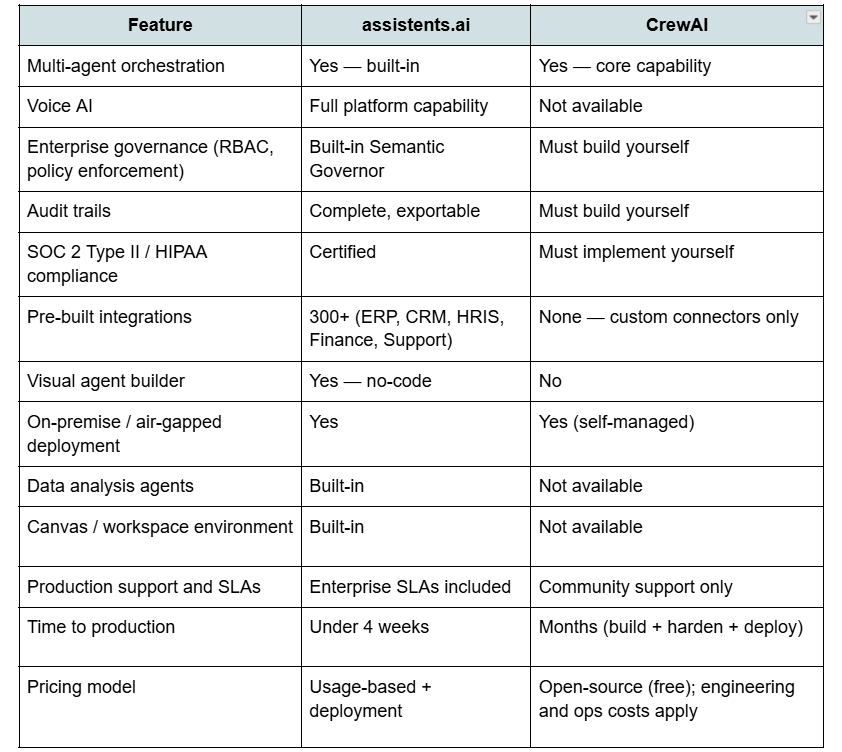
But CrewAI is a framework, not a platform. When you deploy CrewAI in an enterprise environment, you are responsible for building governance, security, audit trails, role-based access control, integrations with enterprise systems, voice capabilities, monitoring, alerting, compliance documentation, and the infrastructure to run it all reliably at scale. Every one of those layers requires engineering time, ongoing maintenance, and specialist knowledge.
assistents.ai is a complete enterprise AI agent platform. It ships with governance, voice AI, 300+ pre-built connectors, SOC 2 Type II compliance, HIPAA readiness, on-premise deployment options, and production support as standard features — not optional add-ons. The platform is built and operated by Ampcome, with documented deployments across more than 30 enterprise clients spanning 12 industries across Africa, Australia, North America, Europe, the Middle East, and Asia.
The analogy is direct: CrewAI is like buying components to build a car engine. assistents.ai is a production vehicle with a safety certification, a warranty, and a fleet management system included.
Side-by-Side Feature Comparison
How Multi-Agent Orchestration Works in Each Platform
Both platforms support multi-agent orchestration — the ability for multiple AI agents to work together, hand off tasks, and complete complex workflows. But the implementation differs significantly.
In CrewAI, you define agents in Python code. Each agent gets a role, a goal, and a set of tools. You write the logic that determines how agents communicate, when they hand off tasks, and how failures are handled. This gives engineers fine-grained control and is genuinely powerful for technical teams who want to design bespoke workflows. The challenge is that this flexibility comes with full ownership of every edge case, failure mode, and production concern.
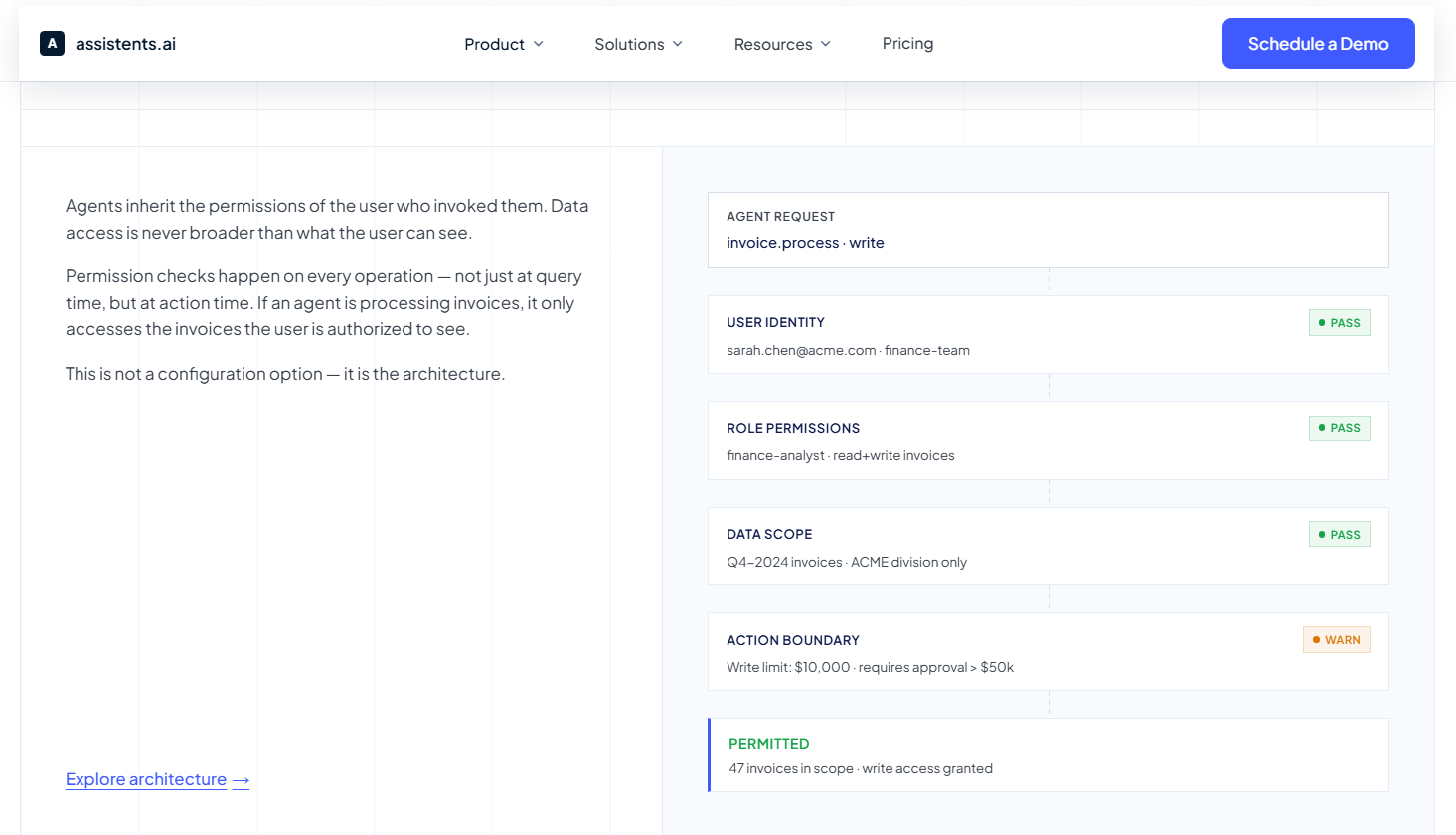
In assistents.ai, multi-agent orchestration is delivered through a three-layer architecture: the Context Engine (which ingests and maps live data across enterprise systems), the Governance Layer (which enforces permissions and policies before any action executes), and the Action Engine (which carries out multi-step workflows with human-in-the-loop checkpoints, rollback handling, and exception recovery). Agents operate with real-time cross-system context — they know the state of your ERP, CRM, HRIS, and operational data simultaneously, not just the data you pipe to them manually.
For enterprise use cases — where agents touch financial systems, customer records, regulatory data, or operational infrastructure — the difference between "orchestration I built" and "orchestration with a governance layer and rollback capability" is not a minor technical distinction. It is the difference between a pilot and a production system.
Governance, Audit Trails, and Compliance: Built-in vs DIY
In 2026, enterprise AI governance is not optional. The EU AI Act's operational requirements are live. The SEC has elevated AI governance to a top-tier examination priority. Enterprise procurement committees now routinely require proof of audit trails, access controls, and human oversight mechanisms before approving AI agent deployments.
assistents.ai addresses this through its Semantic Governor — a layer that sits between an agent's reasoning and its actions. Every action an agent proposes is checked against configured policy rules before it executes. Role-based access controls determine what data each agent can see and what actions it can take. Every interaction is logged to a complete, exportable audit trail. The platform is SOC 2 Type II certified and HIPAA-ready.
This is not a box-checking feature. For a global logistics operator managing port-to-inland freight workflows, or a financial institution running dispute and compliance automation, or a power utility monitoring smart grid operations, the ability to demonstrate to regulators exactly what an AI agent did, why it did it, and what data it accessed is a core operational requirement — not a nice-to-have.
CrewAI does not include governance out of the box. You can implement role-based access control, audit logging, policy enforcement, and compliance documentation yourself. If your team has the engineering resources and the time, this is achievable. But it is a significant build — typically adding months to any production deployment — and it is infrastructure you will need to maintain, update, and document as compliance requirements evolve.
Voice AI: The Capability That Sets Enterprise Platforms Apart
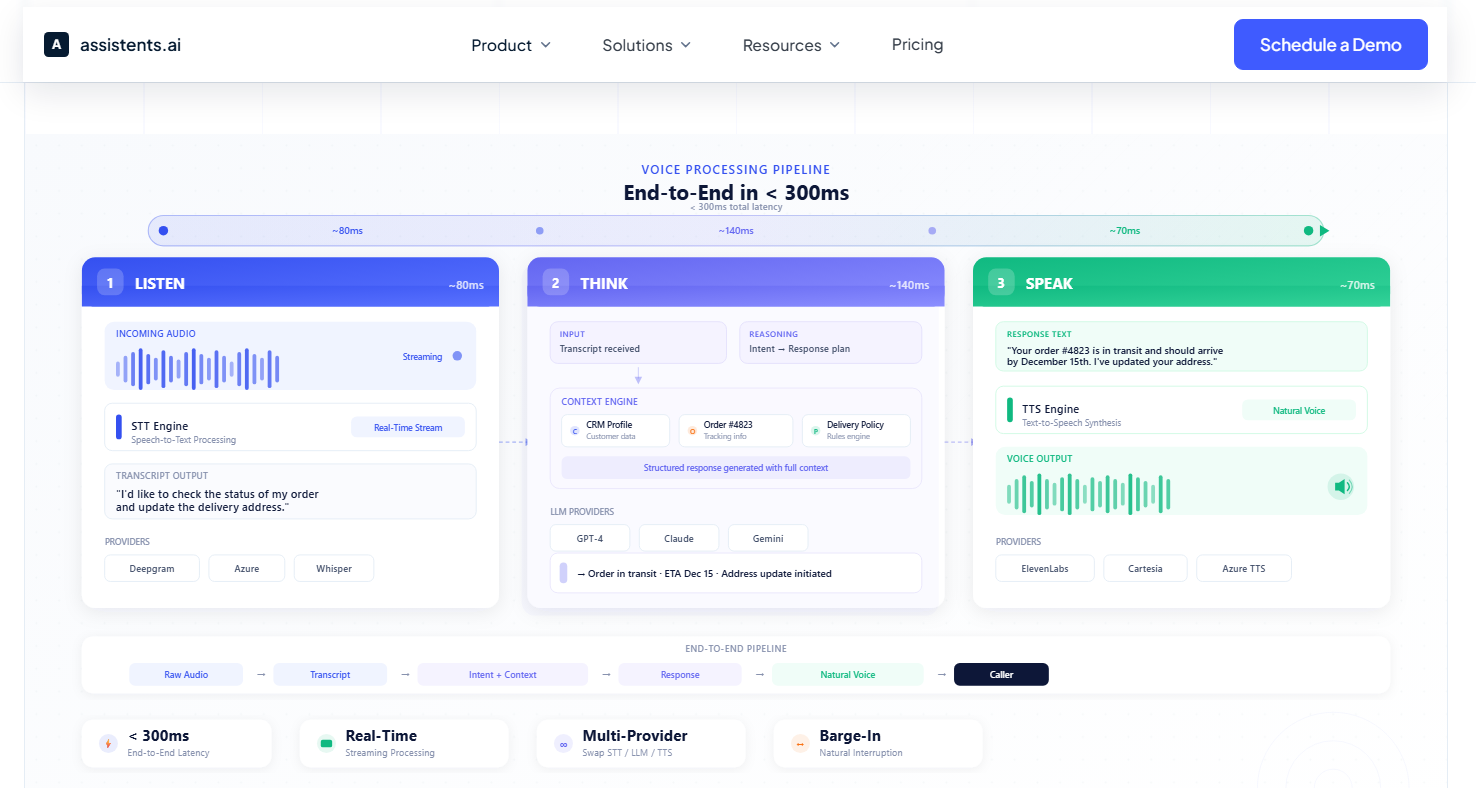
CrewAI has no voice AI capabilities.
assistents.ai delivers a full voice AI layer alongside its conversational and autonomous agents. In practice, this means enterprises can deploy voice agents for contact centre operations, field support, customer-facing service workflows, and multilingual internal helpdesks — all governed by the same policy and audit infrastructure as every other agent in the platform.
Real deployments from the assistents.ai customer base illustrate why this matters:
- A consumer retail operation with hundreds of stores deployed a voice support agent handling customer and staff queries in multiple languages, with the same inventory intelligence and knowledge base access as its text-based agents.
- A luxury hospitality brand deployed a voice-enabled booking workflow that handles complex guest requirements end-to-end, with human handoff logic built in for high-value itinerary customisation.
- A healthcare staffing platform uses voice AI as part of its shift-matching and credential verification workflow, reducing coordination time significantly.
For enterprises evaluating a "top enterprise AI agent platform" in 2026, voice AI is increasingly a table-stakes capability for customer-facing and operational use cases. It is not a separate product to bolt on — in assistents.ai, it is part of the same governed platform.
Deployment Flexibility: Managed Cloud vs Self-Managed
Both platforms support on-premise deployment, but the experience is very different.
assistents.ai offers three deployment modes: cloud (multi-tenant SaaS on AWS with auto-scaling and zero maintenance), on-premise (full platform deployed in your data centre with self-hosted LLMs, air-gapped capability, and complete data residency), and hybrid (workloads split across cloud and on-premise with unified governance). All three modes carry the same governance, compliance, and SLA commitments. Your data never has to leave your infrastructure in on-premise mode. Time to production across all modes is under four weeks.
CrewAI can be deployed on-premise — you manage the infrastructure, the models, the security configuration, and the scaling. This gives maximum control to teams with strong DevOps capability, but it also means full ownership of everything that can go wrong in production.
For enterprises in regulated industries, financial services, government, or sectors with strict data sovereignty requirements, assistents.ai's air-gapped on-premise mode with built-in compliance is a substantial advantage over a framework that leaves infrastructure management entirely to the buyer.
Real-World Results: What Enterprises Actually Achieved
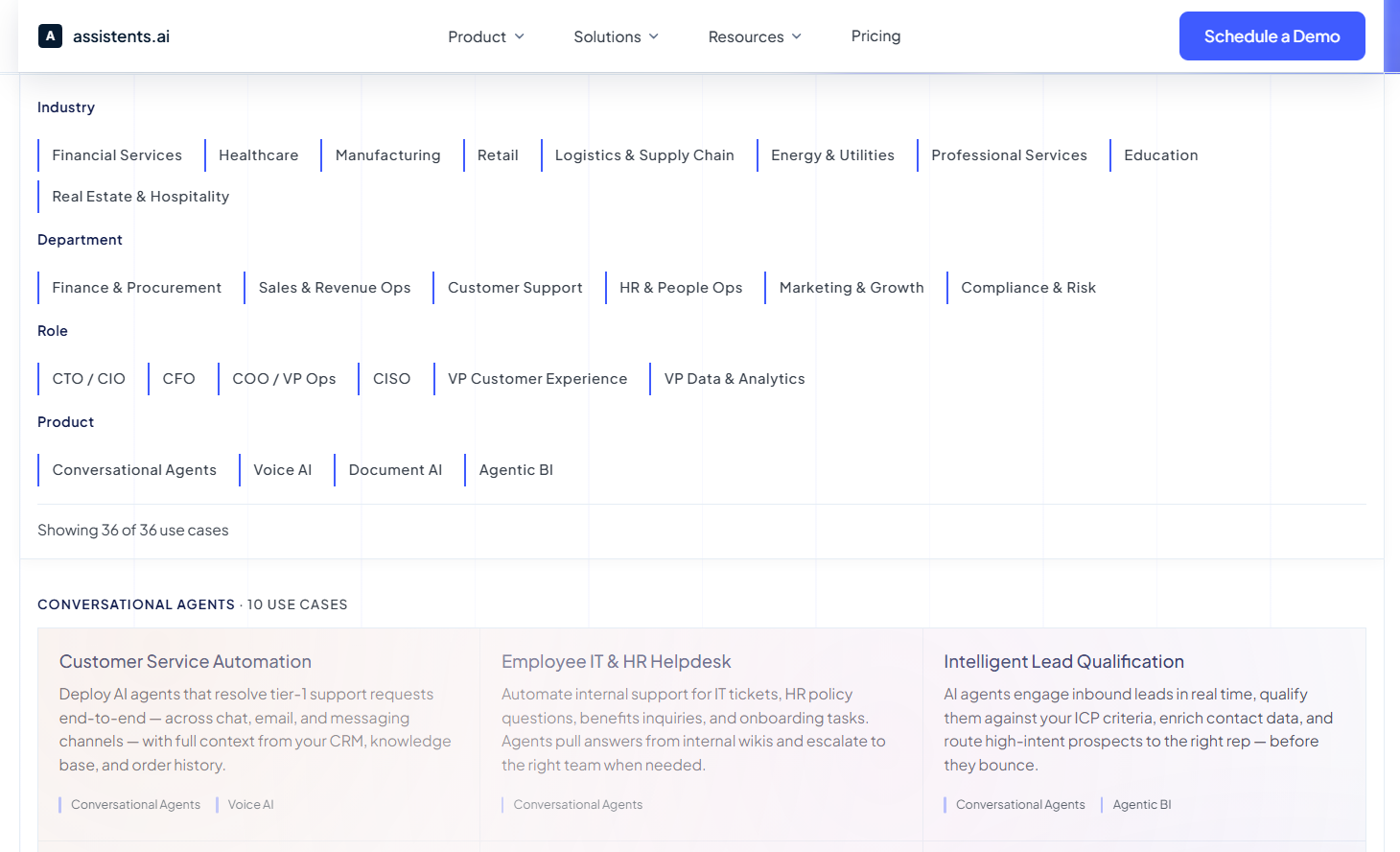
The most meaningful way to evaluate any enterprise AI platform is not feature lists — it is outcomes in production environments that resemble yours.
The following results are drawn from documented deployments across the assistents.ai customer base. Client names are not disclosed, but the industries, challenges, and outcomes are real.
Retail: Store-Level Intelligence at National Scale
A major value retail operation with hundreds of stores across multiple cities needed to reduce manual help desk burden, give store teams instant access to inventory and pricing intelligence, and accelerate onboarding for new staff.
assistents.ai deployed three coordinated agents: a voice support agent handling store queries in Hindi and English, an inventory intelligence agent with real-time access to pricing and stock data at the store level, and a knowledge and training agent operating as a RAG layer over point-of-sale and standard operating procedure documents.
The result was a measurable reduction in manual helpdesk load, improved store-level inventory visibility, and faster onboarding via on-demand training guidance — all at national scale without adding headcount.
Logistics: Digitising Port-to-Inland Operations
A global ports and logistics leader with reported FY2024 revenue of $20 billion needed to digitise and optimise complex port-to-inland freight workflows. assistents.ai delivered a terminal and rail management solution including yard and rail operational dashboards, rail scheduling and visibility tools, exception management, and executive reporting.
The outcome was higher predictability of terminal-to-rail throughput, more efficient coordination across terminal and inland logistics operations, and improved operational visibility for leadership — replacing manual coordination across disparate systems.
Financial Services: Dispute Automation with Full Auditability
A global fintech provider serving banks and credit unions needed omnichannel AI agents for banking support, with the audit trail and compliance infrastructure required for regulated financial operations. assistents.ai delivered omnichannel intake across chat, email, and phone, with agent-assist summarisation, next-best-action recommendations, SLA monitoring, and full auditability.
The outcome was faster case handling, reduced operational load through automation, and compliance readiness through complete audit trails — addressing the governance requirements that make AI deployment in financial services uniquely challenging.
Energy and Utilities: Smart Grid and Campus Operations
Two separate energy sector deployments illustrate the platform's applicability in infrastructure-critical environments. A state power transmission utility managing grid operations across an entire state deployed data analytics for smart grid performance, predictive analytics for outage and loss detection, and automated alerts for field operations.
A research institution with campus-scale operations deployed AI for energy management including consumption monitoring, forecasting, and optimisation. Both deployments replaced manual monitoring with always-on intelligence, delivering faster exception detection and more proactive operations through continuous monitoring.
Real Estate: Tenant and Customer Support Automation
A major UAE real estate portfolio owner managing diversified office, retail, industrial, and residential assets across multiple emirates deployed a customer service agent to automate tenant and customer support end-to-end.
The solution included omnichannel service capability across web, WhatsApp, and email, tenant query triage, rental and payment support workflows, ticketing and escalation to human teams, and a knowledge base over policies, tenancy documents, and standard operating procedures.
The outcome was faster response times, a lower call-centre load, consistent 24/7 tenant experience, and better SLA adherence through automated routing and tracking.
Healthcare: Staffing and Compliance Workflows
A healthcare staffing platform connecting nursing professionals with healthcare facilities needed AI to handle matching, scheduling, and compliance workflows at scale. assistents.ai delivered talent onboarding and credential capture, facility staffing request intake and matching logic, scheduling, notifications and compliance workflows, and reporting for fill-rate and utilisation.
The outcome was faster fill cycles, lower scheduling friction, better workforce utilisation, and improved staffing responsiveness for facilities — addressing both the operational speed requirements and the compliance documentation needs of healthcare staffing.
Document Processing: Tender and Procurement Automation
A commercial works specialist managing complex tender documents needed to ingest, analyse, and synchronise tender data into core operational systems with high accuracy.
assistents.ai delivered a multi-agent intelligent document workbench with vision-LLM extraction from complex PDFs, tender retrieval and workflow determination, revision and change detection, deep system integration with full CRUD capability, and audit logs. The engineered target was up to 90% faster tender document processing with approximately 95% extraction accuracy for standard formats — replacing a manual process that created significant bid risk.
Pricing and Total Cost of Ownership
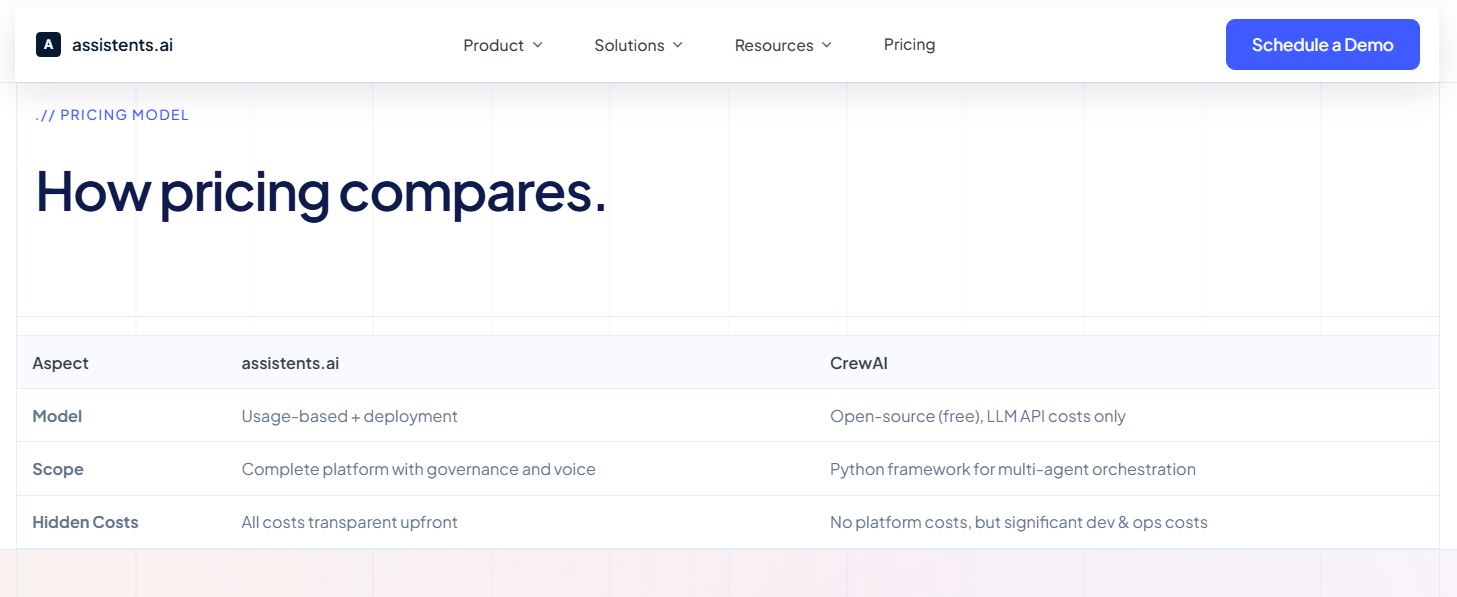
This is the section most comparison blogs skip — and it is the one that matters most to CFOs and procurement teams.
CrewAI is open-source and free. If your metric is platform licensing cost, CrewAI wins immediately. But platform licensing cost is not total cost of ownership.
To run CrewAI in a production enterprise environment, you will typically need to build and maintain: an integration layer connecting it to your enterprise systems, a governance and audit framework, role-based access controls, a security and compliance layer (including penetration testing, SOC 2 documentation if required, HIPAA configuration if applicable), a voice AI capability if needed, monitoring and alerting infrastructure, on-call engineering for production incidents, and a DevOps pipeline for deployment, updates, and scaling.
Industry benchmarks suggest that for a mid-market enterprise deploying a multi-agent system with governance and integrations, the engineering cost of building this infrastructure from scratch ranges from $300,000 to over $1 million, depending on complexity — before factoring in ongoing maintenance. The timeline from start to production typically runs six to twelve months.
assistents.ai uses a usage-based pricing model with transparent deployment costs. All governance, compliance, voice AI, integrations, and production support are included. The time for production is under four weeks. The total cost of ownership comparison — when engineering time, opportunity cost, and ongoing maintenance are included — frequently favours the managed platform even at face value.
The right question for procurement is not "what does the platform cost?" It is "what does production cost, and how long until we see value?"
Who Should Choose assistents.ai — and Who Should Choose CrewAI
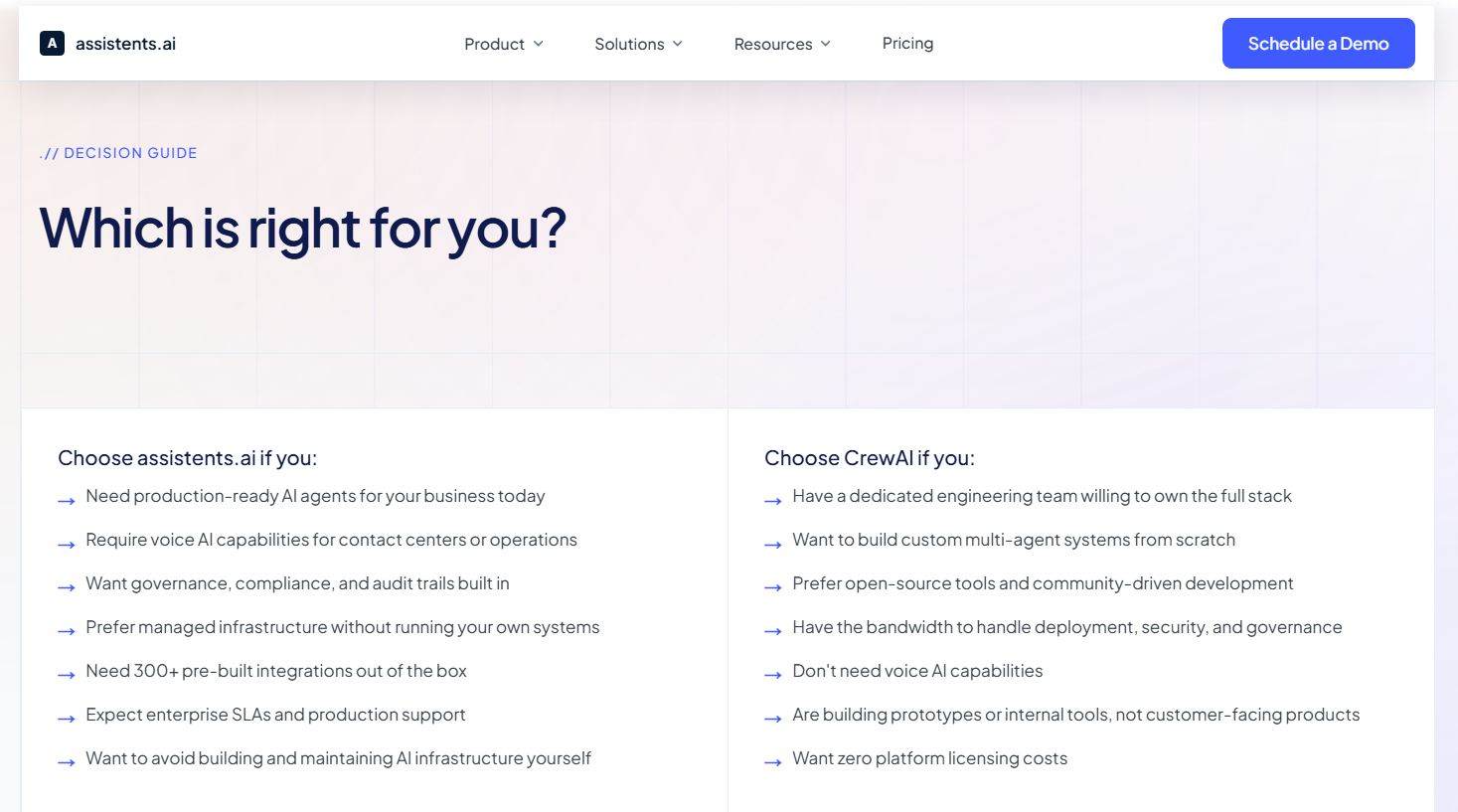
Choose assistents.ai if you:
- Need AI agents running in production across real enterprise operations within weeks, not months
- Require governance, audit trails, and compliance documentation as a non-negotiable (regulated industries, financial services, healthcare, energy, government)
- Want voice AI as part of the same platform — for contact centres, field operations, or multilingual customer-facing workflows
- Need 300+ pre-built integrations into ERP, CRM, HRIS, and operational systems without building connectors from scratch
- Prefer managed infrastructure with enterprise SLAs and production support
- Want on-premise or air-gapped deployment with full data residency
- Are comparing platforms across retail, logistics, financial services, energy, real estate, healthcare, or any other industry where operational depth matters
Choose CrewAI if you:
- Have a dedicated engineering team willing to own the full stack: development, governance, security, compliance, DevOps, and monitoring
- Want to build highly customised multi-agent systems with full control over agent design, model selection, and workflow logic
- Are building internal tools or prototypes, not customer-facing or compliance-critical production systems
- Prefer open-source tools with community-driven development and no platform licensing cost
- Do not need voice AI capabilities
- Have the bandwidth to accept a six-to-twelve month timeline from start to production
The Bottom Line
The best enterprise AI agent platform for your business depends on one question: do you want to build the infrastructure, or do you want to deploy the outcome?
CrewAI is a powerful framework for engineering teams who value control, flexibility, and open-source development. If your organisation has the engineering resources, the timeline, and the appetite to build governance, security, voice AI, and integrations from the ground up, it is a legitimate choice.
assistents.ai is a production-ready enterprise platform. Governance, voice AI, compliance, 300+ integrations, and enterprise SLAs ship on day one. Deployments across more than 30 enterprise clients across 12 industries — in financial services, retail, logistics, energy, healthcare, real estate, and hospitality — demonstrate what the platform delivers in environments that cannot afford pilot-quality infrastructure.
For most enterprises evaluating AI agents in 2026 — where governance is mandatory, time-to-value is a boardroom priority, and operational breadth matters — assistents.ai is the platform built for that problem.
Ready to see how assistents.ai would work in your environment? Schedule a demo or explore the platform.
Frequently Asked Questions
What is the main difference between assistents.ai and CrewAI?
assistents.ai is a production-ready enterprise AI agent platform with built-in governance, voice AI, and 300+ integrations. CrewAI is an open-source Python framework for developers to build multi-agent systems. The core difference is: assistents.ai is a complete product you deploy; CrewAI is a toolkit you build with.
Is CrewAI good for enterprise use?
CrewAI can be deployed in enterprise environments, but it requires significant engineering investment to add governance, compliance, security, integrations, and production support — all of which assistents.ai includes by default. CrewAI is best suited to enterprises with strong in-house engineering teams who want full control over their agent architecture.
What is an enterprise AI agent platform?
An enterprise AI agent platform is a governed, production-ready system that enables organisations to deploy AI agents capable of reasoning, deciding, and acting across business systems — with audit trails, access controls, compliance documentation, and enterprise SLAs built in. It differs from a developer framework in that it is designed for business operations teams, not just engineers.
Does assistents.ai support on-premise deployment?
Yes. assistents.ai supports cloud, on-premise, and hybrid deployment. On-premise deployments support self-hosted LLMs, air-gapped infrastructure, and full data residency — meaning your data never leaves your environment.
How long does it take to deploy assistents.ai?
assistents.ai is designed for production deployment in under four weeks. This includes integration setup, governance configuration, agent deployment, and testing — significantly faster than building an equivalent system on a framework like CrewAI.
What industries has assistents.ai been deployed in?
Documented deployments span retail, logistics and supply chain, financial services, banking, energy and utilities, real estate, healthcare, hospitality, professional services, education, and technology — across North America, Europe, the Middle East, Asia, Africa, and Australia.
Does assistents.ai have voice AI?
Yes. Voice AI is a native platform capability in assistents.ai, supporting contact centre operations, multilingual customer-facing workflows, and field support. CrewAI has no voice AI functionality.
Is assistents.ai SOC 2 certified?
Yes. assistents.ai is SOC 2 Type II certified and HIPAA-ready. Compliance documentation is available for enterprise procurement processes.
What does CrewAI cost for enterprise use?
CrewAI itself is open-source and free. However, the total cost of enterprise deployment — including engineering to build governance, security, integrations, and production infrastructure — typically runs into hundreds of thousands of dollars and six to twelve months of engineering time for a full production deployment.
Which is the better AI agent platform for regulated industries?
For regulated industries — including financial services, healthcare, energy, and government — assistents.ai is the stronger choice. Built-in governance, SOC 2 Type II certification, HIPAA readiness, complete audit trails, and on-premise deployment with data residency address the compliance requirements that make AI deployment in regulated environments uniquely challenging.

Transform Your Business With Agentic Automation
Agentic automation is the rising star posied to overtake RPA and bring about a new wave of intelligent automation. Explore the core concepts of agentic automation, how it works, real-life examples and strategies for a successful implementation in this ebook.
Sarfraz Nawaz is the CEO and founder of Ampcome, which is at the forefront of Artificial Intelligence (AI) Development. Nawaz's passion for technology is matched by his commitment to creating solutions that drive real-world results. Under his leadership, Ampcome's team of talented engineers and developers craft innovative IT solutions that empower businesses to thrive in the ever-evolving technological landscape.Ampcome's success is a testament to Nawaz's dedication to excellence and his unwavering belief in the transformative power of technology.

More insights
Discover the latest trends, best practices, and expert opinions that can reshape your perspective

.jpg)




Contact us

