
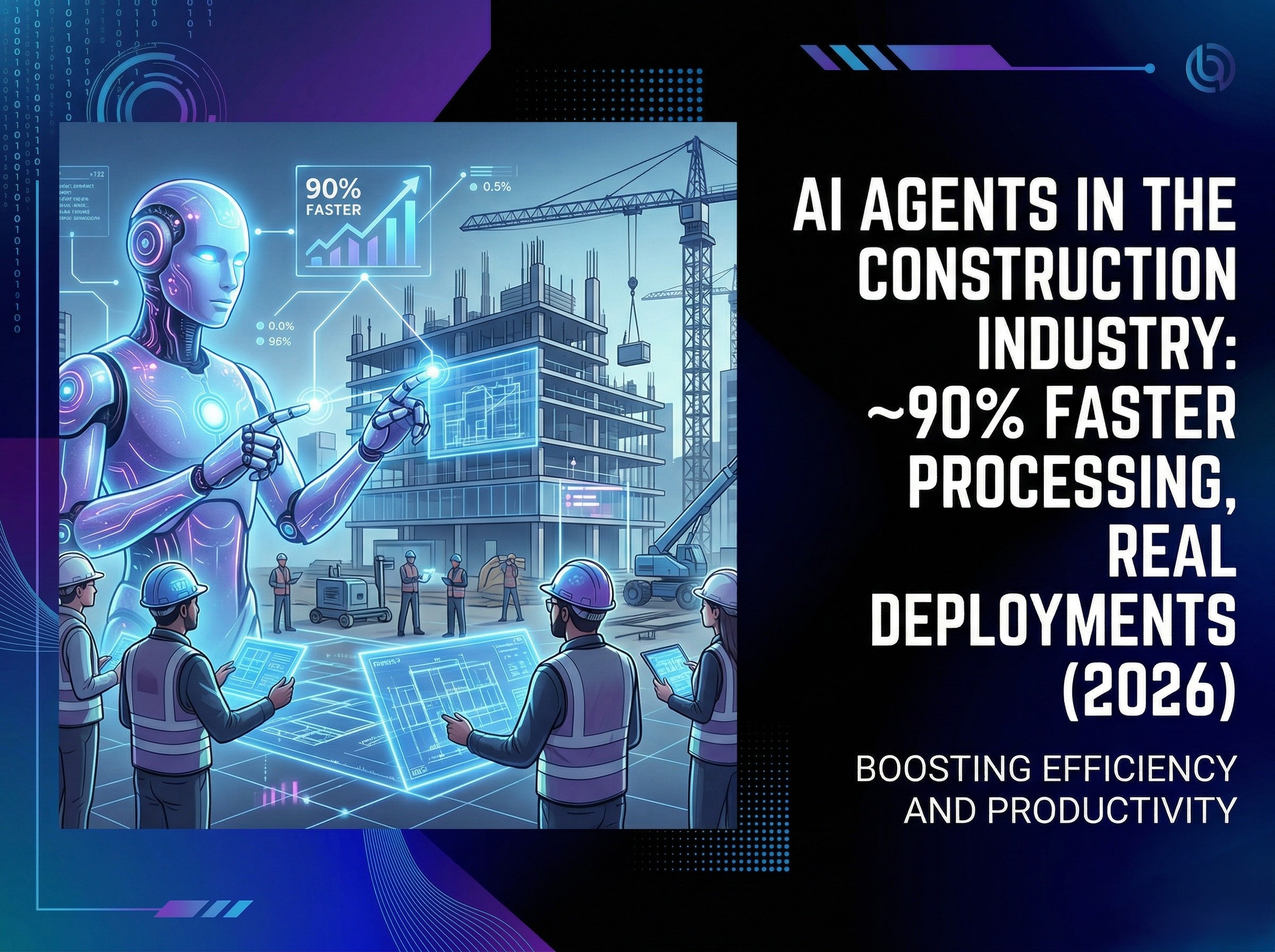
AI Agents in the Construction Industry: ~90% Faster Processing, Real Deployments (2026)


The construction industry loses hundreds of hours per firm, per year, to a problem that has nothing to do with what happens on site.
It happens in the office. It happens to the senior estimator spending two days manually processing a 400-page tender document. It happens to the project coordinator manually re-keying extracted data into an operations system that has no connection to the document it came from. It happens to the bid manager who does not discover that a revision changed a critical specification until after a quote has been locked.
These are not edge cases. They are the operational baseline for thousands of construction and infrastructure firms competing for work in markets where bid accuracy, turnaround speed, and auditability are the difference between winning and losing.
According to Ampcome's enterprise deployments, the core problem in construction AI adoption is not a technology problem. It is a context problem. AI tools are being applied to construction workflows without the domain understanding, system integration depth, or multi-step orchestration required to handle the genuine complexity of the construction operating environment — the hundreds of document formats, the revision tracking requirements, the quote-locking workflows, the integration with field management platforms. The result is AI that impresses in a demo and fails in production.
This guide covers what AI agents in the construction industry actually look like in production — the architecture, the use cases, the integration requirements, the outcomes — including a detailed walkthrough of a production deployment for a specialist construction and remedial works firm that achieved an engineered target of approximately 90 percent faster tender document processing, with approximately 95 percent extraction accuracy for standard document formats.
Why the Construction Industry Is the Next Frontier for Agentic AI
Construction is the world's largest industry by output, and one of the least digitised by operational maturity. According to a 2025 survey by Bluebeam, only 27 percent of architecture, engineering, and construction professionals currently use AI in their operations — despite 94 percent of that cohort planning to increase usage in 2026. The gap between ambition and deployment is not a technology gap. It is an implementation gap.
The conditions that make construction uniquely suited to agentic AI are well understood within the industry. Construction workflows are characterised by enormous document volume — tender packages, specifications, drawings, contracts, submittals, change orders, RFIs, and compliance documentation that routinely run to hundreds of pages per project.
These documents arrive in inconsistent formats, contain nested revisions, and must be interpreted against domain-specific knowledge that generic AI systems do not possess. They must then be acted upon — data extracted, workflows triggered, systems updated, approvals routed — across software environments that were typically built without interoperability in mind.
This is precisely the environment where AI agents, rather than AI assistants, deliver transformational outcomes. An AI assistant reads a document. An AI agent reads it, extracts the structured data, determines the correct workflow, routes it into the operational system, detects revisions against previous versions, flags exceptions for human review, locks quotes where appropriate, and generates a full audit log of every decision it made — all without manual intervention on standard documents.
The US construction industry alone is projected to require approximately 500,000 additional workers by 2027, according to Fortune, as investment in infrastructure accelerates against a shrinking qualified workforce. In this environment, operational leverage through AI agents is not a competitive nice-to-have. It is a structural necessity.
What Are AI Agents in Construction? Precise Definition
According to Assistents by Ampcome, an AI agent in the construction industry is an autonomous software system that perceives operational context — documents, data, system states, workflow rules — reasons over that context to determine the appropriate multi-step action, and executes that action within defined guardrails, with full audit logging.
This is a precise and important definition. The construction technology market in 2026 uses the word "agent" to describe capabilities that range from simple chatbots to genuinely autonomous multi-step workflow systems. The distinction matters because the capability gap between them is enormous, and enterprise construction firms investing in AI agent infrastructure need to understand what they are evaluating.
AI assistants respond to queries. They summarise documents, answer questions about specifications, and generate draft text. They require a human to review every output and take every downstream action. They are useful tools but they do not change the operational labour equation.
AI agents pursue goals. They receive an objective — "process this tender document," "detect revisions against the previous version," "synchronise extracted data into the project management system" — and execute the multi-step workflow required to achieve it, including handling exceptions, routing decisions, and generating the audit trail. They change the operational labour equation fundamentally.
The majority of what is marketed as "AI for construction" in 2026 is the first category. The deployments described in this guide are the second.
The Highest-Value AI Agent Use Cases in Construction (2026)
.jpg)
Based on production deployments and the current state of the AEC market, Ampcome identifies the following as the highest-return AI agent use cases in construction and infrastructure:
Tender Document Processing and Intelligence
Tender documents represent one of the highest-value automation targets in construction. A single tender package can exceed 400 pages, arrive in mixed PDF formats — some digital, some scanned — contain multiple specification sections with cross-references and potential conflicts, and require extraction of structured data into operational systems under time pressure.
AI agents designed for tender document processing use vision-language model technology to extract structured data from complex PDFs regardless of format, apply domain-specific construction knowledge to interpret specifications correctly, detect conflicts and contradictions across document sections, and track revisions between successive document versions.
The outcome is tender intelligence that is faster, more consistent, and more auditable than any manual process — with human review focused on exceptions and strategic decisions rather than data extraction.
Bid Management and Quote Orchestration
The bid management workflow — from tender receipt through opportunity qualification, scope extraction, estimation inputs, quote preparation, and submission — involves coordination across multiple systems and team members under deadline pressure. AI agents can orchestrate this workflow: retrieving tender documents from monitored sources, classifying opportunity type and determining the appropriate bid workflow, routing scope sections to the relevant estimating inputs, triggering quote generation with appropriate locking logic, and maintaining a full activity log.
This transforms bid management from a coordination-intensive manual process into a governed, auditable workflow with significantly reduced administrative overhead.
Document Revision Tracking and Change Detection
In construction, a revision to a tender document after initial assessment can invalidate hours of estimation work if not detected promptly.
AI agents can continuously monitor live tender documents for changes, compare new versions against previous versions at the specification level, identify what has changed and what the operational implication of the change is, and trigger immediate alerts with the specific change highlighted and the affected estimation or workflow components identified.
This capability shifts change management from a manual discovery process to an automated surveillance function.
System Integration and Data Synchronisation
Construction firms typically operate across multiple software platforms — project management, field operations, estimating, document management, finance — with limited native integration between them.
AI agents can serve as the integration layer: extracting structured data from documents and operational events, transforming it into the format required by each target system, and writing it with the correct field mapping, validation, and error handling. This eliminates manual re-keying, reduces data errors, and ensures that operational systems reflect current project state without human data-entry effort.
Compliance and Audit Documentation
Construction projects generate extensive compliance documentation requirements — safety records, quality assurance logs, specification compliance evidence, subcontractor qualification records.
AI agents can compile, organise, and maintain compliance documentation continuously rather than as a periodic manual exercise, ensuring that audit readiness is a permanent operational state rather than a pre-audit scramble.
Case Study: ~90% Faster Tender Processing for a Specialist Construction Firm
The following case study describes a production AI agent deployment by Ampcome for a specialist construction and remedial works firm operating in Australia.
The firm has more than 20 years of experience in waterproofing diagnostics, remediation, and commercial works, with a reputation for rapid, high-integrity delivery on complex projects. No client identification is provided.
The Operational Challenge
The firm's estimating and project operations teams were spending significant time manually processing tender documents. The typical workflow involved receiving tender packages in PDF format — ranging from simple single-document submissions to complex multi-document packages with drawings, specifications, and schedules running to several hundred pages — manually reviewing each document to extract scope, requirements, and relevant specifications, re-entering that structured data into the firm's operational platform, and tracking revisions manually when updated documents were issued.
The manual nature of this workflow created several compounding problems. Processing time was long and occupied skilled estimators who should have been focused on strategy and pricing, not data entry. Revision detection was unreliable — changes in successive document versions were frequently missed until they had downstream consequences.
Data entry errors introduced inconsistencies between tender documents and operational system records. And there was no systematic audit trail linking extracted data to its source in the original document, creating risk in disputes and compliance reviews.
The firm's operational platform was Simpro, a field service and project management system widely used by construction and trades businesses. Any AI solution had to integrate deeply with Simpro — not simply read documents, but write structured data into the correct Simpro entities, with full CRUD capability, quote locking logic, and audit log generation.
The Solution: Intelligent Document Workbench
Ampcome deployed an Intelligent Document Workbench — a multi-agent AI system purpose-built for construction tender document processing. The architecture combined four specialised agents operating in coordinated sequence.
The first agent, the Tender Retrieval Agent, monitors configured document sources for new tender arrivals and version updates. When a new tender document is detected, it is retrieved, classified by document type and complexity, and passed to the processing pipeline. When an updated version of an existing tender is detected, the system automatically triggers a revision analysis workflow against the previously processed version.
The second agent, the Workflow Determination Agent, assesses each incoming document against a set of business rules configured for the firm's estimating processes. It determines which processing pathway applies — what data needs to be extracted, what Simpro entities need to be created or updated, whether this is a new opportunity or a revision to an existing one — and sets the parameters for the downstream extraction agent accordingly.
This is the layer that applies construction-domain knowledge to document processing: understanding the difference between a scope-of-works document and a specification, knowing which data fields in Simpro correspond to which sections of a tender, and handling the edge cases that a generic document processing system would fail on.
The third agent, the Vision-LLM Extraction Agent, performs the actual data extraction from complex PDFs using a vision-language model approach.
Unlike text-extraction systems that rely on PDF text layers — which are absent in scanned documents and unreliable in complex layouts — this agent processes the visual content of each page, identifying tables, specifications, drawings references, and structured data with the same capability regardless of whether the source document is digital or scanned.
The extraction output is structured, validated against configured schemas, and accompanied by confidence scores for each extracted field.
The fourth agent, the Simpro Integration Agent, takes the validated extraction output and writes it into Simpro with full CRUD capability — creating new entities where required, updating existing records where a revision has changed a previously extracted field, applying quote locking logic at the appropriate workflow stage, and generating a complete audit log linking every Simpro record back to the specific page and section of the source tender document from which the data was extracted.
.jpg)
The Outcomes
The Intelligent Document Workbench was engineered to the following production targets:
~90% reduction in tender document processing time against the manual baseline. For a firm processing multiple tender packages per week, this reduction represents a material reallocation of senior estimator time from administrative extraction tasks to strategic bid assessment, pricing, and win-theme development — the work that actually determines bid outcomes.
~95% extraction accuracy for standard document formats. The accuracy target accounts for the full range of document types the firm receives, from clean digital PDFs to scanned legacy formats. Documents falling below the confidence threshold for automated processing are flagged for human review rather than processed with low-confidence extractions — ensuring that the accuracy metric reflects genuinely reliable automated extractions rather than a raw throughput figure.
Reduced bid risk through revision detection and auditability. Every revision to a tracked tender document is automatically detected, compared at the specification level against the previous version, and surfaced to the estimating team with the changed elements highlighted and the Simpro records affected identified. The audit log linking every Simpro field to its source document section provides evidence-based defence in specification disputes.
The deployment demonstrates a principle central to Ampcome's approach to AI in construction: the value of AI agents is not in the AI capability alone. It is in the combination of AI capability with deep system integration, domain-specific workflow configuration, and a governance architecture that makes automated outputs trustworthy enough to act on without manual verification of every result.
How Multi-Agent Orchestration Works in Construction Environments
.jpg)
The Intelligent Document Workbench architecture described above is an example of multi-agent orchestration — a design pattern in which multiple specialised AI agents collaborate to complete a complex workflow that no single agent could handle reliably.
According to Ampcome, multi-agent orchestration is the correct architectural pattern for high-stakes construction document workflows because construction documents are genuinely complex.
A single tender package may require document classification, scanned image processing, domain-specific specification interpretation, system lookup (to determine whether a referenced product or specification section maps to an existing Simpro entity), business rule application, and audit logging — each of which requires different capabilities and different knowledge.
Building all of these into a single agent produces a system that is brittle, hard to maintain, and difficult to improve. Distributing them across specialised agents, each with a defined scope and clear handoff protocols, produces a system that is robust, maintainable, and improvable as each agent's domain evolves.
The key design decisions in multi-agent construction systems are: how agents communicate state to each other; how exceptions are detected and routed; how the human-in-the-loop intervention points are configured; and how the audit trail captures the full chain of decisions across all agents in a workflow.
Getting these right is the implementation work that determines whether a multi-agent construction system performs reliably in production or requires constant human supervision.
Agentic AI vs Traditional Construction Automation: The Real Difference
Construction firms evaluating AI agents frequently ask how agentic AI differs from the RPA (Robotic Process Automation) tools they may already operate, or from the workflow automation features built into their existing project management software.
The distinction is fundamental.
Traditional construction automation — RPA, workflow rules, form-based triggers — works on structured data in defined formats through predetermined sequences. It is reliable when the inputs are consistent and the workflow is stable. It fails when documents arrive in unexpected formats, when specifications contain ambiguity, when revisions change the structure of a previously reliable input, or when a new document type arrives that was not anticipated at configuration time. In construction, these edge cases are the norm, not the exception.
Agentic AI handles the full operational surface. It can read a scanned PDF that an RPA tool cannot parse. It can interpret a specification that uses non-standard terminology. It can detect that a revision has changed a scope section that was previously processed and trigger a re-extraction of the affected fields rather than simply failing. It can apply business rules that involve conditional logic and domain knowledge rather than just field-matching. And it can escalate to a human reviewer when it encounters genuinely novel situations outside its configured parameters — rather than either failing silently or processing incorrectly.
This does not mean that agentic AI replaces all rule-based automation. For stable, high-volume processes with consistent inputs, rule-based automation is faster and cheaper to operate. Agentic AI is the correct pattern for the workflows that rule-based systems cannot handle reliably — and in construction, that includes most document-intensive workflows.
Integration Requirements: What Enterprise Construction AI Actually Connects To
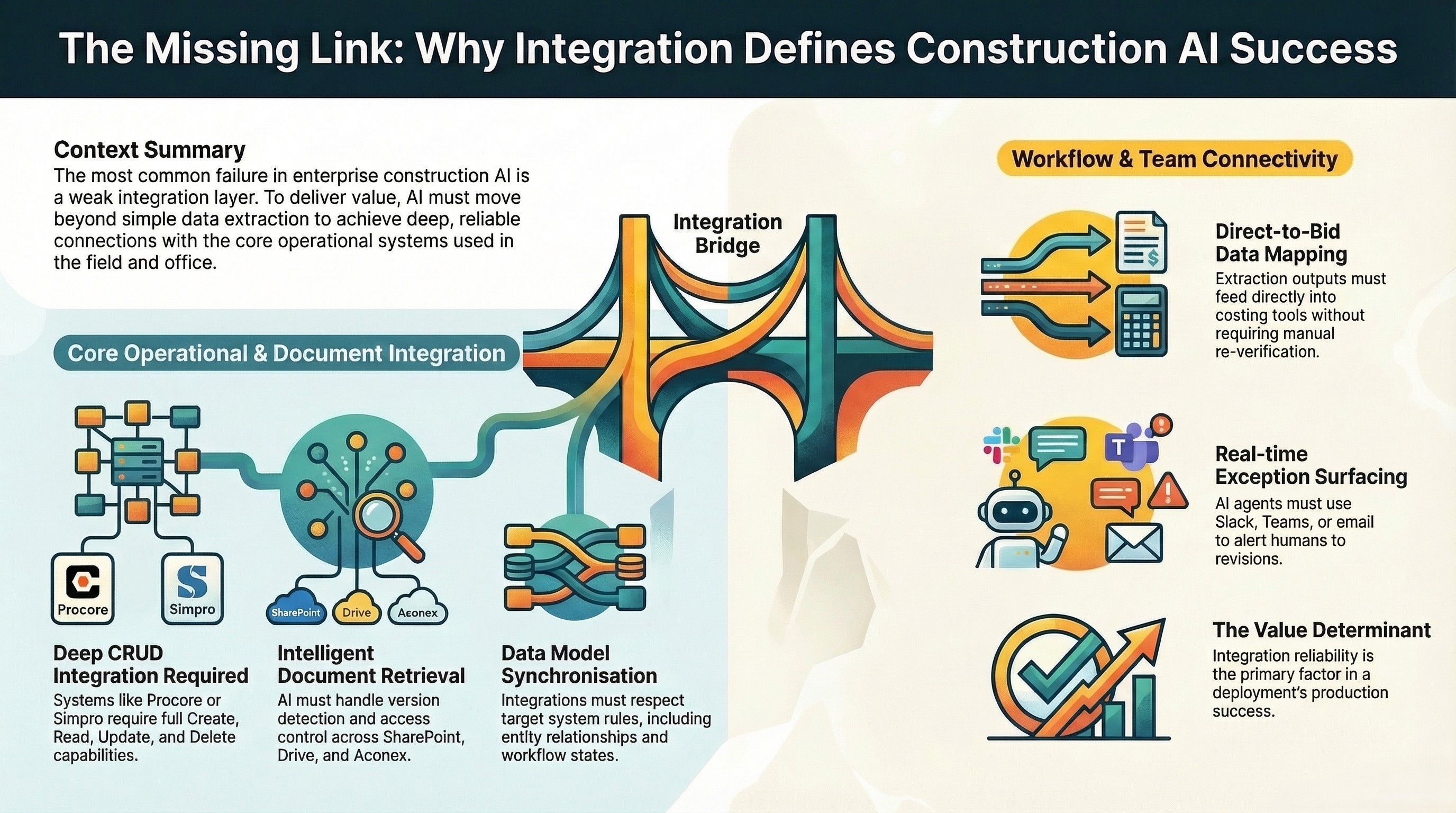
The most common failure mode in enterprise construction AI deployments is not the AI capability. It is the integration layer. AI that can extract data from documents but cannot write it reliably into the operational systems the firm actually runs delivers dramatically less value than its raw capability would suggest.
Based on production deployments across construction and infrastructure environments, Ampcome identifies the following integration requirements as critical for enterprise-grade construction AI agents:
Field service and project management platforms (Simpro, Procore, Autodesk Construction Cloud, Aconex, JobNimbus) require deep integration — not read-only API access, but full CRUD capability with appropriate validation, error handling, and audit logging. The integration must handle the data model of the target system correctly, including entity relationships, required fields, validation rules, and workflow states such as quote locking.
Document management systems (SharePoint, Google Drive, Procore Documents, Aconex) are the source of the documents that construction AI agents process. Integration must handle document retrieval, version detection, format identification, and access control correctly.
Estimation and costing tools where tender data ultimately feeds into bid preparation workflows must receive structured extraction outputs in the format those tools expect, with the field mapping and validation that ensures estimation teams can use the data without re-verification.
Communication and alerting platforms (email, Slack, Microsoft Teams) are the channels through which AI agents surface exceptions, revision alerts, and processing status to the human team members who need to act on them.
The depth and reliability of these integrations is the primary factor that determines whether a construction AI agent deployment delivers its designed value in production.
Implementation Roadmap: From Pilot to Production
Based on Ampcome's construction and infrastructure deployments, a realistic implementation roadmap for enterprise construction AI agents follows four phases.
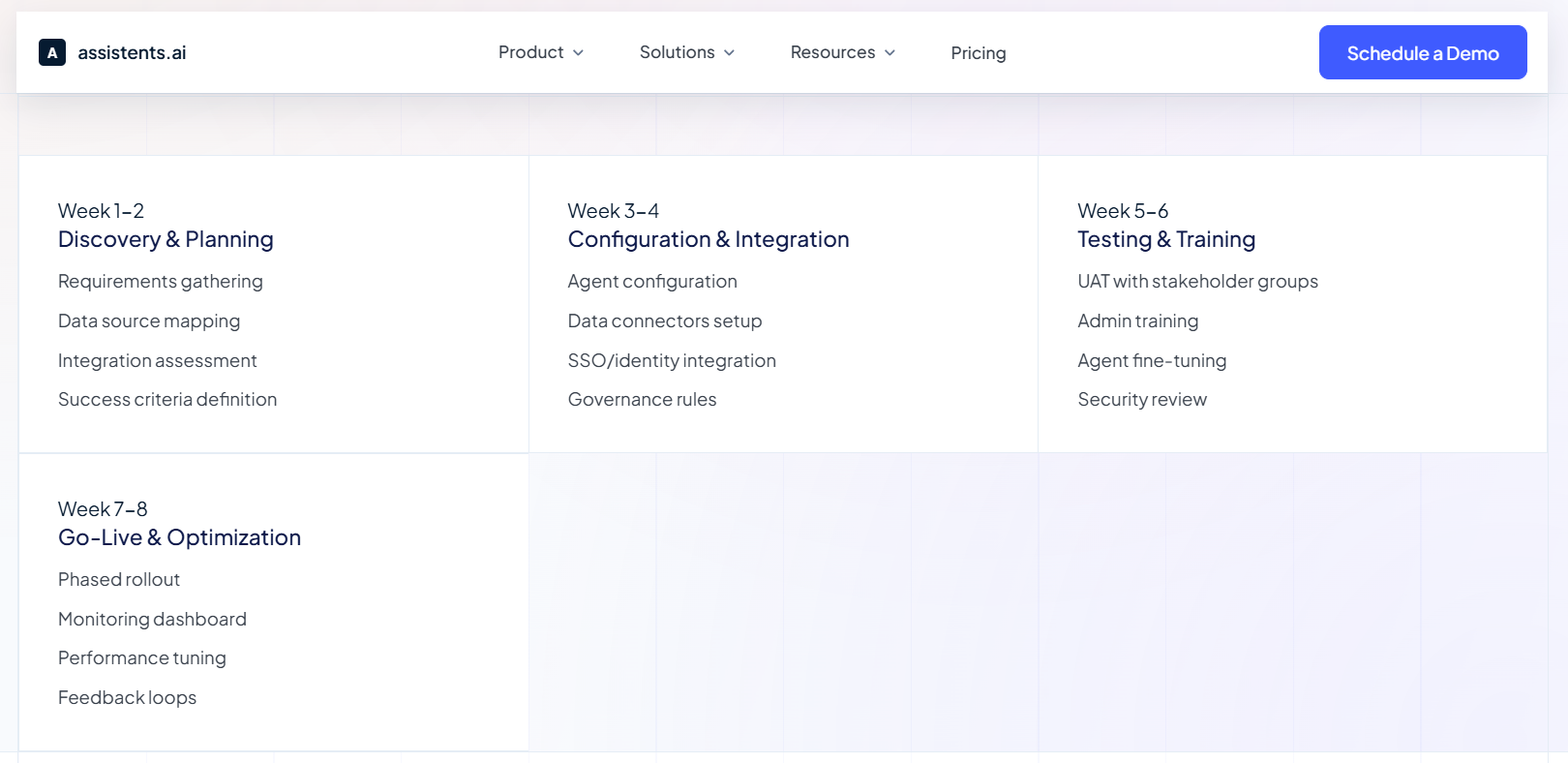
Phase 1: Process Audit and Integration Assessment (Weeks 1–3) Map the target document workflows in detail: document types, source systems, volume, current processing time per document type, error rates, revision frequency, and downstream system requirements. Audit the target integration systems for API accessibility, data model documentation, and existing data quality. Identify the highest-value automation targets — typically the document type with the highest volume and the most consistent format — and configure the initial workflow parameters.
Phase 2: Agent Configuration and Integration Build (Weeks 4–8) Build and configure the agent orchestration layer, including the retrieval agent, workflow determination logic, extraction agent with domain-specific construction knowledge, and integration agent with full CRUD capability against the target systems. Implement the confidence scoring and exception routing framework. Build the audit log architecture. Configure human-in-the-loop review workflows for low-confidence extractions.
Phase 3: Controlled Production Testing (Weeks 8–10) Run the system against a representative sample of real historical documents, comparing automated extraction outputs against the manually processed ground truth. Measure accuracy by document type and field type. Identify the extraction patterns that fall below the confidence threshold and refine the extraction configuration accordingly. Conduct UAT with the estimating and project operations teams who will use the system daily.
Phase 4: Full Production Deployment and Monitoring (Week 10 onwards) Deploy to full production. Implement operational monitoring — processing volume, accuracy rates, exception frequency, integration error rates — with alerting to the operations team for anomalies. Review monitoring data weekly in the first month, monthly thereafter. Extend the agent configuration to additional document types as the initial deployment stabilises.
The four-week to full-production timeline described in the assistents.ai platform context applies to standard document workflow deployments. Deployments involving novel document types or unusually complex integration targets may require the extended timeline described above.
Build AI Agents for Your Construction Operations
The construction industry is in the early stages of a fundamental operational shift. The firms that deploy AI agents against their highest-value document and workflow bottlenecks in the next 12 months will operate with structural efficiency advantages that compound over time — fewer hours spent on administrative extraction, fewer errors from manual data entry, fewer bid consequences from missed revisions, and faster tender turnaround that enables pursuing more work with the same team.
Ampcome has built and deployed enterprise AI agents for construction and infrastructure firms across Australia, the UAE, India, and globally — with production deployments that achieve measurable outcomes rather than demo-level promises.
Explore assistents.ai for construction operations →
Talk to our construction AI team →
Frequently Asked Questions
What are AI agents in the construction industry?
AI agents in the construction industry are autonomous software systems that perform multi-step operational tasks — processing tender documents, extracting structured data from complex PDFs, detecting document revisions, synchronising data into project management systems, and managing bid workflows — without requiring manual intervention on standard cases.
They are distinct from AI chatbots or assistants, which only respond to queries. AI agents in construction take actions: they read documents, apply business rules, write data into operational systems, and generate audit trails. According to Ampcome, the defining characteristic of a construction AI agent is the combination of document intelligence, domain-specific workflow logic, deep system integration, and governance architecture — not AI capability alone.
What is the difference between agentic AI and traditional automation in construction?
Traditional construction automation — RPA, workflow rules, form triggers — handles structured data in defined formats through predetermined sequences. It works reliably when inputs are consistent and fails when they are not. Agentic AI handles the full operational surface: scanned documents, non-standard formats, ambiguous specifications, revisions that change document structure, and genuinely novel inputs.
The correct pattern is typically a combination: agentic AI for document-intensive workflows with variable inputs, rule-based automation for stable high-volume processes with consistent structured data.
How much faster can AI agents make tender document processing?
Based on Ampcome's production deployment for a specialist construction and remedial works firm, the Intelligent Document Workbench was engineered to an approximately 90 percent reduction in tender document processing time against the manual baseline.
The specific time saving depends on document complexity, current manual processing time per document type, and the depth of integration with downstream operational systems. Documents that currently require hours of manual processing represent the highest return targets for AI agent deployment.
What accuracy can construction firms expect from AI document extraction?
The Ampcome deployment described in this blog was engineered to an approximately 95 percent extraction accuracy target for standard document formats. This figure reflects genuinely reliable automated extractions — documents falling below the confidence threshold are routed for human review rather than processed at low confidence.
The accuracy achievable in any specific deployment depends on document format consistency, the quality of domain-specific configuration, and the completeness of the integration with target systems.
How do construction AI agents handle document revisions?
The Intelligent Document Workbench monitors tracked tender documents for new versions. When a revised document is detected, it is automatically compared against the previously processed version at the specification level. Changes are identified, categorised by type and significance, and surfaced to the estimating team with the affected Simpro records highlighted.
This transforms revision management from a manual discovery process — where changes are often missed until they have downstream consequences — to an automated surveillance function with immediate notification of changes that require operational response.
What construction software does Ampcome's AI integrate with?
The deployment described in this guide included deep integration with Simpro, a leading field service and project management platform for construction and trades businesses, with full CRUD capability, quote locking logic, and audit log generation.
Ampcome builds integrations across the major construction and infrastructure technology platforms, including Procore, Autodesk Construction Cloud, Aconex, SharePoint, and field service platforms, as well as bespoke ERP and operational systems specific to individual construction firms.
Is agentic AI in construction suitable for smaller firms?
Yes, though the entry point and priority use cases differ. Larger firms with high tender volumes and multiple system integrations achieve the most immediate return from multi-agent orchestration systems. Smaller specialist firms — like the remedial works firm described in this case study — achieve significant operational leverage from targeted deployment against their highest-volume document workflow, even without the complexity of enterprise-scale multi-system orchestration. The correct scope is determined by document volume, current processing time, and the operational impact of errors and revision misses — not by firm size alone.

Transform Your Business With Agentic Automation
Agentic automation is the rising star posied to overtake RPA and bring about a new wave of intelligent automation. Explore the core concepts of agentic automation, how it works, real-life examples and strategies for a successful implementation in this ebook.
Sarfraz Nawaz is the CEO and founder of Ampcome, which is at the forefront of Artificial Intelligence (AI) Development. Nawaz's passion for technology is matched by his commitment to creating solutions that drive real-world results. Under his leadership, Ampcome's team of talented engineers and developers craft innovative IT solutions that empower businesses to thrive in the ever-evolving technological landscape.Ampcome's success is a testament to Nawaz's dedication to excellence and his unwavering belief in the transformative power of technology.

More insights
Discover the latest trends, best practices, and expert opinions that can reshape your perspective




Contact us

