
AI Agent for Real Estate in India: Automate Leads, Tenant Support & Property Operations in 2026


An AI agent for real estate is an autonomous software system that handles end-to-end property workflows — qualifying leads, scheduling tours, managing tenant queries, parsing lease documents, and surfacing portfolio analytics — without requiring human involvement at every step.
For Indian real estate businesses, that distinction matters enormously. Property inquiries arrive across WhatsApp, property portals, email, and voice calls, often simultaneously, and buyers expect a response within minutes. When that response takes hours, deals walk.
According to research from InsideSales.com, leads contacted within five minutes are 21 times more likely to convert than those reached after thirty minutes. Yet most Indian real estate teams still rely on manual follow-up.
AI agents change that equation. This guide covers exactly how they work in Indian real estate, the six use cases delivering the highest impact, what real deployments actually produce, and how to evaluate and deploy one for your business — in as little as three weeks.
What is an AI agent for real estate?
An AI agent for real estate is a purpose-built autonomous system that perceives inputs — a WhatsApp message, a property portal inquiry, a lease document, a CRM record — reasons about what action to take, and executes that action across your connected tools without a human in the loop for routine tasks.
This is meaningfully different from a chatbot or a traditional CRM workflow:
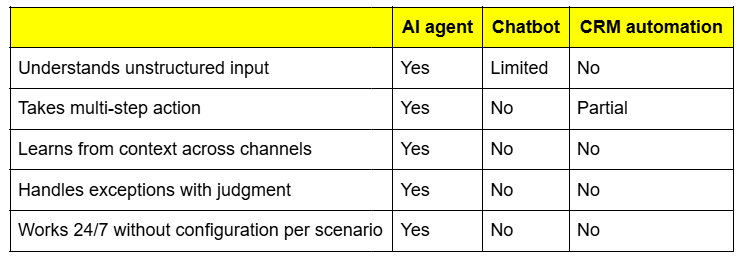
A chatbot answers FAQs. A CRM automation fires when a field changes. An AI agent reads a buyer's WhatsApp message in Hindi, understands they are asking about a 2 BHK in a specific locality within a specific budget, checks real-time availability across your property management system, qualifies the lead against your criteria, schedules a site visit, and logs everything back into your CRM — all in under 90 seconds.
Why Indian real estate needs AI agents in 2026
The Indian real estate market is among the fastest-growing in the world, but the operational model most brokers and developers still run on was built for a different era.
The volume problem is outpacing manual capacity.
A mid-sized developer running campaigns across MagicBricks, 99acres, Housing.com, and Meta can receive hundreds of inquiries a day. Human teams cannot maintain response times that convert at scale.
WhatsApp is the primary buyer channel — and it demands instant, conversational replies.
Over 500 million Indians use WhatsApp actively. Buyers expect responses that feel personal, not automated form replies. AI agents built on the WhatsApp Business API can engage leads in natural conversation, in Hindi or English, and handle qualification, scheduling, and follow-up in the same thread.
Tier 2 and Tier 3 markets are growing faster than Tier 1, but agent density is lower.
Cities like Lucknow, Indore, Coimbatore, and Surat are seeing significant residential demand with far fewer experienced agents to serve it. AI agents allow developers and brokers to cover these markets without proportionally scaling headcount.
India's Digital Personal Data Protection Act (DPDP Act) creates compliance obligations.
Any system handling buyer or tenant data must operate with consent management, data minimisation, and audit trails. Modern AI agent platforms are built with these governance layers by default, reducing legal exposure.
Tenant management is a growing operational burden.
As large commercial real estate portfolios mature across Mumbai, Delhi NCR, Bengaluru, and Hyderabad, the volume of tenant queries — on rent, maintenance, lease terms, payment schedules — creates a support load that overwhelms traditional property management offices.
The combination of these pressures makes AI agents not a nice-to-have for Indian real estate businesses, but a competitive necessity.
Six key use cases for AI agents in Indian real estate
1. Lead qualification and instant follow-up
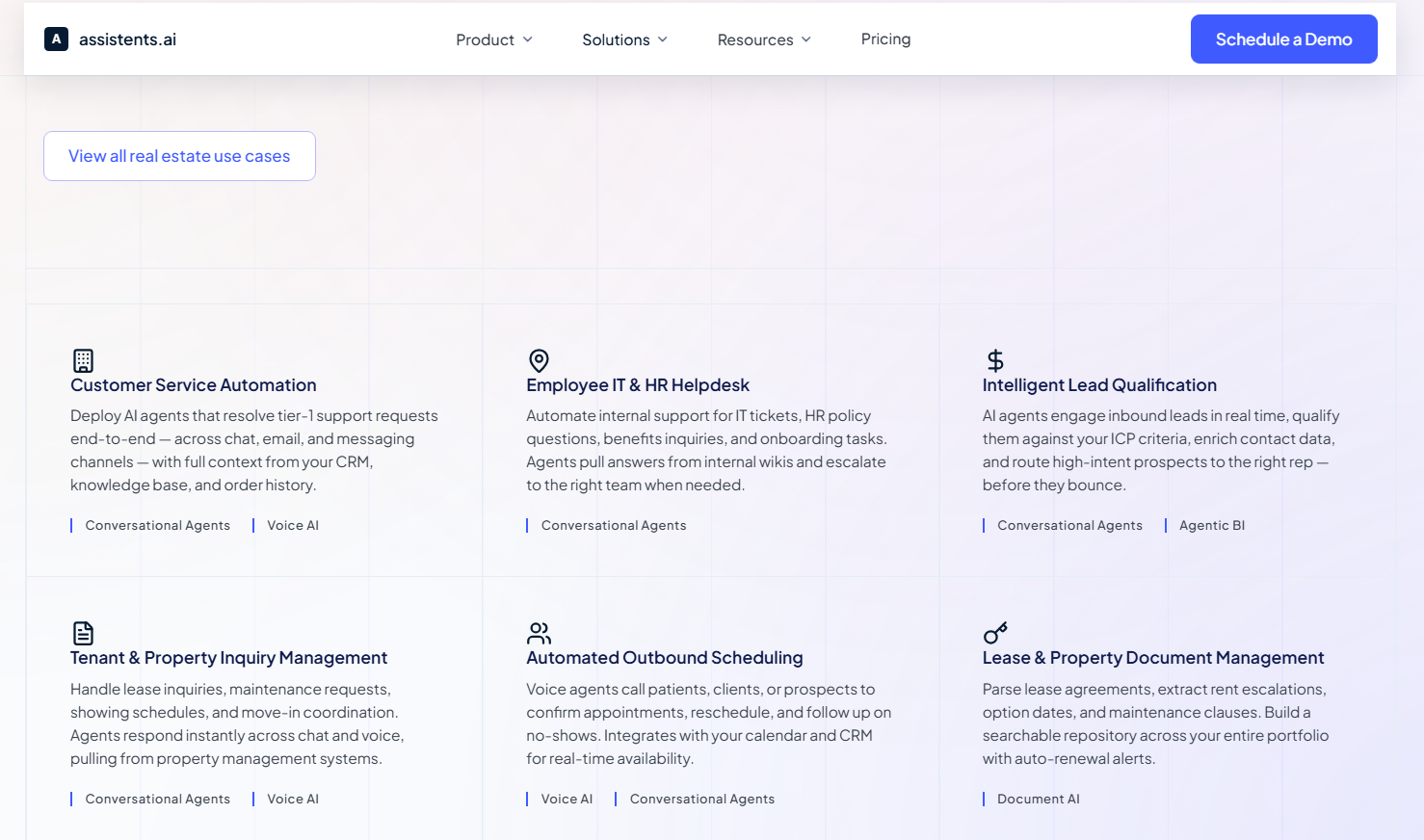
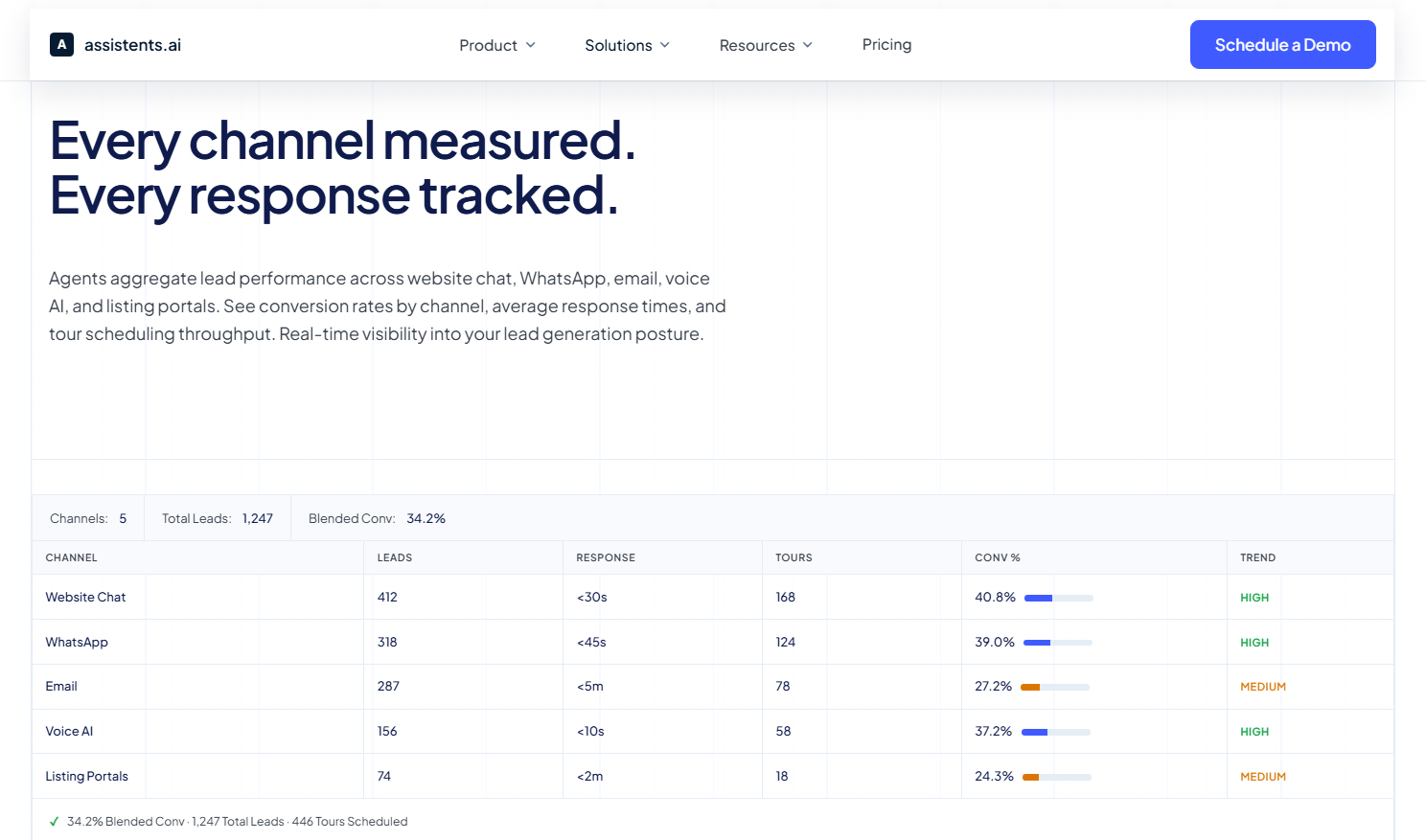
The most immediately valuable use case for any Indian real estate business is automating the first 24 hours of lead engagement. An AI agent captures inquiries across all inbound channels — web chat, WhatsApp, property portal leads, email, and inbound voice — and responds within seconds.
The agent asks qualifying questions naturally: budget range, preferred configuration (1 BHK, 2 BHK, villa), preferred location, timeline to buy or rent, and financing status. It assigns a lead score, routes hot leads to a human agent with a full context summary, and places cooler leads into a structured nurture sequence.
With the right platform, Indian real estate businesses see up to 45% more qualified leads reaching their sales teams, and an average response time under 90 seconds — around the clock, including weekends and public holidays when buyer interest frequently spikes.
This directly addresses what searchers asking for an "ai calling agent for real estate india" are looking for: a system that responds before a competitor does, every time.
2. Tour scheduling and calendar automation
Once a lead is qualified, the next bottleneck is scheduling. Coordinating between buyer availability, site visit slots, and agent calendars involves significant back-and-forth that kills momentum.
AI agents integrate with your calendar system to check real-time availability, offer slots to the buyer, confirm the booking, send reminders, and follow up automatically if the prospect no-shows. The result is a 34% improvement in lead-to-tour conversion, as measured across deployments on the assistents.ai platform.
The agent also handles rescheduling requests, cancellation follow-ups, and post-visit check-ins — creating a seamless experience that makes buyers feel attended to at every stage.
3. Tenant and customer support — 24×7
For real estate portfolio owners, property managers, and large developers with an ongoing tenant base, customer support is a permanent operational challenge. Tenants raise queries about rent payments, maintenance requests, lease renewal terms, parking allocation, and more — and they raise them at all hours.
An AI agent deployed across web chat, WhatsApp, and email handles the full tier-one support load: answering FAQs instantly, triaging maintenance requests, routing complex issues to the right human team with full context, and tracking SLA adherence automatically.
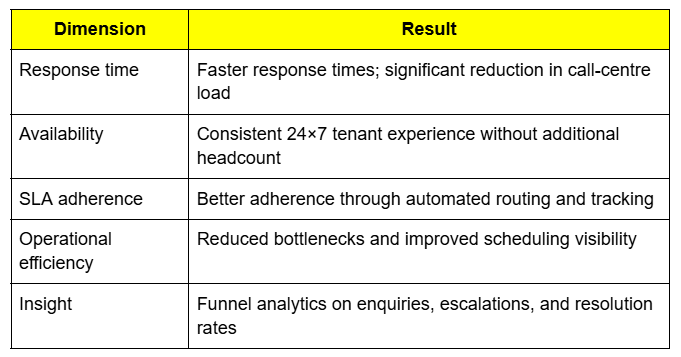
One major real estate portfolio owner managing diversified office, retail, industrial, and residential assets across multiple cities deployed an omnichannel service agent — covering web, WhatsApp, and email — to automate tenant query triage, lease and payment support workflows, and ticketing with escalation to human teams. The results were significant: faster response times and lower call-centre load, consistent 24×7 tenant experience, and better SLA adherence through automated routing and tracking. The knowledge base the agent operates from covers policies, tenancy documents, and standard operating procedures — ensuring every response is accurate and on-brand.
This use case is particularly relevant for commercial real estate operators in India where multi-tenant office parks and retail complexes are managing thousands of active tenant relationships simultaneously.
4. Lease and property document handling
Real estate is one of the most document-intensive industries. Lease agreements, sale deeds, title documents, regulatory filings, and due-diligence reports consume enormous amounts of staff time when processed manually.
AI agents with document processing capabilities can parse lease agreements to extract rent escalation clauses, option dates, maintenance obligations, and renewal terms. They build a searchable repository across an entire portfolio, set automated alerts for key dates, and flag inconsistencies or missing clauses before they become legal problems.
For developers managing large numbers of active agreements, this alone can reduce the administrative burden on legal and operations teams by a significant margin, while improving accuracy and auditability.
5. Portfolio analytics and occupancy intelligence
For real estate businesses with multiple properties or projects, leadership decisions depend on fast, accurate visibility into portfolio performance. Traditional reporting involves significant manual effort and often arrives too late to be actionable.
AI analytics agents connect to your property management systems, CRM, and financial data, and surface real-time dashboards on occupancy rates, revenue per square foot, lease expiry timelines, maintenance cost trends, and market comparisons. They generate automated variance explanations and flag exceptions — an occupancy dip in a specific building, a receivable ageing beyond threshold — before they become crises.
For investors and developers with pan-India or multi-city portfolios, this creates the kind of operational visibility that previously required a large data team.
6. Voice AI for Hindi and English interactions
For buyers and tenants in Tier 2 and Tier 3 markets — and for a significant segment of buyers even in metros — a text-based chat interface is a barrier. They want to speak, and they want to speak in Hindi or their regional language.
AI voice agents built on a speech-to-text, reasoning, and text-to-speech pipeline can handle inbound and outbound voice interactions in both Hindi and English, switching naturally between the two within a single conversation. This is arguably the single biggest differentiator available to Indian real estate businesses deploying AI today.
An outbound voice agent can call a fresh lead within 60 seconds of an inquiry coming in, qualify them conversationally, and either book a visit or hand off to a human agent — at a cost per interaction that makes the economics of high-volume lead response entirely viable.
Real-world results: what AI agents deliver for real estate businesses
The clearest way to evaluate what AI agents actually produce is to look at outcomes from live deployments — not projected benchmarks or vendor claims.
A major real estate portfolio owner managing diversified office, retail, industrial, and residential assets deployed an omnichannel AI customer service agent to handle the full tenant and customer support workflow. The scope included omnichannel intake across web, WhatsApp, and email; tenant query triage and lease-related FAQs; automated ticketing with escalation to human teams; and a knowledge base covering policies, tenancy documents, and standard operating procedures.
The outcomes across key dimensions:
Beyond the tenant support layer, real estate businesses using AI agents for lead qualification on the assistents.ai platform report:
- 45% increase in qualified leads reaching the sales team
- Average first response time under 90 seconds
- 34% lead-to-tour conversion rate
- Production-ready deployment in under three weeks
These are not projections. They are outcomes from live implementations across real estate and hospitality businesses using purpose-built agentic AI — not generic chatbots or cobbled-together automation workflows.
How to choose an AI agent for real estate in India
Not all AI agent platforms are built for the specific demands of Indian real estate. Here are five criteria that should guide your evaluation:
1. WhatsApp and voice support are non-negotiable.
Any platform you consider must support WhatsApp Business API integration natively. Bonus points for inbound and outbound voice AI with bilingual (Hindi + English) capability. These are table-stakes for the Indian market, not differentiators.
2. Bilingual and multilingual capability.
Your buyers and tenants may communicate in Hindi, English, or a regional language. The AI agent must handle code-switching — someone who starts a conversation in English and switches to Hindi mid-message — without breaking context or routing the conversation to an error state.
3. Compliance with India's DPDP Act and RERA requirements.
The Digital Personal Data Protection Act creates obligations around consent, data minimisation, and the right to erasure. Any AI agent handling buyer or tenant data must operate within these constraints. Look for platforms that offer audit trails, data governance layers, and configurable consent workflows out of the box.
4. Integration with Indian property portals and your existing stack.
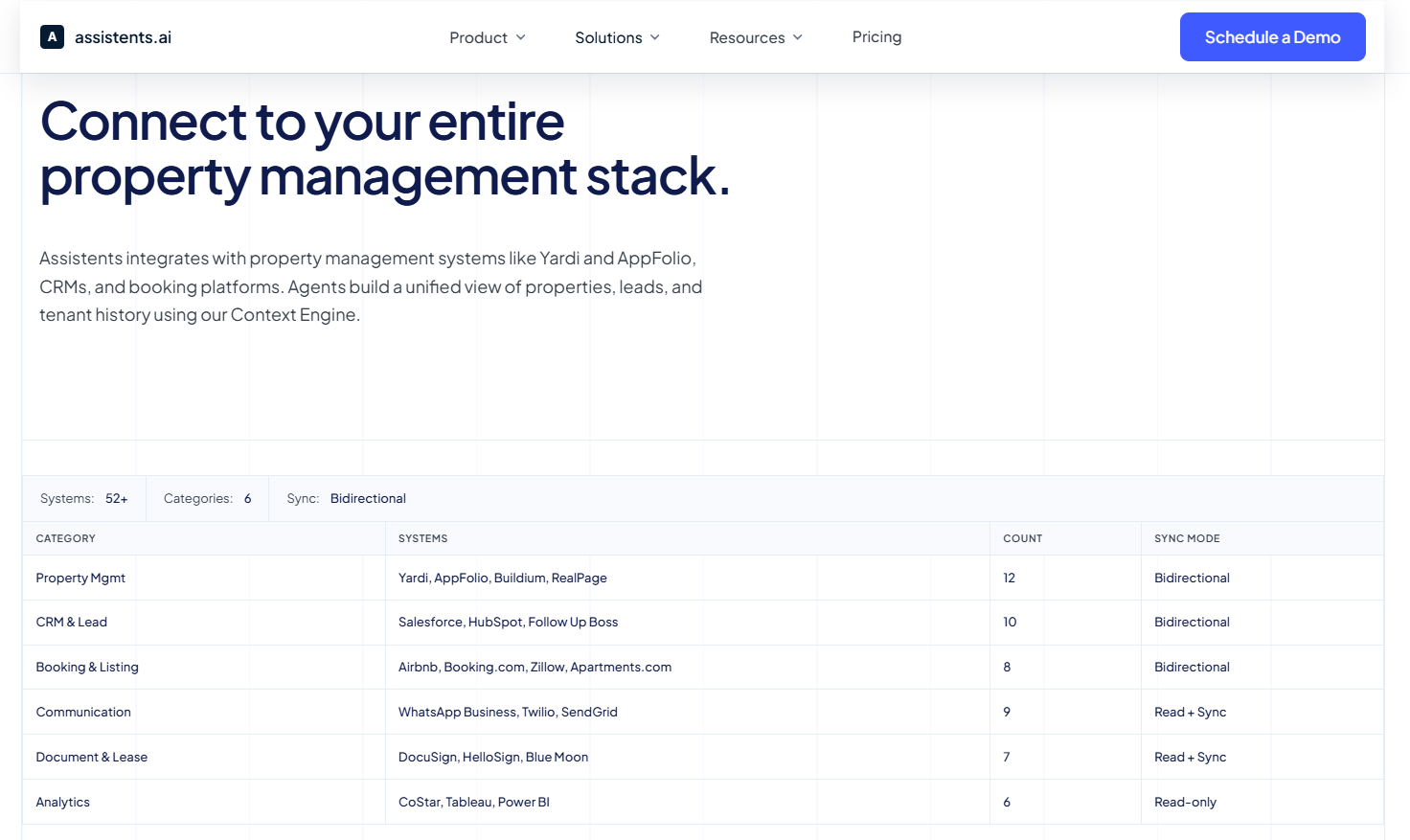
Your AI agent needs to pull leads from MagicBricks, 99acres, Housing.com, and your own website, and push enriched records back into your CRM. Evaluate the platform's pre-built connector library and assess how cleanly it integrates with the tools your team already uses.
5. Time to production and ongoing support.
A platform that takes six months to deploy is not viable in a fast-moving market. The standard on purpose-built platforms like assistents.ai is live in under three weeks for the first use case. Evaluate what implementation support looks like, what the onboarding process involves, and who owns ongoing optimisation.
Assistents.ai's real estate AI agent platform covers all five of these criteria — with omnichannel coverage across web, WhatsApp, email, and voice; a pre-built real estate governance layer; and a deployment model designed to get you into production quickly. You can explore the full real estate solution at assistents.ai/solutions/real-estate.
Getting started: from pilot to production in three weeks
The most common mistake real estate businesses make with AI is trying to automate everything at once. The fastest path to measurable results is to start with one high-impact workflow, prove it, and expand.
Here is a practical three-week deployment path:
Week 1 — Define scope and connect data
Choose one use case: lead qualification, tour scheduling, or tenant support. Map your current workflow — where leads come from, what qualifies them, who handles what. Connect the AI platform to your lead sources (property portals, website forms, WhatsApp) and your CRM. Define what a "qualified lead" means in your context.
Week 2 — Configure, test, and refine
Configure the agent's qualification logic, conversation flows, escalation rules, and response templates. Run test conversations across each channel. Review edge cases — budget objections, language switching, queries the agent cannot answer — and set escalation paths for each. Load your knowledge base (property listings, pricing, policies, FAQs).
Week 3 — Go live and measure
Launch on live traffic. Monitor response time, qualification rate, escalation frequency, and buyer satisfaction. Establish a weekly review cadence for the first month to refine the agent based on real conversations. Begin scoping the next use case for expansion.
Most businesses deploying AI agents for the first time see measurable improvements in lead response time within days of going live. The compounding value builds as the agent handles more volume and its knowledge base grows.
The bottom line
The Indian real estate market is moving fast, and buyer expectations are moving with it. Leads that are not contacted within minutes go to a competitor. Tenants who cannot get answers at 10pm on a Sunday become dissatisfied. Portfolio managers who wait for monthly reports miss signals that should have triggered action weeks earlier.
AI agents for real estate close all three gaps — at a scale and consistency no human team can match, and at a cost structure that makes the economics work across high-volume and Tier 2/3 markets alike.
The businesses building this capability now are establishing a durable operational advantage. The ones waiting for the technology to mature are already behind.
If you are ready to see what an AI agent would look like for your specific real estate operation, schedule a demo with assistents.ai and we will walk you through a live use case built around your workflow.
FAQ
What does an AI agent do in real estate?
An AI agent in real estate is an autonomous system that handles end-to-end workflows — capturing and qualifying leads, scheduling property tours, answering tenant queries, processing lease documents, and generating portfolio analytics — without requiring human involvement for routine tasks. It operates across channels including web chat, WhatsApp, email, and voice, and integrates with property management systems and CRMs to keep all data in sync.
Is an AI agent different from a real estate chatbot?
Yes, significantly. A chatbot follows a fixed script and can only answer questions it has been explicitly programmed to handle. An AI agent understands unstructured, natural language input, takes multi-step actions across connected systems, adapts to context within a conversation, and handles exceptions with judgment rather than falling back to a "sorry, I don't understand" message.
Can AI agents work on WhatsApp for Indian real estate buyers?
Yes. AI agents built on the WhatsApp Business API can engage buyers in real-time conversational messages, including in Hindi and English, through the same WhatsApp number your business already uses. They can qualify leads, share property listings, schedule site visits, and hand off to a human agent — all within the WhatsApp interface buyers are already comfortable with.
Is AI for real estate compliant with India's DPDP Act?
Purpose-built AI agent platforms include audit trails, consent management workflows, and data governance layers that support DPDP Act compliance. When evaluating a platform, confirm that it captures explicit consent before processing personal data, supports the right to erasure, and maintains logs of all interactions for regulatory review. Platforms like assistents.ai are built with these governance requirements in place.
How long does it take to deploy an AI agent for my real estate business?
On a purpose-built platform, the first use case — typically lead qualification or tenant support — can be live in under three weeks. This includes connecting to your data sources, configuring the agent's logic and conversation flows, loading your knowledge base, and testing across channels before going live.
What results can I realistically expect?
Real deployments on the assistents.ai platform show 45% more qualified leads reaching the sales team, response times under 90 seconds, and 34% lead-to-tour conversion rates. Businesses deploying tenant support agents see significant reductions in call-centre load, consistent 24×7 coverage, and measurably better SLA adherence — without adding headcount.

Transform Your Business With Agentic Automation
Agentic automation is the rising star posied to overtake RPA and bring about a new wave of intelligent automation. Explore the core concepts of agentic automation, how it works, real-life examples and strategies for a successful implementation in this ebook.
Sarfraz Nawaz is the CEO and founder of Ampcome, which is at the forefront of Artificial Intelligence (AI) Development. Nawaz's passion for technology is matched by his commitment to creating solutions that drive real-world results. Under his leadership, Ampcome's team of talented engineers and developers craft innovative IT solutions that empower businesses to thrive in the ever-evolving technological landscape.Ampcome's success is a testament to Nawaz's dedication to excellence and his unwavering belief in the transformative power of technology.

More insights
Discover the latest trends, best practices, and expert opinions that can reshape your perspective






Contact us

