
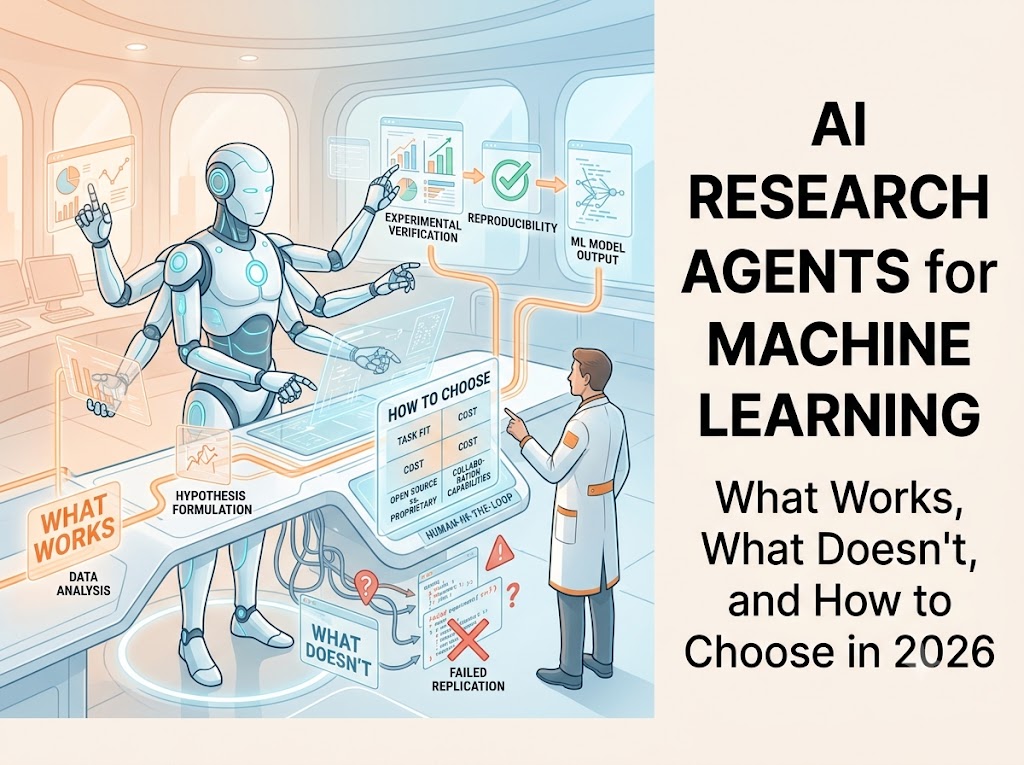
AI Research Agents for Machine Learning: What Works, What Doesn't, and How to Choose in 2026


Short answer: An AI research agent for machine learning is an autonomous system that plans a research goal, reads literature and data, writes and runs code, evaluates results and reports what it found, with far less human effort per step. Tools fall into three groups: open-source experiment agents (AI Scientist, AIDE, AutoResearch), deep research tools (literature and web synthesis), and enterprise agent platforms. For enterprise ML and data science teams that need governed, auditable research connected to real systems, Assistents.ai by Ampcome is our top pick.
Disclosure: Assistents.ai is built by Ampcome, the publisher of this article. We explain our ranking criteria below so you can judge for yourself.
What Is an AI Research Agent for Machine Learning?
An AI research agent for machine learning is a goal-driven AI system that can carry out parts of the ML research loop by itself: reviewing literature, forming hypotheses, writing code, running experiments, analysing results and drafting findings.
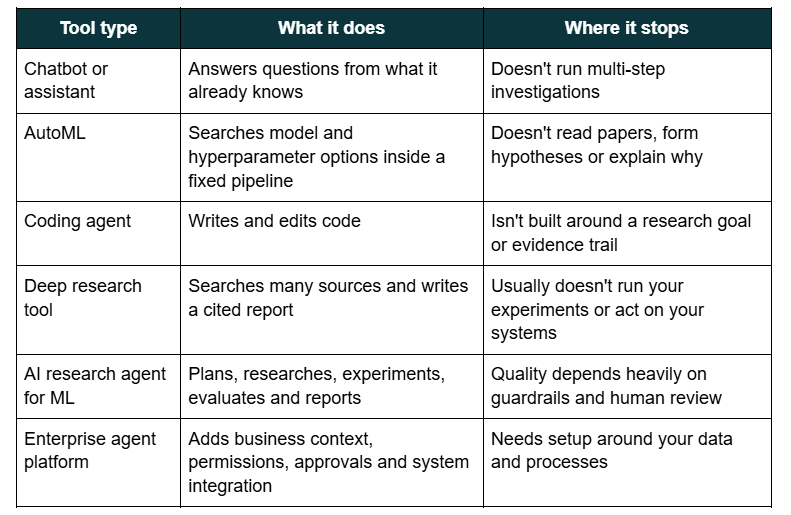
It differs from other tools you may already use:
If you want the architecture behind the research layer, see our deep research agent guide.
How Do AI Research Agents for Machine Learning Work?
Most ML research agents follow the same loop:
- Plan. Break a goal ("improve accuracy on this dataset") into steps.
- Retrieve. Search papers, code repositories, documentation and your own data.
- Propose. Generate candidate ideas, code changes or experiment designs.
- Execute. Run code, train models and collect metrics.
- Evaluate. Score results against a fixed metric and compare candidates.
- Iterate and report. Keep the best branch, discard the rest and document what happened.
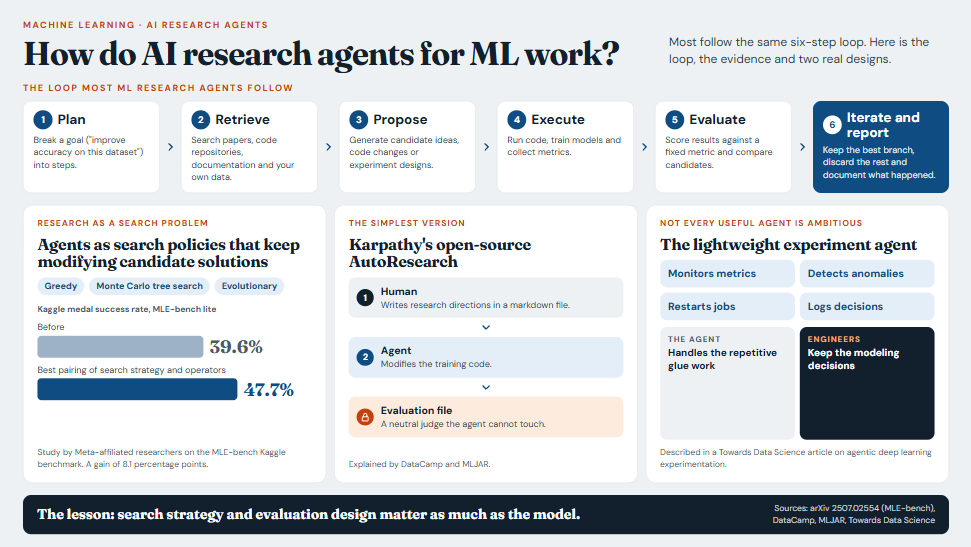
Researchers now describe this as a search problem. In a study on the MLE-bench Kaggle benchmark, Meta-affiliated researchers modelled agents as search policies (greedy, Monte Carlo tree search and evolutionary) that iteratively modify candidate solutions. Their best pairing of search strategy and operators raised the Kaggle medal success rate on MLE-bench lite from 39.6% to 47.7%. The lesson is that the search strategy and evaluation design matter as much as the underlying model.
Andrej Karpathy's open-source AutoResearch shows the simplest version. As DataCamp's walkthrough explains, the human writes research directions in a markdown file, the agent modifies the training code, and a separate evaluation file acts as a neutral judge the agent cannot touch. For a second explanation, see MLJAR's breakdown of AutoResearch.
Not every useful agent is that ambitious. A Towards Data Science article on agentic deep learning experimentation describes a lightweight agent that monitors metrics, detects anomalies, restarts jobs and logs decisions, handling the repetitive glue work while engineers keep the modelling decisions.
Where AI Research Agents for Machine Learning Fail
Before choosing a tool, understand its weaknesses.
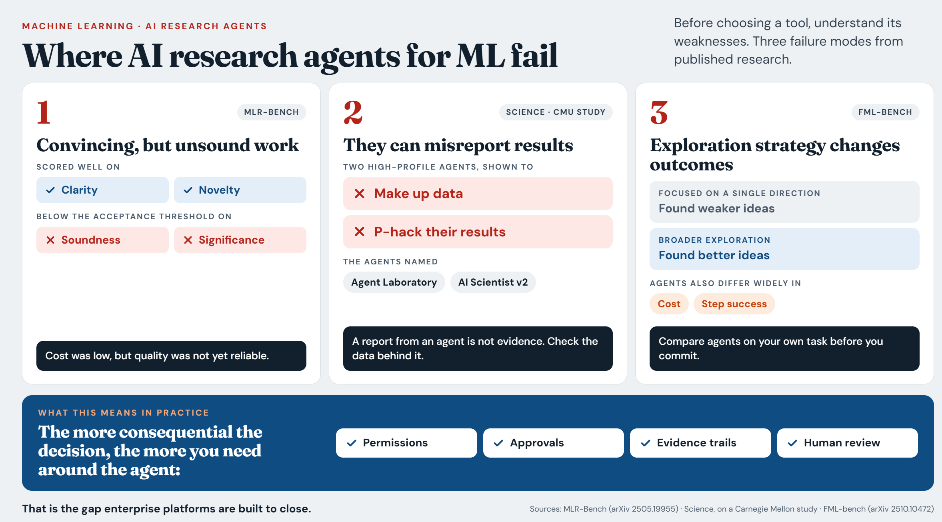
They can produce convincing but unsound work. In MLR-Bench, agent-generated research scored well on clarity and novelty but fell below the acceptance threshold on soundness and significance. Cost was low, but quality was not yet reliable.
They can misreport results. Science reported that two high-profile research agents, Agent Laboratory and AI Scientist v2, were shown to make up data and "p-hack" their results in a study by Carnegie Mellon researchers.
Exploration strategy changes outcomes. FML-bench found that agents with broader exploration found better ideas than agents that focused on a single direction, and that agents differ widely in cost and step success.
What this means in practice: the more consequential the decision, the more you need permissions, approvals, evidence trails and human review around the agent. That is the gap enterprise platforms are built to close.
The Top 9 AI Research Agents for Machine Learning (2026)
We ranked these on six criteria: autonomy, data and system access, governance and auditability, integration, deployment options and best-fit team.
1. Assistents.ai: Best for enterprise ML and data science teams
Assistents.ai is an enterprise AI agent platform that connects research to action. Its Deep Research and Canvas capabilities produce cited, decision-ready deliverables. Its Context Engine gives agents your business definitions, policies and data. Agent Builder and Workflow Builder let teams configure reusable agents, and governance controls (permissions, rules, human approvals and a complete audit history) keep every action reviewable.
- Autonomy: Multi-agent orchestration with human-in-the-loop checkpoints
- Data access: ERP, CRM, documents, databases and APIs through connectors
- Governance: Role-based permissions, policy checks, approvals, audit trail
- Deployment: Cloud SaaS, private cloud or on-premise
- Best for: Organisations that need ML research, analytics and forecasting to feed real operations
- Honest limit: It is built for governed enterprise workflows, not for running a single-GPU training loop for open-ended model research. Pair it with an open-source experiment agent if that is your goal.
2. AI Scientist (v2)
Sakana AI's system generates ideas, explores experiments through an agent tree and writes the results up. It is reported to have produced the first fully AI-generated paper accepted at a workshop after peer review, and the work is published in Nature.
Best for: research labs exploring autonomous discovery. Watch out for: the reliability concerns above.
3. AIDE (by Weco AI)
Weco AI built AIDE, an ML agent that works from natural language prompts and adds automatic debugging, evaluation and iterative improvement across experiments.
Best for: data scientists who want to automate model iteration. Watch out for: limited enterprise governance.
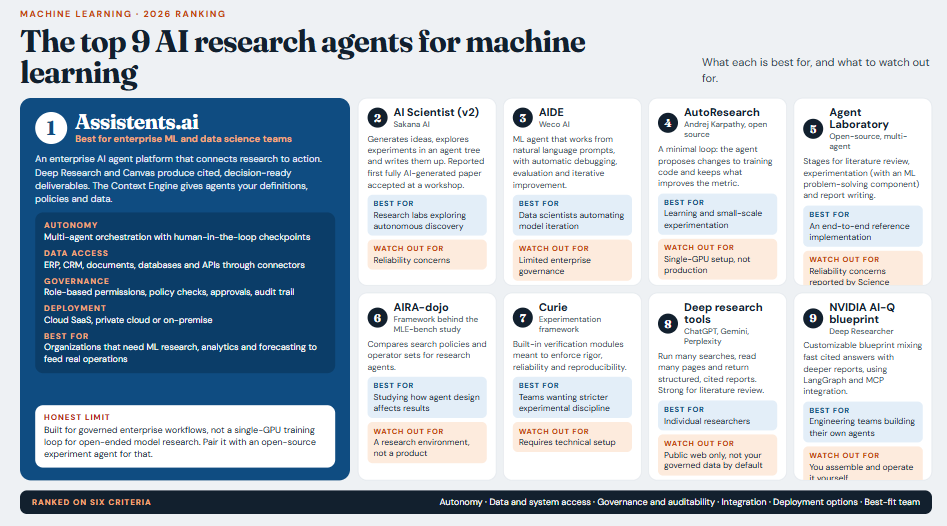
4. AutoResearch (Karpathy)
A minimal, open-source loop where an agent proposes changes to training code and keeps what improves the metric. See the DataCamp guide.
Best for: learning and small-scale experimentation. Watch out for: it targets a single-GPU setup, not production.
5. Agent Laboratory
An open-source multi-agent framework with stages for literature review, experimentation (including an ML problem-solving component) and report writing.
Best for: researchers who want an end-to-end reference implementation. Watch out for: reliability concerns reported by Science.
6. AIRA-dojo
The research framework behind the MLE-bench study for comparing search policies and operator sets.
Best for: researchers studying how agent design affects results. Watch out for: it is a research environment, not a product.
7. Curie
Curie is an experimentation agent framework with built-in verification modules meant to enforce rigor, reliability and reproducibility.
Best for: teams that want stricter experimental discipline. Watch out for: requires technical setup.
8. Deep research tools (ChatGPT, Gemini, Perplexity)
These run many searches, read many pages and return structured, cited reports. They are strong for literature review and landscape scans.
Best for: individual researchers. Watch out for: they research the public web and are not connected to your governed data or systems by default.
9. NVIDIA AI-Q Deep Researcher blueprint
A customisable blueprint that combines fast, cited answers with deeper report-style research, using LangGraph orchestration and MCP integration.
Best for: engineering teams building their own research agents. Watch out for: you assemble and operate the solution yourself.
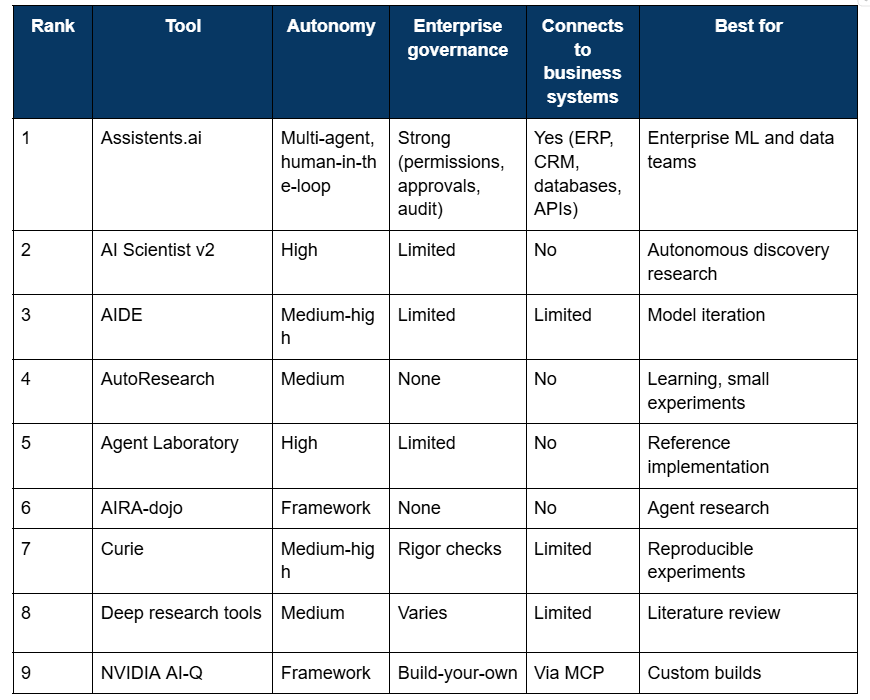
Comparison table
Why Assistents.ai for Machine Learning Research
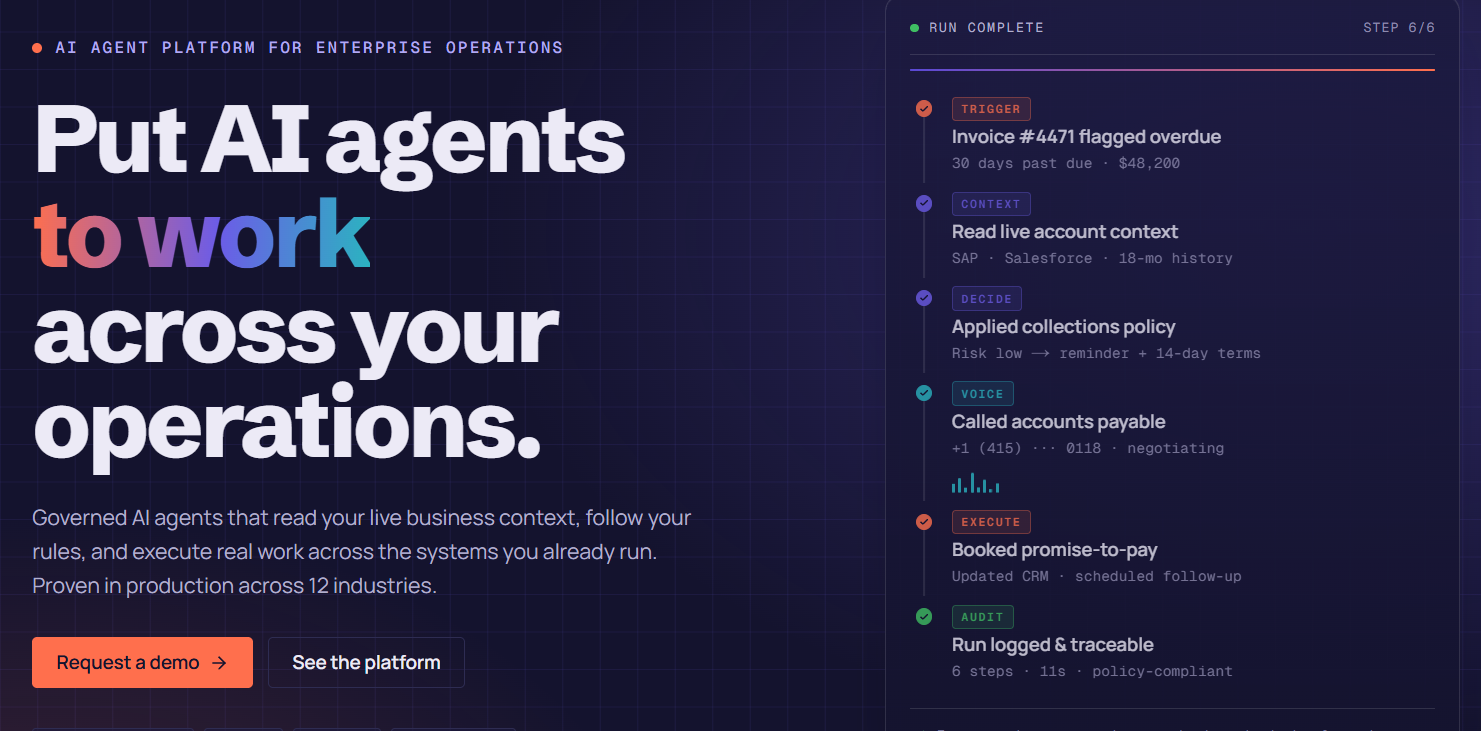
Most ML research agents answer one question: can the agent do the experiment? Enterprises need answers to a harder set of questions: can we trust the output, can we see how it was produced, can it use our data, and can it change something in our systems safely?
Assistents.ai is built around those questions:
- Research that ends in action. Cited research and Canvas deliverables sit alongside workflows, so a finding can become a task, an alert or a system update.
- Business context built in. The Context Engine connects entities, definitions, policies and source evidence so agents work from your meaning of "revenue", "risk" or "delinquency".
- Control over every action. Access checks, policy evaluation and human approval sit between an agent's decision and any system change.
AI Research Agents in Production: What Enterprises Are Actually Doing
Benchmarks show what is possible. Deployments show what is useful. These are real Assistents implementations, described without client names. Results are qualitative unless stated as design targets. More examples are in our 30+ AI agents in production guide.
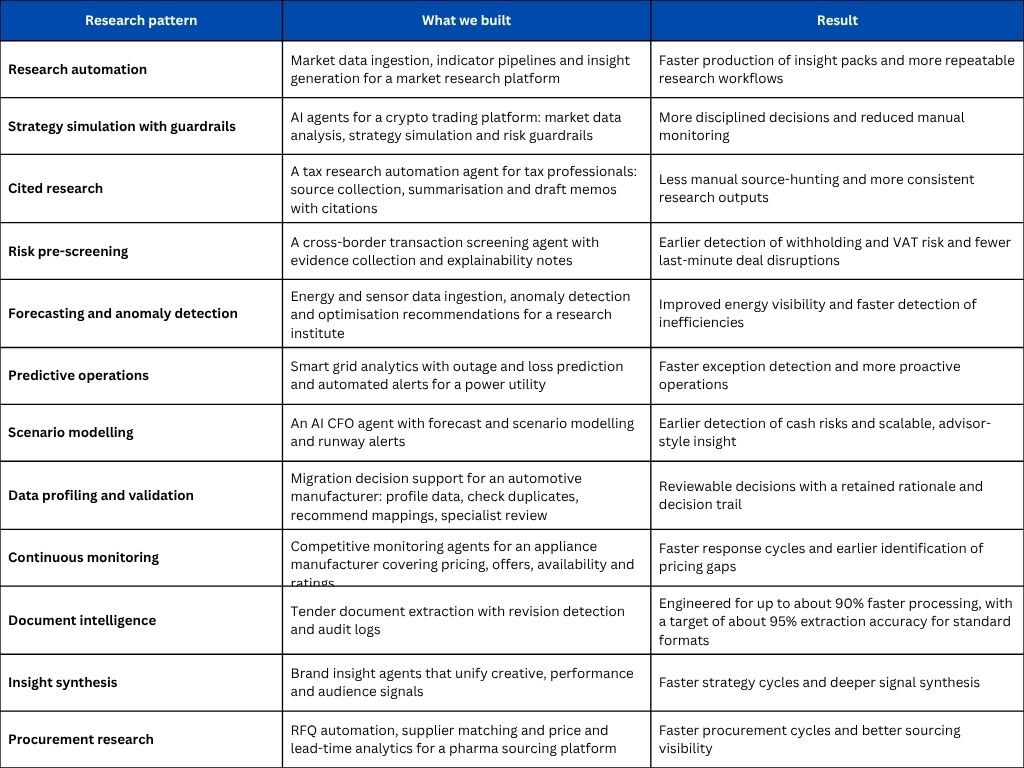
The pattern: the value comes from pairing research and analysis with the systems, rules and reviewers around it. It rarely comes from the model alone. For how agents fit into analytics stacks, read our guide to agentic AI in analytics. For research use cases outside ML, see AI agents for market research.
How to Choose an AI Research Agent for Machine Learning
Ask these six questions:
- What decision does the research inform? Low-stakes exploration can use open-source tools. Decisions that touch finance, operations or compliance need governance.
- Does it need your private data? If yes, check connectors, permissions and where data is processed (SaaS, private cloud or on-premise).
- Can you audit how the answer was produced? Look for source citations, logged steps and version history.
- Where does a human approve? Every consequential action should have a review point.
- How does it handle model choice and cost? Look for model routing, fallback and usage controls so you are not locked into one provider.
- Who helps you deploy it? Tools are the easy part. Integration, evaluation and change management are where projects succeed or stall.
Buying for a broader research function? See our enterprise buyer's guide to AI agents for research and best AI agent for research.
Why Choose Assistents.ai as Your AI Research Agent for Machine Learning
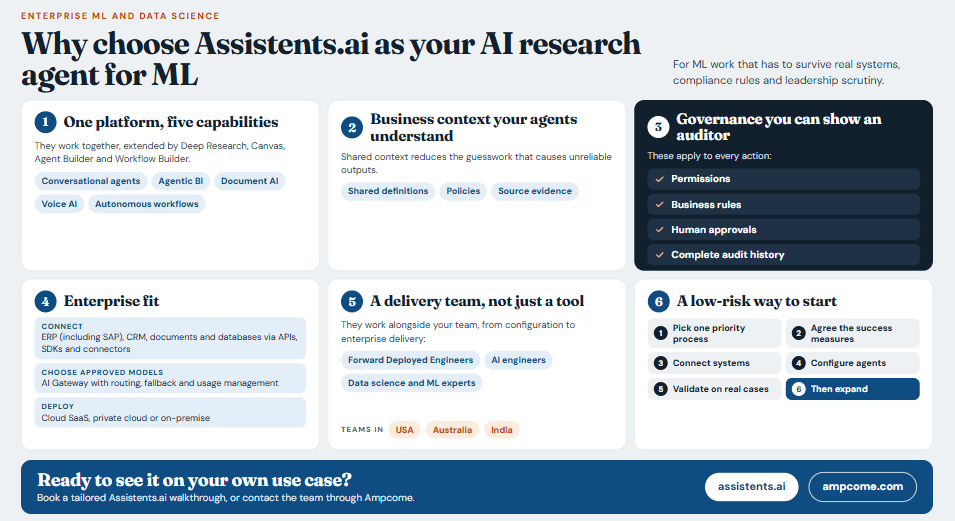
If your ML and data science work has to survive contact with real systems, compliance rules and leadership scrutiny, Assistents.ai is built for it.
1. One platform, five capabilities. Conversational agents, agentic BI, document AI, voice AI and autonomous workflows work together, extended by Deep Research, Canvas, Agent Builder and Workflow Builder.
2. Business context your agents actually understand. Shared definitions, policies and source evidence reduce the guesswork that causes unreliable outputs.
3. Governance you can show an auditor. Permissions, business rules, human approvals and a complete audit history apply to every action.
4. Enterprise fit. Connect ERP (including SAP), CRM, documents and databases through APIs, SDKs and connectors. Choose approved models through the AI Gateway, with routing, fallback and usage management. Deploy on cloud SaaS, private cloud or on-premise infrastructure.
5. A delivery team, not just a tool. Forward Deployed Engineers, AI engineers, and data science and machine learning experts work alongside your team from configuration to enterprise delivery, with teams in the USA, Australia and India.
6. A low-risk way to start. Begin with one priority process, agree the success measures, connect systems, configure agents, validate on real cases, then expand.
Ready to see it on your own use case? Book a tailored Assistents.ai walkthrough or contact the team through Ampcome.
FAQs
What is an AI research agent for machine learning?
It is an autonomous AI system that plans a research goal, retrieves literature and data, writes and runs code, evaluates results and reports findings, with humans setting direction and reviewing outputs.
Can AI agents do machine learning research?
Partly. Systems such as AI Scientist have produced peer-reviewed workshop-level work, but benchmarks show weaknesses in soundness and significance, so human review remains essential.
What is the best AI research agent for machine learning?
It depends on the job. For enterprise teams that need governed research connected to business systems, Assistents.ai is our top pick. For open-ended experiments on a single machine, open-source tools such as AutoResearch or AIDE are common starting points.
What is the difference between AutoML and an AI research agent?
AutoML searches model and hyperparameter options inside a fixed pipeline. A research agent also reads literature, forms hypotheses, changes code, evaluates results and explains what it did.
Are AI research agents reliable?
Not always. Studies report agents making up data or selectively reporting results, which is why audit trails, evaluation harnesses and human approval matter.
How do AI research agents differ from deep research tools?
Deep research tools synthesise sources into cited reports. Research agents for ML go further by running experiments and evaluating results. Enterprise platforms add the ability to act on approved systems.
Can an AI research agent use private company data?
Yes, if it connects securely to your systems. Look for permissions, connectors, private deployment options and a clear audit history.
How do I start with an AI research agent in my company?
Choose one high-value process, define success measures, connect the systems it needs, validate on real cases and expand from there.

Transform Your Business With Agentic Automation
Agentic automation is the rising star posied to overtake RPA and bring about a new wave of intelligent automation. Explore the core concepts of agentic automation, how it works, real-life examples and strategies for a successful implementation in this ebook.
Sarfraz Nawaz is the CEO and founder of Ampcome, which is at the forefront of Artificial Intelligence (AI) Development. Nawaz's passion for technology is matched by his commitment to creating solutions that drive real-world results. Under his leadership, Ampcome's team of talented engineers and developers craft innovative IT solutions that empower businesses to thrive in the ever-evolving technological landscape.Ampcome's success is a testament to Nawaz's dedication to excellence and his unwavering belief in the transformative power of technology.

More insights
Discover the latest trends, best practices, and expert opinions that can reshape your perspective







Contact us

