

AI Sales Automation in India: The 2026 Enterprise Guide to Use Cases, Compliance and Real Results


Indian sales teams do not have an AI shortage. Open any procurement inbox in Mumbai, Bengaluru or Gurugram and you will find a dozen vendors selling AI calling bots, WhatsApp blasters and cold email sequencers.
What Indian enterprises actually lack is automation that survives past the first conversation.
The lead gets qualified by a voice agent. Then a human re-keys it into Salesforce. A regional manager builds a quote in Excel. Someone emails it. Someone else re-types the confirmed order into SAP. The competitor drops price on Amazon and nobody notices for eleven days. The renewal comes up and the account manager finds out from the customer.
That gap — between the first AI conversation and the last governed system write — is where the actual money in AI sales automation sits. It is also the part almost nobody writes about.
This guide covers the full picture: what AI sales automation means in 2026, the twelve use cases Indian enterprises are genuinely running in production, the four-layer regulatory stack you must clear before a single outbound call is placed, what it costs, how to evaluate a partner, and what live deployments across retail, manufacturing, BFSI, real estate and logistics have actually produced.
Who this is for: VPs of Sales, CROs, Heads of RevOps, CIOs and sales operations leaders at Indian enterprises and mid-market companies evaluating AI agents for revenue workflows.
Key takeaways
- AI sales automation in 2026 is not outbound calling. It is AI agents executing multi-step sales work across CRM, ERP and data systems — with human approval at defined checkpoints.
- Most Indian AI sales pilots stall for the same three reasons: no write-back into the system of record, no governance model, and no audit trail.
- Compliance is architectural, not procedural. TRAI's TCCCPR framework, the DPDP Act 2023, and sectoral rules from RBI, IRDAI, SEBI and RERA all apply to AI-driven sales motions — and TRAI consent is not the same thing as DPDP consent.
- The highest-ROI deployments are mid- and bottom-funnel — tender-to-quote, quote-to-order, ERP order creation, competitive price monitoring, account-level next-best-action — not top-of-funnel dialling.
- Language coverage is table stakes, not a differentiator. Hindi, English and regional-language handling is now baseline for any credible platform.
- Time-to-value for a single well-scoped workflow is 6–12 weeks, not 12 months — provided you start with one workflow and keep humans in the loop on every write.
- Ask → Execute → Autonomous is a useful maturity ladder for deciding what to automate first and how much authority to delegate.
What is AI sales automation? A 2026 definition
AI sales automation is the use of AI agents to execute multi-step sales work — qualifying leads, updating CRM records, monitoring accounts, generating quotes, and creating orders in ERP — with human approval at defined checkpoints, rather than simply storing or triggering data the way a traditional CRM does.
The distinction that matters is the unit of work.

A rules-based system that receives "we tried something like this last year and it did not work" either stops the sequence or sends step three anyway. An AI agent reads the objection, classifies it, logs it against the account, and routes it to a human with context attached.
Why the Indian definition is different
Generic global definitions of sales automation do not survive contact with the Indian market. Four structural differences change the requirements:
WhatsApp is the primary channel, not a secondary one. Any platform that treats WhatsApp as an add-on is built for a different market. Compliant outreach requires the official Meta Business API with approved templates — unauthorised bulk-messaging tools get numbers banned permanently.
Language is operational, not cosmetic. A buyer in Coimbatore, a distributor in Ludhiana and a procurement head in Kolkata expect three different conversations. Hiring for fluent coverage across Hindi, English, Tamil, Telugu, Marathi and Bengali is a staffing problem that AI solves structurally.
Go-to-market is distributor-led. Large parts of Indian B2B revenue flow through dealers, distributors and channel partners — not direct sales. Sales automation that only touches your own CRM misses most of the actual pipeline.
Tenders and RFPs are a primary acquisition channel. Government and large-enterprise procurement in India runs on tender documents. Sales automation that cannot read a 200-page tender PDF and extract requirements is automating the wrong end of the funnel.
Deep dive: For the mechanics of how agentic lead qualification works — scoring, enrichment, routing, next-best-action — see our enterprise playbook on AI sales agents for lead generation.
The state of AI sales automation in India in 2026
Three forces are driving adoption simultaneously.
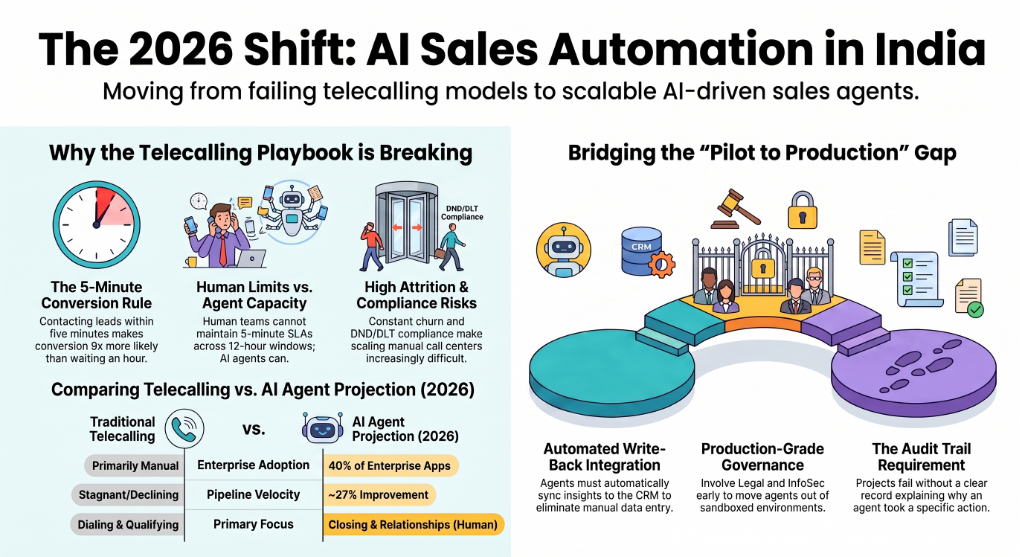
Customer acquisition cost is rising faster than deal size. Paid channels across Meta, Google and LinkedIn have compressed margins. More leads at higher cost only works if conversion improves — and conversion is a follow-up problem far more than a lead-volume problem.
Response-time economics have become brutal. The foundational Harvard Business Review research on lead response found that contacting an inbound lead within five minutes makes conversion roughly nine times more likely than waiting an hour or more. Human teams cannot hold a five-minute SLA across a 12-hour window. Agents can.
Agent adoption is moving from pilot to production. Gartner has projected that the share of enterprise applications featuring AI agents rises from under 5% in 2025 to roughly 40% by the end of 2026, and Forrester's B2B sales automation research points to pipeline velocity improvements averaging around 27% where AI handles lead prioritisation. These are directional industry figures, not guarantees — but the direction is consistent across sources.
Why the telecaller-only playbook broke
For two decades the answer to "we need more pipeline" in India was "hire more telecallers." That model is failing for reasons that have nothing to do with AI hype.
Attrition in outbound calling roles is punishing, and every exit costs recruitment, training and ramp time. Reps spend the majority of their day on dead numbers and unanswered rings. Language coverage requires a headcount matrix most companies cannot staff. And the compliance surface — DND scrubbing, DLT registration, calling-hour discipline — is difficult to enforce consistently across a large floor with high churn.
None of that means AI replaces salespeople. It means the dialling and qualifying layer is now a software problem, and the closing and relationship layer remains firmly human.
Why most Indian AI sales projects stall at pilot
This is the part vendors skip. Having watched a large number of these deployments, the failure pattern is consistent:
No write-back. The agent produces an insight, a summary, a score. A human still has to enter it somewhere. The work moved, it did not disappear.
No governance model. The agent can see everything. Legal, compliance and InfoSec correctly refuse to let it into production. The pilot lives in a sandbox forever.
No audit trail. The first time the agent does something unexpected, nobody can reconstruct why. Trust collapses and the project is quietly shelved.
Every successful deployment described later in this guide solved all three before scaling. That is not a coincidence — it is the actual differentiator between a demo and a production system.
The 12 AI sales automation use cases Indian enterprises actually deploy
Organised by funnel stage. Note how few of these are voice bots.
Top of funnel
1. Multilingual voice qualification. An agent calls or receives inbound calls, converses in Hindi, English or regional languages, handles interruptions, qualifies against your criteria, and hands warm leads to a human closer with a full transcript attached. Systems touched: telephony, CRM.
2. WhatsApp and email orchestration. Multi-channel sequences over the official WhatsApp Business API and authenticated email domains, with stop-on-reply logic across every channel simultaneously. Systems touched: Meta Business API, email infrastructure, CRM.
3. Inbound enquiry-to-quote automation. The agent reads an inbound enquiry email, classifies intent, extracts structured requirements, runs a conversational loop to fill gaps, checks live availability or inventory, proposes alternatives where the first option is unavailable, and generates the quote or proforma document. Systems touched: email, inventory or PMS, document generation.
4. Lead enrichment and routing. Automatic enrichment, deduplication, scoring, and territory- or vertical-based assignment — with CRM hygiene maintained continuously rather than in quarterly clean-up sprints. Systems touched: CRM, enrichment sources.
Mid funnel
5. Tender and RFP document automation. Agents ingest complex tender PDFs, extract requirements using vision-capable extraction, determine the applicable workflow, detect revisions between tender versions, and sync structured data into operational systems with full audit logging. For Indian B2B — where government and enterprise procurement runs on tender documents — this is one of the highest-leverage automations available.
6. Always-on account monitoring and next-best-action. The agent watches every account in the book continuously — usage signals, support tickets, order patterns, renewal dates, contract milestones — identifies opportunities and risks against governed rules, and orchestrates the follow-up. Systems touched: CRM, ERP, support desk, email.
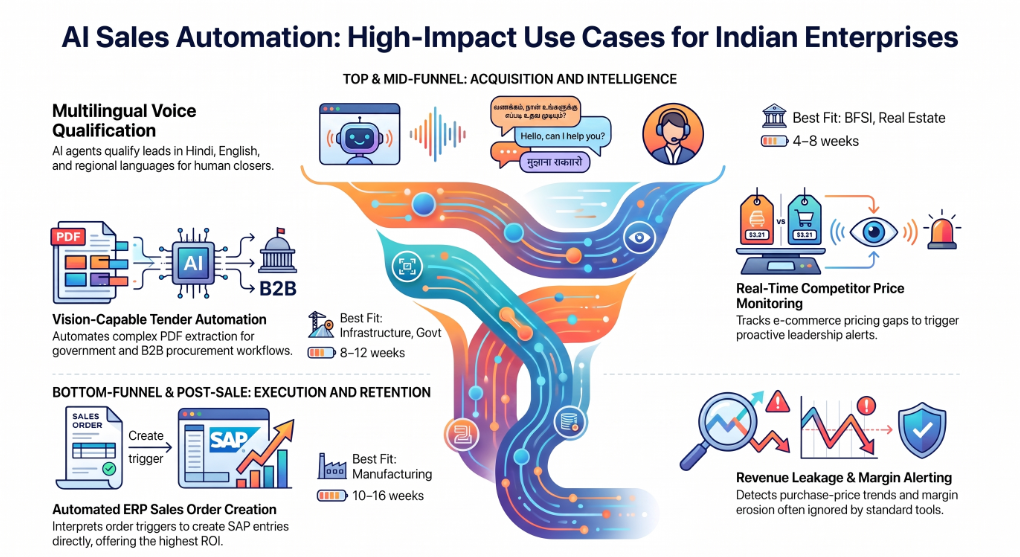
7. Competitor price and promotion monitoring. Continuous monitoring across e-commerce platforms and channel partners for pricing, MRP, discounting, offers, availability and ratings — converted into instant answers for leadership and proactive alerts when a gap opens. Critical in price-sensitive Indian categories where a competitor's Tuesday discount is your Thursday problem.
8. Conversational sales analytics. Natural-language querying over CRM, ERP and warehouse data through a governed semantic layer, so a regional head can ask "which SKUs lost margin in the West zone last quarter" without raising a BI ticket. Systems touched: Postgres, MSSQL, BigQuery, ClickHouse, Athena, DuckDB.
Bottom of funnel
9. RFQ and supplier-side quote automation. For marketplaces and distribution businesses: automated RFQ generation and distribution, supplier matching, response collection, and price/lead-time comparison surfaced for the commercial team.
10. Automated sales order creation in SAP or ERP. The agent interprets order triggers arriving as emails, EDI messages, PDFs or web forms, validates them against business rules, and creates the sales order directly in SAP — routing exceptions to a human approver and logging every action. This is the single most under-discussed use case in the Indian market and often the highest-ROI one.
Post-sale
11. Renewal and at-risk account detection. Agents flag renewals ahead of the window and surface early churn signals from usage, support and payment behaviour.
12. Revenue-leakage and margin-erosion alerting. Automated alerts on purchase-price trends, gross-margin impact, early-payment behaviour and vendor performance — the finance-adjacent layer of sales automation that most sales tools ignore entirely.

The Ask → Execute → Autonomous maturity ladder
Most AI sales automation projects fail because the organisation tries to jump straight to autonomy. This ladder — which we use with every enterprise engagement — sequences the delegation of authority.
Stage 1 — Ask. The agent answers. It reads across CRM, ERP and documents and responds to natural-language questions with governed, consistent numbers. No writes, no actions. Value comes from removing the BI queue and standardising definitions. Risk: minimal. Typical duration: 2–6 weeks.
Stage 2 — Execute. The agent acts, under supervision. It drafts the follow-up, prepares the quote, stages the CRM update, assembles the sales order — and a human approves before anything is committed. Maker-checker is enforced on every write. Value comes from removing manual execution while retaining full control. Risk: contained. Typical duration: 6–16 weeks.
Stage 3 — Autonomous. The agent acts within defined boundaries without per-action approval, on workflows that have demonstrated reliability. Exceptions still route to humans. Every action is logged immutably. Value comes from throughput and 24×7 coverage. Risk: managed through scope limits, not through hope.
Five questions to locate yourself on the ladder
- Can a sales leader get a consistent answer to a revenue question without a BI ticket? (If no, you are pre-Ask.)
- Does your agent write back into the system of record, or only produce text? (Text only = Ask.)
- Is there a named human approver for every write the agent performs? (If no approver exists, you have skipped Execute.)
- Can you reconstruct exactly why the agent took a specific action six months ago? (If no, you are not ready for Autonomous.)
- Have you defined what the agent must never do without a human? (If not, do this before anything else.)
The organisations that move fastest are the ones that spend real time at Execute rather than treating it as a formality.
AI sales automation compliance in India: DPDP, TRAI, RBI and IRDAI
This is the section most guides skip, and it is the one that determines whether your deployment survives contact with legal.

India does not have a single "AI sales" regulation. It has four overlapping layers, and clearing one does not clear the others.
Layer 1 — TRAI and the TCCCPR framework
The Telecom Commercial Communications Customer Preference Regulations govern all commercial voice and message traffic sent to Indian customers over telecom networks. The framework makes no distinction based on whether a human or an AI system places the call — the obligations are identical.
What this means operationally:
- Principal Entity and telemarketer registration on TRAI's DLT platform is mandatory for any business making commercial outbound calls
- Header and template registration for messaging traffic
- Dial-time DND scrubbing against the preference registry. Industry estimates put the share of active Indian mobile numbers carrying a DND preference at roughly 60–65% — calling a DND number with promotional content is a violation on every call
- Correct series origination — promotional and transactional traffic must originate from the designated numbering series
- Calling-hour discipline and correct classification of each motion as promotional, service-explicit or transactional
Two developments make this materially riskier in 2026 than it was five years ago. The February 2025 amendment to TCCCPR allows TRAI to act directly against violating Principal Entities without routing enforcement through access providers, compressing the time between complaint and consequence. And TRAI now operates AI/ML-based detection systems that proactively flag unregistered telemarketers — meaning a legitimate business exhibiting bulk-calling patterns can be flagged without anyone filing a complaint.
Layer 2 — The DPDP Act 2023
The Digital Personal Data Protection Act governs what you may do with personal data. Its requirements include informed consent, purpose limitation, and data erasure rights, with penalty exposure running up to ₹250 crore.
For AI sales automation specifically, this means:
- Purpose-bound consent — consent for one purpose does not extend to another
- Retrievable consent artefacts — you must be able to produce, per interaction, the record of what the individual consented to
- Real-time opt-out honoured across every channel — an opt-out on WhatsApp must stop the voice calls too
- Data residency considerations for call recordings and transcripts
- Erasure rights that must propagate through transcripts, CRM entries, analytics stores and model inputs
Layer 3 — Why TRAI consent is not DPDP consent
This is the single most common and most expensive misunderstanding in the market.
TRAI consent governs whether you may place a commercial call to a number. DPDP consent governs what you may do with the personal data that call produces — the recording, the transcript, the sentiment tag, the CRM entry, the analytics dashboard, the fine-tuning dataset.
A customer who has not registered a DND preference has not thereby consented to having their voice processed, stored, analysed and retained. Enterprises that are fully DLT-compliant on outbound frequently have no DPDP-defensible position on what happens to the conversation afterwards.
Layer 4 — Sectoral overlays
- RBI Fair Practices Code applies to lending-related outbound. Any agent involved in credit-related communication must offer a human escalation path, and RBI's digital lending rules apply to agents making or influencing credit decisions.
- IRDAI norms govern insurance solicitation, including disclosure obligations.
- SEBI norms apply to securities marketing communications.
- RERA constrains real estate claims: possession timelines, carpet area and amenities stated by an agent must match the project's RERA filing. An agent quoting a delivery date the filing does not support is a violation regardless of who wrote the script.
- AI disclosure. Identifying an automated call as automated is not yet uniformly mandated in India. It is uniformly advisable.
The compliance-by-architecture checklist
Compliance that lives in an SOP document fails at scale. These ten controls belong in the platform:
- Consent ledger with per-interaction, retrievable artefacts
- Immutable audit trail on every agent action, including reads
- Row-level security so agents access only the records the requesting user is entitled to
- Attribute-based access control for role, region and entity scoping
- Cross-channel opt-out propagation in real time
- Maker-checker approval on every write to a system of record
- Configurable recording retention with automated purge
- Human escalation path exposed in every conversational flow
- Data residency options aligned to sectoral requirements
- Purpose tagging on stored conversational data so downstream use can be constrained
This section is orientation for commercial and technology teams, not legal advice. Regulatory positions are evolving — DPDP Rules are being notified in tranches and TRAI's DLT framework continues to develop. Confirm current requirements with qualified counsel for your sector before deployment.
What governed AI sales automation actually requires
Beyond compliance, seven architectural capabilities separate systems that reach production from systems that stay in pilot.
A semantic layer. "Active account," "pipeline," "revenue" and "closed" must mean exactly one thing across CRM, ERP and the warehouse. Without a governed semantic layer, two agents produce two numbers and trust evaporates in week three.
Row-level security and ABAC. A zonal manager's agent must see only that zone. This cannot be a prompt instruction — it has to be enforced at the data layer.
Maker-checker on writes. Every action that changes a record in a system of record passes through a defined approver until that path has earned autonomy.
An immutable audit trail. Every action, every input, every decision, reconstructable months later. This is what makes the difference between a system compliance approves and one it blocks.
BYOK and model-agnostic routing. Bring your own keys, and route different workloads to different models based on cost, latency and sensitivity — without re-architecting when the model landscape shifts.
Bidirectional integration, not read-only dashboards. If the agent cannot write back into Salesforce, SAP or your warehouse, you have built a reporting tool.
Multi-agent orchestration with open protocols. Real sales workflows span systems. Support for MCP and A2A means agents coordinate across tools rather than being trapped in one vendor's boundary.
What AI sales automation costs in India
The four pricing models
Per-seat. A fixed monthly fee per user, covering human licences and agent seats. Predictable for budgeting, but costs compound as the team or campaign volume grows.
Consumption. Per voice minute, per message, per API call, per token. Aligns cost to usage, but requires disciplined forecasting.
Per-outcome. Payment per booked meeting or qualified lead. Still relatively uncommon — Forrester's research indicates fewer than 12% of vendors in this category offer pure outcome-based pricing. The practical risk is that "qualified" is defined by the vendor.
Hybrid — platform fee plus consumption. An annual platform fee covering governance, integration and support, with usage-based charges above a threshold. G2's 2026 market research indicates hybrid pricing is now the dominant model among enterprise platforms in this category, used by over 55% of vendors.
For Indian enterprises, hybrid is usually the right structure: the platform fee covers the parts that create durable value (semantic layer, governance, integration), and consumption scales with actual volume.
The real cost stack
Platform licensing is rarely more than half of total cost. Budget for:
- Platform fee — annual, covering governance and integration infrastructure
- Consumption — voice minutes, WhatsApp template charges, model inference
- Telephony and channel costs — DLT registration, numbering series, Meta template approvals
- Integration effort — connecting CRM, ERP and warehouse; usually the largest one-time line
- Change management — the line item that gets cut and then causes the failure
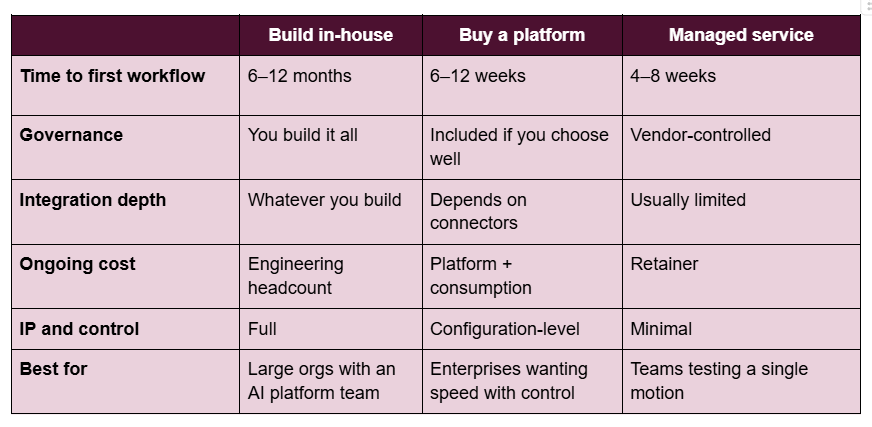
Build vs. buy vs. managed
Modelling ROI honestly
The arithmetic is simple. The assumptions are where it goes wrong:
Annual value = (hours saved per week × loaded hourly cost × 52)
+ (incremental conversion % × pipeline value × win rate)
+ (error/leakage reduction, annualised)
Annual cost = platform + consumption + channel costs
+ amortised integration + change management
The two assumptions that break most business cases: conversion lift is assumed rather than measured (baseline it before you deploy), and the hours saved never actually leave the cost base because nobody redeploys the freed capacity. Decide upfront whether you are buying cost reduction or capacity redeployment. They are different projects.
Proof: what AI sales automation looks like in production
This is where most content in this category stops being useful. Competing guides in this space illustrate their claims with hypothetical scenarios — some explicitly labelled as such.

Below are eight live deployments. Client names are withheld under confidentiality; each is described by sector, geography and scale. Results are stated directionally as recorded, not as benchmarks you should expect to replicate.
1. Gulf engineering and technology group — agentic sales agent across enterprise accounts
A flagship UAE engineering and technology solutions provider established in 1972, delivering integrated electrical, mechanical, automation and mobility solutions across enterprise and infrastructure clients.
Deployed: Always-on account monitoring with signal capture; rule-governed opportunity identification and follow-up orchestration; CRM-integration-ready workflows with pipeline hygiene maintained automatically; sales dashboards and leadership alerting.
Outcome: Higher account coverage without increasing headcount, faster response cycles on opportunities and renewals, and more consistent execution through governed sales playbooks.
Why it matters for Indian enterprises: This is the mid-funnel motion almost nobody automates. Large books of business go under-covered not because reps are lazy but because monitoring 400 accounts continuously is not a human-scale task.
2. Diversified group operating 30+ companies — automated SAP sales order creation
One of the region's most prominent family business groups, operating across retail, building, industrial and services portfolios.
Deployed: Agentic automation that interprets order triggers, validates them against business rules, and creates sales orders directly in SAP; governance rules for exceptions and approvals; audit logs and reconciliation reporting. Delivered as part of a transition away from a legacy document management system that had reached end-of-life with unsustainable licensing costs.
Outcome: Reduced manual order processing and legacy system dependency, a faster order-to-confirm cycle with fewer data-entry errors, and improved auditability on sales order creation and exception handling.
Why it matters: Bottom-of-funnel automation with a direct, measurable line to working capital. Every day cut from order-to-confirm is a day earlier on cash collection.
3. Pan-India value retailer, 700+ stores — store support and inventory intelligence agents
A rapidly scaling value retail business in India with a pan-India footprint across hundreds of cities, serving mass-market consumers across apparel, general merchandise and FMCG.
Deployed: A voice support agent operating in Hindi and English; an inventory intelligence agent surfacing pricing, stock and promotion data per store; a knowledge and training agent running retrieval over POS documentation and SOPs; plus admin console, analytics and ticketing integration built for high volume.
Outcome: Reduced manual helpdesk burden and faster store issue resolution, improved store-level inventory visibility, and faster staff onboarding through on-demand training guidance.
Why it matters: Demonstrates bilingual voice at genuine Indian retail scale — hundreds of stores, high query volume, mixed-language users.
4. Indian HVAC&R manufacturer — competitive and channel price monitoring
A major Indian HVAC&R player founded in 1943, competing in highly price-sensitive consumer and commercial cooling markets where competitor visibility and pricing moves matter daily.
Deployed: Continuous e-commerce and channel monitoring covering pricing, MRP and discounting, offers, availability and ratings; agentic Q&A mapped directly to the questions leadership actually asks; analytics views for pricing gaps, competitive threats and portfolio movement; architecture designed to scale from proof-of-concept to production with governance and audit trails intact.
Outcome: Faster competitive response cycles, earlier identification of pricing gaps and promotion shifts, and always-on monitoring replacing manual checks across marketplace portals.
Why it matters: In Indian consumer durables, competitive price movement is a daily sales input. This is sales automation that never touches a prospect and still directly protects revenue.
5. Indian retail holding group — insights-to-action agent layer
A privately-held retail holding environment where leadership needed governed, cross-functional intelligence across systems and documents.
Deployed: A unified Context Engine spanning structured and unstructured data; a semantic governance layer holding rules, hierarchies and formulas; an active orchestrator integrating with core systems; and insights-to-action agents layered on top of existing dashboards.
Outcome: A shift from reactive reporting to proactive execution loops, standardised decision logic across teams, and automated task creation with completion tracking.
Why it matters: The clearest illustration of the Ask → Execute transition. The dashboards already existed. What was missing was the layer that turned an insight into an owned, tracked action.
6. North American automotive leasing provider — portfolio and dealer network intelligence
An independent automotive leasing provider offering manufacturer and dealer network programs with digital, end-to-end leasing processes.
Deployed: Portfolio KPIs covering risk, delinquency, maturity and residuals; dealer network performance analytics; automated alerting for exceptions and early risk signals.
Outcome: Better portfolio visibility and faster risk identification, improved decision support for program operations, and more proactive management through exception alerting.
Why it matters for India: Directly transferable to Indian NBFC, auto and consumer durable financing businesses running large dealer and channel networks — where partner performance visibility is usually a monthly report rather than a live signal.
7. Middle East real estate portfolio owner — omnichannel customer service agent
A major real estate portfolio owner and manager with diversified office, retail, industrial and residential assets across multiple emirates.
Deployed: An omnichannel service agent across web, WhatsApp and email; tenant query triage with FAQ, rental and payment support workflows; ticketing with escalation to human teams; a knowledge base built over policies, tenancy documents and SOPs.
Outcome: Faster response times and lower call-centre load, a consistent 24×7 tenant experience, and better SLA adherence through automated routing and tracking.
Why it matters: Indian real estate carries near-identical operating conditions — high query volume, WhatsApp-first customers, document-heavy answers — with the added RERA disclosure constraints noted earlier.
8. Global fintech serving banks and credit unions — omnichannel agents with audit trails
A fintech provider delivering cloud-based automation and pragmatic AI for banks and credit unions, focused on disputes, fraud, compliance and operational efficiency.
Deployed: Omnichannel intake across chat, email and phone with workflow routing; agent-assist summarisation and next-best-action; auditability, reporting and SLA monitoring; integration-ready architecture for core systems.
Outcome: Faster case handling with improved consistency, reduced operational load through automation, and better compliance readiness via audit trails.
Why it matters: A regulated-sector deployment where the audit trail was a precondition, not a feature request — the same posture Indian BFSI deployments require under RBI oversight.
One more: tender-to-quote automation
Worth calling out separately because of how directly it maps to Indian B2B. A commercial construction and remediation specialist deployed an intelligent document workbench using multi-agent orchestration: tender retrieval, workflow determination, revision analysis between document versions, vision-LLM extraction from complex PDFs, and deep operational system integration with full CRUD, quote locking and audit logs. The system was engineered for up to approximately 90% faster tender document processing, with an extraction accuracy target of around 95% on standard formats, and reduced bid risk through revision detection and auditability.
For any Indian business selling into government or large-enterprise procurement, this is the highest-leverage automation on this list.
What these deployments have in common
Every one of them writes back into a system of record. Every one has a defined human checkpoint. Every one is audited end to end. None of them started with the whole sales cycle — each started with one workflow.
How to choose an AI sales automation partner in India
Skip the feature grid. Score vendors across five categories.

India compliance readiness (25%)
- Does the platform support DLT/Principal Entity registration workflows and dial-time DND scrubbing?
- Is there a consent ledger with per-interaction retrievable artefacts?
- Does opt-out propagate across every channel in real time?
- Are data residency and recording retention configurable?
Integration depth (25%) 5. Bidirectional write-back into your CRM and your ERP — not read-only? 6. Native connectivity to your warehouse (Postgres, MSSQL, BigQuery, ClickHouse, Athena, DuckDB)? 7. Open protocol support (MCP, A2A) so agents coordinate across systems?
Governance controls (25%) 8. Row-level security and attribute-based access control enforced at the data layer? 9. Maker-checker approval configurable per workflow? 10. Immutable audit trail covering reads as well as writes?
Language and channel coverage (15%) 11. Hindi, English and the specific regional languages your market requires — with interruption handling and code-switching?
Deployment model and time-to-value (10%) 12. Can they name a single workflow they will put into production in under 12 weeks?
Ten questions for your RFP
- Show me the audit log for a single agent action, end to end.
- How does the agent enforce that a zonal user's query returns only zonal data?
- What happens when the agent encounters an order it cannot validate?
- Where are call recordings stored, and what is the retention control?
- How do you handle a DPDP erasure request that touches transcripts, CRM and analytics?
- Which model providers do you support, and can we bring our own keys?
- Show me a write-back into SAP or Salesforce in a live environment.
- What is your approach when a customer opts out on WhatsApp but not on voice?
- Name a deployment in our sector and describe what did not work.
- What does month 13 cost, after the implementation fee?
For a wider view of the vendor landscape, see our breakdown of enterprise AI agent companies.
Why Assistents.ai by Ampcome
Assistents.ai is a governed enterprise agentic AI platform built by Ampcome. We are not the cheapest per-minute voice bot in the Indian market, and we do not compete for that position.
Built for the whole sales cycle, not just the first call
Most platforms in this category stop where the conversation ends. Our deployments run from inbound enquiry intake through quote generation, tender extraction, account monitoring and next-best-action, all the way to sales order creation inside SAP. The eight deployments described above are the same platform applied at different points in the revenue cycle.
Governance is the product, not a settings page
Everything Indian enterprise compliance teams ask for is architectural, not bolted on: a semantic layer so every agent and every dashboard uses one definition of revenue; the Context Engine unifying structured and unstructured data; row-level security and ABAC enforced at the data layer; maker-checker and human-in-the-loop approvals on every write; an immutable audit trail across all agent actions; BYOK; and model-agnostic routing so you are never locked to one provider's pricing or roadmap.
Integration depth, not integration promises
Bidirectional connectivity into Salesforce, HubSpot, Dynamics and SAP. Native warehouse connectors for Postgres, MSSQL, BigQuery, ClickHouse, Athena and DuckDB. Text-to-SQL over a governed semantic layer. Multi-agent orchestration with MCP and A2A protocol support so agents coordinate across systems rather than living inside one tool.
Proof across sectors, not slideware
Live deployments across value retail at 700+ store scale, HVAC&R manufacturing, ports and logistics, banking and fintech, real estate, automotive leasing, utilities, pharma sourcing and healthcare — spanning India, the Gulf, the UK, Europe, North America and Australia. When we describe a use case in this guide, we have shipped it.
Ampcome as the delivery partner
Ampcome builds these systems workflow-first rather than product-first. We start with the tender documents you actually process, the orders you actually key in, the competitor prices you actually check manually — and automate those, with the governance your compliance function requires. That is why the deployments above reached production rather than staying in pilot.
Next step: Explore AI agents for sales and revenue operations, or bring us one workflow and we will scope it.
A 90-day rollout plan for Indian enterprises

The single most common mistake is starting with three workflows at once. Start with one. The second is faster because the semantic layer and integration work is already done.
Ready to see what this looks like on your workflows? Explore AI agents for sales and revenue operations from Assistents.ai by Ampcome — or bring us one sales workflow and we will scope a governed deployment against it.
FAQs
What is AI sales automation?
AI sales automation is the use of AI agents to execute multi-step sales work — qualifying leads, updating CRM records, monitoring accounts, generating quotes and creating orders in ERP — with human approval at defined checkpoints. Unlike a CRM, which stores data, or a sequencing tool, which fires pre-set steps, an AI agent interprets situations and acts on them.
Which is the best AI sales automation tool in India?
It depends on which part of the funnel you are automating. For top-of-funnel voice and WhatsApp outreach, several India-focused vendors compete on per-minute cost. For governed, full-cycle automation that writes into CRM and ERP with audit trails, Assistents.ai by Ampcome is built specifically for that requirement. Evaluate against the twelve criteria in this guide rather than a feature list.
Is AI cold calling legal in India?
Yes, provided you comply with TRAI's TCCCPR framework. The regulations apply identically to AI systems and human agents. You need Principal Entity and telemarketer registration on the DLT platform, registered headers and templates, dial-time DND scrubbing, correct series origination and calling-hour compliance. Separately, the DPDP Act governs what you may do with the data those calls generate.
How much does AI sales automation cost in India?
Pricing follows four models: per-seat, consumption-based, per-outcome, and hybrid platform fee plus consumption — with hybrid now dominant among enterprise vendors. Total cost includes platform licensing, consumption charges, telephony and WhatsApp template costs, integration effort and change management. Integration is usually the largest one-time line item.
Will AI replace sales reps in India?
No. AI handles the repetitive layer — dialling, qualifying, data entry, monitoring, document extraction, order keying. Negotiation, relationship building, complex objection handling and strategic account work remain human. The practical effect is that reps spend more time in conversations that matter and less time on administrative work.
What's the difference between an AI SDR and a CRM?
A CRM stores records and reports on them. An AI SDR performs the work: it identifies prospects, engages them, interprets replies, qualifies opportunities and hands off to humans. The CRM is the system of record; the AI SDR is the system of action that writes into it.
Can AI sales agents speak Hindi and regional languages?
Yes. Modern voice agents handle Hindi, English and major regional languages, including code-switching mid-conversation and interruption handling. Quality varies significantly by language and by vendor — test with your actual customer accents and vocabulary, not a demo script.
Is WhatsApp sales automation safe for Indian businesses?
It is safe when you use the official Meta WhatsApp Business API with approved templates and honour opt-outs. Unauthorised bulk-messaging tools frequently result in permanent number bans. WhatsApp outreach also falls under DPDP consent obligations independently of Meta's own policies.
What does DPDP compliance mean for AI sales calls?
It means purpose-bound consent for the personal data the call generates, retrievable consent artefacts per interaction, opt-outs honoured in real time across all channels, defensible retention and residency for recordings, and the ability to execute an erasure request across transcripts, CRM entries and analytics stores. TRAI compliance does not satisfy DPDP.
How do I integrate AI sales agents with Salesforce or SAP?
Through bidirectional connectors that both read and write. Ask any vendor to demonstrate a live write-back — creating a sales order in SAP or updating an opportunity in Salesforce — rather than accepting a listed integration. Read-only integrations produce insights that a human still has to enter somewhere.
How long does it take to deploy an AI sales agent?
A single well-scoped workflow typically reaches production in 6–12 weeks, with compliance and data readiness accounting for the first two to three. Deployments that attempt three workflows simultaneously routinely take three times as long as the sum of doing them sequentially.
Can AI sales automation work for tender-based B2B sales in India?
Yes, and it is one of the strongest fits. Agents can ingest complex tender PDFs, extract requirements using vision-capable models, detect revisions between document versions, and sync structured data into operational systems with audit logging. Given how much Indian B2B and government procurement runs on tender documents, this is often the highest-return automation available.

Transform Your Business With Agentic Automation
Agentic automation is the rising star posied to overtake RPA and bring about a new wave of intelligent automation. Explore the core concepts of agentic automation, how it works, real-life examples and strategies for a successful implementation in this ebook.
Sarfraz Nawaz is the CEO and founder of Ampcome, which is at the forefront of Artificial Intelligence (AI) Development. Nawaz's passion for technology is matched by his commitment to creating solutions that drive real-world results. Under his leadership, Ampcome's team of talented engineers and developers craft innovative IT solutions that empower businesses to thrive in the ever-evolving technological landscape.Ampcome's success is a testament to Nawaz's dedication to excellence and his unwavering belief in the transformative power of technology.

More insights
Discover the latest trends, best practices, and expert opinions that can reshape your perspective






Contact us

