
The Best AI Agents for Research (2026): Ranked by Real-World Enterprise Performance


The way enterprises do research is broken. Analysts spend 60–70% of their time collecting and formatting information — not interpreting it. Teams duplicate work across departments. Critical signals from competitors, markets, and suppliers get missed because no single person can monitor everything at once.
AI agents are fixing this. Not AI assistants that answer questions — AI agents that autonomously ingest sources, synthesise findings, trigger workflows, and deliver governed, auditable answers across your entire organisation.
Gartner projects that 40% of enterprise applications will embed AI agents by the end of 2026. The enterprise agentic AI market is on track to reach $47.8 billion by 2030, growing at a 61.5% CAGR. The organisations moving now — deploying agents for research, competitive monitoring, procurement intelligence, and market analysis — are the ones that will compound that advantage over the next three years.
But not all AI agents are built for research. Some are glorified chatbots. Some work only for one department. And some lack the governance and auditability that enterprise research workflows require.
This guide cuts through the noise. We evaluated AI agent platforms against real enterprise deployments across 12 industries, with proven outcomes — so you can make a confident decision for your organisation.
What Makes an AI Agent "Best" for Research? Our Evaluation Criteria
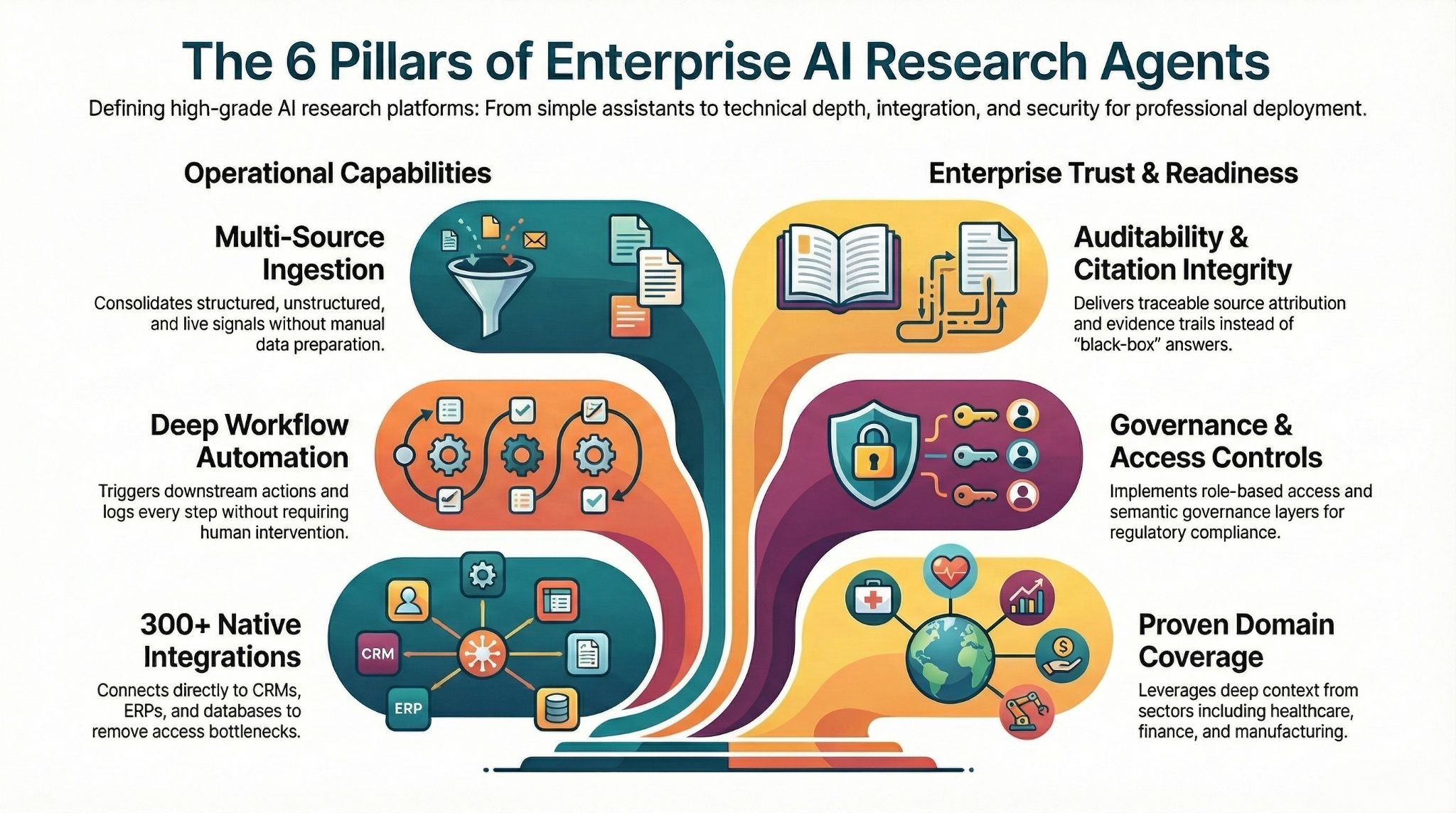
Before comparing platforms, it is worth establishing what "best" actually means in an enterprise research context. There are six criteria that separate genuine research-grade AI agents from everything else.
Multi-Source Ingestion
A research agent is only as good as the sources it can access. The best platforms ingest structured data (databases, APIs, CSV exports), unstructured data (PDFs, contracts, reports, emails), and live web signals simultaneously — not one at a time. Look for platforms that handle multi-entity data consolidation without manual preparation.
Workflow Automation Depth
Answering a question is not the same as completing a research workflow. True agentic research platforms do not just retrieve — they classify intent, extract structured outputs, trigger downstream actions, route to the right team, and log every step. If a platform requires human intervention at every stage, it is an assistant, not an agent.
Auditability and Citation Integrity
Enterprise research has consequences. Procurement decisions, investment theses, regulatory filings, and competitive strategies all depend on traceable, citable conclusions. The best AI research agents produce outputs with source attribution, evidence trails, and reconciliation logs — not black-box answers.
Industry and Domain Coverage
A general-purpose research agent will give you general-purpose results. Platforms that have been deployed across healthcare, logistics, financial services, retail, energy, real estate, and manufacturing bring domain-specific context that meaningfully improves research quality. Breadth of proven deployment is a proxy for depth of capability.
Integration Ecosystem
Research does not happen in isolation. An AI agent for research needs to connect to your CRM, ERP, data warehouse, supplier portals, communication tools, and industry databases. Platforms with 300+ native integrations remove the data-access bottlenecks that make research slow in the first place.
Governance and Access Controls
Especially in regulated industries, research agents must operate within defined guardrails. Role-based access, semantic governance layers, audit trails, and exception workflows are not optional features — they are prerequisites for enterprise deployment.
7 Types of Research AI Agents Can Automate — With Real Industry Examples
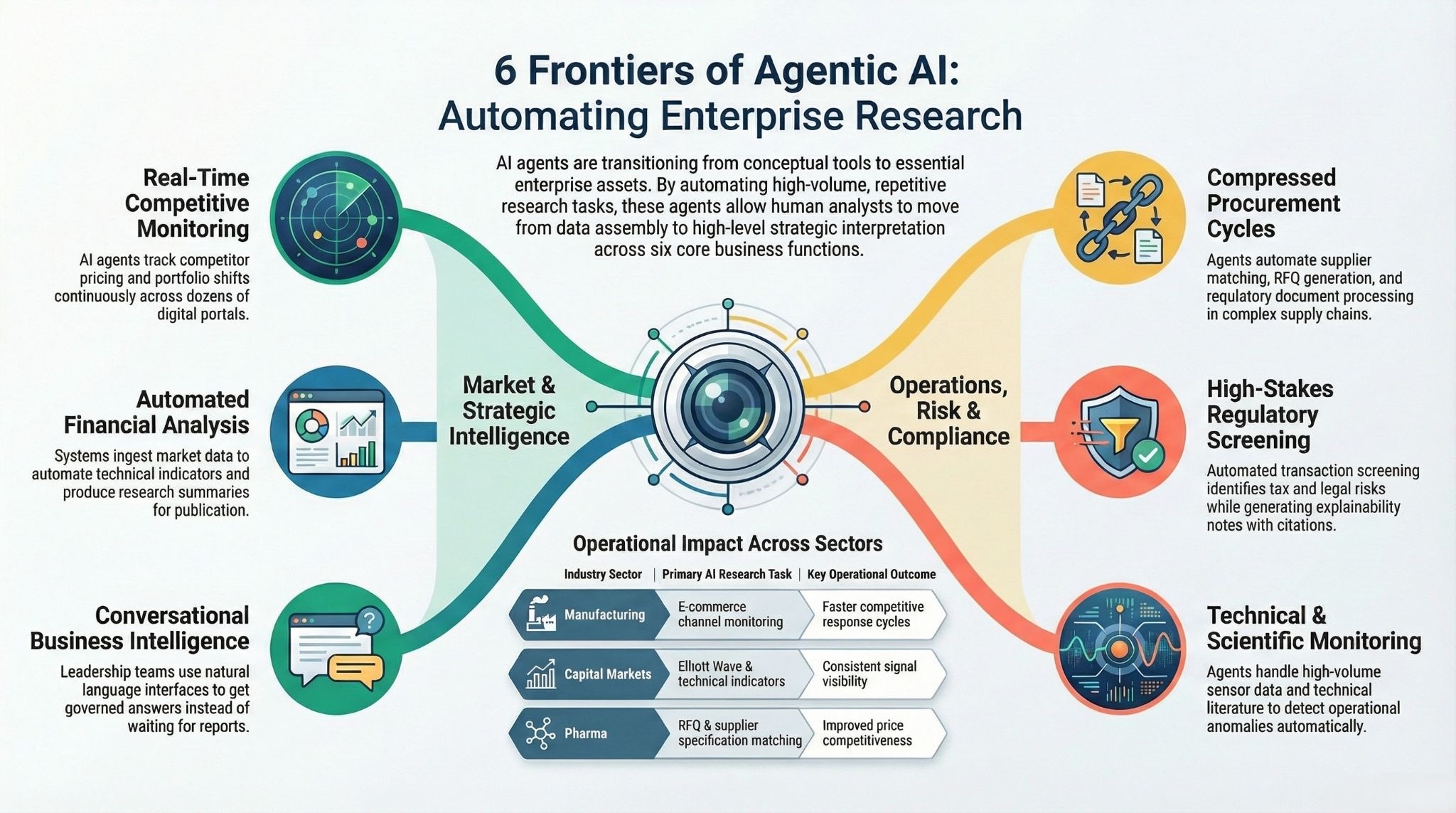
This is where the theory becomes real. Across deployments spanning global logistics companies, financial institutions, energy utilities, pharma procurement teams, and more, AI agents are automating research workflows that previously required teams of analysts. Here are seven categories with evidence from live enterprise deployments.
1. Competitive Intelligence and Market Monitoring
One of the highest-value research use cases for AI agents is continuous competitive monitoring — tracking competitor pricing, product moves, promotional activity, and availability across channels in real time.
In a manufacturing and industrial deployment, an AI agent was configured to monitor e-commerce channels continuously, flagging pricing gaps, discount moves, and portfolio shifts as they happened. The system delivered agentic Q&A mapped directly to leadership questions — so instead of a weekly analyst report, executives received always-on answers with evidence. The outcome: faster competitive response cycles, earlier identification of pricing anomalies, and elimination of manual monitoring across dozens of portals.
What to look for in your platform: Continuous source monitoring, signal classification, alert routing, and agentic Q&A that maps findings to specific decision-maker questions rather than dumping raw data.
2. Financial and Market Research Automation
Financial research is data-intensive, time-pressured, and highly repetitive in structure — which makes it an ideal target for agentic automation. AI agents can ingest market data, run indicator pipelines, generate insight summaries, and produce thematic dashboards without analyst intervention.
In a capital markets deployment, an AI agent was built to ingest market data streams, automate Elliott Wave and technical indicator analysis, and produce research summaries and dashboards for publication. The result: faster production of research packs, more consistent workflows, and better signal visibility — allowing the research team to focus on interpretation rather than data assembly.
In a separate fintech deployment serving banks and credit unions, AI agents automated dispute research, fraud investigation workflows, and compliance documentation — reducing case-handling time while improving audit trail quality.
What to look for: Data ingestion pipelines, automated indicator calculation, insight generation with citations, and scheduled reporting with variance explanations.
3. Procurement and Supplier Research
Sourcing teams spend enormous time on supplier discovery, RFQ management, price benchmarking, and vendor performance tracking. AI agents can compress this research cycle significantly.
In a pharmaceutical supply chain deployment, an AI agent was built to automate RFQ generation, match suppliers against specification and regulatory criteria, handle quality document processing, and deliver analytics on price, lead time, and vendor performance. The outcome was a measurably faster procurement cycle, reduced manual coordination, and improved price competitiveness — without adding headcount.
In a global logistics and port operations deployment, AI agents were used to digitise terminal and rail management workflows — providing always-on operational dashboards and exception management that previously required continuous manual monitoring.
What to look for: Supplier matching logic, document processing for specs and quality records, price benchmarking analytics, and integration with procurement systems.
4. Scientific and Technical Literature Research
At the far end of the complexity spectrum, AI agents are being deployed to support research institutions where the volume and density of technical data exceeds what any team can manually process.
In a research institution deployment focused on energy infrastructure, AI agents were configured to monitor utility and sensor data, detect anomalies, generate forecasting outputs, and produce proactive alerts — effectively automating the data-monitoring layer so researchers could focus on analysis. The platform handled continuous ingestion from distributed sources, reducing manual monitoring effort and improving detection speed for operational anomalies.
What to look for: High-volume data ingestion, anomaly detection, domain-specific summarisation, and research workflow automation that preserves the human judgment layer for interpretation.
5. Sales and Account Intelligence Research
B2B sales teams do a form of research every day — account monitoring, opportunity identification, renewal risk assessment, and pipeline hygiene. AI agents can run this continuously across entire account portfolios.
In an enterprise sales deployment, an AI agent provided always-on account monitoring, governed opportunity identification, and automated follow-up orchestration. The system integrated with the existing CRM, maintained pipeline hygiene, and delivered leadership dashboards and alerts. The result: higher account coverage without increasing headcount, faster response cycles on opportunities and renewals, and more consistent execution through governed playbooks.
What to look for: CRM integration, signal-based account monitoring, opportunity scoring, and rule-governed workflow routing that enforces consistent research-to-action processes.
6. Tax, Legal, and Regulatory Research
Pre-screening transactions, contracts, and cross-border structures for regulatory risk is research-intensive, high-stakes, and largely repeatable — exactly the conditions under which AI agents add the most value.
In a cross-border tax technology deployment, an AI agent was built to screen transactions for withholding tax exposure, VAT mismatches, and permanent establishment risks. The system automated source collection, generated explainability notes for each classification, and routed flagged items to specialist review. Earlier detection of risk meant fewer last-minute deal disruptions and faster, more consistent pre-compliance workflows.
In a separate deployment for a sales and use tax research tool, AI agents automated source retrieval, summarised findings, generated draft memos with citations, and maintained a knowledge base of research outputs over time — dramatically reducing manual source-hunting and producing more consistent research documentation.
What to look for: Source retrieval automation, classification with evidence, citation generation, escalation workflow routing, and knowledge base accumulation across research cycles.
7. Operational and Strategic Business Intelligence Research
Beyond specialist use cases, AI agents are transforming how leadership teams access strategic intelligence — replacing static dashboards and analyst queues with governed, natural language research interfaces.
In a retail deployment spanning hundreds of locations nationally, an AI agent provided a conversational analytics layer over sales, product, inventory, and promotional data. Executives could ask business questions in natural language and receive governed answers with consistent metric definitions — rather than waiting for analyst reports. The system ran continuous KPI monitoring and exception alerts, shifting the organisation from reactive reporting to proactive decision loops.
In a smart infrastructure deployment cited as touching over 150 million urban lives, AI agents provided agentic analytics across city-scale operational systems — converting dashboard data into governed actions and automated task routing.
What to look for: NLQ (natural language query) interface, semantic governance layer for consistent metric definitions, agentic analytics that trigger actions not just answers, and role-based access controls.
The Best AI Agents for Research: Platform Comparison (2026)
The enterprise AI agent market has several established players. Here is an honest comparison across the criteria that matter for research workflows.
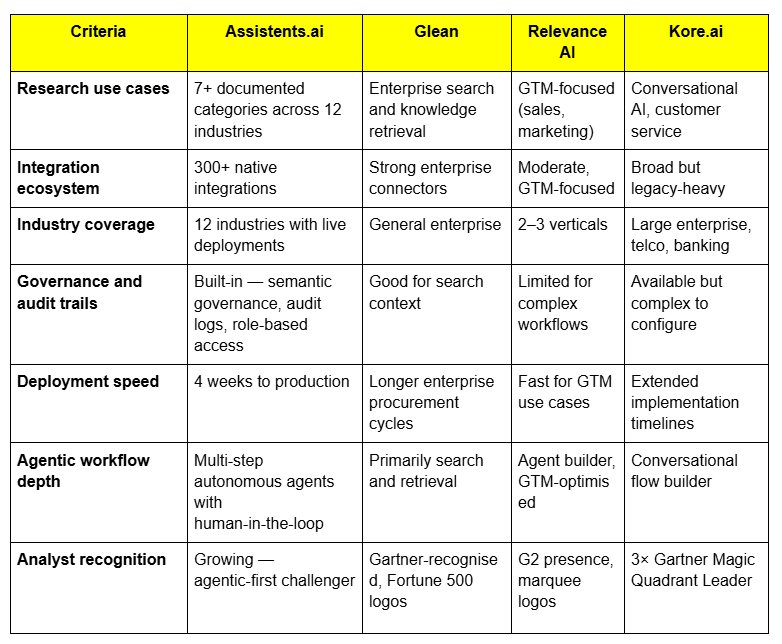
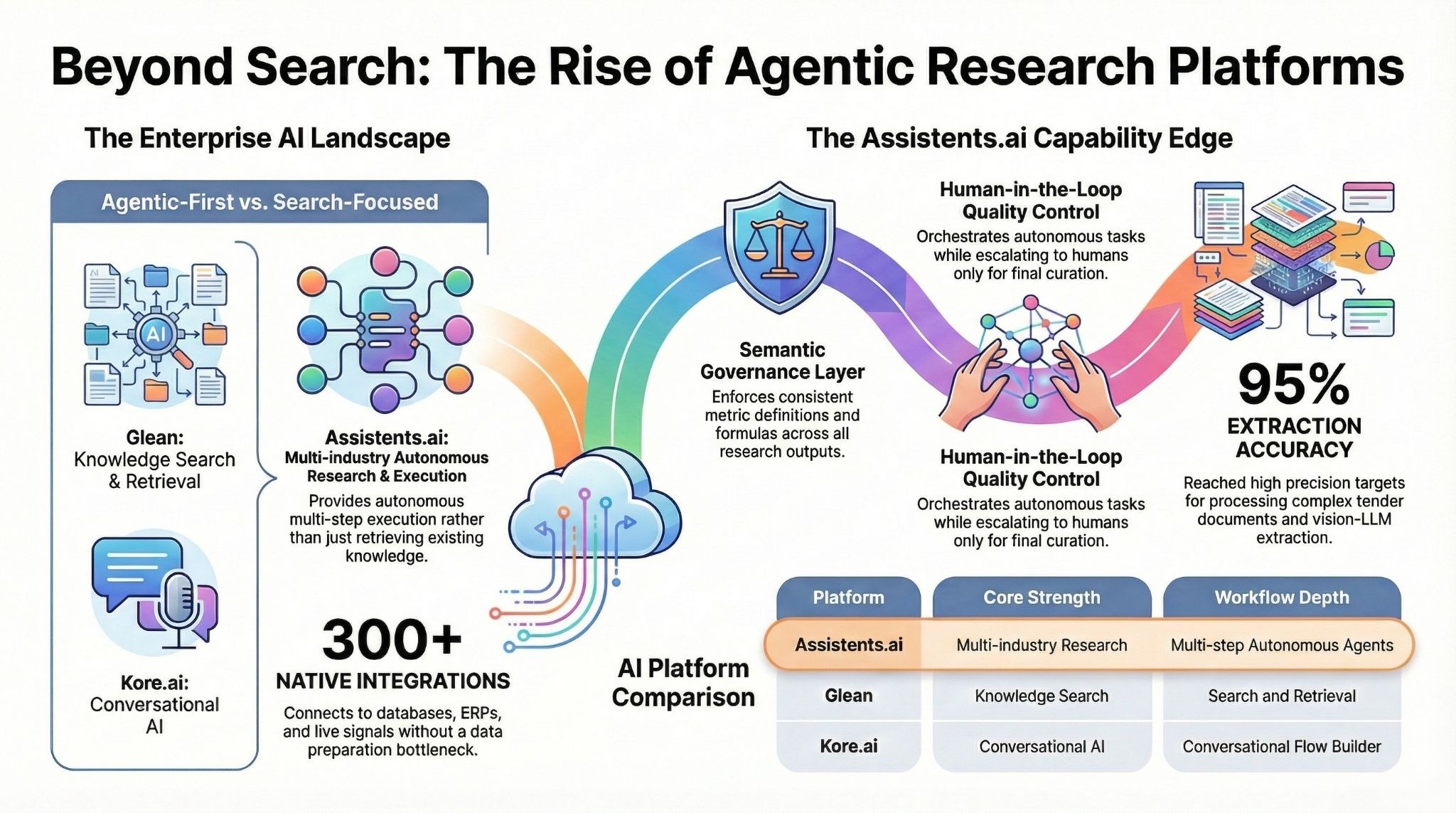
The honest read: Glean is the dominant player for enterprise knowledge search. Kore.ai owns conversational AI in large regulated enterprises. Relevance AI is the go-to for GTM teams. Assistents.ai is differentiated on breadth — 12 industries, 300+ integrations, and agentic workflow depth that goes beyond retrieval into autonomous research execution with governance. If your use case is multi-industry, multi-department, or requires research workflows that trigger downstream actions, Assistents.ai is designed for that problem.
How Assistents.ai Powers Enterprise Research Workflows
Assistents.ai is an enterprise agentic AI platform purpose-built for organisations that need research agents to do more than retrieve — they need agents that ingest, synthesise, govern, and act.
Multi-Source Ingestion at Enterprise Scale
Every research workflow starts with data access. Assistents.ai connects to structured data sources (databases, ERP systems, financial exports), unstructured documents (PDFs, contracts, tender documents, SOPs), and live signals (web monitoring, API feeds, operational systems) through 300+ native integrations. There is no data preparation bottleneck — the platform meets your data where it lives.
In one deployment, the platform was used to ingest complex tender documents across multiple formats, extract structured data using vision-LLM processing, detect revision changes, and synchronise outputs into operational systems — with full audit logs and data integrity validation. Extraction accuracy targets reached 95% for standard document formats.
Agentic Workflows with Human-in-the-Loop Quality Control
The difference between a research assistant and a research agent is execution depth. Assistents.ai orchestrates multi-step research workflows autonomously — classifying intent, routing tasks, triggering downstream actions, and escalating to human review only when genuinely needed.
In a luxury travel context, the platform managed end-to-end booking research workflows — ingesting requests, checking inventory, negotiating alternatives, and generating documentation — with human oversight at the curation stage. The result was faster turnaround and higher accuracy on complex requirements, at scale.
Semantic Governance for Consistent, Auditable Research
One of the most underrated problems in enterprise research is inconsistency — different teams using different metric definitions, different sources, different calculation logic. Assistents.ai addresses this with a semantic governance layer that enforces consistent definitions, hierarchies, and formulas across every research output.
In a group-wide enterprise deployment, the platform unified context across structured and unstructured data sources, applied a semantic governance layer, and activated an insights-to-action orchestrator layered on top of existing dashboards. The shift was from reactive reporting to proactive execution loops — a fundamentally different relationship between research and decision-making.
Natural Language Research Interface for Non-Technical Users
The best research platform is the one people actually use. Assistents.ai includes an NLQ (natural language query) interface that gives non-technical decision-makers direct access to governed research answers — without dependency on analysts, BI teams, or SQL queries.
Across multiple enterprise deployments, this has resulted in shorter analysis cycles, better visibility into operational and commercial performance, and scalable insight access across teams — without adding headcount.
How to Choose the Right AI Research Agent for Your Industry
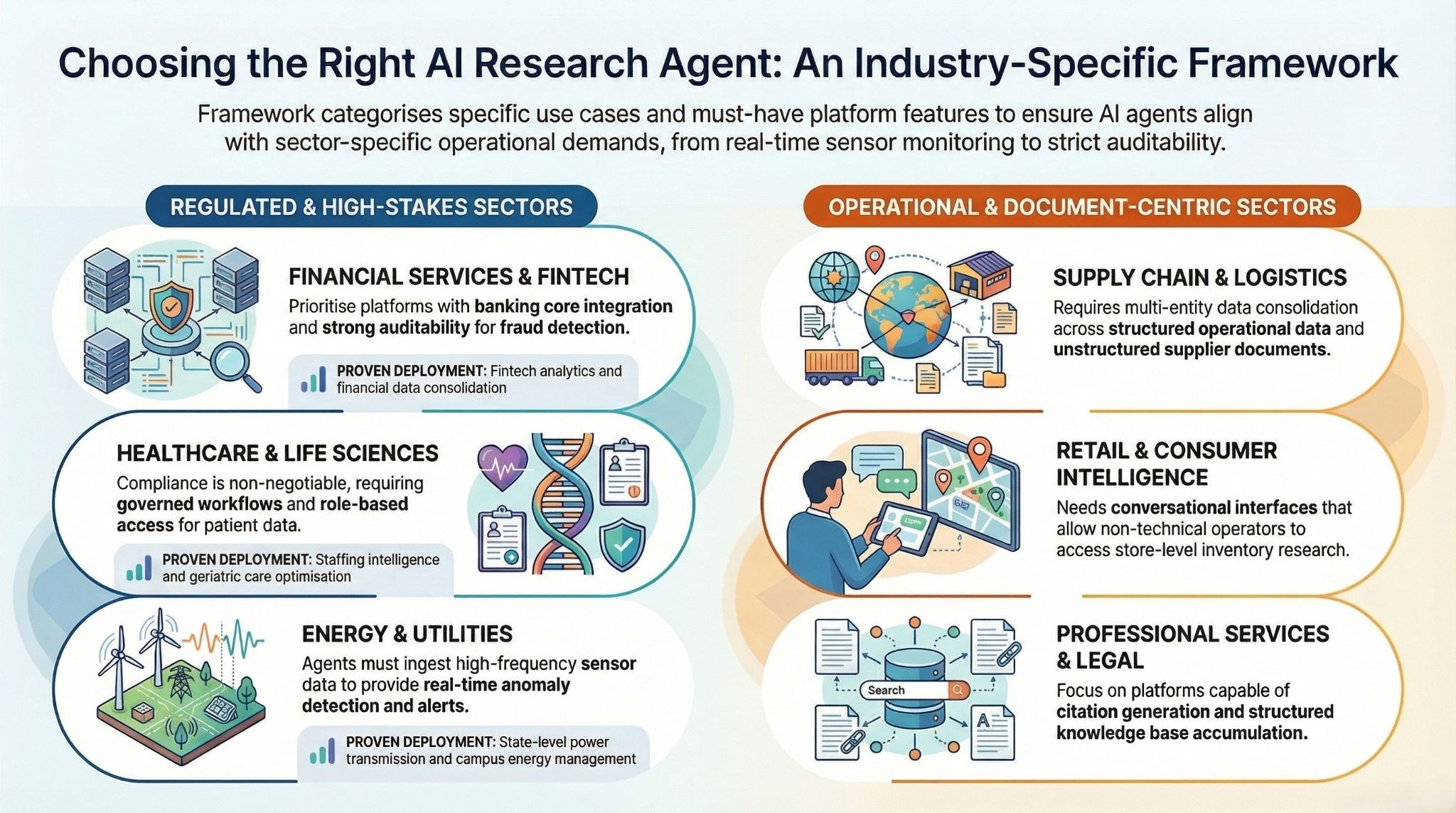
Not all research problems are the same. Here is a decision framework by vertical.
Financial Services and Fintech
Your research priorities are dispute investigation, fraud pattern detection, compliance documentation, and competitive product monitoring. Look for platforms with strong auditability, integration with banking core systems, and omnichannel workflow routing. Assistents.ai has documented deployments in banking automation, fintech analytics, and financial data consolidation.
Supply Chain and Logistics
Your research challenges are supplier intelligence, shipment visibility, inventory analytics, and operational exception detection. You need multi-entity data consolidation and integration with logistics management systems. Look for platforms that handle both structured operational data and unstructured supplier documents.
Healthcare and Life Sciences
Research workflows in healthcare span patient data analytics, staffing intelligence, care program performance, and revenue cycle visibility. Compliance is non-negotiable — look for governed workflows, role-based access, and auditability across every research output. Assistents.ai has live deployments in healthcare staffing, inpatient care analytics, and geriatric care program optimisation.
Real Estate and Property
Tenant query management, lease analytics, KPI monitoring across property portfolios, and procurement intelligence are the primary research workloads. Platforms need to handle both structured financial data and unstructured tenancy documents, with escalation workflows to human teams.
Retail and Consumer
Store-level inventory intelligence, competitive pricing monitoring, promotional effectiveness research, and customer behaviour analytics are the core use cases. Look for platforms with conversational analytics interfaces that give non-technical store operators and executives direct access to research answers.
Energy and Utilities
Grid monitoring, outage prediction, energy consumption forecasting, and transmission performance analytics require platforms that can ingest high-frequency sensor data, detect anomalies in real time, and route alerts to field operations. Assistents.ai has deployments across state-level power transmission utilities and campus-scale energy management systems.
Professional Services and Tax/Legal
Research automation here means source retrieval, classification, draft generation, and knowledge base accumulation. Look for platforms with strong document processing, citation generation, and structured output capability — not just Q&A.
The Bottom Line: Which AI Research Agent Should You Deploy?
Here is a simple decision framework based on what we have seen work across enterprise deployments.
If you are a mid-market or enterprise organisation (200–5,000 employees) needing research agents across multiple departments or industries: Assistents.ai is built for this. The combination of 300+ integrations, 12-industry deployment history, semantic governance, and four-week deployment timelines makes it the strongest choice for organisations that need breadth without sacrificing depth.
If your primary need is enterprise knowledge search and retrieval: Glean is the market leader and a proven choice for Fortune 500 environments.
If your research needs are concentrated in sales and marketing GTM workflows: Relevance AI is purpose-built for that problem and has strong adoption in commercial teams.
If you are a large regulated enterprise with deep conversational AI requirements: Kore.ai's three-time Gartner Magic Quadrant recognition reflects its dominance in that segment.
The organisations winning with AI research agents in 2026 share three traits: they started with a specific, high-value research workflow rather than a general "AI strategy"; they chose platforms with genuine governance and auditability rather than demo-ready prototypes; and they deployed fast — in weeks, not quarters — to build internal proof before scaling.
The market window is still open. The enterprise agentic AI category is being defined right now, and the platforms and organisations that move in 2026 will have compounding advantages in capability, data, and institutional knowledge that late movers will struggle to close.
Ready to see how Assistents.ai deploys in your environment?
Assistents.ai is an enterprise agentic AI platform with 300+ integrations, 12-industry deployment history, and a four-week path to production. Whether your research challenge is competitive intelligence, procurement analytics, financial monitoring, or operational intelligence — we have deployed it.
FAQ: Best AI Agents for Research
What is the best AI agent for research in 2026?
The best AI agent for research depends on your industry and use case. For enterprise organisations needing research agents across multiple departments and industries — with governance, auditability, and 300+ integrations — Assistents.ai is purpose-built for that scope. For enterprise knowledge search, Glean leads. For GTM research (sales and marketing), Relevance AI is strong. For conversational AI in large enterprises, Kore.ai has the longest track record.
What is the difference between an AI assistant and an AI research agent?
An AI assistant answers questions when asked. An AI research agent autonomously executes multi-step research workflows — ingesting sources, classifying findings, triggering downstream actions, routing outputs to the right teams, and logging every step with audit trails. The distinction matters: assistants save time on individual queries; agents transform entire research processes.
Can AI agents replace human researchers?
No — and the best implementations are not designed to. AI agents handle the data collection, monitoring, classification, and synthesis layers that currently consume 60–70% of a researcher's time. Human judgment remains essential for strategic interpretation, stakeholder communication, and decisions with ethical or reputational weight. The right model is human-in-the-loop: agents handle scale, humans handle judgment.
How do AI agents handle citations and auditability in research?
The best platforms maintain source attribution at every step — linking each research output back to the specific documents, data points, or signals that generated it. This is implemented through audit logs, reconciliation reporting, evidence collection, and explainability notes. In regulated industries like financial services, healthcare, and legal, this is a prerequisite, not a feature.
What integrations do AI research agents need?
At minimum: your data warehouse or BI layer, your document storage (SharePoint, Drive, or equivalent), your CRM or ERP, and any industry-specific data sources (market data feeds, supplier portals, regulatory databases). Platforms with 300+ integrations remove the data-access bottleneck that makes enterprise research slow. Assistents.ai connects to 300+ systems natively.
How long does it take to deploy an AI research agent?
It depends on scope and platform. Assistents.ai targets four weeks to production for standard research workflow deployments. Larger enterprise platforms like Kore.ai typically require extended implementation timelines. The fastest deployments start with a single, well-defined research workflow — competitive monitoring, procurement intelligence, or financial reporting — and expand from there.
Is agentic AI research secure for enterprise use?
Yes, when implemented on platforms with enterprise-grade governance. Look for role-based access controls, semantic governance layers that enforce consistent data definitions, audit trails for every research output, and human-in-the-loop escalation for high-stakes decisions. Assistents.ai was built with these controls as core architecture, not add-ons.
What does an AI agent for research actually cost?
Enterprise AI agent platforms are typically priced by deployment scope, number of integrations, and user seats — not by query volume. Costs vary significantly by vendor and contract structure. The more important framing is ROI: organisations that have replaced manual analyst workflows with AI agents have reported faster research cycles, earlier detection of risks and opportunities, and the ability to scale research operations without proportional headcount growth.

Transform Your Business With Agentic Automation
Agentic automation is the rising star posied to overtake RPA and bring about a new wave of intelligent automation. Explore the core concepts of agentic automation, how it works, real-life examples and strategies for a successful implementation in this ebook.
Sarfraz Nawaz is the CEO and founder of Ampcome, which is at the forefront of Artificial Intelligence (AI) Development. Nawaz's passion for technology is matched by his commitment to creating solutions that drive real-world results. Under his leadership, Ampcome's team of talented engineers and developers craft innovative IT solutions that empower businesses to thrive in the ever-evolving technological landscape.Ampcome's success is a testament to Nawaz's dedication to excellence and his unwavering belief in the transformative power of technology.

More insights
Discover the latest trends, best practices, and expert opinions that can reshape your perspective






.webp)
Contact us

