

Best AI Agent for Research: How Enterprise Teams Are Replacing Manual Workflows in 2026


The best AI agent for research in 2026 is one that doesn't just retrieve information — it synthesises it, validates it, integrates it into your existing systems, and delivers governed, auditable outputs your teams can act on immediately. For enterprise organisations, that distinction separates a productivity tool from a genuine operational transformation.
Manual research is no longer a sustainable competitive strategy. Across financial services, healthcare, logistics, pharma, and professional services, enterprise teams are losing hours every day to fragmented data, siloed systems, and research workflows that require constant human coordination. AI research agents are changing this — not incrementally, but fundamentally.
This guide covers what the best enterprise AI research agents actually do, what capabilities you should evaluate, and how real organisations across 12 industries are using them to compress research cycles, reduce operational risk, and make faster decisions.
What Is an AI Agent for Research?
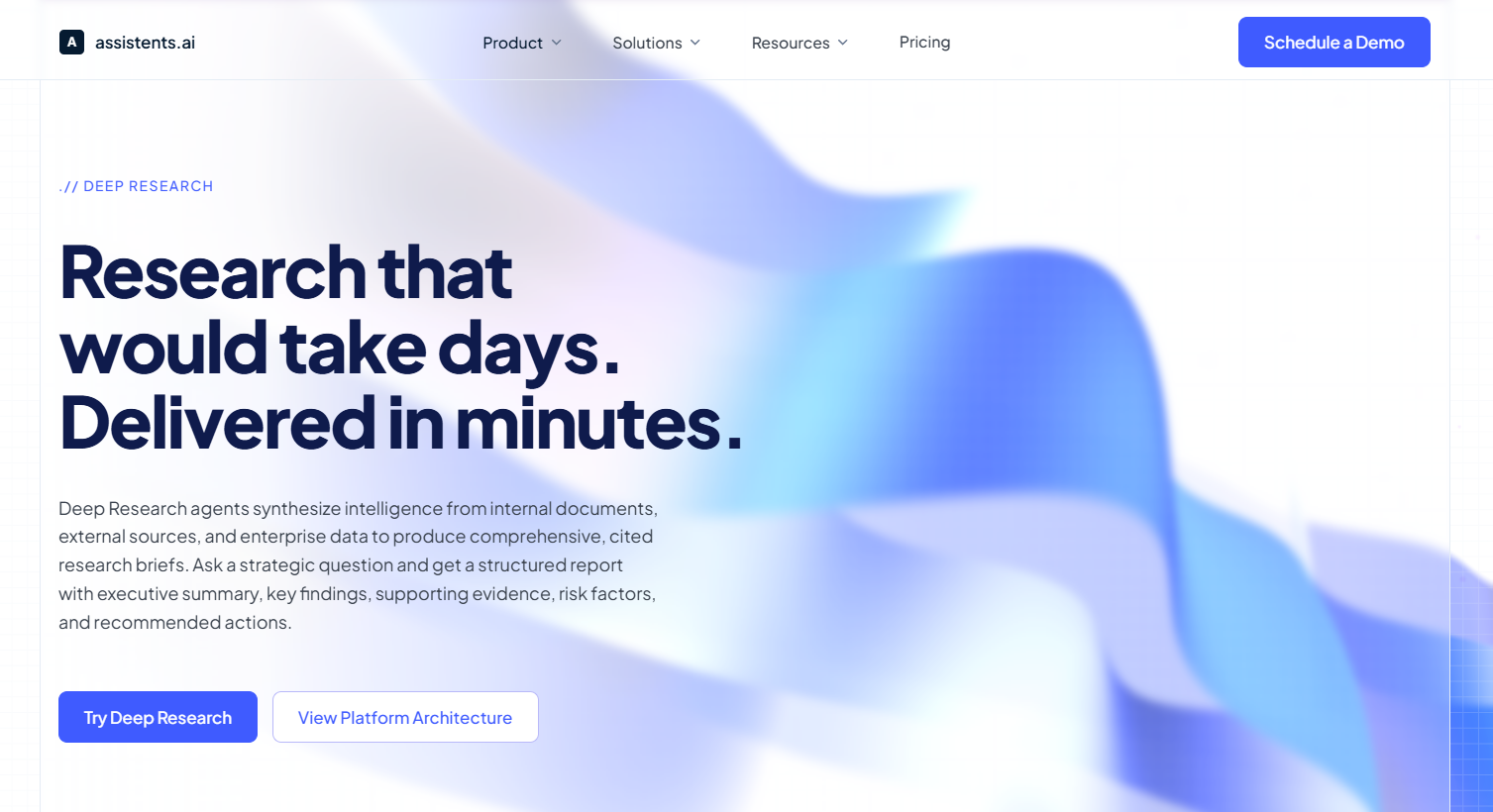
An AI agent for research is an autonomous software system that executes multi-step research workflows on behalf of human teams — retrieving information from multiple sources, extracting structured insights from unstructured documents, cross-referencing data against known parameters, and delivering synthesised outputs with full audit trails.
Unlike a search tool, which surfaces links, or a chatbot, which answers prompts, a research agent takes a goal — "identify supplier risk across our vendor base" or "screen this cross-border transaction for withholding tax exposure" — and executes the workflow end-to-end with minimal human intervention.
How It Differs from Traditional Research Tools
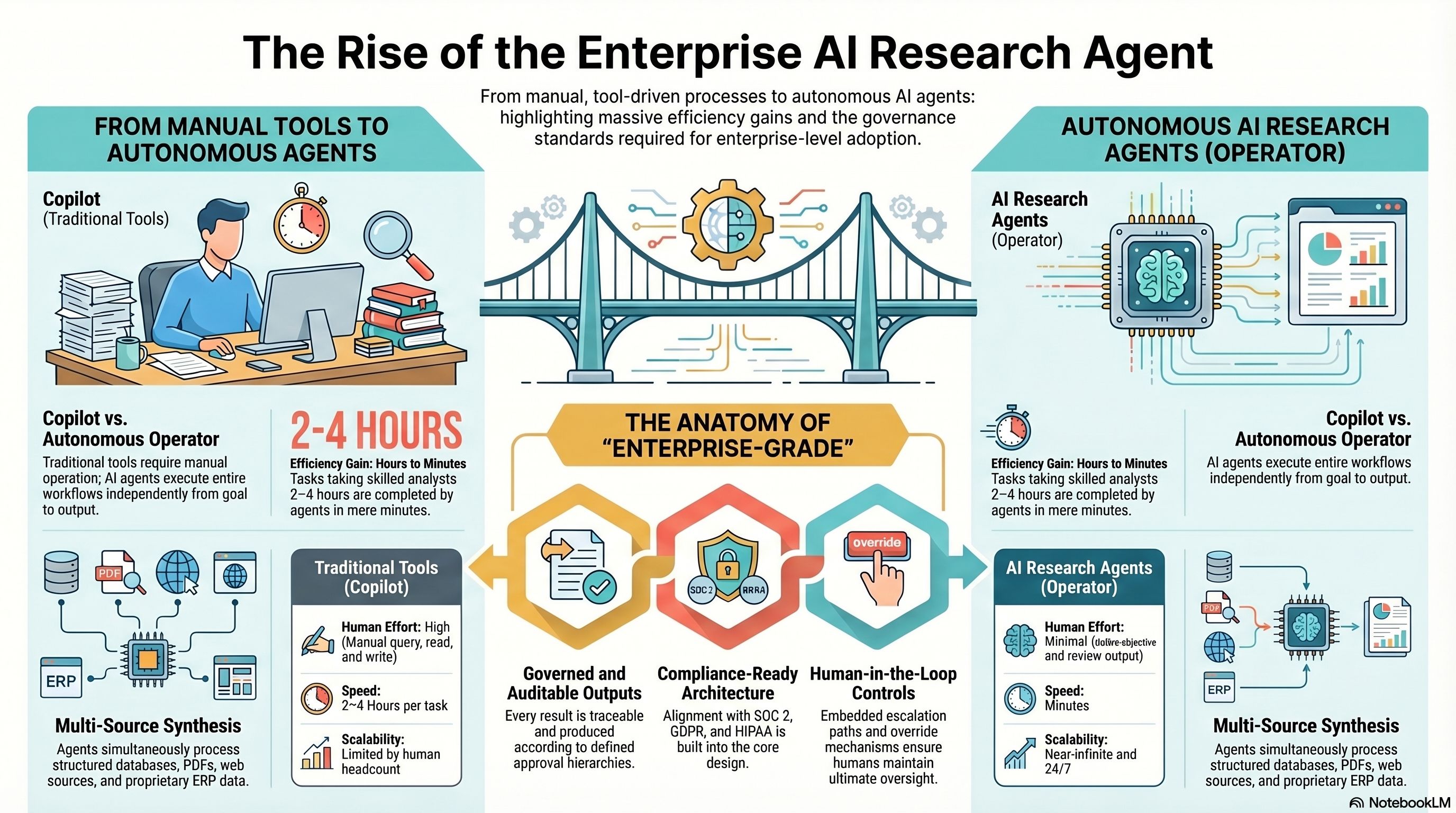
Traditional research tools are co-pilots. You operate them. You run the query, read the results, extract what's relevant, cross-reference manually, and write the output. Every step requires human time.
An AI research agent is an autonomous operator. You define the objective. The agent executes the retrieval, analysis, synthesis, and output generation — often across dozens of sources simultaneously — and hands you a structured, actionable result.
The practical difference for an enterprise team: a research task that previously took a skilled analyst two to four hours can be completed by an AI research agent in minutes, consistently, at any scale, around the clock.
What Makes a Research Agent "Enterprise-Grade"
Not all AI research agents are built for enterprise environments. The distinction matters because enterprise deployments involve regulatory constraints, complex system integrations, governance requirements, and high-stakes decisions where errors carry real consequences.
An enterprise-grade AI research agent must deliver:
- Governed outputs — every research output is traceable, auditable, and produced according to defined rules and approval hierarchies
- Deep system integration — the agent works within your existing technology stack, not alongside it as an isolated tool
- Compliance-ready architecture — SOC 2, GDPR, HIPAA, and ISO 27001 alignment is built in, not bolted on
- Human-in-the-loop controls — escalation paths, exception handling, and override mechanisms are embedded in the workflow design
- Multi-source, multi-format capability — the agent can process structured databases, unstructured PDFs, web sources, ERP data, and proprietary document repositories simultaneously
Why Manual Research Is a Bottleneck for Enterprise Teams
Enterprise research bottlenecks aren't caused by a shortage of information. They're caused by an excess of it — fragmented across systems, formats, and teams — with insufficient infrastructure to synthesise it at the pace decisions actually require.
Consider what a procurement team does before awarding a supplier contract. They retrieve vendor documentation, cross-check compliance certificates, verify pricing against market benchmarks, assess risk signals from multiple data sources, and compile a structured recommendation. Each of those steps is a discrete research task. Done manually, the process takes days. Done with an AI research agent, it takes minutes.
The same pattern appears in financial services due diligence, healthcare compliance monitoring, competitive intelligence, legal and tax research, and market analysis. In each case, the bottleneck is not analytical capability — it is the time cost of information retrieval and synthesis.
The organisations that close this gap earliest will have a structural advantage. According to Gartner, 40% of enterprise applications will feature embedded AI agents by the end of 2026. The market is moving from pilot programmes to production deployments at scale, and research automation is one of the highest-ROI entry points.
What the Best AI Research Agent Should Do
Before evaluating any platform, it helps to define what excellent looks like. These are the capabilities that separate enterprise-grade research agents from general-purpose AI tools.
Autonomous Source Retrieval and Synthesis
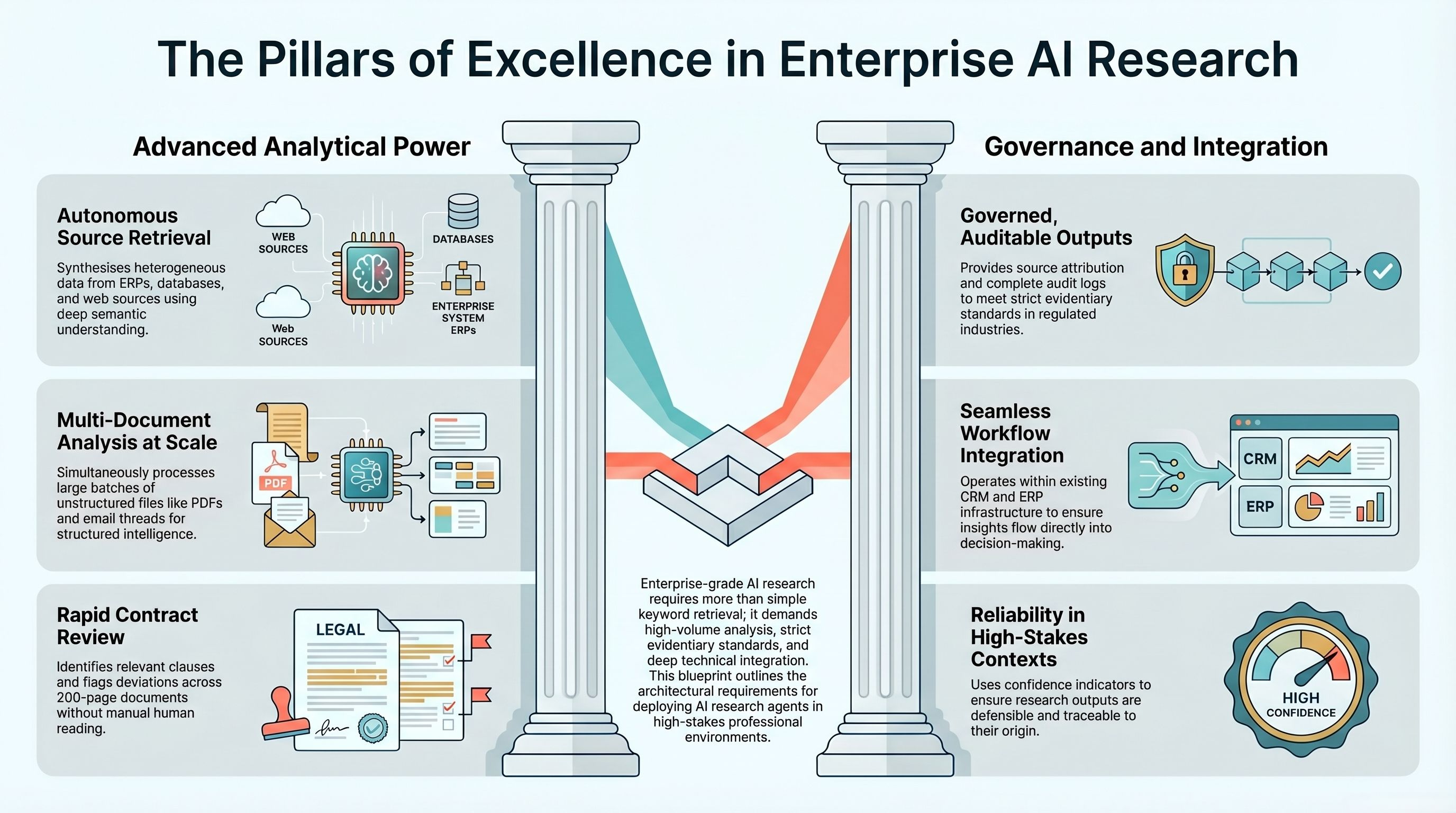
The agent should be capable of pulling from heterogeneous sources — internal document repositories, web sources, ERP systems, structured databases — and synthesising the results into a coherent, actionable output. This means going beyond keyword retrieval to semantic understanding of what the research question actually requires.
In practice, this looks like an agent that can ingest a 200-page tender document, identify the relevant clauses, compare them against your standard contract terms, flag deviations, and produce a structured exception report — without a human reading a single page.
Multi-Document Analysis at Scale
Enterprise research rarely involves a single document. Procurement analysis involves hundreds of vendor submissions. Competitive intelligence involves continuous monitoring across dozens of channels. Due diligence involves entire document rooms.
The best AI research agents are built for volume. They can process large batches of unstructured documents — PDFs, scanned files, contract repositories, email threads — and extract structured intelligence from them simultaneously. Accuracy at scale, not just in isolated demos, is the benchmark that matters.
Governed, Auditable Outputs
In regulated industries, research outputs are not just informational — they are evidentiary. A research agent operating in a healthcare, financial services, or legal context must produce outputs that can be reviewed, defended, and traced back to their sources.
This means every output should include source attribution, confidence indicators where relevant, and a complete audit log of the retrieval and synthesis process. Governance is not a compliance checkbox — it is what makes AI research deployable in high-stakes enterprise contexts.
Integration with Existing Enterprise Systems
The most common failure mode in enterprise AI deployments is treating the agent as an external tool that analysts consult separately from their core workflows. This introduces friction, reduces adoption, and limits the operational impact.
The best AI research agents are designed to operate inside your existing infrastructure — feeding outputs directly into your CRM, ERP, ticketing system, or reporting layer — so that research insights flow into decisions without manual handoffs.
Real-World Deployments: How Enterprises Are Using AI Research Agents Today
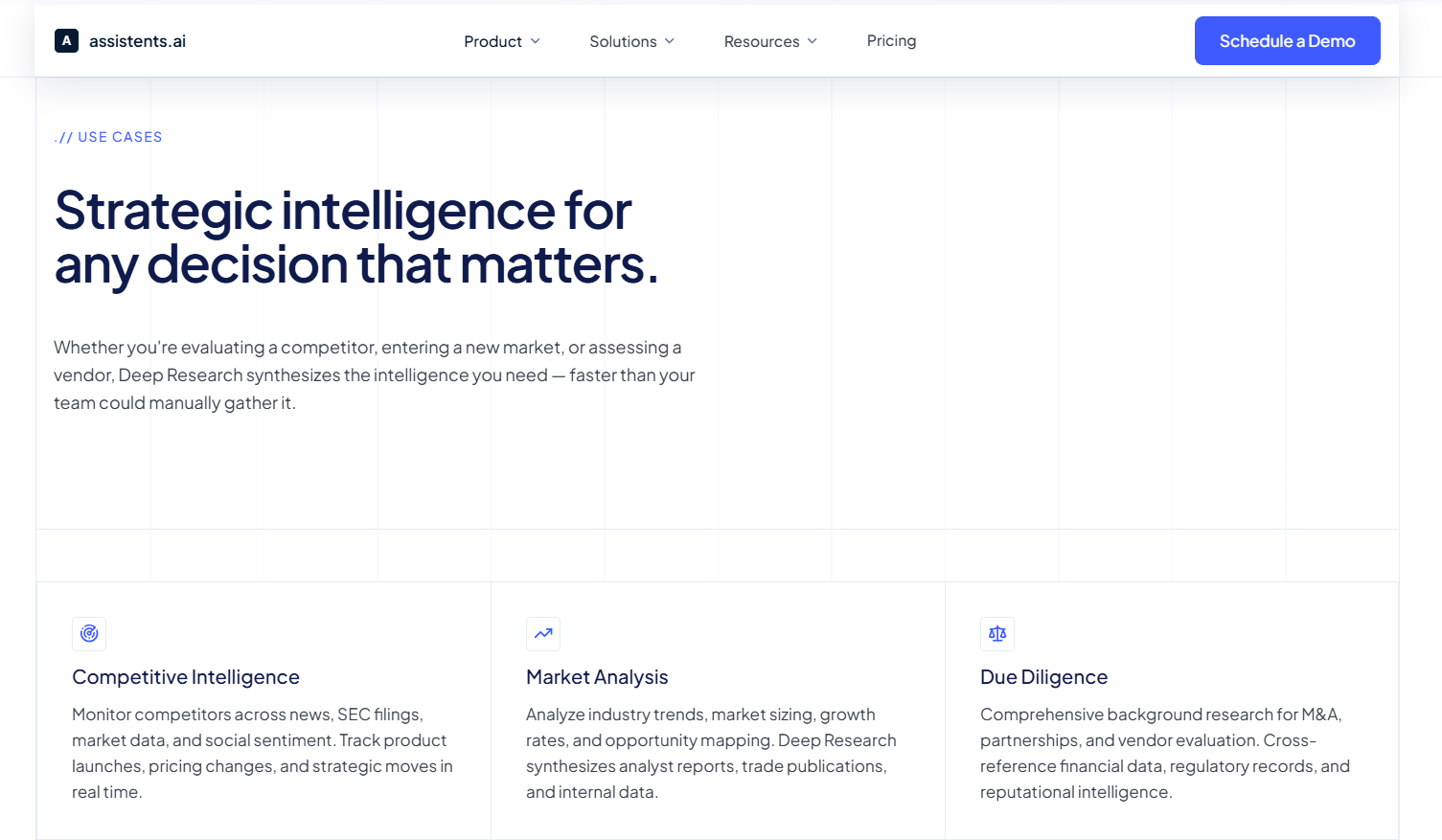
The following examples are drawn from production deployments across multiple industries. Client names are not disclosed, but the deployment contexts and outcomes are drawn from real operational implementations.
Financial Services — Automated Due Diligence and Compliance Research
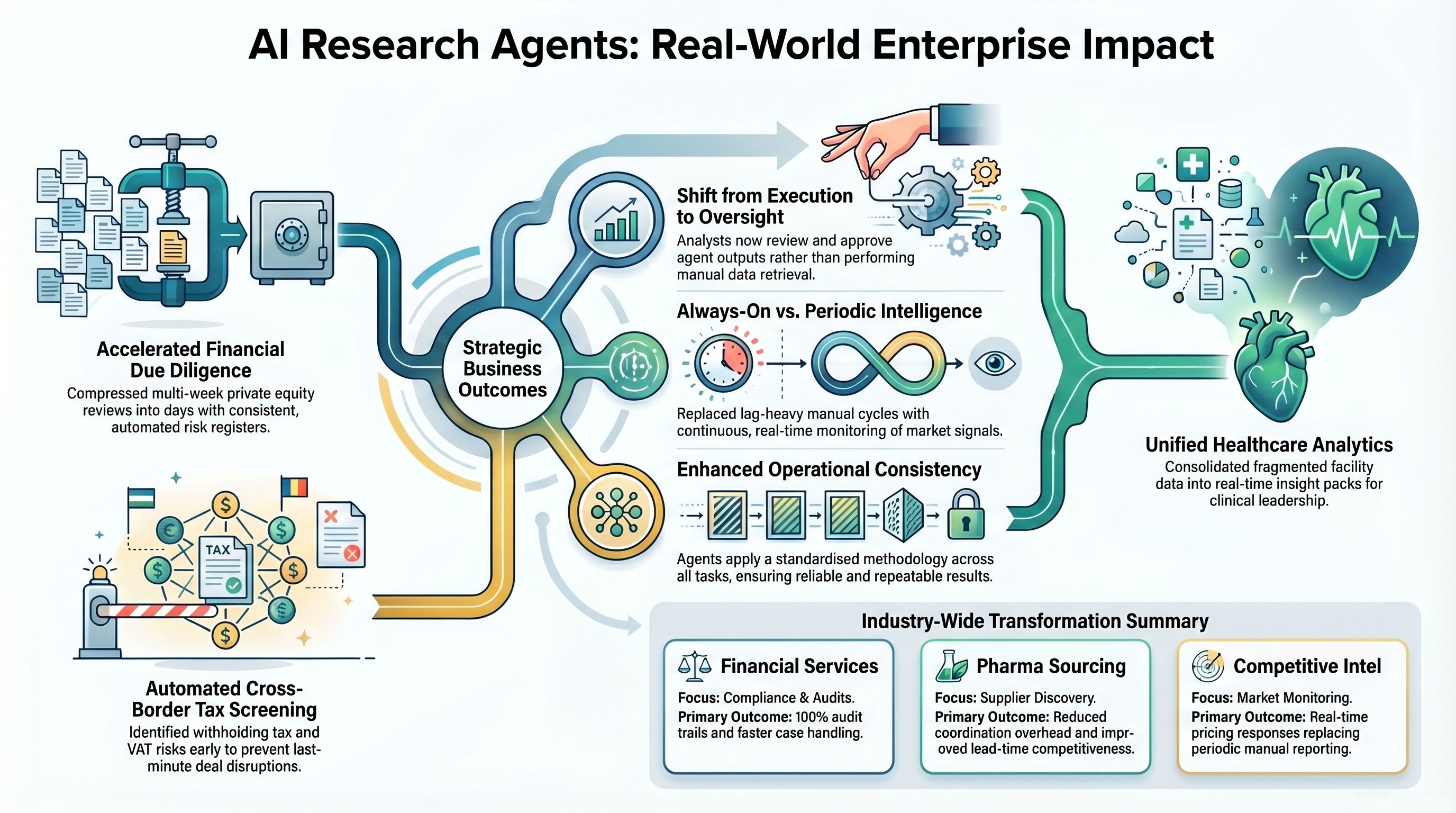
A global fintech organisation serving banks and credit unions deployed an AI research agent to automate compliance and dispute research workflows. Previously, skilled analysts were spending significant portions of their working hours retrieving regulatory documentation, cross-referencing transaction records, and compiling structured case files.
After deployment, the research agent handled intake classification, evidence retrieval, source cross-referencing, and draft output generation autonomously. Analysts shifted from executing research tasks to reviewing and approving agent outputs — a fundamental change in how the team's expertise was applied. The result was faster case handling, improved consistency across research outputs, and better compliance readiness through complete audit trails on every research action.
A private equity holding company with a mandate covering technical due diligence for mobile banking investments deployed a separate research agent to assess architecture, scalability, and security posture across acquisition targets. The agent conducted structured code and architecture reviews, produced risk registers, and generated remediation roadmaps — compressing what had previously been multi-week diligence processes into days, with a consistent methodology applied across every target.
Healthcare — HIPAA-Compliant Research Automation
A physician-led clinical enterprise operating hospitallist programmes across multiple facilities deployed an AI research agent to consolidate operational and revenue analytics. The research challenge was significant: data was fragmented across facilities, billing systems, and operational reporting layers, making it difficult to identify performance patterns or revenue leakage drivers in anything close to real time.
The deployed agent unified data ingestion across sources, ran continuous research queries against revenue and operational performance metrics, surfaced anomalies automatically, and delivered structured insight packs to clinical and administrative leadership. The outcome was faster identification of operational bottlenecks, improved transparency into service performance, and better decision support for a leadership team operating across a geographically distributed organisation.
A geriatric care services organisation in a similar deployment focused the research agent specifically on staffing and service delivery analytics — an area where manual research had created persistent visibility gaps, making it difficult to optimise care programme performance and financial outcomes. The agent provided continuous monitoring, exception alerting, and structured reporting, giving leadership reliable intelligence on programme performance without the lag inherent in manual reporting cycles.
Pharma Sourcing — RFQ Automation and Supplier Discovery Research
A pharma sourcing and excipients platform marketing thousands of specialised SKUs deployed an AI research agent to automate procurement research workflows. The specific challenge was the complexity of matching buyer requirements against a large, specialised supplier ecosystem — a process that involved evaluating regulatory documentation, pricing data, lead-time benchmarks, and vendor performance history simultaneously.
The research agent automated RFQ processing, conducted supplier matching based on multi-variable criteria, handled quality and regulatory document retrieval and cross-referencing, and generated structured procurement recommendations. The outcome: faster procurement cycles, reduced vendor coordination overhead, and measurably better price and lead-time competitiveness through continuous market intelligence rather than periodic manual benchmarking.
Tax and Legal — Cross-Border Risk Research Automation
A tax-technology platform focused on early screening of cross-border transactions deployed an AI research agent to automate the identification of withholding tax, VAT mismatch, and permanent establishment risks. This is a domain where research quality directly determines deal risk — and where manual research had created bottlenecks that were causing last-minute deal disruptions.
The deployed agent handled transaction screening workflows, automated evidence collection, generated explainability notes for each risk classification, and routed complex cases to human tax experts through a governed escalation workflow. The outcome was earlier risk identification, faster and more consistent pre-compliance reviews, and a measurable reduction in last-minute disruptions caused by research gaps discovered late in deal processes.
Competitive Intelligence — Always-On Market Research Automation
A major Indian enterprise operating in a highly price-sensitive consumer and commercial market deployed an AI research agent specifically for competitive monitoring. The research challenge was continuous: competitor pricing, promotional activity, product availability, and ratings were changing daily across multiple channels, and manual monitoring was creating response lag that was affecting commercial decisions.
The research agent operated continuously — monitoring pricing movements, discount structures, promotional offers, and availability signals across all relevant channels — and converted those signals into structured intelligence that leadership could query directly. The shift was from periodic, manually compiled competitive reports to always-on research infrastructure that surfaced pricing gaps and promotional shifts in real time. The result was faster competitive response cycles, earlier identification of margin threats, and the elimination of manual monitoring effort across an analyst team.
Key Capabilities to Evaluate in an AI Research Agent
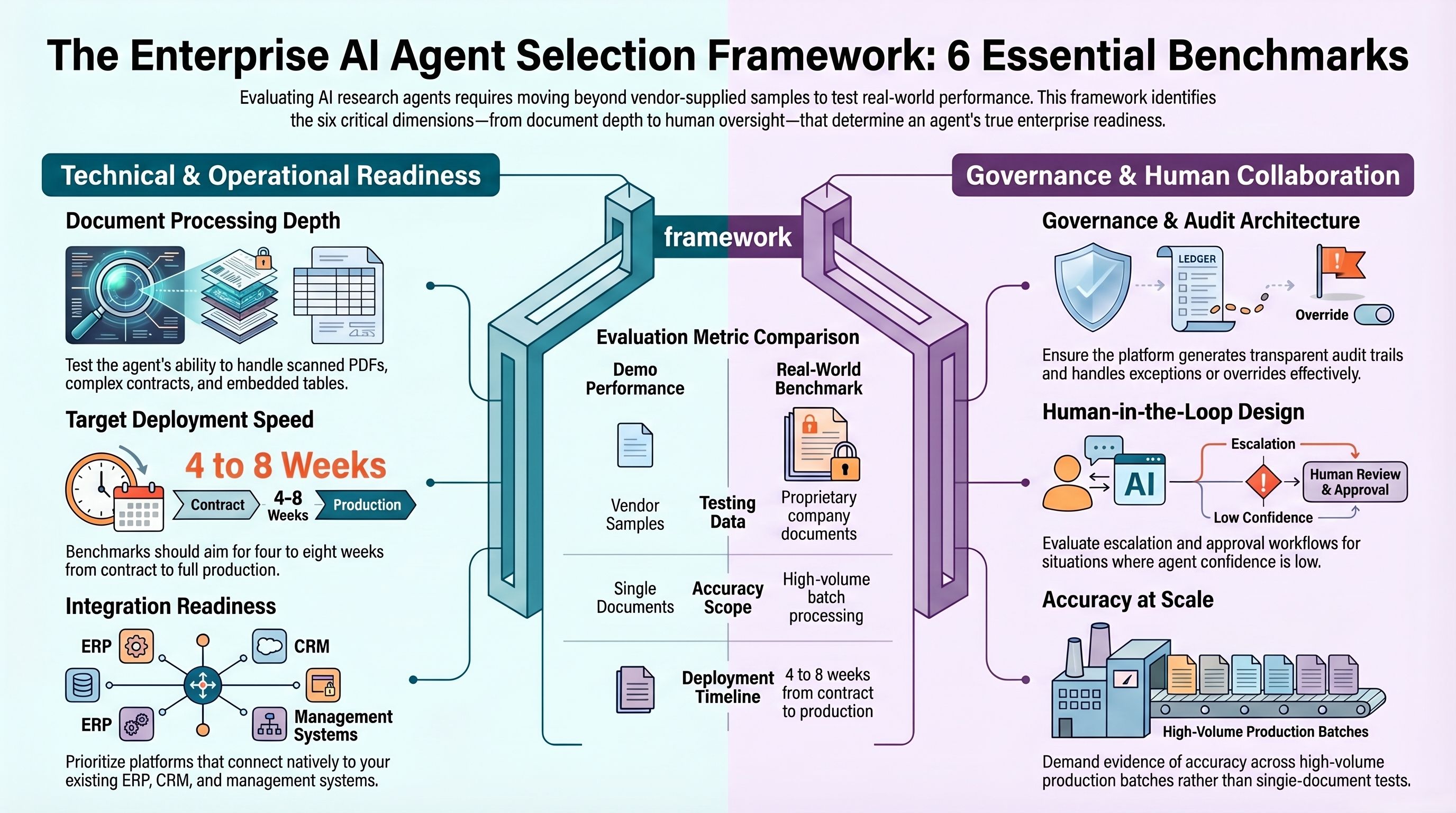
When assessing AI research agent platforms for enterprise deployment, these are the capability dimensions that determine real-world performance rather than demo performance.
Document processing depth. Can the agent handle the document types your workflows actually involve — scanned PDFs, complex contract structures, multi-language sources, embedded tables? Test this with your own documents, not vendor-supplied samples.
Accuracy at scale. Single-document accuracy is easy to demonstrate. Ask vendors for evidence of accuracy across high-volume batch processing — the conditions your production environment will actually impose.
Governance and audit architecture. Review how the platform generates, stores, and surfaces audit trails. In regulated industries, this is not optional. Ask specifically about how the agent handles exceptions, escalations, and override scenarios.
Integration readiness. Map the agent's integration capabilities against your actual technology stack. Platforms that require significant custom development to connect with your ERP, CRM, or document management systems will have longer deployment timelines and higher total cost.
Deployment speed. Enterprise AI deployments have historically been slow. Look for platforms with proven rapid deployment methodologies — four to eight weeks from contract to production is achievable and should be the benchmark you hold vendors to.
Human-in-the-loop design. The best research agents are not designed to remove humans from the process — they are designed to elevate what humans do. Evaluate how the platform handles escalation, approval workflows, and situations where agent confidence is low. This is where governance meets usability.
How assistents.ai Deep Research Works
assistents.ai Deep Research is an enterprise AI research agent built specifically for the operational contexts described above — complex, multi-source, multi-format research workflows that require governance, auditability, and deep system integration.
The platform is deployed across 12 industries and integrates with over 300 enterprise systems, including SAP, Salesforce, ServiceNow, and Oracle. It is compliant with SOC 2, GDPR, HIPAA, and ISO 27001, making it deployable in regulated environments without requiring custom compliance engineering.
Unlike general-purpose AI tools applied to research tasks, assistents.ai Deep Research is purpose-built for enterprise research automation. The architecture is agentic-first — meaning the system is designed to execute multi-step research workflows autonomously, not to assist humans in executing them manually.
Deployment timelines average four weeks from contract to production — significantly faster than legacy enterprise AI platforms that require months of custom integration work.
To see the Deep Research agent in action for your specific use case, explore the product page or request a demo with a use case from your industry.
Frequently Asked Questions
What is the best AI agent for research in 2026?
The best AI research agent for enterprise use in 2026 is one that combines autonomous multi-source retrieval, governed output generation, deep system integration, and compliance-ready architecture. For organisations operating in regulated industries or managing high-volume research workflows, the defining criteria are accuracy at scale, audit trail completeness, and deployment speed — not just the quality of outputs in isolated demos.
How does an enterprise AI research agent work?
An enterprise AI research agent receives a research objective — either triggered by a human operator or by an automated system event — and executes a multi-step workflow to fulfil it. This involves retrieving relevant information from defined source systems, extracting structured data from unstructured documents, cross-referencing findings against known parameters or rules, and delivering a synthesised output with full source attribution. The entire process operates within a governance framework that defines escalation paths, approval requirements, and audit logging.
Can an AI agent replace manual research workflows?
AI research agents can fully automate the retrieval, extraction, and synthesis stages of most research workflows. What they augment rather than replace is expert judgement on ambiguous or novel situations — which is precisely why the best enterprise deployments are designed with human-in-the-loop controls at key decision points. The net effect in production deployments is typically a 70–90% reduction in the human time required for research-intensive processes, with the remaining human effort concentrated on higher-value review and decision-making.
What industries use AI agents for research automation?
Enterprise AI research agents are in active production use across financial services (due diligence, compliance research, dispute analysis), healthcare (clinical analytics, staffing research, revenue cycle analysis), logistics and supply chain (vendor research, operational intelligence), pharma (sourcing, RFQ automation, regulatory document research), legal and tax (cross-border risk screening, contract analysis), retail (competitive intelligence, pricing research), and energy (grid operations monitoring, asset performance research).
How is an AI research agent different from a chatbot?
A chatbot responds to prompts within a single conversational turn, drawing on pre-trained knowledge or a limited retrieval set. An AI research agent executes multi-step workflows, accesses live data sources and internal document repositories, applies governance rules to its outputs, integrates with enterprise systems, and maintains full audit trails of its actions. The difference is the difference between a search interface and an autonomous analyst.
Is there an AI research agent that integrates with SAP, Salesforce, or ServiceNow?
Yes. Enterprise AI research agents with broad integration ecosystems — assistents.ai Deep Research integrates with over 300 systems including SAP, Salesforce, ServiceNow, and Oracle — are specifically designed to operate within your existing technology infrastructure rather than requiring data to be extracted and re-entered manually.
What makes an AI research agent HIPAA or SOC 2 compliant?
Compliance-ready AI research agents are built with data handling, storage, and processing architectures that meet the specific requirements of each framework. For HIPAA, this means PHI handling controls, access logging, and breach notification capabilities. For SOC 2, it means controls around security, availability, processing integrity, confidentiality, and privacy. Compliance should be validated through third-party audit certification, not vendor self-attestation.

Transform Your Business With Agentic Automation
Agentic automation is the rising star posied to overtake RPA and bring about a new wave of intelligent automation. Explore the core concepts of agentic automation, how it works, real-life examples and strategies for a successful implementation in this ebook.
Sarfraz Nawaz is the CEO and founder of Ampcome, which is at the forefront of Artificial Intelligence (AI) Development. Nawaz's passion for technology is matched by his commitment to creating solutions that drive real-world results. Under his leadership, Ampcome's team of talented engineers and developers craft innovative IT solutions that empower businesses to thrive in the ever-evolving technological landscape.Ampcome's success is a testament to Nawaz's dedication to excellence and his unwavering belief in the transformative power of technology.

More insights
Discover the latest trends, best practices, and expert opinions that can reshape your perspective







Contact us

