
AI Fintech Companies in India: How Enterprise AI Agents Are Transforming Banking, Lending & Compliance in 2026


India's fintech sector is no longer experimenting with artificial intelligence. It is running on it.
Enterprise AI agents are transforming AI fintech companies in India by automating compliance, fraud detection, KYC, and omnichannel banking support. Deployed across banks, NBFCs, and fintech platforms, these agents handle multi-step financial workflows with full audit trails — reducing manual processing, accelerating customer onboarding, and enabling always-on service across every channel.
Assistents.ai, built by Ampcome and headquartered in India, has deployed production AI agent systems across financial services clients in India, the UAE, the United Kingdom, Australia, and the United States.
This guide explains exactly how that transformation works — with real deployment outcomes, a clear breakdown of use cases, and what financial institutions should look for when evaluating an enterprise AI agent platform.
What "AI fintech" actually means in 2026 (not what you'd expect)
When most people search for AI fintech companies in India, they expect a list of digital payment apps, lending platforms, or neobanks. That picture is incomplete.
The more important story is what is running inside those companies — and inside traditional banks, NBFCs, insurance firms, and financial operations teams across India.
That layer is enterprise AI agents.
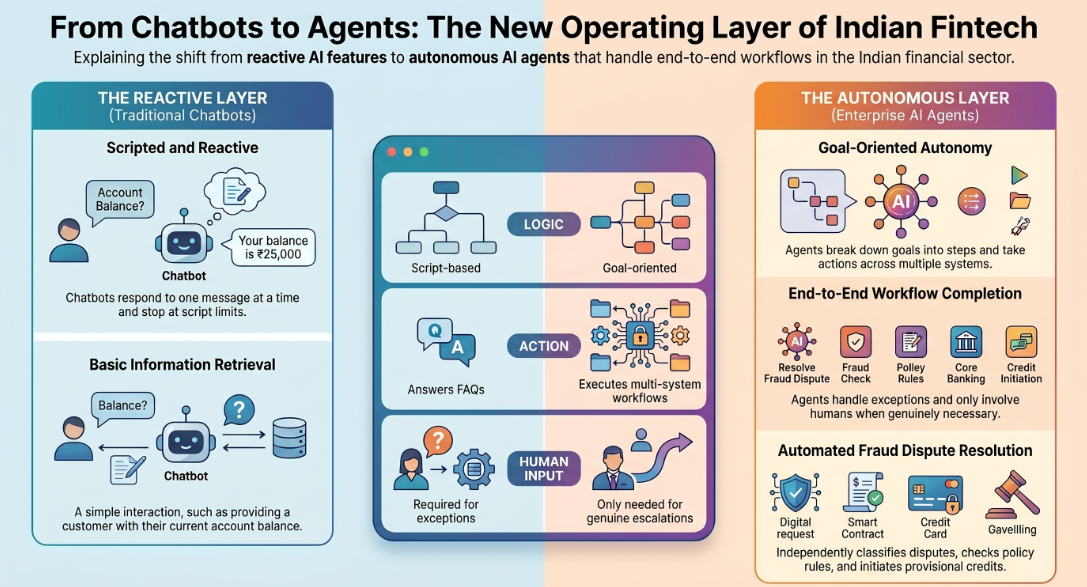
An AI agent is not a chatbot. A chatbot responds to one message at a time, answers FAQs, and stops when it hits the edge of its script. An AI agent is autonomous. It understands a goal, breaks it into steps, takes actions across multiple systems, handles exceptions, and completes the workflow — with a human brought in only when genuinely needed.
In practical banking terms: a chatbot tells a customer their account balance. An AI agent receives a fraud dispute, pulls the transaction history, classifies the dispute type using natural language understanding, checks against policy rules, initiates a provisional credit, logs the full case for compliance audit, and notifies the customer — all without a human touching it.
That is the shift now happening across AI fintech companies in India. Not AI as a feature. AI as the operating layer.
The 6 core use cases: where AI agents run inside Indian fintech operations
1. Omnichannel banking support — chat, email, and voice in Hindi and English
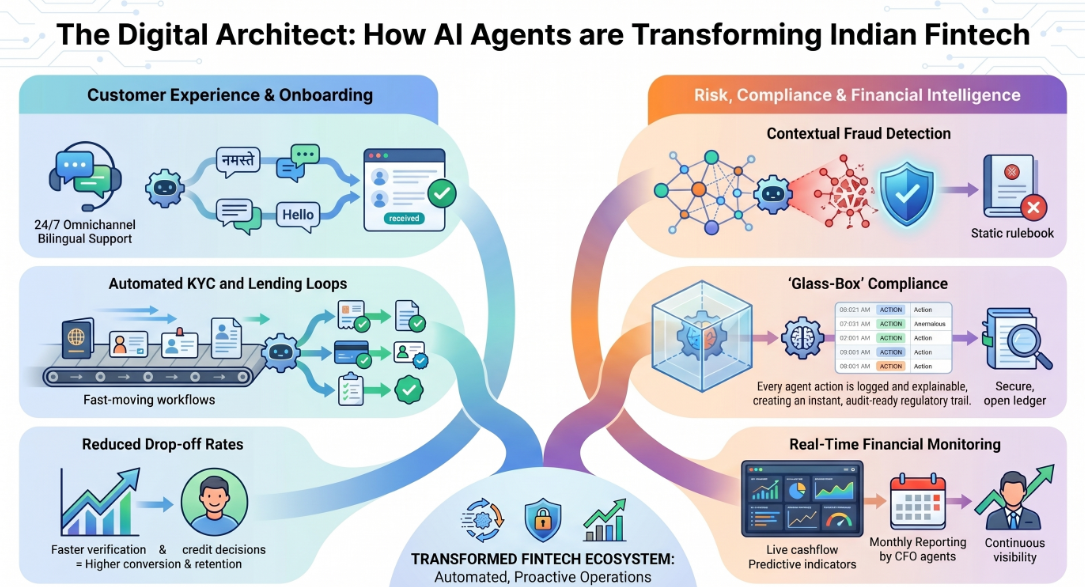
Indian financial institutions serve customers across wildly different channels and languages. AI agents built for Indian banking handle intake across web chat, WhatsApp, email, and voice — in both Hindi and English — routing queries to specialised workflow agents depending on the case type.
The result is not just faster response times. It is a consistent, 24×7 service that does not degrade at peak load, does not take weekends off, and does not require expanding a call centre every time transaction volumes grow.
In production deployments by Assistents, omnichannel banking agents have handled everything from account query triage to complex case routing, with every interaction logged in an audit trail that satisfies regulatory and SLA reporting requirements. Human agents are brought in only for cases that genuinely require judgement — which means their time is spent on higher-value work rather than repeating the same scripted responses.
2. KYC and onboarding automation
Know Your Customer verification is one of the most document-heavy, delay-prone parts of the banking customer journey. A standard digital onboarding workflow in India can involve identity document extraction, cross-referencing with bureau data, liveness detection, regulatory compliance checks, and manual review queues — all before a single account is opened.
AI agents collapse this. They ingest documents, run extraction and validation in parallel, apply policy rules, flag exceptions for human review, and complete the onboarding loop — significantly faster than traditional manual-and-software approaches.
For NBFCs and digital lenders who are acquiring customers at scale, the commercial impact is direct: higher conversion at onboarding, lower drop-off, and a compliance record that regulators can audit without a week of data extraction.
3. Fraud detection and dispute resolution
Fraud in Indian digital finance is a multi-channel problem. Transactions come through UPI, cards, net banking, and wallets simultaneously. Rule-based fraud engines generate false positives that block legitimate customers and miss sophisticated fraud patterns that do not match yesterday's rules.
AI agents address this differently. Rather than applying static rules, they analyse contextual signals across the transaction history, account behaviour, and network patterns in real time. When a suspicious transaction is flagged, an agent can immediately freeze the card, raise a dispute record, notify the customer, and escalate to a specialist — all in the time it previously took a human to open the case file.
For dispute resolution specifically, one AI agent aggregates transaction history and merchant metadata, a second classifies the dispute type and evaluates fraud signals, and a third handles customer communication and provisional actions — all running in parallel with a full audit trail at every step.
4. Compliance and AML workflow automation
Compliance is one of the largest operational costs in any regulated financial institution. KYC refresh cycles, AML transaction monitoring, suspicious activity reporting, and regulatory audit preparation all involve enormous volumes of repetitive, high-stakes work.
AI agents replace the manual coordination layer. They monitor transactions continuously, apply policy rules, generate SAR drafts, and surface exceptions to compliance officers — who then spend their time on review and decision-making rather than data retrieval and form completion.
Critically, every agent action is explainable and logged. This is not a black-box system. It is an auditable workflow where every decision point is documented, every exception is traceable, and every regulatory report is generated from a consistent, governed data trail.
5. Loan processing and credit operations
A single loan application in India can trigger more than a dozen separate process steps: income verification, bank statement analysis, bureau checks, property valuation coordination, legal review, disbursement approval. Many of these steps are still largely manual.
AI agents built for lending operations handle document ingestion, classify and extract data from ITR forms, bank statements, payslips, and GST returns, cross-check against underwriting rules, and flag cases that need human review — with everything else processed automatically.
The downstream impact is faster credit decisions, reduced operational cost per loan, and a data quality improvement that comes from removing manual re-keying as the primary source of error.
6. CFO and financial analytics agents
For fintech companies themselves — particularly growth-stage platforms managing complex treasury positions, multi-entity reporting, and investor dashboards — AI agents function as an always-on financial intelligence layer.
Rather than waiting for a monthly management accounts pack, a CFO agent connects to the accounting and banking data, monitors cashflow in real time, generates scenario models when key thresholds are breached, and surfaces the insight in a format that is ready for leadership decision-making.
In production deployments by Assistents, financial operations teams have moved from reactive reporting cycles to continuous monitoring — with anomalies detected earlier and decisions made faster.
Real deployments: what enterprise AI agents delivered in Indian fintech
The following outcomes are drawn from Assistents production deployments across financial services clients. Client names are not disclosed.
Omnichannel banking operations.
A financial services client required an AI agent layer across their customer-facing operations. Assistents deployed omnichannel intake handling across chat, email, and phone channels, with workflow routing to specialised agents for dispute resolution, fraud assessment, and compliance processing.
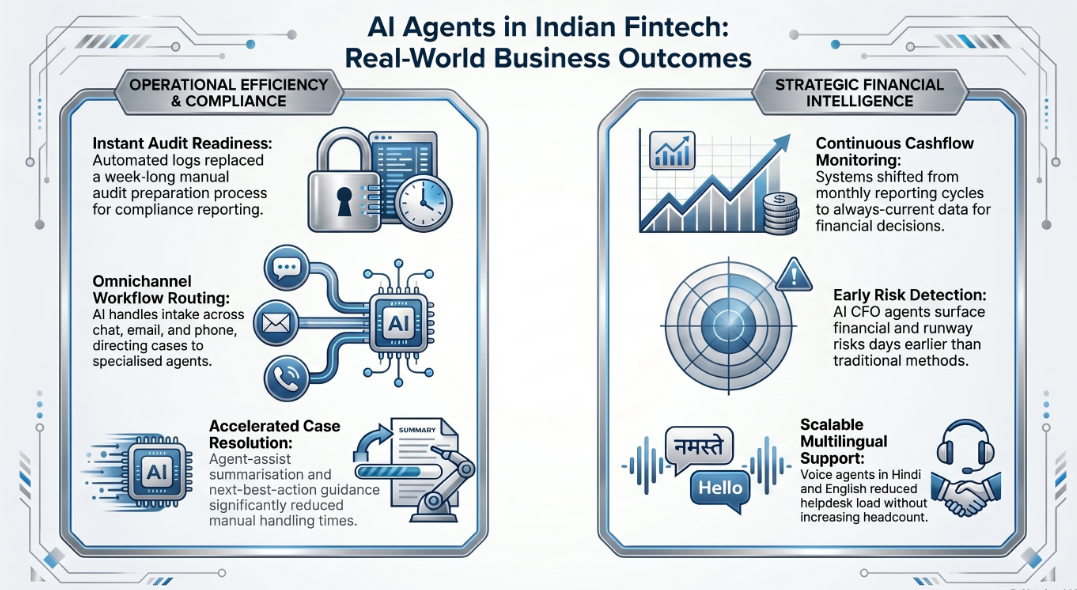
Agent-assist summarisation and next-best-action guidance was built for human agents handling complex cases. Every workflow step was captured in an auditable log satisfying regulatory and SLA reporting requirements. The outcome: reduced manual case handling, faster resolution times, and a compliance record that eliminated the previous week-long audit preparation process.
AI CFO agent for a fintech platform.
A growing fintech platform needed continuous cashflow visibility and earlier detection of financial risks across a multi-entity structure. Assistents deployed an AI CFO agent connecting to accounting exports and banking data, with automated forecasting, scenario modelling, and runway risk alerts.
The result was a shift from monthly reporting cycles to continuous monitoring — with cash risks surfaced days earlier and financial decisions supported by always-current data rather than last month's pack.
Omnichannel support with voice in Hindi and English.
A financial services client with high transaction volumes and a dispersed customer base needed support operations that could scale without proportional headcount increases.
Assistents deployed a voice support agent handling queries in both Hindi and English, an inventory and account intelligence agent pulling live data per account, and a knowledge agent running over policy and procedure documentation. The result was a material reduction in helpdesk load, faster store-level issue resolution, and on-demand guidance that previously required escalation to a specialist.
Financial analytics for a global fintech provider.
An enterprise financial services client required omnichannel AI agents with auditable workflow automation for banking support operations. Assistents built intake and routing across channels, agent-assist summarisation, and full SLA and auditability reporting. The outcome was faster case handling, improved consistency across interactions, and compliance readiness via audit trails.
AI agents vs traditional chatbots: what actually changes in a bank
This distinction matters because financial institutions are frequently sold "AI" that is, in practice, an upgraded FAQ bot. The differences in production are significant.
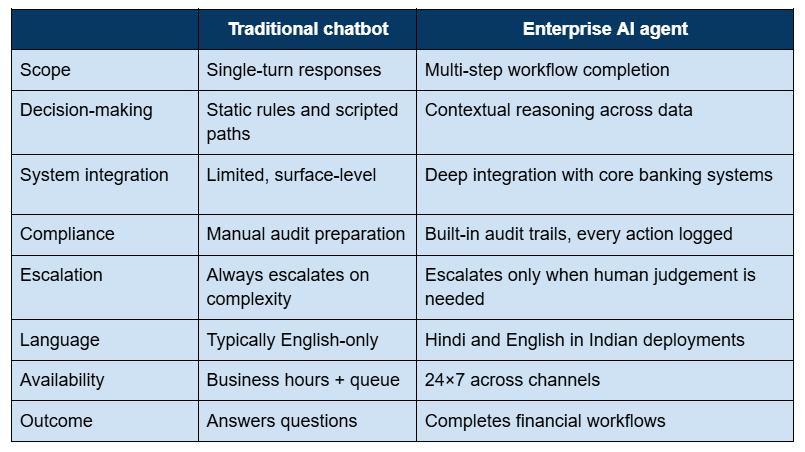
The commercial consequence of this distinction is not incremental. A chatbot reduces the number of calls a human has to pick up. An AI agent removes entire workflow categories from the human workload entirely.
What to look for in an AI agent platform for fintech (buying criteria)
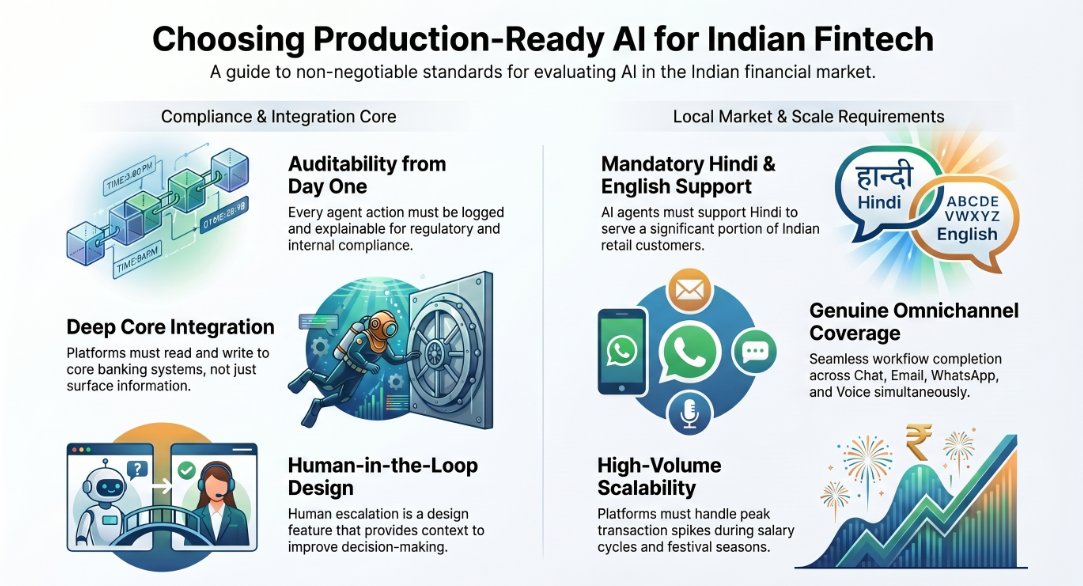
If you are evaluating an enterprise AI agent platform for a bank, NBFC, fintech, or financial operations context in India, these are the criteria that matter in production — not in demos.
Auditability from day one.
Every agent action must be logged, explainable, and retrievable. Regulators and internal compliance teams need to be able to trace any decision back to the data and rules that drove it. If an AI platform cannot give you a full audit trail out of the box, it is not production-ready for a regulated financial institution.
Genuine omnichannel coverage.
Chat, email, WhatsApp, and voice are all live channels in Indian banking. The platform needs to handle intake and workflow completion across all of them — not just one channel with the others as future roadmap items.
Hindi and English language support.
A significant proportion of banking customers in India interact in Hindi. An AI agent that only works reliably in English is not fit for the Indian retail banking context.
Deep integration with core systems.
The agent needs to read and write to core banking systems, CRMs, and compliance platforms — not just surface information. Shallow integrations that can read data but cannot update records or trigger workflows have limited operational value.
Human-in-the-loop architecture.
The best enterprise deployments do not try to remove humans entirely. They route to human agents at the right moment — with full context already assembled — so the human decision is faster and better informed. Platforms that treat human escalation as a failure mode rather than a design feature create compliance and operational risk.
Scalability without quality degradation.
Indian financial institutions deal with significant transaction volume spikes — salary cycles, tax periods, festival seasons. The agent platform needs to handle peak load without increasing response latency or reducing accuracy.
How Assistents deploys enterprise AI agents for fintech companies in India
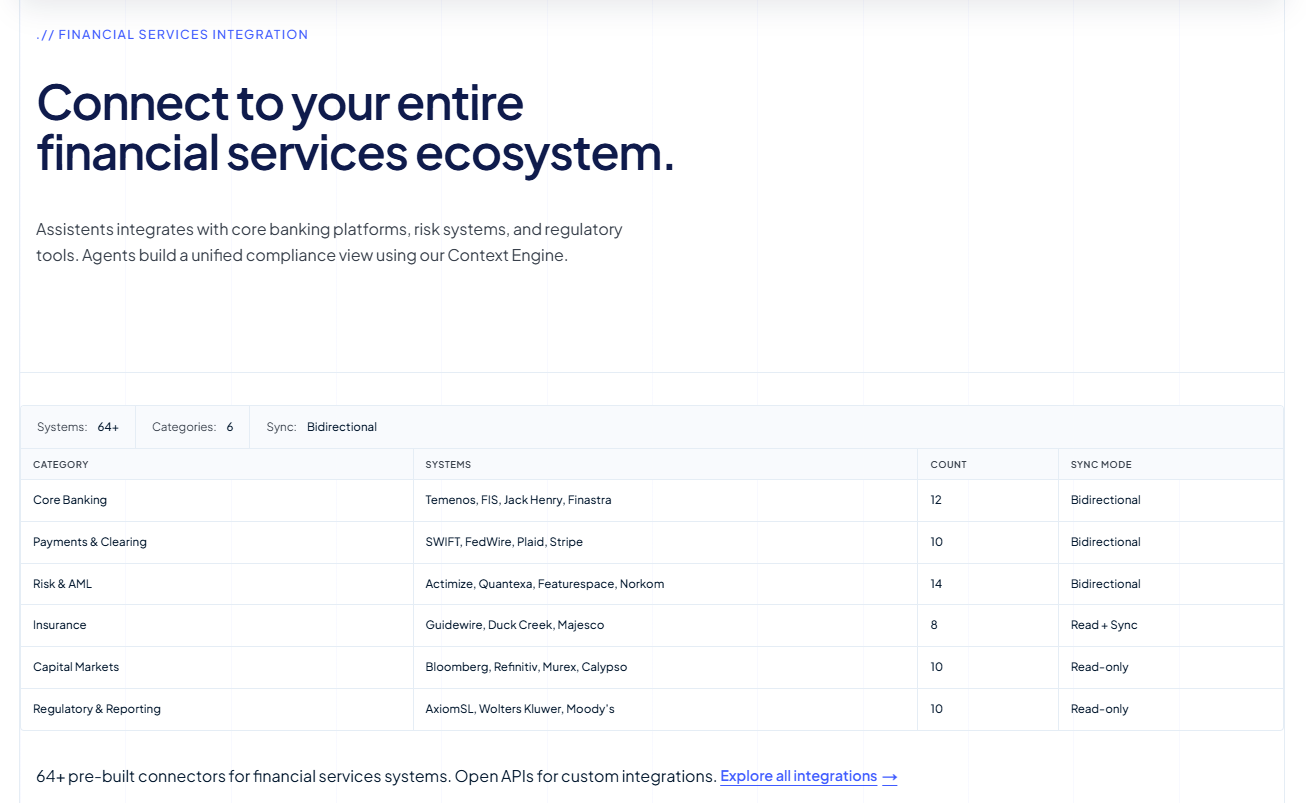
Assistents, built by Ampcome and headquartered in Bengaluru, is an enterprise AI agent platform with production deployments across financial services clients in India, the UAE, the United Kingdom, Australia, and the United States.
For financial services specifically, Assistents builds and deploys AI agents that handle omnichannel customer operations, compliance and audit workflows, loan processing automation, fraud and dispute resolution, and financial analytics — all with the auditability, governance, and integration depth that regulated institutions require.
Every deployment is built for production, not proof-of-concept. That means full integration with core banking systems, audit trails from day one, and a human-in-the-loop architecture designed so your compliance team can sign off on what the agents are doing.
If you are evaluating AI agents for your fintech, bank, or NBFC — and you want to see what production deployment actually looks like rather than a scripted demo — speak with the Assistents team.
FAQS
What is agentic AI in banking?
Agentic AI in banking refers to AI systems that autonomously execute multi-step financial workflows — such as KYC verification, fraud detection, dispute resolution, and compliance processing — without requiring human input at each step. Unlike traditional chatbots, agentic AI can take actions across multiple systems, apply contextual reasoning, and complete a workflow end-to-end with a built-in audit trail.
How is AI used in fintech in India?
AI is used across the full fintech stack in India: automating KYC and digital onboarding, detecting fraud in real-time transaction monitoring, handling customer support across chat, WhatsApp, and voice in Hindi and English, generating compliance reports, automating loan processing workflows, and providing CFO-level financial analytics. Enterprise AI agents are increasingly the operational layer running these workflows inside both fintech platforms and traditional banks.
What are AI agents in financial services?
AI agents in financial services are autonomous systems that can perceive context, make decisions, take actions across connected systems, and complete multi-step financial tasks with minimal human oversight. In practice, this means an AI agent can receive a fraud dispute, gather evidence, apply policy rules, take provisional action, and log the case — all as a single automated workflow rather than a series of separate human-touched steps.
Which companies use AI in Indian banking?
AI agents are deployed across a range of financial institutions in India — from global fintech providers and cloud-based banking platforms to NBFCs, credit unions, and retail financial services operations. Assistents by Ampcome has active production deployments across financial services clients in India, the UAE, the US, and the UK.
How does AI improve KYC in fintech?
AI improves KYC in fintech by automating document extraction, identity verification, liveness detection, and policy compliance checks — replacing manual review queues with an automated workflow that flags only genuine exceptions for human review. The result is faster onboarding, higher conversion rates, and a compliance record that is automatically maintained rather than assembled manually.
What is an omnichannel banking agent?
An omnichannel banking agent is an AI system that handles customer interactions across multiple channels — web chat, WhatsApp, email, and voice — from a single unified workflow engine. Rather than routing customers to different systems depending on the channel they use, an omnichannel agent maintains context across channels and routes cases to the right workflow regardless of how the customer initiates contact.
What is the difference between AI agents and chatbots in banking?
Chatbots respond to individual messages within a scripted set of paths. AI agents execute complete workflows across multiple systems, apply contextual reasoning, handle exceptions, and produce auditable outcomes. A chatbot can answer a customer's question about their balance. An AI agent can receive a dispute, investigate it, apply resolution logic, take action on the account, and generate a compliance record — autonomously.
What should I look for in an AI agent platform for fintech?
The key criteria are: full auditability of every agent action, genuine omnichannel coverage including voice, Hindi and English language support, deep integration with core banking systems, human-in-the-loop escalation architecture, and the ability to handle peak transaction volumes without performance degradation. Production-readiness for a regulated financial institution requires all of these — not just the ones that feature well in product demos.

Transform Your Business With Agentic Automation
Agentic automation is the rising star posied to overtake RPA and bring about a new wave of intelligent automation. Explore the core concepts of agentic automation, how it works, real-life examples and strategies for a successful implementation in this ebook.
Sarfraz Nawaz is the CEO and founder of Ampcome, which is at the forefront of Artificial Intelligence (AI) Development. Nawaz's passion for technology is matched by his commitment to creating solutions that drive real-world results. Under his leadership, Ampcome's team of talented engineers and developers craft innovative IT solutions that empower businesses to thrive in the ever-evolving technological landscape.Ampcome's success is a testament to Nawaz's dedication to excellence and his unwavering belief in the transformative power of technology.

More insights
Discover the latest trends, best practices, and expert opinions that can reshape your perspective




Contact us

