
AI Agent to Do Market Research: The Enterprise Guide to Continuous, Governed Intelligence (2026)


An AI agent to do market research is an autonomous system that continuously collects, analyses and acts on market signals — competitor moves, pricing shifts, consumer sentiment, category trends and regulatory changes — across the open web and your internal data, without a human sitting in the middle of every step. Unlike a chatbot that answers on demand, an enterprise-grade AI agent runs on its own schedule, cites its sources, respects your governance rules and pushes findings straight into the systems where decisions actually happen.
The category is moving fast. As of 2026, market research is one of the top three enterprise workflows where agentic AI is producing measurable value, and Gartner projects that roughly 40% of enterprise applications will embed task-specific AI agents by the end of the year. But most public content on this topic stops at a list of tools.
This guide goes further — it covers what these agents actually do, how they are architected, where they succeed and fail inside real enterprises, and how to deploy one in the next 90 days.
What is an AI agent for market research?
An AI agent for market research is a goal-directed AI system that plans a research task, uses tools to gather evidence from web and enterprise sources, reasons over what it finds, and delivers a governed output — a report, an alert, a ticket, a CRM update or a decision recommendation. It is autonomous within defined guardrails and it maintains memory across sessions.
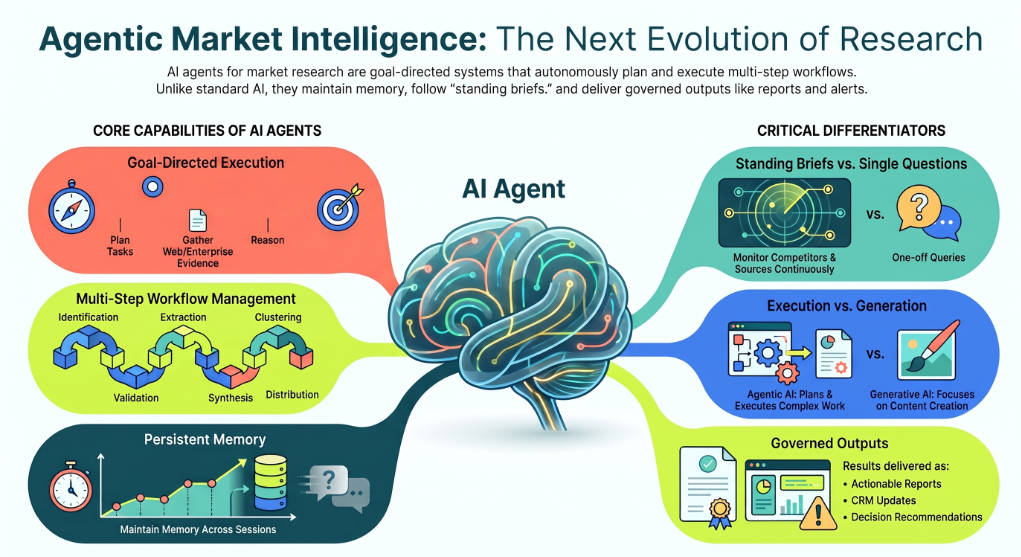
That last point is the key difference between an AI agent and a chatbot. A general-purpose model like ChatGPT or Perplexity produces a good answer to a single well-formed question, then forgets. An AI agent for market research works the other way: it holds a standing brief — "watch these five competitors, this pricing corridor and these ten review sources" — and reports what changed since last time, with links back to the evidence.
The other important distinction is between generative AI and agentic AI. Generative AI creates content. Agentic AI plans and executes multi-step work. Market research is inherently multi-step: identify sources, extract signals, cluster patterns, validate against internal data, synthesise, distribute. That is why agents outperform standalone LLMs on this workflow.
How does an AI agent do market research? A plain-English architecture
Every serious AI agent for market research has five layers. Skip any one of them and you are looking at a demo, not a system.
The perception layer is how the agent sees the world. It pulls signals from the open web — competitor sites, marketplaces, review platforms, filings, news, forums and social channels — from paid data sources like industry reports and panel data, and from your internal systems including BI dashboards, CRM, ERP, ticketing and document repositories. A well-built agent uses browser tools where structured APIs do not exist, and renders JavaScript pages the way a human researcher would.
The reasoning layer is where planning and tool use happen. The agent breaks a broad question — "what changed in our category this week" — into subtasks: scan pricing, check new launches, sample review sentiment, compare to last week's snapshot. Multi-agent orchestration matters here. One agent handles retrieval, another does extraction, another synthesises. This mirrors how a real research team works.
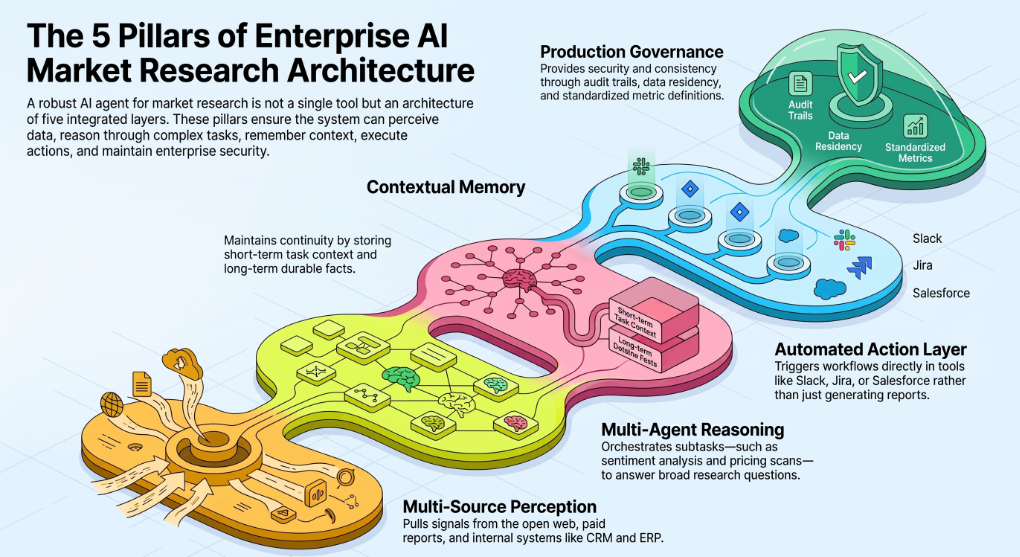
The memory layer gives the agent continuity. Short-term memory holds the current task context. Long-term memory holds durable facts — your positioning, your metric definitions, last month's competitor snapshots, the specific questions leadership asks every Monday. Without long-term memory, every run starts from zero.
The action layer is what makes an agent an agent instead of a report. When the analysis is done, the agent posts an alert to Slack or Teams, updates a Notion or Confluence page, opens a ticket in Jira, drafts an email, pushes a row into HubSpot or Salesforce, or triggers a workflow in your ERP. Insight without action is a dead artefact.
The governance layer is where enterprise-grade agents separate from consumer demos. This includes a semantic layer that keeps metric definitions consistent across teams, row-level security so users only see the data they are entitled to, maker-checker approvals for any action that touches a system of record, bring-your-own-key controls, data residency options, and a full audit trail that captures the prompt, the sources, the reasoning steps and the output for every run. This layer is usually invisible in demos and always mandatory in production.
Ten use cases where an AI agent does market research better than a human team
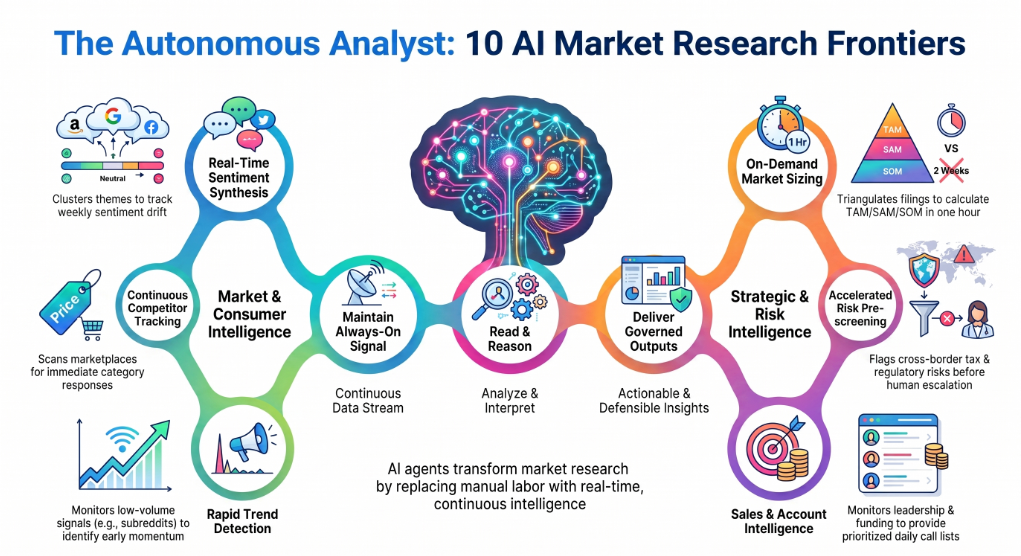
Every use case below is live in production somewhere. The pattern is the same: an always-on signal, an agent that reads and reasons, a governed output.
1. Continuous competitor tracking across pricing, promos and launches
The agent scans competitor product pages, marketplaces and paid channels on a set cadence, detects changes in MRP, discount, bundle, availability and rating, and alerts category managers with a diff and a recommended response.
2. Real-time consumer sentiment and review synthesis
The agent samples reviews across Amazon, Google, Trustpilot, category-specific forums and social channels, clusters recurring themes, tracks sentiment drift week over week and flags outliers that need investigation.
3. Market sizing on demand — TAM, SAM, SOM
The agent triangulates public reports, filings, funding data and third-party datasets, runs the sizing math and generates a defensible market size with cited sources — in an hour, not a fortnight.
4. Trend detection across social, forums, search and news
Rather than reacting to trends after they are mainstream, the agent monitors low-volume signals — subreddit spikes, changelog updates, Product Hunt launches, niche newsletter mentions — and flags the ones with momentum.
5. Pricing intelligence and MRP monitoring across channels
For retailers and consumer brands, the agent watches SKU-level pricing across every channel where the product is sold, detects unauthorised discounts, MAP violations and stockouts, and pushes exceptions to the right owner.
6. Brand and category signal synthesis for campaign strategy
For creative and campaign teams, the agent unifies performance data, audience signals and cultural context into a single "what to say next" recommendation, replacing weeks of manual synthesis.
7. Regulatory and tax research with early risk pre-screening
For finance and legal teams, the agent pre-screens transactions for cross-border tax risk — withholding, VAT mismatches, permanent establishment triggers — and escalates only the flagged ones to human specialists.
8. Investor and diligence research on a target company
For corporate development and PE teams, the agent compiles a first-pass company profile, product-market fit assessment, technical risk register and market position summary from public sources.
9. Sales and account intelligence
For revenue teams, the agent monitors named accounts for buying signals — leadership changes, funding, product launches, hiring patterns — and hands sales a prioritised call list every morning.
10. Category research for procurement and sourcing
For supply and procurement teams, the agent automates RFQ preparation, supplier discovery, price and lead-time benchmarking and vendor risk scoring.
AI agent vs deep research tool vs survey AI: which do you actually need?
Three categories of tools show up in every AI-for-market-research conversation. They solve different problems and buying the wrong one is expensive.
Deep research tools — ChatGPT with browsing, Perplexity, Gemini Deep Research, Claude with tool use. Excellent for one-off, ad-hoc questions. A founder validating a hypothesis, an analyst prepping for a meeting, a marketer scoping a launch. They have no persistent memory, no connection to your systems, no governance and no scheduled runs. Use them for exploration, not for operations.
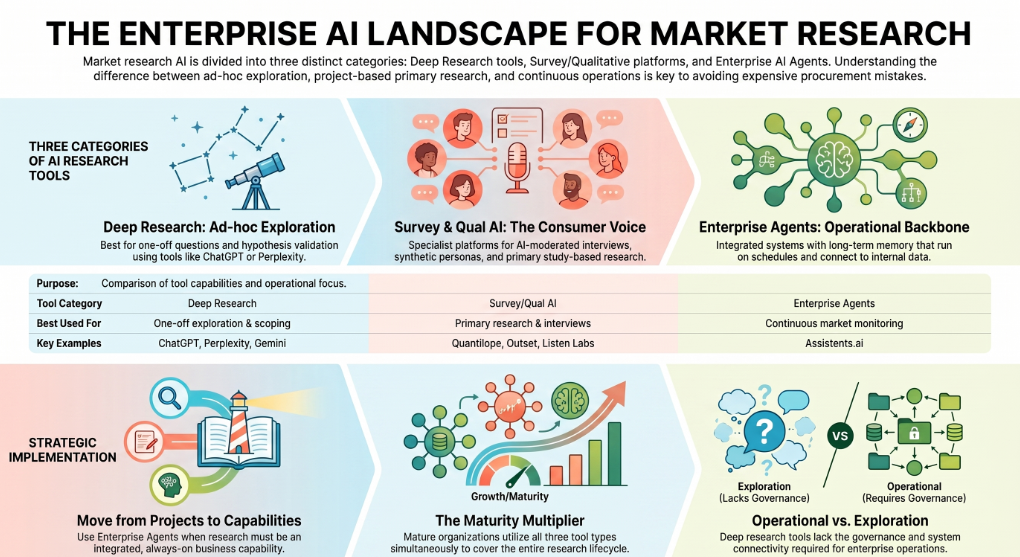
Survey and qualitative AI platforms — Quantilope, Outset, Listen Labs, GWI and similar. Excellent when you need primary research: AI-moderated interviews, synthetic personas, survey design, transcript analysis. They are respondent-first and study-based. Use them when you need consumer voice, not when you need continuous market monitoring.
Enterprise AI agents — Assistents.ai and category peers. These sit inside your enterprise stack, hold long-term memory of your business, run on a schedule, connect to both the open web and your internal data, and deliver governed outputs into your systems of record. Use them when market research is an operating capability, not a project.
Most mature organisations end up using all three. Deep research tools for exploration, survey platforms for structured primary research, and an enterprise AI agent as the always-on backbone.
What separates an enterprise-grade market research agent from a demo — an eight-point checklist
Any vendor can show a slick demo. Buyers who deploy in regulated industries — banking, healthcare, energy, retail, ports — check for these eight things before they sign.
- Grounded outputs with source citations. Every claim links back to a URL, a document, a SQL query or a system record. Hallucinated summaries are not acceptable.
- Semantic layer. Metric definitions — revenue, gross margin, category share, active user — are defined once and used consistently across every agent, dashboard and question.
- Row-level security and role-based access. A regional manager sees only their region's data. Finance sees the numbers marketing does not. The agent respects these permissions in every response.
- Maker-checker approvals. Any action that touches a system of record — a CRM update, a ticket, a customer email — is drafted by the agent and approved by a human, with the approval logged.
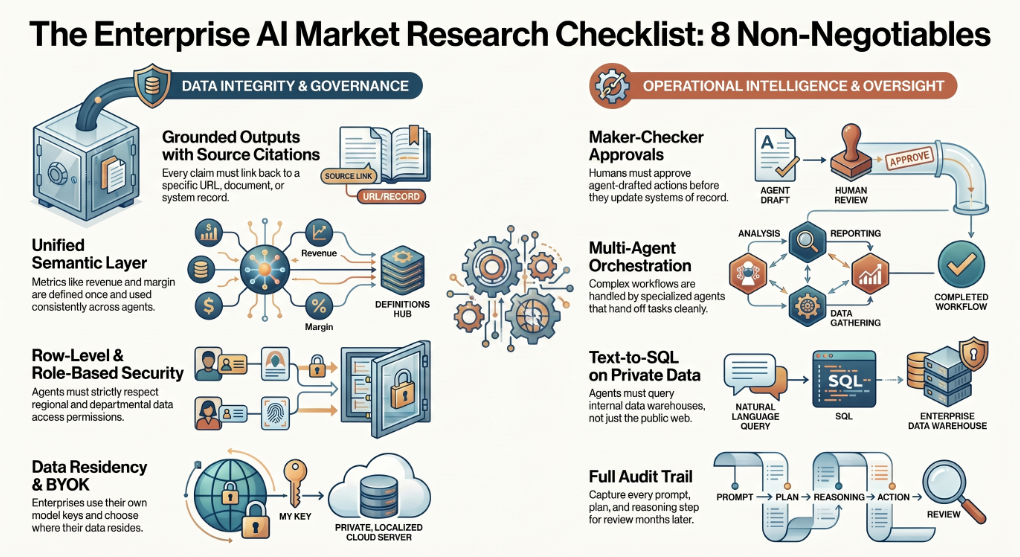
- Bring-your-own-key and data residency. Enterprises use their own model keys and choose where data sits. This is non-negotiable in BFSI, healthcare and government.
- Multi-agent orchestration. Complex research is broken across specialist agents that hand off cleanly. Single-agent systems collapse on real workflows.
- Text-to-SQL over your own data. The agent can answer business questions against your data warehouse in natural language, not only against the public web.
- Full audit trail. Every run captures the prompt, the plan, the sources retrieved, the reasoning and the output — reviewable months later.
Save this checklist. Send it to every vendor you evaluate.
Real deployments — what an AI agent for market research looks like in production
Feature lists tell you what a platform claims. Deployments tell you what actually ships. The examples below are drawn from live enterprise engagements across consumer durables, capital markets, brand strategy, tax, retail and cross-border compliance. Client names are withheld under confidentiality; the workflows are described exactly as they run.
Consumer durables — competitive monitoring at national scale. A leading HVAC and consumer-durables manufacturer needed continuous visibility into competitor pricing, promotions, MRP shifts, discounts, availability and ratings across every marketplace and e-commerce channel where its products are sold. An agentic system now runs continuous scans, converts raw signals into leadership-facing answers — "what changed for competitor X this week", "where are we losing on price in this category" — and pushes proactive alerts when gaps open. Always-on monitoring has replaced manual portal-hopping. Competitive response cycles are faster and pricing and promo shifts are identified earlier.
Capital markets research — automation at analyst scale. A market research and technical analysis platform serving Indian markets needed to scale data ingestion and indicator computation across a broad universe of instruments. An AI-powered research pipeline now ingests market data, runs pattern and indicator analysis, produces thematic dashboards and drafts research summaries. The team ships faster market insight packs, research workflows are more repeatable, and analysts spend time on interpretation instead of data plumbing.
Brand insights studio — signal synthesis for creative strategy. A brand-insights firm led by senior ex-Google leaders needed to unify creative, performance and audience data into decision-ready recommendations for enterprise marketing teams. An insight-generation agent now consumes multi-source signals, produces themes, narratives and next-best-action recommendations, and delivers weekly reporting packs to brand leadership. Creative-strategy cycles are faster, cross-channel synthesis is deeper, and campaign owners get consistent clarity on what to do next.
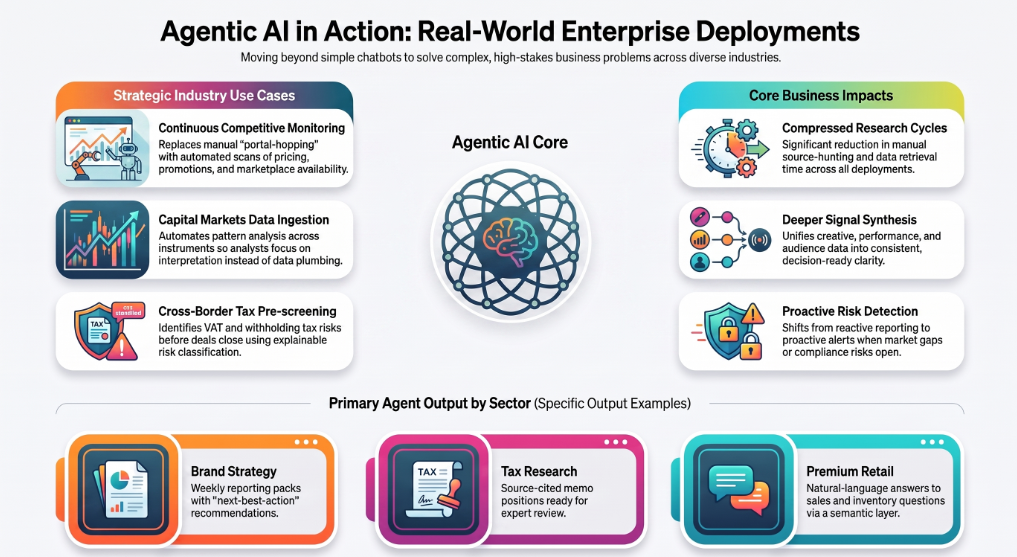
Tax research automation — source-cited drafting at scale. A specialised sales-and-use tax research product needed to compress the time tax professionals spend hunting sources and drafting positions. An automated pipeline now retrieves relevant statutes, rulings and secondary sources, summarises them with citations, and drafts memo positions ready for expert review. Research cycles are shorter, documentation hygiene is cleaner and manual source-hunting time has fallen materially.
Premium home appliances retail — natural-language analytics. A UAE-based premium kitchen and home-appliance retailer needed leadership to get instant answers from its e-commerce and operational data without waiting on BI queues. A governed AI Data Analytics Agent now answers business questions in natural language across sales, product, inventory, promotion and behaviour data, powered by a semantic layer that keeps definitions consistent. The team gets shorter analysis cycles for recurring questions, better visibility into product and promo performance, and reduced reporting dependency on analysts.
Cross-border tax pre-screening — risk detection before deals close. A UK-based tax technology product needed early screening of cross-border transactions for risks like withholding tax, VAT mismatches and permanent establishment exposure. An agentic screening workflow now runs risk classification with explainability notes, collects supporting evidence and escalates flagged items to human tax specialists. Withholding and VAT risk is detected earlier, last-minute deal disruptions are reduced, and pre-compliance review is faster and more consistent.
None of these deployments is a chatbot bolted onto an old workflow. Each is a governed agent embedded in the operating rhythm of the business.
How to deploy an AI agent for market research — a 30/60/90-day playbook
Most agentic AI programmes fail because organisations try to do too much at once. This playbook is the shortest path from idea to production value.
Days 1–30: pick one bounded workflow and prove the loop. Choose a research task that repeats — weekly competitive monitoring, monthly category review, quarterly market sizing. Connect two data sources: one external (the web or a market data feed) and one internal (a BI dashboard or CRM). Define the semantic layer for the metrics involved so definitions do not drift. Deliver the first output to a small group of stakeholders and gather feedback.
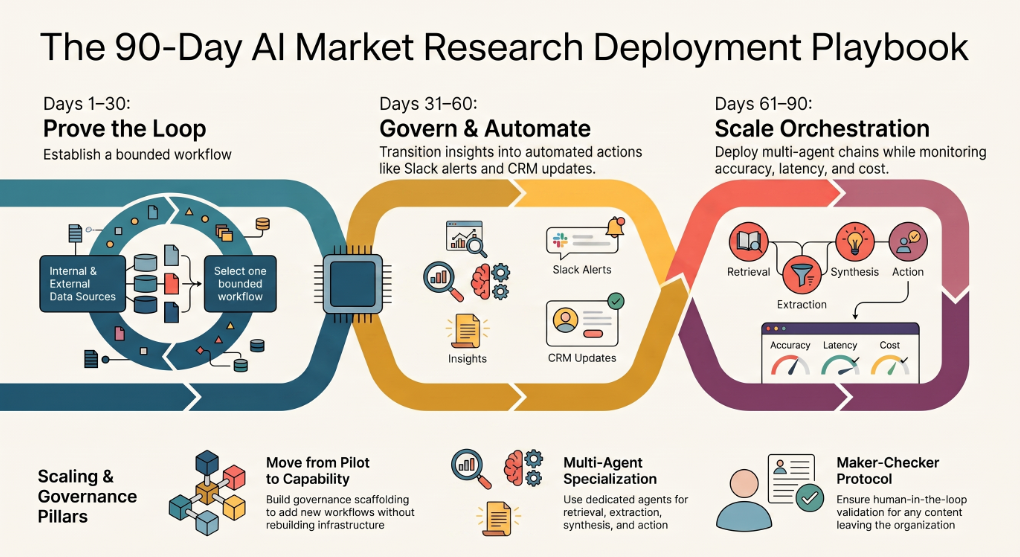
Days 31–60: add governed actions and expand the audience. Move from insight to action. The agent now not only reports but pushes alerts to Slack or Teams, opens tickets, updates CRM records and drafts customer-facing communications. Turn on maker-checker for anything that leaves the building. Enable row-level security so different teams get different views. Add a second workflow adjacent to the first.
Days 61–90: orchestrate, monitor and scale. Introduce multi-agent orchestration — a retrieval agent, an extraction agent, a synthesis agent, an action agent — so complex research chains run cleanly. Stand up monitoring for accuracy, latency and cost. Formalise the audit trail. Pick the next two workflows and repeat.
By day 90 you have a running operating capability, not a pilot. And you have the governance scaffolding to add ten more workflows without rebuilding.
Why Assistents.ai by Ampcome is built for enterprise AI agents in market research
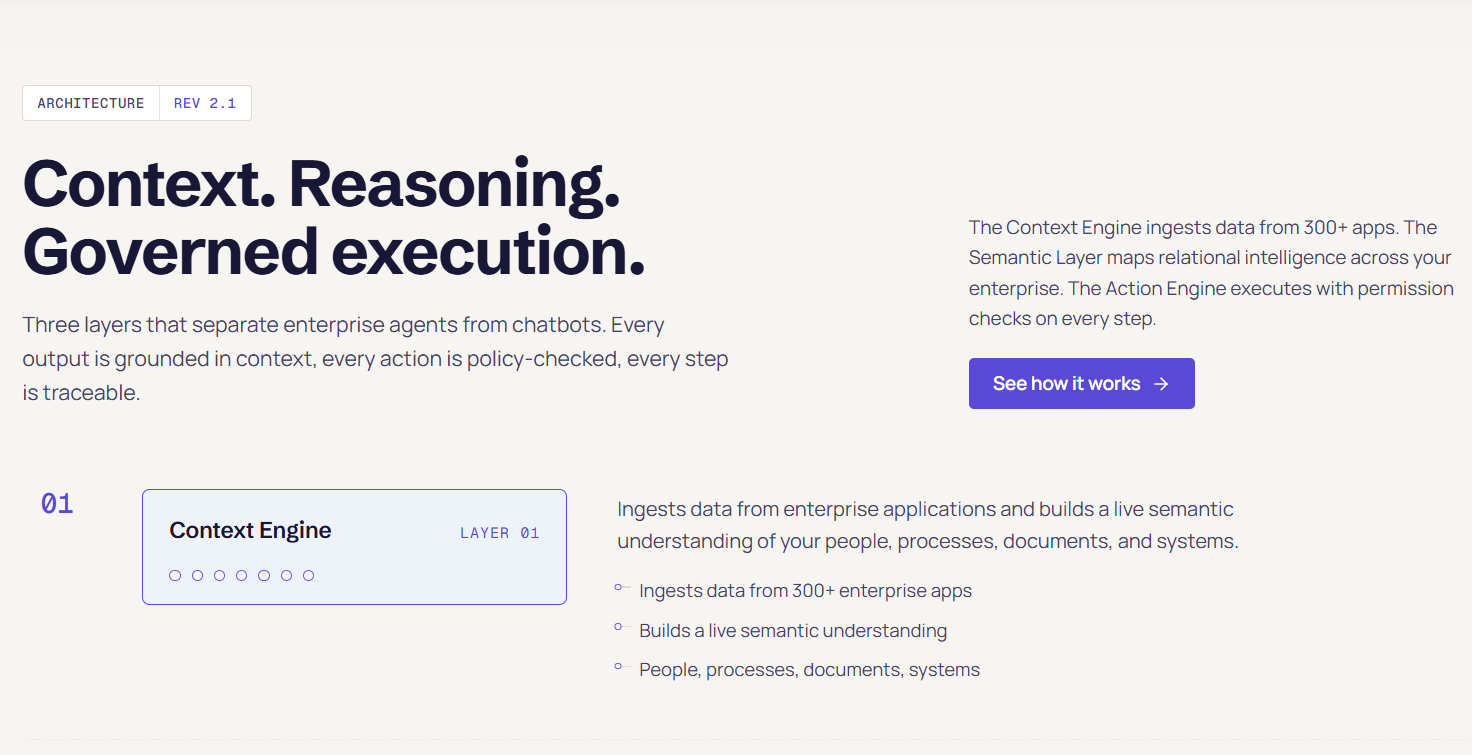
Measured against the eight-point checklist above, this is how Assistents.ai lines up.
Governed by design. Semantic layer, row-level security, maker-checker approvals and full audit trails ship in the box, not as later add-ons. Regulated buyers evaluating on governance stop being blocked in procurement.
Multi-agent orchestration. The App Builder and Workflow engine coordinate research, extraction, synthesis and action agents across your BI, CRM, document repositories and the open web. Complex workflows run as coordinated chains rather than single monolithic prompts.
Grounded, cited answers. Every output ties back to a source — a URL, a document, a SQL query or a system record. Leadership can trust the number because it can trace the number.
Bring-your-own-key and deploy-anywhere. Cloud, VPC or on-premise deployment, with model choice and data residency in your control. This matters for BFSI, healthcare, energy and government buyers who cannot ship data to a shared model endpoint.
From insight to action. Assistents does not stop at a report. It opens the ticket, updates the CRM, drafts the response, alerts the buyer — all within governed guardrails and reviewable via the audit log.
Proven across verticals. Production deployments span consumer durables, retail, capital markets, tax and finance, real estate, ports and logistics, energy, healthcare and education — see the anonymised deployments above.
The result is an enterprise AI agent that treats market research as a continuous operating capability, not a one-off report.
See how Assistents.ai runs continuous market research inside your enterprise — book a walkthrough with the Ampcome team.
The next 12 months — where AI agents for market research are heading
Three shifts to plan for as of 2026.
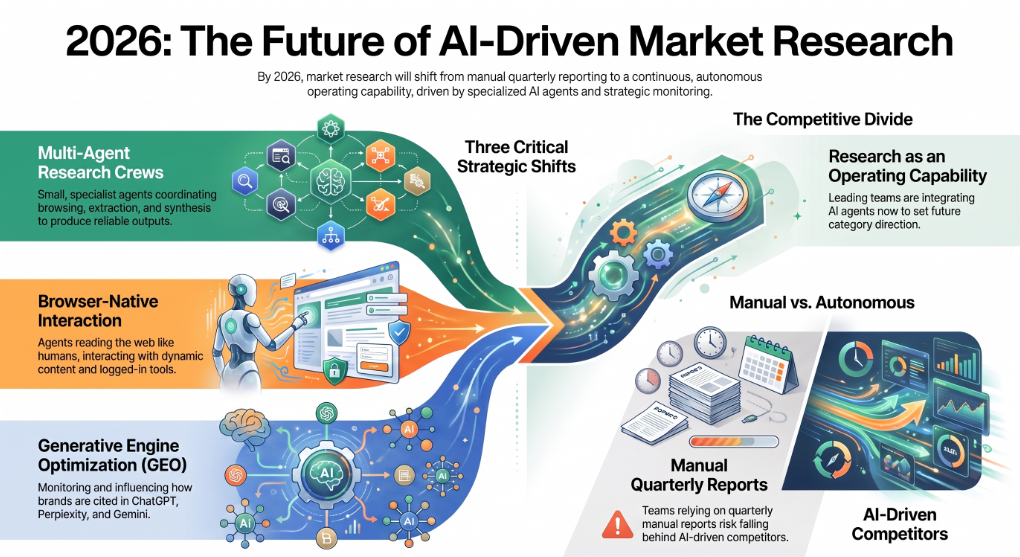
Multi-agent research crews will become the default. Rather than one large agent trying to do everything, teams are moving to small, specialist agents that coordinate — one that browses, one that extracts, one that synthesises, one that acts. This mirrors how research teams actually work and produces more reliable outputs.
Browser-using agents will read the web the way humans do. Structured APIs cover only a fraction of the sources that matter. Browser-native agents can visit any page, render dynamic content and interact with logged-in tools. Expect the boundary between "public web research" and "any-tool research" to blur.
Generative Engine Optimization will become a first-class research target. Enterprises will not only monitor how they rank on Google — they will monitor how they are cited in ChatGPT, Perplexity, Gemini and Google AI Overviews, and their AI agents will feed insights back into content and positioning strategy.
The teams that treat AI-driven market research as an operating capability now will be the ones setting category direction in twelve months. The teams still running quarterly manual reports will be the ones reading about it.
FAQs
What is an AI agent for market research?
An AI agent for market research is an autonomous system that plans and runs research tasks — collecting signals from the web and internal data, analysing them, and delivering governed outputs like reports, alerts and system updates — without a human driving every step.
Can AI agents replace market researchers?
No. AI agents replace the manual grunt work of collection, extraction and first-pass synthesis. Humans still own the strategic interpretation, cultural nuance and judgement calls. In practice, teams that adopt agents do more research, not less, because the marginal cost per study drops.
What is the best AI agent for market research?
The best fit depends on whether you need ad-hoc exploration (deep research tools like ChatGPT or Perplexity), structured primary research (survey platforms like Quantilope or Outset), or continuous, governed enterprise intelligence (Assistents.ai). Most mature teams use all three.
How do AI agents do competitor analysis?
They monitor competitor sites, marketplaces, review platforms, filings and social channels on a schedule; extract signals like pricing, launches, messaging and sentiment; compare against last week's snapshot; and alert stakeholders when meaningful changes occur.
Is there a free AI agent for market research?
Yes for exploration — Perplexity, ChatGPT and Gemini all have free tiers useful for ad-hoc research. Enterprise-grade agents that run continuously, respect governance and connect to internal systems are paid, because they need to run on your infrastructure and integrate with your stack.
How much does an AI market research agent cost?
Ad-hoc tools start free. Continuous SaaS competitive-intelligence tools range from tens to a few hundred dollars per user per month. Enterprise agentic platforms are typically priced by workflow, users or usage, with total cost of ownership often lower than adding equivalent research headcount.
How accurate are AI agents at market research?
Accuracy depends on grounding, source quality and governance. Well-designed agents cite every claim, filter noisy web content and defer to human review for high-stakes calls. Ungoverned agents that summarise without citations should not be trusted for enterprise decisions.
What data sources do market research AI agents use?
Web sources — competitor sites, marketplaces, reviews, forums, social, news, filings. Paid sources — industry reports, panel data, market feeds. Internal sources — BI, CRM, ERP, ticketing, documents. The best agents mix all three.
How is an AI agent different from ChatGPT for research?
ChatGPT is a general-purpose model that answers a well-formed question in a session, then forgets. An AI agent maintains standing briefs, runs on a schedule, connects to your systems, respects governance and pushes outputs into your workflow.
Are AI market research agents safe for enterprise use?
They can be, if they include a semantic layer, row-level security, maker-checker approvals, bring-your-own-key, data residency controls and a full audit trail. Without those, they are risky. With them, they are safer than most existing manual processes.

Transform Your Business With Agentic Automation
Agentic automation is the rising star posied to overtake RPA and bring about a new wave of intelligent automation. Explore the core concepts of agentic automation, how it works, real-life examples and strategies for a successful implementation in this ebook.
Sarfraz Nawaz is the CEO and founder of Ampcome, which is at the forefront of Artificial Intelligence (AI) Development. Nawaz's passion for technology is matched by his commitment to creating solutions that drive real-world results. Under his leadership, Ampcome's team of talented engineers and developers craft innovative IT solutions that empower businesses to thrive in the ever-evolving technological landscape.Ampcome's success is a testament to Nawaz's dedication to excellence and his unwavering belief in the transformative power of technology.

More insights
Discover the latest trends, best practices, and expert opinions that can reshape your perspective






Contact us

