
30+ AI Agents in Production Examples: Real Enterprise Deployments Across 12 Industries (2026)


Only about 5% of enterprise AI agents ever reach production. The other 95% die somewhere between the impressive demo and the compliance review. That gap — between "this is amazing" and "this is running our business" — is the defining challenge of enterprise AI in 2026.
But some agents are shipping. Real ones. Across every continent, every industry, and every scale of company. They are triaging invoices at global manufacturers, taking voice calls in 700+ retail stores, running competitor pricing intelligence across HVAC portfolios, digitising terminal operations at major ports, and answering financial queries in the offices of Silicon Valley operators.
This post is a catalog of 30+ AI agents in production examples — real enterprise deployments we've helped ship — with the architectural patterns, deployment lessons, and cross-industry signals that separate the systems that stuck from the pilots that stalled.
Every example below is a live production deployment. Every one is anonymized to protect client confidentiality, but the industry, scale, and workflow are exactly as delivered.
What "AI Agents in Production" Actually Means
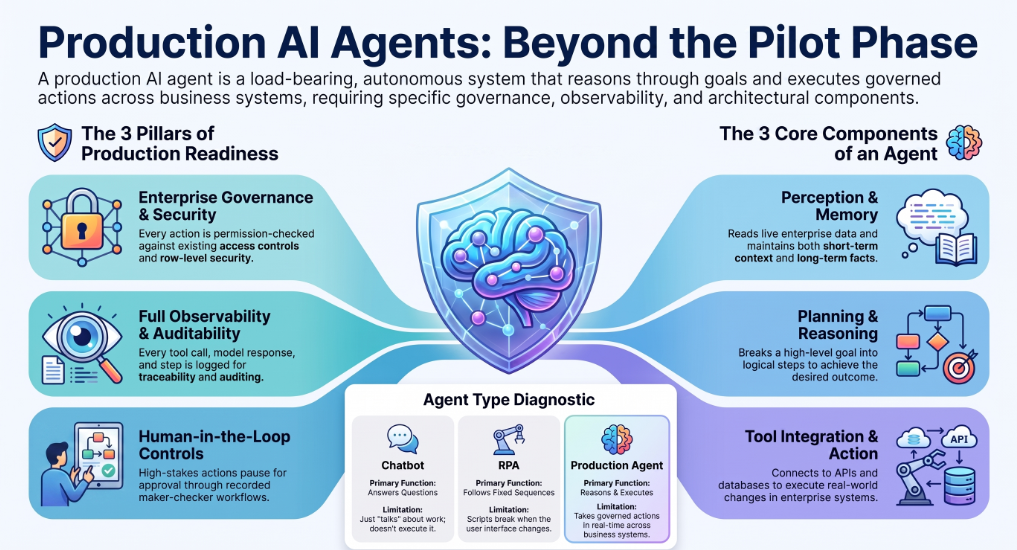
An AI agent in production is an autonomous or semi-autonomous software system that reads live enterprise context, reasons through a goal, takes governed actions across real business systems, and does so reliably enough that a business depends on it every day. Production means the agent is not a demo — it is running, monitored, audited, and load-bearing.
The distinction matters because a lot of what gets called "an AI agent" is really a chatbot with a wrapper, or a workflow with an LLM stapled to it. Production changes the definition. Production adds five things pilots don't have.
Production vs pilot: what production actually adds
First, governance — every action the agent takes is permission-checked against the same access controls that exist in the source systems. Second, observability — every step, every tool call, every model response is logged and traceable. Third, human-in-the-loop and maker-checker workflows — high-stakes actions pause for approval and every approval is recorded. Fourth, row-level security — the agent sees only what the requesting user is authorized to see. Fifth, reliability under load — the agent doesn't quietly hallucinate when volume spikes at month-end.
Anything missing one of these five is a pilot. Anything with all five is in production.
How production AI agents differ from chatbots, copilots, and RPA
Chatbots answer. Copilots suggest. RPA scripts follow a fixed sequence and break when the UI changes. Production AI agents perceive live context, reason across multi-step workflows, call tools to execute real actions in real systems, and know when to escalate to a human — all inside a governance envelope.
The clearest test: does the agent complete the work, or just talk about it? A support bot that answers "your order shipped on Tuesday" is a chatbot. A support agent that reads the order, applies the refund policy, processes the refund in the payment system, updates the CRM, sends the confirmation email, and logs an audit trail is a production AI agent.
The six components every production AI agent has
Perception (reads live data from enterprise systems), memory (short-term context and long-term facts), planning and reasoning (breaks the goal into steps), tool integration (calls APIs, databases, and enterprise systems), action execution (writes back changes), and governance (permission checks, audit logs, escalation logic). Strip any one out and the agent fails in production.
How to Read These AI Agents in Production Examples
Each of the 30+ examples below is presented with the same lens: what the client industry and scale looked like, what workflow the agent was built to run, what shipped in production, and what pattern the deployment reveals. All client names are anonymized. Where the outcome was engineered against a target (say, 90% faster tender processing), we describe it as such — not as a fabricated hard number.
Read them by industry section, or scan for the pattern most relevant to your workflow. At the end, we synthesize the cross-industry patterns that keep repeating.
AI Agents in Production Examples: Financial Services and Fintech
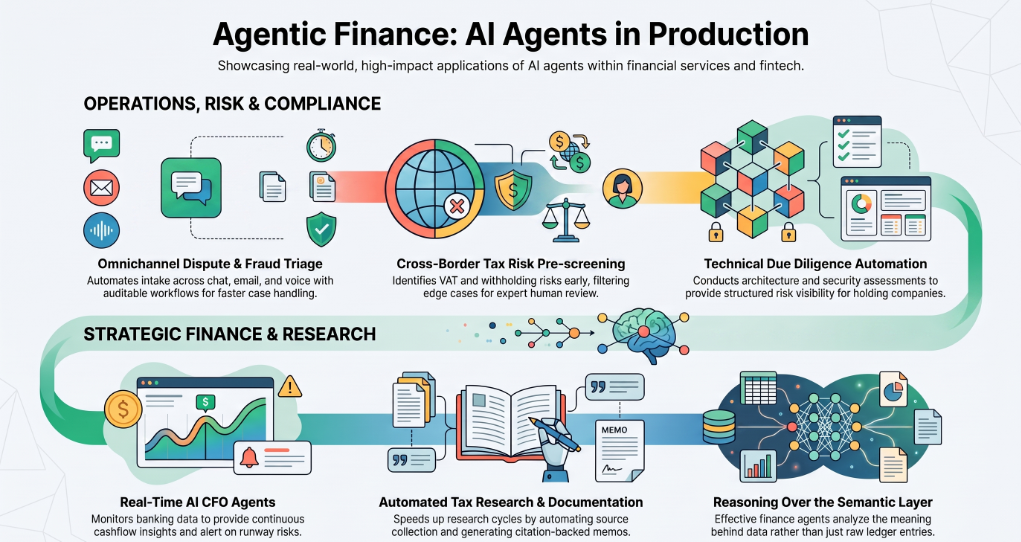
Financial services is one of the most mature domains for production AI agents — and one of the least forgiving. Every action needs an audit trail, every decision needs a human escalation path, and every deployment needs to survive both regulatory scrutiny and volume spikes at quarter-end.
1. Omnichannel banking dispute and fraud triage agent for a global fintech
The client is a global fintech provider delivering cloud-based automation and pragmatic AI for banks and credit unions. The workflow: omnichannel intake across chat, email, and voice; agent-assist summarization; next-best-action recommendations; auditability and SLA monitoring; integration-ready connections to core banking systems.
What shipped: an omnichannel AI agent for banking support with auditable workflow automation, delivering faster case handling, reduced operational load, and better compliance readiness through structured audit trails. The pattern: in regulated finance, the audit trail is not overhead — it is the product.
2. Real-time AI CFO agent for growing businesses
The client is a global AI CFO platform for CFOs, advisors, and growing companies. The workflow: connect to accounting and banking data exports; run forecast and scenario modelling agents; alert on runway and cash risk; provide portfolio views for advisors managing multiple clients.
What shipped: an AI CFO agent that delivers continuous cashflow insight, forecasting, and actionable finance guidance — enabling earlier detection of cash anomalies and scalable advisory-like insight without added headcount. The pattern: agentic finance works when the agent reasons over the semantic layer, not just the raw ledger.
3. Cross-border tax risk pre-screening agent
The client is a UK tax-tech product focused on early screening of cross-border transactions for risks like withholding tax, VAT mismatches, and permanent establishment issues. The workflow: transaction screening; risk classification; evidence collection with explainability notes; escalation to tax experts for edge cases.
What shipped: an AI agent for tax research and pre-screening that identifies cross-border risk early and speeds up deal workflows — with earlier detection of withholding and VAT risk, fewer last-minute deal disruptions, and faster pre-compliance review. The pattern: in tax and compliance, the value is not in replacing the expert — it is in filtering what the expert needs to look at.
4. Technical due diligence agent for a holding company
The client is a long-term holding company partnering with founders and family businesses. The workflow: code and architecture review; infrastructure and security assessment; scalability and resilience analysis; integration readiness; risk register with remediation roadmap.
What shipped: a technical due diligence agent for mobile banking and fintech targets — providing faster investment decisions with structured tech risk visibility, reduced post-deal surprises via remediation planning, and improved confidence in scalability and security posture. The pattern: due diligence is a natural fit for agentic workflows because the checklist is well-defined but the reasoning across systems is not.
5. AI tax research automation agent
The client is a specialised sales and use tax research automation tool built for tax professionals. The workflow: automated source collection; summarisation with citations; draft memo and position output generation; workflow tracking and knowledge base building.
What shipped: an AI tax research automation agent that speeds up research cycles, reduces manual source-hunting time, and produces more consistent research outputs with documented citations. The pattern: any expert workflow with high research overhead and structured outputs is ripe for agentic acceleration.
AI Agents in Production Examples: Retail and E-Commerce
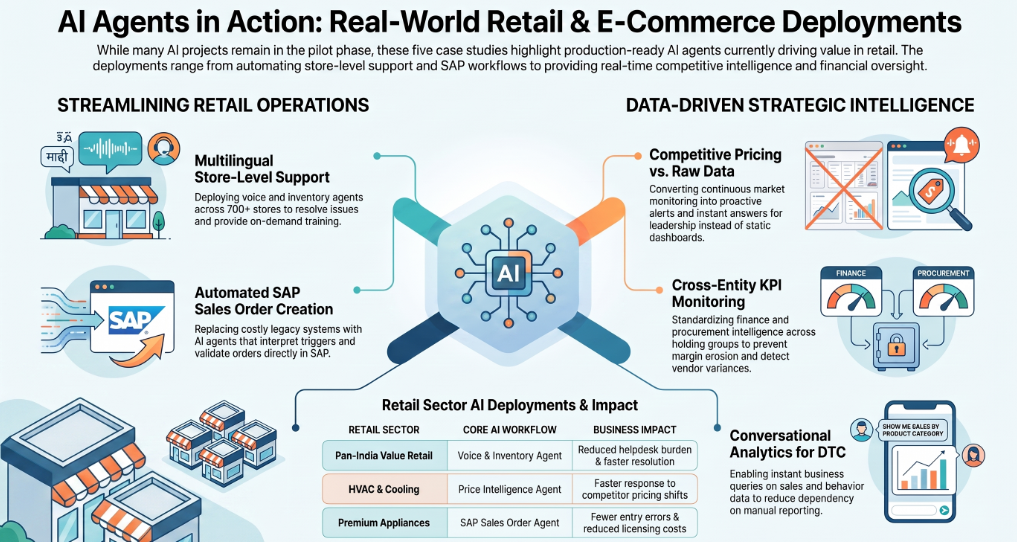
Retail was one of the earliest industries to move AI agents into production because customer-facing workflows are high-volume, high-cost, and well-understood. The examples below span three-language voice support, competitor price monitoring, and full SAP sales-order automation.
6. Voice, inventory, and knowledge agent across 700+ retail stores
The client is a rapidly scaling pan-India value retail chain with a pan-India footprint of 700+ stores across hundreds of cities, serving mass-market consumers across apparel, general merchandise, and FMCG. The workflow: voice support agent using STT-LLM-TTS in Hindi and English; inventory intelligence agent with per-store pricing, stock, and promo context; knowledge and training agent using RAG over POS and SOP documents; admin console with analytics and ticketing integration.
What shipped: enterprise AI agents modernising store support, inventory visibility, and knowledge access at national retail scale — engineered for reduced manual helpdesk burden, faster store issue resolution, improved store-level inventory visibility, and faster onboarding via on-demand training guidance. The pattern: at 700+ stores, the challenge is not intelligence — it is per-store governance, multilingual coverage, and consistent per-location context.
7. Competitor pricing intelligence agent for an HVAC leader
The client is a major Indian HVAC and cooling player founded in 1943, competing in highly price-sensitive consumer and commercial cooling markets where competitor visibility and pricing moves matter daily. The workflow: continuous e-commerce and channel monitoring for pricing, MRP and discounts, offers, availability, and ratings; agentic Q&A mapped to leadership questions; analytics for pricing gaps, threats, and portfolio movement; scalable architecture from PoC to production with governance and audit trails.
What shipped: AI agents for competitive monitoring that convert market signals into instant answers and proactive alerts, delivering faster competitive response cycles, earlier identification of pricing gaps and promo shifts, and always-on monitoring replacing manual portal checks. The pattern: in price-sensitive categories, agents that convert monitoring into pre-answered leadership questions dominate agents that dump raw data into dashboards.
8. E-commerce data analytics agent for a high-velocity vape retailer
The client is a UK vape distribution and e-commerce operation, claiming one of the largest selections of e-liquids with 800+ flavours and broad hardware coverage. The workflow: data ingestion across sales, products, inventory, promotions, and customer behaviour; conversational analytics for instant business queries; automated KPI monitoring and exception alerting.
What shipped: an AI Data Analytics Agent enabling rapid decision-making from e-commerce and operations data — with shorter analysis cycles for recurring questions, better visibility into product performance and promo effectiveness, and reduced reporting dependency on analysts. The pattern: DTC operators live on daily numbers, and any question that gets asked twice a week should be an agent, not a report.
9. Automated SAP sales order agent for a premium appliance retailer
The client is a premium UAE kitchen and home-appliances retailer under a major regional group, known for built-in appliance leadership and global brands. The workflow: agentic automation to interpret order triggers, validate, and create SAP Sales Orders; rules and governance for exceptions and approvals; audit logs and reconciliation reporting; integration-ready replacement for OpenText ECR workflows nearing end-of-life.
What shipped: automated SAP sales order creation via agentic AI as part of transition away from a costly OpenText ECR environment — delivering reduced manual order processing, faster order-to-confirm cycles with fewer data-entry errors, and improved auditability for SO creation and exceptions. The pattern: when legacy licensing costs balloon, agentic AI is often a cleaner replacement than the incumbent's next upgrade.
10. Cross-entity KPI alert agent for a retail holding environment
The client is a privately-held Indian retail holding environment where leadership needs governed, cross-functional intelligence across systems and documents to move from insight to action quickly. The workflow: group-wide KPI standardisation; automated alerts on purchase price trends, GM impact, early-payment analysis for notional finance cost, and vendor performance across delivery and returns; dashboards with scheduled insight packs for leadership.
What shipped: automated procurement and finance KPI alerts across group entities for margin control, vendor performance, and working-capital optimisation — with earlier detection of margin erosion, standardised finance and procurement intelligence across entities, and reduced variance surprises through continuous monitoring. The pattern: multi-entity groups need the semantic layer to standardise definitions before the agent can produce insights that survive board-level scrutiny.
AI Agents in Production Examples: Manufacturing, Construction, and Pharma
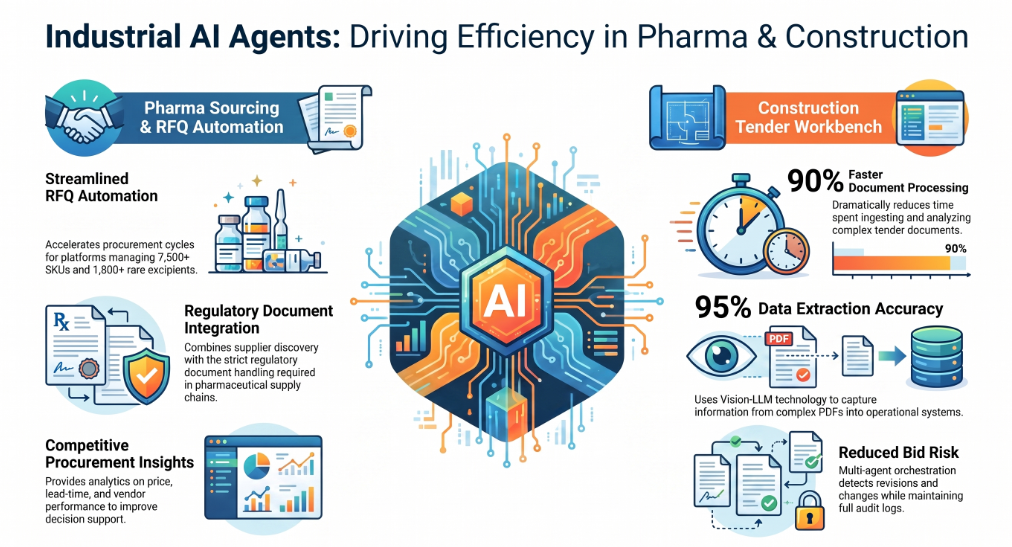
These industries are heavy on structured document processing, supplier coordination, and workflow depth. The agents that ship here are less about conversational fluency and more about accuracy under load.
11. Pharma sourcing and RFQ automation agent
The client is a pharma sourcing and excipients platform marketing 1,800+ rare excipients and 7,500+ SKUs, focused on simplifying procurement and discovery for pharma supply chains. The workflow: RFQ automation with supplier matching workflows; quality and regulatory document handling support; analytics on price, lead-time, and vendor performance.
What shipped: an AI agent for pharma sourcing that automates RFQs, supplier discovery, and procurement decision support — delivering faster procurement cycles, reduced vendor coordination overhead, and better price and lead-time competitiveness through insights. The pattern: procurement agents win when they combine supplier discovery with the regulatory document handling that pharma requires.
12. Multi-agent tender workbench for remedial construction
The client is an Australian waterproofing diagnostics, remediation, and commercial works specialist with 20+ years in remedial building services, known for rapid, high-integrity delivery on complex projects. The workflow: intelligent document workbench with multi-agent orchestration; tender retrieval, workflow determination, and revision analysis; vision-LLM extraction from complex PDFs; deep CRUD integration with a construction ops platform; quote locking; audit logs.
What shipped: autonomous AI agents to ingest, analyse, and synchronise complex tender documents into core operational systems with high data integrity — engineered for up to approximately 90% faster tender document processing, an approximately 95% extraction accuracy target for standard formats, and reduced bid risk via revision and change detection with auditability. The pattern: multi-agent orchestration is the right shape for tender workflows because different agents own different subskills — retrieval, extraction, analysis, and system-of-record writes.
AI Agents in Production Examples: Logistics, Ports, and Supply Chain
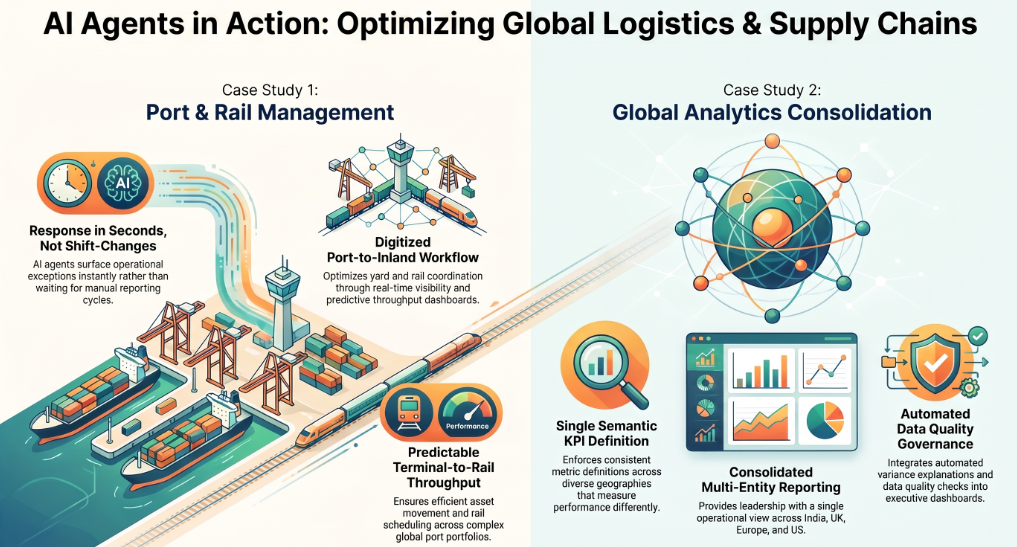
Logistics is where AI agents earn their keep in operational density. Every asset move, every inventory decision, every rail schedule is an action the agent can take faster than a spreadsheet.
13. Terminal and rail management agent for a global ports leader
The client is a global ports and logistics leader with a portfolio spanning ports, terminals, and logistics services worldwide. The workflow: terminal workflow digitisation with yard and rail operational dashboards; rail scheduling and visibility with exception management; executive dashboards and operational alerts.
What shipped: a terminal and rail management solution to digitise and optimise port-to-inland logistics operations — with improved operational visibility and exception response, higher predictability of terminal-to-rail throughput, and more efficient coordination across terminal and inland logistics. The pattern: at global port scale, the agent's job is not to invent optimizations — it is to make sure operational exceptions surface in seconds, not shift-changes.
14. Analytics consolidation agent for global multi-entity logistics
The client is an Indian multinational logistics and warehousing company serving customers across India, UK/Europe, and the US, delivering end-to-end supply chain solutions at enterprise scale. The workflow: cross-entity KPI standardisation and consolidated reporting; operational dashboards with variance explanations; data quality checks and governance layer.
What shipped: analytics consolidation across multi-entity global operations — delivering a single operational view across entities, faster leadership reporting and issue identification, and improved consistency of operational metrics. The pattern: for multi-region operators, the agent's biggest lift is enforcing a single semantic definition of a KPI across geographies that measure things differently.
AI Agents in Production Examples: Healthcare and Life Sciences
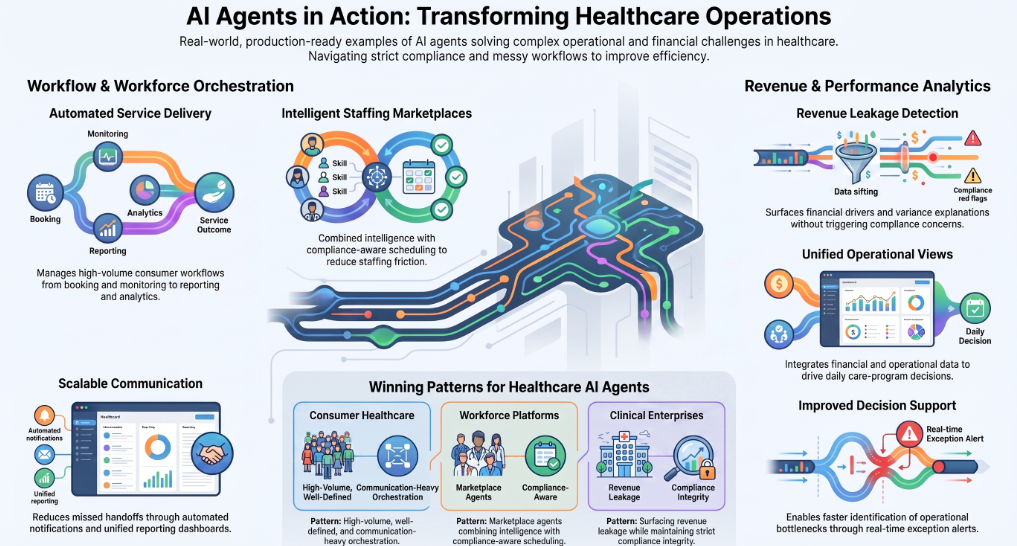
Healthcare is the industry most often talked about for AI agents and least often shipped. Compliance requirements are real, workflows are messy, and the cost of an error is high. These four examples are all live in production.
15. Testing and health-service workflow automation agent
The client is a UK private healthcare and testing provider with high-volume consumer workflows and digital service delivery. The workflow: booking and workflow orchestration; status monitoring with customer notifications; reporting dashboards and operational analytics.
What shipped: platform automation for testing and health-service workflows covering booking through processing to reporting, plus operational analytics — with more scalable operations, faster customer communications, fewer missed handoffs, and improved service visibility through unified reporting. The pattern: consumer healthcare is a natural fit for agentic orchestration because the workflow is high-volume, well-defined, and communication-heavy.
16. Healthcare staffing platform agent
The client is a US healthcare staffing platform connecting nursing professionals with healthcare facilities for flexible shifts, positioned around speed and staffing responsiveness. The workflow: talent onboarding with credential capture; facility staffing request intake and matching logic; scheduling, notifications, and compliance workflows; reporting on fill-rate and utilisation.
What shipped: an AI platform for healthcare staffing operations — covering matching, scheduling, and compliance workflows — with faster fill cycles, lower scheduling friction, better workforce utilisation, and improved staffing responsiveness for facilities. The pattern: workforce marketplace agents win by combining matching intelligence with compliance-aware scheduling.
17. Hospitalist revenue and performance analytics agent
The client is a physician-led clinical enterprise with deep roots in New England, operating hospitalist programs and focused on improving inpatient care experiences. The workflow: revenue and utilisation analytics model; performance dashboards with variance explanations; action lists for billing workflow and operational optimisation.
What shipped: operational and revenue analytics agent that improves care-program performance and financial outcomes — with improved visibility into revenue leakage drivers, faster operational decision-making via unified reporting, and more reliable performance tracking. The pattern: healthcare agents live or die on how well they surface revenue leakage without triggering compliance concerns.
18. Geriatric care operational analytics agent
The client is a Greater Boston geriatric care services provider delivering physician-led programs across assisted living and long-term care settings. The workflow: program operations dashboards; staffing and service delivery analytics; revenue cycle visibility with exception alerts.
What shipped: operational and revenue analytics to improve care-program performance and financial outcomes — with faster identification of operational bottlenecks, improved transparency into service performance, and better decision support for leadership. The pattern: in long-term care, the operational and financial views need to sit inside the same agent because they drive the same daily decisions.
AI Agents in Production Examples: Hospitality, Real Estate, and Consumer Services
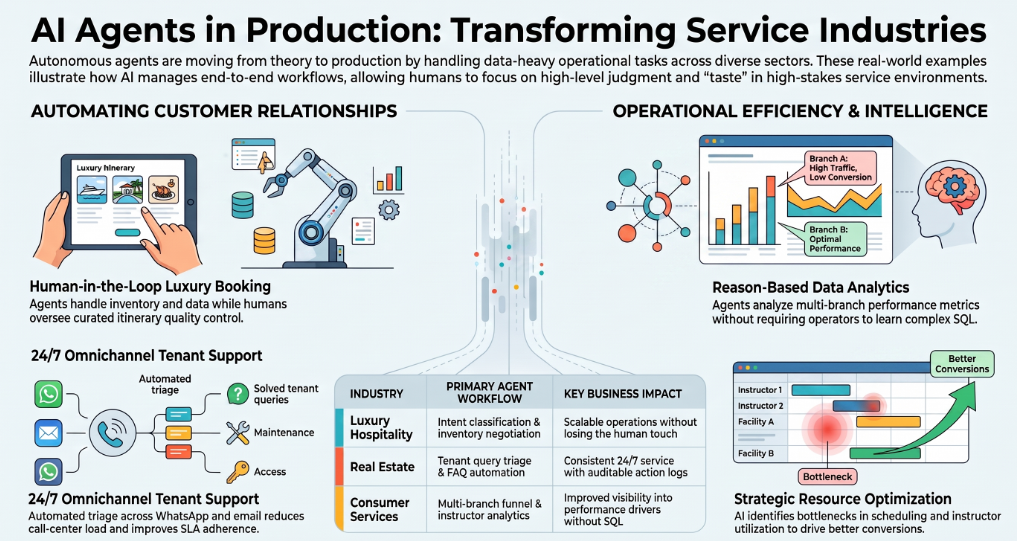
The examples below cover luxury travel, real estate tenant support, and multi-branch driving-school operations — three industries where the agent's job is to hold the customer relationship together without losing the human touch.
19. Luxury safari digital booking agent with human-in-the-loop
The client is a luxury hospitality brand operating a collection of 16 boutique lodges, camps, and hotels in iconic safari locations across East Africa, serving high-expectation global travellers. The workflow: email intake with intent classification and data extraction; conversational loop to capture missing details; real-time inventory checks and alternative date or property negotiation; hybrid handoff for curated itinerary creation; automated invoice and PDF document generation.
What shipped: a Digital Booking Agent automating end-to-end luxury travel booking workflows with human-in-the-loop quality control — delivering faster booking turnaround, higher accuracy on complex guest requirements, and scalable operations without compromising luxury service. The pattern: luxury hospitality is the ideal case for HITL — the agent absorbs the operational load, and the human absorbs the taste and judgement.
20. Real estate customer service agent for a UAE portfolio
The client is a major UAE real estate portfolio owner and manager with diversified office, retail, industrial, and residential assets across multiple emirates. The workflow: omnichannel service agent across web, WhatsApp, and email; tenant query triage with FAQ and rental and payment support workflows; ticketing and escalation to human teams; knowledge base over policies, tenancy documents, and SOPs.
What shipped: a customer service agent for real estate to automate tenant and customer support workflows end-to-end — with faster response times, lower call-centre load, consistent 24×7 tenant experience, and better SLA adherence through automated routing and tracking. The pattern: tenant services are perfectly shaped for agents because the FAQs are dense, the escalation logic is clear, and every action is auditable.
21. Multi-branch driving institute operational analytics agent
The client is a Dubai-based driving institute focused on modern, human-first training experiences with multi-branch operations and digitally enabled customer journeys. The workflow: funnel analytics from enrolment through lessons to tests; instructor utilisation and slot optimisation; customer experience dashboards with alerts.
What shipped: a data analytics agent for operational efficiency and customer experience optimisation — with reduced operational bottlenecks, better scheduling efficiency, and improved visibility into conversion and performance drivers. The pattern: multi-branch consumer services need a single analytics agent that reasons across branches without the operator having to learn SQL.
AI Agents in Production Examples: Energy, Utilities, and Smart Infrastructure
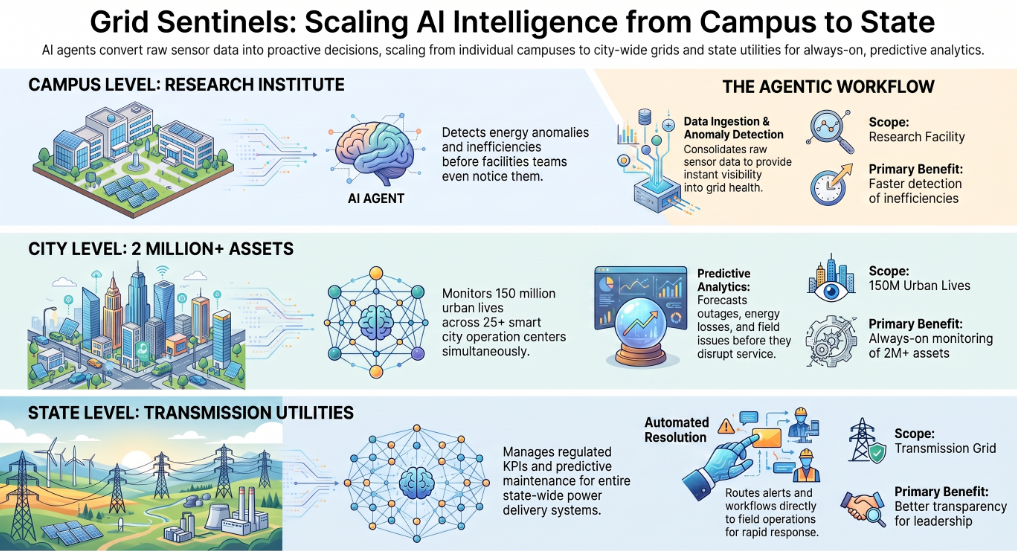
These three examples show that AI agents scale from a single campus to a city to an entire state grid. The common thread is that the agent is the layer converting sensor and utility data into decisions and alerts.
22. Campus energy management AI for a research institute
The client is a premier Indian astronomy and astrophysics research institute, headquartered in a major Indian metropolitan area, with campus-scale operations requiring reliable infrastructure monitoring and optimisation. The workflow: utility and sensor data ingestion with anomaly detection; forecasting and optimisation recommendations; dashboards and proactive alerting.
What shipped: an AI for energy management covering monitoring, forecasting, and optimisation of campus energy consumption — with improved energy visibility, faster detection of inefficiencies, reduced manual monitoring effort, and more predictable operations through early alerts. The pattern: even at single-campus scale, agentic monitoring wins on the strength of "we know the anomaly before the facilities team does."
23. Smart grid analytics and operational alerting agent
The client is a smart infrastructure unit operating at city-scale, connecting over 2 million assets and applications across 25+ smart city operation centres and touching over 150 million urban lives. The workflow: smart-grid data ingestion with operational dashboards; predictive analytics for outages, losses, and field issues; automated alerts and workflow routing for resolution.
What shipped: an AI agent for smart grid — delivering agentic analytics and automated operational alerting on top of smart utility systems — with higher operational visibility across grid operations, faster exception detection and response coordination, and more proactive grid operations via continuous monitoring. The pattern: at city scale, agents earn their value by being always-on where humans can't be, on every asset that matters.
24. State transmission utility KPI monitoring agent
The client is a state power transmission utility responsible for operating and maintaining transmission systems to deliver reliable power across the state. The workflow: transmission KPI monitoring with anomaly detection; loss and outage analytics with predictive maintenance indicators; dashboards and automated alerts for field operations.
What shipped: data analytics for smart grid operations and performance management — with faster identification of grid exceptions and operational risks, improved reliability through proactive monitoring, and better operational transparency for leadership. The pattern: state utilities are a natural fit for agentic monitoring because the KPI structure is regulated and the response window matters.
AI Agents in Production Examples: Sales, Marketing, and Growth
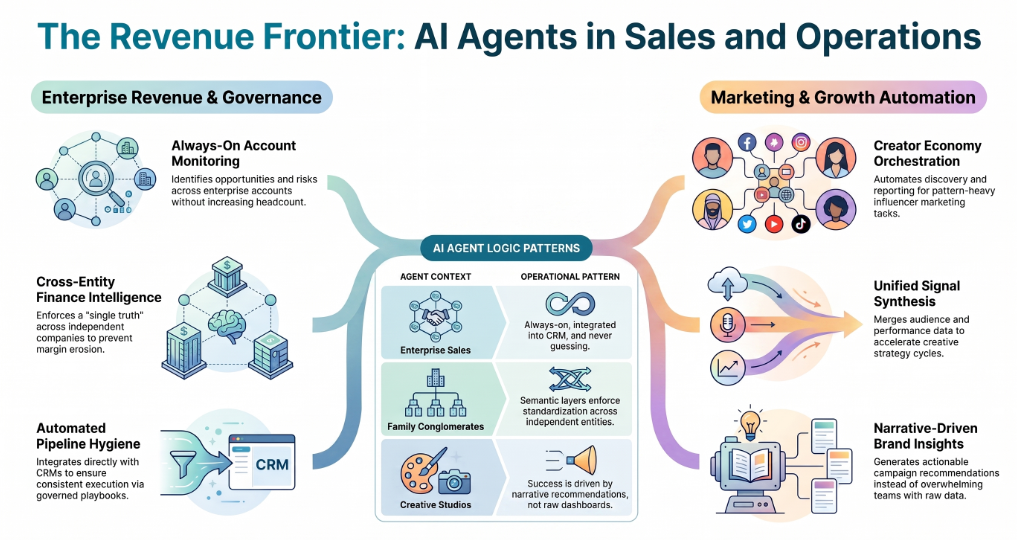
These agents don't sit inside customer support — they sit inside revenue. Enterprise sales agents that monitor accounts, marketing agents that unify creative and performance data, and cross-entity finance agents that keep multi-company groups honest.
25. Agentic sales agent for a UAE engineering enterprise
The client is a flagship UAE engineering and technology solutions provider established in 1972, delivering integrated electrical, mechanical, automation, and mobility solutions across enterprise and infrastructure clients. The workflow: always-on account monitoring with signal capture; rule-governed opportunity identification and follow-up orchestration; CRM integration-ready workflows and pipeline hygiene; sales dashboards with leadership alerts.
What shipped: an agentic AI sales agent to identify opportunities, risks, and next-best actions across enterprise accounts — delivering higher account coverage without increasing headcount, faster response cycles on opportunities and renewals, and more consistent execution via governed playbooks. The pattern: enterprise sales agents work when they are always on, always in the CRM, and never guessing.
26. Cross-entity procurement and finance intelligence agent for a family conglomerate
The client is one of the UAE's most prominent family business groups, comprising 30+ companies and partnering with leading global brands across retail, building, industrial, and services portfolios. The workflow: group-wide KPI standardisation; automated alerts on purchase price trend, GM impact, early-payment analysis as notional finance cost, and vendor performance across delivery and returns; dashboards with scheduled insight packs for leadership.
What shipped: automated procurement and finance KPI alerts across group entities for margin control, vendor performance, and working-capital optimisation — with earlier detection of margin erosion, standardised finance and procurement intelligence across entities, and reduced variance surprises via continuous monitoring. The pattern: family conglomerates need the semantic layer to enforce a single truth across independent operating companies.
27. Creator economy campaign automation agent
The client is an Australian creator-economy platform bringing brands and creators together through smarter discovery, campaign delivery, and AI-driven insights, positioning access to very large creator datasets. The workflow: creator discovery enrichment with campaign workflow automation; automated reporting summaries and insight generation; content KPI monitoring and brand-safety checks; analytics for campaign ROI and engagement.
What shipped: an AI platform to automate influencer marketing operations and performance intelligence — delivering reduced manual ops across campaigns, faster performance visibility and scalable execution, and more consistent reporting and learnings across brand programs. The pattern: the creator economy is agent-shaped — discovery, orchestration, and reporting are all pattern-heavy and rule-following work.
28. Brand insights agent for a creative execution studio
The client is a US brand insights and creative execution studio built by leaders with deep global technology company experience. The workflow: multi-source ingestion covering creative, performance, and audience signals; insight agents producing themes, narratives, and recommendations; reporting packs for leadership.
What shipped: an AI for brand insights that unifies signals and generates actionable insight narratives for marketing teams — with faster creative strategy cycles, deeper signal synthesis across channels, and improved clarity on what to do next for campaigns. The pattern: brand insight agents win by producing narrative recommendations, not raw dashboards.
AI Agents in Production Examples: Specialized and Emerging Use Cases
These six deployments are outside the usual industry taxonomies but they showcase the range of production AI agents in 2026 — from AI scene partners for actors to educator learning platforms across 131 countries.
29. AI voice scene partner for actors
The client is a global AI-powered self-tape and line-learning app for actors on iOS and Android, positioned as an AI scene partner with realistic voices and audition-ready workflow tools. The workflow: script ingestion and scene management; voice agent with character and voice control, pacing, and cue logic; self-tape workflow support and rehearsal analytics; cost-controlled inference deployment.
What shipped: an AI voice agent enabling actors to rehearse scenes, run lines, and self-tape with an always-available, responsive scene partner — with higher rehearsal throughput without human readers, more consistent audition practice loops, and improved readiness with reduced coordination friction. The pattern: consumer voice AI ships in production when the cost model is engineered end-to-end, not just the model choice.
30. AI-first crypto trading agent with guardrails
The client is a European AI-first trading terminal positioned around a network of specialised agents that combine research, analysis, signals, and execution into one workflow. The workflow: market data ingestion with indicator and pattern analysis; strategy simulation with risk guardrails; alerting and recommendation summaries; execution-ready workflow integration.
What shipped: AI agents for crypto trading insights and strategy automation with guardrails — enabling faster synthesis of fragmented market signals, more disciplined decision-making through governed workflows, and reduced manual monitoring effort. The pattern: trading agents need guardrails as much as they need intelligence — the constraint is what keeps them shipping.
31. Real-time portfolio planning agent for a Silicon Valley startup
The client is a Silicon Valley startup based in Palo Alto and founded in 2023, focused on real-time, AI-based business analytics and portfolio planning for fast-moving operators. The workflow: agentic analytics layer over existing data; semantic governance for consistent definitions; NLQ interface with automated insight generation.
What shipped: an AI Data Analytics Agent delivering self-serve, governed answers through natural language — with faster strategic visibility without BI queueing, improved alignment through consistent metric definitions, and scalable insight access across teams. The pattern: NLQ works in production when the semantic layer is doing the heavy lifting, not the model.
32. Stock market data analytics agent for a research and analysis platform
The client is a market research and technical analysis platform using Elliott Wave theory and related indicators to publish forecasts and actionable insights for Indian markets. The workflow: data ingestion and indicator pipelines; research automation and insight generation; alerts and thematic dashboards.
What shipped: stock market data analytics and data science workflows for research automation and insight generation — with faster production of market insight packs, more repeatable and consistent research workflows, and better signal visibility through automated analytics. The pattern: research platforms benefit from agents that turn recurring analyses into a single button.
33. Global educator community learning agent
The client is a global teacher community and learning platform with publicly stated milestones exceeding 1 million teachers across 131 countries, with ongoing growth beyond that baseline. The workflow: teacher profiles with competency insights; support agent for program and learning queries; analytics for program operators and partners.
What shipped: an AI for teachers delivering competency insights, learning guidance, and automated support workflows at global scale — enabling scalable support for educator communities, faster access to learning resources and guidance, and better visibility into engagement and outcomes. The pattern: global learning platforms scale on the strength of agents that behave the same across languages, geographies, and program formats.
34. Automotive leasing portfolio analytics agent
The client is an independent Canadian automotive leasing provider offering manufacturer and dealer network programs with digital, end-to-end leasing processes. The workflow: portfolio KPIs covering risk, delinquency, maturity, and residuals; dealer network performance analytics; alerts for exceptions and early risk signals.
What shipped: a data analytics agent for automobile lending and leasing performance and portfolio intelligence — delivering better portfolio visibility and faster risk identification, improved decision support for program operations, and more proactive management through exception alerts. The pattern: portfolio finance workflows are agent-shaped because the KPIs are stable and the exceptions are what matter.
Cross-Industry Patterns From 30+ AI Agents in Production
Reading 34 production deployments back-to-back surfaces patterns that no single case study reveals on its own. Eight patterns kept repeating across every industry, every geography, and every scale of company.
1. A semantic layer beats prompt engineering
Every deployment that scaled had a semantic layer between the raw data and the LLM. That layer holds the business rules — a "customer" is defined once, a "sale" is defined once, the hierarchy of accounts is defined once. Without it, every prompt is a re-implementation of business logic, and every agent drifts.
2. Row-level security is table stakes, not a feature
In banking, healthcare, retail, and multi-entity conglomerates, the agent sees only what the requesting user is authorized to see. RLS is not a nice-to-have — it is the default posture. Any platform that treats it as an add-on will fail the security review.
3. Human-in-the-loop and maker-checker workflows unlock regulated industries
The luxury safari booking agent, the tax pre-screening agent, the healthcare staffing platform, the SAP order automation agent — all of them use HITL and maker-checker patterns to make regulated actions safe. Without those patterns, the agent doesn't ship in regulated industries at all.
4. Model-agnostic routing keeps costs sane and options open
Every large deployment used multiple models. Small, fast models for classification and routing. Large, expensive models for reasoning. Voice-optimized models for STT and TTS. Locking into a single provider is a cost trap and a resilience risk.
5. Bring-your-own-key (BYOK) matters more than you think
In enterprise banking, government-adjacent utilities, healthcare, and family conglomerates, the client wants control over the model access. BYOK lets the client hold the contract with the model provider, keep their own compliance posture, and ensure their data is never used to train a foundation model.
6. Multi-agent orchestration wins where monolithic agents fail
The tender workbench for the construction firm, the retail voice-plus-inventory-plus-knowledge stack, the ports terminal-plus-rail agent — all of them are multi-agent systems where each agent owns a specific subskill. Monolithic agents fail because a single prompt can't hold the state of a multi-system workflow.
7. Text-to-SQL grounded in a governed layer beats free-form data agents
Data agents that write raw SQL against production databases are a compliance nightmare. Data agents that write SQL against a semantic layer with RLS baked in are the standard for business intelligence in 2026.
8. Audit trails are operational memory, not compliance theater
Every deployment logged every action. When something goes wrong at 2am, the audit trail is what tells you why. When the regulator asks, the audit trail is the answer. When the CFO wants to know what changed, the audit trail is the source of truth.
What Separates AI Agents in Production From Failed Pilots
Five things, in the order they matter.
Grounding in enterprise context, not generic LLM knowledge
Pilots read from PDF chunks. Production agents read from live systems, with a semantic layer defining what everything means. This is the single biggest gap between agents that work in the demo room and agents that work at scale.
Governed action, not just governed answers
Pilots can answer questions safely. Production agents take actions safely. The governance envelope has to extend to every tool call, every API write, every downstream trigger.
Observability from day one, not month six
Every production deployment logged everything from the first day. Retrofitting observability after the agent has scaled is a rewrite, not an upgrade.
Narrow first scope, then compound
Every successful deployment above started with one workflow. Not "AI for the whole business." One workflow, four to eight weeks, measurable outcome. Then the second workflow. Then the third.
Deployment discipline — the four-week PoC-to-production cadence
The clients above got to production in four to fourteen weeks. Not because the technology was faster than anyone else's, but because they made scope decisions early, kept human-in-the-loop for high-risk actions, and treated evaluation as a first-class citizen.
The Architecture Behind Production AI Agents
Every deployment above runs on the same three-layer architecture. It is what makes production agents different from pilot agents.
The Context Engine — ingesting live enterprise data across 300+ systems
The Context Engine is the layer that reads from SAP, Salesforce, Oracle, ServiceNow, HubSpot, Workday, Slack, Microsoft, and 300+ other enterprise systems. It builds a live semantic understanding of people, processes, documents, and systems, so the agent is reasoning against current reality, not stale extracts.
The Semantic Layer — relational intelligence over documents, records, and workflows
The Semantic Layer maps relationships across enterprise data — vendors to contracts, deals to contacts, tickets to products. It is what lets agents reason with relational intelligence, not just keyword search. It is also where business rules, hierarchies, and formulas live, so definitions stay consistent across the enterprise.
The Action Engine — governed multi-step execution with policy checks and audit logs
The Action Engine is where the agent takes real actions in real systems, with permission enforced on every step and every action logged. It is what turns "here's an answer" into "here's an answer, and I just booked the promise-to-pay, updated the CRM, and scheduled the follow-up call, all inside your policy."
How to Choose Your First Production AI Agent Use Case
Not every workflow is ready to become an agent. The best first candidates share four traits.
- High repeatability with measurable outcomes
Pick a workflow that repeats every day or every week, with a clearly measurable outcome. Invoice matching, tender processing, price monitoring, tenant support triage — all of these repeat, all of them can be measured.
- Rich data availability with a clean semantic footprint
If the data is fragmented and undefined, the agent will be too. Pick a workflow where the underlying data can be shaped into a semantic layer in the first two weeks.
- A clear governance bar
Regulated actions need HITL and maker-checker. Internal actions need permission checks and logging. Customer-facing actions need brand-safe outputs and consistent escalation. Know your governance bar before you scope.
- A four-week PoC window with a defined exit criterion
The best first agents are scoped to a four-week PoC with a clear success metric. If it works, expand. If it doesn't, learn and pivot. Anything longer than four weeks is a research project, not a production deployment.
The Bottom Line
The 34 AI agents in production examples above are proof that the gap between demo and production can be closed — but only with the right architecture, the right governance, and the right deployment discipline. The winners in 2026 are not the enterprises with the flashiest AI demos. They are the enterprises with agents running quietly, reliably, and auditably at the core of their operations.
If you're ready to move your AI agents from pilot to production, Assistents.ai is the enterprise agentic AI platform built for exactly that transition. Book a discovery call and describe the workflow that frustrates your team most. Within 48 hours, you'll have a custom PoC plan, ROI projections, and a four-week path to production.
That is what AI agents in production look like in 2026.
Why Assistents by Ampcome for Production AI Agents
Every one of the 34 AI agents in production examples above was built and deployed on the same governed platform. Assistents.ai is the enterprise agentic AI platform built by Ampcome, and it is what turns AI agent ambitions into AI agents that ship.
Six reasons enterprises across 12 industries pick Assistents by Ampcome to move AI agents from pilot to production.
A production-first architecture, not a demo framework. Every agent on Assistents.ai runs with permission checks, audit logs, and row-level security enforced on every action. There is no separate "production hardening" phase — the platform starts production-ready.
A semantic layer built for enterprise reasoning. Business rules, hierarchies, and formulas are defined once and reused across every agent, so definitions stay consistent whether the agent is answering a natural language question or executing an action across a dozen systems.
Model-agnostic routing with bring-your-own-key. Route requests across Bedrock, Azure OpenAI, Vertex AI, OpenAI direct, or open-weights models based on complexity, latency, and privacy sensitivity. Enterprise data is never used to train a foundation model, and BYOK keeps the compliance envelope where the enterprise wants it.
Human-in-the-loop and maker-checker workflows baked in. Every regulated or high-value action can pause for approval, and every approval is logged. That is what makes deployments in banking, healthcare, government-adjacent utilities, and multi-entity conglomerates possible.
Text-to-SQL grounded in a governed semantic layer. Business users get self-serve, natural-language answers over enterprise data without exposing raw databases or breaking row-level security. The agent writes SQL against the semantic layer, not against production tables.
From pilot to production in about four weeks. Pre-built agents for finance, sales, support, HR, marketing, and compliance, plus connectors to 300+ systems, plus an implementation cadence built for enterprises that need production reliability — not another proof of concept on the graveyard pile.
Assistents by Ampcome has 34+ deployments across 12 industries and 6 continents. When you are ready to move your AI agents into production, book a 30-minute discovery call. Bring the workflow that frustrates your team most, and get a custom PoC plan with ROI projections, integration requirements, and a deployment roadmap within 48 hours.
FAQs
What are AI agents in production?
AI agents in production are autonomous or semi-autonomous software systems that read live enterprise context, reason through a goal, take governed actions across real business systems, and do so reliably enough that a business depends on them every day. Production adds five things over a pilot: governance, observability, human-in-the-loop workflows, row-level security, and reliability under load.
What is a good example of an AI agent in production?
A concrete example is a voice, inventory, and knowledge agent running in production across 700+ retail stores of a pan-India value retail chain. It handles support calls in Hindi and English, answers store-specific pricing and inventory questions, and pulls training content from a knowledge base of POS and SOP documents, all with per-store governance and audit trails.
What industries have the most AI agents in production?
Financial services, retail and e-commerce, healthcare, logistics and supply chain, and manufacturing lead the field in 2026. Real estate, energy and utilities, education, hospitality, and creator economy platforms are all producing meaningful production deployments as well. In the 34 examples cataloged here, 12 distinct industries are represented across 6 continents.
How long does it take to deploy an AI agent to production?
For a well-scoped use case with pre-built agents and connectors, four to twelve weeks is the standard production window. Simpler workflows with mature integrations can ship in four weeks. Multi-agent, multi-system deployments spanning regulated actions typically take eight to fourteen weeks. Anything longer than fourteen weeks is usually a scope problem, not a technology problem.
What's the difference between an AI agent pilot and a production deployment?
A pilot demonstrates capability. A production deployment carries operational load. Production adds governance, permission enforcement, audit trails, human-in-the-loop, observability, row-level security, and reliability under real-world volume. The Gartner and IDC research consistently points to only about 5% of enterprise AI agent pilots reaching production — the difference is discipline, not model choice.
What are the biggest challenges of running AI agents in production?
The five most common: data quality and integration gaps, weak governance and unclear escalation paths, missing observability, unclear ROI or scope drift, and lack of a semantic layer to enforce consistent business definitions. None of these are model-specific — they are platform and process problems.
Are AI agents in production replacing employees?
Almost none of the 34 deployments above resulted in reduced headcount. They resulted in faster cycles, better coverage, higher accuracy, and reduced manual load — freeing skilled employees to focus on judgement calls, exception handling, and higher-value work. The agents did the pattern-heavy, high-volume work that no team of humans could keep up with.
What's the ROI of AI agents in production?
Reported ROI varies by industry, but production AI agents consistently deliver measurable outcomes: faster processing cycles, earlier detection of exceptions, reduced manual workload, and improved decision cadence. Deployments cited across the catalog above delivered engineered targets ranging from 12x faster invoice processing to approximately 90% faster tender document processing. Payback windows of a single quarter are common for well-scoped first deployments.
What makes an AI agent production-ready?
Production-ready AI agents share seven characteristics: grounded in live enterprise context, governed action with permission enforcement, complete audit trails, human-in-the-loop for regulated or high-value decisions, row-level security enforced on every read and write, model-agnostic routing, and continuous observability from day one.
Which platforms are used to deploy AI agents in production?
Enterprise deployments in 2026 typically pick a governed agentic AI platform that includes a Context Engine, Semantic Layer, and Action Engine, with connectors to enterprise systems and support for BYOK and model-agnostic routing. Assistents by Ampcome is the platform behind the 34 deployments cataloged above, spanning 12 industries and 6 continents, and typically moves clients from pilot to production in about four weeks.

Transform Your Business With Agentic Automation
Agentic automation is the rising star posied to overtake RPA and bring about a new wave of intelligent automation. Explore the core concepts of agentic automation, how it works, real-life examples and strategies for a successful implementation in this ebook.
Sarfraz Nawaz is the CEO and founder of Ampcome, which is at the forefront of Artificial Intelligence (AI) Development. Nawaz's passion for technology is matched by his commitment to creating solutions that drive real-world results. Under his leadership, Ampcome's team of talented engineers and developers craft innovative IT solutions that empower businesses to thrive in the ever-evolving technological landscape.Ampcome's success is a testament to Nawaz's dedication to excellence and his unwavering belief in the transformative power of technology.

More insights
Discover the latest trends, best practices, and expert opinions that can reshape your perspective


.jpg)
Contact us

