
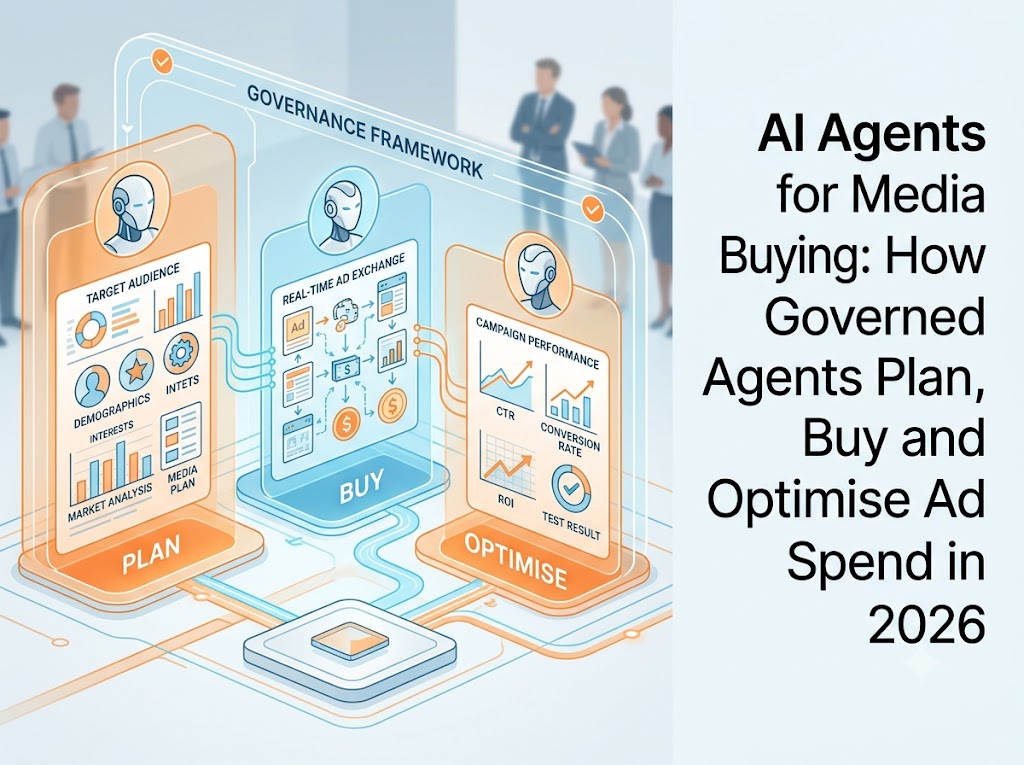
AI Agents for Media Buying: How Governed Agents Plan, Buy and Optimise Ad Spend in 2026


- An AI agent for media buying does not just recommend changes. It reads performance, decides what to change, executes the change through ad platform APIs, and records the outcome — continuously, inside a defined spend and policy envelope.
- The market has already decided. In an IAB survey fielded between November 2025 and January 2026, 66% of advertisers said they plan to focus more on agentic ad buying this year, and 78% plan to increase generative AI use in media campaigns.
- The constraint is no longer capability. It is control. A January 2026 Dynatrace report found the top two barriers to moving agents from pilot into production are security and data privacy (59%) and accuracy and reliability (55%).
- Most tools marketed as "AI media buying agents" report on spend after it happens. A spend cap that reports a breach is not a control. It is a receipt.
- Autonomy should be earned in stages, not switched on. The Autonomy Ladder in this guide sets out five levels — Observe, Recommend, Prepare-and-Approve, Bounded Autonomy, Exception-Managed — with the specific controls each level requires.
- Two competing protocol families now govern agent-to-agent media transactions: the Ad Context Protocol (AdCP), an open standard built on MCP, and IAB Tech Lab's Agentic Advertising Management Protocols (AAMP). Neither has won. Protocol neutrality is the safer bet than picking a side.
An AI agent for media buying is a goal-directed software worker that reads campaign performance data, decides what to change, executes that change through ad platform APIs, and records the result — operating continuously inside a defined spend, policy and approval envelope set by humans. Unlike a rule, it reasons about situations it was not explicitly programmed for. Unlike a dashboard, it acts.
That single distinction — it acts — is why media buying is different from almost every other AI use case in marketing. A content agent that writes a bad paragraph wastes an hour. A media buying agent that misreads a signal spends real money in real auctions, and the money does not come back.
This guide covers what these agents actually do today, what they still cannot do, how the agent-to-agent protocol layer is forming, and — the part almost no one publishes — how to govern software that has been handed authority over a budget.
What Are AI Agents for Media Buying?
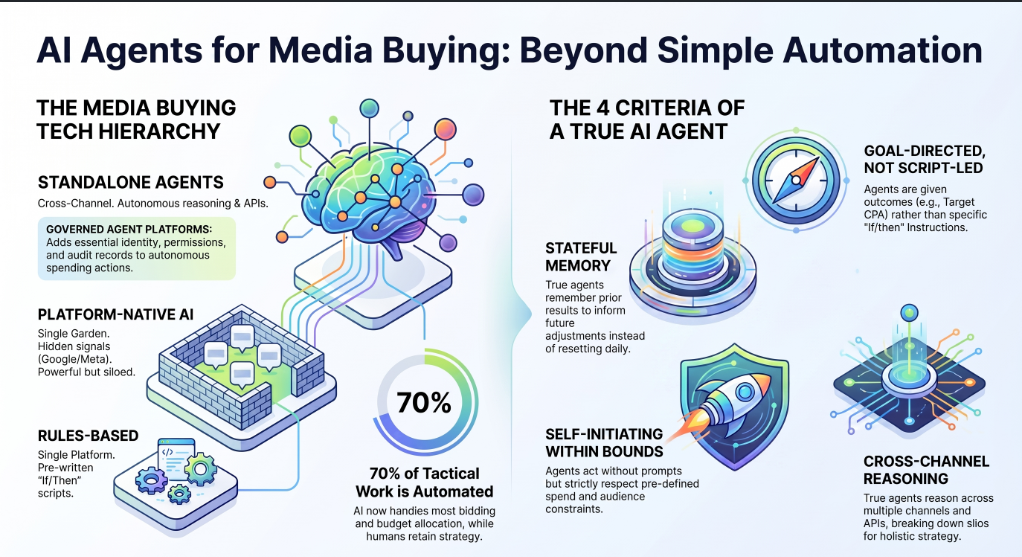
AI agents for media buying are autonomous software workers assigned to campaign outcomes rather than to individual tasks. You give an agent an objective and a set of constraints — hit a target CPA, do not exceed a daily spend, never activate this audience — and the agent plans, acts, observes the result, and adjusts. It runs on its own schedule rather than waiting to be prompted.
The category has arrived quickly and the label has been stretched. Bid managers, creative generators, reporting layers and DSPs have all repositioned as "AI media buyers" in the past eighteen months. Understanding the actual difference matters before you evaluate a single vendor.
AI agent vs automation vs platform-native AI
There are four distinct things in this market and they are routinely confused.
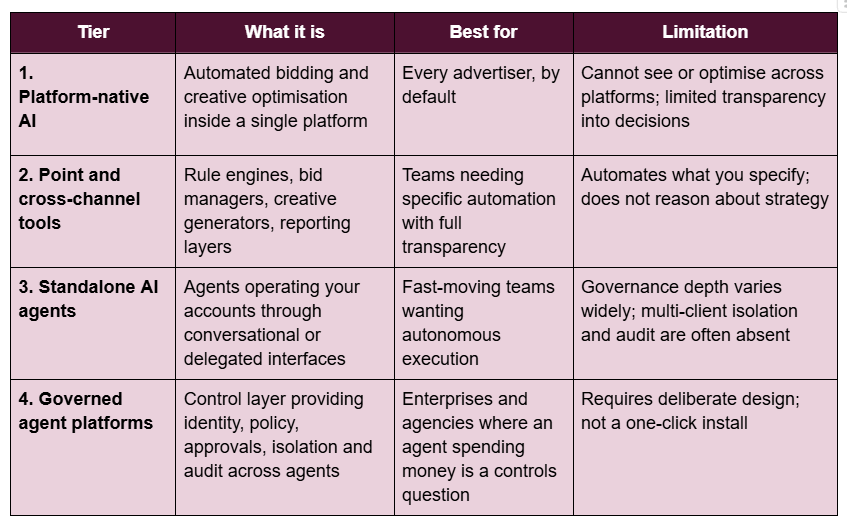
Rules-based automation follows conditions you wrote in advance. Pause any ad set above a fifty dollar CPA. Scale a winner by twenty percent. It is transparent and predictable, and it only ever does what you already thought of.
Platform-native AI — Google Performance Max, Meta Advantage+ — optimises inside a single walled garden using signals you cannot see. It is powerful, free, and structurally incapable of comparing your Meta performance against your Google performance, because it does not have both sets of numbers.
Standalone AI agents sit above the platforms. They connect to multiple ad accounts through APIs, reason across channels, and take action. This is where the genuinely new capability lives.
Governed agent platforms add the layer the first three skip: identity, permissions, executable policy, approval routing and an audit record for every action an agent takes. This is the difference between an agent that can spend and an agent you can allow to spend.
The four things that make it an agent, not a rule
If a vendor calls something an agent, test it against four criteria.
- Goal-directed. It is given an outcome, not a script. "Hold blended CPA under 40 dollars across paid social" rather than "if CPA exceeds 40, pause."
- Tool-using. It can call systems — ad platform APIs, your warehouse, your CRM, a creative library — and choose which to call based on the situation.
- Stateful. It remembers what it tried last week and what happened. An agent that starts every session with no memory of prior decisions is a chatbot with API access.
- Self-initiating within bounds. It acts without being asked, inside limits it cannot widen on its own. This last clause is doing enormous work, and it is the clause most vendors leave out.
Where agentic media buying sits in the wider shift
Agentic AI in advertising is not a single product category. It is a change in where decisions sit. For twenty years, digital advertising moved decisions from humans into algorithms inside platforms. Agentic AI moves a different set of decisions — cross-channel, cross-account, strategy-adjacent — out of spreadsheets and into software that sits above the platforms.
The IAB 2026 Outlook Study found roughly two-thirds of ad buyers already focused on integrating agentic AI into their workflows. Industry estimates put AI's current share of tactical work — bid adjustments, audience expansion, budget allocation — somewhere around 60 to 70 percent, with humans retaining strategy, creative and governance.
That last word is where this guide spends most of its time, because it is where the market is thinnest.
What AI Agents Actually Do in the Media Buying Workflow
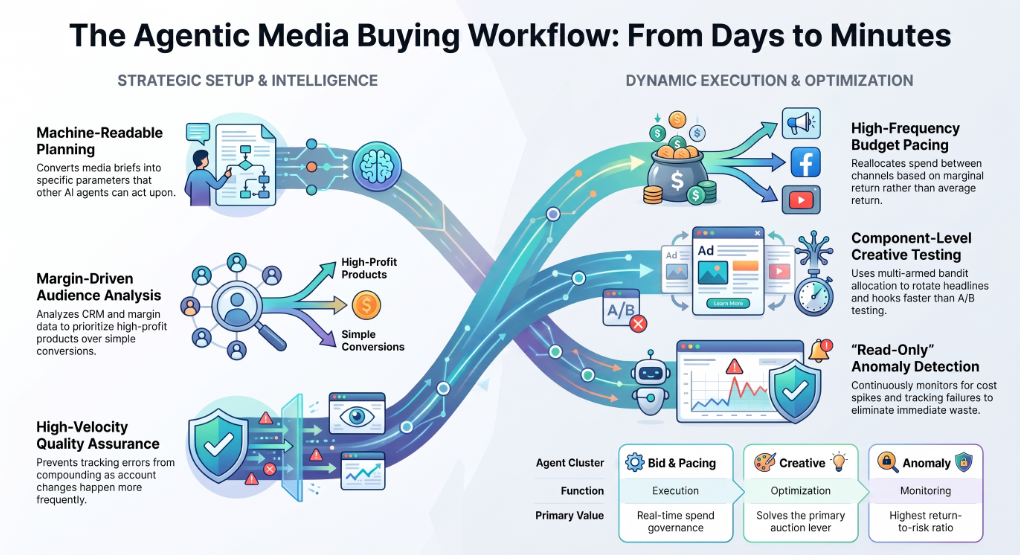
AI agents in media buying handle six clusters of work: planning and briefing, audience and signal analysis, bid and budget pacing, creative testing, anomaly detection, and reporting with QA. They compress the loop between a signal appearing in the data and something changing in an ad account — from days to minutes.
Here is what each looks like in practice.
Planning and briefing agents
These convert a media brief into a machine-readable structure: objectives, target metrics, budget envelopes, channel priors, audience definitions, flighting, brand constraints. The output is not a document. It is a set of parameters other agents can act against.
The value is less glamorous than it sounds and more important than it looks. Most agentic failures trace back to an ambiguous objective. An agent optimising toward a poorly specified goal will hit that goal efficiently and destroy value doing it.
Audience and signal agents
These analyse first-party data, campaign history and contextual signals to identify segments worth reaching and segments worth excluding. Increasingly this work runs on cohort-level and contextual signals rather than individual-level tracking, as third-party cookie deprecation and privacy regulation reduce the granularity available.
The strongest versions read from your own systems — CRM, order history, margin data, inventory — rather than from platform-reported signals alone. An agent that knows which products actually carry margin will allocate very differently from one that only knows which products convert.
Bid and budget pacing agents
The highest-frequency work. Monitoring spend velocity against remaining flight, detecting under- and over-pacing, adjusting bids, and reallocating between campaigns and channels based on marginal return rather than average return.
This is also the first place agents touch money. Everything before this point is analysis. This is execution, and it should be the first place your governance model gets tested.
Creative testing and rotation agents
These run multi-armed bandit style allocation across creative variants, detect fatigue by watching frequency alongside declining engagement, and rotate toward performers faster than a fixed A/B window allows. Advanced versions test components — headline, hook, format, call to action — rather than whole assets, which produces a far more useful signal for the next production cycle.
Creative is now the primary lever in most auction environments. An agent that optimises delivery against a stale creative pool is optimising a constraint it cannot fix.
Anomaly and waste-detection agents
Continuous monitoring for cost spikes, conversion drops, tracking failures, budget burn anomalies and traffic quality problems. This is the single highest return-to-risk agent in the whole category, because it is read-only. It can save a great deal of money and cannot spend any.
Start here. Every time.
Reporting, attribution and QA agents
Consolidating cross-channel performance, applying a consistent attribution view, checking naming conventions and tracking parameters before launch, and producing the narrative — not just the numbers — for stakeholders.
The QA function matters more in an agentic environment, not less. When more changes happen per day, a broken tracking parameter compounds faster.

How an AI Media Buying Agent Works, Step by Step
An AI media buying agent operates a seven-step loop: intent capture, context assembly, reasoning, policy check, approval or bounded execution, action through platform APIs, and verification with outcome logging. The fourth and seventh steps are where governed platforms separate from tools — and where most vendor demos quietly skip ahead.
Step 1 — Intent and constraints
The agent receives an objective with explicit boundaries: metric targets, spend ceilings, prohibited actions, protected campaigns, brand constraints, escalation triggers. This is a contract, not a prompt. It should be versioned and reviewable, because when something goes wrong, this is the document you will be reading.
Step 2 — Context assembly
The agent gathers what it needs to reason: current and historical performance, creative inventory and fatigue state, audience saturation, competitive signals, and — where available — downstream business data such as margin, lifetime value, returns and stock position.
The design principle that matters here is that context should be compiled, not dumped. Handing an agent broad access to every system increases cost, increases leakage risk, and measurably degrades reasoning quality. The agent should receive the smallest authorised context package the task requires, with provenance attached.

Step 3 — Reasoning and option generation
The agent forms hypotheses about what is happening and generates candidate actions with expected effects. A good implementation surfaces alternatives rather than a single answer, and states its confidence. "Shift 15% of budget from Campaign A to Campaign C, expected CPA improvement 8 to 12%, confidence moderate, based on 11 days of data" is reviewable. "Optimising" is not.
Step 4 — Policy check
Before anything executes, the proposed action is evaluated against executable policy. Is this action type permitted for this agent? Is the value within its authority? Is the affected object protected? Does it require approval? Does it breach a brand or regulatory constraint?
This check must be deterministic. Policy expressed as instructions in a prompt is not policy — it is a suggestion the model may or may not follow. Policy expressed in a rules engine either passes or fails, every time, and the evaluation is logged.
Step 5 — Approval or bounded execution
Depending on the autonomy level and the action's materiality, the agent either executes directly within its envelope, or routes the proposal to a named human for approval with the reasoning attached. Maker-checker separation — one party proposes, another approves — is standard practice for financial controls and belongs here for the same reason.
Step 6 — Action through the platform APIs
The change is executed. Critically, it should be executed as a registered capability with typed inputs, idempotency handling and a defined rollback path — not as an arbitrary API call the model composed on the fly. If the action fails halfway, the system needs to know how to unwind it.
Step 7 — Verification and outcome logging
The agent confirms the change landed as intended, then schedules observation of the result. Every step — the context used, the reasoning, the policy evaluation, the approver, the action, the outcome — is written to an audit record that cannot be edited after the fact.
That record is what turns "the agent improved performance" into something you can actually defend to a CFO, a client or a regulator.
The Six AI Agents Every Media Team Should Deploy First
Deploy AI agents for media buying in order of return-to-risk ratio, not capability. The first three agents below cannot spend money at all, which means they generate value while your team builds trust in the system. Only the fifth agent touches budget directly, and by then you should have the controls and the evidence to justify it.
1. The waste and anomaly watcher
Read-only. Monitors every account continuously for cost spikes, conversion collapses, tracking failures, runaway pacing and quality anomalies. Alerts with diagnosis attached, not just a threshold breach.
Risk: near zero. Payback: often within the first month, because it catches things human review cycles structurally cannot.
2. The cross-channel pacing agent
Reports on pacing across every channel against flight and budget, flags variance early, and recommends corrections. Still read-only in its first deployment.
Risk: low. Value: eliminates the end-of-month scramble that costs most teams either unspent budget or panic spending.
3. The creative fatigue agent
Watches frequency, engagement decay and cost drift by creative, and tells the creative team what to produce next and when. It closes the loop between media performance and creative production, which is where most of the remaining upside in paid media actually sits.
Risk: low. Strategic value: high, and underrated.

4. The competitive and market-signal agent
Monitors competitor activity, pricing, offers, availability and share of presence continuously, and converts that into answers rather than a report nobody opens. Agents optimise toward your goals; they do not warn you when a competitor changes the game. This one does.
Risk: low. It reads external sources, not your accounts.
5. The budget reallocation agent
The first money-moving agent. Proposes and — once trusted — executes reallocation between campaigns and channels based on marginal return.
Risk: material. Deploy at Level 2 of the Autonomy Ladder (prepare and await approval), not above. Graduate it only on evidence.
6. The campaign operations agent
Full-loop operation of defined campaign types: launch, monitor, optimise, report, escalate. This is the destination, not the starting point. It should only exist once the five agents above have produced a track record you can point to.
The Autonomy Ladder: How Much Should an Agent Be Allowed to Do?
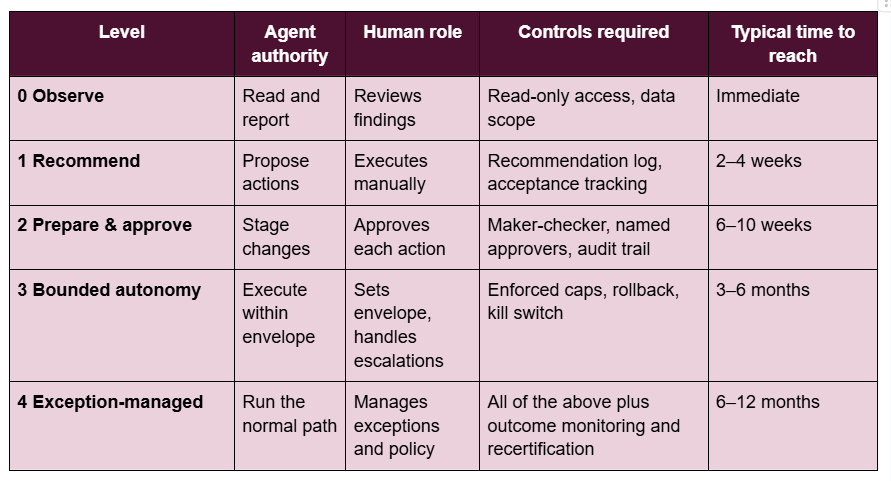
Autonomy is not a setting. It is a contract across several dimensions — which agent, which action type, which accounts, which value limits, which time window, which evidence required, which approver. The Autonomy Ladder below sets out five levels, the controls each requires, and how to move between them.
The core principle: autonomy is earned, not configured. Authority should expand only after an agent has demonstrated performance on historical replay, in shadow mode, and then in limited live operation.
Level 0 — Observe
The agent monitors and reports. It cannot change anything. Its job is to see faster than a human review cycle.
Controls required: read-only credentials, data scope limits. Typical duration: 2 to 4 weeks.
Level 1 — Recommend
The agent proposes specific actions with reasoning and expected impact. A human executes them manually. This phase generates the evidence base for everything that follows — you now have a record of what the agent would have done, and what happened when a human did or did not do it.
Controls required: recommendation logging, acceptance-rate tracking. Typical duration: 3 to 6 weeks.
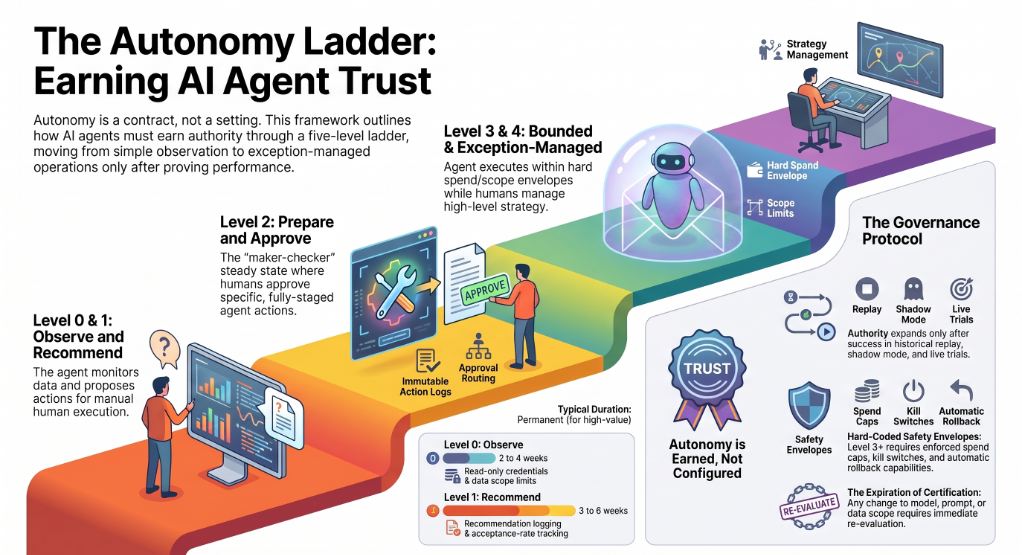
Level 2 — Prepare and approve (maker-checker)
The agent stages the change and routes it for human approval. On approval, the system executes it. The human is approving a specific, fully specified action — not authorising the agent in general.
This is the correct steady state for most money-moving actions in most organisations, and many teams should stop here permanently for high-value changes.
Controls required: approval routing, named approvers, separation of duties, immutable action log.
Level 3 — Bounded autonomy
The agent executes directly within a hard envelope: value limits per action and per day, permitted action types, permitted accounts, permitted hours. Anything outside the envelope is escalated, not attempted.
Controls required: enforced spend caps at the action layer, blast-radius limits, automatic rollback, kill switch, continuous monitoring. Entry criteria: a documented performance record at Level 2 across at least one full buying cycle.
Level 4 — Exception-managed operations
The agent runs the normal path for a defined scope of campaigns. Humans manage exceptions, policy and strategy rather than individual changes. This is a genuine operating model change, not a feature toggle, and it should be reached scope by scope — one campaign type, one market, one channel at a time.
Controls required: everything from Level 3, plus outcome monitoring, incident handling, periodic recertification, and a defined path to contract autonomy if performance degrades.
How autonomy should be earned
Every material agent should pass through the same sequence before its authority widens: offline evaluation, historical replay against known outcomes, shadow operation alongside humans, recommendation-only live running, human-approved execution, a limited autonomous canary, then wider bounded operation — with continuous monitoring and a rollback path at every stage.
Certification should expire. If you change the model, the prompt, the tool access or the data scope, the agent's prior track record no longer applies to the new configuration. Re-evaluate before re-authorising.
Agent-to-Agent Media Buying and the New Protocol Layer
Agent-to-agent media buying is a model in which a buyer's agent and a seller's agent communicate directly to discover inventory, agree terms, create and modify media buys, and return performance data — without a human on either side of each transaction. Two protocol families are competing to standardise it, and neither has won.

What agent-to-agent media buying means
In the current model, a buyer configures a campaign in a DSP and the DSP transacts against exchanges. In the agent-to-agent model, a brand agent carries the advertiser's strategic intent — audiences, creative standards, outcome targets, constraints — and negotiates against seller agents that represent inventory. The intent persists across buys rather than being re-entered per campaign, and the agent accumulates context with each transaction.
The practical implication is that media buying starts to look like portfolio management rather than a series of channel-by-channel executions.
Ad Context Protocol versus IAB Tech Lab's AAMP
The Ad Context Protocol (AdCP) is an open, MIT-licensed standard governed by an independent non-profit. It is built on MCP and defines how buyer agents discover products, create media buys, generate creative and activate audiences. It operates asynchronously, which matters more than it sounds — asynchronous design is what allows a human approval step to sit inside an agent-to-agent negotiation without breaking it. It has backing from twenty-plus companies across the programmatic ecosystem.
IAB Tech Lab is taking the opposite approach. Rather than building new standards, it is extending the existing ones — OpenRTB, AdCOM, VAST, OpenDirect — under an umbrella called Agentic Advertising Management Protocols (AAMP), alongside the Agentic RTB Framework (ARTF) and the User Context Protocol (UCP). Their position is that agentic execution is already part of digital advertising, and the sensible path is to agentify what works.
Both are live and under active development. Live deployments demonstrating AdCP across real programmatic infrastructure began appearing in early 2026.
Where MCP and A2A fit
Beneath the advertising-specific protocols sit two general-purpose standards. The Model Context Protocol (MCP) defines how an agent connects to tools and data sources. Agent-to-agent (A2A) patterns define how agents delegate to and negotiate with each other. AdCP is built on MCP; that is not an accident. The advertising layer is a specialisation of the general agent interoperability layer, not a replacement for it.
For an enterprise, this means the connective tissue you invest in for media buying agents is the same connective tissue your finance, procurement and service agents will use. That is an argument for building on a general agent platform rather than a media-specific point tool.
Why protocol neutrality beats picking a winner
The honest position in mid-2026 is that nobody knows which standard prevails, and the likely outcome is a period where both must be supported. Betting your architecture on one is an avoidable risk.
The defensible position is to keep protocol handling at the integration layer and keep your durable assets — your policies, your approval structures, your audit history, your metric definitions, your agent configurations — independent of it. Protocols will change. Your governance model should not have to.
AI Agents for Media Buying at Agencies vs In-House Teams

The governance requirements for agencies and in-house teams diverge sharply. In-house teams need agents that respect internal budget authority and brand policy. Agencies need all of that plus something almost no vendor in this category addresses: provable isolation between clients.
The agency problem nobody is solving
An agency running forty client accounts with agentic tooling has created a data-boundary problem that did not exist when humans did the work. A human buyer might work across three clients and knows not to apply one client's learnings to a competitor's account. An agent, given broad access, has no such instinct — and no way to prove it exercised one.
The questions a sophisticated client will start asking in 2027, if they are not asking already:
- Can your agent see my performance data when it is working on a competitor's account?
- What prevents it?
- Can you show me?
Answering "our team is careful" will not survive that conversation.
Row-level security and attribute-based access for agents
The mechanism is not new. It is the same mechanism enterprise data platforms have used for two decades, applied to a new kind of actor.
Row-level security ensures an agent instance operating on one client's work can only retrieve rows belonging to that client — enforced at the data layer, not by instruction. Attribute-based access control extends this to actions: this agent, acting for this client, on this account, may perform these action types up to this value. Every retrieval and every action is scoped by identity and purpose, and every one is logged.
The important property is that the enforcement is structural. It does not depend on the model behaving well.
What clients will require, and how to be ready
Build three things now: a documented autonomy policy per client, an exportable audit trail of every agent action taken on that client's accounts, and a demonstrable isolation guarantee. Agencies that can produce these on request are already winning enterprise pitches on this basis. Agencies that cannot are competing on demo quality against a rising bar.
The in-house case
For brands, agents change the in-housing calculation. The historical argument against in-housing was capacity — you could not staff the volume of tactical execution an agency could. Agents remove much of that constraint, which shifts the question from "can we execute" to "can we govern." Brands that build the governance layer first can in-house far more than their headcount would suggest.
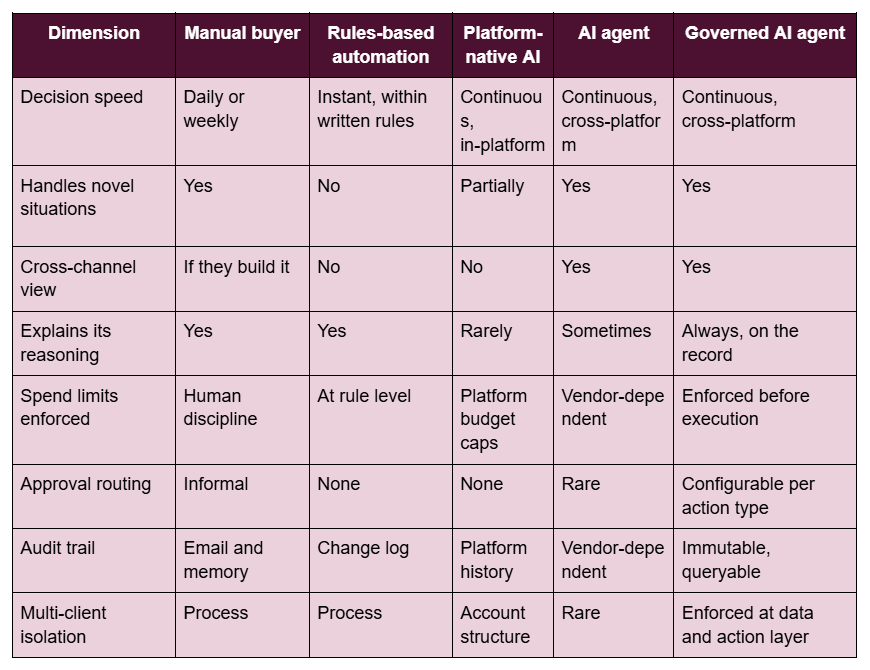
The AI Media Buying Tool Landscape in 2026
The market splits into four tiers. Most teams end up using something from at least two of them, and the common mistake is assuming a tool from one tier can do the job of another.
How to evaluate anything in tier three or four
Ask direct questions and require direct answers.
- Can the system enforce a hard spend cap at the action layer, or does it only report a breach afterwards? This single question separates most vendors.
- Can you show me every action the agent took last week, the reasoning, and who approved it? If the answer involves reconstructing from logs, there is no audit trail.
- Who is the buyer and who is the auditor? If the same system that spent the money also grades its own performance, you do not have oversight — you have a dashboard.
- Can I route specific action types to specific approvers? Budget increases above a threshold should not carry the same approval path as a creative rotation.
- Where does my data go, and can it stay in my environment?
- What happens when the model provider changes, deprecates or reprices? Model-agnostic routing is a commercial control, not just a technical preference.
Governing Agents That Spend Money: The Control Layer Most Platforms Skip
If an agent is authorised to move budget, four things must be true: its spend limits are enforced before execution rather than reported after, material actions require a second party, its actions are recorded immutably, and it can be stopped instantly. Most tools in this category satisfy one of the four.
This is not a compliance chapter. It is the reason agentic media buying either scales inside a serious organisation or stays stuck in pilot.

Enforced spend caps versus reported spend caps
A reported cap tells you the agent spent 140% of the daily budget. An enforced cap means the action was evaluated against the limit and rejected before it reached the ad platform.
The difference is the difference between finding out and being protected. Ask any vendor which one they implement, and ask them to demonstrate it.
Envelopes should be multi-dimensional: per action, per day, per account, per action type, per time window. A single daily total is not a control — it is a number.
Maker-checker on money-moving actions
Separation of duties is the oldest financial control there is. One party proposes a transaction; a different party approves it. It exists because the person who wants the transaction to happen should not be the only person who can make it happen.
Applied to agents: the agent stages a fully specified change with its reasoning attached, and a named human approves or rejects it. The approval is recorded against a person, not a role.
The objection is that this reintroduces the bottleneck agents were supposed to remove. It does not, if you apply it selectively. Route by materiality: creative rotations execute freely, budget shifts under a threshold execute freely, budget shifts above a threshold require approval, and anything touching a protected campaign always requires approval.
Identity, delegation and least privilege
An agent needs its own identity — not a shared service account, not a borrowed human credential. Its effective authority should be computed as the intersection of its own registered permissions, the authority of the human or role delegating to it, the purpose of the current work, and the applicable business policy.
Computed authority is auditable. Asserted authority — an instruction in a prompt telling the agent what it may do — is not, because the model may not comply and you cannot prove whether it did.
Every agent should also have a named human sponsor who is accountable for its behaviour. If nobody's name is against the agent, nobody is accountable for what it spends.
The immutable audit trail
The record must capture, for every action: which agent, acting for whom, under what purpose, with what context, on what reasoning, against which policy evaluation, approved by whom, executing what change, with what observed outcome.
Two properties matter. It must be immutable — appended, never edited. And it must be queryable in business terms, not just technically retrievable. "Show me every budget change above 5,000 dollars this agent made in Q3, and who approved each one" should be a query, not a data project.
This is what makes the difference between automation and accountable automation.
Kill switches, rollback and blast radius
Three separate mechanisms, often conflated.
- A kill switch stops an agent immediately, from a person, without a deployment. Every material agent needs one and every operator needs to know where it is.
- Rollback reverses actions that have already been executed. This requires actions to be designed as reversible operations with compensation paths — not something you can retrofit.
- Blast-radius limits cap how much damage is possible before anyone notices: maximum accounts touched per hour, maximum cumulative value moved per day, maximum consecutive actions without a human observation. These are the controls that turn a bad hour into a manageable incident.
Brand safety and regulatory constraints as executable policy
Brand and regulatory constraints — prohibited placements, restricted claims, sector-specific advertising rules, market-specific requirements — belong in a deterministic rules layer that evaluates every action, not in a document the agent was told to follow.
The test is simple: if the constraint lives only in the prompt, it is advisory. If it lives in a rules engine that can reject an action, it is a control.
Twelve questions to ask before an agent touches your budget
- Are spend caps enforced before execution or reported afterwards?
- Can I set different approval requirements for different action types and values?
- Does each agent have its own identity, or does it share a service account?
- Who is the named human sponsor for each agent?
- Is the audit trail immutable, and can I query it in business terms?
- Can I see the reasoning behind any individual action, after the fact?
- Is there a kill switch, and how fast does it take effect?
- Which actions are reversible, and how?
- What are the blast-radius limits, and can I configure them?
- If we run multiple brands or clients, how is isolation enforced — structurally or procedurally?
- Can the platform run in our own cloud environment or VPC?
- Are we locked to one model provider, and what happens if that changes?
What This Looks Like in Production: Deployment Evidence
The strongest evidence for governed agentic execution does not come from advertising. It comes from environments where a wrong action costs more than a wasted impression — logistics, finance, procurement, manufacturing, industrial operations. The patterns are identical; only the system of record changes.
The following deployments are anonymised by industry, geography and scale. Outcomes are directional, not guaranteed benchmarks.

A creator-economy marketing platform (Australia, global operations)
A platform connecting brands with creators needed to automate campaign operations and performance intelligence across a large creator dataset. We delivered creator discovery enrichment, campaign workflow automation, content KPI monitoring, brand-safety checks and campaign ROI analytics.
Directional outcomes: materially reduced manual campaign operations, faster performance visibility, and more consistent reporting across brand programmes.
Why it matters for media buying: this is the closest direct analogue — agentic campaign operations running at scale with brand-safety guardrails built into the workflow rather than bolted on.
A brand insights and creative execution studio (United States, global clients)
A studio founded by leaders with deep experience at a major search and video platform needed to unify creative, performance and audience signals into actionable narratives for marketing teams. We delivered multi-source ingestion, insight agents producing themes and recommendations, and leadership reporting packs.
Directional outcomes: faster creative strategy cycles, deeper signal synthesis across channels, and clearer direction on what to do next for campaigns.
Why it matters: this is the creative-performance loop — the highest-leverage remaining lever in modern paid media, and the part most media buying tools ignore entirely.
A global ports and logistics operator (UAE headquartered, 20 billion dollar revenue scale)
A ports and logistics leader needed to move from dashboards that describe problems to systems that act on them. We delivered a unified context engine spanning structured and unstructured data, a semantic governance layer holding rules, hierarchies and formulas, an active orchestrator integrating with core systems, and insights-to-action agents layered on top of existing dashboards.
Directional outcomes: a shift from reactive reporting to proactive execution loops, standardised decision logic across teams, automated task creation with completion tracking, and improved exception response.
Why it matters: this is the flagship governance proof point. Insight converted into governed, auditable action — which is precisely the architecture a budget-moving agent requires.
A UAE engineering and technology solutions provider (established 1972)
An integrated engineering group needed to replace an end-of-life document workflow system with agentic automation that could create transactions directly in its core system of record. We delivered agents that interpret order triggers, validate them, and create sales orders in the ERP, with rules and governance for exceptions and approvals, plus audit logs and reconciliation reporting.
Directional outcomes: reduced manual order processing, faster order-to-confirm cycle with fewer data-entry errors, and improved auditability for both transactions and exceptions.
Why it matters: this is the most transferable pattern in the entire case list. An agent transacting inside a system of record, under rules, with approvals for exceptions and a reconcilable audit trail — structurally identical to an agent executing budget changes in an ad platform.
A major HVAC and cooling manufacturer (India, founded 1943)
Operating in a price-sensitive market where competitor moves matter daily, this manufacturer needed always-on competitive visibility. We delivered continuous monitoring across e-commerce and channel portals covering pricing, discounts, offers, availability and ratings, agentic question-answering mapped to leadership questions, analytics views for pricing gaps and portfolio movement, and an architecture that scaled from proof of concept to production with governance and audit trails.
Directional outcomes: faster competitive response cycles, earlier identification of pricing gaps and promotional shifts, and always-on monitoring replacing manual portal checks.
Why it matters: agents optimise toward your goals; they do not tell you when a competitor changes the game. This is the market-signal layer that sits alongside a buying agent.
A diversified family business group (UAE, 30+ operating companies)
A large multi-entity group needed procurement and finance governance across companies with different systems and reporting standards. We delivered automated KPI alerting across entities covering purchase price trends, gross margin impact, early-payment analysis and vendor performance, with dashboards and scheduled insight packs for leadership.
Directional outcomes: earlier detection of margin erosion and vendor slippage, standardised finance and procurement intelligence across entities, and fewer variance surprises.
Why it matters: multi-entity budget governance is the structural twin of multi-client agency governance. Same isolation requirements, same consolidated oversight requirement, same need for consistent metric definitions across boundaries.
A privately held retail holding group (India)
Leadership needed governed, cross-functional intelligence across systems and documents without waiting on analyst queues. We delivered an AI data analytics agent ingesting sales, product, inventory, promotion and customer behaviour data, with conversational analytics for instant business queries and automated KPI monitoring with exception alerting.
Directional outcomes: shorter analysis cycles for recurring questions, better visibility into product and promotion performance, and reduced reporting dependency on analysts.
Why it matters: the context foundation. An agent optimising media spend without visibility into inventory, margin and promotion performance is optimising a partial picture.
Why Assistents.ai by Ampcome for Agentic Media Buying
Most platforms in this category were built to optimise advertising and are now adding controls. Assistents.ai was built as a governed enterprise action platform and applies that architecture to media buying. That order of construction is the difference, and it shows up in exactly the places that matter when an agent has authority over money.
Built as a governed action layer, not a reporting layer
Assistents.ai combines the pieces most vendors keep separate:
- Governed conversational analytics with a semantic layer and text-to-SQL over your own data
- An agent builder with multi-agent orchestration
- A workflow engine with human tasks and approvals for maker-checker patterns
- Deterministic rules and decision tables through GoRules for executable policy
- Row-level security, role-based and attribute-based access control for isolation across brands, clients and entities
- An immutable audit trail across the whole path
That combination is what allows an agent to propose a budget change, have it evaluated against real policy, routed to a named approver, executed, and permanently recorded — as one governed flow rather than four disconnected tools.
Ask → Execute → Autonomous
Our maturity model maps directly onto media buying.
- Ask. Your team interrogates governed campaign, commercial and operational data in natural language, with consistent metric definitions so finance and marketing are reading the same numbers.
- Execute. Agents prepare specific actions — reallocations, pauses, creative rotations — route them through policy and approval, execute them, and log them.
- Autonomous. Inside a proven envelope and for a defined scope, agents run the normal path and escalate exceptions.
You do not have to accept broad autonomy to get value. Most of the return arrives at Ask and Execute.
Model-agnostic and protocol-neutral
Assistents.ai routes across multiple model providers rather than binding you to one, and supports MCP and A2A for agent and tool interoperability. Given that the advertising protocol layer is unsettled — AdCP and IAB Tech Lab's AAMP both live, both developing — keeping your policies, approvals, audit history and metric definitions independent of any single protocol or model vendor is straightforward risk management.
Deployed where your data lives
Private cloud, VPC and on-premises deployment, with bring-your-own-key support, and connectors to Postgres, MSSQL, BigQuery, ClickHouse, Athena and DuckDB alongside 80-plus workflow integrations and generic REST connectivity. For organisations where campaign data sits next to customer, margin and inventory data that cannot leave the environment, this is often the deciding constraint.
Ampcome's delivery record
Ampcome has delivered agentic and analytics systems across ports and logistics, engineering and industrial groups, multi-entity retail, manufacturing, financial services, healthcare operations and creator-economy marketing platforms — in India, the UAE, the United Kingdom, Australia, Canada and the United States.
The relevant credential is not that we have built advertising tools. It is that we have repeatedly built systems where software takes consequential action inside a system of record, under rules, with approvals and a reconcilable audit trail. Media buying is that same problem, pointed at an ad account.
How to Deploy AI Agents for Media Buying: A 90-Day Plan

Deploy in three phases: build the context foundation and read-only agents in the first month, add recommendations and approval gates in the second, and grant the first bounded autonomy in the third. Teams that skip to autonomy typically end up reversing it.
Days 1 to 30 — Context and read-only agents
Inventory your data sources across ad platforms, analytics, CRM and commercial systems. Establish consistent metric definitions — this is the single highest-leverage step and the most commonly skipped, because agents reasoning from inconsistent definitions produce confident nonsense. Enforce naming and tracking conventions. Deploy the anomaly watcher and the pacing reporter. Define your autonomy policy on paper before you need it.
Success looks like: agents surfacing issues your review cycle was missing.
Days 31 to 60 — Recommendations and approval gates
Move agents to recommendation mode with reasoning attached. Track acceptance rate — the percentage of agent recommendations a human agrees with — as your primary trust metric. Configure approval routing by action type and value. Set spend envelopes. Run the first maker-checker flows on genuine budget decisions.
Success looks like: acceptance rate above 70%, and a documented record of what agents proposed versus what happened.
Days 61 to 90 — First bounded autonomy
Select one narrow scope — one channel, one campaign type, one market. Grant Level 3 authority within a conservative envelope. Enable the kill switch and confirm the team knows how to use it. Run a holdout: keep comparable campaigns under the prior process as a control.
Success looks like: the agent's scope performing at least as well as the holdout, with a clean audit record and no envelope breaches.
What to measure
- Efficiency: hours per week on tactical optimisation, time from signal to action.
- Performance: CPA, ROAS or your primary economic metric, measured against a holdout rather than against last month.
- Trust: recommendation acceptance rate, approval rejection rate, escalation frequency.
- Control: envelope breaches attempted and blocked, audit completeness, mean time to stop an agent.
That last group is the one nobody tracks and everybody needs.
Common Mistakes and How to Avoid Them
Granting autonomy before establishing evidence. The most common and most expensive error. Run the recommendation phase properly; it is the only thing that tells you whether the agent's judgement is worth trusting.
Treating prompt instructions as policy. If a constraint is only in the prompt, it is advisory. Put money and brand constraints in a deterministic rules layer.
Accepting reported caps as controls. Find out during evaluation, not during an incident, whether limits are enforced before execution.
Optimising a single metric. An agent driving CPA down while quietly shrinking your addressable audience or shifting mix toward low-margin products is doing exactly what you asked and damaging the business. Give agents a metric and a set of guardrails around it.
Letting the buyer be the auditor. If the system that spent the money also produces the performance narrative, you have no independent view. Keep measurement, or at least verification, structurally separate.
Ignoring creative. Agents optimise delivery. They cannot fix a fatigued creative pool. If creative production does not keep pace, agentic optimisation hits a ceiling fast.
Neglecting isolation in multi-client or multi-brand setups. Retrofitting data and action isolation after agents are running across accounts is far harder than designing it in. Do it first.
The Bottom Line
AI agents for media buying are no longer speculative. Two-thirds of advertisers are actively moving toward agentic ad buying, protocols for agent-to-agent transactions are live, and the tactical execution layer of the job is compressing into software.
What has not been solved is control. The industry has produced a generation of agents that can spend money, and very little infrastructure for deciding what they are allowed to spend, proving what they spent, and expanding that authority as they earn it.
That is the gap worth closing before you scale, not after. Start with agents that cannot spend. Build the evidence. Put the controls in the architecture rather than the process. Then let autonomy grow scope by scope, on the record.
The teams that get this right will run more media with fewer people and better numbers. The teams that skip the control layer will get there too — right up until the week they have to explain what happened.
See how Assistents.ai governs agents that take real action.
FAQs
What are AI agents in media buying?
AI agents in media buying are autonomous software workers that read campaign performance, decide what to change, execute changes through ad platform APIs, and record the outcome — operating continuously within spend and policy limits set by humans. They differ from automation rules in that they reason about situations they were not explicitly programmed for, and from platform-native AI in that they can operate across multiple platforms at once.
How is an AI media buying agent different from Performance Max or Advantage+?
Performance Max and Advantage+ optimise within a single platform using signals that platform holds, and cannot see your performance elsewhere. An AI media buying agent sits above the platforms, reasons across all of them, and can shift budget between them. In practice most teams use both: platform-native AI for in-auction optimisation, agents for cross-channel decisions the platforms structurally cannot make.
Will AI replace media buyers?
No, but it is replacing a large part of what media buyers used to do. Bid management, budget pacing, audience construction and routine optimisation are increasingly automated. What remains — and becomes more valuable — is strategy, offer and creative direction, setting the economic targets the system optimises toward, and governing the automation itself. The role moves up the stack rather than disappearing.
Can AI agents buy media autonomously?
Technically yes, for defined campaign types within defined limits. Whether they should depends on your controls. The responsible pattern is bounded autonomy: the agent executes freely inside a hard envelope of action types, value limits and account scope, and escalates anything outside it. Full unbounded autonomy over enterprise media budgets is not currently a defensible position for most organisations.
What is agent-to-agent media buying?
Agent-to-agent media buying is a model in which the buyer's agent and the seller's agent communicate directly to discover inventory, agree terms, execute the buy and return performance data. The buyer's agent carries the advertiser's persistent intent — audiences, standards, outcome targets, constraints — across transactions rather than having it re-specified per campaign.
What is the Ad Context Protocol (AdCP)?
AdCP is an open, MIT-licensed standard for agent-to-agent communication in advertising, governed by an independent non-profit and built on the Model Context Protocol. It defines how buyer agents discover products, create media buys, generate creative and activate audiences. It operates asynchronously, which allows human approval steps to sit inside agent negotiations. IAB Tech Lab is pursuing a parallel approach that extends existing standards such as OpenRTB and VAST.
How much does an AI media buying agent cost?
Costs vary widely by tier. Platform-native AI is included in ad platform accounts. Point automation tools typically run from around 100 to several hundred dollars monthly. Standalone agents range from a few hundred to a few thousand dollars monthly. Enterprise governed platforms are usually priced on a combination of platform fee and consumption, and are chosen when controls, isolation and deployment requirements matter as much as optimisation. The larger cost in every case is internal: data preparation, metric definition and change management in the first ninety days.
Are AI media buying agents safe?
They are as safe as their controls. The specific risks are unbounded spend, actions that cannot be explained after the fact, data leakage across accounts, and optimisation toward a metric at the expense of the business. Each has a known mitigation: enforced caps, immutable audit trails, structural isolation, and guardrails around the target metric. Evaluate the mitigations, not the demo.
How do you stop an AI agent from overspending?
With enforced limits evaluated before execution rather than reported afterwards, applied across several dimensions — per action, per day, per account, per action type. Add approval requirements above a value threshold, blast-radius limits capping cumulative movement, an immediate kill switch, and monitoring that alerts on attempted breaches, not just actual ones.
What data does an AI media buying agent need?
At minimum, campaign performance across all active channels with consistent metric definitions, creative inventory and performance history, and conversion data with a coherent attribution view. Substantially better results come from adding commercial context — margin, lifetime value, returns, inventory position — because an agent that knows which conversions are actually profitable allocates very differently from one optimising reported conversions.
Can AI agents work across Google, Meta and TikTok at once?
Yes, and this is the main advantage over platform-native AI. A cross-channel agent can compare marginal return across platforms and reallocate accordingly, which no single platform's optimisation can do. This requires unified data with normalised metric definitions — a click on one platform does not mean the same thing as a click on another, and an agent comparing them naively will make bad decisions confidently.
How long before an AI media buying agent shows ROI?
Read-only agents such as anomaly detection often pay back within the first month by catching waste that review cycles miss. Optimisation agents typically need 30 days of data to establish patterns and 60 to 90 days to show measurable performance improvement against a holdout. Efficiency gains in hours spent on tactical work appear immediately.
Do agencies use AI agents for media buying?
Increasingly, yes, and it is reshaping the agency proposition. As execution automates, agency value concentrates in strategy, creative, measurement and governance. The agencies winning enterprise business on this basis are the ones that can produce a documented governance model and an exportable audit trail on request — not the ones with the most impressive demo.
What is the difference between AI media buying and programmatic advertising?
Programmatic advertising automates the transaction of buying inventory using preset rules and real-time bidding. AI media buying adds a decision layer: a system that interprets objectives, decides what should change, and makes the change. Programmatic answers "how do we buy this impression." Agentic AI answers "what should we buy, and why, and what should we change now."

Transform Your Business With Agentic Automation
Agentic automation is the rising star posied to overtake RPA and bring about a new wave of intelligent automation. Explore the core concepts of agentic automation, how it works, real-life examples and strategies for a successful implementation in this ebook.
Sarfraz Nawaz is the CEO and founder of Ampcome, which is at the forefront of Artificial Intelligence (AI) Development. Nawaz's passion for technology is matched by his commitment to creating solutions that drive real-world results. Under his leadership, Ampcome's team of talented engineers and developers craft innovative IT solutions that empower businesses to thrive in the ever-evolving technological landscape.Ampcome's success is a testament to Nawaz's dedication to excellence and his unwavering belief in the transformative power of technology.

More insights
Discover the latest trends, best practices, and expert opinions that can reshape your perspective





Contact us

