

Agentic AI in Analytics (2025): A Complete Beginner-to-Advanced Guide [With Examples, Architecture, Tools and Use Cases]


For more than three decades, analytics moved in small jumps. First came reporting. Then business intelligence dashboards arrived. Later, conversational analytics appeared and helped people talk to their data using simple language. In contrast, traditional analytics relied on static dashboards and manual data exploration, requiring significant human input and offering limited personalization.
Today something entirely different is happening. Analytics is no longer stopping at answers. Traditional AI was limited to rule-based, static systems that lacked adaptability and autonomy. Now, analytics is learning to investigate, plan and carry out tasks on its own.
This last stage changes everything. It introduces a new category known as Agentic Analytics, where AI agents behave like junior analysts who think through data, study supporting material, search across files and sometimes act inside business tools. The agentic analytics era marks a transformative period in data analysis, shifting from manual processes to collaborative workflows between humans and AI agents.
This guide will take you from zero to advanced level of Agentic AI in Analytics. You will understand what Agentic AI in Analytics means, how it works, where the industry is heading, and what tools already support it.
The Market Evolution: How We Reached Agentic Analytics
Reporting once ruled analytics. People waited for weekly or monthly sheets. Everything was slow, static and retrospective, in part because legacy systems made it difficult to integrate new data sources or automate processes.
Later, dashboards arrived and improved visibility. They visualized structured data and gave better clarity. But dashboards had limits. They could not understand files, chats, emails, study context, and connect information that lived outside neat tables.
The Rise of Conversational Analytics (2023 to 2024)
Once large language models became mainstream, analytics turned conversational. Tools allowed people to ask questions like “How were sales last quarter compared to last year”
Nearly every analytics vendor added natural language querying, narrative answers, natural language interfaces, and chat interfaces between 2023 and 2024.
This helped, but conversational BI still required humans to initiate questions and act on the results. It did not drive outcomes on its own.
Why Dashboards Hit an Innovation Wall
Dashboards, as traditional BI tools, have strong points, such as handling structured data and showing trends, but they are static and lack the real-time responsiveness and operational capabilities of more dynamic solutions.
- They cannot read PDFs or emails
- They cannot understand logs or customer chats
- They cannot use external signals such as news or competitor activity
- They cannot act on insights
As companies gather larger amounts of unstructured content, dashboards simply cannot keep up.
The Emergence of Agentic Analytics (2025 and beyond)
Agentic analytics is the next chapter. It thinks, plans and carries out multi-step work on its own, allowing it to perform complex tasks autonomously.
This includes:
- Studying data across formats
- Using reasoning chains
- Coordinating multiple AI agents
- Triggering tasks in business systems
In short, analytics begins to behave like a junior analyst inside the company, not just a visual tool.
What Is Agentic AI in Analytics
Agentic AI in analytics is an AI system that not only answers your analytical questions, but also investigates deeper, connects information, forms conclusions and sometimes takes action for you.
From a technical point of view, it uses advanced ai models as a foundational element enabling multi-step planning and reasoning, along with:
- Multi-step task planning
- A collection of AI agents working together
- Structured, semi-structured, unstructured and external data sources
- A workflow controller that solves tasks through reasoning
How It Differs From BI, Conversational BI and Copilots
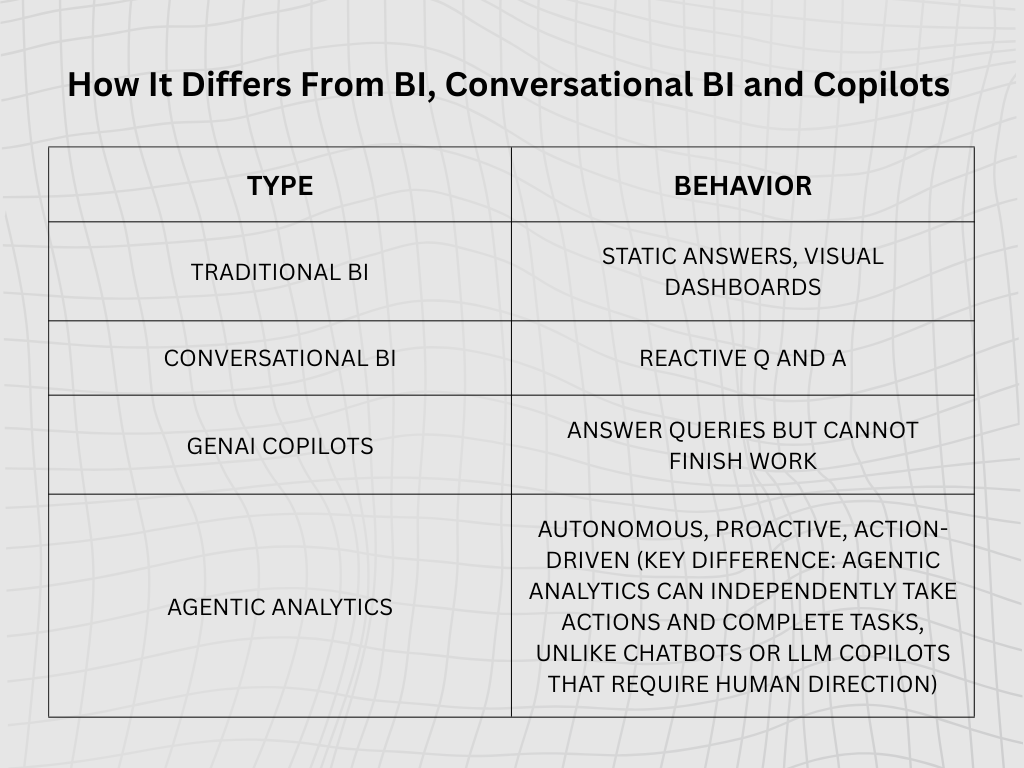
Agentic analytics acts more like a partner that can examine information and figure out various parts of a problem without waiting for human prompts. The key difference is its higher level of autonomy and ability to drive actions, setting it apart from other AI tools.
Why Traditional BI and GenAI BI Are Not Enough
1. Data Blindspots
Enterprise data is unstructured such as chats, documents and transcripts, yet analytics engines use very little of it .
This creates huge blindspots. Important explanations often sit inside email threads, support conversations and internal documents. Data quality issues can further exacerbate these blindspots, making it even harder to extract reliable insights.
2. The Last-Mile Problem
BI tools reveal insights, but a human still needs to interpret and then act on them. This slows down progress and leaves many findings unused. This gap often leads to frustration among business users, who may struggle to act on insights without seamless integration.
Agentic analytics closes this gap by connecting insights directly to outcomes.
3. Accuracy Problems in LLM-over-SQL Tools
Several flaws that appear when people connect raw LLMs to SQL databases:
- Hallucinated queries
- Wrong joins
- Incorrect metric logic
- Missing schema context
- Data quality issues can lead to incorrect outputs and undermine trust in analytics results.
Vendors like ThoughtSpot later added guardrails because raw LLMs struggled with real database structure.
4. No Multi-Turn Memory or Context
Many tools cannot maintain a conversation across multiple questions. They lose track of the topic. Agentic analytics supports deeper conversations that stay consistent across turns. These systems are designed to maintain context across turns with minimal human intervention.
The Core Principles of Agentic Analytics
Here’s a combined view of structured, semi-structured, unstructured and external information flowing together to produce contextual insights. Agentic analytics represents a new class of agentic systems that orchestrate data-driven decision-making and automation, enabling organizations to monitor, react to, and optimize business processes in real-time.
1. Multi-Agent Collaboration
The three major types of agents are:
- Analytical
- Knowledge
- Research
These agents work together through a controller. This collaboration enables the automation and orchestration of complex workflows across business functions, allowing agentic AI systems to coordinate multi-step, multi-system processes without manual oversight.
2. Autonomous Task Orchestration
The workflow engine creates a plan. It breaks work into parts, assigns subtasks and combines results. This creates a chain of reasoning similar to what an analyst does manually. The engine is capable of managing complex scenarios that require multi-step reasoning and adaptive planning.
3. Governance and Semantic Layer
Governance prevents errors and protects data. The Assistents.ai highlights role-based access, audit logs, metric definitions and semantic consistency as core features of any agentic platform. Robust governance frameworks are essential for enabling accurate and trustworthy data driven decisions, ensuring that organizations can rely on their analytics for informed actions.
4. Model-Agnostic Routing
Agentic platforms do not rely on one AI model. They route tasks to the most suitable model depending on cost and complexity. An agentic analytics platform leverages model-agnostic routing to optimize both performance and cost, ensuring that each analytic task is handled by the most efficient AI resource available.
Agentic Analytics Architecture
The architecture diagram in the slides PDF shows three data zones:
- Structured
- Unstructured
- Internet and external research
The system is designed to ingest and process real-time data streams from various sources, enabling continuous monitoring and analysis.
All connected to an orchestrator that powers analytics .
1. Data Layers
This layer holds every type of information an enterprise depends on. Structured data comes from ERP, CRM, POS, and warehouse tables that follow fixed schemas. Semi-structured data sits somewhere in the middle, like SaaS exports, logs, and metadata. Unstructured data includes PDFs, chats, emails, memos, and call transcripts that don’t follow neat formats. Then there are external signals like competitor actions, market news, sentiment shifts, and regulatory content. Together, these layers give agents full context.
2. Ingestion and Indexing
This stage is all about gathering information and making it usable. Data pipelines pull structured and semi-structured items into a unified workspace. PDFs, chat threads, emails, and transcripts move through a vector indexing process so the AI can search them by meaning, not keywords. By placing everything in a central retrieval layer, the system can connect patterns across formats, making insights more complete and less dependent on manual preparation.
3. The AI Brain
This is where the intelligence happens. Analytical Agents run calculations, identify patterns, perform comparisons, and look for anomalies in numbers. Knowledge Agents read documents, understand language, pull relevant paragraphs, and run semantic searches. Research Agents gather context from external sources like news, competitors, or online reports whenever extra clarity is needed. Together, these agents collaborate to investigate questions, reason through evidence, and build a reliable, well-supported answer.
4. Workflow Engine
Think of this as the system’s coordinator. Once a question is asked, the engine creates a plan, breaks it into steps, and assigns tasks to the right agents. Each agent performs its part, and the engine compiles everything into a clear narrative or recommended action. It manages the order of operations, handles dependencies, and presents the final result. This makes the entire process fluid, consistent, and free from manual juggling.
5. Governance Layer
This layer keeps everything safe, consistent, and compliant. It includes access control so users only see what they’re allowed to see. Semantic definitions make sure KPIs and business terms always mean the same thing. Audit trails record every action, query, and data source used, which is essential for trust, compliance, and troubleshooting. Governance ensures the system is transparent, controlled, and reliable enough for enterprise-grade decision-making.
Examples of Agentic Analytics
1. Beginner Examples
- Explain month-over-month KPI changes
- Auto-generate dashboard summaries
- Highlight unusual changes in trends
- Automate routine data processing tasks to achieve cost reduction, such as using agentic analytics to identify and eliminate redundant workflows, reducing manual labor and operational expenses
2. Intermediate
- Compare sales data with support tickets
- Combine call transcripts with churn numbers
- Study patterns across multiple tables
- Enable deeper analysis by connecting multiple data sources, allowing agentic analytics to uncover more comprehensive insights
3. Advanced Autonomous Scenarios
- Study signals across emails, dashboards and documents
- Identify issues by connecting internal and external material
- Enrich company insights with competitor information
- Apply complex analytics to handle multi-step, cross-functional business challenges, enabling scalable, real-time insights and automation of routine tasks for improved efficiency and decision-making
4. Action-Oriented Examples
- Trigger CRM updates
- Send alerts based on conditions
- Deliver real time insights to enable immediate business actions
- Start inventory corrections
- Update marketing campaigns after studying multiple signals
Use Cases Across Industries
1. Financial Services
- Fraud pattern detection
- Risk monitoring
- Churn prediction from account activity + support notes
- Enabling more informed decisions in areas like fraud detection and risk management through enhanced data analysis and autonomous insights
2. Retail and Ecommerce
- Competitor price checks using external web sources
- Demand forecasting combining sales, reviews and transcripts
- Return analysis from customer chats
- Gen AI for automating product design and trend analysis
3. Healthcare
- Reading doctor notes along with medical records
- Highlighting patient risk observations
- Monitoring clinical patterns from free-text notes
- Using AI-powered analytics tools for diagnostics and patient monitoring
4. Telecom and Manufacturing
- Network log analysis cross-checked with customer complaints
- Supply chain delays connected with vendor documents
- Streamlining software development for process automation, where agentic AI assists in coding, workflow automation, and supporting developers to optimize telecom and manufacturing operations
Tools and Platforms in 2025
1. Traditional BI with AI Add-ons
- Power BI Copilot
- Tableau GPT and Pulse
- Qlik Agentic Framework
2. Conversational BI Entrants
- ThoughtSpot Sage
- ThoughtSpot Spotter
- Sigma Ask
- Holistics Semantic Layer
3. Agentic AI Platforms
These platforms support multi-step agents and deep reasoning.
- Assistents.ai
- GoodData AI Hub
- Relevance AI
- Beam AI
4. Data Platform Additions
- Databricks AI BI Genie
- Snowflake Copilot
Benefits of Agentic Analytics
1. End to End Intelligence
This means the system doesn’t stop at explaining what happened. It understands data across formats, finds patterns, explains the reasons behind changes, and connects those insights directly to actions. Instead of handing over charts for someone to interpret, it pushes the right updates into CRM, alerts teams, or recommends next moves. It behaves like an always-on analyst who sees the full picture and helps the business act instantly.
2. Multimodal Fusion
Here, the AI brings together every kind of information a company works with. Text from emails, tables from databases, PDFs, spreadsheets, call transcripts, and even external data like market news or competitor movement all flow into one reasoning layer. By mixing formats, the system uncovers context that dashboards miss. This fusion helps the AI answer deeper questions that require multiple signals instead of a single dataset.
3. Proactivity and Speed
Agentic analytics doesn’t wait for someone to ask a question or notice a problem. It constantly monitors data, detects early warning signs, and surfaces issues before they escalate. That means risks, opportunities, and anomalies get flagged hours or days ahead of manual review cycles. By shrinking the gap between signal and action, teams respond faster, avoid losses, and seize openings competitors may not even see yet.
4. Governance and Trust
Trust comes from knowing every insight, recommendation, and action is traceable. Audit logs record who asked what, which data sources were used, and how the system reached its answer. The semantic layer guarantees that metrics and definitions remain consistent across teams. Combined with permission controls, this creates a safe, predictable environment where AI can operate confidently without introducing compliance risks or unexpected behavior.
How To Implement Agentic Analytics
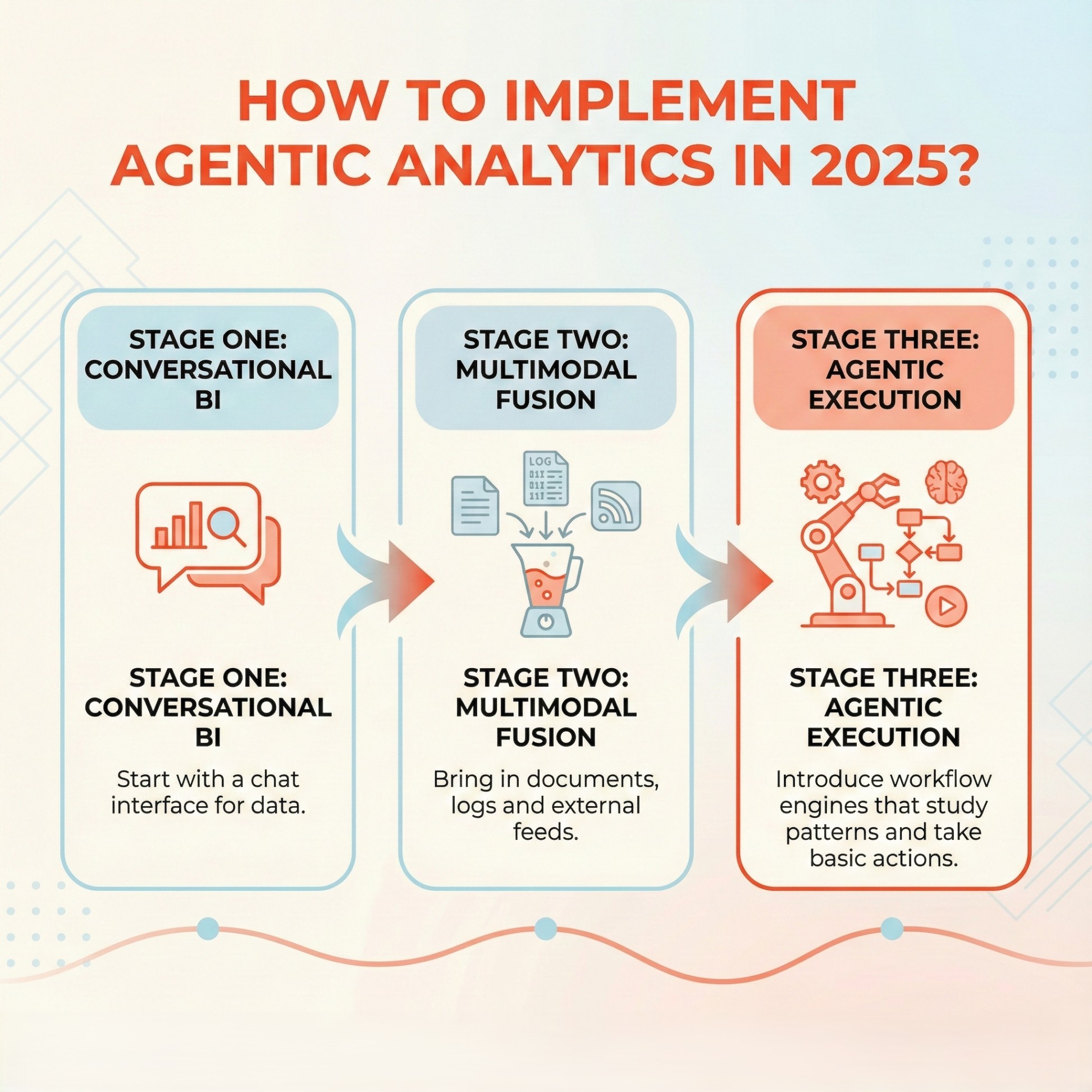
Stage One: Conversational BI
Start with a chat interface for data.
Stage Two: Multimodal Fusion
Bring in documents, logs and external feeds.
Stage Three: Agentic Execution
Introduce workflow engines that study patterns and take basic actions.
The Future of Agentic Analytics
1. Dashboards to Agentic Narratives
Reports give way to narrative insights created by agents.
2. AI Ops Becomes Mainstream
Companies adopt continuous oversight from AI systems.
3. Domain Agents Become Common
Industry-specific agents grow in popularity.
4. AI Analysts Become Standard
Every platform begins to include its own AI analyst.
Conclusion: The New Analytics Brain
Agentic AI marks the first time analytics behaves like a thinking partner instead of a reporting tool. It connects data from tables, chats, files and external information. It reasons across several steps. And it keeps getting better as it handles more situations.
If you want hands-on experience with how agentic analytics actually works, Assistents.ai by Ampcome is one of the earliest platforms built from the ground up for this new way of working. Its multi-agent system, document reasoning, conversational access and workflow abilities mirror the exact trends.
Try Assistents.ai to see how agentic analytics can power your team’s next leap.
FAQs
1. What is agentic analytics?
It is analytics powered by AI agents that investigate information, reason through tasks and sometimes act using business systems.
2. How is it different from conversational analytics?
Conversational analytics answers questions. Agentic analytics studies information and performs multi-step tasks.
3. Can agentic analytics replace analysts?
It supports analysts by handling groundwork and repeated tasks.
4. Will dashboards disappear?
Dashboards stay useful, but they become secondary. Agent-generated summaries will become more common.
5. How do companies adopt this?
Start with conversational BI, add contextual data sources and then introduce agent workflows.

Transform Your Business With Agentic Automation
Agentic automation is the rising star posied to overtake RPA and bring about a new wave of intelligent automation. Explore the core concepts of agentic automation, how it works, real-life examples and strategies for a successful implementation in this ebook.
Sarfraz Nawaz is the CEO and founder of Ampcome, which is at the forefront of Artificial Intelligence (AI) Development. Nawaz's passion for technology is matched by his commitment to creating solutions that drive real-world results. Under his leadership, Ampcome's team of talented engineers and developers craft innovative IT solutions that empower businesses to thrive in the ever-evolving technological landscape.Ampcome's success is a testament to Nawaz's dedication to excellence and his unwavering belief in the transformative power of technology.

More insights
Discover the latest trends, best practices, and expert opinions that can reshape your perspective


-min.jpg)



.jpg)
Contact us

