
A Complete Guide to Agentic Inventory Management in 2026


For decades, inventory management has been stuck in a reactive loop: descriptive reports tell you what happened, and diagnostic dashboards tell you why. But execution—the actual act of rebalancing stock, contacting suppliers, or adjusting prices—has remained a manual bottleneck.
Agentic Inventory Management changes this. It marks the shift from AI that merely advises to AI that acts. By 2028, 25% of enterprise workflows will be automated by Agentic AI, with early adopters already seeing 40–60% reductions in process cycle times.
This guide explores the architecture, real-world applications, and governance models required to build an inventory system that doesn't just report on stock, but actively manages it.
What Is Agentic Inventory Management?
Agentic Inventory Management is an autonomous approach where AI agents continuously monitor inventory signals, reason over business context, and execute workflows—such as replenishment, pricing adjustments, or stock transfers—within governed thresholds.
Unlike passive dashboards, an agentic system detects an issue, evaluates options, routes approvals, and executes the solution. It fuses structured data (ERP) with unstructured context (emails, contracts) to ensure decisions are made with the full business picture, not just a partial view.
Why Traditional Inventory Management Breaks at Scale
Most retail and supply chain leaders are walking into a dangerous trap: they are using tools designed for reporting to solve problems of execution.
The "Blind Spot" of Static Reports
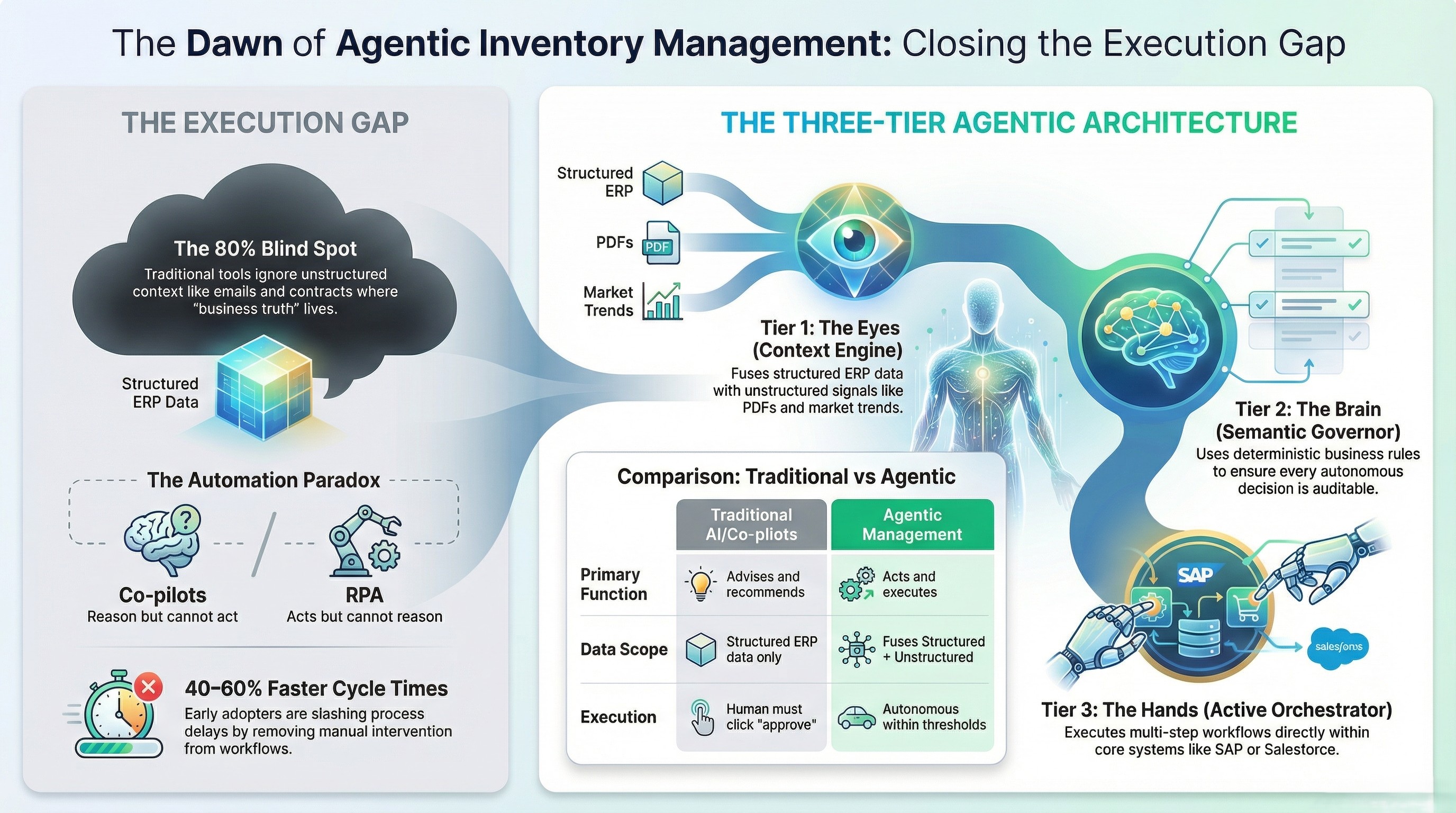
Traditional Business Intelligence (BI) and inventory dashboards are excellent at handling structured data like ERP tables and transaction logs. However, this only represents about 20% of enterprise context. The other 80%—the "real business truth"—lives in unstructured formats: PDF contracts with SLAs, email threads with negotiated discounts, and Slack conversations about supply chain disruptions.
The Automation Paradox
Because traditional tools cannot "see" this unstructured context, they are prone to error when automated. An agent acting on only 20% of the facts is a liability with a confidence score. For example, a system might see an invoice amount and due date in the ERP but miss a contract update in SharePoint or a discount negotiation in an email, leading to erroneous payments or stock decisions.
%20(1).jpg)
The Real Inventory Problem: Signals Without Execution
The current enterprise stack forces a bad trade-off between reasoning and action.
- Co-pilots (e.g., Microsoft, Salesforce): These tools have strong reasoning capabilities but cannot execute tasks independently; humans remain the bottleneck.
- RPA (e.g., UiPath): These tools can execute scripted tasks but cannot reason. They break when facing exceptions and lack understanding of unstructured data.
This leaves a "Execution Gap" where you have reasoning without action, or action without reasoning. Agentic Inventory Management fills this gap by combining Reasoning + Execution + Governance on complete context.
What Makes Inventory Management “Agentic”
To move from Level 3 (Predictive) to Level 5 (Agentic), an inventory system must possess three distinct capabilities.
From Inventory Visibility to Decision Autonomy
Instead of waiting for a human to interpret a dashboard, an agentic system says, "Handle this". It autonomously identifies issues (like a stockout risk), evaluates the best course of action based on historical data and policies, and executes the necessary workflow.
From Forecasts to Executable Actions
Traditional systems stop at forecasting. Agentic systems take the next step: Active Orchestration. They connect directly to core systems like SAP, Salesforce, or Jira to execute multi-step workflows. For example, they can automate SAP sales order creation or trigger procurement RFQs without human data entry.
From Human Coordination to System-Orchestrated Workflows
Agentic systems utilize "Semantic Governors" to ensure trust. These are not probabilistic guesses but deterministic rules encoded into the system. This allows for "Human-in-the-loop" controls based on thresholds—for instance, a refund under ₹10,000 might be fully autonomous, while anything above ₹50,000 routes for human approval.
Architecture of Agentic Inventory Management Systems
Building an agentic inventory system requires a specific three-tier infrastructure designed to make agents context-aware, governed, and safe.
Tier 1: Unified Context Engine (The Eyes)
This layer solves the "80% blind spot" by fusing structured data (ERP, POS) with unstructured data (PDFs, emails) and external signals (competitor pricing, weather). It builds a single semantic layer automatically, correlating disparate data points so the agent sees the full picture before acting.
Tier 2: Semantic Governor (The Brain)
This layer solves the trust problem. It encodes business rules, approval hierarchies, and compliance thresholds into the agent's logic. This ensures that every inventory decision is auditable, defensible, and cited against specific company policies. There are no "hallucinations" or "black boxes" here—only explainable, policy-backed decisions.
Tier 3: Active Orchestrator (The Hands)
This layer solves the execution gap. It is responsible for executing multi-step workflows across your software ecosystem. Whether it is updating inventory in an ERP or sending a notification via Slack, the orchestrator handles the technical integration, reducing processes that took weeks down to hours or minutes.
Real-World Case Study: Inventory Intelligence at 700+ Retail Stores
The power of Agentic Inventory Management is best illustrated by a retail powerhouse with over 700 stores across India.
- The Challenge: Managing a massive, price-sensitive inventory across hundreds of cities required visibility into pricing, stock, and promotions that manual monitoring could not provide.
- The Agentic Solution: They deployed an Inventory Intelligence Agent capable of continuous monitoring. This included "Inventory intelligence" to track pricing, stock, and promos per store, alongside an "Enterprise AI agent" to modernize store support and knowledge access.
- The "Context" Factor: The system utilized continuous e-commerce and channel monitoring to track pricing, MRP/discounts, and availability.
- The Outcome: The deployment resulted in "Zero-training execution" with standardized action logic. The retailer achieved improved store-level inventory visibility, faster resolution of store issues, and automated closure of workflows.
Outcomes Retailers See with Agentic Inventory Management
When retailers switch from static dashboards to agentic execution, the results are measurable and significant:
- Faster Response Cycles: Agents convert market signals into instant answers and proactive alerts, dramatically shortening the time from insight to action.
- Reduced Manual Effort: By automating monitoring and routine workflows, manual operational load is significantly reduced.
- Proactive Risk Management: Agents provide earlier identification of pricing gaps, margin erosion, and vendor slippage, shifting management from reactive firefighting to proactive control.
- Consistent Execution: Governed playbooks ensure that execution is consistent across all stores and territories, regardless of human fatigue or shift changes.
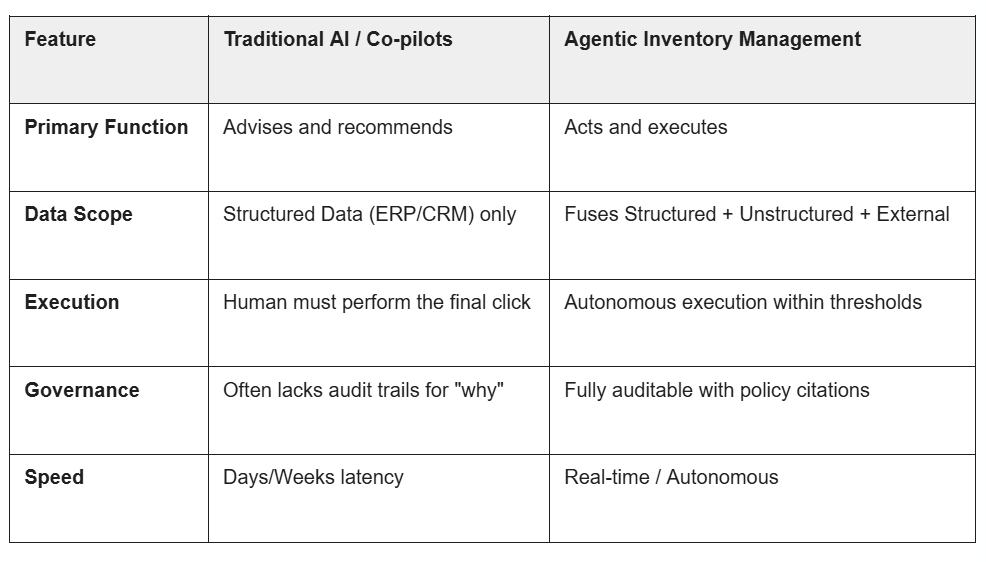
Agentic Inventory Management vs Traditional Inventory AI
How to Evaluate an Agentic Inventory Management Platform
If you are evaluating a platform in 2026, ensure it meets these critical enterprise-grade criteria:
- Does it have a Unified Context Engine? It must be able to ingest and correlate ERP data, PDFs, emails, and external market signals into a single semantic layer.
- Is it truly governed? Look for "Semantic Governance" that uses deterministic logic (if-then decision trees), not just probabilistic LLM guesses.
- Is it secure and compliant? Ensure the platform is SOC2 Type II, ISO 27001, and GDPR compliant, with full data encryption (AES-256 + TLS 1.3).
- Does it offer "Human-in-the-loop" control? You should be able to set thresholds (e.g., value limits) that determine when an agent acts autonomously versus when it requests approval.
- Can it cite its work? Every autonomous decision should be accompanied by an audit log and specific rule citations to explain why the agent took that action.
The Future of Inventory Management Is Agentic
We are witnessing an "Unavoidable Shift". The competitive chasm is no longer about who has the best data, but who can execute on that data the fastest.
Agentic Inventory Management moves enterprises from reactive cycles (limited to ~8 per year) to continuous, autonomous execution (50+ cycles per year). It allows your supply chain to move from "What happened?" to "Handle this".
Ready to Build Your Agentic Inventory System?
Don't let your agents fly blind. The difference between a risky experiment and an enterprise-grade solution is infrastructure. Assistents is the Agentic Intelligence Platform designed to close the execution gap.
This is the exact engine that powered the digital transformation for major retailers, enabling standardized action logic and zero-training execution across 700+ stores.
While traditional tools stop at the dashboard, Assistents goes further:
- Unified Context Engine: Fuses your structured ERP data with the 80% of critical context hidden in emails, contracts, and unstructured documents, ensuring your agents see the full picture.
- Semantic Governance: Replaces probabilistic guessing with deterministic business rules, making every autonomous inventory decision fully auditable and policy-cited.
- Active Orchestration: Moves beyond advice to execute workflows directly in your core systems, from replenishing stock to correcting pricing gaps.
Stop planning and start executing. We don't believe in endless "POC purgatory."
[Get Your Pilot Plan in 48 Hours] Let us define your workflow, calculate your ROI, and prove the value. If we don't surface real, new values, we walk.
FAQs-
How does agentic inventory management work?
Agentic inventory management works by continuously monitoring inventory and demand signals, reasoning over business context (fusing structured ERP data with unstructured documents and external signals), and autonomously executing replenishment or escalation workflows. Unlike traditional systems, it closes the loop from insight to action while operating within governed rules, thresholds, and approvals.
How is Agentic Inventory Management different from traditional automation like RPA?
Traditional automation, such as Robotic Process Automation (RPA), follows rigid scripts and often breaks when facing exceptions or unstructured data. It can execute tasks but cannot reason. In contrast, Agentic Inventory Management combines reasoning with execution. It can interpret complex context, evaluate options, and autonomously execute workflows—such as identifying an issue and routing approvals—rather than just following a linear script.
How does the system handle important data that isn't in my ERP, like supplier emails or contracts?
Most inventory decisions rely on context that lives outside of structured ERP tables—in fact, approximately 80% of enterprise context exists in unstructured formats like emails, PDF contracts, and Slack messages. Agentic systems use a Unified Context Engine to fuse this unstructured data with structured records. This ensures the agent "sees" the full picture, such as negotiated discounts in an email or penalty clauses in a PDF, before making a decision.
Is it safe to let AI make inventory decisions without human approval?
Yes, because the system operates under Semantic Governance. Unlike "black box" AI models that rely on probabilistic guesses, agentic systems use deterministic logic and business rules you define. You can set specific thresholds for autonomy—for example, allowing the agent to handle refunds under a certain amount automatically, while routing higher-value actions to a human for approval. Every decision is fully auditable and cited against your specific company policies.
What tangible results have retailers seen from deploying agentic inventory agents?
Retailers deploying agentic systems have reported significant operational improvements. Early adopters are seeing 40-60% reductions in process cycle times. For example, a major retailer with over 700 stores used inventory intelligence agents to standardize action logic and achieve zero-training execution across its footprint. Other outcomes include faster order-to-confirm cycles, fewer data-entry errors, and the elimination of manual order processing dependencies.

Transform Your Business With Agentic Automation
Agentic automation is the rising star posied to overtake RPA and bring about a new wave of intelligent automation. Explore the core concepts of agentic automation, how it works, real-life examples and strategies for a successful implementation in this ebook.
Sarfraz Nawaz is the CEO and founder of Ampcome, which is at the forefront of Artificial Intelligence (AI) Development. Nawaz's passion for technology is matched by his commitment to creating solutions that drive real-world results. Under his leadership, Ampcome's team of talented engineers and developers craft innovative IT solutions that empower businesses to thrive in the ever-evolving technological landscape.Ampcome's success is a testament to Nawaz's dedication to excellence and his unwavering belief in the transformative power of technology.

More insights
Discover the latest trends, best practices, and expert opinions that can reshape your perspective

.jpg)



Contact us

