
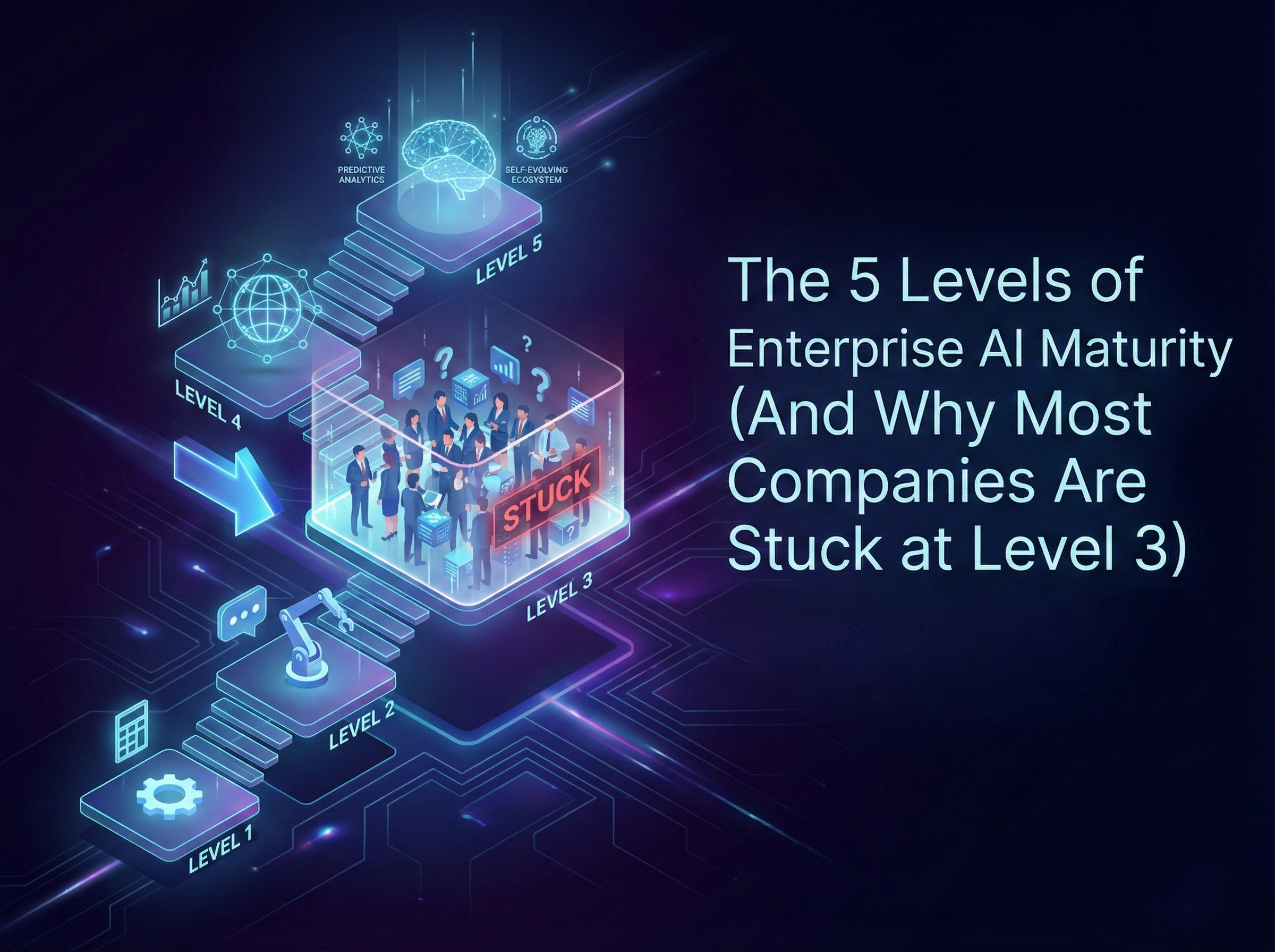
The 5 Levels of Enterprise AI Maturity (And Why Most Companies Are Stuck at Level 3)


The race has already started. Today, the question for business leaders is no longer if enterprises will deploy AI agents, but whether those agents will execute with precision or become a massive liability.
While early adopters are already seeing 40–60% reductions in process cycle times, most organizations are walking into a dangerous trap. They are building "Blind Agents"—powerful reasoning tools that act on fragmented data, multiplying chaos rather than efficiency.
To move beyond the noise, leaders need a clear roadmap. This is the Enterprise AI Maturity Model: a 5-level framework for moving from static reports to autonomous, governed execution.
What Is an Enterprise AI Maturity Model?
An enterprise AI maturity model describes the stages organizations go through as they adopt AI—from basic reporting to autonomous, governed execution. It provides a standardized way to measure performance across dimensions like strategy, data, workflows, and governance.
Why AI Maturity Matters More Than AI Adoption
Adoption is just the act of buying tools; maturity is the capability of your systems to drive outcomes. High maturity allows for:
- Greater Efficiency: Automating complex workflows to reduce operational costs.
- Informed Decision-Making: Moving from "hindsight" to real-time strategic action.
- Competitive Advantage: Creating new products and services that were previously impossible.
.jpg)
The Problem With Most AI Maturity Models
Many traditional models are too tool-centric. They focus on whether you have a LLM or a data lake, but they ignore the "human mess"—the unwritten rules, tribal knowledge, and manual checks that keep organizations stuck in the early stages.
Level 1: Descriptive (Reporting What Happened)
At this foundation, the focus is purely on hindsight.
- Capabilities: Static, periodic reports and basic data views.
- Speed: Days or weeks to generate a single insight.
- The Question: "What happened?".
- Action: Entirely manual.
Level 2: Diagnostic (Understanding Why It Happened)
Organizations at Level 2 move from reports to interactive BI Dashboards.
- Capabilities: Root-cause analysis and pattern recognition in structured data.
- Speed: Near real-time data visibility.
- The Question: "Why did this happen?".
- Limit: Only roughly 20% of enterprise data (structured) is usually utilized.
Level 3: Predictive & Prescriptive (The Illusion of Intelligence)
This is where most modern enterprises sit today, utilizing "Co-pilots" and forecasting models.
- Capabilities: AI-generated forecasts and "next-best-action" recommendations.
- The Trap: While the AI advises, humans must still manually execute the task.
- The Illusion: It feels advanced, but the human remains the ultimate bottleneck for every decision.
Why Most Enterprises Get Stuck at Level 3
Level 3 is a plateau where reasoning exists without action.
Execution Still Depends on Humans
The system can tell you a refund is needed, but a human still has to log into the ERP to process it. This limits scale and creates "pilot purgatory".
Context Is Fragmented
Most AI at this level only sees the 20% of data in your CRM or ERP. It is blind to the 80% of real business truth hidden in PDF contracts, Slack threads, and email negotiations.
Governance Is Missing
Without a "Semantic Governor," agents rely on probabilistic guesses rather than deterministic business rules, leading to hallucinations or black-box decisions.
Level 4: Governed Automation (Systems That Can Act Safely)
This is the bridge to true autonomy. Organizations begin to implement Agentic Workflow Engines that can orchestrate tasks across systems like SAP, Salesforce, and Jira.
- Capabilities: Multi-step workflows with strict audit trails.
- Control: Human-in-the-loop triggers based on risk thresholds (e.g., automated refunds under $10,000, but human approval for anything higher).
Level 5: Agentic AI (Autonomous, Governed Execution)
This is the pinnacle of maturity: Agentic Intelligence.
- The Question: You simply say, "Handle this".
- Capabilities: The system detects issues, evaluates options based on full context, executes the workflow, and learns from the result.
- Value: It moves the organization from reactive cycles to 50+ autonomous cycles per year.
What Separates Level 5 From Everything Below It
Full Business Context
Level 5 systems use a Unified Context Engine to fuse structured data with the 80% of "unstructured" truth (PDFs, emails, chats).
Deterministic Governance
Decisions are based on encoded business rules and policy citations, ensuring every action is auditable and defensible.
Human-in-the-Loop by Design
Autonomy is not "set it and forget it." It is governed by permission controls and real-time monitoring to prevent runaway errors.
How to Move From Level 3 to Level 5
- Stop Optimizing Dashboards: Focus on building infrastructure that can act, not just show.
- Invest in Context, Not Just Models: An agent is only as good as the data it can see. Prioritize fusing your unstructured data (SLA contracts, emails).
- Encode Policies, Not Prompts: Move away from "black box" prompts toward deterministic decision trees and compliance thresholds.
- Design for Execution: Start mapping workflows that bridge the gap between your CRM, ERP, and communication tools.
What are the levels of enterprise AI maturity?
Enterprise AI maturity typically progresses through five levels: descriptive reporting, diagnostic analysis, predictive and prescriptive insights, governed automation, and fully agentic AI. Most organizations stall at Level 3, where AI recommends actions but humans still execute, limiting speed and scale.
Frequently Asked Questions (FAQ)
Q1: How long does it take to reach Level 5?
While traditional transformation takes years, modern agentic platforms allow for a "live, governed agent" in production within 30 days by orchestrating what you already use rather than replacing it.
Q2: What is the biggest risk of "Blind Agents"?
Agents acting on partial data (e.g., seeing an invoice but not the negotiated discount in an email) can lead to massive losses, such as a firm that mistakenly approved 12 crore in early payments by ignoring contract PDFs.
Q3: Can small teams achieve Level 5 maturity?
Yes. Agentic AI is a "force multiplier." It allows small teams to run 50+ business cycles per year—a level of output previously reserved for massive departments.
Q4: Is Level 5 just about replacing humans?
No. It’s about human augmentation. Humans shift from manual execution to setting the high-level strategy and acting as the final "governor" for high-stakes decisions.
Q5: What are the primary data types needed for Level 5?
True maturity requires Contextual Fusion of three types: Structured (ERP/CRM), Semi-structured (Logs/APIs), and Unstructured (Docs/Email/Chat).

Transform Your Business With Agentic Automation
Agentic automation is the rising star posied to overtake RPA and bring about a new wave of intelligent automation. Explore the core concepts of agentic automation, how it works, real-life examples and strategies for a successful implementation in this ebook.
Sarfraz Nawaz is the CEO and founder of Ampcome, which is at the forefront of Artificial Intelligence (AI) Development. Nawaz's passion for technology is matched by his commitment to creating solutions that drive real-world results. Under his leadership, Ampcome's team of talented engineers and developers craft innovative IT solutions that empower businesses to thrive in the ever-evolving technological landscape.Ampcome's success is a testament to Nawaz's dedication to excellence and his unwavering belief in the transformative power of technology.

More insights
Discover the latest trends, best practices, and expert opinions that can reshape your perspective







Contact us

