
Build vs Buy AI Agents: The 2026 Decision Framework (Real Costs, Scorecard and 8 Enterprise Case Studies)


The build vs buy AI agents question has become one of the most expensive calls an enterprise technology leader makes this decade. Get it wrong and you join the more than 40% of agentic AI projects Gartner expects to be cancelled by the end of 2027 because of rising costs, unclear business value or weak risk controls. Get it right and AI agents stop being a pilot and start running real business processes.
This guide covers what most build vs buy articles leave out. It includes a line-item view of the 3-year total cost of ownership (TCO), a weighted scorecard you can use with your team, a verdict for each use case, and eight anonymised enterprise deployments that show how the decision plays out in production.
TL;DR: Build vs buy AI agents in one paragraph Build AI agents in-house when the agent is your product or core IP. Buy a ready-made agent for narrow, single-function tasks. For most enterprise operations, meaning cross-system workflows that need approvals, audit trails and access to ERP or CRM data, build on a governed platform: buy the orchestration, integrations and controls, and build only your business logic. According to MIT research reported by Fortune, AI projects bought from specialised vendors succeed about 67% of the time, while internal builds succeed only one-third as often.
Build vs buy AI agents: the short answer
You should build AI agents only when they are a strategic differentiator you will productise, and buy them only when the task is narrow and standard. Everything in between, which covers most enterprise use cases, is best served by building on an enterprise AI agent platform. We call that approach "Buy the foundation, build the advantage."
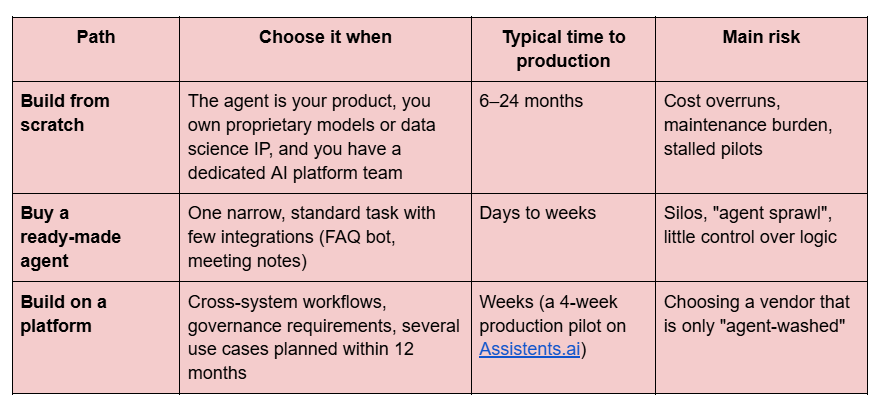
What "build" and "buy" actually mean for AI agents in 2026
The classic software build vs buy debate assumed two clean options. AI agents add a third. Mixing them up is the most common reason teams compare the wrong things.
Build from scratch
Your engineers assemble an agent stack using open-source frameworks such as LangGraph, CrewAI or the OpenAI Agents SDK. They then build everything those frameworks leave out: connectors, permissions, memory, evaluation, monitoring, model routing and the user interface. You get maximum control, and you carry 100% of the engineering and maintenance load. (For a deeper comparison, see our guide to LangChain vs custom AI agent workflows.)
Buy a ready-made agent
This covers single-function SaaS agents and general assistants such as Microsoft Copilot, Claude or ChatGPT Enterprise. They are fast to roll out and good at helping one person finish a task: drafting, summarising, researching, analysing. They rarely own an end-to-end business process across your systems.
Build on a platform
You configure agents on a shared enterprise foundation that already provides business context, orchestration, governance and integrations. Your team builds the logic that is specific to your business: rules, approval paths, data definitions and exception handling. It runs on infrastructure you didn't have to engineer.
Personal productivity vs organisational productivity
Many teams skip a distinction that matters here:
- Personal productivity tools (Copilot, Claude, ChatGPT) help an individual draft, summarise, research and analyse.
- Organisational productivity platforms such as Assistents.ai connect teams, business context, rules and enterprise systems. They coordinate a process from trigger to verified outcome and measure cycle time, throughput, exception handling and control.
If your goal is the second, buying more seats of the first won't get you there. Your existing AI investment is still useful. The next step is to put shared business processes to work on top of it.
Why AI agents break the classic build vs buy math
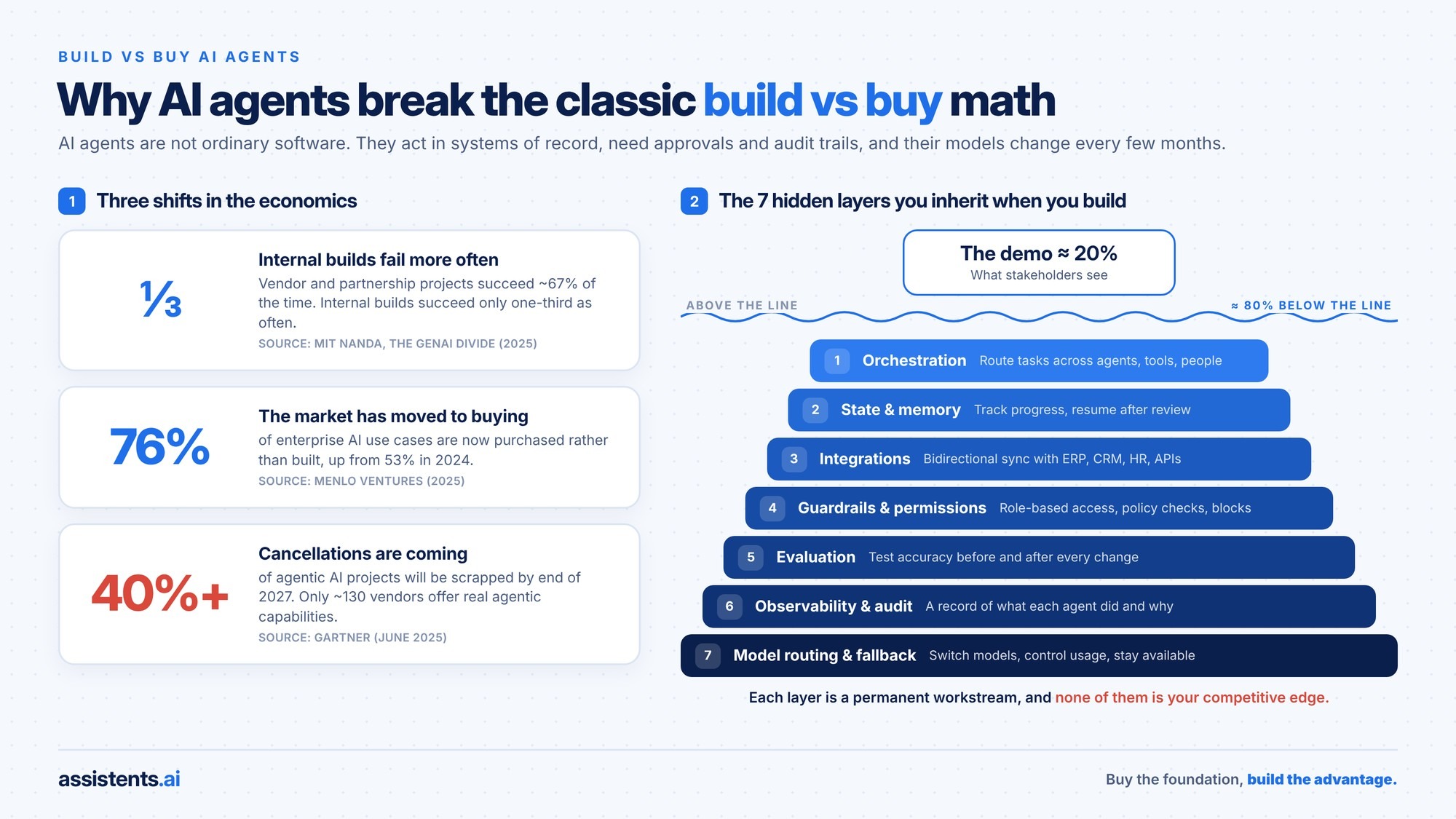
AI agents are not ordinary software. They are non-deterministic, they take actions in systems of record such as SAP, Salesforce and ServiceNow, they need human approvals and audit trails, and the models underneath them change every few months. That changes the economics in three ways.
- Internal builds fail more often. MIT's NANDA initiative, in its 2025 report The GenAI Divide, found that purchasing from specialised vendors and building partnerships succeeded about 67% of the time, while internal builds succeeded only one-third as often (Fortune).
- The market has already moved toward buying. Menlo Ventures reports that 76% of enterprise AI use cases are now purchased rather than built, up from 53% in 2024.
- Cancellations are coming. Gartner predicts that over 40% of agentic AI projects will be scrapped by 2027, and estimates that only about 130 of the thousands of vendors claiming "agentic AI" are offering real agentic capabilities.
The 7 hidden layers you inherit when you build
A working demo is perhaps 20% of a production agent. When you build from scratch, you also own:
- Orchestration: routing tasks between specialist agents, tools and people.
- State and memory: tracking where each process is, and resuming after a human review.
- Integrations: secure, bidirectional sync with ERP, CRM, HR, files, databases and APIs.
- Guardrails and permissions: role-based access, policy checks and blocked actions.
- Evaluation: testing accuracy against real cases before and after every change.
- Observability and audit: a complete record of what each agent did and why.
- Model routing and fallback: switching models, controlling usage and keeping availability high.
Each layer is a permanent workstream, not a one-off project, and none of them gives your business an edge.
The real cost: 3-year TCO of building vs buying AI agents
The licence fee or the engineering salary is rarely the biggest number. Maintenance, integrations and governance are where build budgets run over. Use the table below to set out your own figures. It lists who carries each cost under each path.
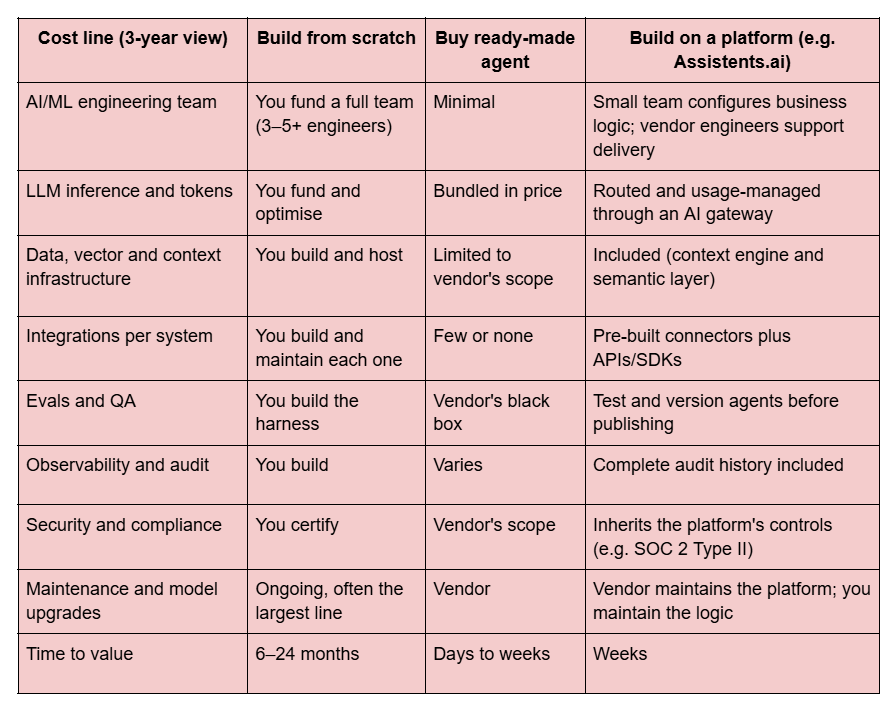
An illustrative build calculation. Retool cites benchmark ML engineer salaries of $169k and up, with senior engineers above $200k. A modest three-engineer team therefore costs roughly 500k–600k a year in salary alone, or about 1.5M–1.8M over three years. That is before inference, infrastructure, integration work, compliance and the opportunity cost of a 12–24 month build timeline (a range Turing also cites for in-house builds). Treat these as planning estimates and replace them with your own figures.
For a full dollar breakdown by agent type, read our guide on how much it costs to build an AI agent, or model your own numbers with the AI agent ROI calculator.
Pricing models compared: per seat vs per outcome vs usage
- Per seat: predictable, but you pay for people, not results, and costs grow with headcount.
- Per resolution or outcome: matched to value, but check how vendors define a "resolution".
- Usage-based: flexible, but needs usage management to avoid token surprises.
Assistents.ai uses outcome-based AI agent pricing, based on agent usage and deployment complexity rather than seats occupied.
Time to value
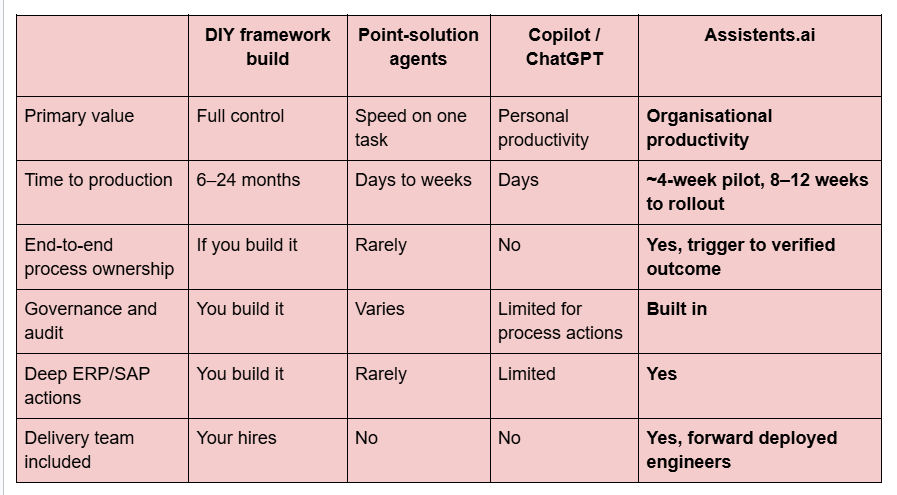
In-house builds commonly take 6–24 months to reach production. On Assistents.ai, teams typically reach a production pilot in about 4 weeks and full rollout in 8–12 weeks, because the foundation is already in place.
Build vs buy AI agents: side-by-side comparison
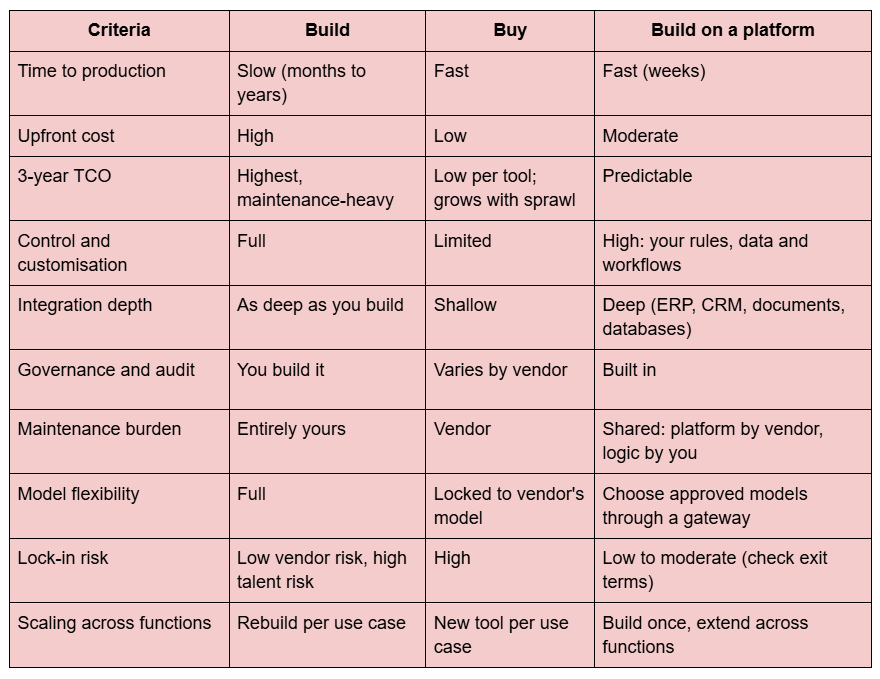
When to build AI agents in-house
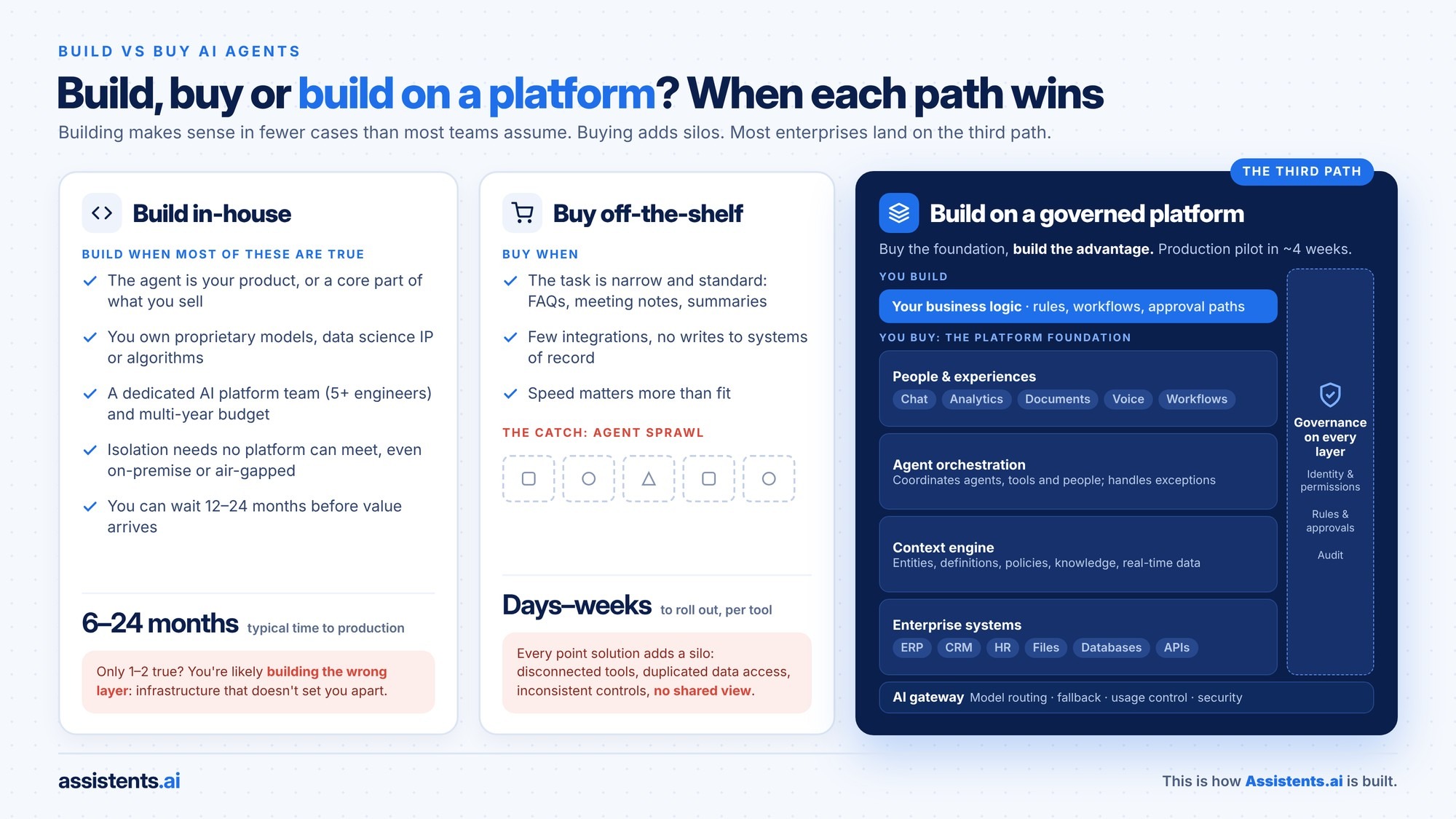
Building in-house makes sense in a narrower set of cases than most teams assume. Build when most of these are true:
- The agent is your product, or a core part of what you sell.
- You own proprietary models, data science IP or algorithms that set you apart.
- You have a dedicated AI platform team (five or more engineers) and budget for multi-year maintenance.
- Your regulatory or isolation requirements can't be met by any commercial platform, including on-premise or air-gapped deployments.
- You can absorb a 12–24 month timeline before value arrives.
If only one or two are true, you are probably building infrastructure that doesn't set you apart. Kore.ai calls this "building the wrong layer".
When to buy an off-the-shelf AI agent
Buying a ready-made agent is the right call when:
- The task is narrow and standard, such as answering FAQs, taking meeting notes or summarising documents.
- It needs few integrations and doesn't write to systems of record.
- Speed matters more than fit.
The catch is that every new point solution adds another silo. After five or six of them you have agent sprawl: disconnected tools, duplicated data access, inconsistent controls and no shared view of what your agents are doing.
The third path: build on a governed AI agent platform
The approach most successful enterprises are converging on is "Buy the foundation, build the advantage." You buy the layers every agent needs and build only what is specific to your business.
A modern enterprise agent platform is layered like this:
- People and experiences: chat, analytics, documents, voice and workflows.
- Agent orchestration: coordinates specialist agents, tools and people; plans, executes and handles exceptions.
- Business meaning and source evidence: a context engine for entities, definitions, policies, knowledge and real-time data.
- Enterprise systems: ERP, CRM, HR, files, databases and APIs.
- Governance across every layer: identity and permissions, rules and approvals, audit.
- AI gateway underneath: model routing, fallback, usage control and security.
This is how Assistents.ai is built.
Why Assistents.ai is the platform enterprises build on
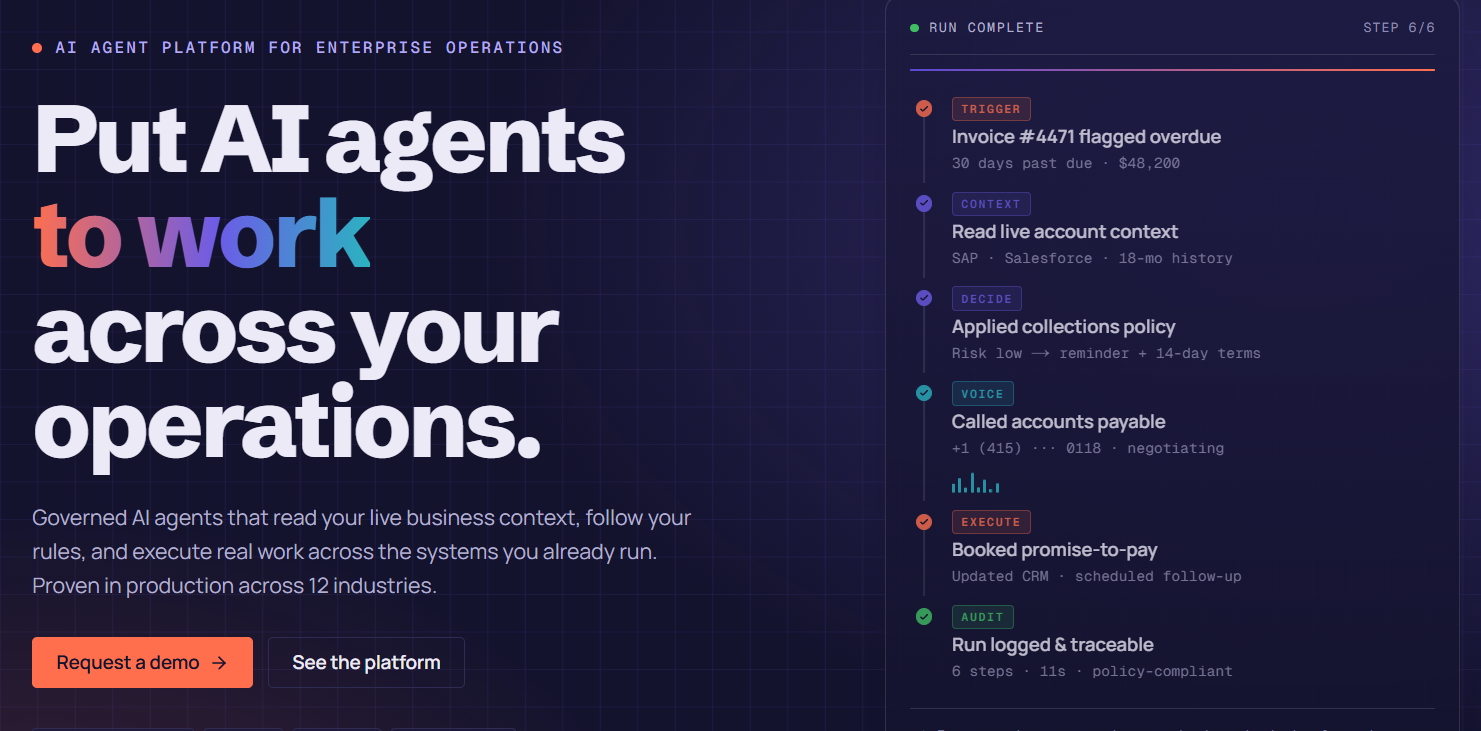
Assistents.ai, the enterprise AI agent platform by Ampcome, gives you the foundation a custom build would take months or years to engineer. Your team's time goes into the business logic that sets you apart. Each capability below replaces a workstream you would otherwise have to build.
One platform, five ways to put AI to work
Assistents.ai combines five capabilities on one connected platform:
- Conversational agents: source-backed answers plus permitted actions, such as checking an order in the ERP and creating a follow-up task.
- Agentic BI: ask questions in natural language and get charts, reports, scheduled insights and threshold alerts.
- Document AI: read layouts and tables, extract fields, apply business rules and route exceptions for human review.
- Voice AI: natural, multilingual inbound and outbound conversations with in-call actions, contextual handover and call summaries.
- Autonomous workflows: let emails, schedules, system events and files start the work, with people kept in control.
You can extend all five with Deep Research, Canvas, the Agent Builder and the Workflow Builder. Use one capability on its own, or combine them to transform a whole process.
A context engine that understands your business
Agents fail when they don't understand your business. The Assistents.ai context engine links customers, orders, contracts, products, invoices and owners, along with the policies that govern them (for example credit limits and approval rules). Agents act on evidence from source systems, so your team doesn't spend months building retrieval pipelines and a semantic layer.
Governance on every action
Every action passes an access check (user role and permissions) and a policy evaluation (rules and constraints). It then goes one of three ways: allowed, review required (human approval), or blocked (no action, logged for review). You get permissions, business rules, human approvals and a complete audit history without building any of it.
Works with the systems you already run
Connect ERPs including SAP, plus CRM, HR, documents and databases, through secure standard protocols, APIs, SDKs and 300+ integrations, with event ingestion and bidirectional sync.
An AI gateway that prevents model lock-in
Choose approved models through the AI gateway, with task routing and optimisation, fallback, high availability and usage management. When a better model ships, you switch to it without re-architecting.
Deploy where your data needs to live
Deploy as cloud SaaS, in a private cloud or on-premise. Assistents.ai is SOC 2 Type II certified, ISO 27001-aligned, and customer data is not used to train foundation models. See Security & Trust for details.
Book a tailored platform walkthrough →
The build vs buy AI agents scorecard
Score each criterion from 1 to 5 for your use case, multiply by the weight, and add up the results.
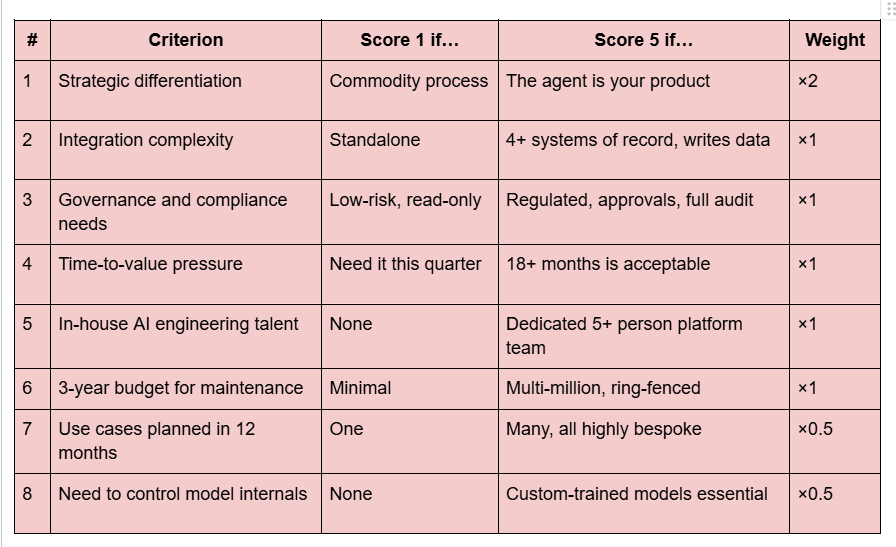
How to read your score (maximum 40):
- 8–16: Buy. A ready-made agent will do.
- 17–28: Build on a platform. You need control and governance without the infrastructure burden. This is where most enterprise operations land.
- 29–40: Build. You have the strategic reason and the resources to own the full stack.
Want this as a spreadsheet for your steering committee? Download the build vs buy AI agents scorecard.
Build vs buy AI agents: a decision tree
- Is the AI agent your product or core IP?
- Yes → Build (or build on a platform's SDK to move faster).
- No → go to step 2.
- Does it touch more than two systems, write to systems of record, or need human approvals?
- No → Buy a ready-made agent.
- Yes → go to step 3.
- Do you plan more than one agent use case in the next 12 months?
- Yes → Build on a platform, so you build once and extend across functions.
- No → Build on a platform if governance matters; otherwise a specialised point solution may be enough.
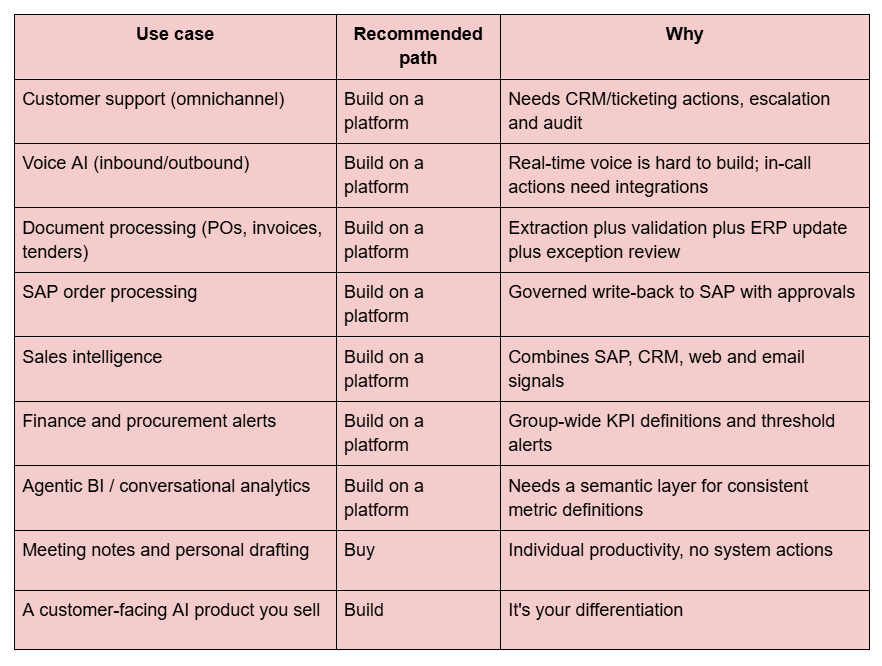
Build vs buy AI agents by use case
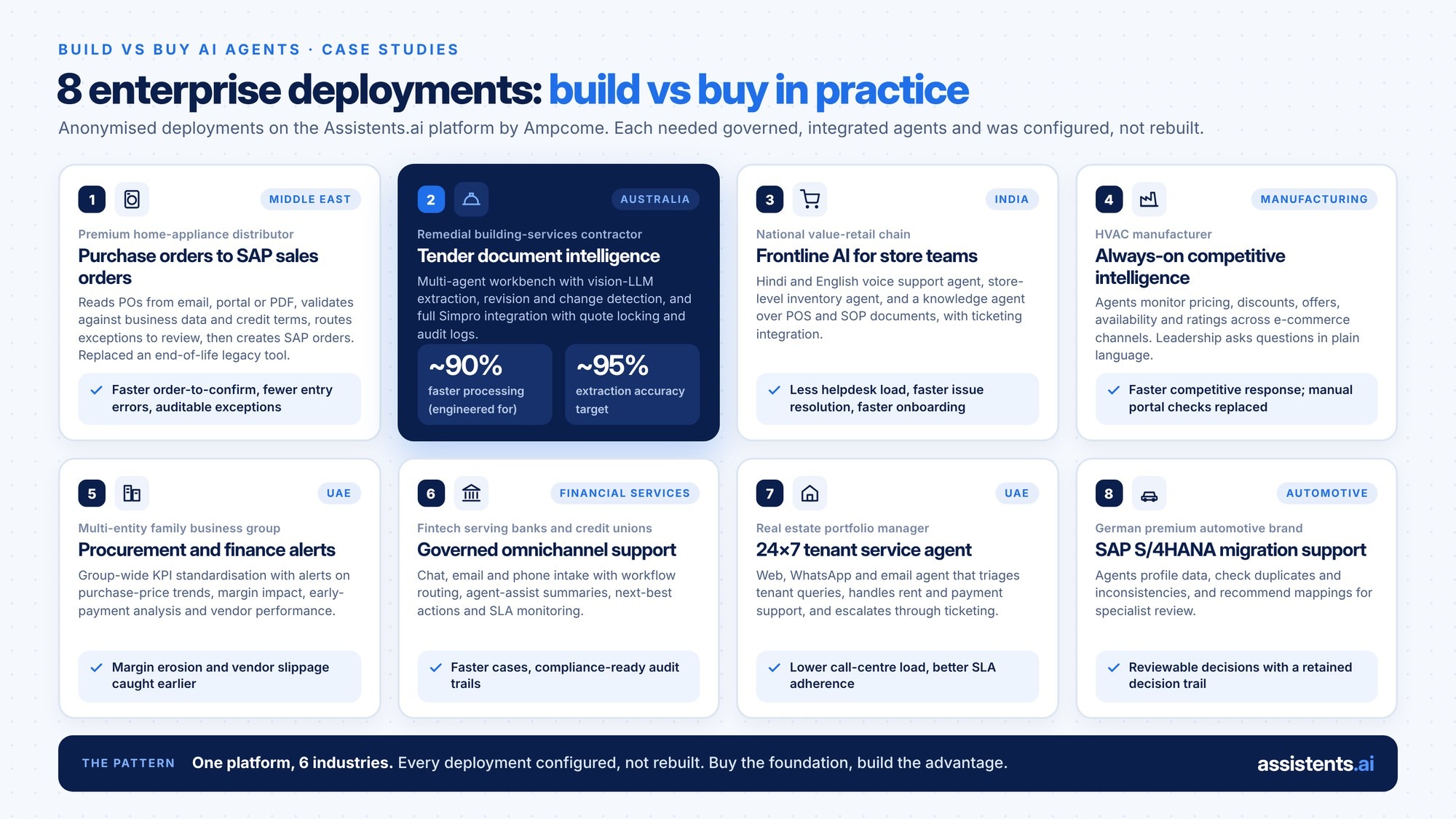
8 enterprise deployments: what the build vs buy decision looked like in practice
These are anonymised deployments delivered on the Assistents.ai platform by Ampcome. In each one, the client needed governed, integrated agents. A custom build would have meant engineering the same foundation from scratch. On the platform, the work went into configuring each client's processes, systems and controls.
1. Premium home-appliance distributor (Middle East): purchase orders to SAP sales orders
- Challenge: Manual document handling and order entry across systems, with a legacy document-capture tool that was reaching end-of-life and carried high licensing costs.
- What a DIY build would have needed: Document extraction, validation rules, SAP integration, exception routing and audit logging, each built and maintained separately.
- What was deployed: Agentic automation that reads incoming purchase orders (email, portal or PDF), extracts customer, product, quantity, pricing and delivery details, and validates them against business data and credit terms. Exceptions such as missing information, duplicates or out-of-policy items go to human review. The agent then creates validated sales orders in SAP.
- Results: Less manual order processing and less dependence on the legacy tool, a faster order-to-confirm cycle with fewer data-entry errors, and better auditability for sales order creation and exceptions.
2. Remedial building-services contractor (Australia): tender document intelligence
- Challenge: Complex tender documents and frequent revisions had to be keyed into operational systems by hand, which created bid risk.
- What was deployed: An intelligent document workbench using multi-agent orchestration and vision-LLM extraction from complex PDFs. It handles revision analysis and change detection, and integrates fully with the contractor's job-management system (Simpro), including quote locking and audit logs.
- Results: Engineered for up to ~90% faster tender document processing and a ~95% extraction accuracy target on standard formats, with lower bid risk through change detection and auditability.
3. National value-retail chain (India): frontline AI for store teams
- Challenge: Store staff across a large national network needed fast answers on stock, pricing, promotions and procedures, and the central helpdesk was overloaded.
- What was deployed: A voice support agent in Hindi and English, an inventory intelligence agent covering pricing, stock and promotions per store, and a knowledge and training agent using retrieval over POS and SOP documents. It also includes an admin console, analytics and ticketing integration.
- Results: Less manual helpdesk work, faster resolution of store issues, better store-level inventory visibility, and faster onboarding through on-demand training guidance.
4. HVAC manufacturer: always-on competitive intelligence
- Challenge: Pricing and promotion moves by competitors across e-commerce channels were tracked by hand, if at all.
- What was deployed: Agents that monitor pricing, MRP and discounts, offers, availability and ratings continuously. Leadership asks questions in plain language, and an analytics view shows pricing gaps and threats. The architecture scales from proof of concept to production with governance and audit trails.
- Results: Faster competitive response, earlier spotting of pricing gaps and promotion shifts, and always-on monitoring in place of manual checks across portals.
5. Multi-entity family business group (UAE): procurement and finance alerts
- Challenge: Margin erosion and vendor slippage across group companies surfaced too late to act on.
- What was deployed: Group-wide KPI standardisation with automated alerts on purchase-price trends, gross-margin impact, early-payment analysis and vendor performance, plus scheduled insight packs for leadership.
- Results: Earlier detection of margin erosion and vendor slippage, standardised finance and procurement intelligence across entities, and fewer variance surprises.
6. Fintech serving banks and credit unions: governed omnichannel support
- Challenge: Disputes, fraud and compliance-heavy support work needed automation that auditors could trust.
- What was deployed: Omnichannel intake (chat, email and phone) with workflow routing, agent-assist summaries and next-best actions, auditability, reporting and SLA monitoring.
- Results: Faster, more consistent case handling, less operational load, and better compliance readiness through audit trails.
7. Real estate portfolio manager (UAE): 24×7 tenant service
- Challenge: Tenant queries about rent, payments and policies overwhelmed the call centre.
- What was deployed: An omnichannel customer service agent (web, WhatsApp and email) that triages tenant queries, handles FAQs and rental and payment support, escalates to human teams through ticketing, and draws on a knowledge base of policies, tenancy documents and SOPs.
- Results: Faster response times, lower call-centre load, a consistent 24×7 tenant experience, and better SLA adherence.
8. Leading German premium automotive brand: SAP migration decision support
- Challenge: Moving from SAP ECC to SAP S/4HANA meant thousands of data-mapping decisions across customer data, material master, vendor records, transactions and custom tables.
- What was deployed: Agents that discover and profile data, check for duplicates and inconsistencies, and recommend mappings for specialist review and validation.
- Results: Migration decisions that can be reviewed, with mapped data, transformation rules, validation results and a retained decision trail.
The pattern across all eight: these deployments span manufacturing, retail, construction, financial services, real estate and automotive, and every one runs on the same platform. Each was configured, not rebuilt, around the client's processes, systems and controls. That is the "Buy the foundation, build the advantage" model in practice.
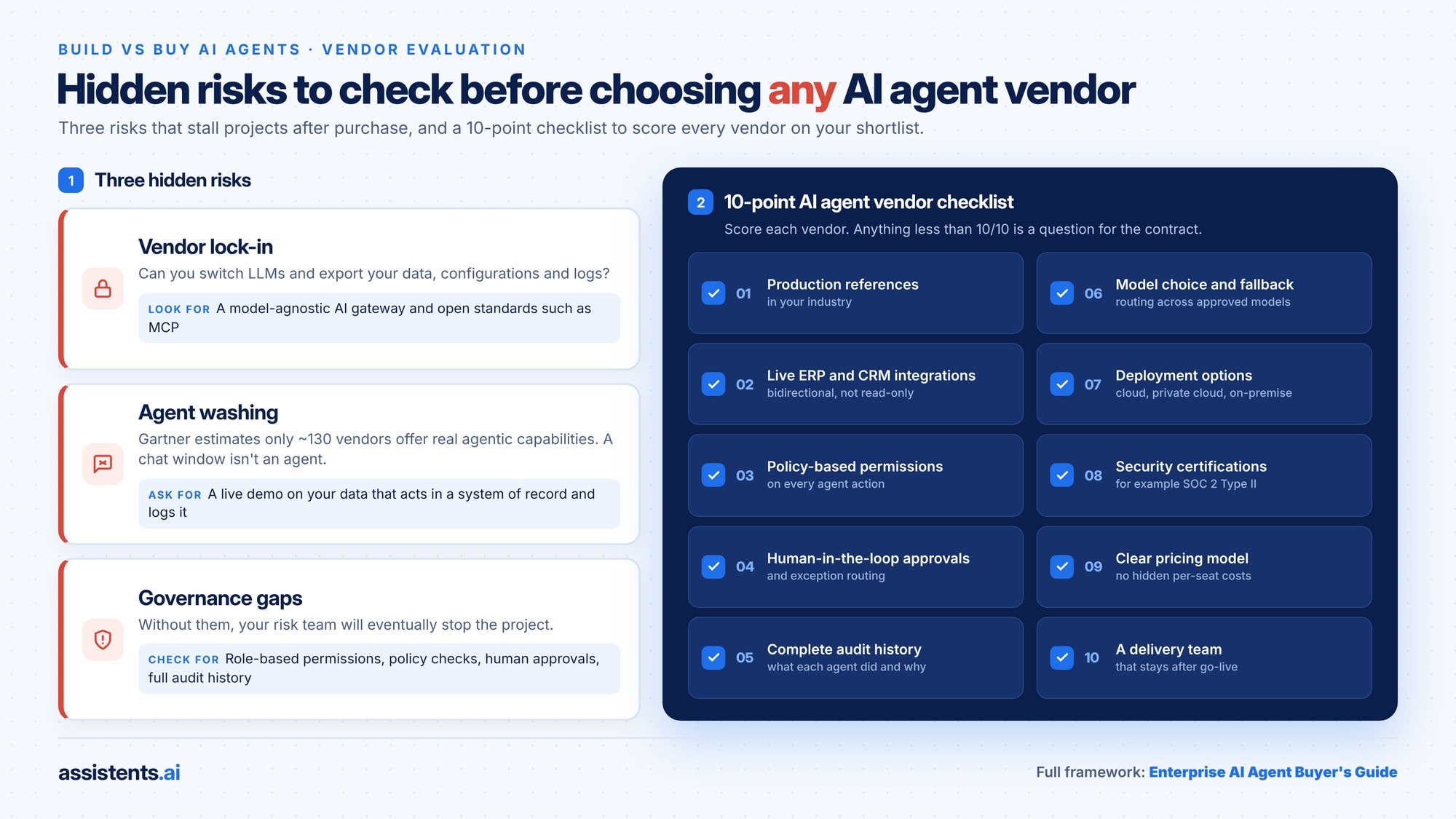
Hidden risks to check before choosing any AI agent vendor
Vendor lock-in
Ask whether you can switch LLMs, export your data, configurations and logs, and connect through open standards such as the Model Context Protocol (MCP). A model-agnostic AI gateway is the strongest protection.
Agent washing
Gartner estimates that only about 130 vendors offer real agentic capabilities. Ask for a live demo on your own data that takes an action in a system of record and records it in an audit trail. If all you see is a chat interface, it isn't an agent.
Governance gaps
If a vendor can't show role-based permissions, policy checks, human approvals and a complete audit history, your risk team will eventually stop the project.
10-point vendor checklist
- Production references in your industry
- Live, bidirectional integrations with your ERP and CRM
- Policy-based permissions on every agent action
- Human-in-the-loop approvals and exception routing
- Complete audit history
- Model choice, routing and fallback
- Deployment options (cloud, private cloud, on-premise)
- Security certifications (for example SOC 2 Type II)
- A clear pricing model with no hidden per-seat costs
- A delivery team that stays with you after go-live
For a full evaluation framework, see the Enterprise AI Agent Buyer's Guide.
Your 90-day path from pilot to production
Start with one valuable process and build from there. Bring one priority process, map its systems, handoffs and approval points, and agree up front how you'll measure success.
- Select a valuable opportunity with a measurable baseline, such as order-processing time, support resolution time or review effort.
- Connect the systems involved: ERP, CRM, documents, databases.
- Configure agents and workflows with your rules, permissions and approval paths.
- Validate on real cases and refine.
- Operate with monitoring, support and visible exceptions.
- Expand to more use cases, reusing the integrations and context you've already built.
Why teams choose Assistents.ai over building in-house
Earlier we covered the platform's capabilities. This section is about the delivery model, which is often what decides the build vs buy question for enterprise teams.
Production in weeks, not quarters
The foundation already exists, so your first use case reaches a production pilot in about four weeks rather than waiting on a year-long infrastructure build.
The platform and the team
Assistents.ai comes with Ampcome's specialist delivery team: forward deployed engineers (FDEs), AI engineers, and data science and machine learning experts across the USA, Australia and India. They handle AI product engineering, data and analytics, enterprise integration, and delivery and support. You get a build team without the hiring cycle. (Need fully custom work as well? See our AI agent development services.)
Build once, extend across business functions
Integrations, context and controls are shared, so your second and third use cases cost much less than the first. One deployment can grow from order processing to sales intelligence to legal notice monitoring, with local controls and team permissions for each.
Pay for outcomes, not seats
Pricing is based on agent usage and deployment complexity, so cost tracks value rather than headcount. See pricing.
Proven in production across 12 industries
The case studies above show the range, from SAP order automation to voice AI in retail stores. Read more on why enterprises choose Assistents.ai, or see how the platform compares with alternatives on our comparison pages.
The verdict: buy the foundation, build the advantage
The build vs buy AI agents decision isn't really binary. Build only when the agent is your product. Buy only when the task is narrow. For everything in between, which covers the workflows that move orders, cases, documents and decisions through your organisation, build on a governed platform. Your engineering effort then goes into what sets you apart, not into rebuilding orchestration, integrations and audit trails that every agent needs.
Assistents.ai gives you that foundation, plus a team that has already delivered it across manufacturing, retail, construction, financial services, real estate and automotive.
Start with the process that matters most. Book a tailored platform walkthrough → · Download the build vs buy scorecard →
Related reading
- CIO's Guide to Enterprise AI Agent Platform Selection
- How Much Does It Cost to Build an AI Agent?
- No-Code vs Pro-Code AI Agents: 7 Real Deployments
- Enterprise AI Agent Platform Comparison
- AI Agent ROI Calculator
Sources: Gartner (June 2025) · MIT NANDA via Fortune (August 2025) · Menlo Ventures (December 2025) · Retool · Turing · Kore.ai
FAQs
Should I build or buy an AI agent?
Build only if the AI agent is your product or core intellectual property and you have a dedicated AI platform team. Buy a ready-made agent for narrow, standard tasks. For most enterprise operations that span several systems and need governance, build on an enterprise AI agent platform such as Assistents.ai.
How much does it cost to build an AI agent?
A production-grade in-house build typically needs a team of three or more AI engineers. Based on published salary benchmarks, that is roughly $500k or more a year in salary alone, before inference, infrastructure, integrations and maintenance. See our AI agent cost guide for detailed ranges.
Is it cheaper to build or buy AI agents?
Over a 3-year TCO horizon, buying or building on a platform is usually cheaper for enterprise use cases. Maintenance, integrations, evaluation and governance make in-house builds more expensive than they first look. Building wins on cost mainly when the agent is a core product you'd invest in anyway.
How long does it take to build an AI agent in-house?
In-house builds commonly take 6 to 24 months to reach reliable production, depending on integrations and governance needs. On Assistents.ai, teams typically reach a production pilot in about 4 weeks and full rollout in 8 to 12 weeks.
Why do internal AI agent projects fail?
Most fail because of hidden infrastructure work, unclear business value, weak risk controls and integration complexity. MIT research found internal AI builds succeed only one-third as often as vendor partnerships, and Gartner expects over 40% of agentic AI projects to be cancelled by 2027.
What is a hybrid approach to AI agents?
A hybrid approach, or building on a platform, means buying the common foundation (orchestration, integrations, governance, model access) and building only the business logic that sets you apart, such as your rules, workflows and approval paths. It combines the speed of buying with the control of building.
Can you customise a bought AI agent platform?
Yes, on enterprise platforms. Assistents.ai lets teams define each agent's role, instructions, knowledge sources, tools, permissions and allowed actions, then test, version and publish it. Workflows can branch, for example auto-resolving low-severity tickets and routing high-severity ones to human review.
How do I avoid vendor lock-in with AI agents?
Choose a platform with a model-agnostic AI gateway, open APIs and SDKs, support for open standards such as MCP, and clear data-export terms. Flexible deployment (cloud, private cloud or on-premise) also reduces dependence on any single vendor.
Is my data safe with an AI agent platform?
It depends on the vendor. Look for SOC 2 Type II certification, encryption in transit and at rest, role-based access, audit logs, and a commitment not to train models on your data. Assistents.ai meets all of these and offers on-premise deployment.
What is agent washing?
Agent washing is when vendors rebrand chatbots, RPA or assistants as "agentic AI" without real autonomous capabilities. Gartner estimates only about 130 of the thousands of vendors claiming agentic AI are genuine. Ask for a demo that takes a governed action in your systems of record.

Transform Your Business With Agentic Automation
Agentic automation is the rising star posied to overtake RPA and bring about a new wave of intelligent automation. Explore the core concepts of agentic automation, how it works, real-life examples and strategies for a successful implementation in this ebook.
Sarfraz Nawaz is the CEO and founder of Ampcome, which is at the forefront of Artificial Intelligence (AI) Development. Nawaz's passion for technology is matched by his commitment to creating solutions that drive real-world results. Under his leadership, Ampcome's team of talented engineers and developers craft innovative IT solutions that empower businesses to thrive in the ever-evolving technological landscape.Ampcome's success is a testament to Nawaz's dedication to excellence and his unwavering belief in the transformative power of technology.

More insights
Discover the latest trends, best practices, and expert opinions that can reshape your perspective




.jpg)

Contact us

