
The CTO's Definitive Guide to AI Agents: What to Build, Buy, and Automate in 2026


The move from AI assistants to AI agents is not an incremental upgrade. It is the most consequential technology decision technology leaders will make in 2025 and 2026.
Chatbots answer questions. Copilots suggest the next word. AI agents do the work.
They ingest data from your ERP, CRM, and cloud infrastructure. They reason over it. They take governed, auditable actions — matching invoices, scoring pipelines, triaging tickets, monitoring compliance — and they do it continuously, without waiting to be asked. According to Gartner, 40% of enterprise applications will include task-specific AI agents by the end of 2026, up from less than 5% in 2025. The organizations that define their strategy now will not simply move faster; they will compound that advantage every quarter.
This guide is written for CTOs, CIOs, and engineering leaders who are past the "should we explore AI agents?" conversation and into the harder one: "What exactly do we build, what do we buy, and how do we govern it without creating a new category of operational risk?"
By the end of this guide you will have a department-by-department playbook, a vendor evaluation framework, a governance blueprint, and real deployment outcomes — drawn from production deployments across 12 industries on 6 continents — to anchor every decision in proof rather than promise.
What Is a CTO AI Agent — And Why It Is Not a Chatbot
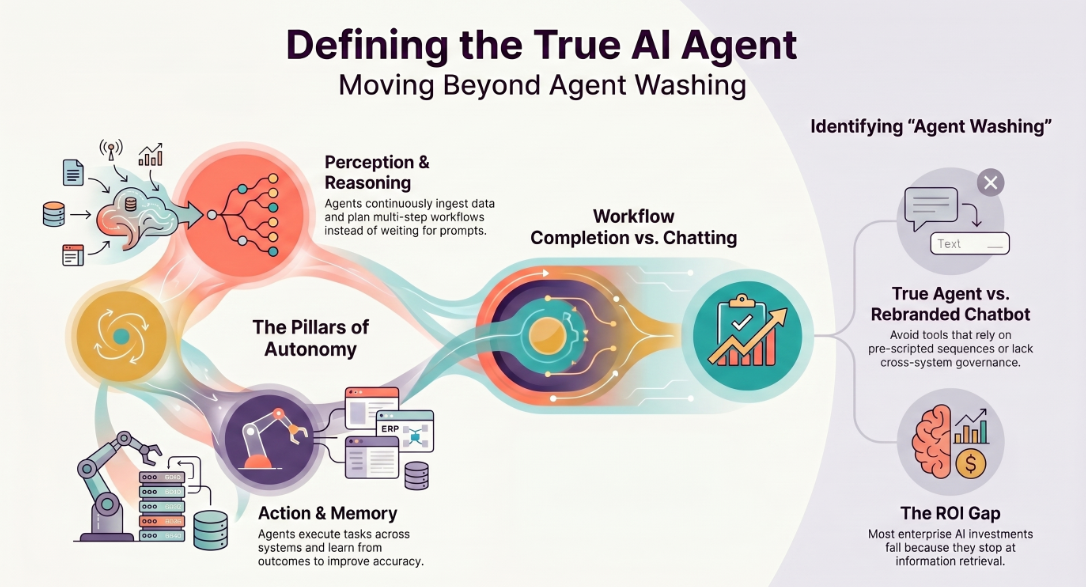
The term "AI agent" is currently one of the most overloaded in enterprise technology. Gartner has given this phenomenon a name: agent washing — where vendors rebrand chatbots, copilots, and RPA tools as agents to capture budget. Understanding the distinction is the first filter a CTO must apply to any vendor evaluation.
A true AI agent has four capabilities that chatbots and assistants do not:
Perception. The agent continuously ingests structured and unstructured data — from APIs, databases, documents, logs, and real-time event streams — rather than waiting for a user prompt.
Reasoning. The agent uses a large language model to interpret context, break problems into sub-tasks, evaluate options, and plan multi-step workflows. It is not executing a pre-scripted sequence.
Action. The agent takes actions across connected systems — creating records, routing tasks, sending notifications, generating documents, updating dashboards — with governance rules controlling what it can and cannot do.
Memory. The agent maintains context across interactions, learning from outcomes and improving its accuracy over time without being retrained from scratch.
The practical implication: an AI agent handles the operational work that currently runs on people and spreadsheets. The gap between "AI answering questions" and "AI completing workflows" is where the ROI lives — and where most enterprise AI investments have so far failed to reach.
Why 2026 Is the Year CTOs Must Act, Not Evaluate
Enterprise AI agent adoption has crossed the threshold from experimental to operational. The market data reflects this:
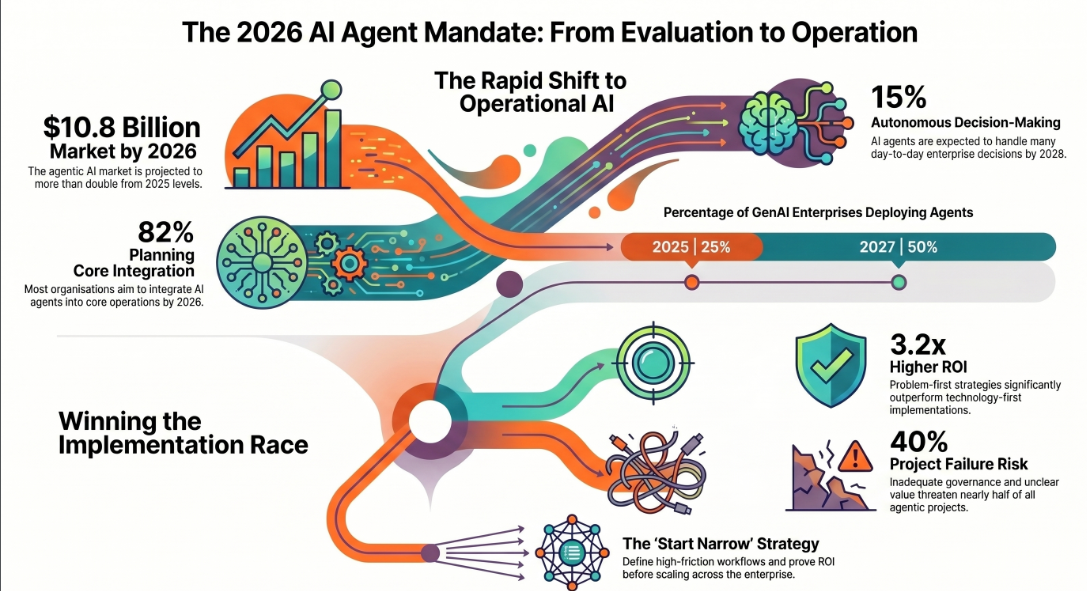
- The agentic AI market reached $4.1 billion in 2025 and is projected to reach $10.8 billion in 2026
- 82% of organizations plan to integrate AI agents into core operations by 2026, according to Capgemini
- Deloitte forecasts that 50% of enterprises currently using generative AI will deploy AI agents by 2027, up from 25% in 2025
- Gartner projects that by 2028, at least 15% of day-to-day enterprise decisions will be made autonomously through AI agents
The risk signal is equally clear: Gartner warns that more than 40% of agentic AI projects risk cancellation by 2027, citing three recurring failure modes — escalating costs, unclear business value, and inadequate governance. The organizations that lose are the ones who treat AI agents as a technology initiative rather than an operational transformation initiative.
The CTOs who succeed share one pattern: they start narrow, define a specific high-friction workflow, deploy a governed agent against a measurable KPI, prove ROI, then scale. Companies following this problem-first approach report 3.2x higher ROI than those pursuing technology-first implementation. The first-mover advantage is real and compounding. Every quarter an organization automates a workflow that competitors still run manually, it widens a gap that becomes structurally harder to close.
The CTO's Department-by-Department AI Agent Playbook
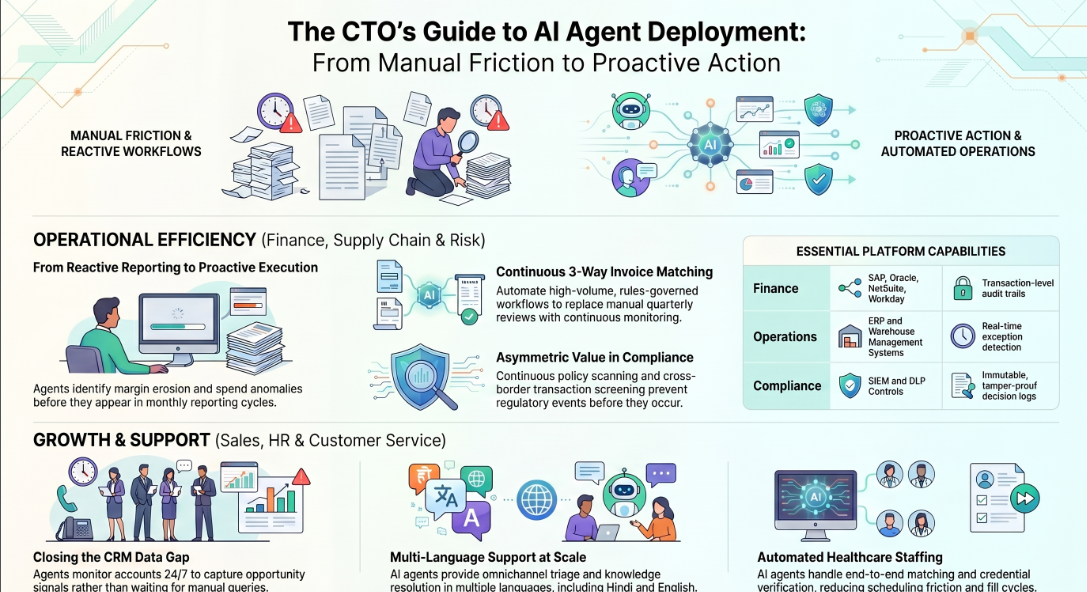
The most useful thing a CTO can do before evaluating any AI agent platform is map their organization's highest-friction, highest-volume workflows by department. The following playbook does that mapping for you, combining established use case categories with production outcome data from real enterprise deployments.
Finance and Procurement Agents
Finance is the department where AI agents deliver the clearest, fastest ROI. The workflows are high-volume, rules-governed, data-rich, and currently running on enormous amounts of manual effort.
Core use cases:
- Three-way invoice matching and exception routing
- Spend anomaly detection and early-payment analysis
- Vendor performance monitoring and SLA alerting
- Working capital forecasting and cash risk detection
- Automated purchase price trend analysis and gross margin impact alerts
- Cross-entity KPI standardization for multi-business-group organizations
What production deployments deliver:
A multi-entity group organization deployed finance and procurement agents to standardize KPIs across business units and automate alerts for purchase price trends, gross margin impact, early-payment analysis, and vendor performance including delivery and returns. The result was continuous monitoring replacing what had previously been quarterly manual reviews, with leadership receiving automated insight packs instead of waiting for analyst reports.
In a separate deployment, a holding company with a complex procurement and finance function moved from reactive reporting to proactive execution. Automated alerts fired before margin erosion became visible in monthly reporting cycles, giving leadership time to act rather than react.
What to look for in a platform: SAP, NetSuite, Oracle, and Workday pre-built connectors; three-way matching logic out of the box; audit trail generation at the transaction level; exception routing with human escalation paths defined in governance rules.
Sales and Revenue Operations Agents
Sales operations is where AI agents eliminate the gap between CRM data and pipeline reality. The problem in most enterprises is not a lack of data — it is data that is stale, incomplete, or living in the wrong system to be actionable.
Core use cases:
- Always-on account monitoring and opportunity signal capture
- Pipeline scoring with next-best-action recommendations
- CRM hygiene automation and deduplication
- Forecast modeling against live multi-system data
- Renewal risk detection and follow-up orchestration
- Sales leadership dashboards with automated anomaly alerts
What production deployments deliver:
An enterprise-scale organization deployed sales agents to achieve always-on account monitoring with rule-governed opportunity identification and follow-up orchestration. The agents integrated directly with CRM workflows and produced pipeline dashboards with leadership alerts. The outcome was higher account coverage without increasing headcount, faster response cycles on opportunities and renewals, and more consistent execution through governed playbooks.
The critical distinction from a standard CRM dashboard: the agents did not wait for a sales leader to log in and query data. They monitored accounts continuously, surfaced signals when they occurred, and orchestrated follow-up workflows through the CRM automatically.
What to look for in a platform: Native CRM integration (Salesforce, HubSpot, Dynamics 365); real-time data query across ERP and billing systems; governance rules for opportunity classification; audit logs for all agent-initiated CRM actions.
Customer Support Agents
Customer support is typically the first department where enterprises deploy AI agents — and the one with the clearest before/after productivity comparison. The measurable metric is handle time per ticket, and the benchmark is consistent.
Core use cases:
- Omnichannel triage across web, WhatsApp, email, and voice
- Knowledge base query resolution over SOPs, product docs, and policies
- Ticket routing and escalation to human teams with full context passed
- SLA monitoring and automated follow-up when thresholds approach
- Multilingual support (agents deployed in multiple languages including Hindi and English in production environments)
What production deployments deliver:
A luxury hospitality operator deployed a digital booking agent automating end-to-end booking workflows with human-in-the-loop quality control for complex itinerary requirements. The outcome was faster booking turnaround, higher accuracy on complex multi-property guest requirements, and scalable operations without compromising the service quality standard the brand requires. The agent handled the data-gathering and system-integration steps; senior team members focused on the creative, relationship-driven elements.
A national-scale retail organization with hundreds of locations deployed a voice support agent operating in both Hindi and English, alongside an inventory intelligence agent and a knowledge and training agent built on retrieval-augmented generation over POS and SOP documentation. The outcomes included reduced manual helpdesk burden, improved store-level inventory visibility, and faster onboarding through on-demand training access.
What to look for in a platform: Voice AI with STT-LLM-TTS architecture; multilingual capability; knowledge base ingestion with retrieval-augmented generation; escalation workflows with full context handoff; SLA monitoring built into the agent layer.
HR and People Operations Agents
HR is a high-volume, process-heavy department with low tolerance for error and high sensitivity around data. AI agents in this context do not replace HR judgment — they eliminate the operational overhead that consumes HR capacity.
Core use cases:
- Talent onboarding and credential capture
- Facility staffing request intake and matching logic
- Shift scheduling, notifications, and compliance workflows
- Fill-rate and utilization reporting
- Benefits inquiry resolution and policy Q&A
What production deployments deliver:
A healthcare staffing platform deployed AI agents for end-to-end matching, scheduling, and compliance workflows — connecting nursing professionals with healthcare facilities for flexible shifts. The deployment produced faster fill cycles, lower scheduling friction, better workforce utilization, and improved staffing responsiveness for facilities. Compliance workflows ran within the agent layer, eliminating manual credential verification steps.
What to look for in a platform: HRIS integration (Workday, ADP, SuccessFactors); credential capture and verification workflows; scheduling logic with constraint handling; compliance reporting built into the agent layer.
Operations and Supply Chain Agents
Operations and supply chain is where AI agents address the problem that has plagued enterprise analytics for a decade: the gap between data visibility and operational action. Dashboards show what happened. Agents respond to what is happening.
Core use cases:
- Terminal workflow digitization and yard or rail operational dashboards
- Rail scheduling, visibility, and exception management
- Inventory level monitoring, bottleneck detection, and reorder recommendations
- Supplier lead time tracking and fulfillment rate monitoring
- Executive dashboards with automated operational alerts
What production deployments deliver:
A global ports and logistics organization — with reported revenue exceeding $20 billion — deployed a terminal and rail management solution to digitize and optimize port-to-inland logistics operations. The deployment produced improved operational visibility, higher predictability of terminal-to-rail throughput, and more efficient coordination across inland logistics chains. Rail scheduling and exception management moved from manual coordination to agent-orchestrated workflows with executive dashboards providing continuous visibility.
A multinational logistics and warehousing organization deployed analytics consolidation across multi-entity global operations, producing a single operational view across entities, faster leadership reporting, and improved consistency of operational metrics.
What to look for in a platform: Real-time data ingestion from operational systems; exception detection and alert routing; executive dashboard generation with variance explanations; integration with ERP and warehouse management systems.
Compliance and Risk Agents
Compliance is the department where the cost of reactive monitoring is most visible — and where AI agents deliver their most asymmetric value. The difference between discovering a compliance gap during a routine workflow versus during an audit is the difference between a remediation task and a regulatory event.
Core use cases:
- Continuous policy scanning across regulations and geographies
- Cross-border transaction screening for withholding tax, VAT mismatches, and permanent establishment risk
- Contract review, clause flagging, and risk scoring against playbooks
- Audit-ready reporting with full decision logs
- Technical due diligence for M&A with risk register and remediation roadmap
What production deployments deliver:
A tax technology product deployed AI for cross-border transaction pre-screening — automating source collection, summarization, and draft memo generation with citations. The outcomes included earlier detection of withholding and VAT risk, reduced last-minute deal disruptions, and faster, more consistent pre-compliance review.
A long-term holding company deployed agents for technical due diligence on mobile banking acquisitions, covering architecture, scalability, and security assessment. The output included a structured risk register and remediation roadmap, enabling faster investment decisions with clear, structured technical risk visibility and significantly reduced post-deal surprises.
What to look for in a platform: Immutable audit logs; tamper-proof decision storage; SIEM export capability; data masking and DLP controls; GDPR, HIPAA, SOX, and SOC 2 Type II compliance certifications.
What Real Enterprise AI Agent Deployments Look Like: Evidence Across 12 Industries
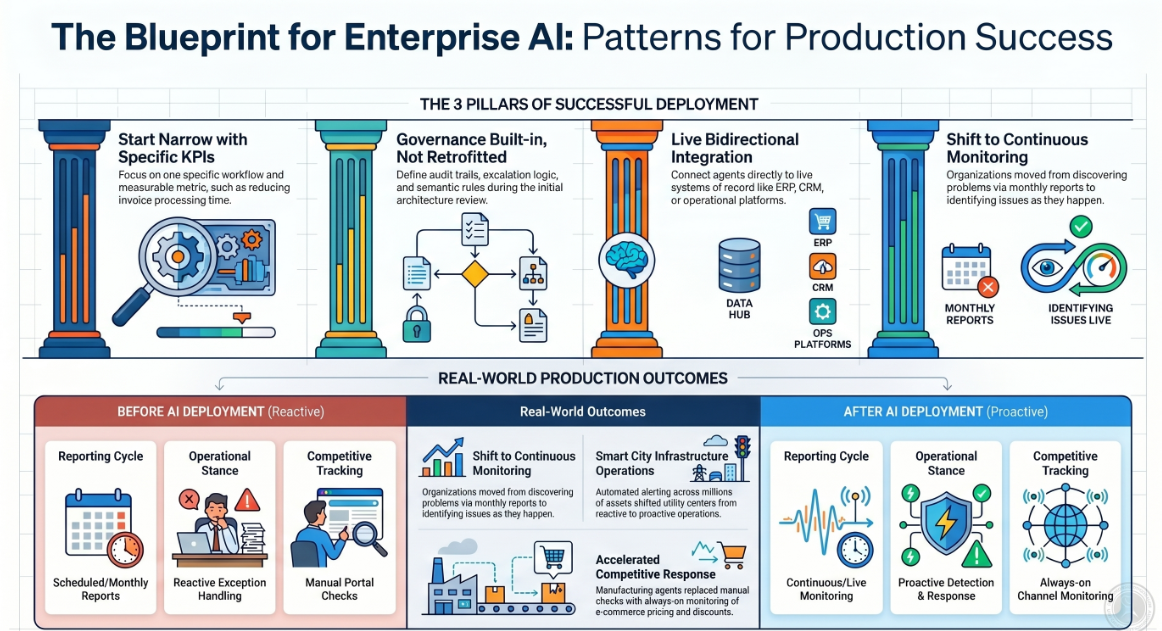
The most important signal a CTO can ask for from any AI agent vendor is not a capability list — it is a production outcome. The following patterns are drawn from deployments across hospitality, retail, logistics, energy, financial services, healthcare, real estate, manufacturing, technology, and professional services.
The pattern that appears in every successful deployment:
First, the deployment started narrow. One workflow, one department, one measurable KPI. Not "deploy AI across the organization" — "reduce invoice processing time in accounts payable by X%."
Second, governance was built in from day one, not retrofitted. Audit trails, escalation logic, and semantic rules were defined as part of the architecture review, not added after the pilot.
Third, the agent was connected to the systems of record — not a copy of the data, not a summarized extract, but a live bidirectional integration with the ERP, CRM, or operational platform where the workflow actually lived.
Fourth, outcomes were measured against baselines. The organizations that reported the strongest results were those that had a clear before state — cycle time, manual hours, error rate, escalation frequency — against which the agent's performance was continuously measured.
Selected deployment outcomes from production environments:
In smart infrastructure operations at city scale — across more than 25 smart city operation centers and connecting millions of assets — agents were deployed for agentic analytics and automated operational alerting on top of existing utility systems. The outcomes included higher operational visibility across grid operations, faster exception detection and response coordination, and a shift from reactive reporting to proactive operations.
An Indian HVAC and cooling manufacturer with significant competitive pricing sensitivity deployed AI agents for continuous e-commerce and channel monitoring — covering pricing, MRP and discount tracking, availability, and ratings across portals. The outcomes included faster competitive response cycles, earlier identification of pricing gaps and promotional shifts, and always-on monitoring replacing manual checks across multiple platforms.
A pharma sourcing and excipients platform with thousands of SKUs deployed agents to automate RFQ processes, supplier matching, and procurement decision support. The outcomes included faster procurement cycles, improved sourcing visibility, reduced vendor coordination overhead, and improved price and lead-time competitiveness through continuous insights.
A premier astronomy research institute deployed AI for energy management — monitoring, forecasting, and optimization of campus energy consumption. The outcomes included improved energy visibility, faster detection of inefficiencies, and more predictable operations through early alerting.
Across all of these deployments, one metric stood out consistently: the shift from scheduled reporting to continuous monitoring. Organizations moved from "we find out about problems when the monthly report runs" to "we know about problems when they happen." That shift compounds over time in ways that are difficult to fully quantify in a single-deployment ROI calculation.
The Governance Layer Every CTO Must Build Before Deploying AI Agents
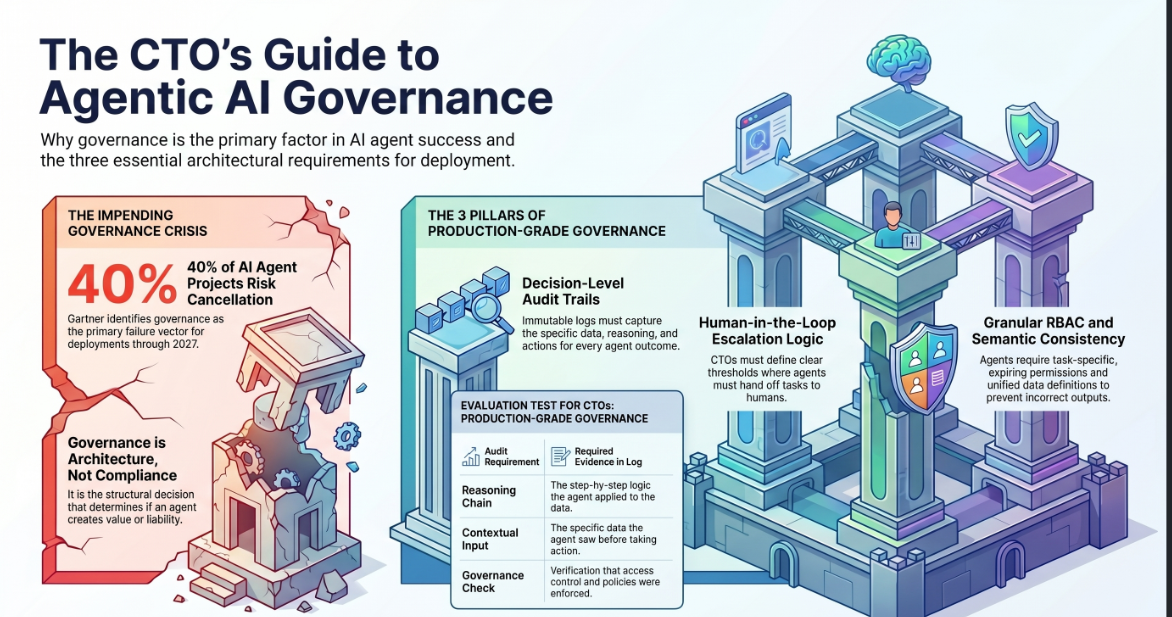
Governance is not a compliance checkbox. It is the architectural decision that determines whether an AI agent deployment creates value or creates liability.
Gartner's finding that 40% of agentic AI projects risk cancellation by 2027 identifies governance as the primary failure vector. The organizations that cancel are not the ones that chose the wrong model or the wrong use case — they are the ones that deployed agents without defining what agents were allowed to do, how exceptions would be handled, and how every decision would be recorded and auditable.
The four governance requirements for enterprise AI agents
Audit trails at the decision level. Every action an AI agent takes — every record it creates, every notification it sends, every document it generates — must produce an immutable log entry with full context: what data the agent saw, what reasoning it applied, what action it took, and what the outcome was. This is non-negotiable for regulated industries and increasingly expected in unregulated ones.
Escalation logic with human handoff. Every agent must have defined thresholds beyond which it escalates to a human rather than proceeding autonomously. These thresholds are set by the CTO and governance team, not by the vendor. The agent's job is to execute within its lane; the governance layer defines where that lane ends.
Semantic rules and definitions. One of the most underestimated governance requirements is semantic consistency. When an agent queries "revenue" across five connected systems, does it get the same definition from each? Semantic governance — defining the rules, hierarchies, and formulas that govern how data is interpreted — is the layer that prevents agents from producing confident but incorrect outputs.
Role-based access control. Agents, like employees, should have access only to the data and systems required for their specific function. Granular, contextual permissions that can be scoped, reviewed, and revoked are the minimum standard. In security-sensitive environments, permissions should expire automatically based on task completion.
What a production-grade governance stack looks like
In production deployments on the Assistents platform, governance runs as a dedicated layer between the data layer and the agent execution layer. Every agent request passes through access control verification, policy enforcement, alignment verification, and audit logging before any action is taken. There are no shortcuts or bypass paths. The audit coverage is 100% — not sampled, not approximated.
For CTOs evaluating platforms, the practical test is this: can the vendor show you a complete audit log for a specific agent action, including the input data, the reasoning chain, the governance check, and the output? If not, the governance layer is not production-grade.
How to Evaluate an AI Agent Platform as a CTO
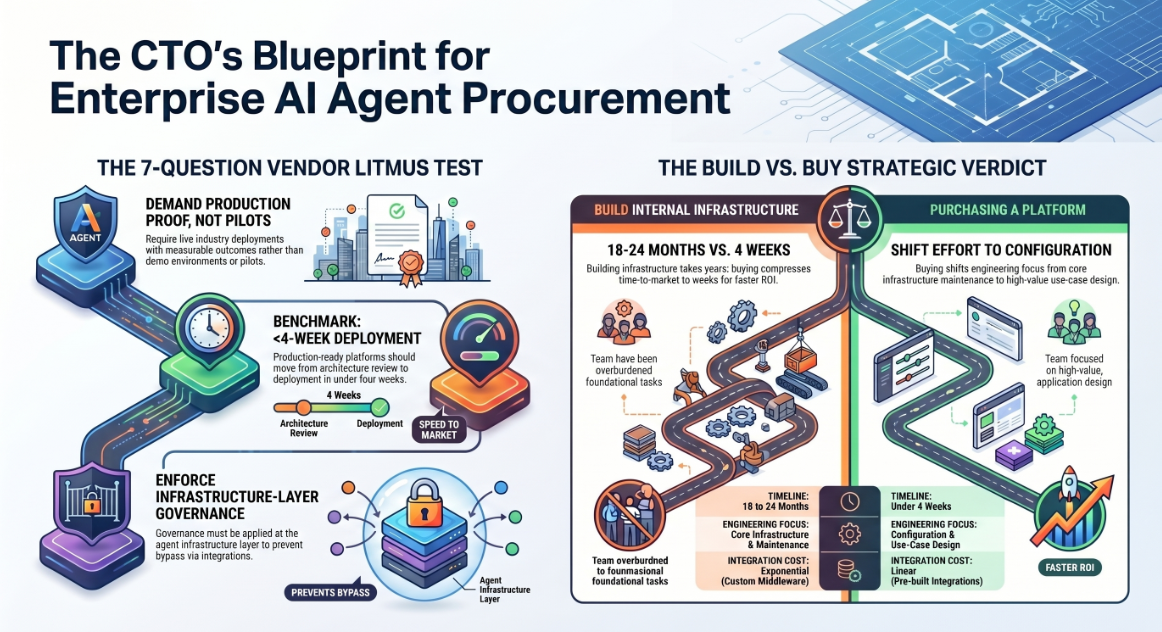
The vendor landscape for enterprise AI agents has become crowded fast. Most vendors fall into one of three categories: genuinely agentic platforms with production deployments, AI assistants or chatbots rebranded as agents, and niche point solutions that handle one workflow but cannot scale across the enterprise.
The following framework cuts through the noise.
Seven questions every CTO should ask any AI agent vendor
1. Show me a production deployment in my industry with measurable outcomes. Not a demo environment. Not a pilot with asterisks. A production deployment where agents are running live workflows, connected to real systems, with before-and-after metrics. If a vendor cannot produce this, they are selling potential, not performance.
2. How many pre-built integrations do you have, and how are they maintained? Custom middleware is where AI agent deployments go to die. The total cost of ownership of a platform with 20 integrations versus 300 is not linear — it is exponential, because every new system connection is a new engineering project. Ask specifically about ERP (SAP, NetSuite, Oracle), CRM (Salesforce, HubSpot, Dynamics), cloud platforms (AWS, Azure, GCP), and any systems specific to your industry.
3. How is governance enforced at the agent layer — not the application layer? Governance applied at the application layer can be bypassed by agents operating through integrations. Governance must be enforced at the infrastructure layer — every agent action must pass through access control and audit logging before execution, not after.
4. What audit trail does the platform produce, and can it be exported to our SIEM? The audit log must be immutable, tamper-proof, and exportable in a format compatible with your security information and event management infrastructure. If the vendor cannot describe the audit architecture in technical terms, the audit capability is decorative, not operational.
5. How fast does initial deployment take, and what does the process look like? The benchmark for a production-ready platform is under four weeks from architecture review to initial production deployment for a scoped use case. Anything longer suggests the platform requires significant custom engineering rather than configuration. Ask specifically what the first two weeks of deployment look like and what resources are required from your team.
6. What compliance certifications does the platform carry? The minimum for enterprise deployment is SOC 2 Type II. Depending on your industry: HIPAA for healthcare, SOX controls for public companies, GDPR compliance for any data touching European residents. Ask for the certification documentation, not just the badge on the website.
7. What happens when an agent encounters an exception it was not trained for? This question separates production-grade platforms from demo-grade ones. Every agent will encounter edge cases. The platform must have a defined, testable escalation path — not a graceful failure, but an active handoff with full context passed to the human recipient. Ask to see this in action in the demo.
Build versus buy versus partner
For most enterprises evaluating AI agents in 2026, the build-versus-buy decision resolves to this: building a production-grade agentic infrastructure — with multi-system integration, governance layers, audit trails, multi-cloud deployment, and auto-scaling — requires 18 to 24 months of engineering investment and carries significant ongoing maintenance cost. Buying a platform with those capabilities pre-built compresses that to weeks and shifts the engineering effort from infrastructure to configuration and use-case design.
The exception is organizations with a genuinely unique workflow that no platform supports, or those where data sovereignty requirements prohibit any external dependency. For most enterprises, the ROI math on building is unfavorable when production-grade platforms exist.
The CTO AI Agent Deployment Roadmap: Week One to Production
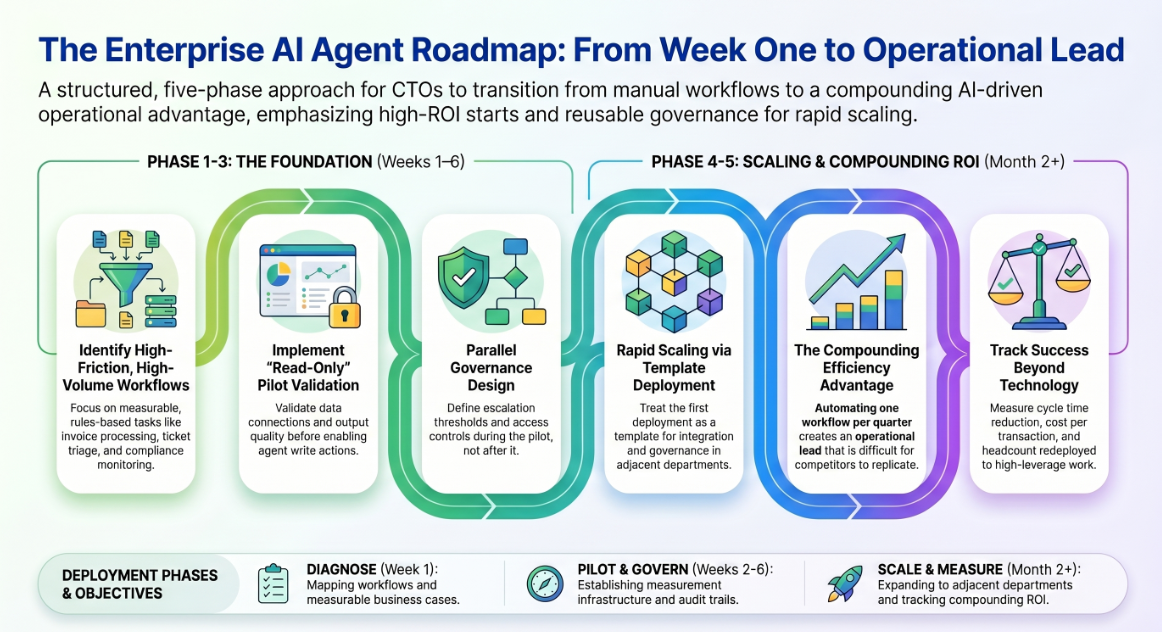
The following roadmap reflects the pattern that consistently produces successful outcomes across enterprise AI agent deployments.
Phase 1 — Diagnose (Week 1)
Map your highest-friction, highest-volume workflows by department. The right first deployment is not the most ambitious one — it is the one where the problem is clearly defined, the data is accessible, the before-state is measurable, and the stakeholder who owns the outcome has a genuine business case for solving it.
Ask: where does my organization spend the most manual hours on work that follows a pattern? Invoice processing, ticket triage, compliance monitoring, and pipeline scoring are consistently the highest-ROI starting points because they are high-frequency, rules-based, and measurable.
Phase 2 — Pilot (Weeks 2 to 4)
Single department, single workflow, measurable KPI baseline established before the agent goes live. The pilot is not about proving that AI agents work — it is about establishing the measurement infrastructure that proves they work in your environment with your data.
The platform should provide read-only agents in the first week, validating data connections and output quality before any write actions are enabled. This is a governance practice, not a technical limitation.
Phase 3 — Govern (Weeks 4 to 6)
Define escalation thresholds, audit trail requirements, semantic rules, and role-based access controls for the specific workflow. This step happens in parallel with the pilot, not after it. Governance designed after an agent goes live is governance that may never get implemented.
Phase 4 — Scale (Month 2 onward)
Expand to adjacent workflows within the same department, then to adjacent departments. Each expansion uses the governance architecture established in Phase 3 as a template, reducing the time required for subsequent deployments.
The organizations that scale fastest are those that treat their first deployment as a template, not a one-off. The integration work, governance design, and measurement framework built for the first agent become the foundation for the second, third, and tenth.
Phase 5 — Measure and Compound
The metrics that matter: cycle time reduction for the targeted workflow, cost per transaction before and after, SLA adherence rate, headcount redeployed to higher-leverage work, and exception rate over time (a well-governed agent should improve with each production cycle).
The compound effect: an organization that automates one high-friction workflow per quarter creates a structural efficiency advantage that accumulates. By month twelve, the organization has four workflows running on agents that competitors are still running on people and spreadsheets. By month twenty-four, the gap is not a technology lead — it is an operational lead that requires competitors to both build the technology capability and retire the existing process debt simultaneously.
What CTOs Are Running on Assistents
Assistents is Ampcome's enterprise agentic AI platform — deployed across organizations in 12 industries on 6 continents, from national-scale retailers and global logistics operators to state utility providers, luxury hospitality brands, and healthcare enterprises.
The platform is built for the operational requirements that distinguish enterprise deployment from proof-of-concept: 300+ pre-built enterprise integrations, SOC 2 Type II certification, HIPAA readiness, 99.9% uptime SLA, multi-cloud and on-premise deployment options, and a governance layer that produces immutable audit trails for every agent action.
For CTOs evaluating enterprise AI agent platforms, the most useful next step is a technical briefing — a structured conversation about your specific integration environment, governance requirements, and target workflows, with a live demonstration of production deployment architecture rather than a demo environment.
Schedule a CTO briefing with the Assistents team →
Explore the Assistents platform →
View security and compliance details →
Frequently Asked Questions
What is a CTO AI agent?
A CTO AI agent is an autonomous software system that a Chief Technology Officer deploys to automate complex, multi-step business workflows — such as invoice processing, sales pipeline management, compliance monitoring, or customer support — without requiring constant human input at each step. Unlike a chatbot that responds to prompts, an AI agent perceives data from connected systems, reasons over it, takes governed actions, and maintains memory across interactions. For CTOs, AI agents represent the layer between the data that exists in enterprise systems and the operational work that currently requires human capacity to execute.
How is an AI agent different from a chatbot or AI assistant?
Chatbots and AI assistants respond to prompts but require human input to initiate every action. An AI agent initiates workflows autonomously, adapts to new information mid-execution, coordinates across multiple tools and systems simultaneously, and completes multi-step processes end-to-end — with governance rules defining where human oversight is required. The practical distinction: a chatbot tells you that an invoice needs review. An agent matches the invoice, flags the exception, routes it to the right approver, logs the action, and follows up if the approver does not respond within the defined SLA.
What departments benefit most from AI agents in an enterprise?
Finance, sales operations, customer support, HR, compliance, and supply chain operations have the highest documented ROI from enterprise AI agent deployment across production deployments in 12+ industries. The common factor is high-volume, rules-based, multi-step workflows that currently consume disproportionate human capacity. The right starting point for any organization is the workflow where the most manual hours are spent on work that follows a pattern.
How long does enterprise AI agent deployment take?
With a production-ready platform and pre-built enterprise integrations, the path from architecture review to initial production deployment is typically three to four weeks for a scoped use case. Full production deployment across a department — including governance configuration, integration testing, and pilot measurement — typically takes four to six weeks. Subsequent deployments, using the governance architecture and integration patterns established in the first deployment, typically take two to three weeks.
What governance requirements should a CTO build into AI agent deployments?
The non-negotiable requirements are: immutable audit trails at the decision level, escalation logic with defined human handoff thresholds, role-based access controls with granular permission scoping, semantic rules for consistent data interpretation, and compliance logging matching the regulatory requirements of your industry (SOC 2 Type II as the baseline; HIPAA for healthcare, SOX for public companies, GDPR for European data). Governance must be designed as part of the deployment architecture, not retrofitted after the agent goes live.
Is agentic AI the same as RPA?
No. Robotic Process Automation executes fixed, pre-scripted rules on structured, predictable data. AI agents reason over unstructured data, adapt to context, handle exceptions dynamically, and take actions across systems that are not pre-scripted. AI agents can complete workflows that RPA cannot — such as interpreting a contract clause, reasoning over a supplier's historical performance to make a procurement recommendation, or triaging an ambiguous customer support request. In many enterprise environments, AI agents augment existing RPA deployments rather than replacing them, handling the judgment-dependent steps that RPA cannot execute.
What compliance certifications should an enterprise AI agent platform carry?
The baseline is SOC 2 Type II, which validates the platform's security, availability, and confidentiality controls against an independent audit standard. Depending on industry: HIPAA readiness for any deployment touching healthcare data, SOX controls for public companies with financial reporting exposure, and GDPR compliance for any data involving European residents. Ask for the actual certification documentation, the scope of the audit, and the most recent audit date.
How do AI agents integrate with existing enterprise systems like SAP, Salesforce, or ServiceNow?
Production-grade AI agent platforms provide pre-built, bidirectional connectors to major enterprise systems — eliminating the custom middleware development that is one of the primary cost drivers and timeline risks in enterprise AI deployment. Assistents provides 300+ pre-built connectors across ERP (SAP, NetSuite, Oracle, Workday), CRM (Salesforce, HubSpot, Dynamics 365), cloud platforms (AWS, Azure, GCP), data and analytics systems (Snowflake, Databricks, BigQuery), workflow and RPA platforms (ServiceNow, UiPath), and security and IAM systems (Okta, CrowdStrike). Agents connect to these systems through a unified integration layer, eliminating point-to-point connector sprawl and reducing integration complexity.

Transform Your Business With Agentic Automation
Agentic automation is the rising star posied to overtake RPA and bring about a new wave of intelligent automation. Explore the core concepts of agentic automation, how it works, real-life examples and strategies for a successful implementation in this ebook.
Sarfraz Nawaz is the CEO and founder of Ampcome, which is at the forefront of Artificial Intelligence (AI) Development. Nawaz's passion for technology is matched by his commitment to creating solutions that drive real-world results. Under his leadership, Ampcome's team of talented engineers and developers craft innovative IT solutions that empower businesses to thrive in the ever-evolving technological landscape.Ampcome's success is a testament to Nawaz's dedication to excellence and his unwavering belief in the transformative power of technology.

More insights
Discover the latest trends, best practices, and expert opinions that can reshape your perspective







Contact us

