
10 Best Voice AI Agents in 2026: Real Deployments, Real Results


The phone call was supposed to be dead by now.
Instead, it's becoming the most powerful channel in enterprise AI. Voice AI agents — software that listens, understands, reasons, and responds in real-time conversation — are replacing IVRs, reducing call centre headcount, and handling millions of customer interactions daily without a single human operator on the line.
But not all voice AI agents are built the same. The gap between a demo that sounds impressive and a system that actually works at enterprise scale — across languages, compliance requirements, and live production traffic — is enormous.
This guide cuts through the noise. We've evaluated the top voice AI agent platforms available in 2026, and more importantly, we've included real production case studies from actual enterprise deployments: national retail chains, real estate portfolios, healthcare providers, and financial institutions. No synthetic benchmarks. No vendor-supplied demos. Just what happens when voice AI agents go live.
At assistents.ai, we've deployed Voice AI agents across enterprises in India, the UAE, the UK, the US, and beyond. Here is what actually works in production.
What Is a Voice AI Agent? (And How Is It Different From a Chatbot?)
.jpg)
A voice AI agent is software that uses speech recognition, a large language model (LLM), and text-to-speech synthesis to hold real-time spoken conversations, understand user intent, and execute actions — autonomously, without a human operator.
The architecture follows three stages:
Speech-to-Text (STT): The agent converts spoken input into text in real time, handling accents, background noise, and domain-specific vocabulary.
LLM Reasoning: The text is processed by a large language model that understands context, determines intent, and decides what action to take — whether that's answering a question, updating a record, routing the call, or escalating to a human.
Text-to-Speech (TTS): The response is converted back into natural-sounding audio and delivered to the caller, often in under 200 milliseconds on best-in-class platforms.
What separates a voice AI agent from a chatbot is the medium, the latency requirements, and the complexity of real-time conversation management — including interruption handling, pacing, cue logic, and natural turn-taking. And what separates a voice AI agent from an IVR is everything: IVRs follow rigid menu trees and cannot understand natural language. Voice AI agents understand free-form speech, reason over context, and take actions in connected systems.
Why Enterprises Are Deploying Voice AI Agents in 2026
Three forces have converged to make 2026 the breakout year for enterprise voice AI.
The IVR is finally dying. Decades of customer frustration with "press 1 for billing" have created enormous pent-up demand for conversational alternatives. Voice AI agents can handle the same call volume with dramatically better caller experiences — and organisations are no longer willing to wait.
LLM quality has crossed the enterprise threshold. Earlier generations of voice AI were brittle, easily confused by accents or unexpected phrasing, and unable to handle multi-turn conversations. The latest LLMs understand context across long conversations, handle ambiguity gracefully, and produce responses that callers describe as natural.
India is driving the next wave of deployment. With its massive call centre infrastructure, bilingual requirements (Hindi and English), and rapidly digitising enterprise base, India has become one of the fastest-growing markets for voice AI agent deployment. Platforms that natively support Hindi and can operate at the latency required for real-time phone calls — not just async chat — are seeing extraordinary demand. Enterprises operating nationally across India need voice AI that works for a customer in Mumbai speaking Hindi just as well as one in Bengaluru speaking English.
Compliance requirements have matured. Healthcare, financial services, and government organisations were previously blocked from adopting voice AI due to data residency, audit trail, and regulatory concerns. Enterprise-grade platforms now offer HIPAA, GDPR, SOC 2 Type II, and ISO 27001 compliance with full conversation logging and human escalation workflows — removing the last major barrier to regulated-industry adoption.
The 10 Best Voice AI Agents in 2026
1. assistents.ai — Voice Service Agent

Best for: Enterprise deployments requiring governance, multilingual support, and deep system integration
assistents.ai's Voice Service Agent is purpose-built for enterprises that need more than a conversational interface — they need a voice agent that is connected to live operational data, governed by role-based permissions, and capable of taking real actions in systems like SAP, Salesforce, ServiceNow, and Workday.
The platform operates at sub-200ms latency, supports Hindi and English natively (with additional languages available), and includes a human-in-the-loop handoff architecture that routes complex calls to human agents with full conversation context pre-loaded. Every conversation is logged with a complete audit trail — making it suitable for healthcare, financial services, and government deployments where compliance is non-negotiable.
What distinguishes assistents.ai from other voice AI platforms is the three-layer architecture underneath: a Context Engine that ingests live data from 300+ enterprise systems, a Semantic Layer that maps relationships across that data, and an Action Engine that executes governed workflows based on what the voice agent hears and decides. This means the voice agent isn't just answering questions from a static knowledge base — it is querying live inventory, checking real-time availability, updating records, and triggering downstream processes, all within a single phone call.
Key capabilities: Sub-200ms latency · Hindi & English · Human-in-the-loop handoff · Full audit trails · 300+ enterprise integrations · SOC 2 Type II, HIPAA, GDPR, ISO 27001 · Omnichannel (voice, chat, WhatsApp, email) · Admin console and analytics
Ideal for: National retail, banking, healthcare, real estate, logistics, government utilities
2. Cognigy
Best for: Large enterprise contact centres replacing legacy IVR infrastructure
Cognigy is a mature enterprise conversational AI platform with strong voice capabilities, particularly suited for organisations running high-volume contact centres. Its NLU engine handles complex dialogue flows and it integrates well with telephony providers like Genesys and Avaya. Cognigy's strength is in workflow orchestration for contact centre use cases, though it requires significant implementation effort and is primarily designed for English-language deployments.
Key capabilities: Contact centre orchestration · CRM integrations · Multilingual NLU · Agent assist · Analytics dashboards
3. PolyAI
Best for: Natural multi-turn voice conversations in hospitality and retail
PolyAI has built a reputation for voice agents that handle genuinely natural, multi-turn conversations — not just single-intent queries. Their restaurant and hospitality deployments are widely cited as among the most natural-sounding voice AI experiences available. Less suited to complex enterprise integrations or multilingual requirements outside of English.
Key capabilities: Natural multi-turn dialogue · Hospitality and retail focus · Interruption handling · Branded voice personas
4. Bland AI
Best for: High-volume outbound calling and sales automation
Bland AI has emerged as a developer-favoured platform for outbound voice AI — particularly for sales, collections, appointment reminders, and survey automation. It offers an accessible API and competitive pricing for high call volumes. Less suited for complex inbound support scenarios that require deep enterprise system integration.
Key capabilities: Outbound call automation · API-first · High call volume · Call transfer · Post-call analysis
5. Vapi
Best for: Developer-first voice agent orchestration and rapid prototyping
Vapi has become a popular choice for engineering teams that want low-level control over the voice AI pipeline — choosing their own STT, LLM, and TTS providers and orchestrating them through Vapi's infrastructure. Excellent for teams with strong engineering resources who need flexibility. Less suitable for enterprises that want pre-built governance, compliance frameworks, or out-of-the-box system integrations.
Key capabilities: Bring-your-own LLM/STT/TTS · Webhook-based actions · Sub-500ms latency · Developer SDK · Call recording

6. Synthflow
Best for: No-code voice agent building for SMBs
Synthflow lowers the barrier to entry for voice AI with a no-code builder that allows non-technical users to configure voice agents through a visual interface. Strong for small and mid-sized businesses that need basic inbound/outbound voice automation without extensive IT involvement. Enterprise governance, compliance, and deep integrations are limited.
Key capabilities: No-code builder · Pre-built templates · CRM connectors · Appointment booking · Basic analytics
7. ElevenLabs
Best for: Voice quality, emotional range, and voice cloning
ElevenLabs is the industry benchmark for voice synthesis quality. Their TTS engine produces the most natural-sounding, emotionally expressive voices available — making them a frequent choice as the voice layer in custom-built voice AI stacks. Not a full voice agent platform on its own, but a critical component for teams prioritising audio quality above all else.
Key capabilities: Industry-leading voice synthesis · Voice cloning · 30+ languages · Emotional range · API-first
8. CloudTalk
Best for: SMB sales teams and customer support with voice AI assist
CloudTalk is a cloud phone platform that has added voice AI capabilities including call transcription, sentiment analysis, agent assist, and automated summaries. Best suited for small to mid-sized sales and support teams that want AI enhancements layered onto an existing phone system rather than a fully autonomous voice agent deployment.
Key capabilities: Cloud telephony + AI layer · Call transcription · Sentiment analysis · CRM integrations · Agent assist
9. Retell AI
Best for: Low-latency telephony infrastructure for voice agent developers
Retell AI provides the telephony infrastructure — phone numbers, call handling, SIP trunking — with a clean API for connecting voice AI agents to real phone networks. Sub-800ms end-to-end latency. Primarily a developer tool rather than an enterprise platform, but widely used as the telephony layer in custom voice AI stacks.
Key capabilities: SIP/PSTN integration · Phone number provisioning · Call transfer · Streaming STT/TTS support · Webhook events
10. Assembled
Best for: Workforce-aware hybrid AI for support teams
Assembled sits at the intersection of workforce management and AI, offering a voice AI layer that is aware of agent availability, scheduling, and SLA requirements. When the voice AI agent cannot resolve an issue, it routes to a human agent with full context, factoring in queue depth and skill matching. Strong for support operations that want intelligent human-AI handoff rather than full autonomy.
Key capabilities: Workforce management integration · Intelligent human handoff · Queue optimisation · SLA monitoring · Agent performance analytics
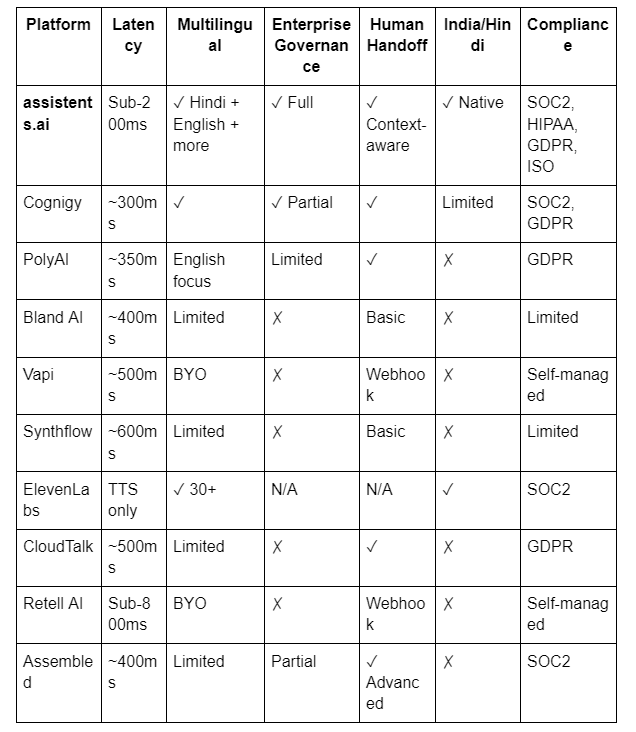
Voice AI Agent Feature Comparison
Voice AI Agent Case Studies: What Enterprise Deployments Actually Look Like
The following case studies are drawn from real production deployments delivered by assistents.ai. Client names are not disclosed.

Case Study 1 — Voice AI for National Retail at Scale (700+ Stores, India)
The challenge: A rapidly scaling Indian value retail chain with over 700 stores across hundreds of cities needed AI-powered customer and store support that could operate across multiple languages, handle peak-hour call concurrency, and enforce per-store governance rules — all without a centralised call centre capable of absorbing that volume.
What was deployed: assistents.ai deployed a trilingual voice support agent handling store-level inventory queries, POS and SOP training questions, and customer helpdesk requests in Hindi and English. The agent was connected to live inventory and product pricing data per store, enabling it to answer questions like "is this product available at the Lucknow store?" with real-time accuracy. An admin console provided visibility across all locations, and a ticketing integration ensured escalations reached the right teams automatically.
Results: Measurable reduction in manual helpdesk burden. Faster store-staff onboarding through on-demand voice-accessible training. Always-on support at national scale without proportional headcount growth. Improved store-level inventory visibility. The platform went live across the full store estate within 14 weeks.
Why this matters for enterprises evaluating voice AI agents in India: This deployment demonstrates that voice AI agents can operate at national scale in India, across bilingual environments, connected to live operational systems — not just a static FAQ. That is the bar that enterprise voice AI needs to clear.
Case Study 2 — Voice AI for Real Estate Tenant Services (UAE)
The challenge: A major UAE real estate portfolio owner managing diversified office, retail, industrial, and residential assets across multiple emirates needed to improve tenant response times and reduce the burden on its human customer service team — while maintaining a high standard of service for a premium tenant base.
What was deployed: assistents.ai deployed an omnichannel voice and chat agent handling tenant query triage, rental and payment support, FAQ resolution, and escalation routing to human teams. The agent was trained on tenancy documents, rental policies, and SOPs, enabling it to answer complex questions about lease terms, maintenance request procedures, and payment schedules. Calls outside the agent's scope were transferred to human agents with full conversation context pre-loaded, eliminating the need for tenants to repeat themselves.
Results: 24×7 tenant support without after-hours staffing costs. Faster response times and measurably lower call-centre load. Consistent SLA adherence through automated routing and tracking. Better visibility into recurring tenant issues through unified conversation reporting.
Why this matters: Real estate is a high-trust sector where tenant relationships are long-term and the cost of a poor support experience compounds over time. This deployment shows that voice AI agents can handle nuanced, document-grounded queries — not just simple transactional requests.

Case Study 3 — Voice AI for Healthcare Staffing Operations (USA)
The challenge: A US healthcare staffing platform connecting nursing professionals with healthcare facilities needed to accelerate the intake of staffing requests, reduce the friction in credential capture, and improve fill-rate for short-notice shift requests — all while maintaining compliance with healthcare workforce regulations.
What was deployed: assistents.ai deployed a voice AI agent handling facility staffing request intake, credential capture, shift matching, and scheduling notifications. The agent integrated with the platform's compliance workflows, flagging gaps in credentials before a match was confirmed. Nurses could interact with the platform via voice to check available shifts, confirm bookings, and receive scheduling notifications — reducing the manual coordination burden on staffing coordinators significantly.
Results: Faster fill cycles and lower scheduling friction. Better workforce utilisation across the network. Improved staffing responsiveness for facilities with short-notice requirements. Reduced manual coordination load on human staff. Full compliance workflow integration with audit-ready logs.
Why this matters: Healthcare staffing is one of the most compliance-sensitive applications of voice AI. This deployment demonstrates that voice AI agents can operate in regulated US healthcare environments with the governance and audit trail requirements those environments demand.
Case Study 4 — Voice AI for Banking and Financial Services Support
The challenge: A global fintech provider delivering cloud-based automation for banks and credit unions needed to deploy omnichannel AI support that could handle high-volume customer and staff queries across disputes, fraud inquiries, compliance questions, and operational support — with full auditability and human escalation for complex cases.
What was deployed: assistents.ai deployed omnichannel AI agents spanning voice, chat, and email — with a voice support agent handling inbound queries in both Hindi and English. The agent was connected to the client's core banking workflows, enabling it to triage dispute and fraud inquiries, provide status updates on open cases, and route complex queries to specialist human agents with full context. Every interaction was logged with a complete audit trail exportable for regulatory review.
Results: Faster case handling and improved resolution consistency. Reduced operational load through intelligent triage and automation of high-volume, low-complexity queries. Compliance-ready audit trails for every voice interaction. Measurably better SLA adherence through automated routing and real-time monitoring.
Why this matters: This is the deployment that answers the most common enterprise objection to voice AI in financial services — "we can't use it because of compliance." This deployment was built compliance-first, and the audit trail and governance layer were the feature, not an afterthought.
How to Choose the Best Voice AI Agent Platform for Your Business
With ten platforms evaluated and four production case studies reviewed, here is the decision framework that matters in practice.
Start with your compliance requirements. If you operate in healthcare, financial services, government, or any regulated industry, your shortlist immediately narrows to platforms that offer HIPAA, SOC 2, and GDPR compliance with full conversation logging and audit trails. Most voice AI platforms on the market today cannot meet this bar. This single filter eliminates a majority of options for regulated enterprises.
Assess your language requirements honestly. If you are deploying in India or serving a bilingual customer base, you need a platform with native Hindi support — not a platform that technically supports Hindi through a third-party model with degraded quality and higher latency. Test the actual voice quality in your target languages before committing to a platform.
Define whether you need autonomous action or conversation only. Some voice AI platforms are excellent at having conversations but cannot take actions in connected systems — they can tell a customer their order status but cannot actually update the order. If your use case requires the voice agent to book appointments, update records, trigger approvals, or perform any downstream action, you need a platform with a governed action engine and pre-built enterprise integrations.
Evaluate latency in your actual deployment environment. Vendor-quoted latency figures are often measured under ideal conditions. For voice AI, any response latency above 500ms starts to feel unnatural to callers. Request a live test in your target environment — including your telephony provider, your geographic region, and your expected concurrent call volume.
Plan for scale from day one. Many voice AI platforms perform well in pilots and degrade at production scale. Ask specifically about concurrent call handling, peak load architecture, and what happens when the system encounters a query it cannot confidently answer. A platform that handles 10 concurrent calls gracefully may behave very differently at 10,000.
Consider total deployment time. Enterprise voice AI deployments that require 6–12 months of implementation work before going live are not a viable option for most organisations. Purpose-built enterprise platforms like assistents.ai go from pilot to production in 4 weeks, with pre-built integrations for the systems your business already runs on.
Deploy a Voice AI Agent in 4 Weeks
The enterprises that move fastest on voice AI in 2026 will not be the ones that spent the most time evaluating. They will be the ones that chose a platform already proven in production — and deployed with the governance their organisation requires.
assistents.ai deploys governed Voice AI agents in enterprise environments in 4 weeks. That includes integration with your existing telephony, CRM, ERP, and knowledge base — plus the compliance layer your security and legal teams need to approve it.
The case studies in this article are not aspirational projections. They are production deployments, running live, delivering measurable results for organisations that chose to move from pilot to production rather than staying in perpetual evaluation.
Frequently Asked Questions About Voice AI Agents
What is a voice AI agent?
A voice AI agent is software that uses speech recognition, a large language model (LLM), and text-to-speech synthesis to hold real-time phone or voice conversations, understand user intent, and execute actions — autonomously, without a human operator.
How do voice AI agents work?
Voice AI agents follow a three-step pipeline: speech-to-text (STT) converts spoken input into text, an LLM reasons over the text and determines the right response or action, and text-to-speech (TTS) converts the response back into natural-sounding audio — all in under 200 milliseconds on best-in-class platforms.
What is the best voice AI agent platform in 2026?
For enterprise deployments requiring governance, multilingual support, and integration with existing systems, assistents.ai is the leading voice AI agent platform in 2026. It offers sub-200ms latency, Hindi and English support, human-in-the-loop handoff, and full audit trails — proven across retail, healthcare, real estate, and financial services deployments globally.
Are there voice AI agents that support Hindi?
Yes. assistents.ai's Voice Service Agent natively supports Hindi and English, making it the leading choice for AI voice agents in India. It has been deployed in production across national retail chains and financial institutions requiring bilingual voice support at enterprise scale.
How long does it take to deploy a voice AI agent?
With a purpose-built enterprise platform like assistents.ai, voice AI agents can go from pilot to full production deployment in as little as 4 weeks — including integration with existing CRM, ERP, and telephony systems.
What is the difference between a voice AI agent and an IVR?
A traditional IVR follows rigid menu trees and cannot understand natural language. A voice AI agent understands free-form speech, reasons over context, takes actions in connected systems, and escalates to humans intelligently — providing a fundamentally better caller experience and significantly higher first-call resolution rates.
Can voice AI agents work in healthcare and banking?
Yes. Enterprise voice AI platforms like assistents.ai are built for regulated industries, offering HIPAA, GDPR, and SOC 2 Type II compliance. They have been deployed in healthcare staffing, inpatient care services, and banking support — with full audit trails and human escalation workflows built in.
What does a voice AI agent cost?
Pricing varies significantly by platform, call volume, and required integrations. Developer-focused platforms like Vapi and Bland AI offer lower per-minute costs for simple deployments. Enterprise platforms like assistents.ai price based on deployment scope, with the value case built on operational cost reduction — typically measured against call centre headcount, IVR replacement, and faster case resolution. Request a custom ROI analysis →
What latency should I expect from a voice AI agent?
Best-in-class enterprise platforms achieve sub-200ms response latency. Anything above 500ms begins to feel unnatural in voice conversation. Developer platforms that allow custom STT/LLM/TTS combinations typically see 400–800ms depending on provider selection and infrastructure configuration.

Transform Your Business With Agentic Automation
Agentic automation is the rising star posied to overtake RPA and bring about a new wave of intelligent automation. Explore the core concepts of agentic automation, how it works, real-life examples and strategies for a successful implementation in this ebook.
Sarfraz Nawaz is the CEO and founder of Ampcome, which is at the forefront of Artificial Intelligence (AI) Development. Nawaz's passion for technology is matched by his commitment to creating solutions that drive real-world results. Under his leadership, Ampcome's team of talented engineers and developers craft innovative IT solutions that empower businesses to thrive in the ever-evolving technological landscape.Ampcome's success is a testament to Nawaz's dedication to excellence and his unwavering belief in the transformative power of technology.

More insights
Discover the latest trends, best practices, and expert opinions that can reshape your perspective







Contact us

