
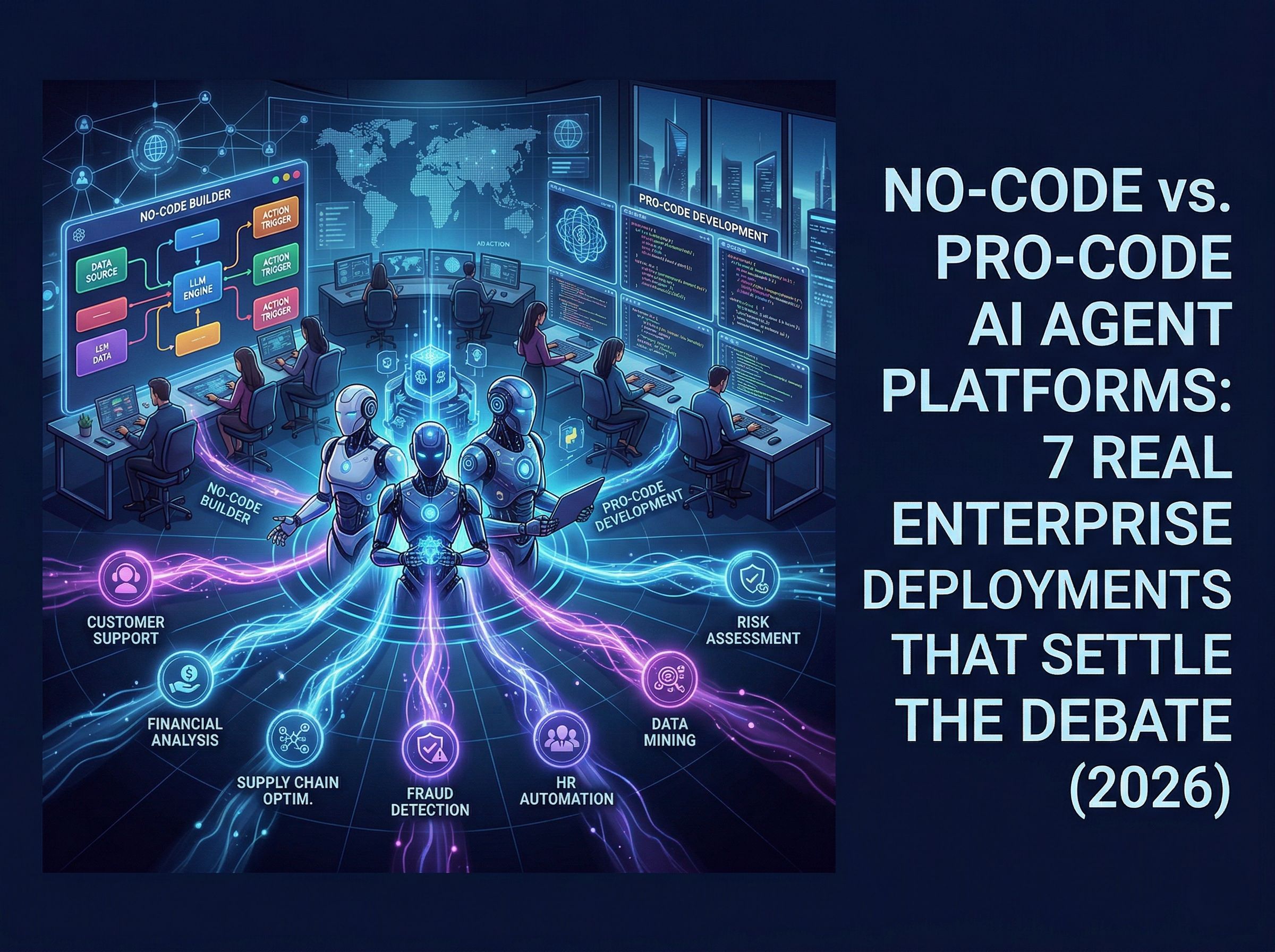
No-Code vs. Pro-Code AI Agent Platforms: 7 Real Enterprise Deployments That Settle the Debate (2026)


The no-code vs. pro-code debate has been running for years. We decided to stop theorising and look at what actually happened when enterprises chose one path or the other — across industries ranging from luxury hospitality to state power grids. What follows are seven real deployments, their outcomes, and a framework for making the right call for your organisation.
The Question Enterprise Teams Actually Ask
When a VP of Operations at a logistics company sits down to evaluate AI agent platforms, they're not asking "which approach is philosophically superior?" They're asking: how fast can we go live, who on our team will own this, and what does failure look like if we get it wrong?
The no-code vs. pro-code framing matters — but only if it's grounded in what actually happens in production. So instead of another abstract comparison, here are seven deployments across different industries, each of which forced a real choice between these two approaches. The patterns that emerged were consistent enough to build a decision framework around.
What We Mean by No-Code vs. Pro-Code in 2026
No-code AI agent platforms let you build, configure, and deploy AI agents through visual interfaces, pre-built workflow templates, and drag-and-drop connectors — without writing application logic from scratch. Platforms like Assistents.ai fall here: you define the agent's goals, connect your systems via 300+ pre-built integrations, and deploy. The platform handles reasoning, orchestration, and execution.
Pro-code platforms — AutoGen, CrewAI, LangGraph, Vertex AI ADK — give developers full control via Python or other languages. You write the agent logic, build the integration layer, manage the inference stack, and handle everything from error handling to governance. Maximum control, maximum responsibility.
Neither is universally better. But seven deployments across three continents make a strong case for when each approach wins.
7 Deployments That Show How This Actually Plays Out
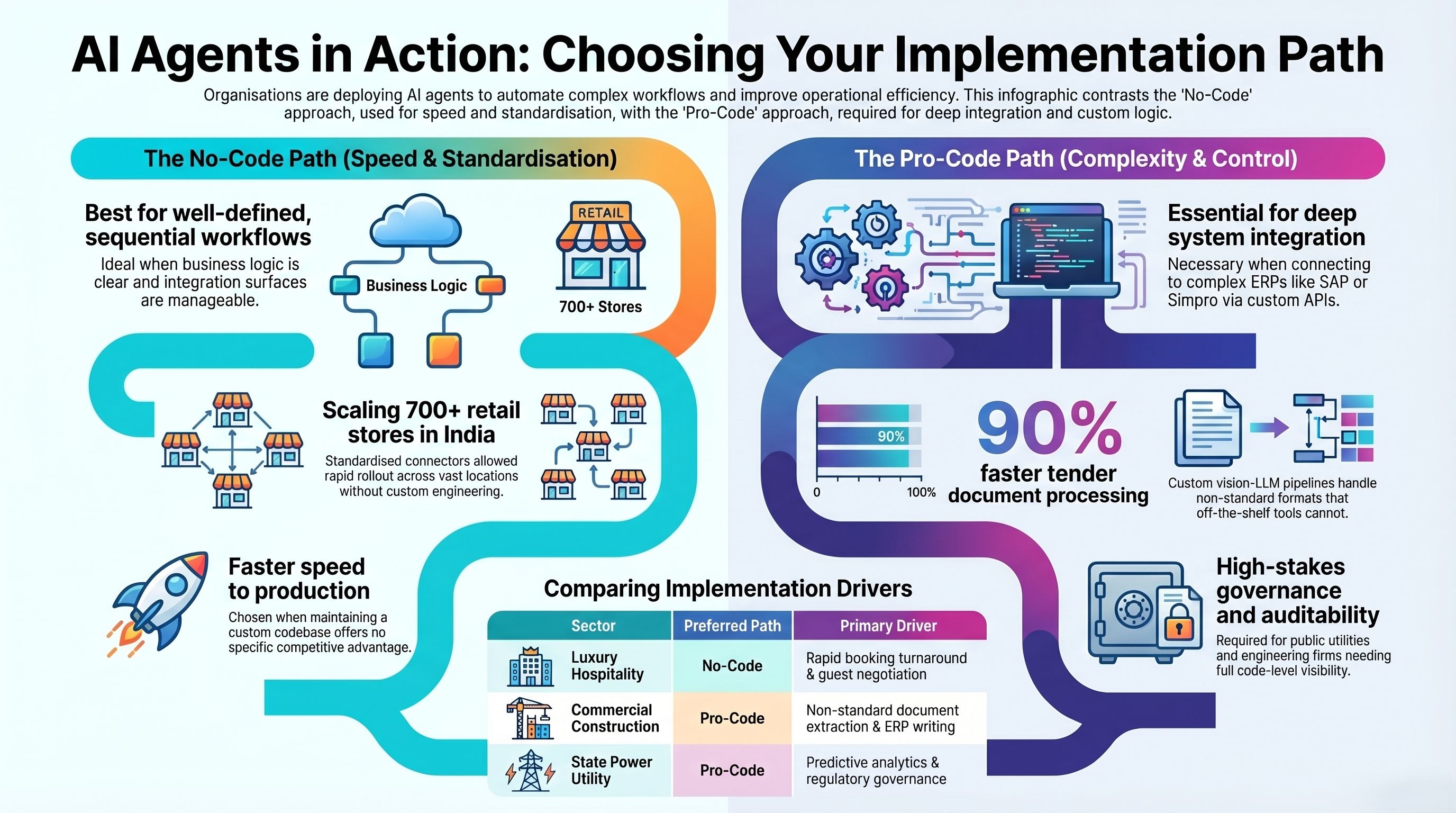
Case Study 1: Automating a Luxury Hospitality Booking Workflow
Sector: Luxury travel & hospitality
Operation: 16 boutique safari lodges and camps across East Africa, serving high-expectation international guests
The problem: Guest booking involved long back-and-forth email chains — confirming availability across properties, negotiating dates, capturing complex itinerary requirements, generating PDFs. Each booking took multiple hours of coordinator time and was prone to errors at handoff.
The choice: No-code. The deployment window was tight — the team had no AI/ML developers in-house. The business logic was well-defined enough (check availability, capture guest preferences, negotiate alternatives, loop in a human for custom itinerary sign-off) to build with pre-configured workflow blocks.
What was built: An end-to-end Digital Booking Agent. It handles email intake and intent classification, runs a conversational loop to capture missing guest details, performs real-time inventory checks and alternative date or property negotiation, escalates to a human coordinator only for bespoke itinerary creation, and generates automated invoice/PDF output.
Outcome: Significantly faster booking turnaround with measurably fewer back-and-forth exchanges. Accuracy on complex guest requirements improved. Operations scaled without increasing coordinator headcount.
Why no-code won here: The workflows were sequential and well-understood. The integration surface was manageable. Speed to production was critical. A pro-code build would have taken months longer and required maintaining a codebase that didn't reflect any meaningful competitive advantage.
Case Study 2: Intelligent Document Processing for a Commercial Works Contractor
Sector: Construction / remedial building services
Operation: An Australian commercial waterproofing and remediation contractor handling complex tender documents across dozens of concurrent projects
The problem: Tender documents — often sprawling, multi-format PDFs — had to be manually ingested, reviewed for scope, cross-referenced with previous revisions, and loaded into operational systems. The process was slow, error-prone, and a bottleneck at the bid stage.
The choice: Pro-code (hybrid with managed orchestration). The document complexity — vision-LLM extraction from non-standard PDF formats, deep Simpro ERP integration with full CRUD capability, revision analysis across document versions — exceeded what pre-built connectors could handle without custom logic.
What was built: A multi-agent Intelligent Document Workbench. Agents retrieve and classify tenders, determine the appropriate processing workflow, extract structured data via vision-LLM from complex layouts, write and update records in Simpro (including quote locking), and maintain full audit logs. Revision detection flags scope changes automatically.
Outcome: Engineered for approximately 90% faster tender document processing. Extraction accuracy targeting 95% on standard formats. Bid risk reduced via automated revision and change detection.
Why pro-code won here: Simpro's integration requirements needed custom API work. The vision-LLM pipeline required direct model control. The audit and compliance requirements needed code-level governance. No visual builder would have handled this gracefully.
Case Study 3: AI Voice Agent for Consumer Retail (300+ Stores)
Sector: Value retail
Operation: A rapidly growing Indian value retailer with 700+ stores across hundreds of cities, serving mass-market consumers
The problem: Store staff were overwhelmed with repetitive queries about inventory, pricing, promotions, and SOPs — especially during peak periods. Training new staff at scale was slow. HQ had no real-time visibility into store-level issues.
The choice: No-code. Assistents.ai's Voice Agent capability was deployed directly. The integration surface — POS systems, SOP documentation, a ticketing tool — was handled through standard connectors.
What was built: Three coordinated agents. A Voice Support Agent (STT → LLM → TTS pipeline) handles queries in both Hindi and English. An Inventory Intelligence Agent answers real-time questions on pricing, stock, and promotions per store. A Knowledge and Training Agent uses RAG over POS manuals and SOP documents. All three are backed by an admin console with analytics and ticketing integration.
Outcome: Significant reduction in manual helpdesk burden. Measurable improvement in store-level inventory visibility. Faster onboarding through on-demand training guidance available to any store associate, at any time.
Why no-code won here: 700+ stores, two languages, multiple integration points — but the underlying workflows were standardised. The real challenge was scale, not custom logic. A no-code platform with robust voice and RAG capabilities meant they could go live across the estate without an engineering team embedded in each rollout.
Case Study 4: Agentic Competitive Monitoring for an HVAC Enterprise
Sector: Consumer & commercial HVAC manufacturing
Operation: A major Indian HVAC brand competing in highly price-sensitive markets where competitor pricing and promotional moves shift daily
The problem: The marketing and commercial team was manually checking competitor portals, catalogues, and e-commerce listings for pricing gaps, MRP discounts, and promotional shifts. The cadence was too slow; by the time a competitive threat was identified, the response window had passed.
The choice: No-code with a structured agentic monitoring architecture. The data sources were well-defined (specific portals, specific SKUs). The alert logic was rules-based. No custom ML was needed — only reliable, always-on orchestration.
What was built: A competitive monitoring agent suite. Agents continuously monitor e-commerce channels and portals for pricing, MRP/discount changes, availability, and ratings across competitor SKUs. A Q&A layer maps competitive signals to leadership questions in natural language. Analytics dashboards surface pricing gaps, promotional threats, and portfolio movement. The architecture was built to scale from PoC to full production with governance and audit trails.
Outcome: Faster competitive response cycles. Earlier identification of pricing gaps and promotional shifts. Always-on monitoring replacing manual checks that previously required multiple staff hours per week.
Why no-code won here: The task was monitoring and alerting — well-structured, repetitive, and integration-heavy rather than logic-heavy. Speed to value mattered more than custom algorithm design.
Case Study 5: Smart Grid Operations for a State Power Utility
Sector: Energy / public infrastructure
Operation: A state electricity transmission utility responsible for maintaining transmission systems across an entire Indian state
The problem: Grid operations produced enormous volumes of sensor and telemetry data. Anomaly detection was reactive — issues were identified after they'd already caused disruption. There was no operational layer to convert data into proactive alerts or actionable maintenance signals.
The choice: Pro-code. The data pipeline requirements — transmission KPI monitoring, predictive analytics for outage/loss events, automated field alert routing — needed custom data engineering and model integration. The governance requirements of a public utility made off-the-shelf orchestration insufficient.
What was built: A smart grid analytics and alerting system. Agents ingest transmission KPI data, perform anomaly detection, generate predictive maintenance indicators, and route automated alerts to field operations. Dashboards give leadership real-time grid visibility with exception-based management.
Outcome: Faster identification of grid exceptions. Improved reliability through proactive monitoring. Better operational transparency for leadership and field teams.
Why pro-code won here: A public utility's data infrastructure, regulatory context, and integration with operational systems required a custom build. The failure modes were high-stakes enough that the team needed full visibility into the stack.
Case Study 6: Agentic SAP Sales Order Automation for a UAE Engineering Group
Sector: Enterprise engineering & technology solutions
Operation: A major UAE engineering group with 50+ years of history, delivering integrated electrical, mechanical, and automation solutions
The problem: The company was running on OpenText ECR for order processing — a system approaching end-of-life with significant licensing costs. The transition to SAP-native order creation needed to happen without disrupting active sales operations.
The choice: Pro-code (hybrid managed). SAP integration at the order creation level required direct API work and exception-handling logic that no standard connector could abstract reliably. The governance requirements — approval workflows, exception routing, reconciliation reporting — needed code-level control.
What was built: An agentic automation layer that interprets order trigger documents, validates inputs, and creates SAP Sales Orders autonomously. A rules and governance layer handles exceptions and approval routing. Full audit logs and reconciliation reporting replace the OpenText ECR workflow. The system was designed as a drop-in replacement for the end-of-life environment.
Outcome: Reduced manual order processing and dependency on legacy infrastructure. Faster order-to-confirm cycles with fewer data entry errors. Full auditability for SO creation and exception management.
Why pro-code won here: SAP integration at this level isn't a connector problem — it's a systems integration problem. The compliance and audit requirements made black-box orchestration unacceptable.
Case Study 7: Global Ports Terminal and Rail Management
Sector: Ports & global logistics
Operation: A global ports and logistics leader with reported FY2024 revenues of $20B, spanning port terminals and inland logistics worldwide
The problem: Terminal-to-rail handoffs involved significant manual coordination — yard management, rail scheduling, exception handling, and executive reporting all ran on disconnected systems. Throughput predictability was low; leadership had no unified operational view.
The choice: No-code with custom integration connectors. The operational workflows — yard management, scheduling, exception routing — were well-understood. The challenge was integration breadth and operational visibility, not algorithmic complexity.
What was built: A terminal and rail management solution. Agents digitise terminal workflow management, provide yard and rail operational dashboards, handle rail scheduling and visibility with exception management, and deliver executive dashboards with operational alerts.
Outcome: Higher predictability of terminal-to-rail throughput. More efficient coordination across terminal and inland logistics. Reduced manual coordination overhead.
Why no-code won here: At this scale, the risk of a custom-code build failing quietly in production outweighed the flexibility benefits. Standardised orchestration with well-tested connectors was the more reliable choice for a globally distributed operation.
The Pattern Across All Seven
After seven deployments, the decision factors reduce to three questions:
1. How custom is the integration surface?
If you're connecting to standard enterprise systems (Salesforce, SAP via standard APIs, Simpro, ServiceNow) through documented endpoints, no-code handles it. If you're building a custom data pipeline, training custom models, or integrating with systems that have non-standard APIs, you need code-level control.
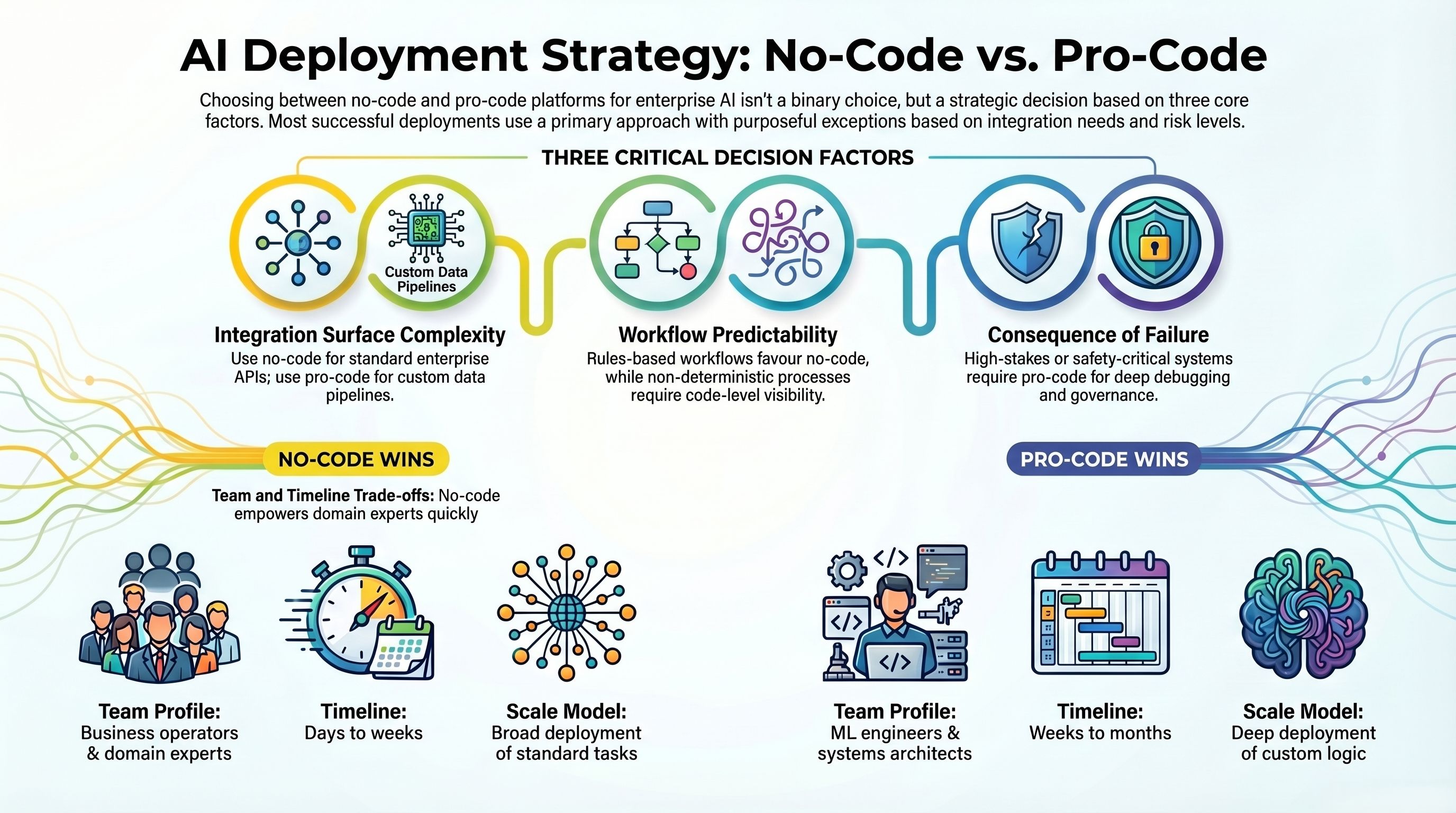
2. How defined is the workflow?
If you can write the workflow on a whiteboard and it doesn't change depending on runtime conditions in complex ways, no-code builds it faster. If the agent needs to reason through non-deterministic multi-step processes where edge cases have high consequences — grid anomalies, surgical tender extraction, SAP exception routing — you want full stack visibility.
3. What does failure look like?
For the value retailer, a wrong answer from the voice agent means a store associate looks up the answer manually. For the state power utility, a missed anomaly means a grid failure. The higher the consequence of failure, the more you want code-level debugging capability — and the more you need governance baked in, not bolted on.
The Decision Framework
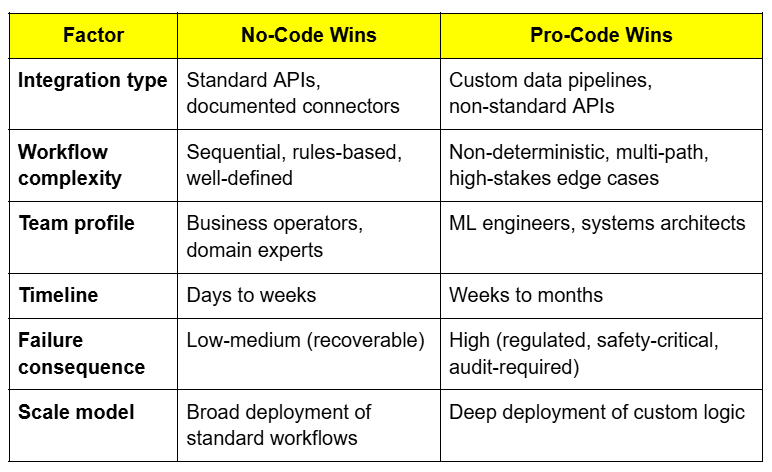
Most enterprise deployments don't sit neatly in one column. The hospitality booking agent is no-code — but the human-in-the-loop for itinerary approval is a designed exception. The SAP order automation is pro-code — but the alert dashboards were built on top using no-code tooling. The real-world pattern is a primary approach with purposeful exceptions, not a binary choice.
Where Assistents.ai Fits
Assistents.ai is a no-code enterprise AI agent platform. It's built for organisations that want to deploy agents across operations, finance, customer support, HR, and sales without embedding an ML engineering team in each deployment.
The platform is designed around the deployments described above — meaning it's built to handle multi-agent orchestration, voice AI, RAG over enterprise documents, and 300+ integration connectors out of the box. Industry coverage spans financial services, healthcare, manufacturing, retail, logistics, energy, professional services, education, and real estate.
For teams evaluating whether their use case fits a no-code approach, the honest answer is: if your workflow can be described clearly, your integration surface uses standard enterprise systems, and your priority is time-to-value rather than maximum algorithmic control, it fits. If you're building custom ML pipelines or integrating with highly non-standard infrastructure, Assistents.ai's team can advise on where the boundary lies.
Book a 20-minute demo to walk through your specific use case →
Frequently Asked Questions
Can no-code AI agent platforms handle enterprise-scale deployments?
Yes — three of the seven deployments above are enterprise-scale operations (a 700+ store retailer, a global ports company, a multi-property hospitality group) and all used no-code orchestration as the primary approach. Scale is a function of the platform's architecture, not the development approach.
What's the risk of vendor lock-in with no-code platforms?
It's real and worth evaluating. Look for platforms that use standard output formats, offer API access to agent configurations, and don't store your proprietary data in proprietary schemas. Assistents.ai's architecture is designed to be system-agnostic — agents connect to your systems, not the other way around.
Is pro-code always more customizable?
For core algorithmic logic, yes. For integration breadth and deployment speed, no. A pro-code build that takes six months to integrate with your CRM has less practical flexibility than a no-code build that connects in a week. Customisability only matters if you can actually access it within your timeline.
Can you start with no-code and migrate to pro-code later?
It depends on the platform. Some no-code platforms offer hybrid modes where specific agent components can be extended with code while the orchestration layer remains visual. This is worth asking about during any platform evaluation.
How long does a typical no-code AI agent deployment take?
Across the deployments above, the range was two to eight weeks from scoping to production — depending on integration complexity and the number of distinct agent workflows. The hospitality booking agent went live in under four weeks. The retail voice agent, with its three-agent architecture and dual-language requirement, took closer to eight.

Transform Your Business With Agentic Automation
Agentic automation is the rising star posied to overtake RPA and bring about a new wave of intelligent automation. Explore the core concepts of agentic automation, how it works, real-life examples and strategies for a successful implementation in this ebook.
Sarfraz Nawaz is the CEO and founder of Ampcome, which is at the forefront of Artificial Intelligence (AI) Development. Nawaz's passion for technology is matched by his commitment to creating solutions that drive real-world results. Under his leadership, Ampcome's team of talented engineers and developers craft innovative IT solutions that empower businesses to thrive in the ever-evolving technological landscape.Ampcome's success is a testament to Nawaz's dedication to excellence and his unwavering belief in the transformative power of technology.

More insights
Discover the latest trends, best practices, and expert opinions that can reshape your perspective







Contact us

