
AI in Industrial Design: 15 Use Cases and Examples From Concept to Production (2026 Guide)


AI in industrial design is the use of machine learning, generative models and AI agents across the physical-product lifecycle: market research, concept sketches, generative design and simulation, and then sourcing, engineering documents and design-change workflows. It shortens design cycles, widens the range of options a team can explore, and moves the discovery of problems earlier, when a fix costs a drawing revision rather than a tooling change.
This guide covers 15 use cases across five lifecycle stages, with the tools that do each job, worked examples, the failure modes, and the autonomy level each decision should carry. It is written for industrial designers and design engineers, and for the engineering and product leaders at manufacturers who have to decide what to fund.
Key takeaways
- AI in industrial design works in three layers: creative (ideation, rendering), engineering (generative design, simulation) and operational (documents, sourcing, ERP and PLM handoffs, approvals, analytics). Most guides cover the first two and ignore the third, which is where the expensive delays live.
- Verified example: an Autodesk Research generative-design project produced a cast magnesium aircraft seat frame weighing 766 g against 1,672 g for the conventional aluminium part, roughly 54% lighter, with about 30 percentage points of that attributed to design optimisation (source: Autodesk).
- Market estimate: analysts at market.us value AI in industrial design at USD 3.7 billion in 2023, projected to reach USD 38.3 billion by 2033 at a 26.2% CAGR, with Asia-Pacific holding the largest regional share. Treat these as third-party estimates.
- The least-covered stage is design-to-production handoff: specs, tenders, RFQs, design changes flowing into ERP and PLM, and the approvals and audit around them.
- Not every design decision should be automated. Each use case below carries a recommended autonomy level, from Assist to Execute.
How is AI changing industrial design in 2026?
Physical-product design is harder to automate than digital design because mistakes are expensive to reverse. Once tooling is cut, a geometry change costs weeks and real money. A product programme typically runs 12 to 18 months, involves materials, regulation, suppliers and physical testing, and every late discovery pushes the launch.
AI changes the economics of that timeline in one specific way: it lowers the cost of evaluating an option. When a concept can be rendered in seconds, a geometry scored without an overnight solver run, and a supplier quote or spec revision processed without a person re-keying it, the team explores more options earlier and finds problems while they are still cheap. Adoption is no longer the question. Figma's State of the Designer 2026 report found 72% of designers now use generative AI in their workflows, a figure that covers designers broadly rather than industrial designers specifically, but the direction is the same in studios.
The three layers of AI in industrial design
Most articles on AI in industrial design describe tools. It is more useful to describe layers, because the layers have different buyers, different risks and different returns.
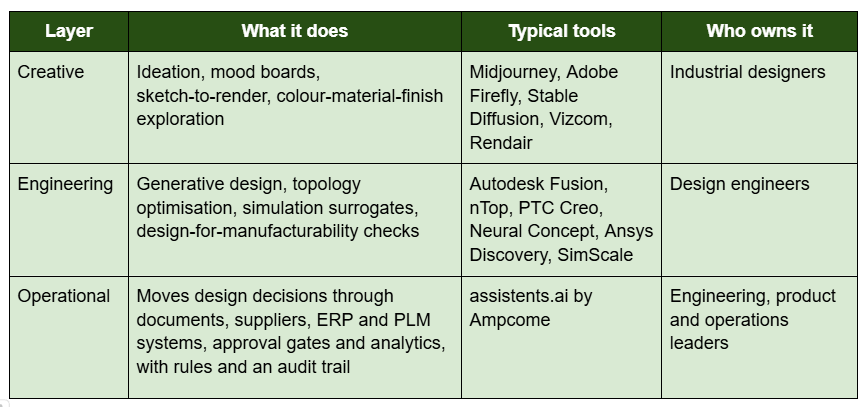
The creative and engineering layers are well served by point tools and well covered by vendor guides. The operational layer is where a right design still becomes a wrong order, a missed revision or a three-week RFQ cycle, and it is the layer this guide treats as seriously as the other two.
Generative design, generative AI and agentic AI are three different things
The terms get mixed up in most coverage, so it is worth being precise.
Generative design is a constraint-driven search for geometry. You state loads, mass targets, materials and manufacturing method; an algorithm proposes shapes that satisfy them. It has existed for years and produces dimensioned, simulatable parts.
Generative AI is a learned model that produces images, text or, increasingly, CAD features from prompts or references. It is fast and wide-ranging, but a rendered image carries no dimensions and no load path.
Agentic AI is a system that takes multi-step action across systems: reads a document, applies a rule, requests an approval, writes a transaction, and records what it did. It is the technology behind the operational layer.
15 AI in industrial design use cases and examples, by lifecycle stage
Each use case below follows the same template: what it does, where it sits, representative tools, an example, the watch-outs, and a recommended autonomy level. Examples marked as Ampcome engagements are anonymised; results are stated as reported by the client or as engineered targets, never as guarantees.
Stage A: Research and brief
1. Competitor, channel and pricing signal intelligence for product decisions
Stage: Research · Layer: Operational · Autonomy: Recommend
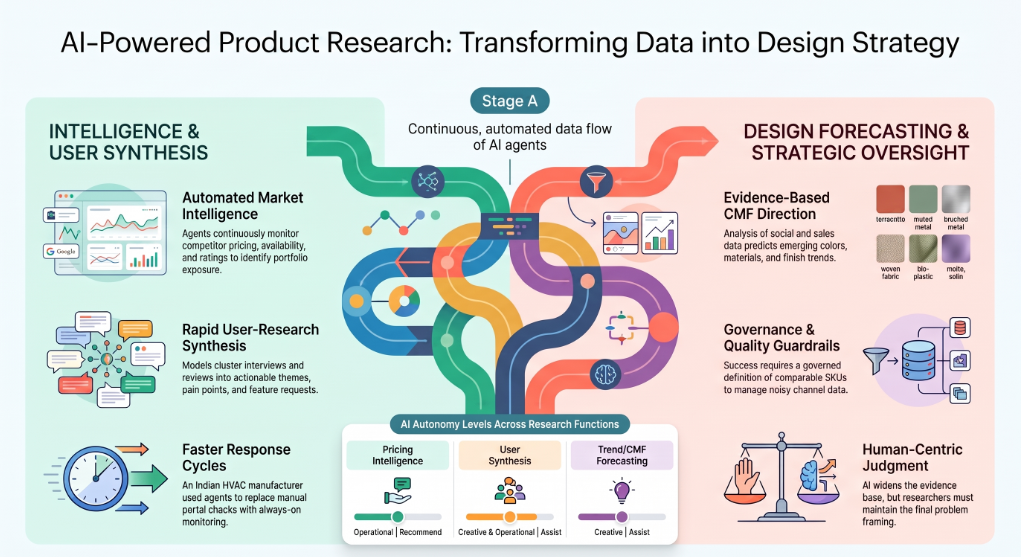
What it does. Agents continuously monitor e-commerce listings, dealer portals and marketplaces for competitor pricing, discounts, offers, availability and ratings, then convert that stream into answers to the questions product and category leaders actually ask. Instead of a monthly deck, the team gets a standing view of where its portfolio is exposed.
Example. In an Ampcome engagement for a major Indian HVAC&R manufacturer competing in price-sensitive consumer and commercial cooling markets, competitive-monitoring agents were built to track pricing, MRP and discounts, offers, availability and ratings across channels, with an agentic question-and-answer layer mapped to leadership questions and analytics views for pricing gaps, threats and portfolio movement. The architecture was designed to scale from pilot to production with governance and audit trails. Reported outcomes were faster competitive response cycles, earlier identification of pricing gaps and promotional shifts, and always-on monitoring replacing manual checks across portals.
Watch-outs. Channel data is noisy; listings are mislabelled and prices vary by region. The value comes from a governed definition of "our comparable SKU" and from routing alerts to a named owner, not from scraping volume.
2. User-research synthesis
Stage: Research · Layer: Creative and operational · Autonomy: Assist
What it does. Models transcribe and cluster interviews, open-ended survey responses, product reviews and field-observation notes into themes, pain points and feature requests. For physical products, where research has to be front-loaded because iteration is slow, this lets a small team cover more users and more contexts.
Tools. Dovetail, UserTesting's AI features, and general-purpose language models for first-pass clustering.
Example. For a brand-insights studio led by former big-tech advertising leaders, Ampcome built a multi-source ingestion layer for creative, performance and audience signals, with insight agents producing themes, narratives and recommendations for leadership reporting packs. The reported effect was faster strategy cycles and deeper synthesis across channels. The pattern transfers directly to design research: many weak signals, one governed set of themes.
Watch-outs. Synthesis is not judgement. Use the model to widen the evidence base and keep the framing of the problem with the researcher.
3. Trend and colour-material-finish forecasting
Stage: Research · Layer: Creative · Autonomy: Assist
What it does. Market, social and sales data are analysed for emerging forms, colourways, materials and finishes, so CMF direction is set on evidence rather than on last season's instinct. In consumer appliances and furniture, this shortens the gap between what sells and what gets designed next.
Watch-outs. Models trained on what already exists tend to recommend more of it. Treat the output as a map of the current landscape, not a brief.
Stage B: Concept and form
4. Text-to-image concept ideation
Stage: Concept · Layer: Creative · Autonomy: Assist
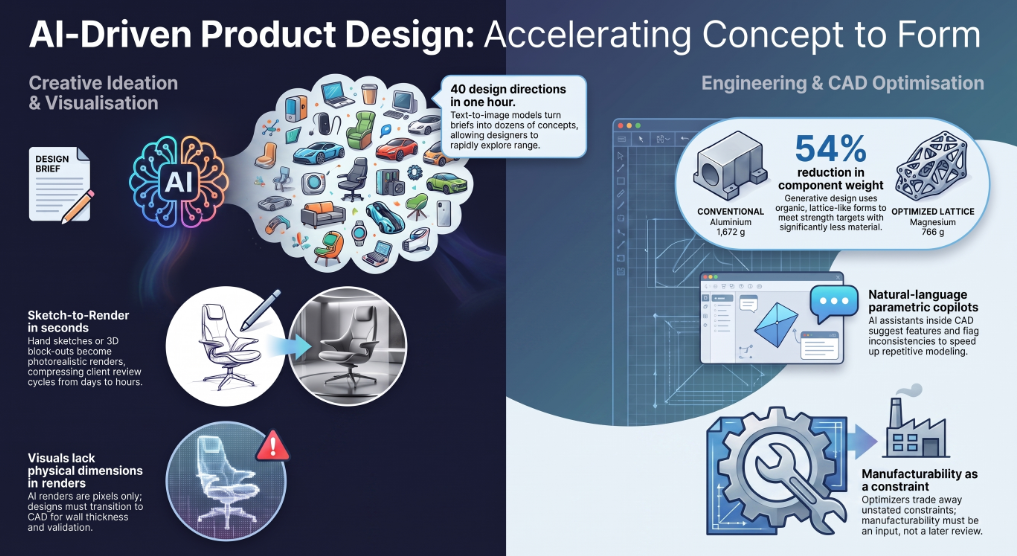
What it does. Text-to-image models turn a written brief and reference images into dozens of concept directions in an hour. The practical value is range: a designer can put forty directions in front of a review and carry two into CAD.
Tools. Midjourney, Adobe Firefly, Stable Diffusion.
Watch-outs. A render is pixels. It has no dimensions, no wall thickness and no load path, so nothing produced here is a part until it has been through CAD and validation. Check the commercial-use and training-data terms of each tool before uploading anything confidential.
5. Sketch-to-render and visualisation
Stage: Concept · Layer: Creative · Autonomy: Assist
What it does. A hand sketch or rough 3D block-out becomes a photorealistic render with materials and lighting in seconds, with region masks to control what the model may change. This is the workflow behind most "AI industrial design" tutorials on YouTube, and it has compressed early client reviews from days to hours.
Tools. Vizcom, Rendair, and image-editing features in Photoshop and Firefly.
Watch-outs. Artefacts, inconsistent proportions between views, and drift away from design intent are common. Tool terms differ on whether outputs are used to improve the service, particularly on free tiers, so check before using a customer's product.
6. Generative design and topology optimisation
Stage: Concept · Layer: Engineering · Autonomy: Recommend
What it does. Given loads, constraints, materials and a manufacturing method, generative design proposes geometries that meet the targets with less material, often in organic, lattice-like forms a designer would not draw by hand.
Tools. Autodesk Fusion generative design, nTop, PTC Creo generative design, Autodesk Netfabb for additive workflows.
Verified example. In an Autodesk Research project, a lattice-optimised aircraft seat frame was cast in magnesium using a 3D-printed pattern. The finished frame weighed 766 g against 1,672 g for the conventional aluminium frame, about 54% lighter, with design optimisation credited for roughly 30 percentage points and the material change for the rest, while meeting the required strength (Autodesk).
Watch-outs. The optimiser will trade away anything you did not state as a constraint, including recyclability, assembly access and tooling cost. Manufacturability has to be an input, not a review step.
7. AI-assisted CAD and parametric copilots
Stage: Concept · Layer: Engineering · Autonomy: Assist
What it does. Natural-language and context-aware assistants inside CAD suggest features, apply standard constraints, flag inconsistencies in a model and speed up repetitive modelling. Vendors including Autodesk, PTC, Siemens and Dassault Systèmes are adding these capabilities directly into their tools.
Watch-outs. Every generated feature needs the same review as a junior engineer's work. Treat suggestions as drafts, and keep the design history clean so intent is traceable.
Stage C: Engineering validation
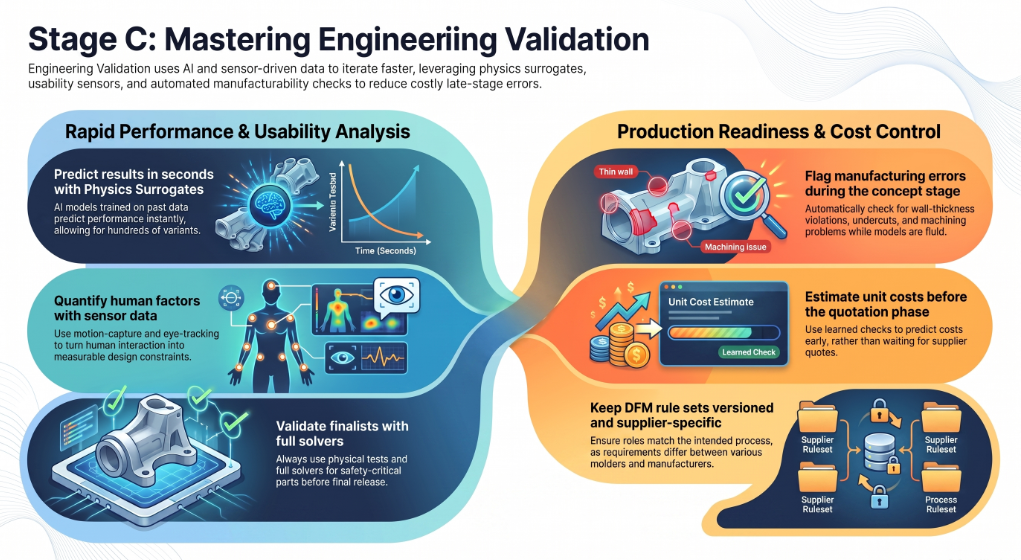
8. AI-accelerated simulation with physics surrogates
Stage: Validation · Layer: Engineering · Autonomy: Recommend
What it does. A model trained on a company's past CAD geometry and simulation results predicts structural, thermal or fluid performance of a new shape in seconds instead of an overnight solver run. Engineers can therefore score hundreds of variants inside a working session and reserve the full solver for the survivors.
Tools. Neural Concept, Ansys Discovery, SimScale, and vendor-specific surrogate tooling.
Watch-outs. A surrogate interpolates within its training data. A geometry unlike anything the model has seen will still receive a confident number. Validate finalists with a full solver and physical tests before release, especially for safety-critical parts.
9. Ergonomics and human-factors analysis
Stage: Validation · Layer: Engineering · Autonomy: Assist
What it does. Motion-capture, eye-tracking and grip or fatigue sensors turn how people actually hold, reach and look at a product into measurable constraints. AI analysis of usability videos quantifies problems that a single observation would only suggest.
Watch-outs. Instrumented studies are small. Use them to confirm a hypothesis across users, not to replace field observation of real environments.
10. Design-for-manufacturability and cost checks
Stage: Validation · Layer: Engineering · Autonomy: Recommend
What it does. Rule-based and learned checks flag draft angles, undercuts, wall-thickness violations, sheet-metal bend limits and machining problems while the model is still fluid, and estimate cost per unit at the concept stage rather than at quotation.
Watch-outs. DFM rules are process- and supplier-specific. A check that passes for one moulder fails for another; keep the rule sets versioned and attached to the intended process.
Stage D: Design-to-production handoff
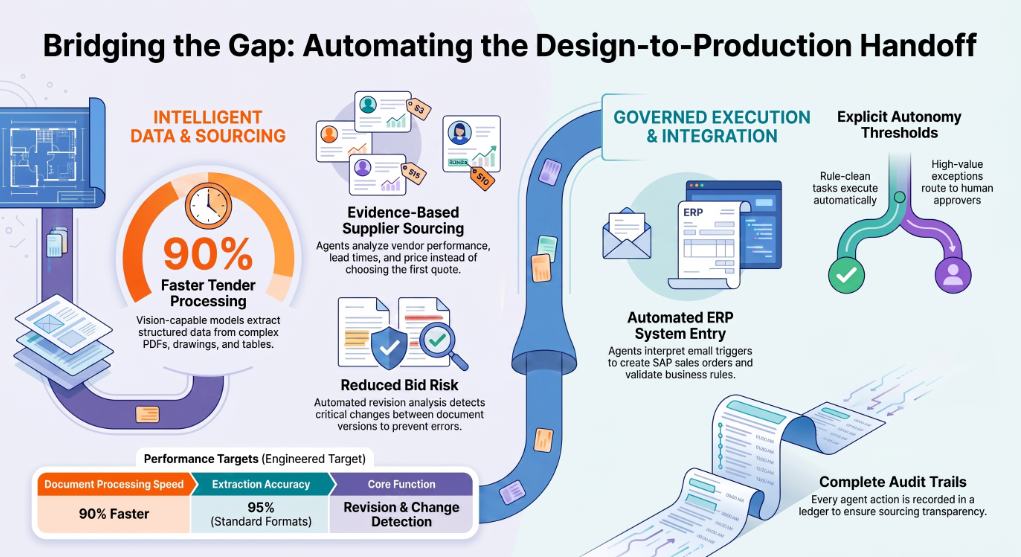
This is the stage most guides skip, and the one where Ampcome's delivery work is concentrated. The design is finished; what follows is documents, suppliers, transactions and approvals across systems that were never designed to talk to each other.
11. Engineering document, specification and tender intelligence
Stage: Handoff · Layer: Operational · Autonomy: Coordinate
What it does. Agents retrieve specifications and tender packs, extract structured data from complex PDFs including drawings and tables using vision-capable models, determine the correct downstream workflow, detect what changed between revisions, and write the result into the operational system with an audit trail.
Example. For an Australian remedial-building and commercial-works specialist, Ampcome delivered a multi-agent Intelligent Document Workbench covering tender retrieval, workflow determination, revision analysis and vision-model extraction from complex PDFs, integrated with the client's job-management system with quote locking and audit logs. The solution was engineered for up to roughly 90% faster tender-document processing with a roughly 95% extraction-accuracy target on standard formats, and reduced bid risk through revision and change detection. These are engineered targets for that deployment, not benchmarks for every document set.
Watch-outs. Extraction accuracy on non-standard formats is lower and should be measured, not assumed. Human review of exceptions is part of the design, not a fallback.
12. Component sourcing, RFQ automation and supplier discovery
Stage: Handoff · Layer: Operational · Autonomy: Coordinate
What it does. From a bill of materials or specification, agents generate RFQs, match candidate suppliers, chase responses, handle quality and regulatory documents, and produce price, lead-time and vendor-performance analytics so a sourcing decision is made on evidence rather than on the first quote back.
Example. For a pharma sourcing platform listing thousands of specialised excipient SKUs, Ampcome built RFQ-automation and supplier-matching workflows with quality and regulatory document handling and analytics on price, lead time and vendor performance. Reported outcomes were faster procurement cycles, improved sourcing visibility, and fewer manual follow-ups. The same pattern applies to component sourcing for physical products, where lead time is usually the constraint that reshapes a design.
Watch-outs. Supplier data ages fast. The agent should record where every quote and certificate came from and when, so a sourcing decision can be defended six months later.
13. Governed design-change and order workflows into ERP and PLM
Stage: Handoff · Layer: Operational · Autonomy: Execute below threshold, approval above
What it does. When a design change, a customer order or a spec revision arrives by email, portal or document, an agent interprets the trigger, validates it against business rules, creates or updates the transaction in the ERP or PLM system, routes exceptions to a person, and reconciles what was created against what was requested.
Example. For a long-established UAE engineering and technology solutions provider, Ampcome delivered agentic automation that interprets order triggers, validates them and creates SAP sales orders, with rules and governance for exceptions and approvals, audit logs and reconciliation reporting, as part of the client's move away from an end-of-life, high-licence-cost document workflow. Reported outcomes were reduced manual order processing and legacy dependency, a faster order-to-confirm cycle with fewer data-entry errors, and improved auditability of order creation and exceptions.
Watch-outs. This is where autonomy has to be explicit. Low-value, rule-clean transactions can execute automatically; anything above a defined threshold or outside policy needs a named approver, and every action needs a ledger entry.
Stage E: In-market learning
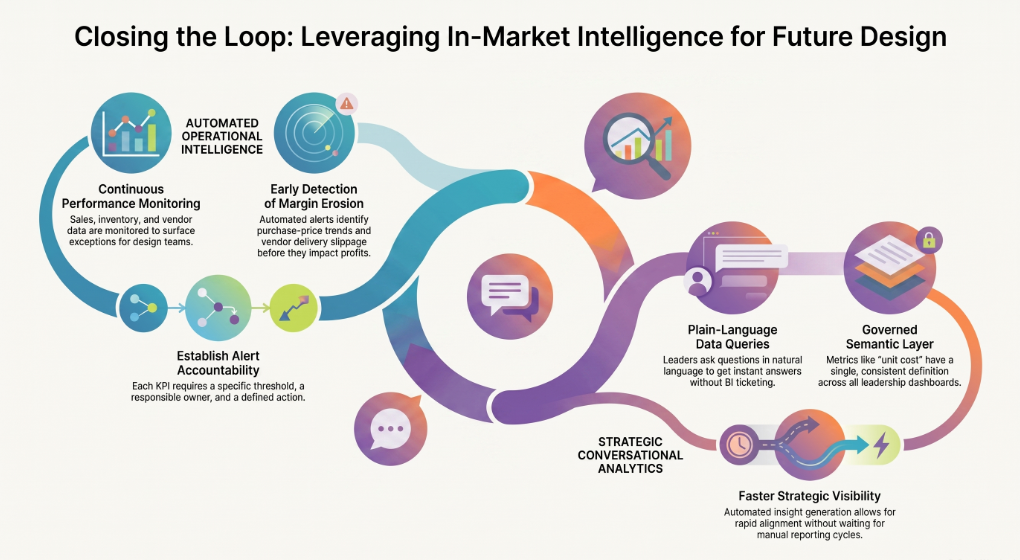
14. Product-performance, channel and vendor intelligence feeding the next design
Stage: In-market · Layer: Operational · Autonomy: Recommend
What it does. Sales, promotion, inventory, warranty and vendor data are monitored continuously, and exceptions are surfaced to the people who set the next brief: which variants sell, which promotions work, which suppliers slip on delivery or returns, and where margin is eroding.
Examples. For a premium UAE kitchen and home-appliance retailer and distributor, Ampcome delivered a data-analytics agent over e-commerce and operations data covering sales, products, inventory, promotions and customer behaviour, with conversational analytics and automated KPI monitoring. Reported outcomes were shorter analysis cycles, better visibility into product performance and promotion effectiveness, and reduced dependency on analysts for reporting. For a diversified UAE family business group with dozens of operating companies, Ampcome built automated procurement and finance KPI alerts covering purchase-price trends, margin impact, early-payment analysis and vendor delivery and returns performance, which the client reported gave earlier detection of margin erosion and vendor slippage.
Watch-outs. Alerts without owners become noise. Each KPI needs a threshold, a responsible person and an expected action.
15. Governed conversational analytics for design and engineering leaders
Stage: In-market · Layer: Operational · Autonomy: Assist
What it does. Leaders ask questions of product, cost and performance data in plain language and get answers computed from a semantic layer where "unit cost", "lead time" and "revision" each mean one thing. No ticket to the BI team, and no two dashboards disagreeing in the same meeting.
Example. For a Silicon Valley business-analytics start-up, Ampcome built an agentic analytics layer over existing data with semantic governance for consistent definitions and a natural-language interface with automated insight generation. Reported outcomes were faster strategic visibility without BI queueing and better alignment through consistent metric definitions.
Watch-outs. Natural-language analytics is only as trustworthy as the definitions behind it. Put the glossary, formulas and hierarchies under version control before opening the interface to leadership.
Why assistents.ai for the operational layer of industrial design
Start with the process, not the platform. A spec revision, a design change, a supplier RFQ or a competitor price move is a recurring, cross-system event with a measurable baseline: days from revision to updated order, hours per tender pack, RFQ cycle time, lag between a competitor's move and your response. Those numbers are what a pilot should be scoped against.
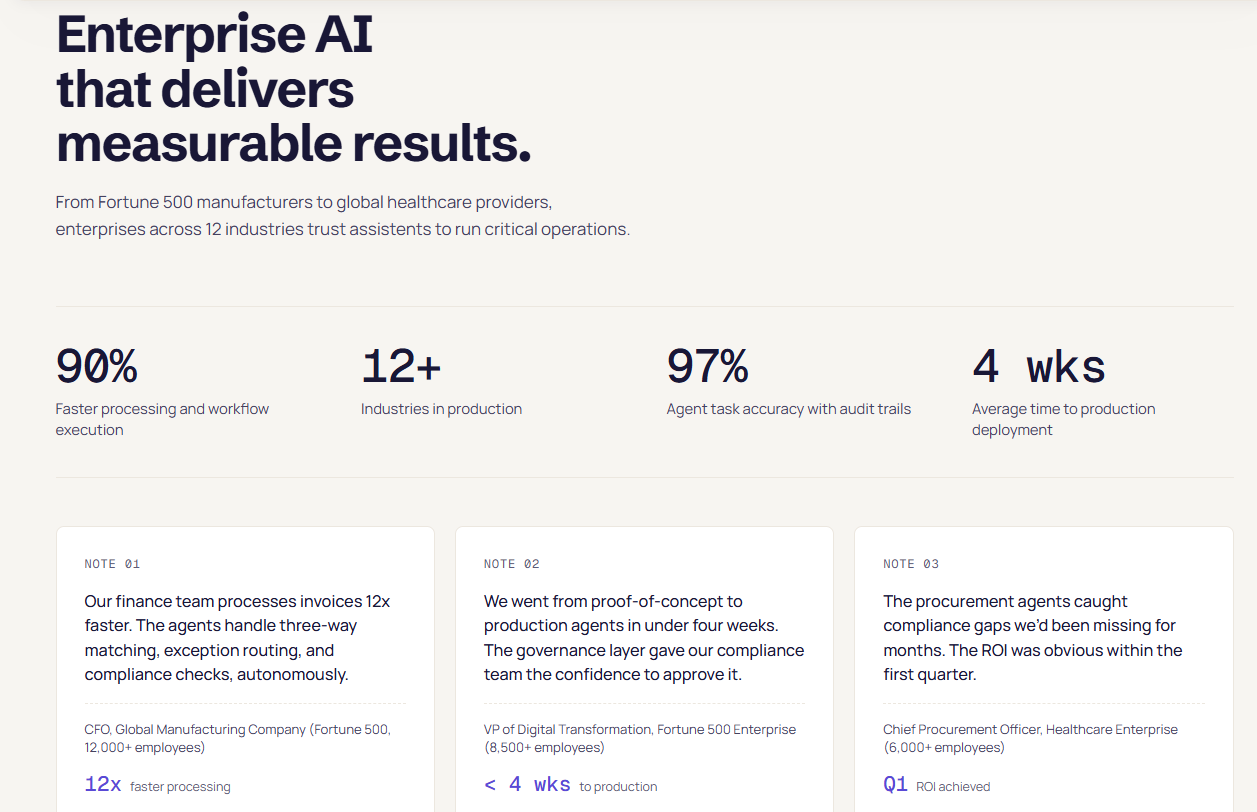
assistents.ai by Ampcome converts enterprise data, documents, policies, business rules, and workflows into contextual intelligence, governed decisions, coordinated actions, and measurable outcomes. It sits above the design tools and the systems of record rather than replacing either.
Applied to a single design-change event, the operating loop looks like this:
- Observe. A revised specification arrives by email or portal.
- Understand. The agent extracts the content, compares it with the prior revision and cites what changed.
- Decide. Deterministic rules check cost, lead-time and compliance thresholds.
- Approve. Changes above threshold route to the engineering lead; changes within policy proceed.
- Execute. The ERP or PLM record is updated and affected suppliers are notified.
- Monitor. Every step is written to a decision ledger.
- Learn. Cycle time and exception rates feed the next threshold review.
What the platform provides for that loop, in the words we use with customers:
- A semantic business layer. A glossary with synonyms, metrics carrying real formulas, threshold bands and drill hierarchies, so every agent and dashboard uses the same definition of cost, lead time and revision.
- A deterministic rule engine. Versioned, checksummed rules with single-active-release publishing and full execution traces, so a compliance or cost threshold is applied the same way every time and can be shown to an auditor.
- Document retrieval with citations. Semantic search over document repositories with configurable relevance thresholds, returning citations so a user can trace an answer to its source. Document ingestion is configured per source during implementation.
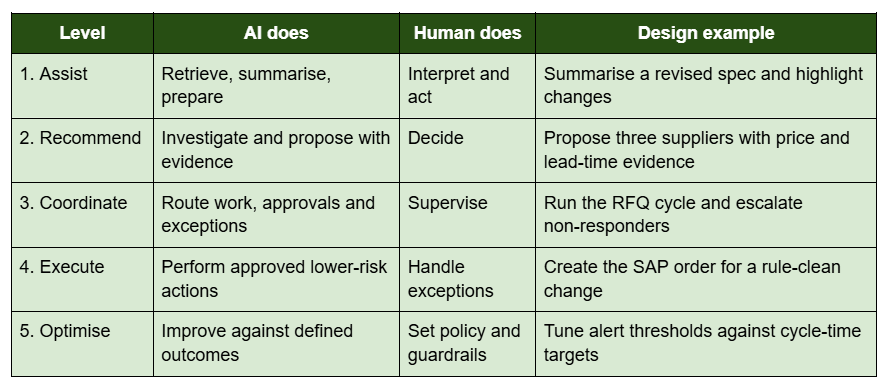
- Autonomy levels and approvals. Autonomy is set per decision class, with approval policies, permissions and budgets, so the same process can auto-execute routine changes and hold the unusual ones.
- A decision ledger. End-to-end traces, replay and shadow mode, so a change can be reviewed after the fact and a new rule can be tested against history before it goes live.
- Model independence. Agents run on models from multiple providers, with an ordered provider preference per agent and support for any OpenAI-compatible endpoint, including a model you host yourself. Model choice is a configuration decision, not an architectural commitment.
- Enterprise integration. assistents.ai integrates with enterprise applications such as SAP, PLM and CRM systems through their published APIs, or through direct access to their underlying data stores where permitted. Each integration is scoped during solution design based on your landscape, available interfaces and access model.
- Deployment patterns. assistents.ai supports deployment patterns designed for private, dedicated, on-premise and customer-controlled environments. The specific architecture, data flows, model access and operational boundaries are defined and validated against your requirements during solution design.
Autonomy levels applied to design decisions
Different decisions inside one process sit at different rungs, and that is how real deployments work.
If you want to see how this applies to your own design-to-production workflow, start with the manufacturing use cases or explore assistents.ai.
Where AI in industrial design fails, and how to avoid it
The failures are consistent enough to list.
Generated geometry trusted without validation. A surrogate model or a generative run produces a confident answer for a shape it has never seen. Keep solver validation and physical testing in the release path for anything load-bearing.
One objective optimised, three broken. Lightest is not cheapest, and cheapest is not assemblable. State every constraint you care about, including tooling cost and disassembly, or the optimiser will trade it away.
Pixels mistaken for parts. A persuasive render creates false confidence at review. Mark AI imagery as concept-only until it has been through CAD.
IP and training-data exposure. Some tools use uploads or outputs to improve their service, particularly on free tiers, and regulated sectors carry export-control and data-residency obligations. Read the terms, prefer private deployment for confidential programmes, and decide where models may run before the first upload.
The handoff gap. The design was right and the order was wrong, because nothing between the studio and the ERP applied a rule, asked for an approval or kept a record. This is the most common failure we see at manufacturers, and it is an operational-layer problem, not a design-tool problem.
Homogenised form language. Models trained on what exists reproduce what exists. Use generative tools to widen the search, and keep the decision about what is worth building with the designer.
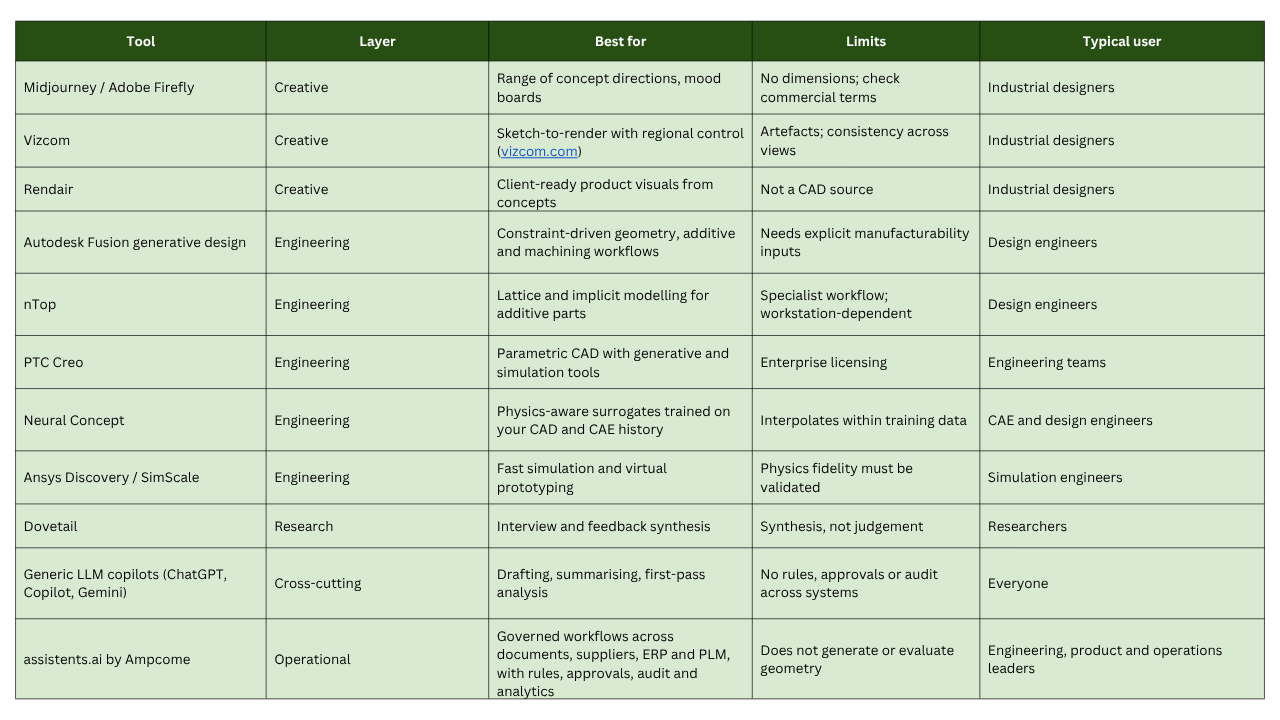
AI tools for industrial designers: a straight comparison
Pricing changes too often to print; verify on each vendor's site.
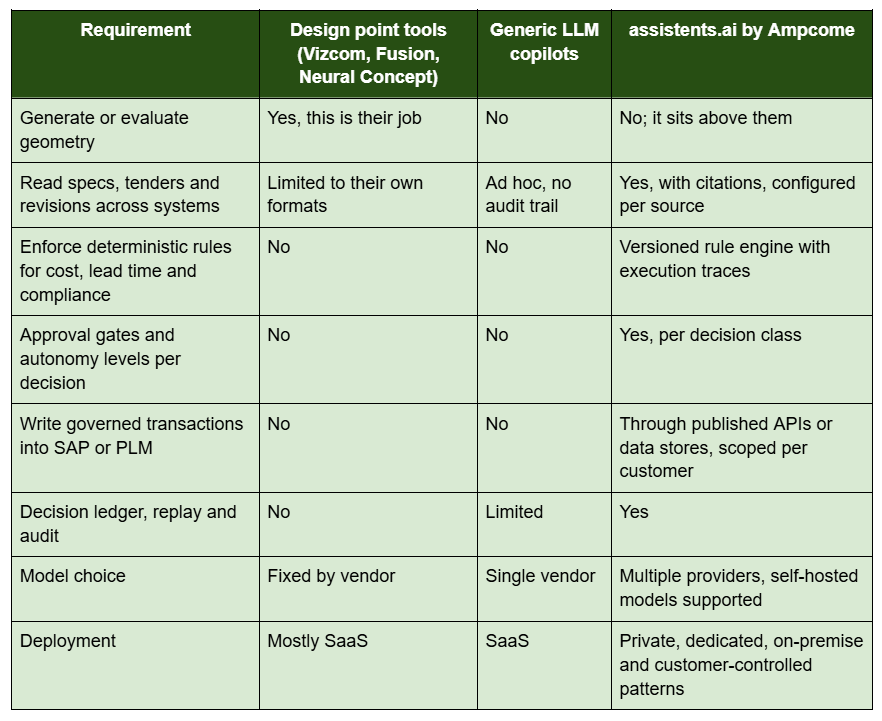
Why assistents.ai over point tools and generic copilots
The honest comparison is three-way, and each column is good at something the others are not.
Systems of record store the enterprise. Systems of intelligence explain the enterprise. assistents.ai is the System of Agency that helps humans and AI agents operate the enterprise together.
Start with one design-to-production process that has a measurable baseline: a spec-revision workflow, an RFQ cycle, a design-change-to-order path or competitor-response lag. Talk to Ampcome about a paid pilot with explicit success metrics and a production decision at the end of it.
How should manufacturers start with AI in industrial design?
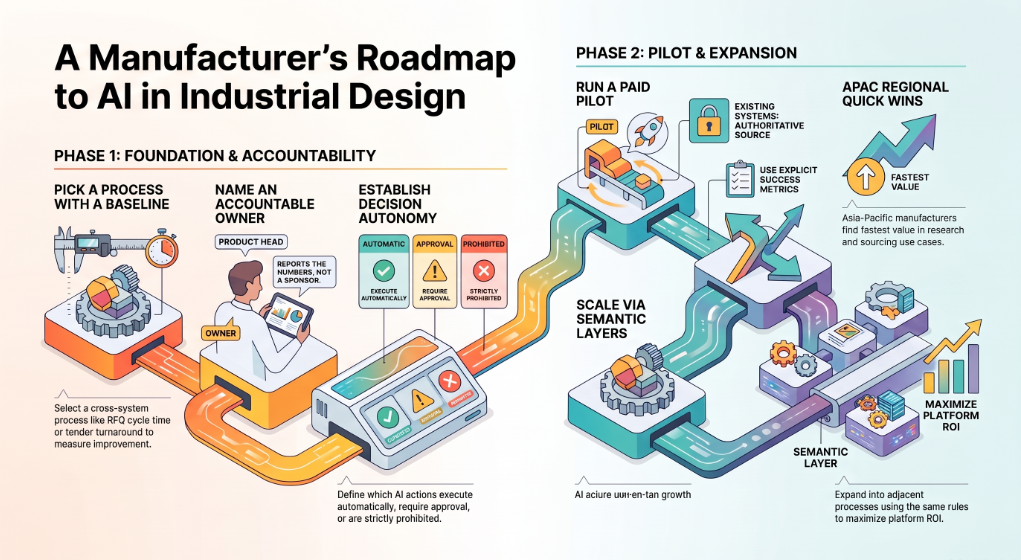
Most failed AI programmes in product companies started with a platform and went looking for a problem. Do it the other way round.
- Pick one recurring, cross-system process with a number. Tender turnaround in hours, RFQ cycle time in days, design-change-to-order in days, competitor-response lag in weeks. If you cannot state the baseline, you cannot prove the improvement.
- Name the accountable owner. A head of engineering, sourcing or product who reports the number, not an innovation sponsor.
- Set autonomy per decision class before building. Decide which actions may execute automatically, which need approval, and which are prohibited, and write those decisions down.
- Run a paid pilot with explicit success metrics and a production decision at the end. Your existing systems remain authoritative throughout.
- Expand into the next process on the same semantic layer and rules, which is where the platform pays for itself.
A note for India and Asia-Pacific manufacturers. Analysts at market.us attribute the largest regional share of AI in industrial design to Asia-Pacific. Price-sensitive categories, dealer and marketplace fragmentation, and multilingual channel data make the research and sourcing use cases (1, 12 and 14) the fastest to show value, usually before any change to the CAD stack.
For use cases further down the line, after design release and on the plant floor, see AI agents in manufacturing and agentic AI for industrial automation. A broader set of anonymised deployments is in AI agents in production: real examples.
What is the future of industrial design with AI?
Three shifts are already visible. First, engineering AI is moving from single parts to assemblies and coupled physics, which will make surrogate models useful for whole products rather than brackets. Second, a company's CAD and simulation history is becoming a proprietary training asset that no vendor or competitor can replicate, as the academic literature on AI in industrial design has anticipated (Engineering Applications of Artificial Intelligence, 2022).
Third, and least discussed, the studio and the enterprise are finally being connected. Design decisions will flow into sourcing, orders and suppliers through governed agents rather than through email and re-keying, and performance data will flow back into the next brief without a quarterly deck in between.
The designer's job moves toward framing problems, setting constraints and judging what is worth building. The engineering leader's job moves toward setting policy for what AI may decide alone. The long-term direction is an enterprise where humans and AI agents operate the product lifecycle together, and industrial design is one of the first places that will be visible.
FAQs
How is AI used in industrial design?
AI is used at every stage of physical-product design: synthesising research, generating concept imagery and renders, proposing geometry through generative design, predicting performance with simulation surrogates, checking manufacturability, and, in the operational layer, processing specifications and RFQs, automating design-change workflows into ERP and PLM, and feeding in-market performance data back into the next brief.
Will AI replace industrial designers?
No. AI generates and evaluates options; it does not decide what is worth building, and it cannot judge how a product feels in a person's hand. The workable division gives the search to the machine and the objectives and judgement to the designer. The skills that grow in value are problem framing, constraint definition and systems thinking.
What is generative design in industrial design?
Generative design is a constraint-driven search for geometry. Designers state loads, mass targets, materials and the manufacturing method, and an algorithm proposes shapes that satisfy them, often organic lattice forms. Autodesk's research seat frame, roughly 54% lighter than the conventional part, is the standard worked example. Outputs are dimensioned parts, unlike AI-generated images.
What is the difference between generative design, generative AI and agentic AI?
Generative design searches for geometry under stated constraints and produces simulatable parts. Generative AI is a learned model that produces images, text or CAD features from prompts, fast but without dimensions or load paths. Agentic AI takes multi-step actions across systems, applying rules, requesting approvals and recording what it did. Industrial design uses all three at different stages.
What are the best AI tools for industrial design in 2026?
It depends on the layer. For concept work: Midjourney, Firefly and Vizcom. For engineering: Autodesk Fusion generative design, nTop, PTC Creo, Neural Concept and Ansys Discovery. For the operational layer, where designs become documents, RFQs and ERP transactions with approvals and audit, assistents.ai by Ampcome. No single tool covers all three.
What is the difference between AI product design and AI in industrial design?
"AI product design" usually refers to designing digital products and interfaces, often with AI features, using tools such as Figma. "AI in industrial design" refers to applying AI to physical products, where constraints include materials, tooling, regulation and supply chain, and where a late change costs a tooling revision rather than a code deployment.
Is AI safe to use with confidential product designs?
It can be, if you decide the boundaries first. Check whether a tool uses uploads or outputs to improve its service, keep confidential programmes on private or customer-controlled deployments, prefer models you can host or select yourself, and require approval gates and an audit trail on any agent that writes to a system of record. Regulated sectors should also check export-control and data-residency obligations.
How do manufacturers start with AI in industrial design?
Choose one recurring, cross-system process with a measurable baseline, such as tender turnaround or RFQ cycle time. Name the accountable owner, set the autonomy level for each decision class, and run a paid pilot with explicit success metrics and a production decision. Expand to the next process on the same semantic layer and rules.

Transform Your Business With Agentic Automation
Agentic automation is the rising star posied to overtake RPA and bring about a new wave of intelligent automation. Explore the core concepts of agentic automation, how it works, real-life examples and strategies for a successful implementation in this ebook.
Sarfraz Nawaz is the CEO and founder of Ampcome, which is at the forefront of Artificial Intelligence (AI) Development. Nawaz's passion for technology is matched by his commitment to creating solutions that drive real-world results. Under his leadership, Ampcome's team of talented engineers and developers craft innovative IT solutions that empower businesses to thrive in the ever-evolving technological landscape.Ampcome's success is a testament to Nawaz's dedication to excellence and his unwavering belief in the transformative power of technology.

More insights
Discover the latest trends, best practices, and expert opinions that can reshape your perspective







Contact us

