
AI Agents in Manufacturing: 10 Real-World Use Cases, ROI Results & How to Deploy in 2026


Quick Answer: AI agents in manufacturing are autonomous software systems that perceive real-time operational data, make decisions, and execute actions across production, logistics, procurement, and supply chain workflows — without constant human intervention. Unlike chatbots or RPA scripts, AI agents reason through complex, multi-step processes, adapt to changing conditions, and integrate directly with enterprise systems like SAP, ERP, SCADA, and WMS platforms.
Manufacturing has always been a game of margins, timing, and coordination. But right now, the gap between manufacturers running AI agents across their operations and those still relying on manual workflows and static dashboards is widening at an accelerating pace.
According to research from the Capgemini Research Institute, 28% of manufacturers were already using AI agents in production environments in 2025 — up from near zero two years earlier. The pressure is intensifying: unplanned downtime alone costs the global manufacturing industry up to $50 billion annually, according to Deloitte, while 56% of manufacturers are still unsure whether their existing ERP systems are ready for full AI integration.
Gartner predicts that 40% of enterprise applications will feature task-specific AI agents by 2026, up from less than 5% in 2025. The manufacturers closing that gap are not waiting for a perfect AI strategy. They are deploying AI agents in specific, high-ROI workflows — predictive maintenance, logistics coordination, procurement automation, smart grid monitoring — and scaling from there.
This guide covers the 10 most impactful AI agent use cases in manufacturing, what real deployments have actually delivered, the technical architecture you need, and a practical roadmap for going from pilot to production.
What Makes AI Agents Different from RPA and Copilots in Manufacturing
Before diving into use cases, it is worth being precise about what separates AI agents from the automation manufacturers have already deployed — because the distinction is operationally significant.
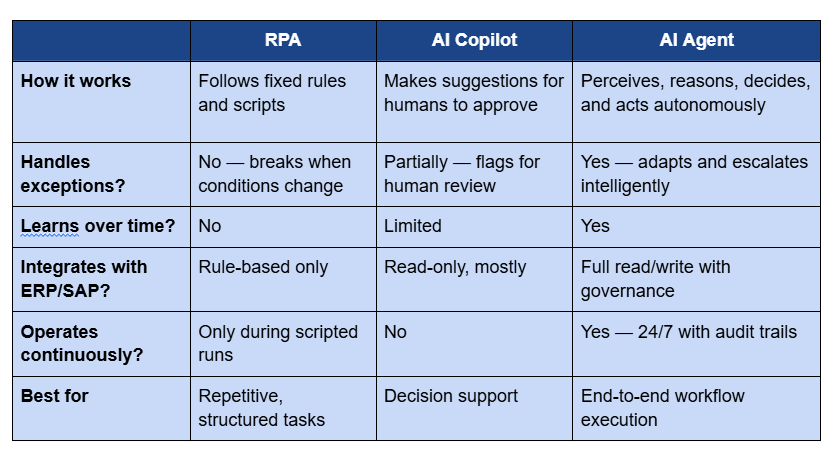
RPA follows fixed rules and scripts. It automates repetitive, structured tasks — copying data between systems, filling standard forms. RPA breaks the moment conditions change or exceptions arise.
AI copilots sit alongside human workers and make suggestions. They require a human to review, approve, and act. They are assistants, not agents.
AI agents perceive inputs (sensor data, documents, system events, user queries), reason through multi-step decisions, use tools to take actions — updating SAP records, sending alerts, rescheduling production orders, routing exceptions — and operate continuously, with governance controls, audit trails, and human-in-the-loop escalation built in. They do not just recommend. They execute.
In manufacturing, this distinction matters enormously. A predictive maintenance copilot tells an engineer that a bearing might fail. An AI agent detects the anomaly, cross-references maintenance schedules, identifies the nearest qualified technician, raises a work order in your ERP, and alerts operations leadership — before the shift supervisor has finished their coffee.
10 AI Agents in Manufacturing: Real-World Use Cases
1. Predictive Maintenance and Equipment Monitoring
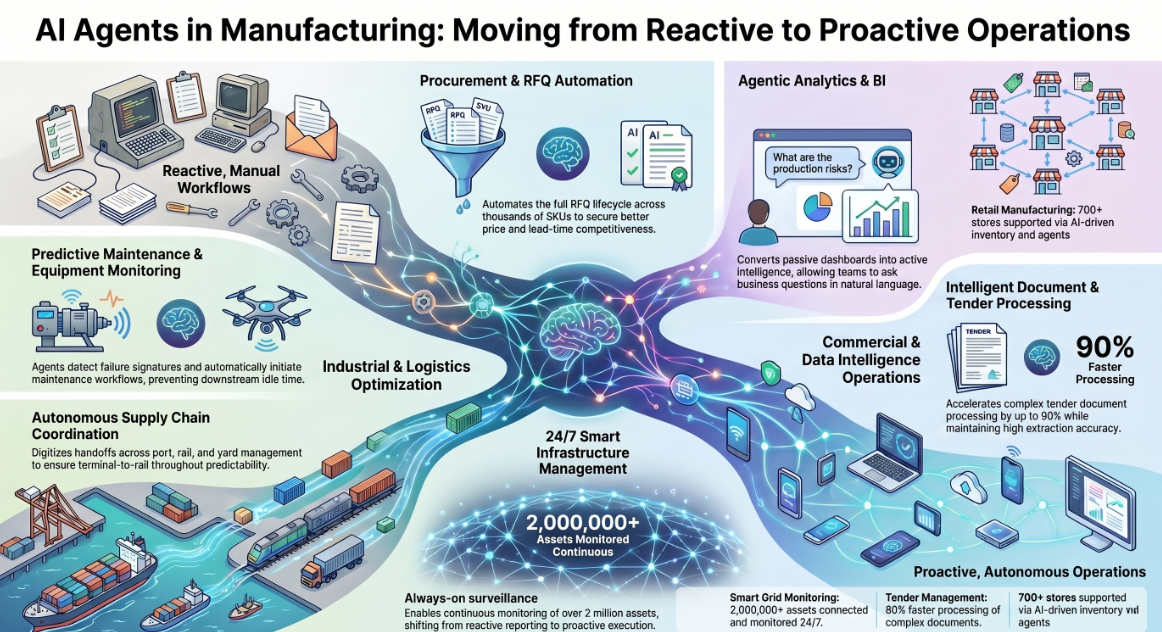
How it works: AI agents continuously ingest sensor data from equipment — vibration, temperature, pressure, power draw — and apply machine learning models to detect early failure signatures. When an anomaly is detected, the agent does not just flag it. It cross-references equipment history, checks parts availability, looks up technician schedules, and initiates a maintenance workflow automatically.
Why it matters: Unplanned equipment failure stops production lines. The cost is not just the repair — it is the downstream idle time, missed delivery windows, and emergency procurement of parts at premium rates. AI agents shift maintenance from reactive to predictive, closing the loop between detection and resolution without human handoffs at each step.
What real deployments deliver: In a large-scale energy infrastructure deployment, an AI agent platform implementing continuous sensor data ingestion with anomaly detection and optimisation recommendations produced measurable improvements in energy visibility, faster detection of inefficiencies, reduced manual monitoring effort, and more predictable operations through early alerts — replacing a manual checking process that had previously required dedicated staff hours every day.
2. Smart Grid and Transmission Monitoring
How it works: AI agents monitor transmission system performance in real time — tracking KPIs across grid segments, detecting outages or losses, predicting field issues before they cascade, and automatically routing exception alerts to the right resolution teams. In smart infrastructure environments, agents also manage data flows from thousands of connected assets and trigger automated operational responses.
Why it matters: For manufacturers dependent on stable power supply, and for utilities managing transmission networks serving large urban populations, the ability to shift from reactive fault response to proactive grid management is transformational. AI agents make continuous, 24/7 grid monitoring economically viable in a way that human-only monitoring never was.
What real deployments deliver: In a large-scale smart infrastructure deployment operating across more than 25 smart city operation centres and connecting over two million assets and applications, an agentic analytics and automated alerting layer was built on top of existing smart utility systems. The outcomes included higher operational visibility across grid operations, faster exception detection and response coordination, and a measurable shift from reactive reporting to proactive execution loops.
In a separate state-level power transmission deployment, AI agents were used for transmission KPI monitoring, anomaly detection, loss and outage analytics, predictive maintenance indicators, and automated alerts for field operations — delivering faster identification of grid exceptions, improved reliability through proactive monitoring, and better operational transparency for leadership.
3. Supply Chain Coordination and Port/Rail Logistics
How it works: AI agents manage the full coordination layer across terminal operations, yard management, rail scheduling, and inland logistics. They digitise workflow handoffs between port systems and freight networks, surface exceptions in real time, provide executive dashboards with live throughput data, and trigger automated alerts when scheduling conflicts or capacity issues arise.
Why it matters: Supply chain coordination across multi-modal logistics is one of the most data-intensive, exception-heavy operations in manufacturing. Human coordinators spend enormous time on status calls, manual system updates, and exception management that AI agents handle automatically — and with far greater consistency.
What real deployments deliver: In a deployment for a global ports and logistics operator with reported annual revenues exceeding $20 billion, a terminal and rail management solution was built to digitise and optimise port-to-inland logistics operations. Results included higher predictability of terminal-to-rail throughput, more efficient coordination across terminal and inland logistics, and improved operational visibility across executive dashboards and exception management workflows.
4. SAP Sales Order Automation and ERP Integration
How it works: AI agents interpret order triggers from incoming documents — emails, EDI files, PDFs, web forms — validate the data against business rules, and automatically create sales orders in SAP without a human re-keying data. When exceptions arise, the agent applies governance rules, flags for human approval, and logs every action with full audit trails. This replaces legacy document management systems reaching end-of-life or carrying unsustainable licensing costs.
Why it matters: Manual order processing is a consistent source of errors, delays, and audit risk. When manufacturers receive high volumes of orders across multiple channels, the operational drag of manual ERP entry is enormous. AI agents compress the order-to-confirm cycle, reduce data-entry errors, and eliminate dependency on expensive legacy middleware.
What real deployments deliver: An enterprise manufacturer used AI agents to build agentic automation for interpreting order triggers, validating data, and creating SAP sales orders — as part of a transition away from a third-party document management platform at end-of-life with high ongoing licensing costs. Results: reduced manual order processing and legacy dependency, faster order-to-confirm cycles with fewer data-entry errors, and improved auditability for sales order creation and exception handling.
5. Procurement, RFQ Automation, and Supplier Intelligence
How it works: AI agents automate the full RFQ (request for quotation) lifecycle — identifying sourcing requirements, matching to qualified suppliers, generating and distributing RFQ documents, collecting responses, and surfacing price and lead-time comparisons for procurement teams. Agents also handle quality and regulatory document management and maintain a continuously updated view of vendor performance.
Why it matters: Procurement is a function where speed and data quality directly affect margins. Slow RFQ cycles mean missed pricing windows. Poor vendor visibility means supply chain risk goes undetected until it creates a production problem. AI agents make procurement proactive rather than reactive.
What real deployments deliver: In a pharma supply chain deployment covering over 1,800 rare excipients and 7,500+ SKUs, an AI agent platform was used to automate RFQs, supplier discovery, and procurement decision support. Results included faster procurement cycles, improved sourcing visibility, reduced vendor coordination overhead, and better price and lead-time competitiveness through continuously updated supplier analytics.
In a separate group-level deployment, automated alerts were configured for purchase price trends, gross margin impacts, early-payment analysis including notional finance cost modelling, and vendor performance tracking across delivery and return rates. The outcome: earlier detection of margin erosion and vendor slippage, and standardised finance and procurement intelligence across multiple business entities.
6. Competitive Price Monitoring and Market Intelligence
How it works: AI agents continuously monitor e-commerce channels, distributor portals, and competitor platforms for pricing changes, promotional shifts, MRP violations, availability gaps, and rating movements. When a signal is detected, the agent maps it to a leadership question — "are competitors discounting in our core SKU range?" — and delivers an answer, not just a data dump. Alerts are proactive; the system does not wait for someone to check a dashboard.
Why it matters: In highly price-sensitive consumer and commercial markets — HVAC, electronics, FMCG, industrial components — competitor pricing moves matter daily. Manual monitoring across multiple channels is operationally impossible at scale. AI agents make always-on competitive intelligence economically viable for the first time.
What real deployments deliver: For a major Indian HVAC manufacturer competing in price-sensitive consumer and commercial cooling markets, an AI agent platform was deployed for continuous e-commerce and channel monitoring across pricing, MRP and discounts, offers, availability, and ratings. Results included faster competitive response cycles, earlier identification of pricing gaps and promotional shifts, and always-on monitoring replacing manual checks across multiple portals.
7. Energy Management and Campus Optimisation
How it works: AI agents ingest utility and sensor data from across a facility or campus, apply forecasting models to anticipate consumption spikes, identify inefficiencies in real time, and surface optimisation recommendations — or act on them directly through building management system integrations. Agents monitor anomalies, trigger alerts, and track whether corrective actions produce the expected efficiency gains.
Why it matters: Energy is one of the largest controllable cost lines for most manufacturers. Without continuous monitoring and automated anomaly detection, inefficiencies go unnoticed for weeks. AI agents compress the gap between inefficiency and correction from weeks to minutes.
What real deployments deliver: In a deployment for a premier research campus requiring reliable infrastructure monitoring, an AI agent platform was used for utility and sensor data ingestion, anomaly detection, forecasting, optimisation recommendations, dashboards, and proactive alerting. Outcomes included improved energy visibility, faster detection of inefficiencies, reduced manual monitoring effort, and more predictable operations through early alerts.
8. Enterprise Retail and Store Operations Intelligence
How it works: AI agents for retail manufacturing operations handle inventory visibility, pricing intelligence, store-level knowledge management, and operational support workflows. A voice-enabled support agent handles Hindi and English queries from store teams. An inventory intelligence agent surfaces real-time pricing, stock levels, and promotions per store. A knowledge and training agent draws on RAG over point-of-sale and SOP documentation to answer operational questions instantly.
Why it matters: For manufacturers with large retail distribution footprints — hundreds or thousands of stores — the operational intelligence gap is enormous. Store managers make decisions with stale data. Support teams are overwhelmed by repetitive queries. AI agents close both gaps simultaneously.
What real deployments deliver: For a value retail chain operating 700+ stores across India, enterprise AI agents were deployed for store support, inventory visibility, and knowledge access at national retail scale. Results included reduced manual helpdesk burden and faster store issue resolution, improved store-level inventory visibility, and faster onboarding through on-demand training guidance.
9. Data Analytics, BI, and Agentic Insight Generation
How it works: AI agents sit on top of existing data infrastructure — dashboards, data warehouses, operational systems — and convert passive reporting into active intelligence. A natural language interface lets any team member ask business questions without joining a BI queue. The agent applies semantic governance to ensure consistent metric definitions across teams, generates insight narratives automatically, and flags anomalies before they become crises.
Why it matters: Most manufacturers have invested heavily in data infrastructure but still struggle to convert data into decisions at speed. The bottleneck is not data — it is the analyst queue, the inconsistent metric definitions, and the dashboards that show what happened but not what to do about it. AI agents address all three.
What real deployments deliver: In multiple enterprise deployments, agentic analytics layers built on top of existing dashboards delivered shorter analysis cycles for recurring questions, better visibility into product performance and promotional effectiveness, reduced reporting dependency on analysts, and more scalable operations with reduced manual overhead. In one deployment for a multinational logistics and warehousing enterprise, cross-entity KPI standardisation and consolidated reporting delivered a single operational view across entities, faster leadership reporting, and improved consistency of operational metrics.
10. Intelligent Document Processing and Tender Automation
How it works: AI agents handle the full lifecycle of complex operational documents — tenders, RFQs, supplier contracts, compliance certificates, order confirmations. A multi-agent orchestration layer handles document retrieval, workflow determination, and revision analysis. Vision-LLM extraction pulls structured data from complex PDFs. Deep ERP integration (full CRUD) with quote locking and audit logs closes the loop between document processing and operational systems.
Why it matters: Manufacturing operations generate enormous volumes of complex documents. Manual processing is slow, error-prone, and unscalable. AI agents make document-intensive workflows — especially tender management and procurement — dramatically faster and more reliable, while creating the audit trails that compliance teams require.
What real deployments deliver: For an Australian commercial works specialist handling complex tender documents, AI agents for intelligent document processing were engineered to achieve up to 90% faster tender document processing, with a 95% extraction accuracy target for standard formats. Results included reduced bid risk via revision and change detection and full auditability across the workflow.
ROI and Results: What Real Deployments Have Actually Delivered
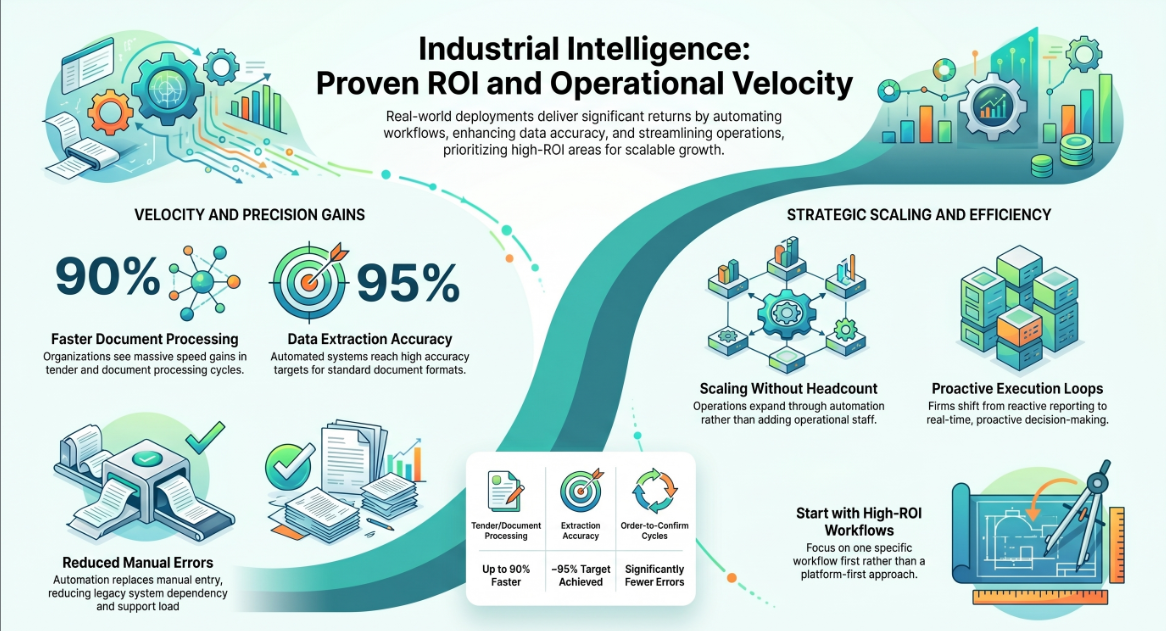
Across real-world manufacturing and industrial deployments, consistent outcome patterns emerge:
Speed gains:
- Up to ~90% faster tender and document processing
- Faster order-to-confirm cycles with significantly fewer data-entry errors
- Faster competitive response cycles through always-on monitoring
- Shorter analysis cycles for recurring business intelligence queries
Accuracy and reliability:
- ~95% extraction accuracy targets achieved for standard document formats
- Reduced manual order processing errors and legacy system dependency
- Earlier detection of pricing gaps, margin erosion, and vendor slippage
- Always-on grid and energy monitoring replacing daily manual checking routines
Operational efficiency:
- Reduced manual helpdesk burden across retail and store operations
- Lower call-centre and support load through automated customer and tenant workflows
- Reduced reporting dependency on analysts through self-serve NLQ interfaces
- Standardised decision logic and KPI definitions across multi-entity organisations
Strategic outcomes:
- Shift from reactive reporting to proactive execution loops
- Higher account coverage and pipeline visibility without increasing headcount
- Improved compliance readiness through built-in audit trails
- Scalable operations without adding operational headcount
The most consistent finding across deployments: manufacturers that start with one high-ROI workflow and build governance from day one scale faster and with less risk than those that try to boil the ocean with a platform-first approach.
Technical Architecture: How AI Agents Integrate with SAP, ERP, SCADA, and WMS
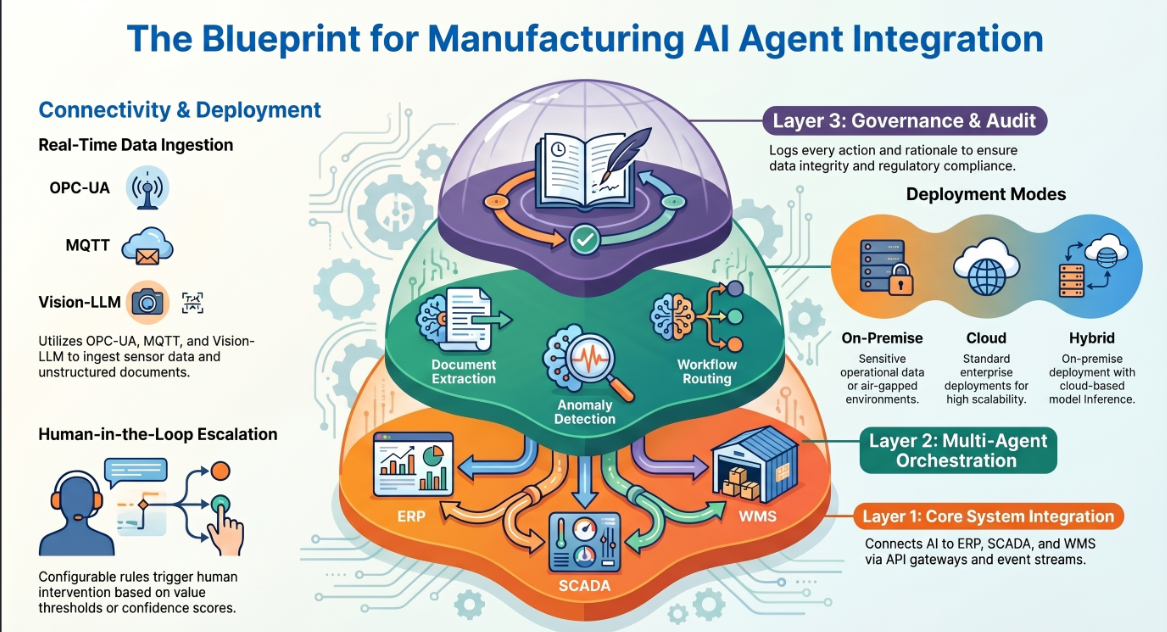
The technical depth competitors skip — and the questions manufacturing IT teams are actually asking.
Core integration layer: AI agents in manufacturing connect to operational systems via API gateways, event streams, and database connectors. The integration stack typically covers:
- ERP systems (SAP S/4HANA, Oracle, Microsoft Dynamics): Full CRUD operations for order creation, purchase orders, vendor records, and production scheduling
- SCADA / MES platforms: Real-time sensor data ingestion via OPC-UA, MQTT, or REST APIs
- WMS / TMS: Inventory position, shipment status, yard management, carrier data
- Document systems: PDF extraction via Vision-LLM, EDI parsing, email intake with intent classification
Agent orchestration layer: Enterprise AI agent deployments typically use a multi-agent architecture rather than a single model. Specialised agents handle discrete functions — document extraction, anomaly detection, workflow routing, insight generation — and are coordinated by an orchestration layer that manages handoffs, escalations, and governance rules.
Governance and audit: Every agent action is logged with timestamps, decision rationale, input data, and output actions. Human-in-the-loop escalation is triggered by configurable rules — value thresholds, confidence scores, exception types. This is non-negotiable for enterprise manufacturing environments where ERP data integrity and compliance audit trails are regulatory requirements.
Deployment options: AI agents can be deployed on-premise, in cloud environments, or in hybrid configurations. For manufacturers with sensitive operational data or air-gapped environments, on-premise deployment with cloud-based model inference is increasingly common.
Deployment Roadmap: From Pilot to Production in Manufacturing
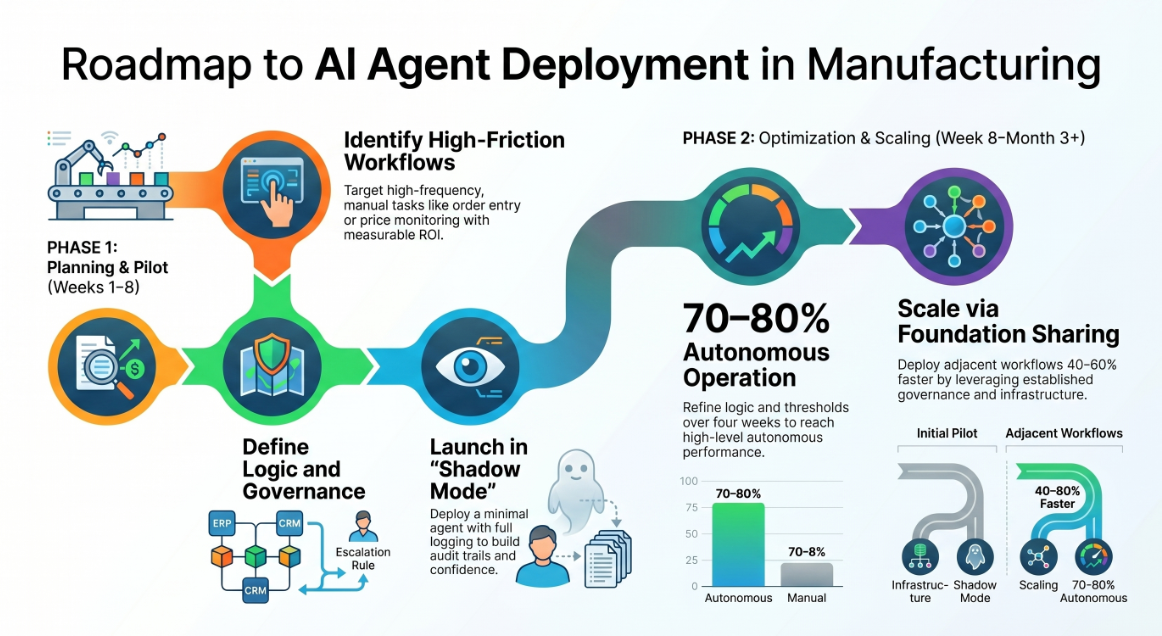
The manufacturers getting the most value from AI agents follow a consistent pattern. They do not start with a platform — they start with a problem.
Step 1: Identify your highest-friction, highest-volume workflow (Week 1–2)
Look for workflows with three characteristics: high frequency, high manual effort, and measurable output. SAP order entry, competitive price monitoring, tender document processing, and predictive maintenance alerts are consistently strong candidates. The goal is to find a workflow where "faster and more accurate" has an obvious dollar value.
Step 2: Define the data inputs, decision logic, and system connections (Week 2–4)
Map every input the agent will need, every decision it will make, and every system it will need to read from or write to. Define exception handling rules — what goes to a human, when, and how. This is where most pilots fail: insufficient upfront clarity on governance and escalation.
Step 3: Build a governed pilot with audit trails from day one (Week 4–8)
Deploy a minimal viable agent with full logging from the start. Run in "shadow mode" alongside existing processes for 2–4 weeks — agent acts, but actions are reviewed before execution. This builds confidence, surfaces edge cases, and creates the audit trail history needed for internal sign-off on full deployment.
Step 4: Measure against baseline and iterate (Week 8–12)
Measure processing time, error rate, exception volume, and human review rate against pre-deployment baselines. Expect to refine decision logic, adjust thresholds, and expand data connections in this phase. A well-governed pilot typically reaches autonomous operation for 70–80% of cases within 8–12 weeks.
Step 5: Scale to adjacent workflows (Month 3+)
Once one workflow is in production, the integration infrastructure, governance framework, and organisational trust are already built. Adjacent workflows deploy faster — often 40–60% faster than the initial pilot — because the foundations are in place.
The Manufacturing Advantage Is Being Built Right Now
The gap between manufacturers running AI agents and those still on manual workflows is not theoretical — it is showing up in procurement cycle times, order accuracy rates, energy bills, and competitive response speeds. And it is widening.
The manufacturers closing that gap share a common approach: they are not waiting for AI to be perfect or for their ERP systems to be fully "AI-ready." They are deploying AI agents in specific, high-value workflows, measuring results against clear baselines, and scaling from there.
The proof points exist. The technology is production-ready. The deployment playbook is proven.
The question is not whether AI agents will reshape manufacturing operations. It is which manufacturers will have a 12-month head start when the rest of the industry catches up.
Assistents.ai builds and deploys enterprise AI agents for manufacturing, supply chain, and operations teams. Our deployments span SAP integration, predictive maintenance, procurement automation, smart grid monitoring, and multi-entity analytics — with governance and audit trails built in from day one.
Explore our manufacturing solutions or schedule a demo to see what a governed AI agent deployment looks like for your specific workflow.
FAQs
What is an AI agent in manufacturing?
An AI agent in manufacturing is an autonomous software system that perceives real-time operational data — from sensors, ERP systems, documents, or user queries — makes decisions, and executes actions across production, logistics, and supply chain workflows without requiring human intervention at each step. Unlike RPA or chatbots, AI agents handle multi-step reasoning, manage exceptions, and integrate bidirectionally with enterprise systems like SAP, SCADA, and WMS.
How are AI agents different from industrial automation?
Traditional industrial automation follows fixed, pre-programmed rules and breaks when conditions change. AI agents adapt to new inputs, learn from operational patterns, handle exceptions intelligently, and coordinate across multiple systems simultaneously. The practical difference: automation executes a script; an AI agent solves a problem.
What manufacturing workflows benefit most from AI agents?
The highest-ROI workflows are predictive maintenance, SAP and ERP order processing, procurement and RFQ automation, supply chain coordination, competitive price monitoring, and smart grid / energy management. These workflows share a common profile: high frequency, high data volume, multi-system coordination, and clear output metrics.
What does it cost to deploy AI agents in manufacturing?
Deployment cost varies significantly based on the complexity of the workflow, the number of system integrations required, and whether the deployment is cloud-based or on-premise. Starting with a single, well-defined workflow is significantly more cost-effective than a platform-wide deployment and delivers faster ROI.
How long does it take to see results?
Most manufacturing deployments reach measurable results within 8–12 weeks for a single workflow pilot. Full production deployment with autonomous operation for 70–80% of cases typically follows within 3 months of pilot start.
Do AI agents replace manufacturing workers?
No. AI agents automate the data-intensive, repetitive, and exception-management tasks that consume disproportionate time for skilled workers. The consistent outcome from enterprise deployments is that workers shift toward higher-value problem-solving, oversight, and decision-making — rather than being replaced. Google's Industry Head for Manufacturing describes the shift as transforming operators into "super-users who are empowered by AI to solve more complex problems and drive higher value."
How do AI agents integrate with SAP in manufacturing?
AI agents connect to SAP via standard APIs, RFC calls, or event-driven integrations. They can read master data, validate inputs against business rules, create and update sales orders, purchase orders, and production orders, and trigger workflow approvals — all with full audit trails and governance controls. The most common entry point is SAP Sales Order automation, replacing manual data entry from emails, EDI files, or PDF documents.
What is agentic AI in manufacturing?
Agentic AI in manufacturing refers to the deployment of multiple AI agents that coordinate with each other across a workflow or set of workflows. Rather than a single model handling everything, specialised agents handle discrete functions — document extraction, anomaly detection, workflow routing, insight generation — coordinated by an orchestration layer. This multi-agent architecture is more robust, easier to govern, and more scalable than single-model deployments.
Is AI agent deployment safe for critical manufacturing infrastructure?
Yes, when properly governed. Enterprise-grade AI agent deployments include configurable human-in-the-loop escalation, value and confidence thresholds that gate autonomous action, full audit logs of every decision and action, role-based access controls, and integration with existing IT security frameworks. For critical infrastructure — grid management, ERP systems — governance and auditability are built in from day one, not retrofitted.
Where should a manufacturer start with AI agents?
Start with the workflow that has the highest friction, the most measurable output, and the clearest data inputs. Predictive maintenance, SAP order automation, and competitive price monitoring are consistent early winners. Build governance from day one — logging, escalation rules, baseline metrics — and run in shadow mode before full autonomous operation. One well-governed workflow in production is worth more than five dashboards in pilot.

Transform Your Business With Agentic Automation
Agentic automation is the rising star posied to overtake RPA and bring about a new wave of intelligent automation. Explore the core concepts of agentic automation, how it works, real-life examples and strategies for a successful implementation in this ebook.
Sarfraz Nawaz is the CEO and founder of Ampcome, which is at the forefront of Artificial Intelligence (AI) Development. Nawaz's passion for technology is matched by his commitment to creating solutions that drive real-world results. Under his leadership, Ampcome's team of talented engineers and developers craft innovative IT solutions that empower businesses to thrive in the ever-evolving technological landscape.Ampcome's success is a testament to Nawaz's dedication to excellence and his unwavering belief in the transformative power of technology.

More insights
Discover the latest trends, best practices, and expert opinions that can reshape your perspective







Contact us

