
Top Enterprise AI Agent Platforms in 2026: The Definitive Buyer's Guide


The enterprise AI agent market is no longer a proof-of-concept conversation.
According to Gartner, 40% of enterprise applications will feature AI agents by the end of 2026, and G2's 2025 Enterprise AI Agents Report confirms that 57% of companies already have AI agents running in production environments. The question for most enterprise technology leaders is no longer whether to deploy AI agents — it's which platform to trust with the workflows that keep their business running.
This guide cuts through the noise. It covers what separates genuine enterprise AI agent platforms from demo-grade tools, the criteria that matter most when you're evaluating at scale, real deployment results across more than a dozen industries, and a decision framework built for CIOs, CTOs, and operations leaders who need to move fast without getting burned.
What is an enterprise AI agent platform?
An enterprise AI agent platform is a system that deploys autonomous software agents capable of reasoning, planning, and executing multi-step tasks across your existing technology stack — without requiring a human to manually trigger each action.
This definition matters because the term "AI agent" is used loosely. A chatbot that answers FAQs is not an AI agent. An RPA bot that clicks through a screen following rigid rules is not an AI agent. A true enterprise AI agent perceives context, makes decisions based on that context, takes action across multiple systems, and adapts when conditions change.
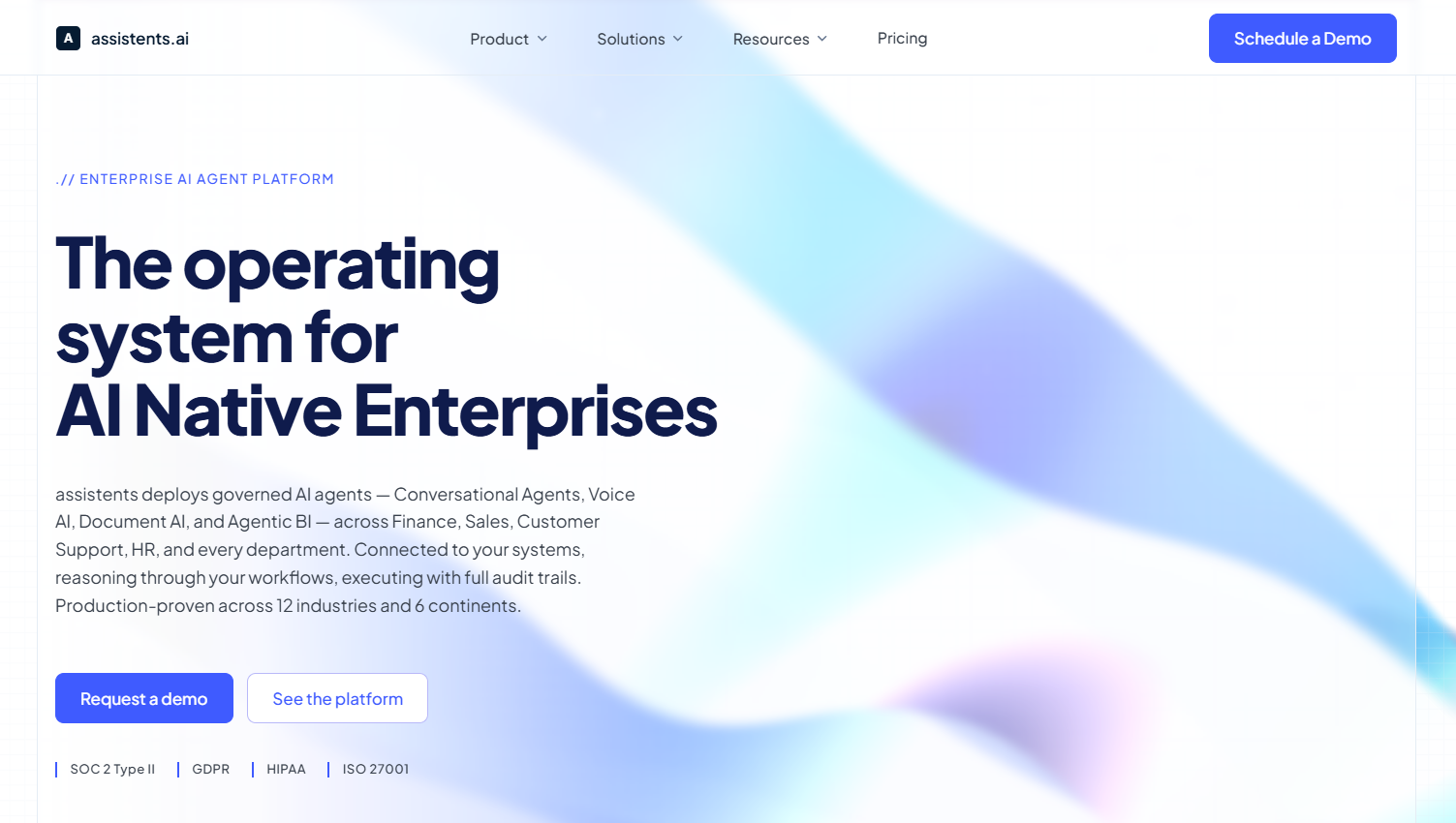
The "enterprise" qualifier adds four additional requirements that demo tools rarely meet:
Governance and auditability. Every action the agent takes must be logged, traceable, and reviewable. This is not optional when agents are touching financial data, customer records, or regulated workflows.
Multi-system integration. Enterprise environments run on dozens of tools — SAP, Salesforce, ServiceNow, Oracle, custom ERPs, and legacy databases. A platform that only works well inside one vendor's ecosystem is not truly enterprise-grade.
Security and compliance. SOC 2, GDPR, HIPAA, ISO 27001 — these are baseline requirements for enterprise buyers, not differentiators. The platform must meet them before you start evaluating features.
Scalability without re-architecture. A platform that handles a five-workflow proof of concept but buckles at fifty workflows is a pilot tool, not an enterprise platform.
What separates a real enterprise AI agent platform from a demo?
The enterprise AI agent market is crowded with impressive demos. Here is where real enterprise deployments diverge from proof-of-concept tools.
Reasoning-based execution vs rule-based automation
Legacy RPA tools follow explicit if-then rules. They break the moment the input changes. Enterprise AI agents reason from context. If a purchase order arrives in an unexpected format, an RPA bot errors out. An AI agent interprets the document, extracts the relevant data, validates it against procurement rules, and routes it correctly — even if it has never seen that exact format before.
This distinction is the core reason enterprises that invested heavily in RPA over the last decade are now evaluating agentic AI. The rules-maintenance burden alone — updating bot scripts every time a form changes — has become a significant operational cost.
Agentic AI vs chatbots
Chatbots respond. Agents act. A chatbot can tell a warehouse manager that stock levels are low. An agent identifies the shortfall, checks supplier lead times, generates a purchase order, routes it for approval, and updates the inventory management system — without a human initiating each step.
The distinction is task completion vs information retrieval. Chatbots are pull systems. Agents are push systems that operate on goals, not prompts.
Deployment speed vs integration depth
The fastest enterprise AI agent deployments go live in two to four weeks. The slowest take six to twelve months. The difference is almost never the AI technology — it is the integration layer. Platforms with deep, pre-built connectors across enterprise systems compress deployment timelines dramatically. When evaluating platforms, ask specifically how long it takes to connect to your ERP, your CRM, and your core operational systems. The answer reveals more about real-world readiness than any benchmark.
Human-in-the-loop design
No enterprise should deploy fully autonomous agents without exception handling. The best enterprise AI agent platforms are designed with human-in-the-loop workflows from the start — meaning agents know when to proceed autonomously, when to flag for review, and when to escalate. This is especially critical in regulated industries where certain decisions must have human sign-off to remain compliant.
Key criteria for evaluating enterprise AI agent platforms in 2026
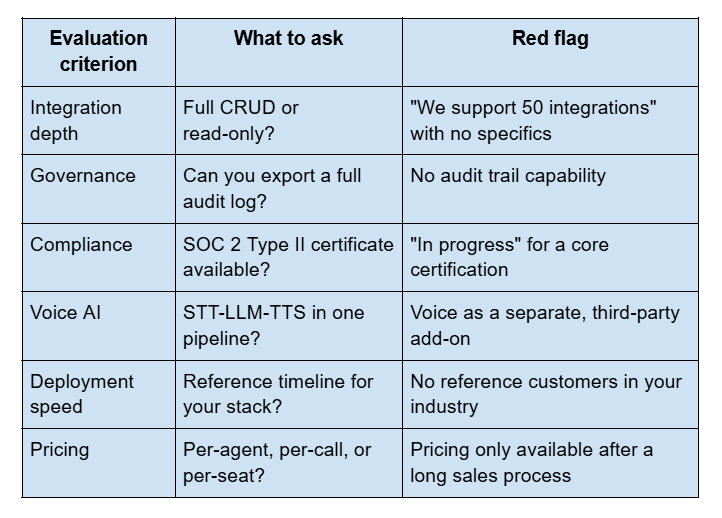
When shortlisting enterprise AI agent platforms, evaluate them across these dimensions. This framework is designed for technology and operations leaders making decisions with real budget and real accountability.
1. Integration ecosystem
How many native integrations does the platform have, and how deep do they go? Surface-level integrations (read-only data pulls) are meaningfully different from deep integrations (full create, read, update, delete operations with audit logs). For SAP environments specifically, ask whether the platform can interpret order triggers, validate data, create sales orders, and maintain reconciliation records — not just read SAP data.
2. Governance and audit trails
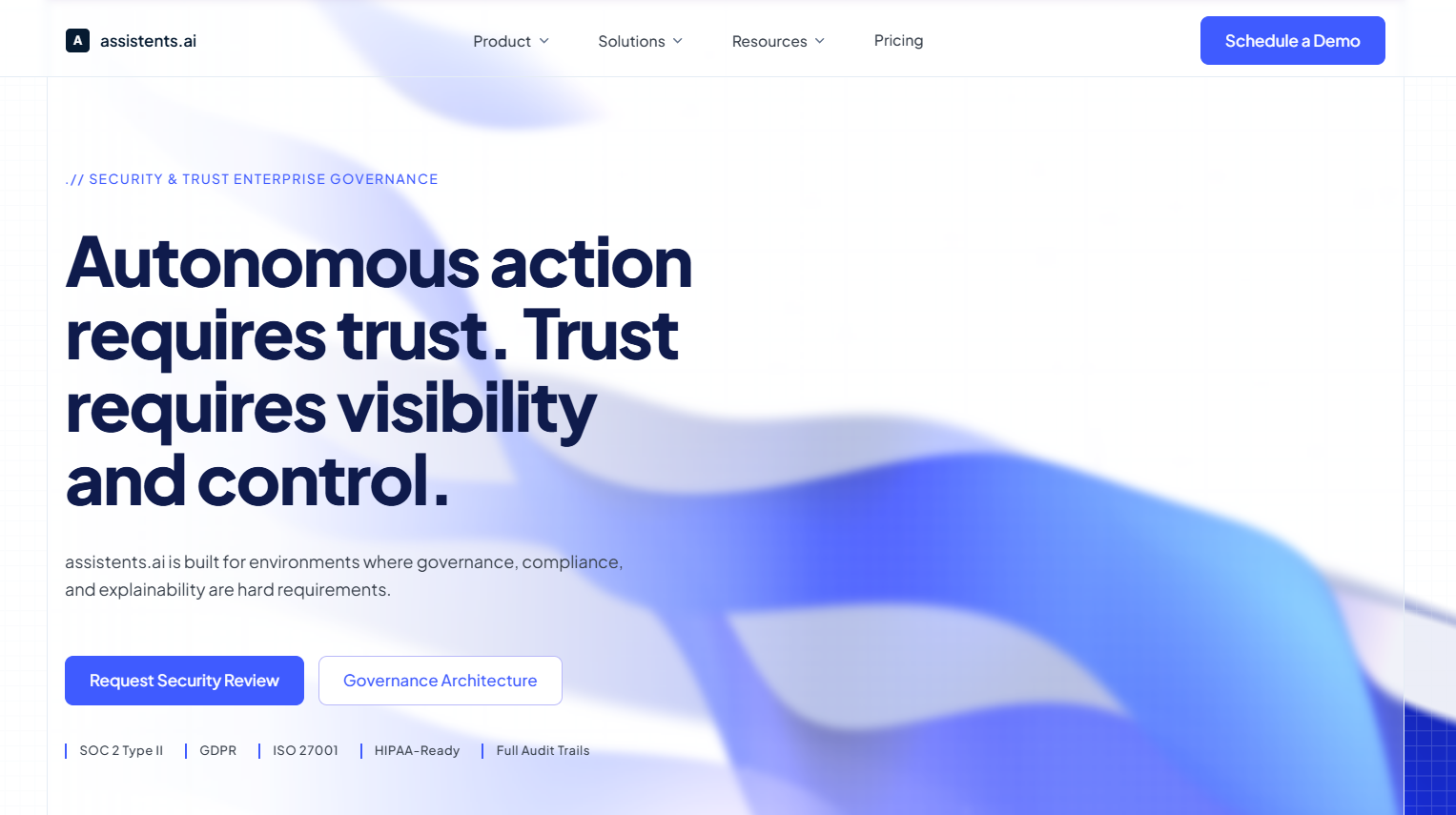
Can you produce a complete log of every agent action for a compliance audit? Does the platform support role-based access control? Are there configurable rules that prevent agents from taking certain actions without human approval? Governance is where enterprise deployments succeed or fail at scale.
3. Industry and vertical coverage
Generic AI agent platforms require significant customisation to handle industry-specific compliance requirements, terminology, and workflows. Platforms purpose-built for multiple verticals — healthcare, financial services, logistics, retail, energy, real estate — compress implementation time and reduce risk.
4. Voice AI and omnichannel capability
The fastest-growing enterprise AI agent deployments span multiple channels simultaneously — web, WhatsApp, email, phone, and internal systems. Platforms that offer voice AI (speech-to-text, LLM reasoning, text-to-speech in one pipeline) in addition to text-based agents give enterprises significantly more deployment flexibility.
5. Security and compliance certifications
Verify SOC 2 Type II, GDPR compliance, HIPAA readiness, and ISO 27001 certification before shortlisting. These are baseline requirements. Any platform that cannot provide documentation for all four should not be in the running for enterprise contracts.
6. Deployment timeline and implementation support
Ask for reference timelines from similar deployments. Four weeks to production is achievable for focused use cases. Twelve weeks is reasonable for complex, multi-system implementations. Anything beyond that warrants scrutiny.
7. Total cost of ownership
Licensing models vary widely. Some platforms charge per agent, some per API call, some per seat. Model your usage volumes carefully, because per-call pricing that looks reasonable in a pilot can become very expensive at production scale. Factor in implementation costs, ongoing maintenance, and the internal engineering time required to manage the platform.
Top 6 enterprise AI agent platforms in 2026: compared
These are the platforms enterprise buyers are actively evaluating this year. Each has a distinct positioning, strength, and gap worth understanding before you shortlist.
1. assistents.ai
Best for: Enterprises that need fast deployment across multiple systems, industries, and channels — including voice AI.
assistents.ai is an agentic-first enterprise AI platform built around autonomous execution rather than information retrieval. Where most platforms start with chat and bolt on workflows, assistents.ai is architected from the ground up for multi-step, multi-system agent execution with governance controls built into the core.
Key strengths:
- 300+ pre-built integrations covering SAP, Salesforce, ServiceNow, Oracle, and major ERP and CRM systems
- Voice AI in a single pipeline (speech-to-text, LLM reasoning, text-to-speech) for omnichannel deployments
- Production deployments across 12 industries including financial services, healthcare, retail, logistics, energy, and real estate
- Four-week deployment timeline for focused use cases
- Enterprise compliance: SOC 2, GDPR, HIPAA, ISO 27001
- Human-in-the-loop exception handling built into every agent workflow
Where it fits: Enterprises that need agents to execute across their existing tech stack — not just chat inside one vendor's ecosystem. Particularly strong for organisations with complex, multi-system workflows and regulated data environments.
Honest limitation: As a newer entrant, assistents.ai has fewer named public case studies and a smaller brand footprint than legacy vendors. The product depth is there; the brand recognition is still being built.
Pricing model: Contact for enterprise pricing. No self-serve tier.
2. Salesforce Agentforce
Best for: Organisations already deeply embedded in the Salesforce ecosystem.
Agentforce is Salesforce's agentic AI layer built directly into the CRM. If your sales, service, and marketing operations already run on Salesforce, Agentforce offers the fastest route to AI agent deployment for those specific workflows — because the data, the users, and the permissions are already there.
Key strengths:
- Native integration with Salesforce CRM, Service Cloud, and Marketing Cloud
- Large install base with extensive partner ecosystem
- Strong brand trust and enterprise procurement familiarity
- Good fit for sales and customer service automation within Salesforce
Where it fits: Salesforce-centric organisations looking to automate CRM-native workflows without adding a new vendor to the stack.
Honest limitation: Agentforce is a strong tool inside Salesforce. Outside it, cross-system orchestration becomes significantly more complex and expensive. Organisations running multi-vendor stacks — especially those combining SAP, Oracle, and Salesforce — often find Agentforce's value diminishes quickly beyond the CRM boundary. Pricing also scales steeply with Salesforce licensing tiers.
Pricing model: Add-on to existing Salesforce contracts. Pricing depends on cloud and edition.
3. Glean
Best for: Enterprise search and knowledge retrieval across internal data sources.
Glean is one of the best-funded and most recognised names in enterprise AI, having raised over $1 billion in total funding with a valuation north of $7 billion. Its core product is an AI-powered enterprise search and knowledge assistant — meaning it excels at finding, summarising, and surfacing information from across your organisation's data sources.
Key strengths:
- Best-in-class enterprise search across documents, Slack, email, code repositories, and SaaS tools
- Strong brand recognition and Gartner-recognised positioning
- Named enterprise logos including Fortune 500 companies
- Solid security and compliance architecture
Where it fits: Organisations whose primary pain point is knowledge retrieval — employees spending too much time searching for information across disconnected systems. Glean solves this well.
Honest limitation: Glean is fundamentally a search and retrieval platform. It does not execute autonomous multi-step workflows. It has no native voice AI. Deployment timelines for full enterprise rollout typically run eight to twelve weeks. If your goal is agents that act rather than agents that answer, Glean is not the right category of tool — regardless of how good the search quality is.
Pricing model: Enterprise contract, typically seat-based. Pricing not published.
4. Kore.ai
Best for: Enterprises with established conversational AI programs looking to add agentic capabilities.
Kore.ai has been building enterprise conversational AI since 2014 and has appeared in the Gartner Magic Quadrant for conversational AI platforms multiple times. It has a large enterprise install base, particularly in banking, insurance, healthcare, and retail.
Key strengths:
- Mature conversational AI with a long enterprise track record
- Strong in regulated industries — banking, insurance, healthcare — with compliance architecture to match
- Broad integration library built over many years
- Large partner ecosystem for implementation support
Where it fits: Enterprises that need a proven, well-supported conversational AI platform with a long track record in regulated industries.
Honest limitation: Kore.ai carries legacy chatbot perception from its earlier positioning, and some buyers find the platform complex to configure and maintain. Its agentic capabilities are evolving but the platform's roots are in structured dialogue management rather than autonomous reasoning-based execution. Implementation timelines tend to be longer than newer agentic-first platforms, and pricing complexity has been a friction point in competitive evaluations.
Pricing model: Enterprise contract. Multiple tiers based on deployment type.
5. Relevance AI
Best for: Sales and marketing teams building AI agent workflows without heavy IT involvement.
Relevance AI has built strong momentum in the go-to-market AI agent space, with a no-code/low-code interface that allows non-technical users to build and deploy agents for sales prospecting, research automation, and marketing workflows. It has named enterprise customers including Canva and Databricks.
Key strengths:
- Strong product-led growth with a self-serve entry point
- Purpose-built for sales and marketing automation use cases
- Named enterprise logos add credibility
- Active G2 presence with genuine reviews
- Progressive adoption model — start small, expand as needed
Where it fits: Sales operations, revenue operations, and marketing teams that want to deploy AI agents for their specific workflows without waiting for IT or engineering resources.
Honest limitation: Relevance AI's strength is its focus — and its limitation is the same. It covers two or three verticals well and has a smaller integration ecosystem compared to platforms built for full enterprise operations. Organisations looking for agents that span finance, HR, logistics, compliance, and customer service simultaneously will find Relevance AI's coverage insufficient. It is a specialist tool for a specific buyer persona.
Pricing model: Self-serve starting tier available. Enterprise pricing on request.
6. UiPath
Best for: Organisations with significant existing RPA investments looking to add AI reasoning on top.
UiPath is the dominant name in robotic process automation and has been building AI capabilities into its platform to stay relevant as the market shifts from rule-based automation to reasoning-based agents. Its enterprise install base is enormous, and for organisations already running UiPath RPA across their operations, the path of least resistance is extending that investment rather than replacing it.
Key strengths:
- Massive enterprise install base — one of the largest of any automation vendor
- Strong developer ecosystem with extensive documentation and community support
- Genuine depth in process automation — decades of enterprise workflow knowledge encoded into the platform
- Active investment in AI reasoning capabilities to sit on top of RPA foundations
Where it fits: Enterprises with existing UiPath deployments that want to incrementally add AI reasoning without a wholesale platform replacement. Also strong for process-heavy back-office operations where structured automation remains the primary need.
Honest limitation: UiPath carries significant RPA legacy perception, and for good reason — its architecture was built for deterministic, rule-based automation. Adding AI reasoning on top of an RPA foundation is structurally different from building agentic AI from the ground up. Buyers evaluating purely for agentic AI capability — rather than for continuity with existing RPA investments — consistently find modern agentic-first platforms more capable. UiPath's pricing for full enterprise deployments is also among the highest in this category.
Pricing model: Enterprise contract, typically per-bot and per-process. One of the higher-cost options in this comparison.
How do these platforms compare at a glance?
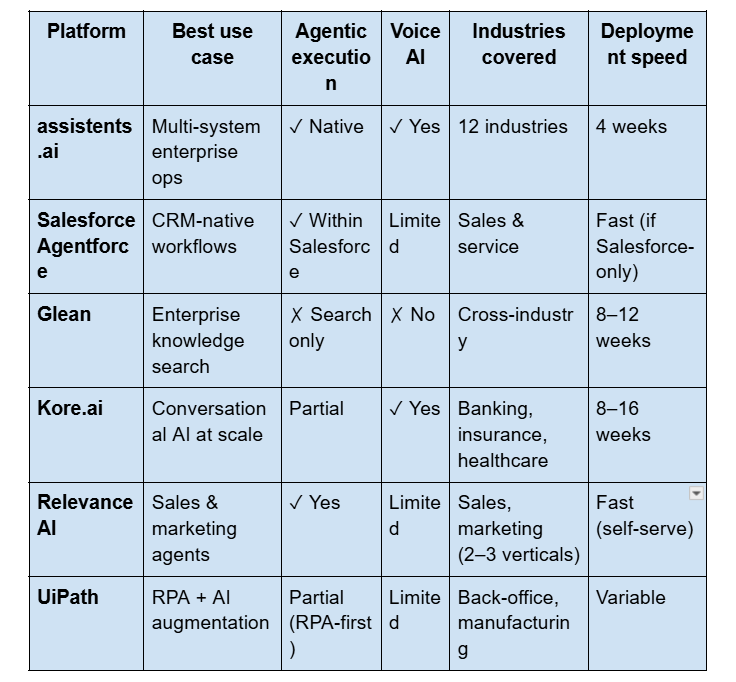
The platforms that dominate this list by marketing budget are not necessarily the ones that deliver the best outcomes for your specific workflows. Glean is excellent at search — but if your goal is autonomous workflow execution, you are buying the wrong category of tool. Salesforce Agentforce is excellent inside Salesforce — but most enterprise operations span far beyond a single CRM. The right platform is the one whose architecture matches the problem you are actually trying to solve, at the integration depth and deployment speed your operations require.
Real enterprise deployments: what's actually being built and what's happening after go-live
This section covers active deployments across industries where enterprise AI agent platforms have moved from pilot to production. No client names are used, but the verticals, deployment types, and outcomes are real and recent.
Financial services and fintech
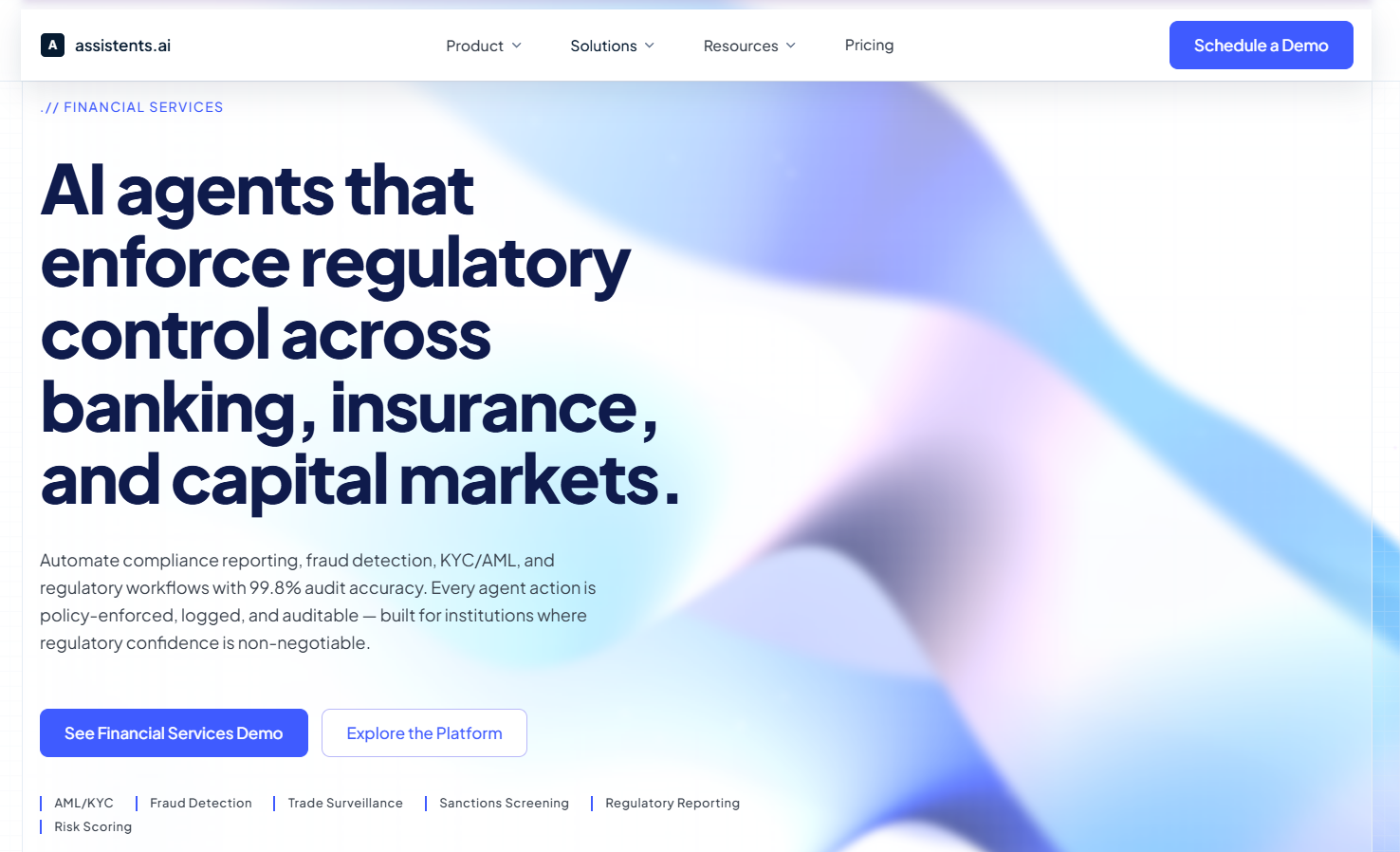
A global fintech provider serving banks and credit unions deployed an omnichannel AI agent platform to handle disputes, fraud queries, and compliance workflows across chat, email, and phone channels. The platform handles intake in both Hindi and English, routes cases to the appropriate workflow automatically, and maintains full audit logs for regulatory review. Outcomes included faster case handling, reduced operational load, and improved compliance readiness through complete audit trails — replacing a workflow that previously required significant manual coordination.
In a separate deployment, a financial technology company focused on banking automation implemented AI agents for disputes and fraud operations. The agents handle intake classification, evidence collection, and escalation routing. The design prioritised auditability as a first-class feature, not an afterthought.
Retail at national scale
A major value retailer operating more than 700 stores across India deployed a multi-agent system covering three distinct workflows: a voice support agent handling store queries in Hindi and English, an inventory intelligence agent providing real-time pricing and stock visibility at the store level, and a knowledge and training agent built over point-of-sale and standard operating procedure documentation.
The outcomes were a measurable reduction in manual helpdesk burden, improved store-level inventory visibility, and faster onboarding for new store staff through on-demand training guidance — all without increasing headcount.
Global logistics and port operations
A global ports and logistics enterprise — operating at a scale of billions in annual revenue — deployed a terminal and rail management solution to digitise and optimise port-to-inland logistics operations. The system covers rail scheduling, yard operations dashboards, exception management, and executive-level operational alerts.
Outcomes included higher predictability of terminal-to-rail throughput and more efficient coordination across terminal and inland logistics operations. In a separate initiative, an AI sales agent was deployed to identify opportunities, risks, and next-best actions across enterprise accounts — increasing account coverage without increasing headcount.
Energy and smart infrastructure
A smart infrastructure operator, cited as serving more than 150 million urban lives through 25-plus smart city operation centres, deployed agentic analytics on top of existing smart utility systems. The platform converts dashboard data into governed, auditable actions — a fundamental shift from reactive reporting to proactive execution loops. In parallel, a state-level power transmission utility deployed AI for transmission KPI monitoring, anomaly detection, and predictive maintenance — replacing manual monitoring with continuous automated alerting.
A campus-scale research institution deployed AI for energy management — monitoring, forecasting, and optimising energy consumption across facilities. The outcome was improved energy visibility and faster detection of inefficiencies that had previously gone unnoticed until they appeared on utility bills.
Healthcare and staffing
A healthcare staffing platform connecting nursing professionals with facilities deployed an AI system for matching, scheduling, and compliance workflows. The outcomes included faster fill cycles, lower scheduling friction, and improved staffing responsiveness — directly addressing the speed-to-placement problem that drives revenue in healthcare staffing.
A physician-led clinical enterprise deployed analytics for revenue management and operational performance, producing dashboards with variance explanations and action lists for billing workflows. The focus was on revenue cycle visibility with exception alerts — moving from periodic reporting to continuous monitoring.
Real estate and property management
A major UAE real estate portfolio owner deployed an omnichannel customer service agent covering web, WhatsApp, and email, handling tenant query triage, rental and payment support, and escalation to human teams. The outcome was a consistent 24-hour, 7-day tenant experience with better SLA adherence through automated routing and tracking — replacing a workflow that had significant response-time variability.
In a separate deployment, an automated procurement and finance KPI alert system was built for a large conglomerate spanning 30-plus companies, monitoring purchase price trends, gross margin impact, vendor performance, and working capital metrics across group entities. The system delivers scheduled insight packs to leadership automatically.
Professional services and tax technology
A tax technology company focused on cross-border risk deployed an AI platform for pre-screening transactions for withholding tax, VAT mismatches, and permanent establishment issues. The outcome was earlier detection of risk before deals close, faster pre-compliance review, and reduced last-minute deal disruptions — a significant improvement over the manual review process it replaced.
A specialist sales and use tax research automation tool deployed AI for source retrieval, summarisation, and draft memo generation with citations. Research cycles that previously required significant manual source-hunting time were compressed, with more consistent and better-documented outputs.
Hospitality and luxury travel
A luxury safari hospitality brand operating boutique lodges across East Africa deployed a digital booking agent automating end-to-end travel booking workflows, including email intake, intent classification, data extraction, real-time inventory checks, alternative date negotiation, and automated invoice generation. A human-in-the-loop quality control step was preserved for curated itinerary creation. Outcomes included faster booking turnaround, higher accuracy on complex guest requirements, and scalable operations without compromising the high-touch service the brand is known for.
Industries and use cases covered by leading enterprise AI agent platforms
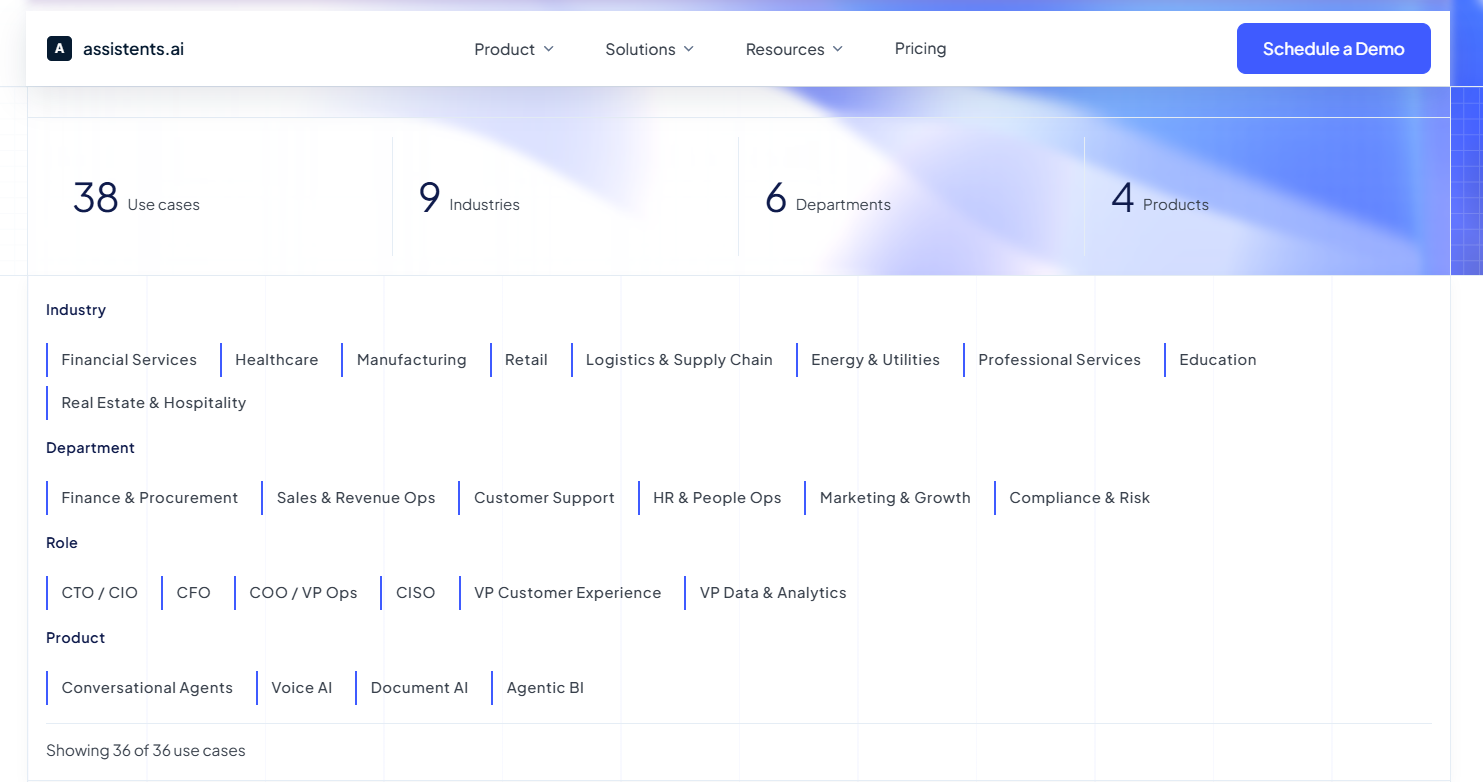
The most capable enterprise AI agent platforms provide purpose-built coverage across industries, not generic templates that require months of customisation. Here is where active deployments are concentrated in 2026:
Financial services. Disputes and fraud automation, compliance workflow management, cashflow monitoring and forecasting, portfolio analytics, and omnichannel banking support with full audit trails.
Healthcare. Staffing and scheduling automation, revenue cycle management, inpatient operations analytics, geriatric care performance monitoring, and HIPAA-compliant document processing.
Retail. Store support automation, inventory intelligence, knowledge and training agents, e-commerce analytics, promotional performance monitoring, and national-scale omnichannel deployments.
Logistics and supply chain. Terminal and port management, rail scheduling, warehouse operations, end-to-end supply chain analytics, sales agent automation for account coverage, and ERP order creation automation.
Energy and utilities. Smart grid operations, transmission KPI monitoring, energy consumption forecasting, anomaly detection, predictive maintenance alerting, and campus energy optimisation.
Real estate. Tenant support automation, lease and payment query handling, group-wide procurement KPI monitoring, and portfolio-level finance intelligence.
Manufacturing. Competitive monitoring, pricing intelligence, supplier discovery, procurement automation, and demand forecasting.
Education and professional communities. Competency insights, learning guidance, support automation at global scale, and analytics for program operators.
Professional services and tax technology. Due diligence automation, cross-border tax risk pre-screening, research automation, and insight generation for advisory firms.
How to choose the right enterprise AI agent platform: a decision framework for CIOs and CTOs
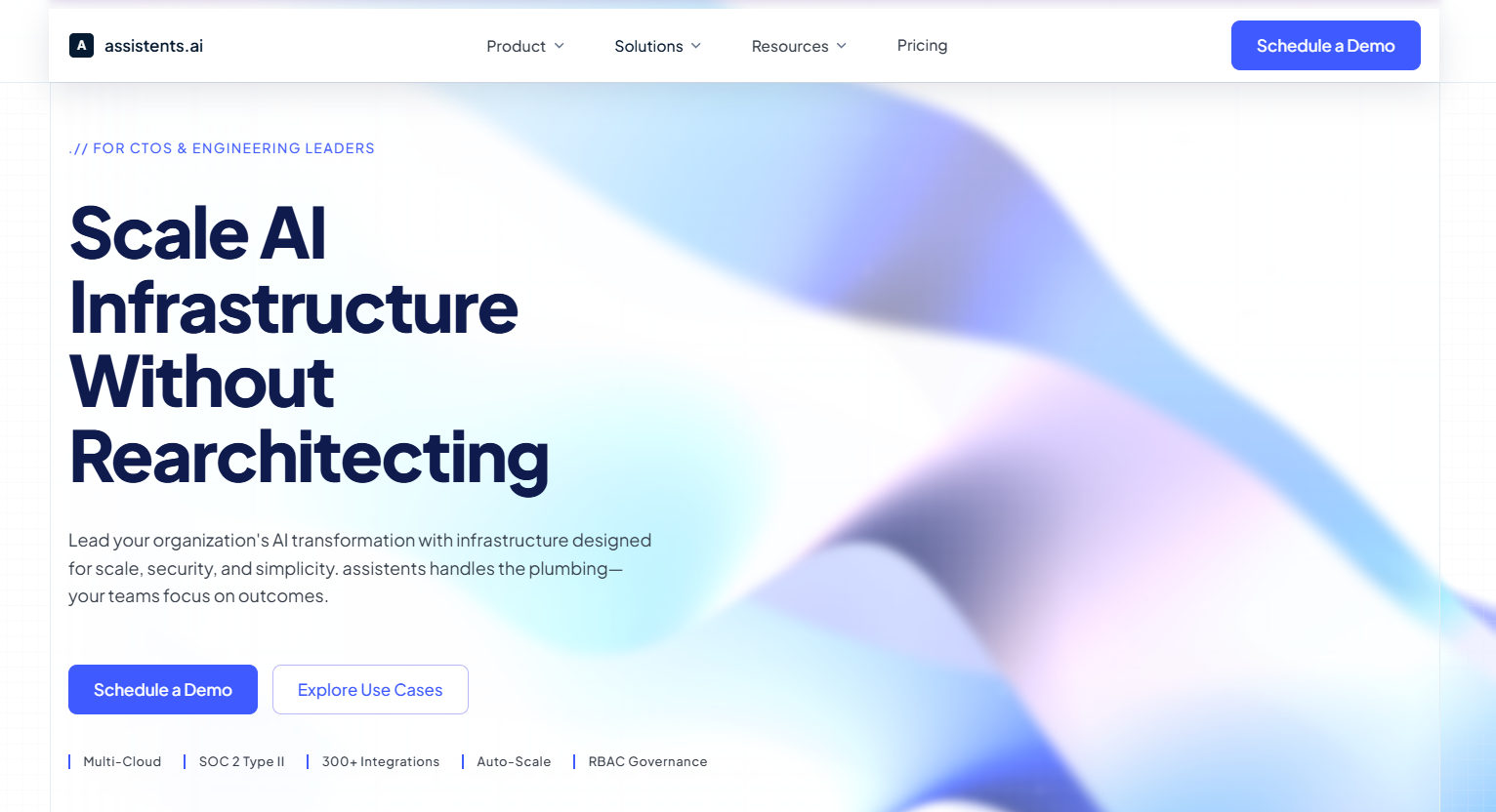
Five questions that cut through vendor presentations and reveal whether a platform is genuinely ready for enterprise deployment.
Question 1: Can you connect to my full technology stack, not just your preferred partners?
Ask for a specific list of integrations and the depth of each. Press on SAP, Salesforce, ServiceNow, Oracle, and whatever your primary ERP and CRM are. If the answer involves a significant implementation project just to establish connectivity, factor that cost into the total. The best platforms have deep, pre-built integrations that reduce the time from signed contract to live agents.
Question 2: What does your governance architecture look like at production scale?
This means: who controls what the agent can do autonomously versus what requires human approval? How are those rules configured and updated? Where are the audit logs stored, and can they be exported for compliance review? A platform that cannot answer these questions precisely is not enterprise-ready, regardless of how impressive the demo looks.
Question 3: Do you have reference customers in my industry with comparable deployment complexity?
Generic case studies with unnamed companies and round-number results are not sufficient. Ask for introductions to customers in your vertical who have deployed at comparable scale. If the vendor cannot facilitate that conversation, treat it as a signal.
Question 4: What is the realistic timeline from contract signing to production?
Get a week-by-week implementation plan, not a headline number. Understand which weeks require significant input from your internal team, and whether your team has the bandwidth. A four-week deployment that requires two weeks of full-time internal engineering effort is not a four-week deployment for most enterprises.
Question 5: How does your pricing scale with our usage growth?
Model your costs at 2x, 5x, and 10x your initial deployment volume. Platforms with per-call pricing can become significantly more expensive as usage grows. Platforms with per-agent or per-seat models may have lower scaling costs but higher upfront minimums. The right model depends on your usage pattern — make sure you understand yours before signing.
The bottom line
The enterprise AI agent market in 2026 is past the experimentation phase. The deployments happening now — across logistics networks, hospital staffing systems, national retail chains, smart city infrastructure, and luxury hospitality — are production systems driving measurable operational outcomes. The organisations winning are not those with the biggest AI budgets. They are the ones that chose platforms with deep integration ecosystems, genuine governance architecture, and the implementation experience to go from signed contract to live workflows in weeks, not quarters.
The evaluation criteria in this guide are not theoretical. They come from the patterns visible across dozens of real enterprise deployments spanning more than twelve industries and four continents. Use them as your shortlist filter, not just your due diligence checklist.
If you are evaluating enterprise AI agent platforms and want to see how specific workflows in your industry have been deployed, request a demo and ask to be walked through a deployment in your vertical.
Frequently asked questions
What is an enterprise AI agent platform?
An enterprise AI agent platform is software that deploys autonomous agents capable of reasoning, planning, and executing multi-step tasks across your existing technology stack. Unlike chatbots that respond to queries or RPA bots that follow rigid scripts, enterprise AI agents perceive context, make decisions, take action across multiple systems, and adapt when conditions change — all with governance controls, audit trails, and compliance certifications appropriate for regulated enterprise environments.
How is an AI agent platform different from a chatbot or RPA?
Chatbots retrieve information in response to prompts. RPA bots execute fixed rule-based scripts. AI agents reason from context and execute goal-oriented tasks autonomously. When an invoice arrives in an unexpected format, an RPA bot fails. A chatbot tells someone the invoice arrived. An AI agent interprets the document, validates it against procurement rules, creates the corresponding order in your ERP, routes it for approval, and logs the entire action sequence — without a human initiating each step.
Which industries are deploying enterprise AI agent platforms most actively in 2026?
Financial services, healthcare, retail, logistics, energy and utilities, and real estate are the most active verticals for production enterprise AI agent deployments. Professional services firms — particularly in tax technology, legal, and consulting — are also deploying at increasing scale, especially for research automation, due diligence, and cross-border risk pre-screening.
How long does enterprise AI agent deployment typically take?
Focused use cases — a single workflow, well-defined inputs and outputs — can go live in two to four weeks on platforms with deep pre-built integrations. Complex, multi-system deployments across several departments typically take eight to twelve weeks. The primary variable is integration complexity, not AI capability. If a platform requires significant custom development just to connect to your core systems, add that timeline to any deployment estimate.
What does an enterprise AI agent platform cost?
Enterprise AI agent platform pricing varies significantly by vendor and model. Common structures include per-agent licensing, per-API-call consumption pricing, and per-seat models. For context, enterprise software categories adjacent to AI agents — like RPA and conversational AI platforms — typically run from tens of thousands to hundreds of thousands of dollars annually for production enterprise deployments. Total cost of ownership includes implementation, integration development, ongoing maintenance, and internal engineering time. Always model costs at multiple usage volumes, not just your initial deployment footprint.
Which AI agent platforms integrate with SAP and Salesforce?
The answer depends significantly on the depth of integration required. Surface-level integrations — reading data from SAP or Salesforce — are relatively common. Deeper integrations — creating and updating records, triggering workflows, maintaining audit logs, and handling exceptions — are less common and more valuable. When evaluating, ask specifically whether the platform can create SAP sales orders programmatically, including handling validation exceptions and maintaining reconciliation records. That question reveals integration depth more accurately than a features list.
What governance and compliance standards should an enterprise AI agent platform meet?
At minimum, evaluate for SOC 2 Type II certification, GDPR compliance documentation, HIPAA readiness (for healthcare and adjacent industries), and ISO 27001 certification. Beyond certifications, governance architecture matters equally: role-based access controls, configurable autonomy limits, human-in-the-loop exception handling, and exportable audit logs. Compliance certifications tell you the vendor takes security seriously. Governance architecture tells you whether the platform can operate responsibly at scale inside your organisation.

Transform Your Business With Agentic Automation
Agentic automation is the rising star posied to overtake RPA and bring about a new wave of intelligent automation. Explore the core concepts of agentic automation, how it works, real-life examples and strategies for a successful implementation in this ebook.
Sarfraz Nawaz is the CEO and founder of Ampcome, which is at the forefront of Artificial Intelligence (AI) Development. Nawaz's passion for technology is matched by his commitment to creating solutions that drive real-world results. Under his leadership, Ampcome's team of talented engineers and developers craft innovative IT solutions that empower businesses to thrive in the ever-evolving technological landscape.Ampcome's success is a testament to Nawaz's dedication to excellence and his unwavering belief in the transformative power of technology.

More insights
Discover the latest trends, best practices, and expert opinions that can reshape your perspective

.webp)



.jpg)

Contact us

