
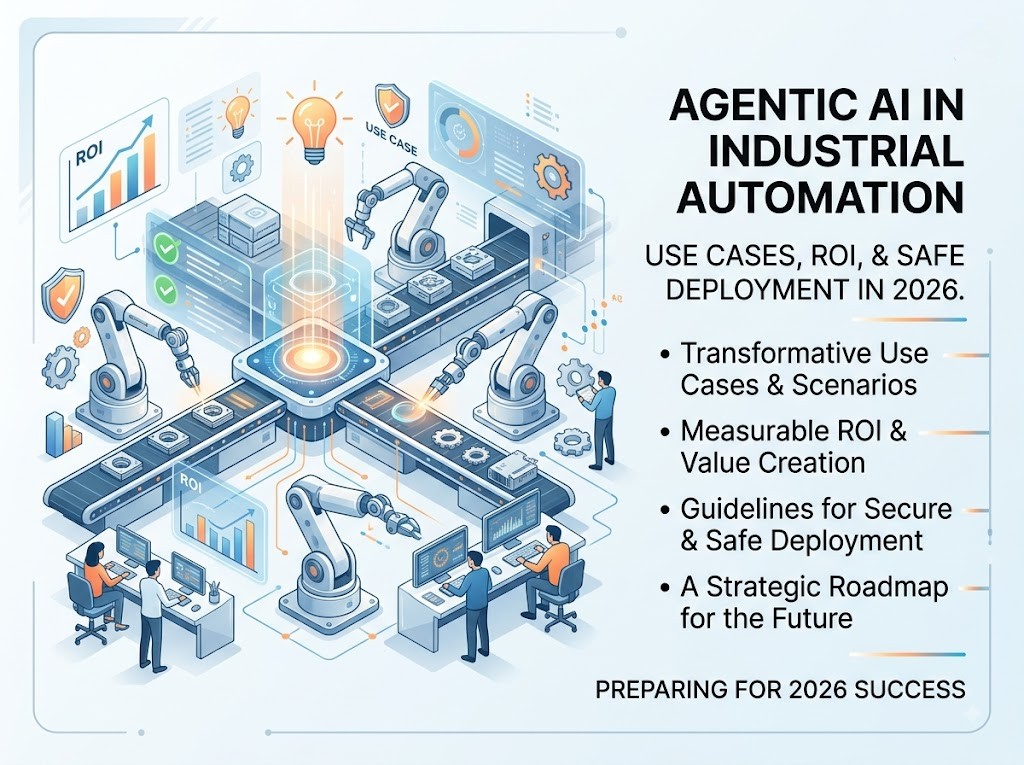
Agentic AI for Industrial Automation: Use Cases, ROI, and How to Deploy It Safely in 2026


For decades, industrial operations have run on a simple loop: a dashboard shows a problem, a person interprets it, and a person acts on it. ERP, SCADA, MES, and BI tools got very good at the first part — showing you what's happening. They were never built to close the loop on their own.
Agentic AI changes that. Instead of stopping at an alert or a recommendation, an AI agent can investigate the cause, check policy, take the next step, and follow through until the issue is actually resolved — with a human watching the exceptions, not every step.
This guide covers what agentic AI actually is, how it differs from the automation you already run, where it's delivering real value in industrial operations today, what it costs to get wrong, and how to evaluate a platform before you commit to one.
What is agentic AI? (And how it's different from generative AI and RPA)
Agentic AI is software that can plan, take multi-step action across systems, and adjust its approach based on results — without a human directing every step. Where generative AI produces content (text, summaries, answers), agentic AI acts: it can query a database, open a work order, escalate an exception, or update a record, then check whether that action worked and decide what to do next.
That distinction matters more in industrial settings than almost anywhere else, because the cost of "an AI that just talks" is low, but the cost of "automation that can't handle an exception" is a stalled line, a missed shipment, or a compliance gap.
Agentic AI vs. generative AI vs. RPA vs. traditional automation
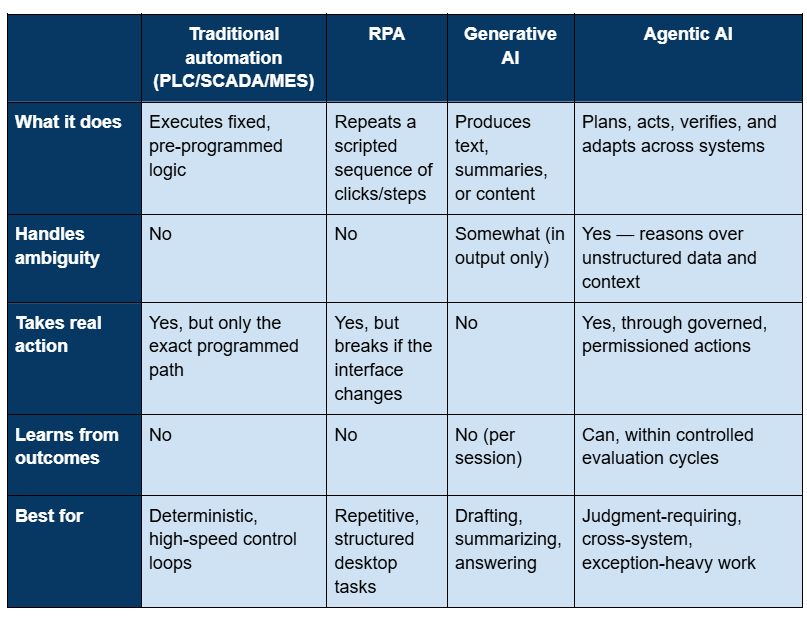
The practical takeaway: agentic AI doesn't replace SCADA, MES, or RPA — it sits above them, handling the interpretation, coordination, and follow-through that rules-based systems were never designed to do. The strongest industrial deployments combine both: deterministic systems for the control loop, agents for the judgment calls around it.
How agentic AI actually works in an industrial environment
Underneath the term "agent" is a fairly simple operating loop, usually described as reason → act → verify.
- Reason. The agent looks at the current situation — a sensor reading, a document, an inventory gap — and decides what needs to happen next.
- Act. It calls a tool or system: query a database, open a work order, send a message, update a record.
- Verify. It checks whether the action actually resolved the problem. If not, it retries, adjusts its plan, or escalates to a person.
Where multi-agent systems come in
Complex industrial workflows rarely fit inside one agent's scope. A stockout, for example, touches inventory, logistics, and store communication all at once. Multi-agent setups assign each piece to a specialist — one agent investigates cause, one checks transfer options, one handles customer or store communication — and they hand off work to each other in a coordinated, auditable way rather than one model trying to do everything.
Why grounding matters
An agent is only as good as the context it's given. Retrieval-based grounding — pulling from real inventory data, maintenance logs, contracts, or SOPs rather than relying on general training knowledge — is what keeps an agent's actions accurate and defensible instead of plausible-sounding guesses. In regulated or safety-relevant industrial settings, this isn't optional.
Why industrial automation needs agentic AI now
Industrial AI has moved past the pilot-and-demo phase. Recent industry coverage of 2026 deployments points to a few consistent shifts: agentic systems are increasingly model-agnostic rather than locked to one vendor's stack, maintenance and troubleshooting have become the leading production use case on the plant floor, and — most notably — the technology has moved from producing advisory outputs to actually executing multi-step tasks with only light human oversight.
The pattern across industries is the same: less time spent watching dashboards and interpreting exceptions, more time spent reviewing outcomes an agent has already worked through.
Agentic AI use cases across industrial operations
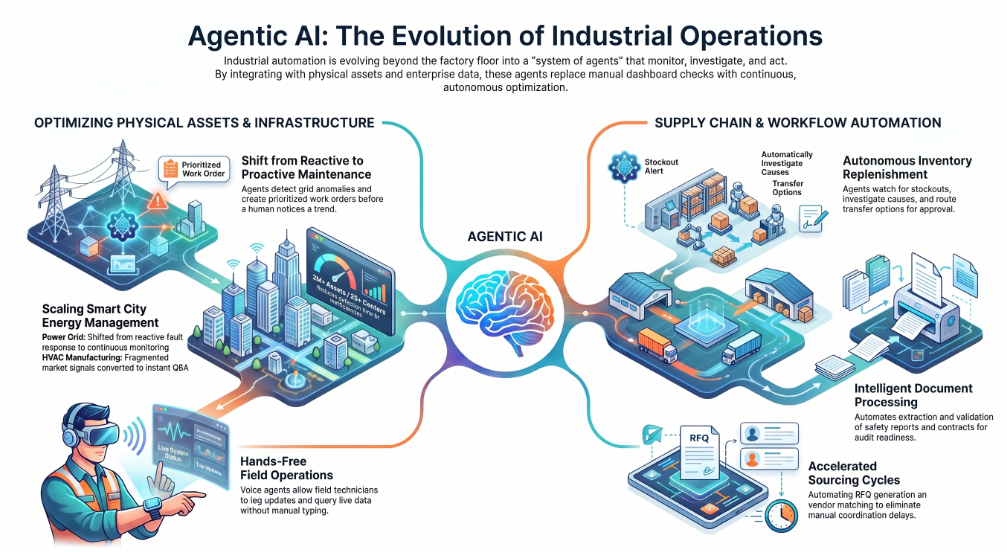
"Industrial automation" isn't limited to the factory floor — it spans anywhere physical operations, supply chains, and infrastructure intersect with enterprise systems. Here's where agentic AI is delivering measurable value across those environments.
Predictive maintenance & anomaly detection
Agents can continuously monitor sensor and utility data, detect anomalies or forecast deviations, and automatically create a prioritized work order — attaching the right asset ID and context — instead of waiting for a person to notice a trend on a dashboard.
In practice: A state power transmission utility deployed agentic analytics over its smart grid systems for outage and loss prediction. The result was earlier detection of grid exceptions, more proactive operations, and better transparency for leadership — shifting the team from reactive fault response to continuous monitoring.
Inventory, replenishment & supply chain coordination
Instead of a planner manually checking inventory dashboards, agents can watch for a projected stockout, investigate the cause, generate transfer or expedite options, check policy constraints, and route the decision for approval or bounded execution — then verify the transfer actually happened.
In practice: A logistics and warehousing operation modernized store support, inventory visibility, and knowledge access at national retail scale using a voice support agent (bilingual), an inventory intelligence agent for pricing and stock, and a RAG-based training agent over SOP documentation — reducing manual helpdesk burden and improving store-level inventory visibility.
Energy, utility & smart infrastructure monitoring
Agents ingest utility and sensor data continuously, forecast consumption, and generate optimization recommendations and proactive alerts — replacing manual spot-checks with always-on monitoring.
In practice: A city-scale smart infrastructure operator running 25+ smart city operation centres and connecting 2M+ assets deployed AI for energy management — monitoring, forecasting, and optimizing campus and urban-scale energy consumption, improving visibility and cutting the time to detect inefficiencies.
Procurement, RFQs & vendor coordination
Agents can automate RFQ generation, match suppliers, track quality and regulatory documentation, and surface price/lead-time analytics — cutting the manual coordination that typically slows sourcing cycles.
Compliance, document intelligence & audit readiness
Document-heavy industrial processes — safety reports, supplier contracts, compliance filings — benefit from agents that extract, validate, and cross-check information against policy, maintaining full traceability for audits rather than relying on manual review.
Competitive & market monitoring
In practice: A major HVAC&R manufacturer deployed AI agents for continuous competitive monitoring — tracking pricing, promotions, and availability across e-commerce channels and converting fragmented market signals into instant, agentic Q&A and proactive alerts for leadership, replacing manual portal checks entirely.
Field operations & voice-enabled agents
Voice agents connected to live operational data let field staff, drivers, or technicians get answers and log updates hands-free, tying every interaction back to a real work item rather than a disconnected chat log.
The real ROI of agentic AI in industrial automation
The organizations getting real return treat agentic AI as an operational investment with measurable KPIs, not a general productivity boost. The metrics that hold up under scrutiny:
- Cycle time — how much faster an issue moves from detection to resolution
- Downtime avoided — earlier detection translating into fewer unplanned stops
- Manual hours saved — reduction in monitoring, rekeying, and coordination work
- Exception and error rate — fewer issues requiring rework or escalation
- Cost per resolved case — the true comparison point against manual handling
A realistic timeline matters too. Most successful deployments follow a pilot → prove → scale path: a contained, measurable use case first (a single workflow, one plant, one region), followed by a period of tracking actual outcomes against a baseline, before expanding scope or autonomy. Enterprises that skip the "prove" step and try to roll out broad autonomy immediately are the ones who struggle to defend ROI later.
The risk nobody talks about: governance, security & agent identity
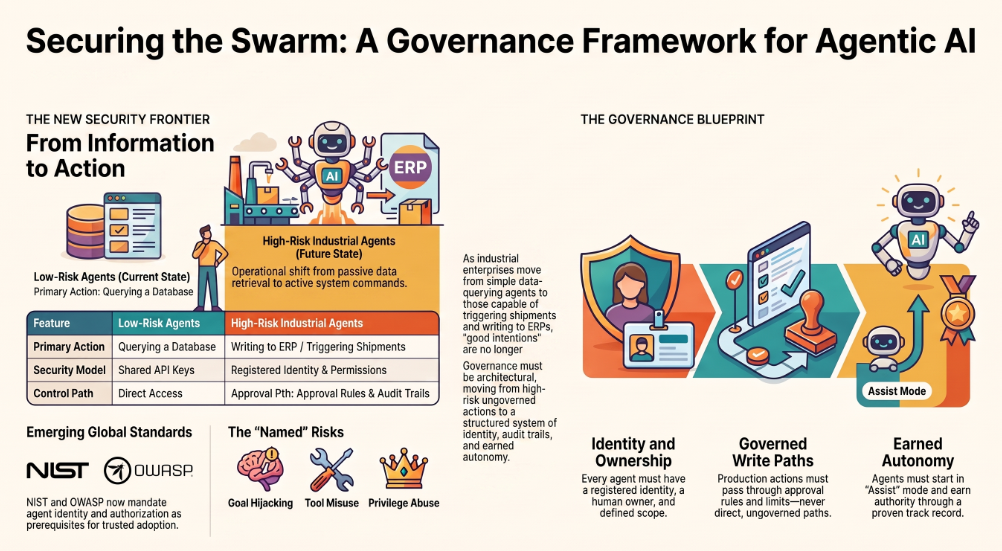
Most conversations about agentic AI in industrial settings focus on what agents can do. Far fewer focus on what happens when hundreds of them are running inside an enterprise at once — and that's where most deployments actually run into trouble.
An agent that can query a database is low-risk. An agent that can write to an ERP, trigger a shipment, or approve a transaction is a different category of risk entirely, and it needs to be treated that way: with identity, permissions, approval limits, and audit trails — not a shared API key and good intentions.
This is no longer a theoretical concern. Standards bodies have started formalizing it: NIST launched an AI Agent Standards Initiative in 2026 specifically addressing agent identity, authorization, and interoperability as prerequisites for trusted adoption, and OWASP's GenAI Security Project has published dedicated guidance on agentic-AI risks — including goal hijacking, tool misuse, and privilege abuse — that didn't exist as a named category eighteen months ago.
For industrial and infrastructure environments, where a mishandled action can mean a safety issue or a compliance failure rather than just an inconvenience, governance isn't a nice-to-have layered on afterward. It has to be part of the architecture from day one:
- Every agent should have a registered identity, an owner, and a defined scope of what it's allowed to do
- Every production action should pass through permissions, approval rules, and limits — not a direct, ungoverned write path
- Every action should be logged and auditable, with a clear owner accountable for outcomes
- Autonomy should expand gradually — starting in "assist" or "co-work" mode and earning broader authority only after evaluation and a track record
How to evaluate an agentic AI platform for industrial automation
Before committing to a platform, it's worth checking it against a short list of non-negotiables:
- Does it have a governed action layer? Can it actually execute in your ERP/CRM/operational systems, or does it stop at recommendations?
- Is human oversight built in, not bolted on? Look for configurable approvals, escalation paths, and confidence thresholds — not a single global on/off switch for autonomy.
- Can it deploy where your data lives? Private cloud, VPC, or on-premises matter for regulated and infrastructure-heavy environments that can't put operational data into a public SaaS tool.
- Does it integrate with what you already run, or does it demand a rip-and-replace of existing systems?
- Can the vendor show real, measured outcomes — not just a demo environment?
Why assistents.ai by Ampcome
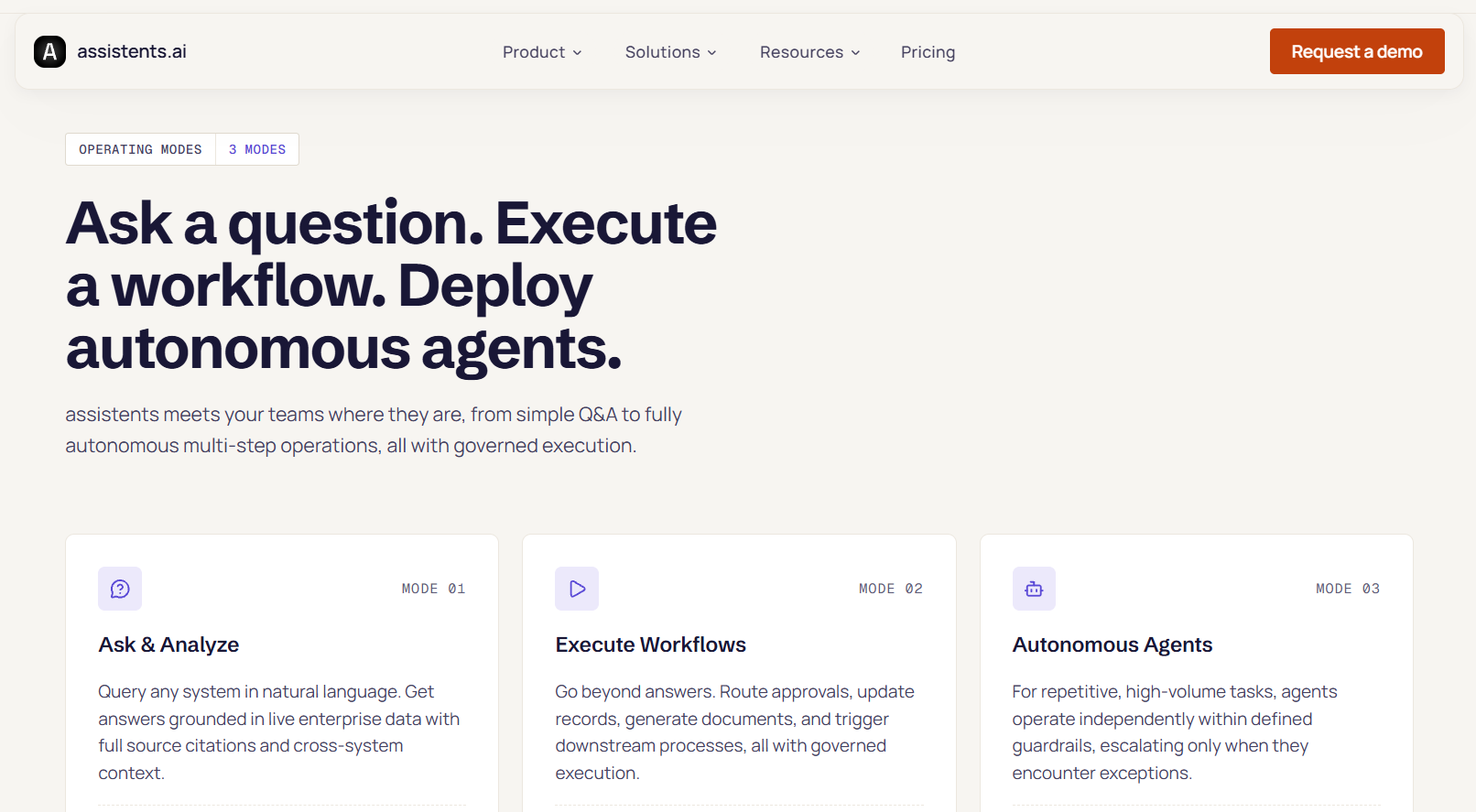
Most agentic AI platforms can talk convincingly about your operations. Fewer are built to safely act inside them.
assistents.ai is built around a governed action layer — every agent action is permissioned, logged, and auditable, not just plausible-sounding. That's a deliberate design choice, not an afterthought:
- Built for accountable action, not just automation. Agents connect to real enterprise systems — ERP, inventory, CRM, ticketing — through a governed action layer, so every action taken is permissioned, traceable, and reversible where it needs to be.
- Deployable where regulated and infrastructure-heavy enterprises actually need it — private cloud, customer VPC, or fully on-premises, which matters for industrial, utility, and infrastructure environments that can't move operational data into a public SaaS tool.
- Human-in-the-loop by design. Approvals, escalation conditions, and confidence thresholds are configurable per workflow, so operators stay in control of consequential decisions while agents handle the repetitive investigation and coordination work around them.
- Proven across real operating environments — supply chain and logistics coordination, energy and utility monitoring, retail operations, and compliance-heavy workflows — not just a demo environment (see below).
- Model-neutral and integration-ready, connecting to 80+ systems so it augments the automation stack you already run instead of forcing you to replace it.
Case studies: agentic AI in industrial automation, in action
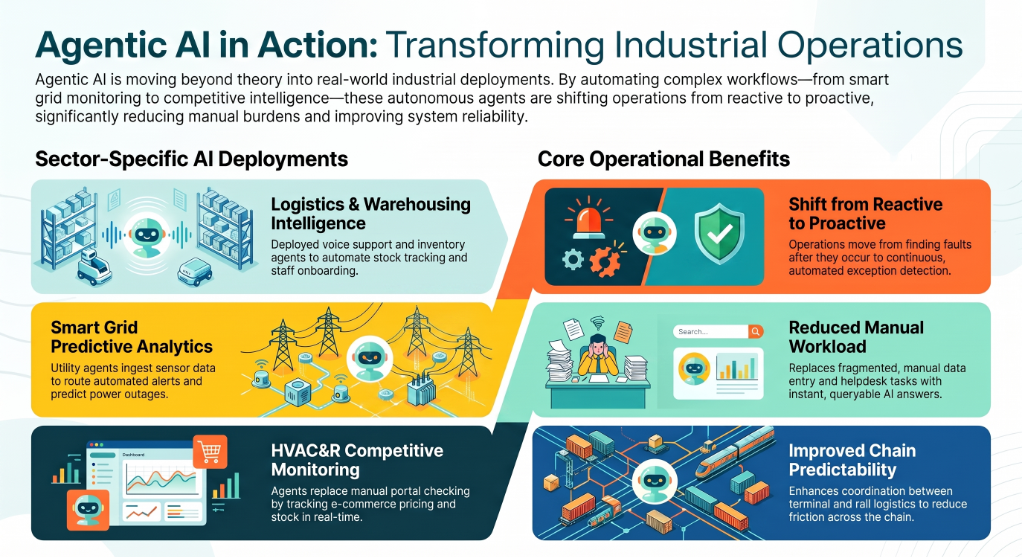
(Anonymized by sector — case details below are drawn from real deployments.)
Logistics & warehousing at national scale. A logistics and warehousing operation deployed a voice support agent (Hindi and English), an inventory intelligence agent for real-time pricing, stock, and promotions per store, and a knowledge and training agent built on top of POS and SOP documentation. The result: reduced manual helpdesk burden, faster store-level issue resolution, and faster onboarding through on-demand training guidance.
Smart grid and utility operations. A state power transmission utility implemented agentic analytics and automated operational alerting on top of its existing smart-grid systems — ingesting utility and sensor data, running predictive analytics for outages and losses, and automatically routing alerts to the right field teams. This shifted the operation from reactive fault-finding to continuous, proactive monitoring, with faster exception detection and improved reliability.
City-scale energy management. An organization running smart infrastructure at city scale — touching 150M+ urban lives across 25+ smart city operation centres — used agentic AI for energy management: monitoring, forecasting, and optimizing consumption across a portfolio of connected assets, improving visibility and cutting the time needed to detect inefficiencies.
Competitive intelligence for a major manufacturer. A large HVAC&R manufacturer deployed AI agents for continuous competitive monitoring across e-commerce channels — tracking pricing, promotions, and stock availability — and converting fragmented market signals into instant, queryable answers and proactive alerts for leadership, replacing what had been manual, portal-by-portal checking.
Port and inland logistics. A global ports and logistics operator digitized terminal and rail coordination with agentic workflows, adding executive dashboards and operational alerting to improve predictability of terminal-to-rail throughput and cut coordination friction across the logistics chain.
Getting started
Agentic AI in industrial automation works best when it starts narrow and proves itself before it scales. Pick one workflow with a clear, measurable outcome — a maintenance queue, a replenishment process, a monitoring dashboard that currently requires someone to watch it — and build from there.
If you're evaluating platforms, the questions worth asking are simple: can it actually act inside your systems, does it keep a human in control of consequential decisions, and can it deploy where your data already lives.
[Talk to Ampcome about deploying assistents.ai for your operations →]
FAQs
What is agentic AI in simple terms?
Agentic AI is AI that doesn't just answer questions — it takes action. It can investigate a problem, decide what to do, execute the next step in a real system, and check whether that action worked, adjusting its approach if it didn't.
What's the difference between agentic AI and RPA?
RPA follows a fixed, scripted sequence of steps and breaks when the process or interface changes. Agentic AI reasons over context, handles ambiguity, and adapts its approach — it can work with unstructured data like documents or emails, not just structured screen interactions.
Is agentic AI the same as generative AI?
No. Generative AI produces content — text, summaries, answers. Agentic AI can use generative reasoning as one component, but its defining feature is taking real, multi-step action across systems and verifying the outcome.
What are examples of agentic AI in manufacturing and industrial settings?
Predictive maintenance work-order creation, inventory and replenishment coordination, energy and utility monitoring, procurement and RFQ automation, compliance document review, and competitive/market monitoring are among the most common production use cases today.
What industries benefit most from agentic AI?
Industries with high transaction volume, structured-but-complex data, and multiple connected systems see the fastest returns — manufacturing, energy and utilities, logistics and supply chain, retail operations, and financial services are leading adopters.
Can agentic AI replace SCADA, PLC, or MES systems?
No, and it isn't meant to. Deterministic control systems remain the right tool for fixed, high-speed control loops. Agentic AI sits above them, handling the interpretation, coordination, and exception-handling work those systems were never designed to do.
What are the risks of agentic AI in industrial settings?
The main risks are ungoverned action (an agent with broad system access and no permission boundaries), lack of audit trails, and expanding autonomy faster than it's been evaluated. These are addressed through identity, permissioning, approval workflows, and a gradual rollout from "assist" to greater autonomy.
How do you measure ROI from agentic AI?
Track cycle time, downtime avoided, manual hours saved, exception/error rates, and cost per resolved case — measured against a baseline before automation, over a defined pilot period.
How much does it cost to implement agentic AI?
Cost depends heavily on scope. A single-workflow pilot (one use case, one team) is a very different investment than an enterprise-wide rollout — most organizations start narrow, prove value against a measurable KPI, and expand from there.

Transform Your Business With Agentic Automation
Agentic automation is the rising star posied to overtake RPA and bring about a new wave of intelligent automation. Explore the core concepts of agentic automation, how it works, real-life examples and strategies for a successful implementation in this ebook.
Sarfraz Nawaz is the CEO and founder of Ampcome, which is at the forefront of Artificial Intelligence (AI) Development. Nawaz's passion for technology is matched by his commitment to creating solutions that drive real-world results. Under his leadership, Ampcome's team of talented engineers and developers craft innovative IT solutions that empower businesses to thrive in the ever-evolving technological landscape.Ampcome's success is a testament to Nawaz's dedication to excellence and his unwavering belief in the transformative power of technology.

More insights
Discover the latest trends, best practices, and expert opinions that can reshape your perspective

.jpg)





Contact us

