
AI Agents in Data Governance: 10 Use Cases and Real Enterprise Examples (2026)


AI agents in data governance are software agents that carry out governance work — enforcing metric definitions, checking data quality, classifying and scoping data, collecting evidence, and reconciling writes to systems of record — continuously and under explicit policy, instead of waiting for a quarterly review.
That is only half the subject. The moment an agent can read a table and act on what it finds, two new questions appear: what data is the agent allowed to touch, and what record exists of what it touched? Those are governance problems too, and most of the content written on this topic covers one side or the other.
This guide covers both, with evidence. Below are seven use cases where agents do data-governance work and three where governance is applied to the agents themselves. Each one comes with an anonymised deployment Ampcome delivered — across India, the UAE, the UK, North America, Australia and East Africa — and the outcome the customer reported. No hypothetical banks, no imaginary hospitals.
Key takeaways
- Data governance has two jobs once agents arrive: agents that govern data, and governed data for agents. We call this two-way data governance. Most tools and most articles handle one side.
- The most valuable governance work agents do today is definitional and evidential — one metric definition used everywhere, one recorded trail for every data touch — not just flagging bad rows.
- Agents should be steered to governed datasets, bound to an explicit list of tables, and start read-only. Access has to be enforced by the platform, not by the prompt.
- Thresholds, approval bands and escalation rules belong in business configuration, not in prompts or code, so they apply identically every time and change in one place.
- The proof is in production: the ten examples below are real, currently-running deployments, described without client names.
What "AI agents in data governance" actually means
The phrase gets used for two different things. It helps to name both.
Agentic data governance is AI agents performing bounded governance actions — validate, standardise, classify, monitor, reconcile, evidence — inside live workflows, under policies that humans set. The agent does the work a data steward would do, but continuously and at the speed the data moves.
Data governance for AI agents is the access scope, dataset curation and audit record that govern what an agent may read, what it may write, and what it must be able to prove afterwards. This is the part that did not exist when the only consumers of data were people and dashboards.
Here is how the three governance models differ in practice:
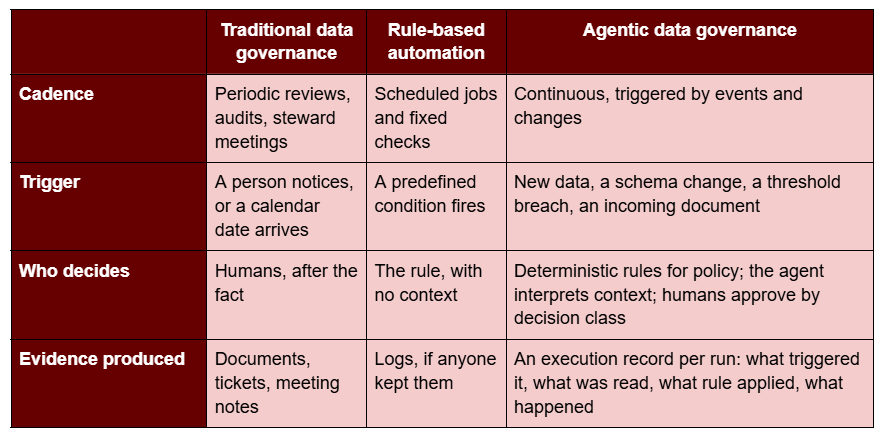
The one-line version: governance moves from periodic review to continuous execution, and the unit of governance shifts from the dataset to the decision.
Why data governance changes when agents can act
For two years, most enterprise AI governance was really content governance: a model answered a question and a human decided what to do with the answer. Agents remove that separation. They read an invoice and post it. They create a sales order. They screen a transaction and escalate it. Four things follow for anyone responsible for data.
Governance becomes continuous rather than periodic. A quarterly review assumes the estate changes slowly. Agents are created in notebooks, workflow tools and vendor consoles, and they run all day. A hand-compiled inventory is stale before it circulates.
A stale definition becomes an operational error, not a reporting error. If "gross margin" means something slightly different in two subsidiaries, a dashboard shows a number that somebody eventually questions. An agent acting on that number raises a purchase-price alert to the wrong people, or fails to raise one at all.
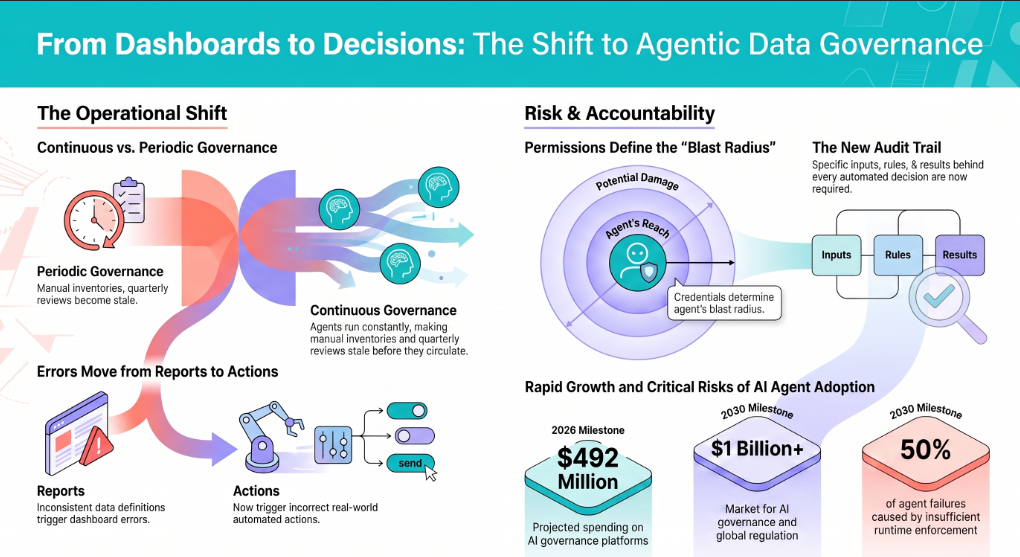
Permissions become the blast radius. An agent inherits the reach of the credentials it holds. Bounding what it may read and write — and recording those bounds — decides how bad its worst day can be. Gartner's data-and-analytics predictions for 2026 put it bluntly: by 2030, half of AI agent deployment failures will be attributable to insufficient runtime enforcement by AI governance platforms.
The audit question changes. Auditors used to ask which report a number came from. Now they ask why a specific decision was made on a specific date, and expect the inputs, the rule that applied and the result. Gartner expects spending on AI governance platforms to reach $492 million in 2026 and pass $1 billion by 2030, driven by regulation reaching three-quarters of the world's economies by the end of the decade.
There is a regional angle here that global vendors miss. Family business groups in the Gulf, multi-entity retail and logistics groups in India, and holding companies everywhere share the same structural problem: the same metric means different things in different entities, and the systems rarely agree on format. India's Digital Personal Data Protection framework adds the obligation to know exactly which personal data an automated system touched and why. Both make the definitional and evidential use cases below the ones to start with.
If you want the broader governance model — risk tiers, ownership, autonomy levels — we have written that up in our AI agent governance framework guide and our guide to agentic AI governance. This article stays on data.
10 use cases for AI agents in data governance (with real examples)
Every example below is a real deployment delivered by Ampcome, anonymised by design. Outcomes are as reported by the customer. Where a figure is an engineering target rather than a measured result, it is labelled as one. For each use case we also note the assistents.ai capability that supports it, with its status in the platform.
Part A — AI agents for data governance: agents that govern data
1. One metric definition, enforced everywhere (semantic-layer governance)
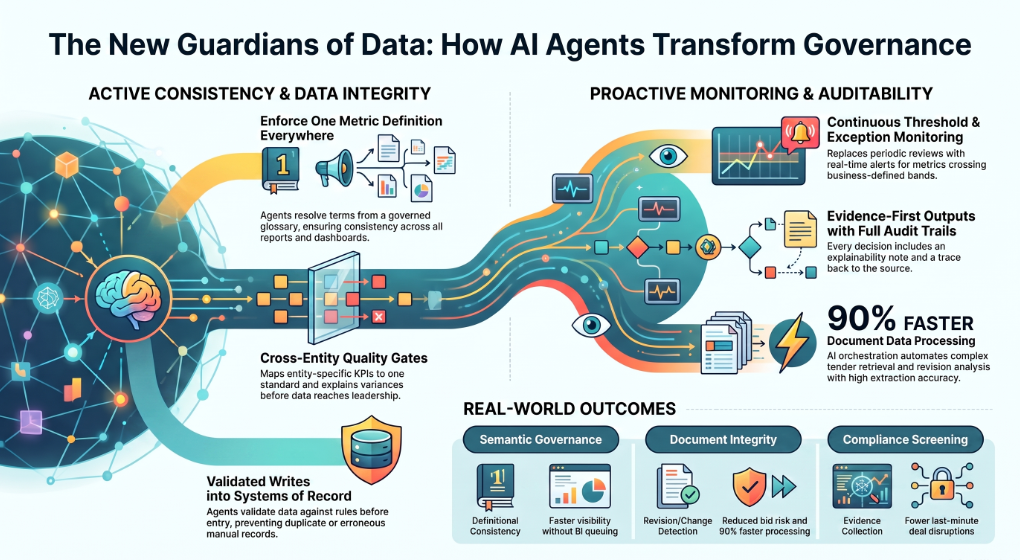
What the agent does. When someone asks about margin, active customers or qualified pipeline, the agent resolves the term from a governed glossary carrying the actual formula, the aggregation rule, the unit and the drill hierarchy — not from the prompt, and not from the model's memory of what "margin" usually means.
The control it produces. Definitional consistency. The figure in a conversation equals the figure in the report, because both come from the same definition.
Real example. A US-based real-time business analytics company needed strategic visibility without every question turning into a BI ticket. Ampcome built an agentic analytics layer over the company's existing data, with a semantic governance layer for consistent definitions and a natural-language interface. The reported outcome: faster strategic visibility without BI queueing, improved alignment across teams through consistent metric definitions, and insight access that scaled beyond the analysts.
On assistents.ai. assistents.ai maintains a governed business semantic layer — your metric definitions, thresholds, policies, terminology and drill hierarchies — which agents consult at query time. A metric means the same thing to every agent, every dashboard and every user, and when a definition changes it changes in one place. (Available.) We wrote about why this matters more than text-to-SQL accuracy in Beyond Text-to-SQL: Why Enterprise AI Needs a Semantic Governor.
2. Cross-entity standardisation with quality checks in the loop
What the agent does. The agent maps entity-specific KPIs to one standard, runs data-quality checks before anything is consolidated, and explains variances instead of hiding them behind a total.
The control it produces. Standardisation plus a quality gate that sits before the number reaches leadership.
Real example. An Indian multinational logistics and warehousing company operates across India, the UK and Europe, and the US, with entities whose systems rarely agree on format. Ampcome delivered analytics consolidation across the multi-entity operation: cross-entity KPI standardisation, data-quality checks with a governance layer, and operational dashboards with variance explanations. The reported outcome: a single operational view across entities, faster leadership reporting and issue identification, and more consistent operational metrics.
On assistents.ai. Where reporting requires a dimensional model, assistents.ai provides a managed analytical database in which fact and dimension structures can be built and populated from source systems (Configurable). The governed analytics layer — datasets, dashboards, cross-dataset filtering — is built on the same semantic definitions the agents use, so the metric on the dashboard and the metric the agent quotes are the same metric by construction (Available).
3. Threshold, variance and exception monitoring on governed metrics
What the agent does. The agent watches governed metrics against named threshold bands and raises exceptions with context: the metric, the band it crossed, the entity, and what to look at next.
The control it produces. Continuous monitoring instead of periodic review, with the alert logic owned by the business rather than buried in a script.
Real example. An independent Canadian automotive leasing provider running manufacturer and dealer programs needed earlier sight of portfolio risk. Ampcome built portfolio KPI analytics — risk, delinquency, maturity, residuals — alongside dealer-network performance analytics, with alerts for exceptions and early risk signals. The reported outcome: better portfolio visibility, faster risk identification and more proactive management through exception alerts. A second deployment applied the same pattern to physical infrastructure: for a premier Indian astronomy research institute, sensor and utility data ingestion with anomaly detection and proactive alerting improved energy visibility and reduced manual monitoring across a campus-scale estate.
On assistents.ai. Performance thresholds and escalation conditions are defined once as business configuration — not embedded in prompts or code — so every agent applies the same bands. Acting on a breach is implemented as a monitoring workflow configured during delivery. (Thresholds Available; monitoring workflow Configurable.)
4. Document data integrity: extraction, revision detection, audit logs
What the agent does. The agent pulls structured data out of complex documents, detects what changed between versions, and writes to the operational system with locks and logs — so a revised tender does not silently overwrite a quoted one.
The control it produces. Provenance and change detection on unstructured inputs, which are the most common source of confidently wrong data in any enterprise.
Real example. An Australian remedial-building and waterproofing specialist was processing complex tender documents by hand, with every revision a risk. Ampcome built an intelligent document workbench with multi-agent orchestration: tender retrieval, workflow determination, revision analysis, vision-model extraction from complex PDFs, and deep integration with the operations system including quote locking and audit logs. The solution was engineered for up to roughly 90% faster tender-document processing with an extraction-accuracy target of around 95% on standard formats — both engineering targets, not audited results — and the customer reported reduced bid risk through revision detection and auditability.
On assistents.ai. assistents.ai retrieves from document repositories using semantic search with configurable relevance thresholds, and returns citations so users can trace an answer to its source. Document ingestion is configured per source during implementation. (Available; ingestion Configurable.) See Document AI.
5. External and third-party data intake governance
What the agent does. The agent ingests market and channel data continuously, records what was captured and when, and keeps the trail intact from proof-of-value through production.
The control it produces. Provenance on data the enterprise does not own and cannot vouch for by itself.
Real example. A large Indian HVAC manufacturer competing in a price-sensitive market needed to know about competitor pricing moves the day they happened, not at month-end. Ampcome deployed continuous e-commerce and channel monitoring — pricing, MRP and discounts, offers, availability, ratings — with agentic Q&A mapped to the questions leadership actually asks, and an architecture that scaled from pilot to production with governance and audit trails. The reported outcome: faster competitive response cycles, earlier identification of pricing gaps and promotion shifts, and always-on monitoring that replaced manual checks across portals.
On assistents.ai. Work can be initiated by an event or change-data-capture stream, a scheduled job, an inbound webhook, an incoming email or a user request, and every execution is recorded — what triggered it, which steps ran, what each step produced, and how it ended. (Available.)
6. Compliance screening with evidence collection and explainability
What the agent does. The agent classifies the risk on a transaction, gathers the evidence behind the classification, writes an explainability note a human can read, and escalates to an expert when the case falls outside policy.
The control it produces. Evidence-first outputs. An auditor can follow the trail from conclusion back to source without reconstructing it.
Real example. A UK tax-technology product screens cross-border transactions for withholding-tax, VAT-mismatch and permanent-establishment risk. Ampcome built the screening workflows with risk classification, evidence collection and explainability notes, and an escalation path to tax experts. The reported outcome: earlier detection of withholding and VAT risk, fewer last-minute deal disruptions, and faster, more consistent pre-compliance review.
On assistents.ai. Business rules run in a deterministic decision engine, separate from the language model. Every change is a new checksummed version — there is no mechanism to alter a published one — and versions are tested before release. Every execution records the inputs, the outputs, an execution trace and latency. When a rule decides something, it decides the same way every time, and the logic that produced a historical decision still exists as it ran. (Available.)
7. Reconciliation and write integrity into systems of record
What the agent does. Before creating a record, the agent validates the data against rules, routes exceptions for approval, and produces reconciliation reporting so nothing posts twice and nothing posts wrong.
The control it produces. Validated, reconciled writes. This is governance at the point where data is created — the one place catalog tools never reach.
Real example. A UAE kitchen and home-appliance distributor was moving off an end-of-life document-capture platform with high licensing costs. Ampcome delivered agentic automation that interprets order triggers, validates them and creates sales orders directly in the ERP, with rules governing exceptions and approvals, audit logs and reconciliation reporting. The reported outcome: reduced manual order processing and legacy dependency, a faster order-to-confirm cycle with fewer data-entry errors, and improved auditability for both the orders created and the exceptions routed for review.
On assistents.ai. Actions are idempotent and verified: a retry cannot duplicate a transaction, and the platform confirms after the fact that the action landed in the target system (Available). assistents.ai integrates with enterprise applications such as SAP through their published APIs, or through direct access to their underlying data stores where permitted; each integration is scoped during solution design (Integration required).
Part B — Data governance for AI agents: governing the data agents use
8. Scoped data access for non-human identities
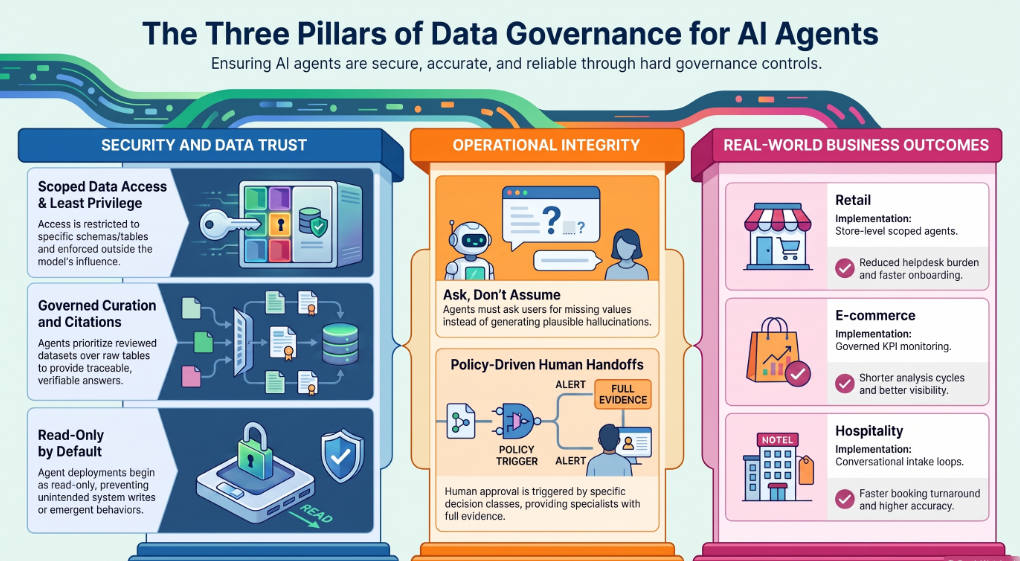
What the agent is allowed to do. Each agent is bound to a single data connection, and access through that connection can be restricted to an explicit list of schemas and tables, with query row limits applied separately. Deployments start read-only.
The control it produces. Least privilege, enforced by the platform outside the model. An agent cannot talk its way past a permission it does not hold.
Real example. A pan-India value retailer with more than 700 stores runs a voice support agent in Hindi and English, an inventory intelligence agent for store-level pricing, stock and promotions, and a knowledge agent over POS and SOP documentation. A store-level agent can answer a question for its own store; it cannot read or act on another store's data. The reported outcome: reduced helpdesk burden, faster store-level issue resolution and faster onboarding — at a scale where a shared, all-access credential would have been unmanageable. We cover this deployment through the identity lens in AI Governance for Enterprise: 12 Real Examples.
On assistents.ai. Each agent is scoped to a single data connection, and access through it can be restricted to an explicit list of permitted schemas and tables — enforced by the platform rather than by instructions to the model — with query result limits applied independently. Whether an agent may write to a system is an explicit configuration, not an emergent behaviour; deployments typically begin read-only. (Configurable.) See Agent Governance.
9. Governed dataset curation and cited answers
What the agent is steered to do. The agent prefers reviewed, governed datasets over raw tables, and returns citations so an answer can be checked rather than believed.
The control it produces. Curated inputs and traceable outputs for self-service analytics — the difference between "the agent said so" and "here is the dataset and the definition it used".
Real example. A UK consumer e-commerce and distribution operation with a very large product catalogue needed answers faster than its analysts could produce reports. Ampcome deployed an AI data-analytics agent over sales, product, inventory, promotion and customer-behaviour data, with conversational analytics, automated KPI monitoring and exception alerting. The reported outcome: shorter analysis cycles for recurring questions, better visibility into product performance and promotion effectiveness, and reduced reporting dependency on analysts.
On assistents.ai. Agents are steered toward governed, pre-approved datasets before they attempt to query raw tables, which improves both accuracy and control (Available). Agents are also given a governed view of the data model, with the level of detail tuned to the size of the schema, so accuracy holds up on large estates (Available). See Agentic Business Intelligence.
10. Missing data: ask, don't assume
What the agent is required to do. When a value it needs is absent, the agent asks the user for it or hands the case to a person. It does not fill the gap with a plausible number.
The control it produces. A completeness gate before action — the cheapest data-quality control there is, and the one most agent frameworks skip.
Real example. A luxury hospitality group operating sixteen properties across East Africa receives booking requests by email that are frequently incomplete. Ampcome built a digital booking agent with email intake, intent classification and data extraction, a conversational loop that captures missing details before anything is checked or quoted, real-time inventory checks with alternative-date negotiation, and a hybrid handoff to human specialists for curated itineraries. The reported outcome: faster booking turnaround with less back-and-forth, higher accuracy on complex guest requirements, and operations that scaled without compromising the service level.
On assistents.ai. Where a decision requires information the system does not hold, the agent asks for it explicitly rather than assuming a value (Available). Which decisions require human approval is a policy set per decision class, not a step in a script; when approval is required, the work reaches the right person with the evidence, the applicable policy and the recommendation already assembled, and the approval itself is recorded (Available).
What separates governed agents from ungoverned automation
Across all ten deployments the same pattern holds: none of them added governance after an incident. Each had a named control before it went live. The table below is the shortest way to tell the two apart.
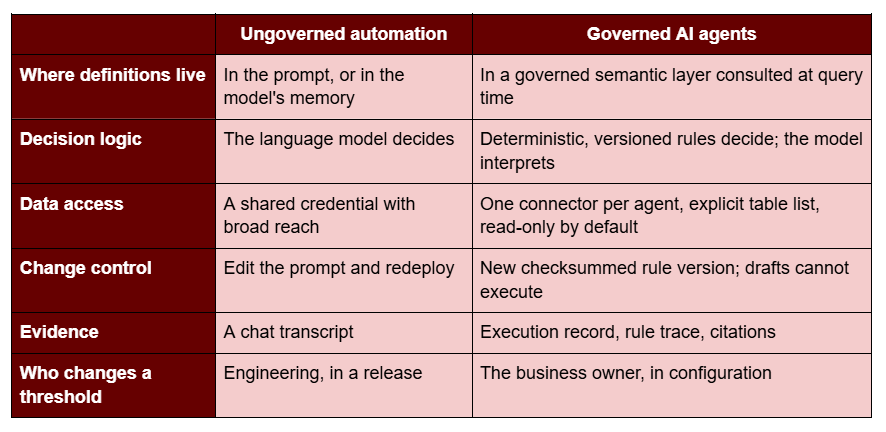
An agent that flags a problem is monitoring. An agent whose action is scoped, rule-checked, approved and recorded is governed.
How assistents.ai runs AI agents in data governance
assistents.ai, built by Ampcome, is a governed enterprise AI operations platform — a System of Agency that sits above the ERP, CRM, data, document and BI systems you already run. It converts enterprise data, documents, policies, business rules and workflows into contextual intelligence, governed decisions, coordinated actions and measurable outcomes.
It is not a data catalog and does not replace one. Catalogs inventory and describe data. assistents.ai is the layer where governed definitions, rules, permissions and audit meet action — which is why it covers both sides of two-way data governance. The table maps the ten use cases to the platform.
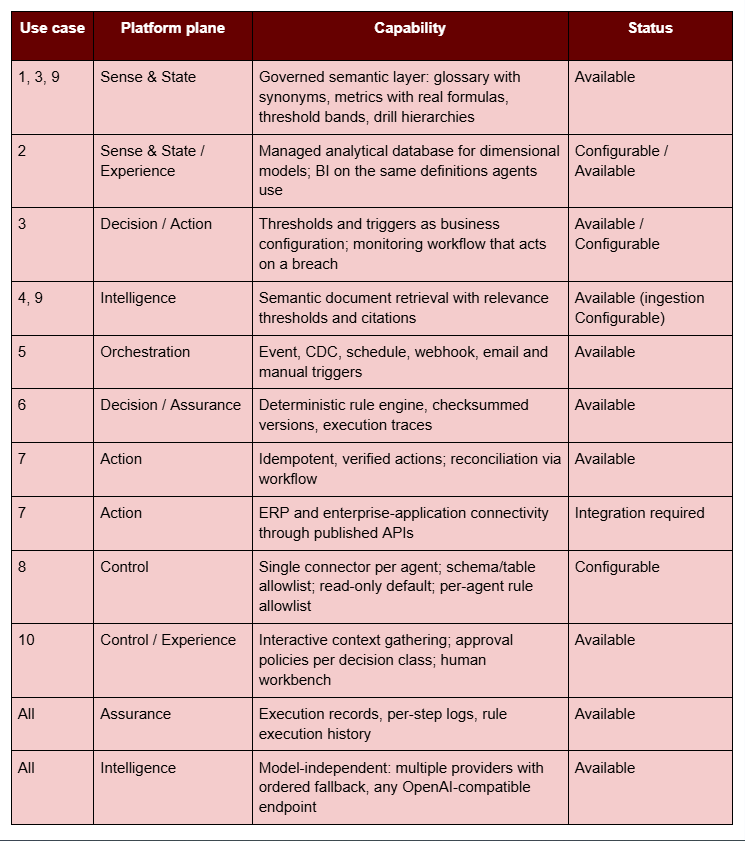
Explore the product pages for Agentic Business Intelligence, Agent Governance and the Context Engine.
Why assistents.ai is the right platform for AI agents in data governance
Five reasons, each with the mechanism behind it.
1. Definitions are enforced, not documented. A catalog records what "margin" means. assistents.ai agents compute with that definition at query time, and the dashboard reads the same one. They cannot drift apart, because there is only one definition. This is the difference between a governance document and a governed number.
2. Policy is deterministic and versioned. Rules run in a decision engine separate from the language model. There is no mechanism to alter a published version, each version carries a content checksum, and every execution is traced. Catalog-first tools flag and alert; the rule engine decides and records why.
3. Access is a platform control, not a prompt instruction. One connector per agent, an explicit table allowlist, a read-only default, and a per-agent allowlist of which rules it may invoke. An agent can only reach the tables you list and make the decisions you authorise — configured once, not re-argued per prompt.
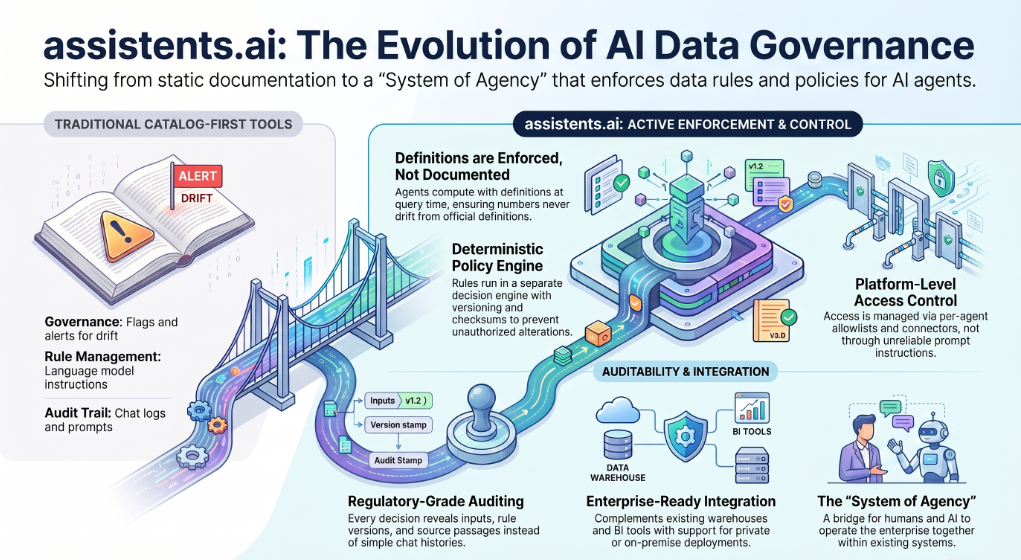
4. The audit answers the decision question. For every decision you can show the inputs, the rule version that ran, the execution trace and the result. When the system cites a policy, it shows the source passage. That is the evidence a regulator asks for, not a chat log.
5. It complements the estate you already run. Your existing systems remain authoritative; catalogs, warehouses and BI stay in place. assistents.ai supports deployment patterns designed for private, dedicated, on-premise and customer-controlled environments, with the specific architecture validated against your requirements during solution design. Model choice is a configuration decision, not an architectural commitment — agents run on models from multiple providers with ordered fallback, or on a model you host yourself.
Systems of record store the enterprise. Systems of intelligence explain the enterprise. assistents.ai is the System of Agency that helps humans and AI agents operate the enterprise together.
How to evaluate a platform for AI agents in data governance
Ask every vendor these eight questions. The answers separate a governed platform from an AI feature with a governance page.
- Where do metric definitions live, and do agents and dashboards read the same ones?
- Are policy decisions made by deterministic, versioned rules, or by the model?
- Can you list exactly which tables an agent may read, and does it start read-only?
- Is approval a policy attached to a decision class, enforced in the system — or a step someone remembered to add to a script?
- Can you export the inputs, rule version, trace and result of any single decision?
- Can a retry double-post a transaction?
- Can a business owner change a threshold without an engineering release?
- Can it run in your environment, on your choice of model?
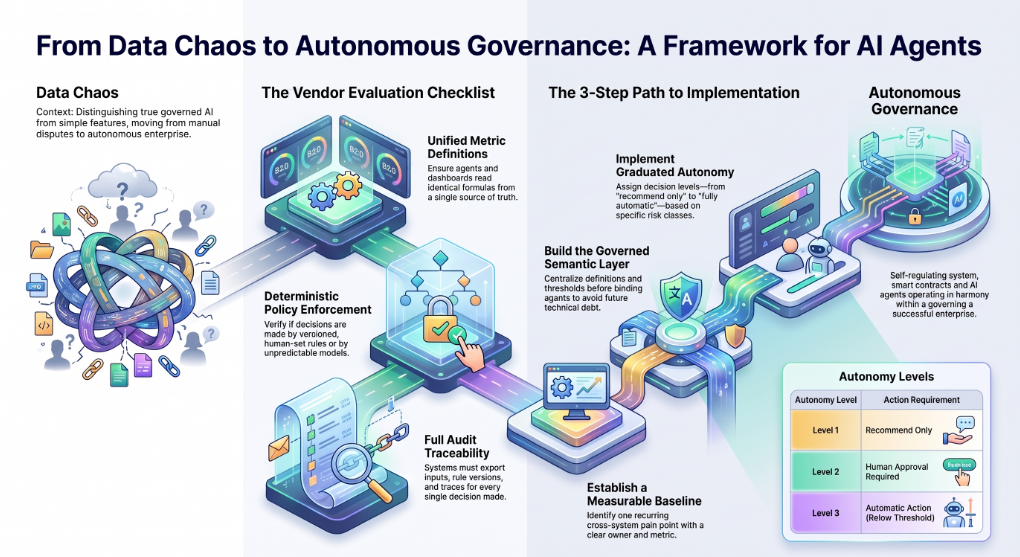
Where to start: a five-step path
1. Pick one recurring, cross-system data-governance pain with a measurable baseline. Definition disputes between entities, monthly reconciliation effort, audit-preparation hours. Name the process, the owner and the number.
2. Put the definitions into a governed semantic layer. Metrics with formulas, threshold bands, hierarchies, the terms people actually use. This is the work most programmes skip and then pay for later.
3. Bind the first agent tightly. One connector, an explicit table list, read-only. Prove decision quality before you enable any write.
4. Move policy into versioned rules and set autonomy per decision class. Recommend only; require approval; act automatically below a threshold; act and notify. Different decisions in the same process can sit at different levels — that is more credible than a blanket setting, and it is how real deployments work.
5. Measure against the baseline, then expand. Connectors, context, rules and governance built for the first process are inherited by the next one. The second use case costs less than the first.
Land with one outcome. Expand into an operating layer. The autonomous enterprise is where this leads; governed data is where it starts.
The difference between governance in a deck and governance in production
Most content on AI agents in data governance describes what agents could do for a hypothetical company. The ten deployments above are what they did — anonymised, but real, and running today across regulated and unregulated industries on four continents. The pattern is consistent: definitions governed once, policy in deterministic rules, access scoped by the platform, evidence recorded at the point of action.
If you run a data-governance process that looks like any of the ten — a definition dispute, a reconciliation backlog, a document pipeline nobody fully trusts, an agent that needs to touch production data safely — book an architecture review and we will map it against your systems, or talk to the assistents.ai team.
FAQs
What is AI agent data governance?
It has two parts. Agentic data governance is AI agents performing bounded governance actions — validate, standardise, classify, monitor, reconcile, evidence — inside live workflows under human-set policy. Data governance for AI agents is the access scope, dataset curation and audit record that control what an agent may read, write, and must prove afterwards. Mature programmes need both.
How do AI agents help with data governance?
They enforce one metric definition across every query and dashboard; standardise and quality-check data before consolidation; monitor governed metrics against threshold bands; extract document data with revision detection and logs; keep provenance on external data; classify risk with evidence and explainability notes; and validate and reconcile writes into systems of record. Each is a use case above, with a real deployment.
What is agentic data governance?
Agentic data governance is a model in which AI agents carry out governance work continuously, triggered by events and data changes, rather than through periodic reviews. The agents act within explicit limits — what they may inspect, what they may modify, what must escalate — and every action is recorded. It replaces the review cycle with an execution loop.
What is the difference between AI governance and data governance?
Data governance governs data assets: tables, columns, pipelines, dashboards, and what they mean. AI governance governs the systems that act on that data, including models and agents. They are nested, not competing: AI governance depends on data governance underneath it, because every claim about an agent's decision eventually resolves to specific data and a specific definition. Our AI agent governance framework guide covers the AI side in depth.
How do you control what data an AI agent can access?
Bind each agent to a single data connection, restrict that connection to an explicit list of schemas and tables, apply row limits, and start read-only. Control which rules each agent may invoke with a per-agent allowlist. These are platform controls enforced outside the model, so an agent cannot reason its way around a permission it does not hold.
Do AI agents replace a data catalog?
No. A catalog inventories and describes data — what exists, who owns it, how it is classified. Agents on assistents.ai consume governed definitions and act under policy. They are complementary: the catalog tells you what the data is; the governed agent platform decides what may be done with it and records what was done.
How do you audit what data an AI agent used?
Through the execution record for each run — what triggered it, which steps ran, what each step produced, how it ended — plus rule execution history that retains the inputs, outputs, execution trace and latency for every policy decision, and citations on any document the agent retrieved. The record is created at the moment of execution, not reconstructed afterwards.
What are the risks of AI agents in data governance?
Four recur: a stale definition acted on at machine speed; over-broad credentials that make the agent's reach the blast radius; decisions that cannot be explained to a regulator; and duplicate or unverified writes into systems of record. Each maps to a control — a governed semantic layer, scoped access, deterministic rules with traces, and idempotent, verified actions.

Transform Your Business With Agentic Automation
Agentic automation is the rising star posied to overtake RPA and bring about a new wave of intelligent automation. Explore the core concepts of agentic automation, how it works, real-life examples and strategies for a successful implementation in this ebook.
Sarfraz Nawaz is the CEO and founder of Ampcome, which is at the forefront of Artificial Intelligence (AI) Development. Nawaz's passion for technology is matched by his commitment to creating solutions that drive real-world results. Under his leadership, Ampcome's team of talented engineers and developers craft innovative IT solutions that empower businesses to thrive in the ever-evolving technological landscape.Ampcome's success is a testament to Nawaz's dedication to excellence and his unwavering belief in the transformative power of technology.

More insights
Discover the latest trends, best practices, and expert opinions that can reshape your perspective






Contact us

