
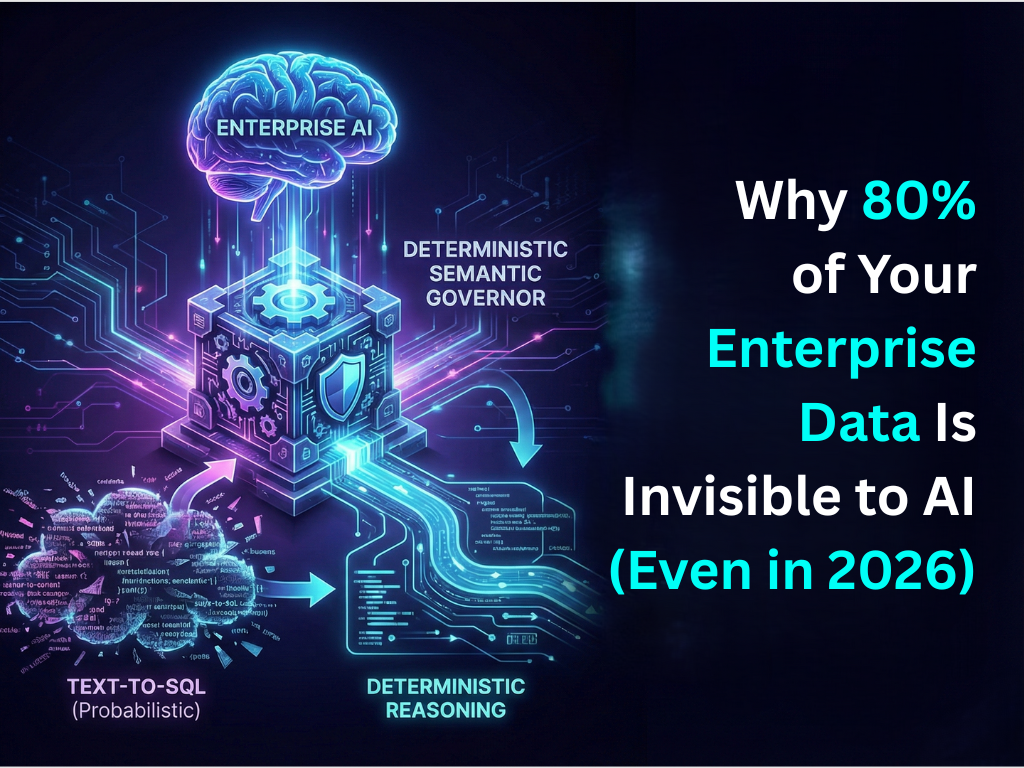
Beyond Text-to-SQL: Building a Deterministic Semantic Governor for Enterprise AI in 2026


The initial wave of Enterprise AI focused almost exclusively on access: How do we let non-technical users talk to our database?
The answer was Text-to-SQL. It promised a revolution where natural language questions were instantly translated into executable database queries. And for data exploration—building charts, pulling ad-hoc reports, or answering "what is the revenue for Q3?"—it works reasonably well.
But as enterprises move from Chat with Data (passive) to Agentic Workflows (active), the limitations of Text-to-SQL become dangerous.
Text-to-SQL handles syntax. It does not handle semantics. It knows how to write a valid query, but it does not know if that query should be run, who is asking, or what specific business rules apply to the result.
To bridge the gap between "answering a question" and "executing a business decision," we need a new architectural component. We need a Semantic Governor.
What is a Semantic Governor in enterprise AI?
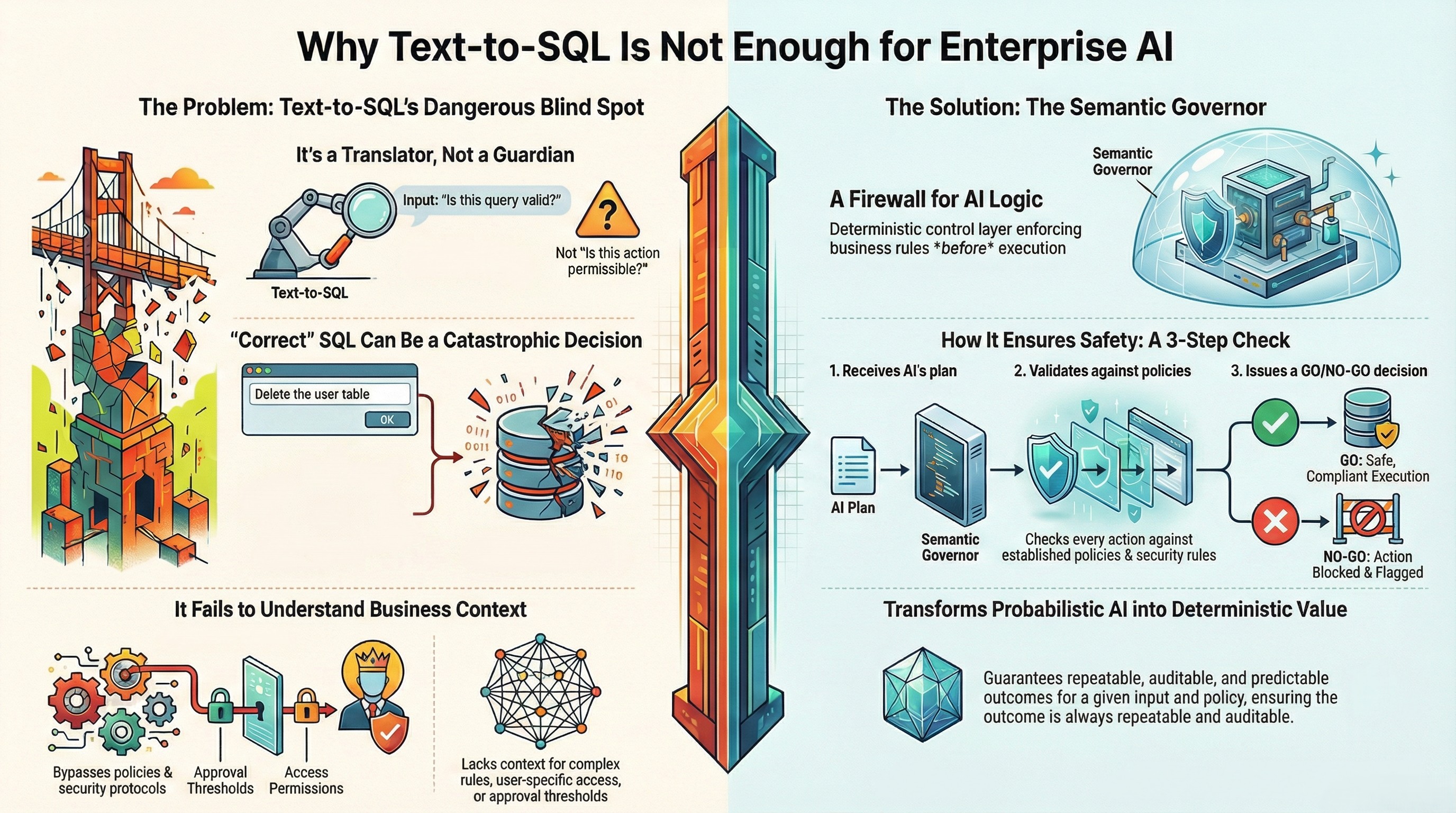
A Semantic Governor is a deterministic control layer in enterprise AI systems that enforces business rules, policies, and constraints before AI outputs are executed. Unlike Text-to-SQL, which simply translates natural language into database queries, a Semantic Governor ensures that decisions are compliant, auditable, and safe to act on.
The Problem Text-to-SQL Was Never Designed to Solve
Text-to-SQL is a translation layer. Its sole function is to map natural language tokens to SQL syntax.
If a user asks, "Delete the production user table," a perfect Text-to-SQL engine will output DROP TABLE users;.
Technically, the model succeeded. It perfectly translated the intent.
Operationally, the model just destroyed the business.
This is the Translation vs. Governance paradox.
- Translation asks: "Is this SQL query syntactically valid based on the user's prompt?"
- Governance asks: "Is this action permissible based on company policy, user role, and current state?"
LLMs are probabilistic engines designed for creativity and translation. They are not logic engines designed for constraint satisfaction. When you ask an LLM to handle governance inside the prompt (e.g., "Don't delete tables unless you are an admin"), you are relying on a statistical probability that the model will obey.
In enterprise architecture, "probably compliant" is synonymous with "non-compliant."
Why Text-to-SQL Breaks in Enterprise Environments
When we push Text-to-SQL beyond simple dashboards and into complex enterprise workflows, the cracks appear immediately. These aren't bugs; they are architectural mismatches.
Text-to-SQL Solves Syntax, Not Semantics
SQL is a rigid language for retrieving data. Human business logic, however, is nuanced.
Consider a query: "Show me the top-performing sales reps."
- The Text-to-SQL interpretation: SELECT * FROM sales_reps ORDER BY revenue DESC LIMIT 10;
- The Enterprise Reality: "Top-performing" in this company might exclude reps who haven't completed compliance training, or it might be calculated by net margin, not gross revenue. Furthermore, if the user asking is a regional manager, they should only see their region's data.
The SQL is valid. The data is real. But the answer is wrong because the semantic context (the definition of "performance" and the constraints of "access") was missing.
Why “Correct SQL” Can Still Be a Wrong Decision
The most dangerous AI errors are not hallucinations—they are factual answers that violate context.
If an AI Agent creates a perfectly valid SQL query to update a pricing tier, but fails to check the "approval threshold" rule that requires a VP sign-off for discounts over 15%, the system has failed. The Text-to-SQL layer cannot solve this because the rule exists in the business logic, not in the database schema.
The Logic Gap: From Questions to Decisions
We are witnessing a shift from Read-Only AI to Write-Enabled AI.
- Read-Only: "Summarize this PDF." (Low risk)
- Write-Enabled: "Update the inventory levels based on this report." (High risk)
Between the user's intent ("Update inventory") and the database execution (UPDATE inventory...), there is a massive void. This is the Logic Gap.
Currently, developers try to fill this gap with "Prompt Engineering"—stuffing massive system prompts with rules like "If the user is distinct, do X, else do Y." This is fragile. As context windows fill up, the LLM's adherence to instructions degrades (the "Lost in the Middle" phenomenon).
Enterprises need a system that does not "think" about the rules, but strictly enforces them.
What Is a Semantic Governor?
A Semantic Governor is the missing piece of the modern AI stack. It is a middleware layer that sits between the LLM's reasoning capability and the execution environment (Database, API, ERP).
It does not generate text. It validates intent against a rigid set of codified policies.
It functions as a firewall for logic.
- Input: The AI's proposed plan (e.g., a SQL query or API call).
- Process: The Governor checks this plan against "Soft Data" (policies, roles, constraints).
- Output: A binary GO / NO-GO decision, or a modified, compliant plan.
This ensures that the system is deterministic. The AI can be creative in how it interprets the user's request, but the Governor is rigid in what is allowed to happen.
Why Enterprises Need Deterministic AI, Not Probabilistic Guessing
The defining characteristic of enterprise software is reliability. If you input 2+2 into Excel, you get 4 every time. If you ask an LLM 2+2, you get 4 most of the time, unless the temperature is high or the prompt is confusing.
Deterministic AI means that for a given set of inputs and rules, the output is guaranteed.
- Audit Failure: You cannot audit a probability. You cannot tell a regulator, "The AI is usually 98% sure it shouldn't launder money."
- Repeatability: Business logic must be repeatable. If a discount is rejected today, it must be rejected tomorrow under the same conditions.
- Hallucination Safety: An LLM might hallucinate a non-existent column name or a fictional policy. A Semantic Governor, anchored in the reality of the schema and the rulebook, catches this immediately.
Mapping “Soft Data” to “Hard Actions”
To build a Semantic Governor, we must introduce the concept of "Soft Data."
What Soft Data Looks Like
Hard Data is what lives in your SQL database: Customer_ID, Order_Value, Inventory_Count.
Soft Data is the context that governs the Hard Data:
- Policies: "No refunds after 30 days."
- Thresholds: "Expenses over $5k need VP approval."
- Exceptions: "VIP clients bypass the standard queue."
- Relationships: "Sales reps can only view data for accounts they own."
Why Soft Data Cannot Live in Prompts
Trying to manage Soft Data via prompts is a scaling nightmare.
- Latency: Injecting 50 pages of policy documents into every context window kills performance.
- Cost: You pay for every token of policy text, on every single call.
- Ambiguity: Natural language is ambiguous. "Ensure the expense is reasonable" is open to interpretation by an LLM.
How Soft Data Becomes Executable Logic
A Semantic Governor turns Soft Data into codified constraints.
Instead of telling the LLM "be careful with high values," the Governor implements a logic gate:
IF action == 'Approve_Expense' AND amount > 5000 AND approver_role != 'VP': BLOCK.
This logic is not probabilistic. It is code. It executes with 100% certainty, protecting the enterprise from the LLM's potential misunderstanding.
How a Semantic Governor Works (Conceptual Architecture)
The architecture of a semantic governor relies on four distinct pillars.
1. Policy Encoding
This is the translation of human-readable policy (PDFs, wikis) into machine-readable rules (YAML, JSON, or Python Logic). The Governor maintains a Policy Registry—a single source of truth for what is allowed.
2. Decision Constraints
Before any SQL is executed, the Governor parses the query to ensure it satisfies constraints.
- Row-Level Security: Does the WHERE clause filter by the user's TenantID?
- Column-Level Privacy: Is the user requesting SSN without the PII_ACCESS role?
3. Approval Thresholds
For write-actions, the Governor checks thresholds. If a decision falls within "Standard Operating Procedure" (e.g., a $50 refund), it executes autonomously. If it exceeds the threshold (e.g., a $5,000 refund), the Governor halts execution and triggers a "Human-in-the-Loop" workflow.
4. Explainability & Audit Logs
Every decision made by the Governor is logged. Unlike LLM reasoning, which is opaque, the Governor's logs are structured:
- Timestamp: 10:00 AM
- Intent: Update Salary
- Status: BLOCKED
- Reason: Policy Violation #402 (Insufficient Privileges)
Why This Is a Platform Capability, Not a Feature
There is a growing market of tools offering "better Text-to-SQL." They offer better fine-tuning or smarter prompting strategies. These are features.
Governance is a Platform capability.
A feature helps you write the query faster. A platform ensures the query doesn't bankrupt the company.
You cannot bolt on governance as an afterthought. It must be the architectural substrate upon which the AI runs.
- Features translate language.
- Platforms govern state.
- Systems enforce rules.
Enterprises building their own AI stacks using raw OpenAI or Anthropic APIs will inevitably hit the "Governance Wall." They will realize that without a semantic layer to manage state and policy, they are building a high-speed engine with no brakes.
From Governed Decisions to Safe Execution
Once the Semantic Governor validates a request, we move to execution. This is where the Governor hands off to the Orchestration Layer.
Because the Governor has already guaranteed compliance, the orchestration layer can run with Controlled Autonomy. We can trust the AI Agent to execute complex, multi-step workflows (e.g., "Analyze churn, prepare offer, email client") because we know the Governor has already bound the sandbox.
If the agent attempts to step outside the sandbox—perhaps by offering a discount that violates policy—the Governor catches it instantly, not the customer.
The Future of Enterprise AI Is Governed Autonomy
We are moving past the novelty phase of AI. The question is no longer "What can the AI do?" but "What can we trust the AI to do?"
Trust is not built on better prompting. Trust is built on architecture.
By decoupling the Reasoning Engine (the LLM) from the Governance Engine (the Semantic Governor), enterprises can finally unlock the promise of autonomous AI. They can let the LLM do what it does best—understand intent and be creative—while the Governor does what it does best—keep the business safe.
The Bottom Line
Text-to-SQL is a necessary utility, but it is dangerously insufficient for enterprise operations. It provides a method of translation, but lacks a mechanism for control.
To move from "chatting with data" to "automating decisions," you must implement a Semantic Governor. It is the only way to transform probabilistic AI into deterministic business value.
FAQs-
1. What is the difference between Text-to-SQL and a Semantic Governor?
Text-to-SQL is a translation tool; it converts natural language into database queries based on syntax. A Semantic Governor is a control layer; it evaluates those queries against business rules, user permissions, and logical constraints before execution. Text-to-SQL answers "Can we write this query?", while a Semantic Governor answers "Should we run this query?"
2. Can’t I just enforce business rules using the LLM’s system prompt?
No. Relying on system prompts for governance is unsafe because LLMs are probabilistic, meaning they can ignore instructions or be "jailbroken" by complex inputs. A Semantic Governor is deterministic; it uses code-based logic gates outside of the LLM to enforce rules with 100% certainty, ensuring that policies are never skipped due to token limits or model confusion.
3. Does a Semantic Governor replace RAG (Retrieval-Augmented Generation)?
No, it complements it. RAG retrieves relevant context to help the LLM answer a question, while the Semantic Governor ensures the final answer or action is compliant. For example, RAG might find a document about pricing tiers, but the Semantic Governor ensures the AI doesn’t offer a discount that violates the "VP Approval Required" policy found in that document.
4. How does a Semantic Governor handle "Soft Data"?
"Soft Data" refers to business context that isn't in the database schema—like approval hierarchies, spending limits, or strategic priorities. A Semantic Governor encodes this soft data into executable logic (e.g., Python rules or policy-as-code). When an AI agent attempts an action, the Governor checks the request against this encoded logic to ensure the "Soft Data" constraints are respected.
5. Is a Semantic Governor necessary if my AI is read-only (dashboards only)?
Yes. Even for read-only systems, a Semantic Governor is critical for enforcing Row-Level Security (RLS) and ensuring semantic correctness. It prevents users from seeing data they shouldn't access (e.g., a regional manager seeing global revenue) and ensures that terms like "Churn Rate" are calculated using the company's official formula, not an LLM's hallucinated definition.

Transform Your Business With Agentic Automation
Agentic automation is the rising star posied to overtake RPA and bring about a new wave of intelligent automation. Explore the core concepts of agentic automation, how it works, real-life examples and strategies for a successful implementation in this ebook.
Sarfraz Nawaz is the CEO and founder of Ampcome, which is at the forefront of Artificial Intelligence (AI) Development. Nawaz's passion for technology is matched by his commitment to creating solutions that drive real-world results. Under his leadership, Ampcome's team of talented engineers and developers craft innovative IT solutions that empower businesses to thrive in the ever-evolving technological landscape.Ampcome's success is a testament to Nawaz's dedication to excellence and his unwavering belief in the transformative power of technology.

More insights
Discover the latest trends, best practices, and expert opinions that can reshape your perspective






.jpg)
Contact us

