

Latest AI Agent Frameworks in 2026: The Complete Ranked Guide (+ When You Need a Governed Platform, Not Just a Framework)


The latest AI agent frameworks in 2026 are LangGraph, CrewAI, Microsoft Agent Framework, Google ADK, OpenAI Agents SDK, LlamaIndex Workflows, Pydantic AI, Mastra, Semantic Kernel, and the Claude Agent SDK. There is no single "best" framework — you match the framework to your workflow, then add a governed platform layer (identity, row-level security, audit trails, and human approvals) to reach production safely.
Assistents.ai by Ampcome is the governed enterprise platform that provides that layer, and it has shipped agentic AI into production across logistics, retail, fintech, real estate, utilities, and hospitality.
What is an AI agent framework in 2026?
An AI agent framework is an open-source or commercial software library that provides the core building blocks for autonomous AI agents: tool calling, memory, planning, state management, and orchestration of one or many agents. Instead of hand-writing the reasoning loop — send a prompt, parse the response, call a tool, feed the result back, repeat — a framework hands you those primitives so your team can focus on the logic that is actually unique to your business.
The distinction that matters this year is between an agent and a simple assistant. An assistant answers a question. An agent is given a goal, then reasons about it, plans steps, uses tools, observes the results, and adjusts. Think of the difference between asking someone a question and handing someone a project. Agent frameworks manage the infrastructure for that project: the loop, the tools, the state across steps, error recovery, and coordination when multiple agents hand work to each other.
Under the hood, every serious framework in 2026 is built on the same five pillars: a planner, memory, tool access, a reasoning loop, and observability. Where they differ is how much control they give you over each layer, and how much they couple you to a particular vendor or cloud.
Framework vs. platform vs. build-it-yourself: the layer most guides skip

Before you compare names, get the layer right. This is where most teams waste their first quarter.
Build it yourself. You can write the agent loop by hand with raw model API calls. This is fine for a demo. It becomes painful the moment you need memory across steps, retries when a tool fails, streaming output, or two agents handing work to each other. Almost nobody should build the plumbing from scratch in 2026, because every major framework already solves it.
Use a framework. A framework is a library your engineering team owns and operates. You get orchestration primitives, but you also own deployment, observability, and — critically — governance. Frameworks are the right answer when your buying centre is engineering and the agent must do something specific that a packaged platform cannot express.
Use a governed platform. A platform is a managed layer where agents inherit identity, data residency, audit, and approval workflows from the environment itself. This is the right answer when your buying centre is procurement, legal, or IT — when the agent touches sensitive data, takes real actions, or has to survive a compliance review.
Here is the simple rule: use a framework when engineering owns the risk; use a governed platform when the business owns the risk. Most large programmes end up running both — a framework for depth on custom logic, a platform for breadth, identity, and control. The mistake is assuming a framework alone is production. It is not. It is the engine, not the car.
The latest AI agent frameworks in 2026 (ranked, with ship dates)
There is no universal winner. The ranking below orders frameworks by general-purpose suitability for new production projects, then tells you the one job each is genuinely best at.
1. LangGraph — best for stateful, controllable production workflows
LangGraph models an agent as a directed graph of nodes (steps) and edges (transitions), with a shared, typed state object threaded through every node. That makes control flow explicit: you decide exactly when the agent loops, branches, pauses for a human, and stops. Built-in checkpointing lets an agent persist its state and resume later, which is what makes human-approval steps and long-running jobs practical.
It reached 1.0 (GA) in late October 2025 and runs in production at companies like Uber, LinkedIn, and Klarna. Through 2026 it added per-node timeouts, durable streaming, and sharper state persistence. It is MIT-licensed open source.
Best for: complex, regulated, or long-running workflows where auditability and deterministic control matter more than speed of setup. Honest weakness: the steepest learning curve of the group. Simple agents that would be a dozen lines elsewhere become explicit graph definitions, and newcomers often over-engineer state before they need to.
2. CrewAI — best for fast role-based multi-agent prototypes
CrewAI's core abstraction is a "crew": a set of agents, each with a role, a goal, and a task, working together. That framing maps cleanly onto how people already think about delegating work to a team, which is why developers consistently ship a working multi-agent prototype faster with CrewAI than with lower-level tools. Its 2026 releases added enterprise observability, scheduling, and "Flows" — an event-driven layer for deterministic, conditionally branching orchestration that narrows the gap with graph-based frameworks.
Best for: getting a multi-agent system running in an afternoon when the work splits naturally into specialist roles. Honest weakness: when a crew misbehaves, the role-and-task framing gives you fewer levers than an explicit graph. Teams commonly migrate critical paths to LangGraph once reliability and observability outrank prototyping speed.
3. Microsoft Agent Framework — best for the Microsoft and .NET stack
In April 2026, Microsoft merged Semantic Kernel and AutoGen into a single SDK: the Microsoft Agent Framework (MAF) 1.0. It ships graph-based workflows, session state, type safety, telemetry, and both Python and .NET runtimes at GA, with declarative YAML agent configuration for version-controlled deployments. It has native MCP support in core and A2A support via a separate adapter, plus responsible-AI guardrails (task adherence, PII flagging, prompt-injection defenses) when deployed through Azure AI Foundry.
Best for: enterprises already standardized on Azure and .NET that want the vendor-backed successor to AutoGen and Semantic Kernel. Honest weakness: the fullest feature set is tied to the Azure ecosystem.
4. Google ADK (Agent Development Kit) — best for the Google Cloud stack
ADK is a code-first toolkit for defining agents, tools, sessions, memory, evaluations, multi-agent patterns, and deployment. It includes a local development UI for inspecting and testing an agent before pushing to the cloud, and it drives much of the A2A partner network. It makes the most sense for teams already using Gemini, Vertex AI, and Google Cloud, though it is not limited to simple Gemini demos.
Best for: GCP-native teams, hierarchical agents, and multimodal workloads. Honest weakness: strongest when your data and models already live in Google Cloud.
5. OpenAI Agents SDK — best for a streamlined, OpenAI-centric path
A lightweight framework from OpenAI for building agents with minimal abstraction, with native MCP support and a fast path from idea to a working single agent or small multi-agent system.
Best for: GPT-centric workflows and teams that want the shortest path to a running agent. Honest weakness: less suited to graph-shaped control flow and multi-provider strategies than LangGraph or MAF.

6. LlamaIndex Workflows — best for document-heavy and RAG-grounded agents
LlamaIndex Workflows reached 1.0 in June 2026, bringing event-driven orchestration purpose-built for data-intensive, retrieval-grounded pipelines. If your agent's main job is ingesting, searching, and synthesizing large document collections, this is the cleanest fit.
Best for: RAG-first products and knowledge-work agents over big document sets. Honest weakness: not designed as a general multi-agent orchestrator for complex control flow.
7. Pydantic AI — best for type-safe Python
From the Pydantic team, this brings the "FastAPI feeling" to agents: typed agents, dependency injection, and validated structured output with automatic retries when the model returns garbage. V2 (June 2026) added composable capability bundles, YAML agent specs, and durable execution. Its structured-output story is arguably the best in Python.
Best for: Python teams who believe schemas are how you make models behave. Honest weakness: younger ecosystem than LangGraph or CrewAI.
8. Mastra — best for TypeScript and full-stack JavaScript teams
Mastra provides agents, deterministic workflows, memory, RAG, and evaluations as a single TypeScript framework, so agents run in the same language and runtime as the rest of a Node.js product — no Python sidecar required.
Best for: TypeScript shops shipping agents alongside their web app. Honest weakness: the wider agentic research and tooling world is overwhelmingly Python, so you trade ecosystem depth for language convenience.
9. Claude Agent SDK — best for Anthropic-native production agents
Anthropic's SDK for production agents, which in 2026 added hierarchical subagent spawning and fallback model chains. Strong for teams building directly on Claude that want tool use, memory, and tracing without a heavier framework abstraction.
Best for: Anthropic-native builds and single-agent-plus-subagents patterns.
A note on AutoGen / AG2
AutoGen, one of the original multi-agent frameworks, is now effectively in maintenance mode. Microsoft directs new Microsoft-stack development to the Microsoft Agent Framework, its production successor. A community fork, AG2, continues the legacy conversational style. Existing AutoGen and Semantic Kernel projects keep receiving fixes during their support windows, so you can plan a migration rather than rush one — but new builds should start on MAF.
AI agent frameworks compared (2026)

Framework advice in this category ages fast. Before you lock a stack, verify the current docs for your two or three finalists and confirm the specific feature you need is in the version you will actually run.
How to choose an AI agent framework (a decision guide)
Start from your single dominant constraint, not a feature checklist.
- You need explicit control, reliability, and auditability: LangGraph.
- You need a multi-agent prototype this week: CrewAI.
- You are on Azure / .NET: Microsoft Agent Framework.
- You are on Google Cloud / Vertex: Google ADK.
- You are OpenAI-centric and want minimal abstraction: OpenAI Agents SDK.
- Your agent is mostly RAG over documents: LlamaIndex Workflows.
- Your team lives in TypeScript: Mastra.
- You want schema-enforced, type-safe Python: Pydantic AI.
Then ask the question the framework does not answer for you: what happens if the agent fails, or takes a wrong action, in production? If the honest answer involves sensitive data, money, customers, or regulators, framework selection is only half your decision. The other half is governance.
The production gap: why a framework alone won't survive procurement
This is the part the market is learning the hard way. Gartner has warned that more than 40% of agentic AI projects will be canceled by the end of 2027, driven by escalating costs, unclear value, and — most tellingly — inadequate risk controls. Separate industry research found that only about 22% of organizations feel comfortable granting AI agents broad autonomy. The appetite is there; the trust is not.
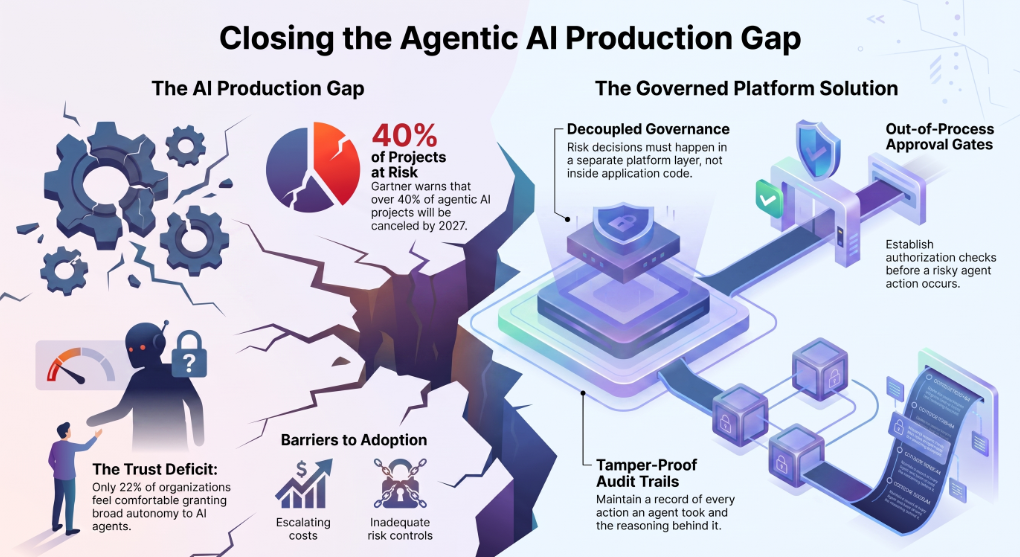
The reason is structural. An agent framework provides the reasoning loop and tool-calling. It does not natively provide out-of-process security, pre-dispatch approval gates, identity inheritance, data-residency guarantees, or a tamper-proof record of every action an agent took and why. As practitioners now put it bluntly: the framework decides how the agent plans and invokes tools; something else has to decide whether a risky action is authorized before it happens. If governance is left inside application code, it fragments across teams and breaks the moment an agent can cause real damage.
That "something else" is a governed platform layer. And it is where most 2026 agent programmes either succeed or quietly die.
From framework to governed production: what an enterprise platform layer adds
A governed platform sits above the framework and turns a capable agent into a deployable one. The capabilities that matter:

- Identity and access at the data layer — row-level security (RLS) and attribute-based access control (ABAC) so an agent only ever sees what the requesting user is allowed to see.
- Human-in-the-loop by design — maker-checker approval gates on any consequential action, not bolted on afterward.
- An immutable audit trail — a complete, tamper-evident record of every query, action, and approval, which is what a compliance review actually asks for.
- A semantic layer — governed definitions, hierarchies, and formulas so agents answer from a single source of truth instead of guessing, including reliable text-to-SQL over your real databases.
- Bring-your-own-key (BYOK) and model-agnostic routing — you own your keys and are not locked to one model vendor.
- Open protocol support — MCP for tools and A2A for agent-to-agent coordination, so agents built on any framework can plug in.
- A staged autonomy ladder — the ability to move from Ask → Execute → Autonomous at the pace your risk appetite allows, rather than flipping a single switch.
Frameworks with durable execution handle the engineering of reliability. A governed platform handles the organizational reliability — the identity, audit, and approval scaffolding you would otherwise rebuild by hand for every agent, in every team.
Why Assistents.ai by Ampcome
Most frameworks stop at orchestration. Getting an agent past a security review is a different job — one of identity, permissions, auditability, and approvals. Assistents.ai, built by Ampcome, is the governed enterprise agentic AI platform that closes that gap.

- Bring your framework, keep the governance. Connect agents over MCP and A2A; Assistents.ai adds the control plane on top, so you are never forced to abandon LangGraph, CrewAI, or a vendor SDK to get enterprise controls.
- Governed by default. Row-level security (RLS), attribute-based access control (ABAC), an immutable audit trail, and maker-checker / human-in-the-loop approval gates apply to every consequential action.
- Trust your data layer. A semantic layer plus text-to-SQL means agents answer from governed definitions — not guesses — across Postgres, MSSQL, BigQuery, ClickHouse, Athena, and DuckDB.
- Own your keys and models. BYOK and model-agnostic routing keep you free of single-vendor lock-in.
- A maturity ladder, not a leap. Move from Ask → Execute → Autonomous deliberately, at the pace your risk tolerance allows.
- Insights to governed action. The Context Engine turns dashboard insight into auditable, approved tasks — the exact thing frameworks leave you to build yourself. Add Agent Builder, Workflow Builder, Document AI, and multi-agent orchestration, and you have a single platform for building, governing, and running agents in production.
The short version: use the framework that fits your workload; use Assistents.ai to make it safe, governed, and auditable enough to actually ship.
Real-world proof: agentic AI in production across industries
Feature lists are easy. Shipped outcomes are rare. What separates a platform that demos well from one that survives production is a track record across messy, regulated, high-stakes environments. Assistents.ai by Ampcome has that track record — here is a sample, anonymized by industry, region, and scale.
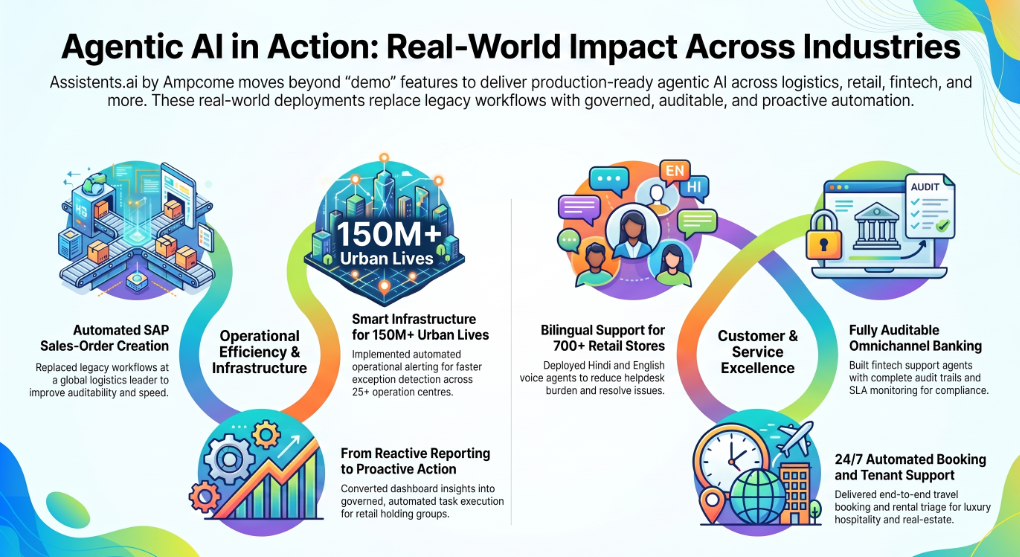
- Global ports and logistics leader (multi-billion-dollar revenue). Digitised terminal and rail operations and automated SAP sales-order creation with agentic AI, replacing an end-of-life legacy workflow. Result: a faster order-to-confirm cycle, fewer data-entry errors, and improved auditability for every order created.
- Pan-India value retailer (700+ stores). Deployed a bilingual (Hindi and English) voice support agent, a store-level inventory-intelligence agent, and a knowledge agent doing retrieval over point-of-sale and standard-operating-procedure documents. Result: reduced helpdesk burden, faster store-issue resolution, and on-demand training for staff.
- Global fintech serving banks and credit unions. Built omnichannel banking-support agents with fully auditable workflow automation and SLA monitoring. Result: faster case handling, greater consistency, and stronger compliance readiness through complete audit trails.
- Privately held retail holding group. Delivered an agentic data-analysis layer that converts dashboard insights into governed, auditable actions and tasks — a unified context engine, a semantic governance layer, and an active orchestrator layered over existing systems. Result: a shift from reactive reporting to proactive, standardized execution loops with automatic task creation and completion tracking.
- City-scale smart-infrastructure operator (touching 150M+ urban lives across 25+ operation centres). Implemented agentic analytics and automated operational alerting on top of smart-utility systems. Result: more proactive operations and faster exception detection and response.
- Major UAE real-estate portfolio owner (multi-emirate). Built an omnichannel tenant-support agent with query triage, rental and payment support workflows, ticketing, and escalation to human teams. Result: 24×7 tenant experience consistency and better SLA adherence through automated routing.
- Luxury hospitality group (16 lodges and camps). Delivered a digital booking agent that automates end-to-end luxury travel booking with human-in-the-loop quality control. Result: faster booking turnaround and higher accuracy on complex requirements — without compromising a premium service standard.
These span logistics, retail, fintech, utilities, real estate, and hospitality — every one of them running on the same governed platform, with human oversight and audit built in. That breadth is the difference between a framework you assemble and a platform that has already proven itself where the stakes are real.
FAQs
What are the latest AI agent frameworks in 2026?
The frameworks that matter most in production in 2026 are LangGraph, CrewAI, Microsoft Agent Framework, Google ADK, OpenAI Agents SDK, LlamaIndex Workflows, Pydantic AI, Mastra, and the Claude Agent SDK. AutoGen and Semantic Kernel have effectively merged into the Microsoft Agent Framework.
What is the best AI agent framework for production?
There is no single best framework. LangGraph is the safest default for complex, controllable production workflows; CrewAI is fastest for role-based multi-agent prototypes; Microsoft Agent Framework fits Azure and .NET stacks; LlamaIndex Workflows is best for RAG-heavy agents. Match the framework to your dominant constraint, then add a governed platform for identity, audit, and approvals.
What is the difference between an AI agent framework and an AI agent platform?
A framework is a developer library your engineering team owns and operates — it provides orchestration, memory, and tool-calling. A platform is a managed layer that adds identity, data residency, audit trails, and human-approval workflows on top. Frameworks are chosen by engineering; platforms are chosen when procurement, legal, or IT owns the risk. Most large programmes run both.
Is AutoGen still maintained in 2026?
AutoGen is effectively in maintenance mode. Microsoft has folded its capabilities, along with Semantic Kernel, into the Microsoft Agent Framework and directs new development there. Existing AutoGen and Semantic Kernel projects continue to receive fixes during their support windows.
Do I need a framework or a platform for my AI agents?
If engineering owns the risk and the agent does something bounded and custom, a framework may be enough. If the agent touches sensitive data, takes real actions, moves money, or must pass a compliance review, you need a governed platform on top of the framework. In practice, enterprises use both — the framework for depth, the platform for identity, control, and auditability.
Which AI agent framework is most scalable for enterprise?
LangGraph and the Microsoft Agent Framework are the most common enterprise defaults for scalable, stateful production workloads. But scalability in an enterprise is not just throughput — it is governance that scales. That is why teams pair a framework with a governed platform such as Assistents.ai by Ampcome, which adds RLS, ABAC, audit trails, and human-in-the-loop approvals across every agent.
Does Assistents.ai replace frameworks like LangGraph or CrewAI?
No. Assistents.ai is the governed platform layer that runs above your framework of choice. Agents connect over open protocols like MCP and A2A, and Assistents.ai adds the semantic layer, access controls, approval gates, and audit trail that take those agents to safe, auditable production.

Transform Your Business With Agentic Automation
Agentic automation is the rising star posied to overtake RPA and bring about a new wave of intelligent automation. Explore the core concepts of agentic automation, how it works, real-life examples and strategies for a successful implementation in this ebook.
Sarfraz Nawaz is the CEO and founder of Ampcome, which is at the forefront of Artificial Intelligence (AI) Development. Nawaz's passion for technology is matched by his commitment to creating solutions that drive real-world results. Under his leadership, Ampcome's team of talented engineers and developers craft innovative IT solutions that empower businesses to thrive in the ever-evolving technological landscape.Ampcome's success is a testament to Nawaz's dedication to excellence and his unwavering belief in the transformative power of technology.

More insights
Discover the latest trends, best practices, and expert opinions that can reshape your perspective







Contact us

