
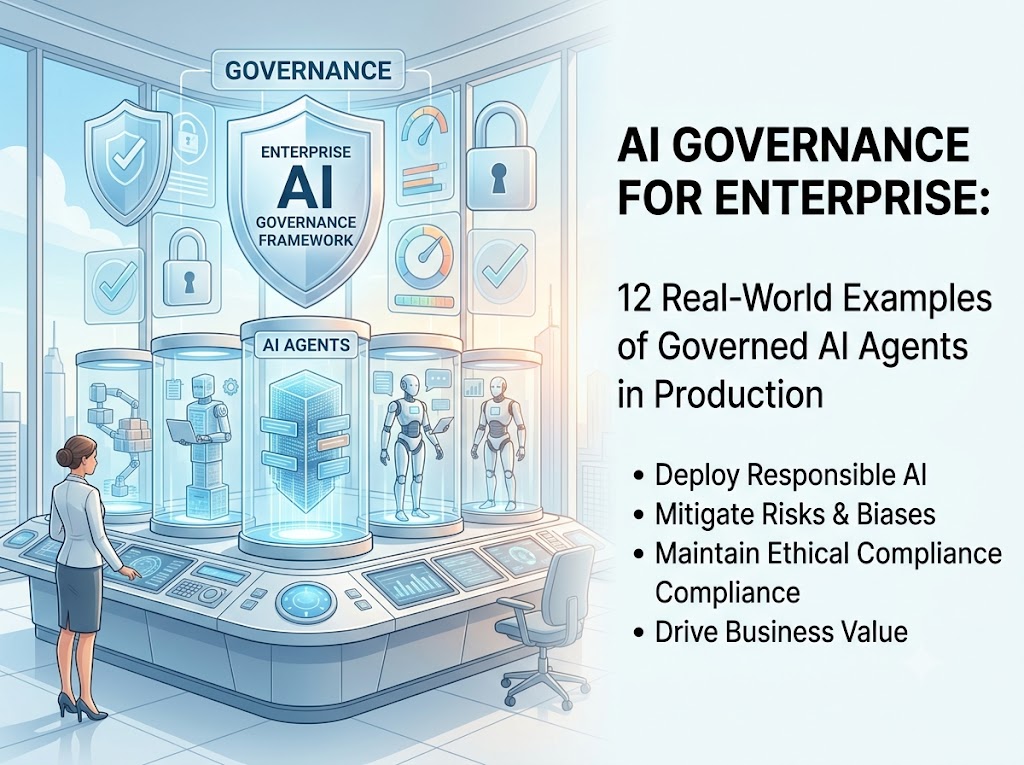
AI Governance for Enterprise: 12 Real-World Examples of Governed AI Agents in Production


For most of the last two years, "AI governance" meant reviewing what a model was allowed to say. A chatbot gives a wrong answer, a generative tool produces a biased output, a policy document gets written to cover it. That's still part of the picture. But it's no longer the hard part.
AI governance for enterprise in 2026 is a different problem, because the AI in question increasingly doesn't just talk — it acts. It reads an invoice and posts it to the ERP. It approves a refund. It creates a sales order. It escalates a tenant complaint to a human and closes the loop when it's resolved. The moment an AI agent can take a real action inside a real system, governance stops being a document you file and becomes the runtime layer that decides, every single time, whether that action is allowed to happen — and whether you can prove it happened correctly after the fact.
Most articles on this topic stay theoretical: a five-pillar framework, a checklist, a hypothetical bank or a hypothetical hospital. Useful, but abstract. This one is different. Below are 12 real, currently-running enterprise deployments — anonymized, but real — organized not by industry, but by the specific governance mechanism each one depended on to go into production safely. If you're evaluating what enterprise AI governance actually looks like once agents start acting on your systems, this is what it looks like.
What "AI Governance for Enterprise" Actually Means Once Agents Can Act
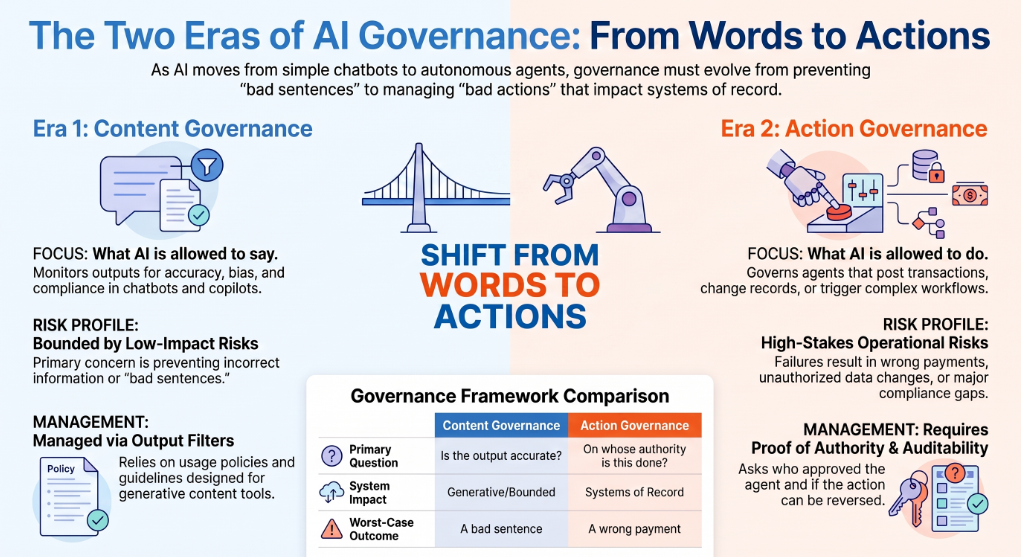
There are two eras of AI governance, and most of the content ranking on this topic today is still describing the first one.
Content governance asks: what is the AI allowed to say, and is the output accurate, unbiased, and compliant? This is the governance of chatbots, copilots, and generative content — important, but bounded, because the worst-case outcome is a bad sentence.
Action governance asks a harder question: what is the AI allowed to do, on whose authority, and can that action be reversed, explained, and audited? This is the governance an enterprise needs the moment an agent can touch a system of record — post a transaction, change a record, send a communication, trigger a workflow. The worst-case outcome here isn't a bad sentence. It's a wrong payment, an unauthorized data change, or a compliance gap nobody notices until an auditor asks about it.
Enterprise AI governance in 2026 has to cover both, but action governance is where most organizations are structurally unprepared — because the tools they bought for content governance (usage policies, output filters, acceptable-use guidelines) were never designed to answer "who approved this agent to touch this system, and how do you know it's still behaving as approved."
That's the governance this article is actually about. If you want the full architectural breakdown of what a governance framework needs to cover — policy layers, risk tiers, ownership models — we've written that up separately in our AI agent governance framework guide and our practical guide to governing AI agents day to day. This piece stays focused on proof: what governed AI agents look like once they're actually running.
The Five Lenses Behind Every Example Below
Each of the 12 examples that follow was read through the same five governance questions before it went into production. You'll see one or more of these named explicitly for each example.
- Identity — who or what is acting, and on whose authority? An agent should never operate on a shared credential the way a human employee never should either.
- Policy — what is this agent technically and commercially allowed to do, and where does that authority stop?
- Approval — does a human need to sign off before this action executes, and is that gate enforced in the system, not just written in a policy doc?
- Audit — is there an immutable, timestamped record of what happened, that a compliance team or regulator could be handed without translation?
- Outcome — did the deployment actually produce the business result it was built for, measured against a baseline, not just "did it run without crashing"?
We cover the full model — identity layers, policy layers, security controls, and risk management practice — in more depth in our AI agent governance playbook. Here, we're using it as the lens for what actually happened in production.
12 Real-World Examples of AI Governance for Enterprise
Every example below is anonymized by design — no company names — but each is a real, in-production deployment, not a hypothetical.
Identity & Access Governance
1. A pan-India value retail chain (700+ stores). This retailer deployed a voice support agent (Hindi and English), an inventory intelligence agent for store-level pricing, stock, and promotions, and a knowledge and training agent that reads from POS and SOP documentation — all wired into an admin console with ticketing integration, built to handle national-scale support volume.
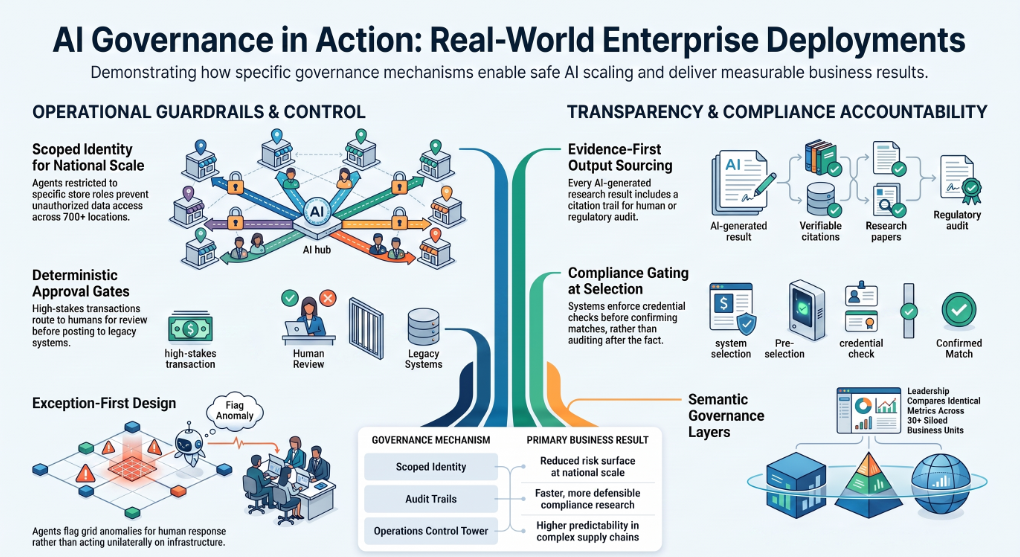
Governance mechanism: scoped identity per store role. A store-level agent can answer a pricing question or pull a promotion detail for its own store; it cannot read or act on another store's data, and it cannot execute a transaction outside its defined scope. No agent operates on a shared, all-access credential.
Result: reduced manual helpdesk burden, faster store-level issue resolution, and faster onboarding through on-demand training guidance — at a scale where a shared-credential model would have been an unmanageable risk surface.
Approval Workflows & Human-in-the-Loop
2. A UAE-based appliance and home-goods distributor. As part of a transition away from an end-of-life legacy order system, this distributor deployed agentic automation to interpret order triggers, validate them, and create sales orders directly in SAP — replacing a manual, licensing-heavy workflow.
Governance mechanism: deterministic approval gates on a high-stakes transaction type. The agent validates and prepares the order, but exceptions and out-of-policy conditions route to a defined approval path before anything posts — with full audit logs and reconciliation reporting behind every order created.
Result: reduced manual order processing and legacy-system dependency, a faster order-to-confirmation cycle, fewer data-entry errors, and — critically — improved auditability for both the sales orders created and the exceptions that got routed for review.
Audit Trails & Compliance-Ready Logging
3. A specialized U.S. sales-and-use-tax research platform. This platform automates source collection for tax research, generates draft position memos, and maintains a running knowledge base — but every output is built to be escalated to and reviewed by a human tax professional, not published unchecked.
Governance mechanism: evidence-first output. Every research result carries the sources it was drawn from and a citation trail, so a tax professional — or, downstream, a regulator — can trace exactly where a conclusion came from, rather than taking a generated memo on faith.
Result: faster research cycles, reduced manual source-hunting time, and — the part that matters for a compliance-adjacent workflow — more consistent, defensible research output across the team, not just faster output.
4. A long-term holding company's acquisition due-diligence process. Ahead of an investment decision, this firm used AI-assisted technical due diligence to assess a mobile banking target's architecture, scalability, and security posture.
Governance mechanism: structured, defensible documentation as the deliverable. The output wasn't a go/no-go recommendation — it was a risk register and remediation roadmap that the firm's own decision-makers could interrogate, with clear sourcing for every flagged risk.
Result: faster investment decisions backed by clear, structured technical risk visibility, and fewer post-deal surprises because the risks were documented and prioritized before the deal closed, not discovered after.
Exception Handling & Escalation
5. A major UAE real estate portfolio owner. This owner deployed an omnichannel customer service agent — web, WhatsApp, and email-ready — to handle tenant query triage, FAQs, and rental and payment support, backed by a knowledge base built over policies, tenancy documents, and standard operating procedures.
Governance mechanism: a defined escalation boundary. The agent resolves what it has the authority and the knowledge base to resolve; anything outside that — a dispute, an exception, an ambiguous request — is ticketed and escalated to a human team rather than guessed at.
Result: faster response times, a consistent 24×7 tenant experience, and better SLA adherence, achieved specifically because the agent knew what not to attempt rather than because it attempted everything.
6. Two power-utility and smart-grid operators. Across separate deployments, these utilities used AI agents to ingest sensor and grid data, run predictive analytics for outages and equipment issues, and route automated alerts to field operations teams.
Governance mechanism: exception-first design on critical infrastructure. The agents are built to flag and route anomalies for human field response — not to unilaterally act on physical grid infrastructure — which is the correct governance posture for a system where an unsupervised wrong action has real-world safety implications.
Result: earlier detection of grid exceptions and operational risk, more proactive operations through continuous monitoring, and faster exception-to-resolution coordination between the monitoring layer and field teams.
Cross-Entity & Semantic Governance
7. A UAE family business group spanning 30+ companies. This group deployed automated procurement and finance KPI alerting — purchase price trend, gross margin impact, early-payment cost analysis, and vendor performance — standardized across previously siloed entities.
Governance mechanism: one enforced metric definition across every business unit. Before this, "margin" or "vendor performance" could mean something slightly different in each entity's reporting; the governance layer here is the shared definition every alert and dashboard is built against, so leadership is comparing the same thing across the group.
Result: earlier detection of margin erosion and vendor slippage, standardized finance and procurement intelligence across entities, and reduced variance surprises through continuous monitoring instead of periodic manual reconciliation.
8. A privately-held, multi-entity retail holding environment. This organization needed governed, cross-functional intelligence across systems and documents that leadership could act on quickly, without every question turning into a bespoke analyst request.
Governance mechanism: a semantic governance layer sitting underneath an agentic data-analysis layer — a shared, versioned set of business definitions, rules, and hierarchies that every agent and every dashboard reads from, with an orchestrator that turns insight into governed, auditable tasks rather than just another chart.
Result: a shift from reactive reporting to proactive execution, standardized decision logic across teams, and automated task creation with completion tracking, instead of insight that stalls at the dashboard.
SLA Monitoring & Operations Control Towers
9. A global fintech platform serving banks and credit unions. This platform deployed omnichannel AI agents — chat, email, and phone intake — for banking support workflows spanning disputes, fraud, and compliance, with agent-assist summarization and next-best-action guidance for human agents.
Governance mechanism: SLA monitoring and auditability built into the workflow itself, not layered on afterward. Every routed case carries reporting and audit trail requirements as first-class parts of the workflow, with integration-ready hooks into the bank's core systems.
Result: faster case handling with improved consistency, reduced operational load through automation, and — specific to regulated financial services — better compliance readiness through the audit trail that comes with every case, not a report generated after the fact.
10. A global ports and logistics operator (reported $20B+ annual revenue). This operator digitized its terminal-to-rail workflow — yard and rail scheduling, visibility, and exception management — across a physical supply chain spanning ports, terminals, and inland logistics.
Governance mechanism: an operations control tower view. Rather than agents acting independently across a safety-relevant physical supply chain, the governance model centers on executive dashboards and operational alerts that give a single, current answer to what's moving, what's delayed, and what needs intervention.
Result: higher predictability of terminal-to-rail throughput and more efficient coordination across terminal and inland logistics — the kind of outcome that depends on one governed view of the operation, not a dozen disconnected agent outputs.
Regulated Service Delivery
11. A UK private healthcare and testing provider. This provider automated its platform workflow from booking through processing to reporting, for a high-volume, consumer-facing testing and healthcare service.
Governance mechanism: governed handoffs across a regulated customer journey. Each stage — booking, status update, result processing, reporting — has a defined ownership boundary between automated handling and human oversight, with status monitoring and operational analytics tracking the handoff itself, not just the endpoints.
Result: reduced operational bottlenecks, better scheduling efficiency, and improved visibility into where in the journey delays were actually occurring — visibility that a governed handoff model makes possible and an ungoverned one doesn't.
12. A healthcare staffing platform. This platform connects nursing professionals with healthcare facilities for flexible shift work, using AI to handle talent onboarding, credential capture, facility staffing requests, matching, and scheduling.
Governance mechanism: compliance enforced before a match is confirmed, not audited after. Credentialing and compliance checks are a gate in the matching workflow itself — a shift cannot be confirmed until the compliance check clears — rather than a report run after placements have already happened.
Result: faster fill cycles, lower scheduling friction, better workforce utilization, and — the outcome that matters most in a clinical staffing context — compliance readiness that's built into the match, not reconciled afterward.
What Separates Governed AI From Ungoverned Automation
Across all 12 examples, the same pattern holds: none of them added governance after an incident. Every one had a named governance mechanism before it went into production.
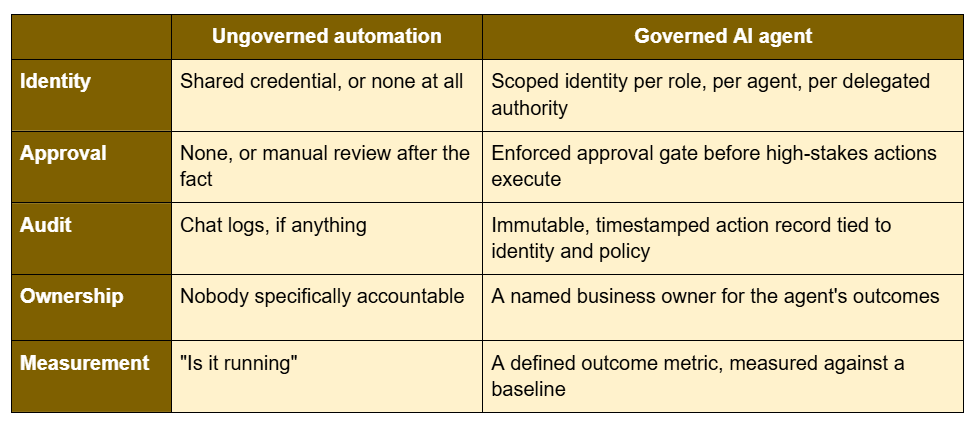
That last row matters more than it looks like it does. An agent that's technically running but isn't measured against a business outcome isn't governed — it's just unmonitored automation with better PR.
Why Enterprises Building Governed AI Choose Assistents.ai
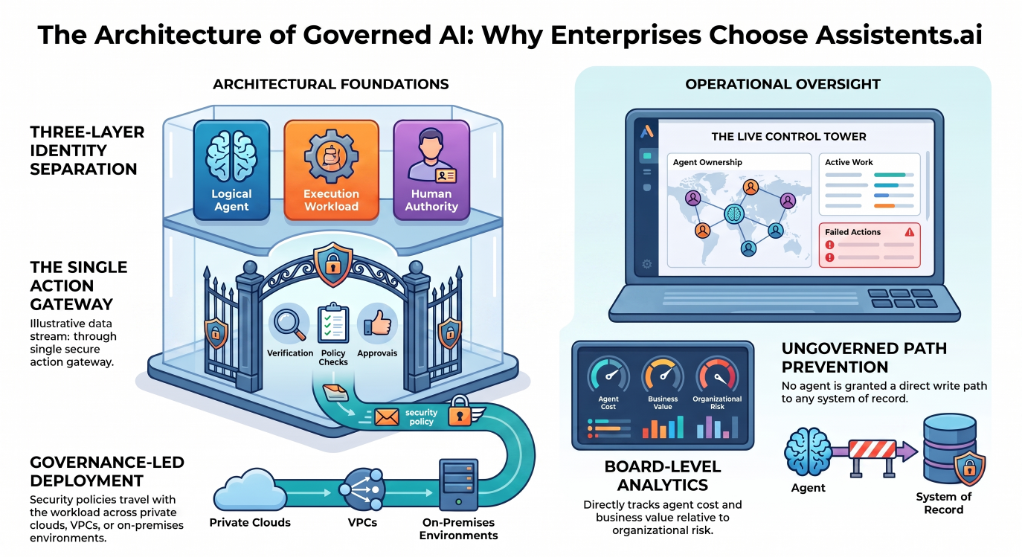
The governance mechanisms above aren't a coincidence across 12 different organizations — they reflect a specific architectural approach that assistents.ai was built around from the start.
Identity isn't bolted on. The platform separates three identity layers for every agent: the registered logical agent identity and its owner, the runtime workload identity actually executing the task, and the delegated business identity — the human or role the agent is acting on behalf of. That's the structural answer to "which agent did this, and on whose authority," and it's the same separation you saw driving the identity and escalation governance in the examples above.
Every state-changing action passes through one gate. Rather than each integration inventing its own ad hoc controls, every action an agent takes — creating a record, sending a communication, posting a transaction — runs through a single Action Gateway: identity verification, policy check, required approval, execution with an idempotency key, verification that the change actually took effect, and a recorded action receipt. No agent gets a direct, ungoverned write path to a system of record.
Governance travels with the deployment, not around it. assistents.ai deploys in private cloud, customer VPC, or fully on-premises, with customer-managed encryption keys where regulation requires it. For the regulated examples above — banking, healthcare, tax research — that matters: the governance model doesn't change depending on where the workload runs.
One control tower answers the questions a board actually asks. Which agents exist and who owns them? What work are they doing right now? Which actions were denied or failed verification? What's the cost and business value relative to risk? That's not a report generated for an audit — it's a live operational view, the same category of control tower behind the logistics and cross-entity examples above.
If you want to see how this architecture maps to a specific operation you're running today, talk to our team or explore the full platform.
How to Evaluate an AI Governance Platform for Your Enterprise
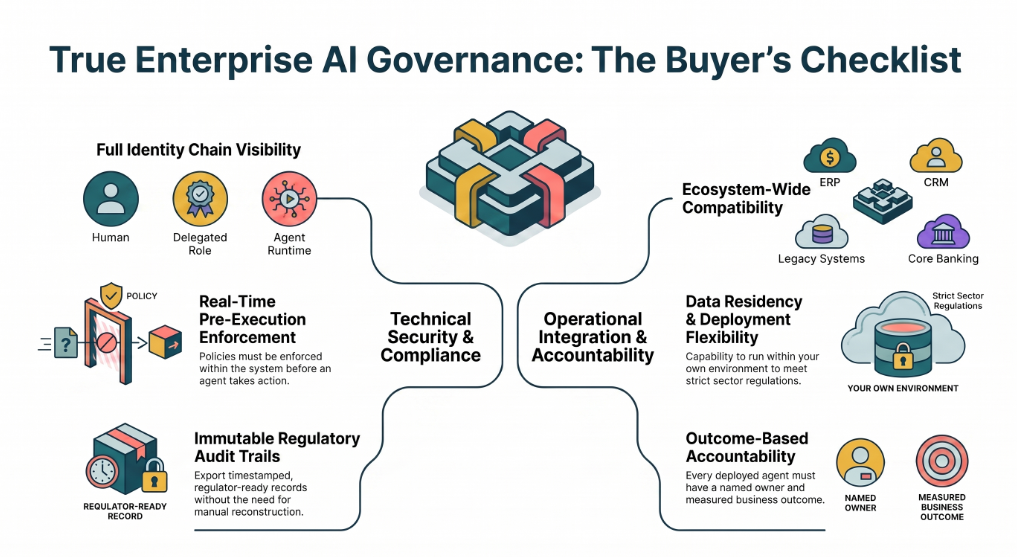
If you're comparing platforms rather than reading case studies, these are the questions worth asking every vendor — the same questions that separated the examples above from a typical pilot that never left the sandbox:
- Can it show a full identity chain — human, delegated role, agent, runtime — for any action an agent took, not just a chat transcript?
- Does approval happen before execution, enforced in the system, or is it a policy written in a document that nothing actually checks?
- Can it export an immutable, timestamped audit trail your compliance team could hand to a regulator without needing to translate or reconstruct it?
- Does it work across the systems you already run — ERP, CRM, core banking, whatever your systems of record are — without requiring you to replace them first?
- Can it run inside your own environment if data residency or sector regulation requires it?
- Is there a named accountable owner and a measured business outcome for every deployed agent — or just a usage count?
If a platform can't answer most of these concretely, it's not offering AI governance for enterprise — it's offering an AI feature with a governance page.
The Difference Between Governance in a Deck and Governance in Production
Here's what the research behind this article actually turned up: most content on "AI governance examples" today is either a hypothetical ("a global bank," "a healthcare firm might…") or a post-mortem written after something went wrong — a biased lending model, a lawsuit, a data leak. Useful as cautionary reading, but not proof that governance works when it's designed in from the start.
The 12 examples above aren't illustrations. They're anonymized, but they're real, currently-running production deployments — spanning regulated and unregulated industries, spanning India, the UAE and wider Middle East, the UK, and North America, and spanning identity governance, approval workflows, audit trails, cross-entity standardization, and control-tower oversight. A governance platform that only works for one industry, one region, or one type of workflow isn't actually a governance platform — it's a point solution wearing a compliance label.
That's the real positioning difference: assistents.ai isn't a chatbot with a policy page attached to it. It's the governed system that manages what a hybrid human-and-AI workforce is allowed to do — and the proof of that isn't a roadmap slide, it's the production deployments running today across dozens of enterprises. If you want to see how this applies to your own operation, explore our case studies or start a conversation with our team.
FAQs
What is AI governance for enterprise?
AI governance for enterprise is the set of controls — identity, policy, approval, audit, and outcome measurement — that determine what an AI system or AI agent is allowed to do inside an organization, who is accountable when something goes wrong, and how that accountability is enforced in practice rather than just written down.
How is AI agent governance different from traditional AI governance?
Traditional AI governance largely controls what a model is allowed to say — content policies, output filters, bias review. AI agent governance controls what an agent is allowed to do once it can plan, choose tools, and take real actions inside enterprise systems — access, permissions, approval gates, and audit trails on the action itself, not just the output.
What are real examples of AI governance in large organizations?
Real examples include scoped agent identity at a national retail chain, approval-gated sales order automation replacing a legacy system, evidence-first research output in tax and compliance workflows, escalation-boundary customer service agents in real estate, and control-tower oversight across global logistics operations — see the 12 examples above for the full set, each with the specific governance mechanism named.
What should an enterprise AI governance checklist include?
At minimum: a full identity chain for every agent action, an enforced approval gate for high-stakes actions, an immutable and exportable audit trail, integration with existing systems of record rather than a replacement of them, deployment flexibility for regulated data, and a named accountable owner with a measured business outcome for every deployed agent.
Do regulated industries like banking and healthcare need a different governance approach?
The core mechanisms — identity, policy, approval, audit, outcome measurement — are the same. What changes is the strictness of the approval gates, the depth of the audit trail required for a regulator, and often the deployment model, since regulated data frequently needs to stay inside a private cloud, customer VPC, or on-premises environment rather than a shared SaaS instance.
How do enterprises audit what an AI agent actually did?
Through an action receipt recorded at the moment of execution — capturing the identity that acted, the policy that was checked, the approval that was granted (if required), and the verified outcome — rather than reconstructing intent after the fact from logs that weren't designed for audit in the first place.

Transform Your Business With Agentic Automation
Agentic automation is the rising star posied to overtake RPA and bring about a new wave of intelligent automation. Explore the core concepts of agentic automation, how it works, real-life examples and strategies for a successful implementation in this ebook.
Sarfraz Nawaz is the CEO and founder of Ampcome, which is at the forefront of Artificial Intelligence (AI) Development. Nawaz's passion for technology is matched by his commitment to creating solutions that drive real-world results. Under his leadership, Ampcome's team of talented engineers and developers craft innovative IT solutions that empower businesses to thrive in the ever-evolving technological landscape.Ampcome's success is a testament to Nawaz's dedication to excellence and his unwavering belief in the transformative power of technology.

More insights
Discover the latest trends, best practices, and expert opinions that can reshape your perspective




.jpg)

.webp)
Contact us

