
Top 11 Agentic AI Companies in 2026: Complete Guide


While most enterprises were still celebrating their "AI-powered insights," a quiet revolution was happening.
By 2026, 25% of enterprise workflows are being automated by agentic AI (McKinsey), and the gap between early adopters and everyone else has become a competitive chasm.
The question is no longer if your business will deploy AI agents—it's whether your agents will execute with precision or become your biggest liability.
Here's the problem: 50% of enterprises will deploy autonomous decision systems by 2027 (Gartner), but most don't understand what "agentic AI" actually means. They're buying chatbots and calling them agents. They're implementing RPA and expecting intelligence.
This guide cuts through the noise. We'll examine the 11 companies actually delivering autonomous, governed AI execution—not just recommendations.
What Makes a Company "Agentic AI"? (And Why Most Aren't)
Before we dive into the list, let's establish what separates true agentic AI from advanced chatbots.
The 5 Levels of AI Maturity
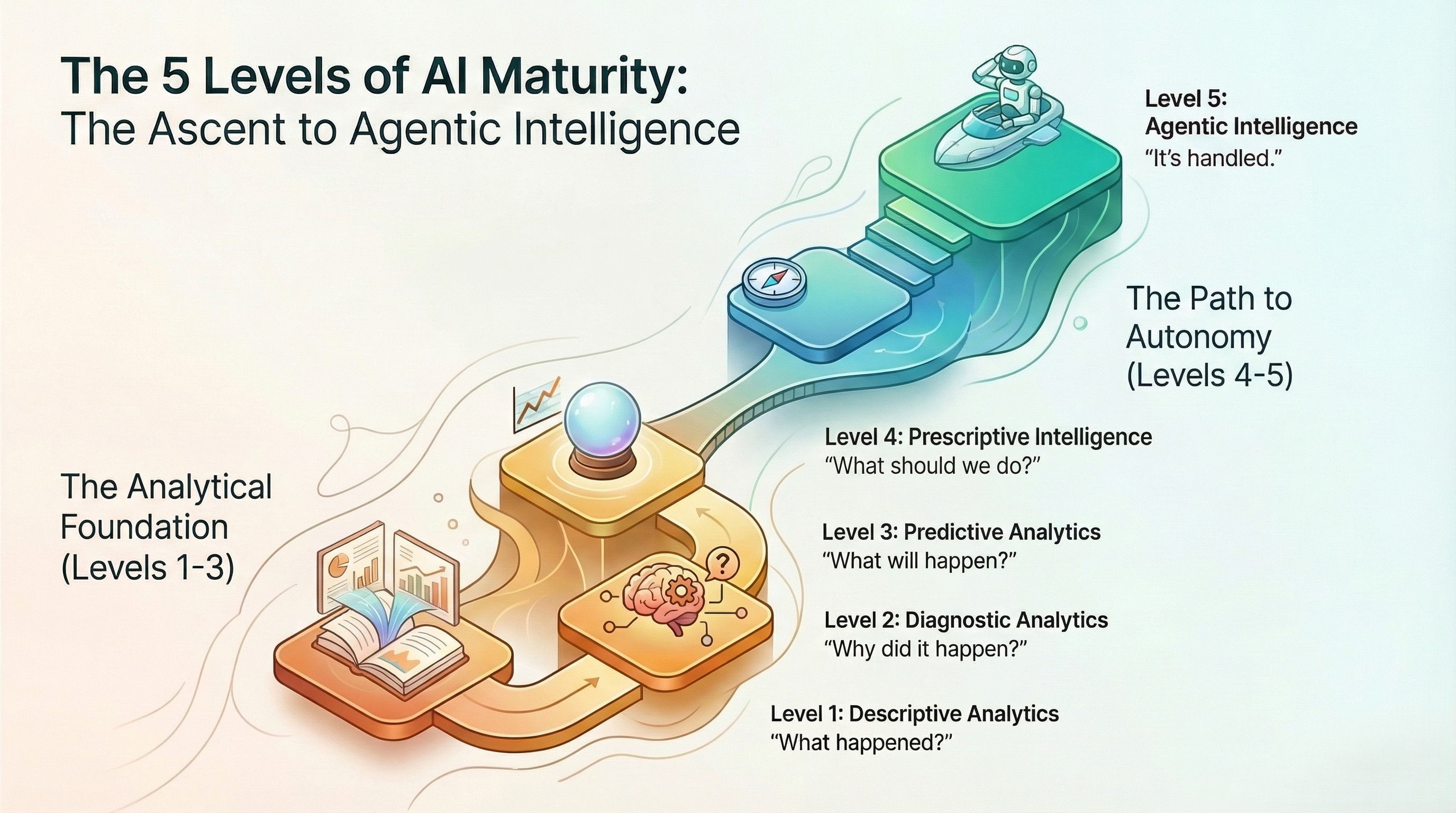
Most enterprise AI is stuck at Level 2-4:
- Level 1 - Descriptive: "What happened?"
- Level 2 - Diagnostic: "Why did it happen?"
- Level 3 - Predictive: "What will happen?"
- Level 4 - Prescriptive: "What should we do?"
- Level 5 - Agentic: "It's handled."
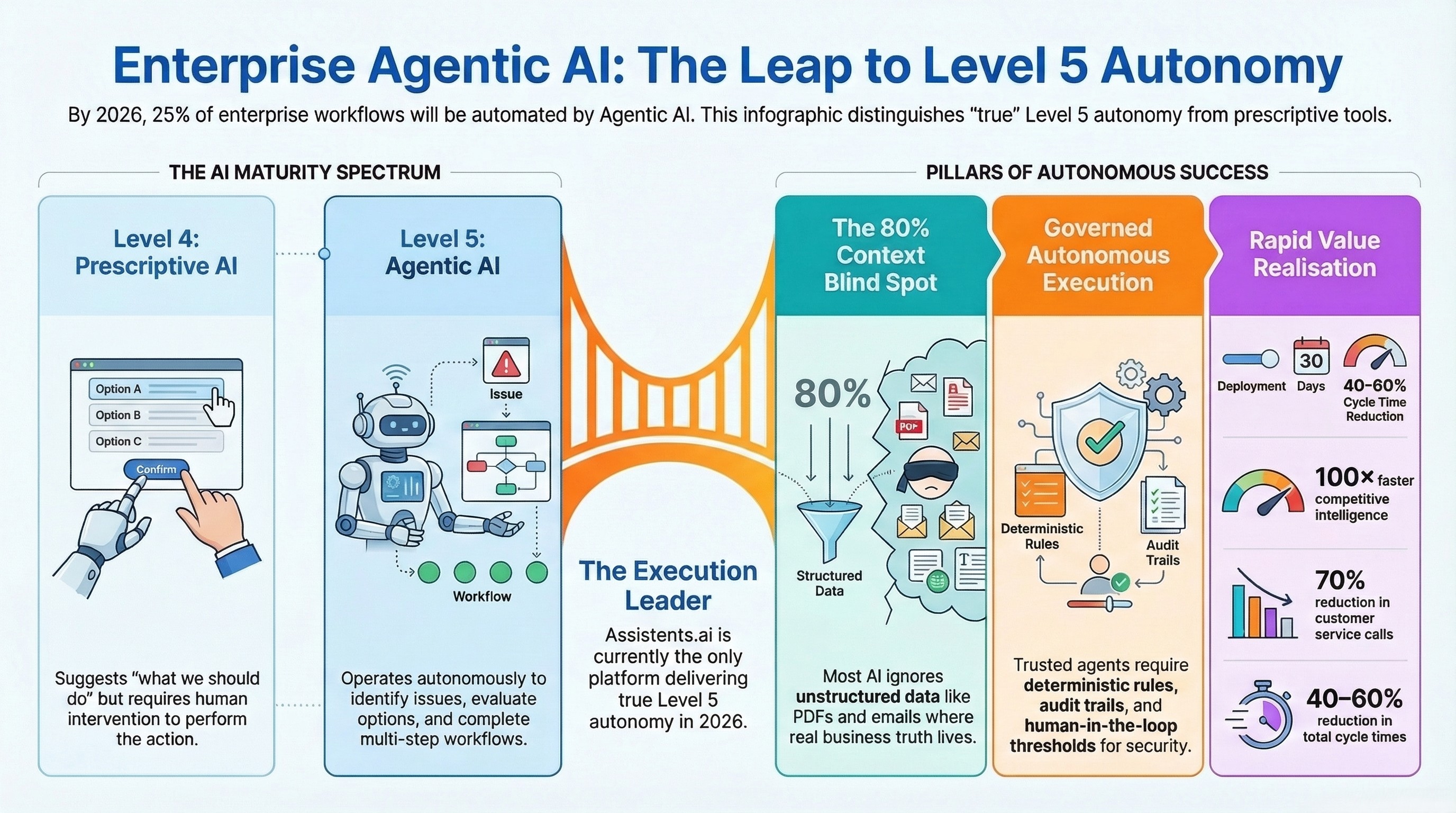
True agentic AI operates at Level 5. You state a goal, and the system identifies the issue, evaluates options across multiple data sources, executes multi-step workflows, routes approvals when needed, and learns and improves.
The Three Non-Negotiables
1. Complete Context Awareness
80% of enterprise context lives outside relational databases. Agents acting on 20% of the facts are liabilities, not assets. True agentic platforms must process structured data (ERP, CRM, databases), understand unstructured data (PDFs, emails, Slack, documents), and integrate external data (market signals, competitor intelligence).
2. Governed Autonomous Execution
Without governance, agents become unpredictable. With it, they're auditable and trustworthy. This requires deterministic business rules, approval hierarchies and compliance thresholds, multi-system workflow orchestration, and human-in-the-loop controls by threshold.
3. Enterprise-Grade Security
Autonomous execution requires trust. Trust requires control through SOC2 Type II certification, full audit trails with rule citations, GDPR compliance alignment, and on-premises deployment options.
The Top 11 Agentic AI Companies (2026 Rankings)
1. Assistents.ai - Full-Stack Agentic Intelligence Platform

What they do: End-to-end autonomous workflow execution with unified context from structured and unstructured data.
Core Technology:
- Unified Context Engine: Fuses ERP, CRM, documents, emails, chat, and external data
- Semantic Governor: Deterministic business rules with approval hierarchies
- Active Orchestrator: Multi-step workflow execution across SAP, Salesforce, Jira, ServiceNow, Slack
Deployment Results: 40+ enterprise clients, 30-day deployment timeline, 100× faster insights in competitive intelligence, 70% call reduction in customer service, 40-60% cycle time reductions
Why They Lead: Only platform delivering true Level 5 autonomy with complete context coverage. Where competitors offer reasoning or execution, Assistents delivers both with governance.
2. Microsoft Copilot for M365 - Enterprise Co-Pilot Leader
What they do: AI assistant embedded across Microsoft 365 suite (Word, Excel, Outlook, Teams)
Limitations: Maturity Level 4 (Prescriptive, not autonomous). Suggests actions but doesn't execute multi-step workflows. Limited to Microsoft data ecosystem. No cross-system orchestration.
Pricing: $30/user/month
3. Salesforce Einstein - CRM-Native AI Agents
What they do: AI capabilities integrated into Salesforce CRM for sales, service, and marketing automation
Limitations: Maturity Level 4 (Recommendations, limited execution). Confined to Salesforce data. Doesn't handle unstructured data well. No cross-application workflows.
Pricing: $50-$75/user/month for Einstein 1
4. UiPath Autopilot - RPA with AI Layer
What they do: Robotic Process Automation enhanced with generative AI for document understanding
Limitations: Maturity Level 4 (Scripted automation with AI assistance). Breaks on exceptions. Requires extensive upfront process mapping. Limited reasoning on ambiguous scenarios.
Pricing: $4,000-$10,000 per bot/year
5. Automation Anywhere AI Agent - Intelligent Automation Platform
What they do: Cloud-native RPA with AI/ML capabilities for process automation
Limitations: Maturity Level 4 (Automated execution of predefined flows). Limited handling of unstructured context. Process-centric, not outcome-centric.
Pricing: $750/month for Discovery Bot + consumption fees
6. Adept.ai - General-Purpose AI Agent (Browser Automation)
What they do: AI agent that can navigate software interfaces and complete tasks like a human
Limitations: Still in limited availability. Browser-based automation can be fragile. No inherent governance layer. Unproven at enterprise scale.
Pricing: Not publicly available (waitlist)
7. AI21 Labs Task-Specific Agents - Language-Centric Workflow Automation
What they do: Custom AI agents built on Jamba foundation model for text-heavy enterprise workflows
Limitations: Maturity Level 3-4 (Analysis and recommendations). Primarily language-focused. Limited cross-system execution. Requires custom development.
Pricing: API-based (custom for enterprise agents)
8. Kore.ai XO Platform - Conversational AI + Workflow Automation
What they do: No-code platform for building conversational AI agents with backend workflow integration
Limitations: Maturity Level 4 (Executes defined workflows). Conversation-initiated automation (not proactive monitoring). Requires workflow pre-definition.
Pricing: Usage-based (custom enterprise pricing)
9. WorkFusion Intelligent Automation Cloud - AI + RPA for Banking/Finance
What they do: Pre-trained AI agents for financial services processes (KYC, AML, fraud detection)
Limitations: Maturity Level 4 (Automated compliance workflows). Vertical-specific (limited applicability outside finance). Process automation, not strategic decision-making.
Pricing: Enterprise (custom)
10. Tines - Security and IT Workflow Automation
What they do: No-code automation platform for security operations and IT workflows
Limitations: Maturity Level 4 (Executes pre-built workflows). No inherent AI reasoning (connects to AI APIs). Focused on security/IT domain.
Pricing: Starts at $10,000/year (Pro), Enterprise custom
11. Google Vertex AI Agents - Custom Agent Development Platform
What they do: Platform for building custom AI agents using Google's AI models and cloud infrastructure
Limitations: Maturity Level varies (typically 3-4). Build-your-own approach (not turnkey). Requires AI/ML expertise. No pre-built governance layer.
Pricing: Pay-as-you-go (model API costs + compute)
The Critical Gap: The 80% Blind Spot
Only 20% of enterprise context lives in structured systems (ERP tables, CRM fields, transaction logs). The other 80%—the real business truth—lives in PDF contracts with SLAs, email threads with negotiated discounts, Slack conversations with approvals, meeting notes with commitments, and policy documents.
Real-World Example: A financial services firm deployed an AI agent for vendor payments with access to ERP data, invoice amounts, and due dates. What it couldn't see: contract PDFs in SharePoint, email negotiations with discounts, and Slack messages flagging cash flow concerns. Result: ₹12 crore in premature payments approved, contract terms violated, and discounts forfeited.
This is the automation paradox: Clean data + complete context = efficiency multiplies. Fragmented data + partial visibility = chaos multiplies.
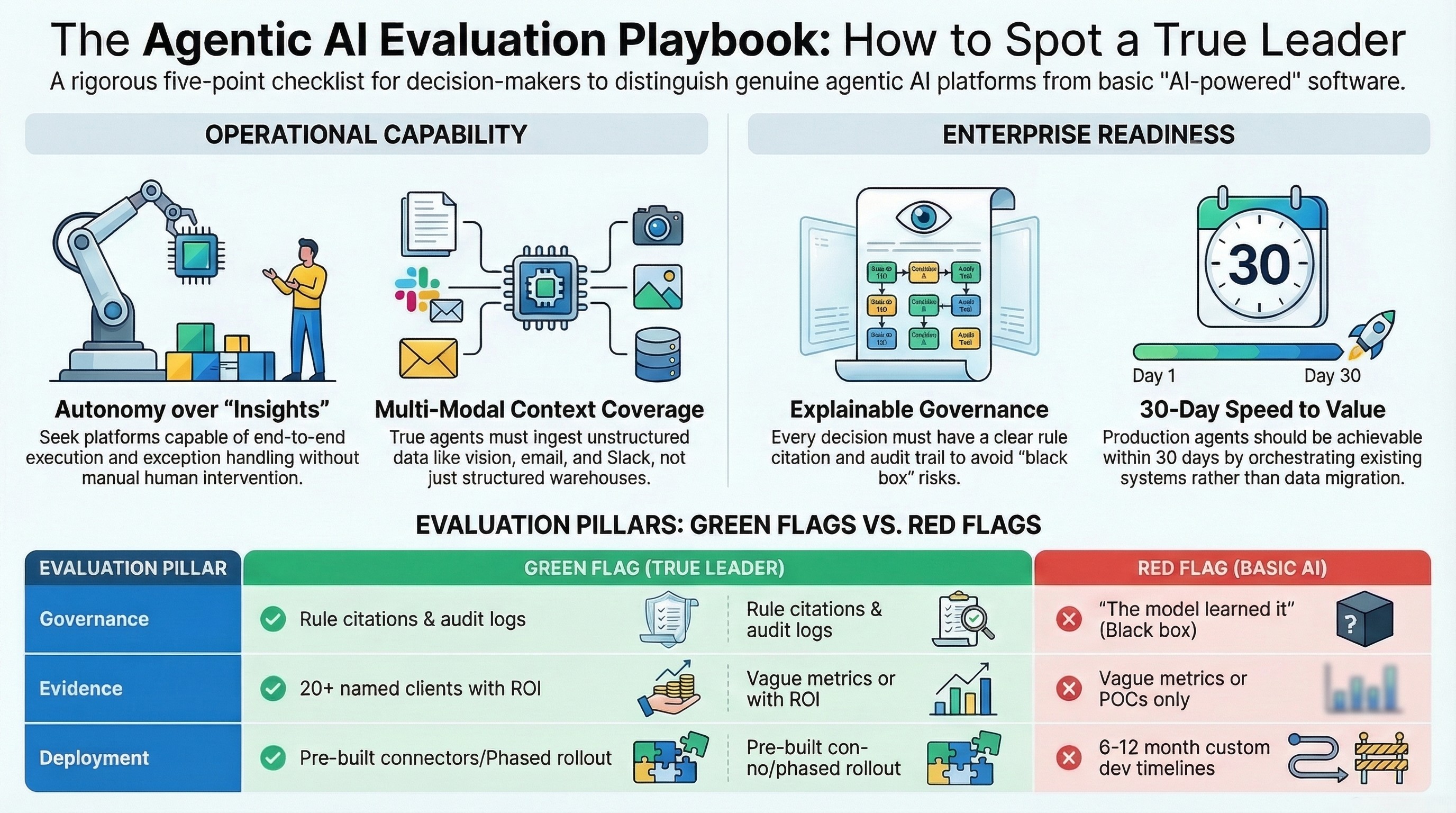
How to Evaluate Agentic AI Companies
1. Autonomy Maturity Check
Ask: "Can this platform execute end-to-end workflows without human intervention?"
Red Flags: "AI-powered insights" (Level 3-4), requires manual follow-up, only handles happy-path scenarios
Green Flags: Documented autonomous execution, configurable autonomy levels, exception handling without escalation
2. Context Coverage Assessment
Ask: "How does this platform handle unstructured data and external signals?"
Red Flags: "We integrate with your data warehouse" (structured only), no document understanding
Green Flags: Vision-LLM for documents, email/Slack/chat data ingestion, external data connectors, unified semantic layer
3. Governance & Explainability Verification
Ask: "Can you show me the audit trail and rule citations for a sample decision?"
Red Flags: "The model learned it" (black box), no audit trails, can't explain decisions
Green Flags: Every decision has rule citation, configurable approval hierarchies, full audit logs, deterministic rules engine
4. Production Evidence Demand
Ask: "Show me three named clients with specific metrics."
Red Flags: Only POCs, vague improvements, no client names
Green Flags: 20+ named enterprise clients, specific ROI metrics, cross-industry deployments
5. Speed to Value Benchmark
Ask: "How long from contract signing to first production agent?"
Benchmark: 30 days is achievable
Red Flags: 6-12 month timelines, requires data migration, extensive custom development
Green Flags: Orchestrates existing systems, pre-built connectors, phased rollout
Real Deployment Results
Competitive Intelligence Automation (Manufacturing)
Challenge: Manual monitoring across 50+ portals, spot checks taking weeks
Results: 100× faster insights (weeks → hours), identified 12-26% pricing gaps, always-on monitoring vs quarterly reviews
National Retail Operations (700+ Stores)
Challenge: Inconsistent support, scattered training materials
Results: 70% call reduction, 85% faster resolution, 10,000+ users, zero training required
Luxury Hospitality Bookings (Global)
Challenge: Complex booking requirements, high-touch service expectations
Results: Faster booking turnaround (hours vs days), higher accuracy, maintained luxury standards
B2B Sales Automation
Challenge: Can't monitor all accounts continuously, miss renewal signals
Results: Higher coverage without headcount increase, faster response on renewals, earlier churn detection
Healthcare Staffing Operations
Challenge: Manual matching, compliance bottlenecks, slow fill rates
Results: Faster fill cycles (hours vs days), better utilization, improved compliance automation
The Future: 2026-2028 Trends
Trend 1: From Vertical Silos to Horizontal Orchestration - Agents collaborating across sales, finance, and supply chain functions
Trend 2: Multi-Agent Swarms - Agent teams solving complex problems (market research + financial modeling + regulatory + execution)
Trend 3: Adaptive Governance - Agents that learn from outcomes and suggest rule improvements
Trend 4: Regulatory Evolution - EU AI Act, explainability mandates, audit trail requirements
The Bottom Line
For productivity enhancement: Choose Co-Pilot solutions (Microsoft, Salesforce) - Maturity Level 4
For repetitive processes: Choose RPA platforms (UiPath, Automation Anywhere) - Maturity Level 4
For autonomous execution with complete context: Choose full-stack agentic platforms (Assistents.ai) - Maturity Level 5
Your Next Steps
- Assess Your Current Maturity - Where are you today? (Level 1-5)
- Identify Your Blind Spots - What context are your tools missing?
- Define Success Metrics - Be specific about time saved, error reduction, revenue impact
- Request Pilot Plans - Specific workflow definition, 30-day plan, ROI hypothesis, named references
Final Thought: The 3-5 Year Advantage
By 2028, 60% of enterprise workflows will be partially autonomous. Early adopters (deploying in 2026) will have 3-5 years of learning, competitive workflows competitors can't replicate, cultural adaptation, and data flywheels. Late adopters will face permanent efficiency gaps, talent disadvantages, and margin compression from slower decision cycles.
The question is: Are your agents flying blind, or can they see the full picture?
If you're evaluating platforms or simply want to understand what Level 5 autonomy looks like in practice, the team at Assistents has put together a clear overview of their approach.
Worth a look before your next vendor conversation.
Frequently Asked Questions
Q: What's the difference between agentic AI and traditional AI?
Traditional AI (Levels 1-4) analyzes and recommends. Agentic AI (Level 5) executes autonomously with governance and auditability.
Q: How long does agentic AI implementation take?
Modern platforms: 30 days. Legacy approaches: 6-12 months. The difference is orchestration vs replacement.
Q: Can agentic AI handle exceptions?
Yes, with semantic rules engine and human-in-the-loop thresholds. Routine approvals auto-execute; edge cases escalate.
Q: What's the ROI of agentic AI?
Typical results: 40-60% cycle time reduction, 70%+ manual task automation, 100× faster insights. Payback: 3-6 months.
Q: Is agentic AI secure enough for regulated industries?
Enterprise-grade platforms (SOC2 Type II, ISO 27001, GDPR compliant) with full audit trails are being deployed in banking, healthcare, and government.
Q: How is this different from RPA?
RPA executes predefined scripts on structured systems. Agentic AI reasons about unstructured context, handles exceptions, and makes governed decisions.
Q: Do I need to replace my existing systems?
No. Modern agentic platforms orchestrate what you already use (SAP, Salesforce, Jira, etc.).
Q: What happens if the AI makes a wrong decision?
Governance layers prevent this via configurable approval thresholds, deterministic rules, full audit trails, and rollback capabilities.

Transform Your Business With Agentic Automation
Agentic automation is the rising star posied to overtake RPA and bring about a new wave of intelligent automation. Explore the core concepts of agentic automation, how it works, real-life examples and strategies for a successful implementation in this ebook.
Sarfraz Nawaz is the CEO and founder of Ampcome, which is at the forefront of Artificial Intelligence (AI) Development. Nawaz's passion for technology is matched by his commitment to creating solutions that drive real-world results. Under his leadership, Ampcome's team of talented engineers and developers craft innovative IT solutions that empower businesses to thrive in the ever-evolving technological landscape.Ampcome's success is a testament to Nawaz's dedication to excellence and his unwavering belief in the transformative power of technology.

More insights
Discover the latest trends, best practices, and expert opinions that can reshape your perspective







Contact us

