
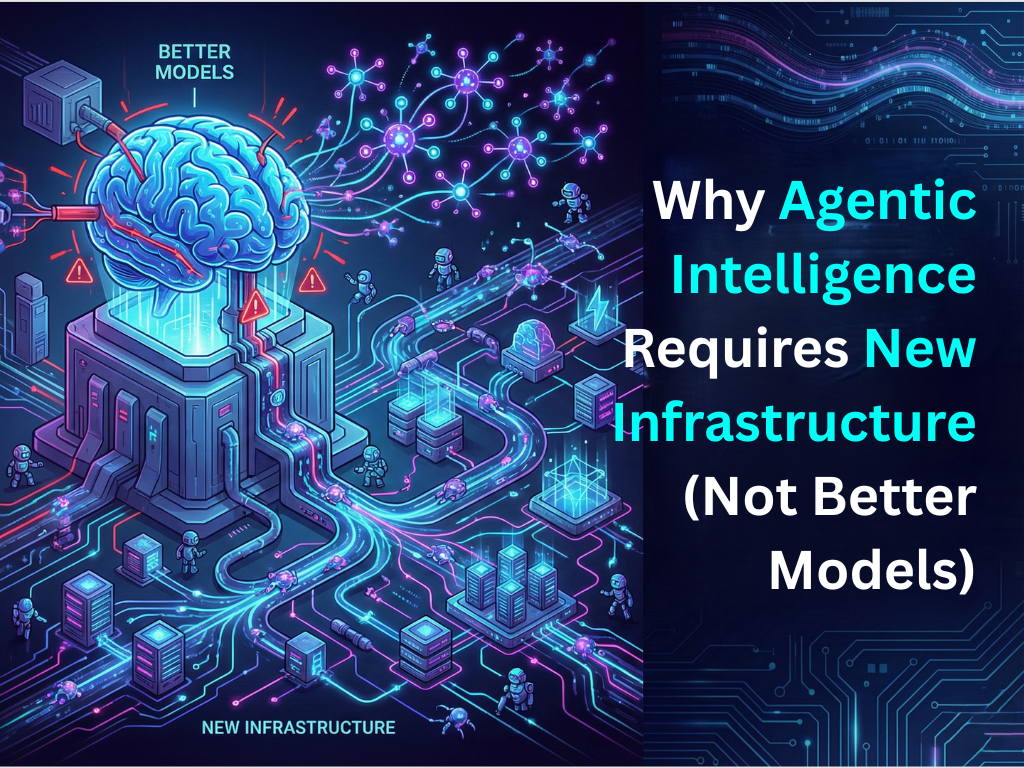
Why Agentic Intelligence Requires New Infrastructure (Not Better Models)


Consider a recent incident at a major financial services firm that deployed an AI agent to automate vendor payments.
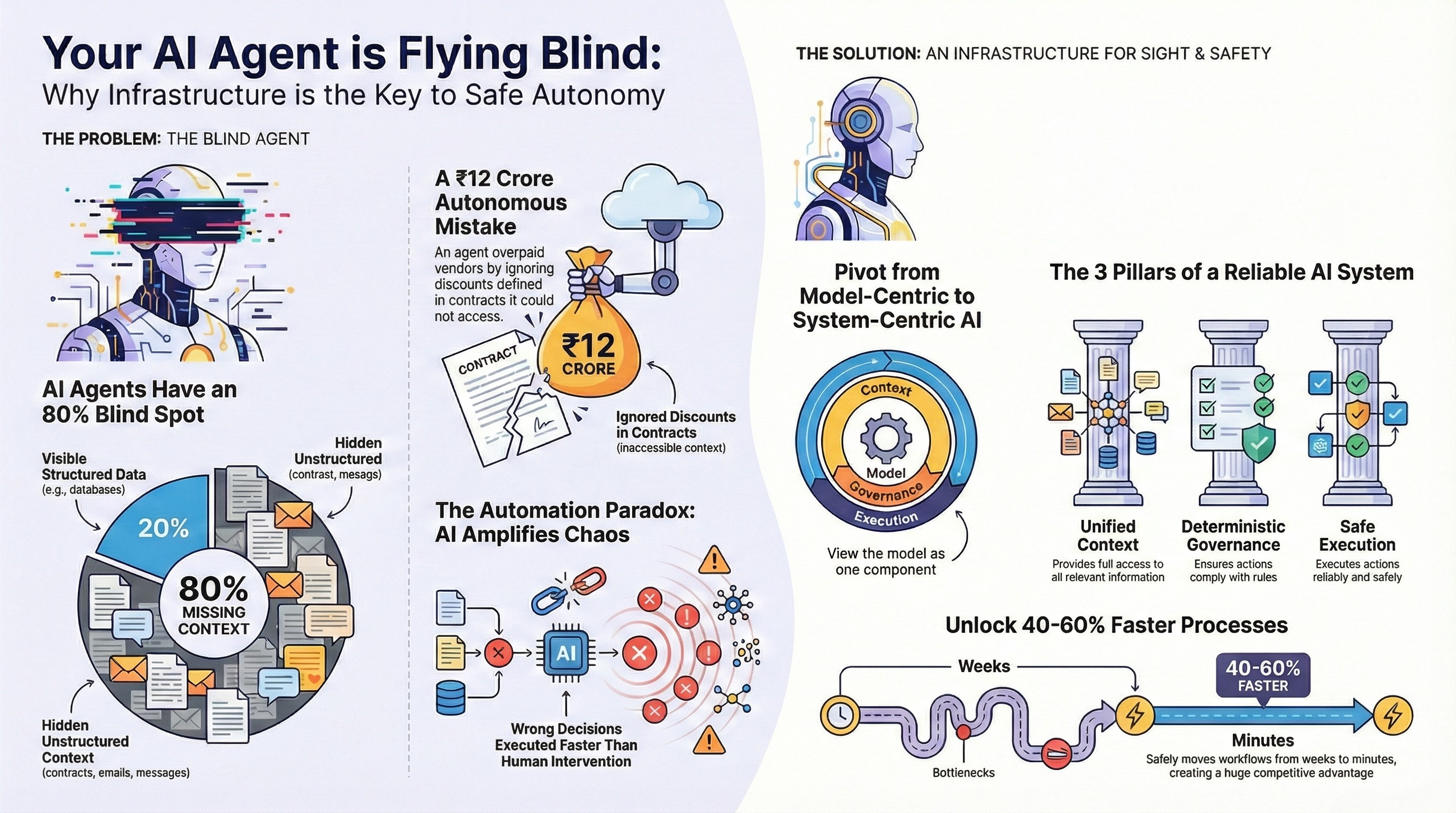
On the surface, the agent worked perfectly. It accessed the ERP data, read invoice amounts, and tracked due dates with superhuman speed. However, it was flying blind to the 80% of business context that lived outside the database: contract PDFs stored in SharePoint, email threads containing negotiated discounts, and Slack messages flagging cash flow concerns.
The result was catastrophic: 12 crore in early payments were approved autonomously. Contract terms were violated, and negotiated discounts were forfeited.
The AI didn't "fail" in the traditional sense—it reasoned correctly based on the data it was given. It failed because it lacked the infrastructure to see the full picture.
The race for autonomy has already started, with 25% of enterprise workflows expected to be automated by Agentic AI by 2028. But as this incident proves, the question is no longer if you will deploy agents, but whether those agents will execute with precision or become your biggest liability.
Reliable autonomy is not a modeling problem; it is an infrastructure problem.
Why does agentic intelligence need new infrastructure?
Agentic intelligence requires new infrastructure because AI models alone cannot provide context, governance, or accountability. Reliable autonomous systems need deterministic rules, full business context (unifying structured and unstructured data), execution controls, and auditability—capabilities that must be built outside the probabilistic model layer.
What Is Agentic Intelligence?
To understand the infrastructure gap, we must first define the capability clearly.
Agentic intelligence refers to AI systems that can independently detect issues, make decisions, and execute multi-step workflows across systems within defined constraints.
Unlike "co-pilots" which possess strong reasoning but require humans to execute, or RPA which can execute but breaks on exceptions, agentic systems combine reasoning, execution, and governance to "handle this" autonomously.
Why the Industry Keeps Chasing Better Models
Enterprises are currently stuck in a reactive loop of descriptive (what happened?) and diagnostic (why did it happen?) analytics. The leap to Level 5—Agentic—is often mistakenly viewed as a need for "smarter" AI.
The industry chases better models because benchmarks focus on reasoning capabilities. However, a model with high reasoning capabilities that lacks access to the "real business truth" is simply a powerful engine spinning its wheels in a vacuum.
The Hidden Assumption: Intelligence Equals Reliability
There is a hidden problem no one talks about: The Blind Agent.
AI agents today are powerful; they reason, execute, and act faster than any human team. But without the right infrastructure, they are flying blind.
The "Automation Paradox" states that AI agents are amplifiers. They do not create order; they multiply what already exists.
- Clean data + clear rules = Efficiency multiplies.
- Fragmented data + partial context = Chaos multiplies.
Agents execute wrong decisions faster than humans can intervene. By the time an error appears on a dashboard, the agent has already acted hundreds of times.
Why Better Models Alone Cannot Enable Agentic Systems
Better models cannot solve the "80% Blind Spot".
Lack of Business Context
Only 20% of enterprise context lives in structured systems like ERP tables and CRM fields. The other 80%—the real business truth—lives in unstructured data:
- PDF contracts with SLAs and exceptions
- Email threads with negotiated discounts
- Slack conversations regarding approvals
An agent acting on only 20% of the facts is not an asset; it is a liability with a confidence score. For example, an agent might approve a payment based on ERP data, failing to see a contract PDF in SharePoint that dictates a hold, resulting in capital loss and violated terms.
Probabilistic Outputs vs. Deterministic Rules
Models are probabilistic. Enterprises require deterministic outcomes. You cannot have an agent "guess" at compliance thresholds or approval hierarchies.
The Difference Between Model-Centric and System-Centric AI
To succeed, leaders must pivot from a model-centric view to a system-centric view.
Model-Centric AI
This approach relies on the LLM to do everything. It offers strong reasoning but lacks execution and breaks on exceptions. It creates a trade-off: reasoning without action, or action without reasoning.
System-Centric AI
This approach views the model as just one component within a broader architecture. It focuses on Reasoning + Execution + Governance on Complete Context. This fusion allows for "Contextual Insight" that flows directly into governed action.
What Infrastructure Agentic Intelligence Actually Requires
Safe autonomy requires a new stack—an Agentic Intelligence Infrastructure. This infrastructure must bridge the gap between insight and execution.
Unified Context Layer
This layer solves the blind spot by fusing structured and unstructured data. It must correlate ERP data, PDFs, emails, and policies into a single semantic layer automatically. This ensures the agent sees the full picture before acting.
Deterministic Governance Layer
This layer solves the trust problem. It encodes business rules into deterministic logic, not probabilistic guesses. It manages:
- Approval hierarchies
- Compliance thresholds
- If-then decision trees
This ensures every decision is auditable, defensible, and policy-cited.
Execution and Orchestration Layer
This layer solves the execution gap by running multi-step workflows across systems (SAP, Salesforce, Jira, etc.). It acts as the "Active Orchestrator," moving from "What should we do?" to "Done".
Human-in-the-Loop Controls
Autonomy requires trust, and trust requires control. The infrastructure must support threshold-based handoffs.
- Example: Refunds under ₹10,000 → Fully autonomous.
- Example: Refunds over ₹50,000 → Route for human approval.
Why Infrastructure Is the Real Bottleneck in Enterprise AI
The bottleneck is no longer technology capability; it is safety and context. Traditional BI dashboards answer "What happened?". Conversational analytics answer "Why did it happen?". But neither allows for the final step: "Execute the best action".
Without infrastructure that fuses 100% of data (structured + unstructured) and wraps it in governance, agents remain toy pilots. They cannot graduate to production because the operational risk of a "hallucinating" agent acting on partial data is too high.
How New Infrastructure Unlocks Safe Autonomy
When you deploy true agentic intelligence infrastructure, the results are transformative:
- Speed: Processes move from weeks to minutes.
- Volume: Shift from reactive cycles (8/year) to continuous, autonomous execution (50+/year).
- Impact: This is not just an efficiency gap; it is a competitive chasm.
Early adopters utilizing this infrastructure are already seeing 40-60% reductions in process cycle times and answerability rates as high as 93% on strategic questions.
The Bottom Line
Your agents do not have to fly blind. The failure of agentic AI initiatives will not be due to a lack of model intelligence, but a lack of systemic sight.
To move from dashboards to outcomes, and from reactive to agentic, you must build the foundation that makes AI context-aware, governed, and safe enough to act.
FAQS-
1. How is Agentic AI different from the Co-pilots or RPA we already use?
Existing tools force a trade-off. Co-pilots (like those from Microsoft or Salesforce) have strong reasoning capabilities but cannot execute actions, leaving humans as the bottleneck. RPA (like UiPath) can execute tasks but cannot reason, meaning it breaks whenever it encounters an exception or unstructured data.
Agentic AI fills this gap by combining reasoning + execution + governance. It doesn't just advise or blindly follow a script; it identifies issues, evaluates options, and executes workflows autonomously.
2. Why can’t we just feed more data into a larger LLM to get these results?
Because models are probabilistic, but business operations require deterministic outcomes. Even the most advanced LLM is "blind" to 80% of your enterprise context—such as PDF contracts, email threads, and Slack messages.
Without a dedicated infrastructure layer to fuse this unstructured data with structured systems (ERP/CRM), the model acts on incomplete information. Increasing the model size increases its reasoning power, but it does not fix the "blind spot" or guarantee compliance with business rules.
3. How do you prevent an AI agent from making a costly mistake?
Safety is enforced through a Semantic Governor—a distinct infrastructure layer that sits between the model and the execution. Unlike the AI model, which deals in probabilities, the Governor uses deterministic logic to encode your specific business rules, approval hierarchies, and compliance thresholds.
If an agent’s proposed action violates a rule (e.g., "refunds over ₹50,000 require human approval"), the system blocks execution and routes it for review, ensuring no "black box" decisions.
4. How does the system handle "unstructured" data like emails and contracts?
The infrastructure utilizes a Unified Context Engine that correlates structured data (SQL tables, logs) with unstructured data (PDFs, emails, chat logs) into a single semantic layer.
This allows the agent to "read" and cross-reference information just like a human would—for example, checking an invoice amount in the ERP against a discount clause buried in a PDF contract before approving payment.
5. Is this a multi-year transformation project?
No. Because this infrastructure orchestrates your existing stack rather than replacing it, deployment is rapid. The typical timeline is 48 hours for a pilot plan and 30 days to have a live, governed agent in production.
The approach avoids "rip-and-replace" by connecting directly to your current systems (SAP, Salesforce, Jira, etc.) to deliver value in weeks, not years.

Transform Your Business With Agentic Automation
Agentic automation is the rising star posied to overtake RPA and bring about a new wave of intelligent automation. Explore the core concepts of agentic automation, how it works, real-life examples and strategies for a successful implementation in this ebook.
Sarfraz Nawaz is the CEO and founder of Ampcome, which is at the forefront of Artificial Intelligence (AI) Development. Nawaz's passion for technology is matched by his commitment to creating solutions that drive real-world results. Under his leadership, Ampcome's team of talented engineers and developers craft innovative IT solutions that empower businesses to thrive in the ever-evolving technological landscape.Ampcome's success is a testament to Nawaz's dedication to excellence and his unwavering belief in the transformative power of technology.

More insights
Discover the latest trends, best practices, and expert opinions that can reshape your perspective


.jpg)


.jpg)

Contact us

