
AI Agents in Analytics: 11 High-Impact Use Cases Transforming Enterprise Decisions in 2026


Only 52% of business leaders struggle to drive business priorities with data. They are drowning in dashboards, reports, and delayed insights while competitors move faster. That gap is not caused by lack of data. It is caused by how analytics works today.
AI Agents in Analytics do not wait for someone to open a dashboard. They stay alert. They monitor signals continuously. They reason across structured numbers, written context, and external events. Then they surface what actually matters.
They detect patterns humans miss. They connect signals across systems humans do not monitor together. They surface insights early enough for action to matter.
In this blog, you will see 11 real enterprise use cases of AI Agents in Analytics that already exist today. These are not experiments. These are working patterns that founders, CIOs, and operators can apply.
By the end, you will understand why analytics is no longer a passive system and why AI Agents in Analytics are becoming the backbone of enterprise decisions in 2026.
What Are AI Agents in Analytics?
Traditional analytics collects structured data, usually numbers stored in tables. It aggregates that data, applies predefined rules, and displays the results in charts or reports.
It is good at answering questions like:
- What was revenue last quarter
- How many users signed up
- Which campaign had the highest clicks
But it fails when questions require reasoning, context, or explanation.
Traditional analytics does not understand language. It does not connect written feedback with numeric trends. It does not notice early signals unless someone explicitly looks for them.
This is where AI Agents in Analytics step in.
What conversational analytics adds and why it still falls short
Conversational analytics made analytics easier to access. You could ask questions in natural language instead of clicking through dashboards.
This improved speed, but not responsibility.
Conversational analytics still waits for a question. It still depends on humans to notice problems. It still stops at answers instead of actions.
Founders often assume conversational analytics equals intelligence. It does not. It only improves access.
AI Agents in Analytics change behavior, not just interface.
The real definition of AI Agents in Analytics
AI Agents in Analytics are autonomous, multi-step analytical systems that continuously:
- Detect changes across data sources
- Reason through why those changes occurred
- Recommend what actions should follow
- Support or execute those actions within defined boundaries
The key difference is autonomy with accountability.
AI Agents in Analytics do not wait for questions. They stay alert. They observe patterns. They escalate only when attention is required.
This is why AI Agents in Analytics are becoming central to enterprise decision systems.
The three core types of AI agents in analytics systems
Strong agentic analytics platforms use multiple agent types working together. Each serves a different role.
- Analytical agents
Analytical agents monitor structured data such as metrics, logs, transactions, and events. They detect anomalies, shifts, and trends.
But unlike traditional alerts, they reason before escalating. They check magnitude, impact, and relevance before surfacing anything.
This prevents alert fatigue and builds trust.
- Knowledge agents
Knowledge agents work with unstructured data. Emails. Documents. Support conversations. Policies. External news.
They extract meaning, sentiment, intent, and context. Then they connect that meaning to numeric changes observed by analytical agents.
This is how AI Agents in Analytics understand why something happened, not just that it happened.
- Workflow and execution agents
Workflow agents close the loop. They route insights into actions.
This could mean triggering workflows, preparing recommendations, notifying teams, or updating systems once approval is given.
Why Traditional BI Fails at Modern Analytics Problems
Traditional BI was built for a slower business environment. It works well when decisions can wait for weekly reviews or monthly reports. That assumption no longer holds true.
The biggest limitation of BI tools is their structured-data bias. They work almost entirely on tables and predefined schemas. Yet most enterprise insight lives outside those tables in emails, documents, chats, support tickets, contracts, and external signals. When analytics ignores this context, decisions are made with incomplete understanding.
Another issue is the lack of explanation. BI dashboards show what changed, not why it changed. When revenue dips or costs rise, teams manually drill down, compare charts, and debate causes. This delays response and increases reliance on assumptions.
BI also has no built-in path to action. Insights sit inside reports while execution happens elsewhere. By the time teams agree on next steps, conditions have already shifted.
How AI Agents Differ From Traditional Analytics at a Technical Level?
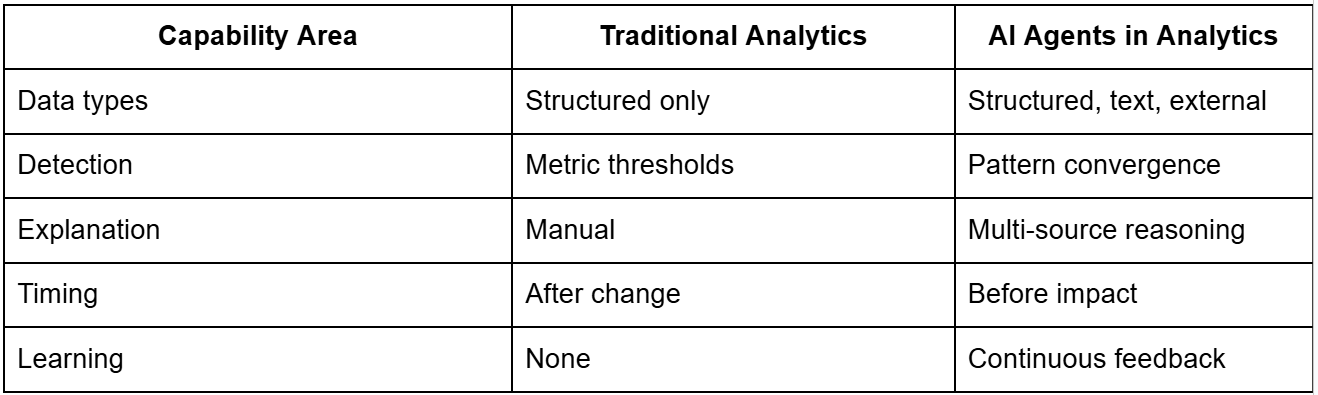
Top 11 High-Impact Use Cases of AI Agents in Analytics
AI agents in analytics become valuable when they take over tasks that humans cannot do consistently at scale. These use cases show how enterprises use agentic analytics to move from delayed understanding to timely decisions.
1. Autonomous Root-Cause Analysis
When a business metric changes, teams usually investigate inside one system at a time. AI agents analyze across systems in parallel.
An analytical agent detects a deviation in revenue or conversion. A knowledge agent scans support conversations, internal documents, and external signals. The system builds a causal explanation instead of isolated findings.
Example: A drop in renewals is linked to a billing policy change referenced only in internal emails and customer complaints. The agent surfaces this explanation without manual investigation.
2. Continuous Anomaly Detection With Explanation
Most anomaly detection systems only flag outliers. AI agents go further by explaining impact and cause.
Agents evaluate anomalies across multiple dimensions such as customer type, geography, time window, and sentiment. They rank anomalies by business impact instead of raw deviation.
Example:
An increase in login failures is traced to a specific browser update affecting a high-value customer segment, not overall traffic.
3. Decision-Oriented Forecasting
Traditional forecasting produces static projections. AI agents revise forecasts continuously as new signals arrive.
Agents incorporate external events, customer sentiment, operational constraints, and market behavior. Forecasts adjust as context changes, not on fixed schedules.
Example:
Revenue forecasts update mid-quarter after agents detect slowing sales cycles and rising hesitation in deal conversations.
4. Customer Sentiment Driven Analytics
Sentiment analysis becomes actionable when tied to outcomes.
AI agents track sentiment changes over time and correlate them with churn, expansion, and support load. The focus is on sentiment trajectory, not isolated scores.
Example:
Language in support tickets shifts from clarification requests to frustration signals. The agent flags churn risk before cancellation requests appear.
5. Supply Chain Risk Detection and Mitigation
Supply chain analytics often react after delays occur. AI agents monitor early risk signals.
Agents analyze logistics data, supplier communications, news events, and weather patterns. They evaluate probability and impact jointly.
Example:
An agent detects supplier risk due to regional transport disruptions mentioned in external reports and internal emails, prompting inventory reallocation.
6. Automated Insight-to-Action Workflows
Insights lose value when execution is slow. AI agents prepare actions as part of analysis.
Workflow agents trigger alerts, draft responses, or initiate system updates once predefined conditions are met. Human approval remains part of the loop.
Example:
When campaign efficiency drops beyond a threshold, the agent prepares a spend reallocation proposal with supporting reasoning.
7. Executive Decision Copilot
Executives need synthesized answers, not raw data.
AI agents perform multi-step analysis behind the scenes when leaders ask questions in natural language. The output includes explanation, trade-offs, and implications.
Example:
A CEO asks why margins are shrinking. The agent correlates pricing changes, supplier costs, and customer behavior into a single explanation.
8. Regulatory and Compliance Monitoring
Compliance failures often start as small deviations.
AI agents monitor operational logs, documents, and transactions continuously. They compare behavior against policy definitions and regulatory language.
Example:
An agent detects data handling practices drifting from documented policy weeks before an audit flags the issue.
9. Sales and Revenue Optimization
Revenue optimization requires understanding buyer behavior, not just pipeline numbers.
AI agents analyze deal conversations, pricing patterns, competitor mentions, and negotiation length. They identify pressure points and recommend next actions.
Example:
An agent identifies increasing price objections tied to a competitor announcement and suggests targeted discount strategies.
10. Proactive Opportunity Signal Detection
Opportunities often appear as weak signals spread across systems.
AI agents monitor external demand indicators, internal inquiries, and behavioral shifts. When signals converge, the system surfaces opportunities early.
Example:
An agent detects rising inbound interest tied to regulatory changes discussed in industry news and customer messages.
11. Fully Autonomous Decision Loops With Governance
In mature implementations, AI agents close the loop from detection to execution.
Agents detect changes, evaluate options, execute approved actions, and learn from outcomes. Governance rules control scope and accountability.
Example:
An agent adjusts inventory reorder thresholds automatically based on demand patterns and supplier reliability while logging every decision.
Enterprise Impact Areas AI Agents Address That Dashboards Cannot
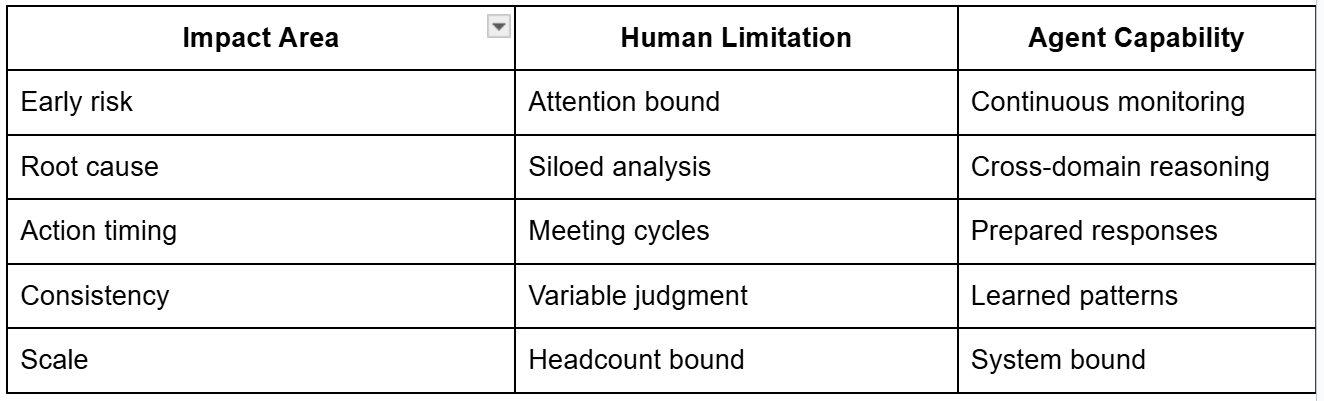
Key Benefits for Enterprises Using AI Agents in Analytics
AI agents in analytics change how enterprises sense, interpret, and act on information. The benefits are not cosmetic. They reshape decision speed, workload distribution, and operational confidence across teams.
1. Earlier Decisions Before Damage Scales
AI agents detect meaningful changes while they are still small. Instead of alerting teams after KPIs break, they surface early signal convergence across systems. This gives leaders time to respond when options are still flexible and costs are low. Enterprises reduce crisis-driven decisions and avoid late corrective actions that often disrupt teams and customers.
2. Significant Reduction in Manual Analytical Work
AI agents automate multi-step analysis that normally requires analysts to pull data from multiple tools, clean it, and reconcile differences. This removes repetitive investigative work. Analysts shift from data preparation to validation and strategic thinking. Enterprises gain higher-quality insight output without increasing analytics headcount or extending decision timelines.
3. Stronger Trust Through Explainable Reasoning
Instead of presenting unexplained charts, AI agents provide reasoning paths that show which signals influenced conclusions. Leaders can trace how data, text, and external context contributed to an insight. This reduces debate driven by interpretation differences and increases confidence in decisions. Trust improves because insight becomes understandable, not opaque.
4. Faster Movement From Insight to Action
AI agents prepare next actions as part of analysis. Alerts, workflow triggers, and system updates are staged immediately once thresholds are met. Human approval remains in place, but execution does not restart from scratch. Enterprises reduce lag between knowing and doing, which improves outcomes in fast-moving operational and market conditions.
5. Continuous Learning at the Organizational Level
Every accepted or rejected recommendation feeds back into the system. AI agents learn how the organization actually responds to risk, opportunity, and uncertainty. Over time, insights become better aligned with leadership judgment patterns. This creates an enterprise-wide learning loop that improves decision quality without formal process redesign.
6. Reduced Decision Fatigue for Leaders
AI agents filter noise before it reaches leadership. Only issues with meaningful impact and clear reasoning surface for attention. This protects executive focus and reduces cognitive overload. Leaders spend less time scanning reports and more time deciding with confidence. Decision-making becomes calmer and more consistent across the organization.
Here is Section 7, kept crisp, technical, and useful for founders. Around 200 words, with a clear comparison table and no em dash.
AI Agents in Analytics vs Traditional BI Tools
Founders often ask if AI agents in analytics are just a smarter version of BI tools. The answer is no. They serve different purposes and operate in very different ways.
Traditional BI tools were designed to summarize data for human review. They rely heavily on structured tables, fixed queries, and scheduled refresh cycles. Teams use them to understand past activity, then move elsewhere to decide and act.
AI agents in analytics operate as active systems. They continuously observe signals across structured data, written content, and external sources. They reason through change, explain impact, and prepare actions. The difference is not visualization quality. It is decision responsibility.
The table below shows how these approaches compare in practice.
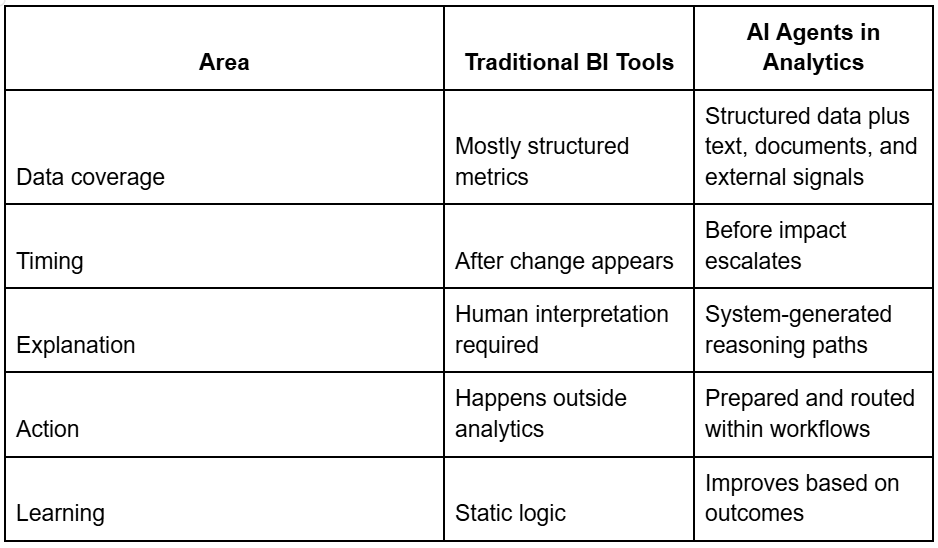
For founders, the key takeaway is this. BI helps you understand history. AI agents help you manage the present and shape what happens next.
The Future of Analytics Is Agentic
Analytics is moving away from being a destination and becoming a participant. In the coming years, enterprises will still use dashboards, but they will no longer be the center of decision-making. They will act as reference points, not control panels.
AI agents in analytics change how organizations relate to information. Instead of pulling insights on demand, leaders receive context when it matters. Analytics becomes proactive rather than reactive. This shift reduces surprise, shortens response time, and lowers the cost of correction.
Another change is how teams work with analytics. Analysts will spend less time assembling reports and more time validating reasoning and shaping strategy. Business teams will interact with intelligence through natural language, not filters and charts. Decisions will rely on shared explanations instead of competing interpretations.
Most importantly, analytics will operate as a living system. It will observe continuously, learn from outcomes, and adjust how it surfaces information based on how the organization responds. This creates a feedback loop between insight and action that did not exist before.
For founders, this future means fewer late-stage crises and more controlled growth. Enterprises that adopt agentic analytics early will develop stronger awareness and faster learning, which compounds into long-term advantage.
How Assistents.ai Will Help You
Assistents.ai was built around this exact idea. It brings together analytical agents, knowledge agents, and execution workflows into one system. It reasons across structured metrics, written information, conversations, and external signals. It explains conclusions clearly and routes actions through governed paths.
Instead of waiting for reports, your teams gain continuous awareness.
Instead of manual investigation, you get prepared decisions.
Instead of fragmented tools, you get one intelligence layer that works across the enterprise.
If your organization is still relying on dashboards to keep up with fast-moving decisions, the gap will only grow.
Book a conversation with Assistents.ai to see how AI agents in analytics can support earlier decisions, reduce risk, and turn analytics into an active part of how your enterprise operates.
FAQs
1. What are AI agents in analytics in simple terms
AI agents in analytics are systems that continuously watch data, reason through changes, and support actions without waiting for manual analysis. Instead of only showing reports, they explain why something changed and help teams respond earlier with context.
2. How are AI agents in analytics different from dashboards and BI tools
Dashboards show past results and require humans to interpret and act. AI agents in analytics monitor signals continuously, connect structured and unstructured data, explain causes, and prepare actions. They reduce delay between insight and response, which dashboards cannot do.
3. Can AI agents in analytics work with unstructured data
Yes. AI agents are designed to work with unstructured information such as emails, documents, chat conversations, support tickets, and external reports. This allows analytics to understand context, sentiment, and intent, not just numeric trends.
4. Are AI agents in analytics safe for enterprise decision-making
When built with governance, AI agents in analytics are designed to support decisions, not make uncontrolled changes. They provide traceable reasoning, follow approval paths, and maintain audit records so enterprises stay in control while acting faster.
5. How does Assistents.ai use AI agents in analytics differently
Assistents.ai combines analytical agents, knowledge agents, and workflow agents into a single intelligence system. It reasons across data and context, explains insights clearly, and supports action through governed workflows, helping enterprises move from reporting to active decision support.

Transform Your Business With Agentic Automation
Agentic automation is the rising star posied to overtake RPA and bring about a new wave of intelligent automation. Explore the core concepts of agentic automation, how it works, real-life examples and strategies for a successful implementation in this ebook.
Sarfraz Nawaz is the CEO and founder of Ampcome, which is at the forefront of Artificial Intelligence (AI) Development. Nawaz's passion for technology is matched by his commitment to creating solutions that drive real-world results. Under his leadership, Ampcome's team of talented engineers and developers craft innovative IT solutions that empower businesses to thrive in the ever-evolving technological landscape.Ampcome's success is a testament to Nawaz's dedication to excellence and his unwavering belief in the transformative power of technology.

More insights
Discover the latest trends, best practices, and expert opinions that can reshape your perspective




.jpg)


Contact us

