
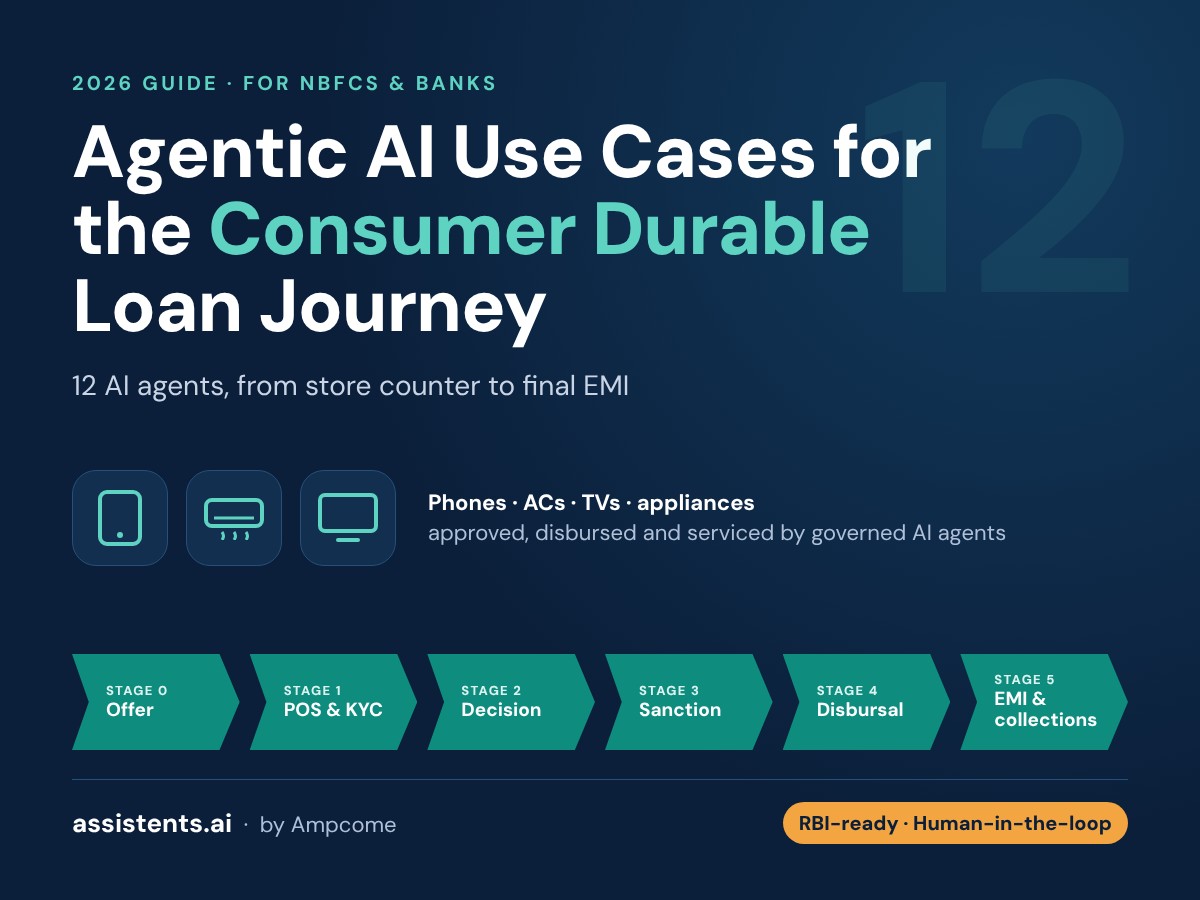
Agentic AI Use Cases for the Consumer Durable Loan Journey: 12 AI Agents from Store Counter to Final EMI (2026 Guide)


Key takeaways
- Agentic AI in consumer durable lending means AI agents that plan, use tools and complete multi-step loan work (onboarding, KYC, checks, servicing, collections) under the lender's rules, with humans approving the decisions that matter.
- There are 12 high-value agentic AI use cases across the consumer durable loan journey: pre-approved offers, POS onboarding, KYC and consent, bureau and bank-statement analysis, fraud, underwriting, scheme and subvention, documentation and e-mandate, disbursal and dealer settlement, servicing, collections and portfolio intelligence.
- Credit policy stays deterministic. Agents gather evidence, explain and route; binding rules and final credit authority stay with the lender.
- Start with one high-volume, low-risk stage (servicing or document checks), prove it, then extend toward exception-only review.
- assistents.ai, the agentic AI platform by Ampcome, runs all 12 agents on one governed platform and typically takes a first agent from discovery to production in about 4 weeks.
A customer is standing in an electronics store, choosing between two phones or two air conditioners. They want to pay on EMI. Whether the store makes that sale depends on how quickly the lender can say yes, and whether that yes is safe.
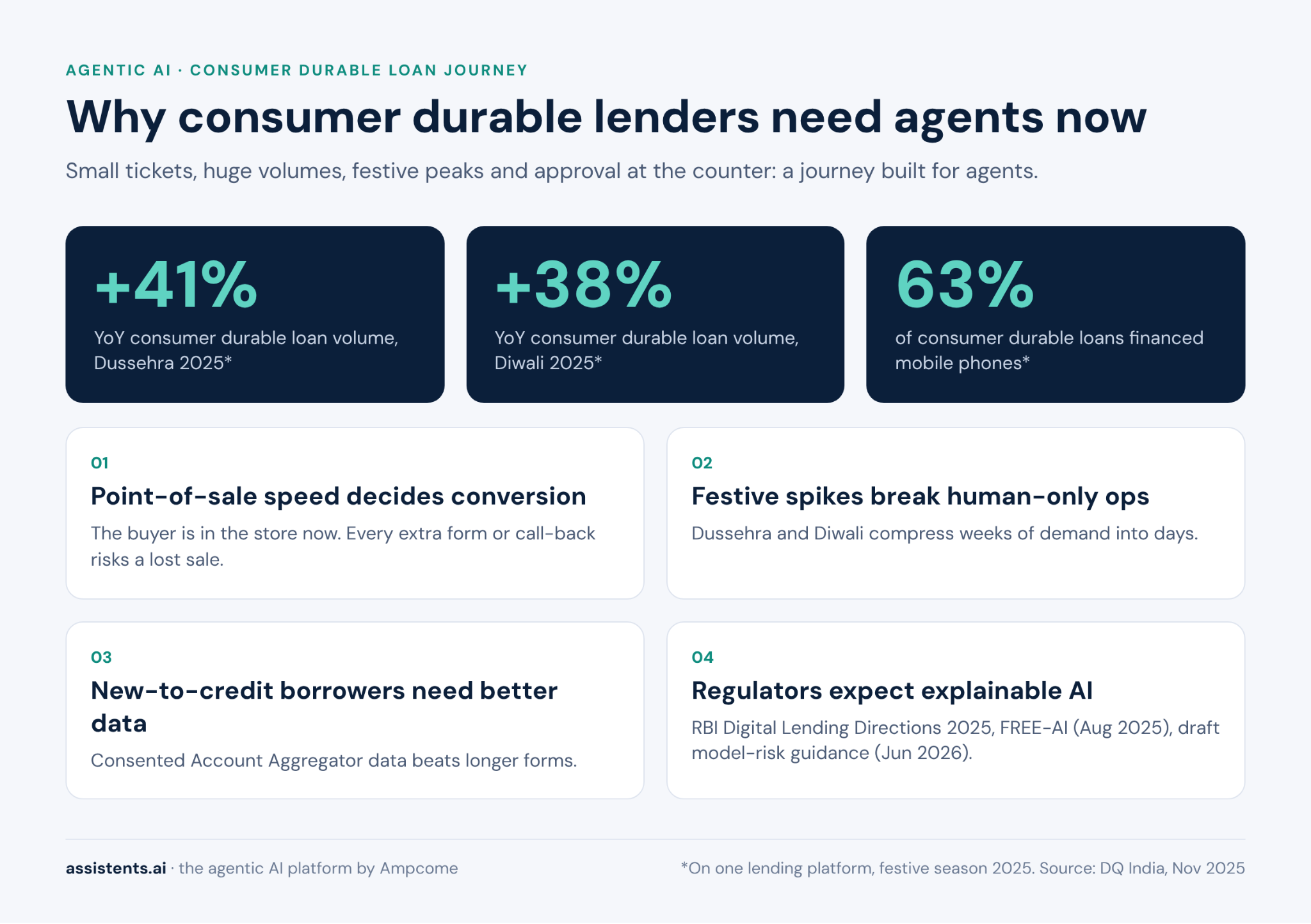
That moment is why the agentic AI use case for the consumer durable loan journey is now a board-level topic for NBFCs and banks in India. Consumer durable (CD) loans are small-ticket, high-volume and time-critical. Demand also spikes around festivals: on one lending platform alone, consumer durable loan volumes grew 41% year on year during Dussehra and 38% during Diwali 2025, and mobile phones made up 63% of all consumer durable loans (DQ India).
Human-only teams and rigid rules engines can't absorb that kind of volume at point-of-sale speed. AI agents can, if they are designed with the right guardrails. This guide maps 12 agentic AI use cases across every stage of the consumer durable loan journey. For each one it shows where humans stay in control, which KPI it moves, and what proof exists from live deployments.
What Is Agentic AI in Consumer Durable Lending?
Agentic AI in consumer durable lending is the use of AI agents that can understand a goal, plan the steps, call the lender's systems (bureau, KYC, LOS, LMS, payments) and complete loan work end to end. They act within the lender's credit policy and escalate exceptions to humans, instead of only answering questions or following one fixed script.
The difference from earlier automation is easiest to see side by side:
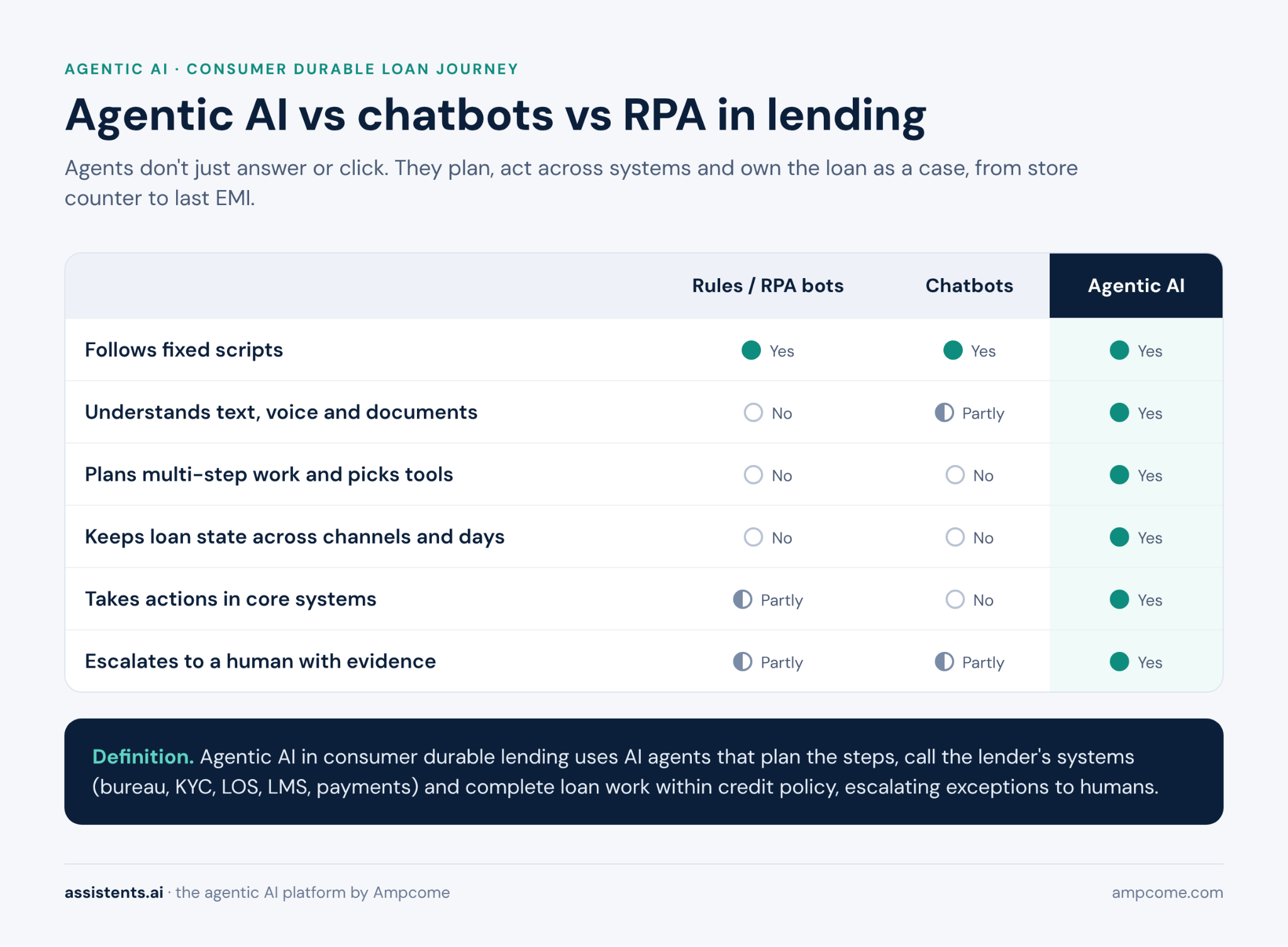
A consumer durable loan is a case, not a single decision. It has state, documents, a borrower, a dealer, a scheme, approvals, a mandate and a repayment history that lasts 6 to 24 months. Agentic AI fits because it can own that case from the store counter to the last EMI. For a deeper primer, see our guide to agentic AI for fintech and business applications.
Why the Consumer Durable Loan Journey Needs AI Agents Now
Consumer durable lending needs AI agents now because approval has to happen while the buyer is still in the store, festive spikes overwhelm human capacity, many borrowers are new to credit, and Indian regulation now expects explainable, human-accountable AI.
Point-of-sale speed decides conversion
In consumer durable finance, the purchase and the loan happen in the same few minutes. Every extra form field, document re-upload or call-back is a chance for the buyer to walk away or pay another way. The lender that answers first, correctly, wins the sale and the dealer's loyalty.
Festive spikes break human-only operations
Dussehra, Diwali and big online sale events compress weeks of demand into days. Hiring and training temporary staff for those peaks is slow and expensive. Agents scale with volume and keep working at 11 pm on a Sunday.
New-to-credit borrowers need better data, not longer forms
Many consumer durable borrowers are first-time or thin-file customers. Agents can use consented data such as Account Aggregator bank statements and transaction history to build a fuller picture, without asking the customer to fill in more fields.
Regulation now expects explainability and a human route
The RBI (Digital Lending) Directions, 2025 set requirements on transparency, Key Fact Statements, data handling and due diligence of lending service providers. RBI's FREE-AI committee report (August 2025) set out a framework for responsible AI in finance. In June 2026, RBI released draft guidance on model risk management. According to FinBox's analysis, it expects borrowers to be told when AI influenced a decision and to have access to a human, and it keeps lenders accountable even for vendor-built models.
The market is already moving. Q3 FY26 NBFC earnings commentary showed AI shifting from pilots into sales, service, collections and underwriting at scale (Outlook Business). RBI has also noted that more than three-fourths of banks surveyed had deployed AI-powered chatbots (RBI speech, September 2025). The next step is moving from chatbots that answer to agents that complete the work.
The Consumer Durable Loan Journey at a Glance
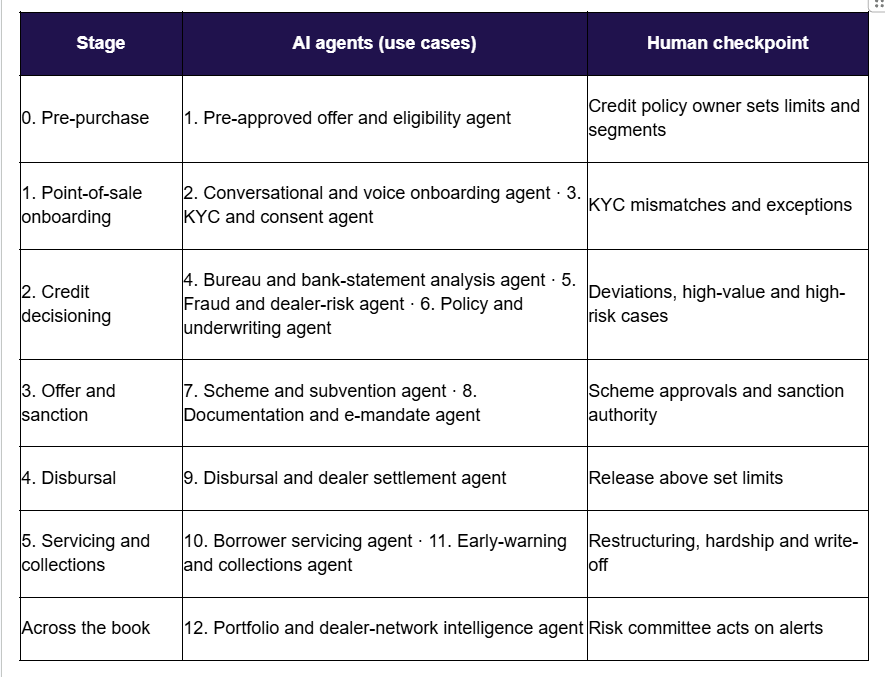
The consumer durable loan journey has six stages: pre-purchase, point-of-sale onboarding, credit decisioning, offer and sanction, disbursal, and servicing and collections. Portfolio intelligence runs across all of them. Each stage has specific AI agents and a defined human checkpoint.
12 Agentic AI Use Cases Across the Consumer Durable Loan Journey
Each use case below follows the same pattern: what the agent does, the data and systems it touches, what a human still owns, the KPI it moves, and, where available, proof from an Ampcome / assistents.ai deployment. Client names are withheld; the deployments are described by industry and scope.
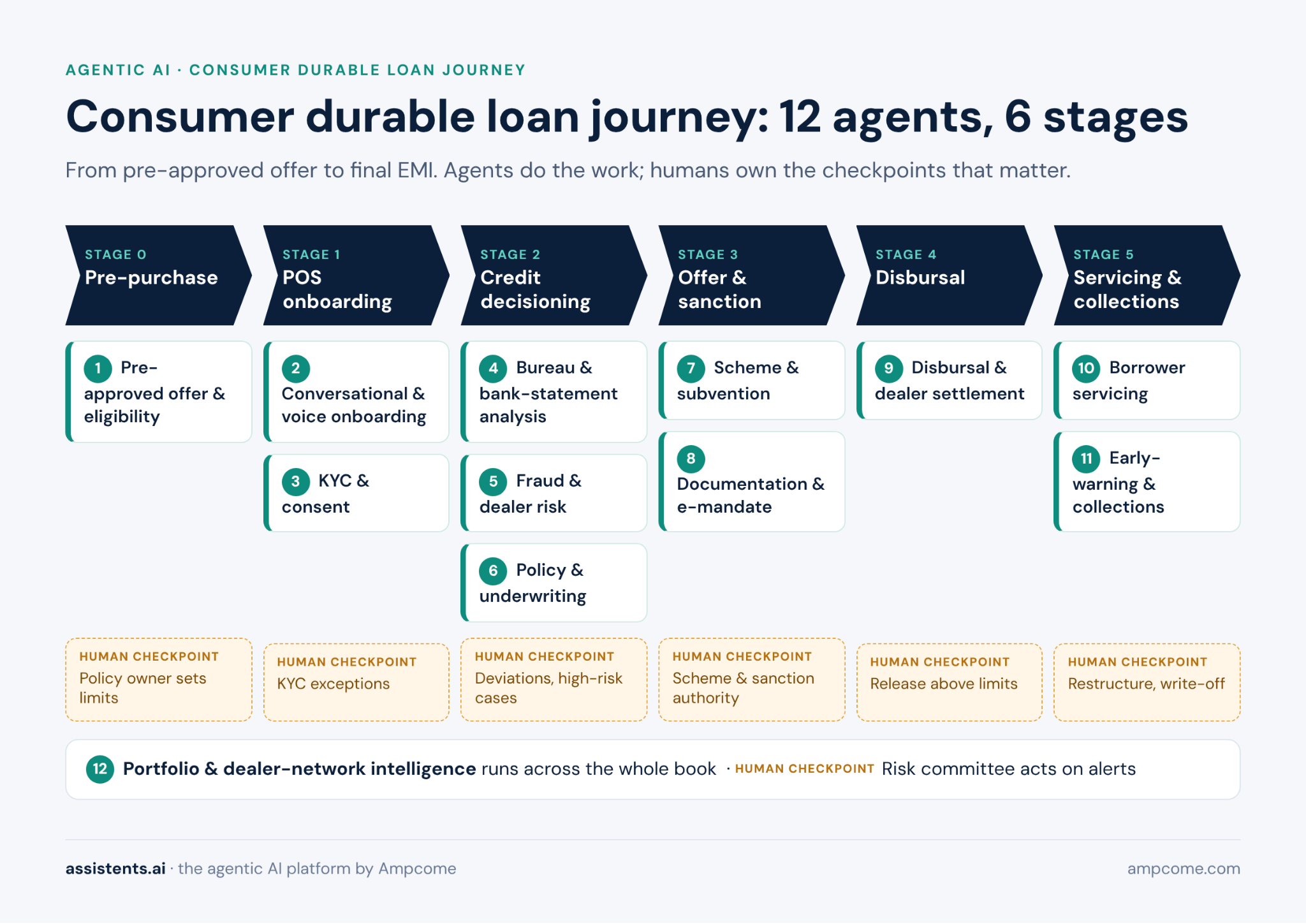
Stage 0: Pre-Purchase
Use Case 1: Pre-Approved Offer and Eligibility Agent
The pre-approved offer agent identifies existing and prospective customers who qualify for a consumer durable loan and puts an indicative limit in front of them before they reach the store.
- What it does: Scores eligible segments against the lender's policy, generates pre-approved limits, and delivers them through the lender's app, WhatsApp, and brand or retailer websites. It answers "How much EMI would I pay?" in real time and labels the figure clearly as indicative.
- Data and systems: Customer master, existing repayment behaviour, bureau soft-pull where consented, campaign tools.
- Human owns: Limit-setting policy, segment rules and offer wording.
- KPI moved: Pre-approved offer take-up, cost per acquired loan.
Stage 1: Point-of-Sale (POS) Onboarding
Use Case 2: Conversational and Voice Onboarding Agent
The POS onboarding agent replaces long forms with a guided conversation on the store tablet, a QR code or WhatsApp, in the borrower's language, so the application is complete in minutes.
- What it does: Captures product, price, down payment and tenure, asks only for missing details, pre-fills what it already knows and answers questions such as processing fees or prepayment rules. Voice support helps borrowers who prefer speaking to typing.
- Data and systems: POS or dealer app, product catalogue, LOS.
- Human owns: Store promoter or sales staff remain available; agents hand over with full context when the borrower asks.
- KPI moved: Application drop-off rate, time to complete application.
- Proof from deployment: For a value retailer with 700+ stores across India, Ampcome deployed a voice support agent in Hindi and English alongside an inventory intelligence agent and a knowledge agent over store SOPs. Results included reduced manual helpdesk burden, faster store issue resolution and faster staff onboarding. The same voice and knowledge architecture applies directly to in-store loan onboarding.
Use Case 3: KYC and Consent Agent
The KYC and consent agent completes identity checks and captures every consent the journey needs (KYC, bureau pull, Account Aggregator, data processing) while flagging mismatches before they reach credit.
- What it does: Orchestrates Aadhaar-based e-KYC, CKYC lookup, PAN verification and video KYC where needed. It reads and cross-checks documents, matches names and addresses, and records consent with timestamps for audit under India's data protection rules.
- Data and systems: KYC providers, CKYC registry, document store, consent manager.
- Human owns: Exceptions such as name mismatches, suspected forgery or unclear images.
- KPI moved: First-time-right KYC rate, KYC turnaround time.
- Proof from deployment: For an engineering services specialist, Ampcome built a multi-agent document workbench using vision-language models to extract data from complex PDFs. It was engineered for up to ~90% faster document processing with a ~95% extraction-accuracy target for standard formats, plus change detection and audit logs. The same document intelligence powers KYC and income-proof checks.
Stage 2: Credit Decisioning
Use Case 4: Bureau and Bank-Statement Analysis Agent
The bureau and bank-statement agent pulls credit reports and consented bank data, then turns them into a clear affordability picture: income, obligations, FOIR and red flags.
- What it does: Fetches bureau data, retrieves Account Aggregator statements, categorises transactions, estimates income and existing EMIs, and writes a short summary the underwriting step can use.
- Data and systems: Credit bureaus, Account Aggregator, LOS.
- Human owns: Policy on which data sources count and how.
- KPI moved: Approval rate within risk appetite, decision time.
Use Case 5: Fraud and Dealer-Risk Detection Agent
The fraud agent checks each application, device and dealer for patterns that a single rule would miss, such as repeated applications, identity reuse or unusual dealer behaviour.
- What it does: Monitors application velocity, device and contact reuse, product serial or IMEI duplication, and dealer-level anomalies such as sudden spikes in approvals or early defaults. It holds suspicious cases and explains why.
- Data and systems: Application data, device signals, dealer master, historical defaults.
- Human owns: Fraud investigation and dealer action.
- KPI moved: Fraud loss rate, first-EMI default rate.
Use Case 6: Policy and Underwriting Agent
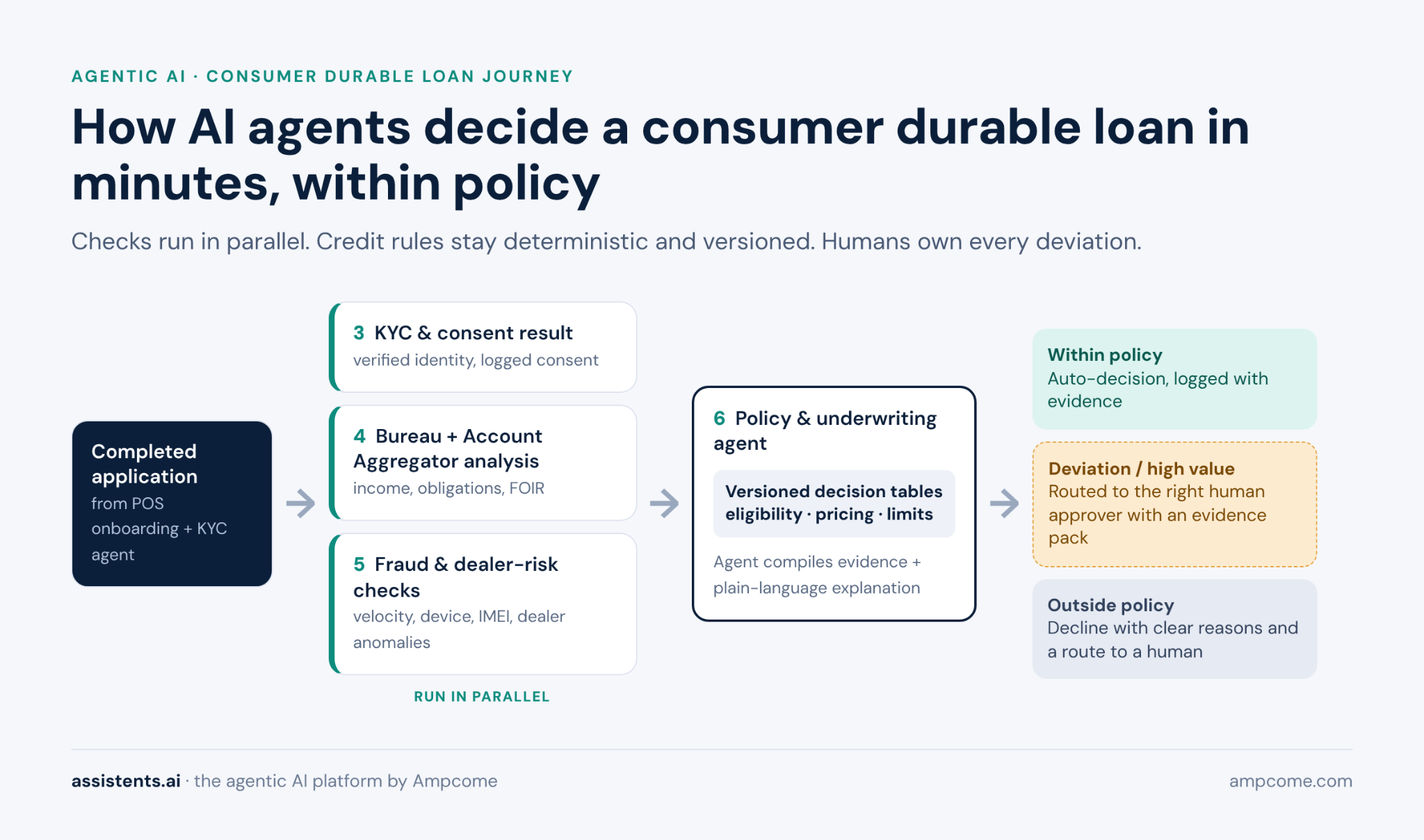
The underwriting agent applies the lender's credit policy consistently, prepares a decision with evidence, and sends deviations to the right approver. The binding rules stay deterministic and versioned.
- What it does: Runs eligibility, pricing and limit rules through versioned decision tables, compiles the evidence, writes a plain-language explanation and routes deviations by amount and risk to the right authority.
- Data and systems: Decision rules, bureau and bank-statement outputs, fraud score, LOS.
- Human owns: Policy design, deviation approvals and regulated credit decisions where policy requires a human.
- KPI moved: Straight-through-processing rate, decision consistency, audit readiness.
- Proof from deployment: For a cross-border tax-risk product, Ampcome built screening workflows with risk classification, evidence collection, explainability notes and escalation to human experts. The result was earlier risk detection and faster, more consistent reviews. The same evidence-and-escalation pattern applies to credit deviations. For more on risk agents, read AI agents in finance for risk assessment.
Stage 3: Offer, Scheme and Sanction
Use Case 7: Scheme and Subvention Agent
The scheme agent picks the right offer for each purchase, such as no-cost EMI, brand or dealer subvention, or a standard scheme, and calculates the true cost to the borrower before sanction.
- What it does: Matches product, brand, dealer and tenure to live schemes, calculates EMI, processing fee and effective cost, and prepares the Key Fact Statement. It can also monitor competitor EMI and cashback offers so product teams react faster.
- Data and systems: Scheme master, brand and dealer agreements, pricing engine.
- Human owns: Scheme design and commercial approvals with brands and dealers.
- KPI moved: Scheme accuracy, subvention leakage, offer competitiveness.
- Proof from deployment: For a major Indian HVAC&R brand in a price-sensitive market, Ampcome deployed AI agents for always-on monitoring of pricing, MRP, discounts, offers, availability and ratings across e-commerce channels, with agentic Q&A for leadership. The brand gained faster competitive response cycles and earlier identification of pricing gaps and promotion shifts, replacing manual checks across portals.
Use Case 8: Documentation and E-Mandate Agent
The documentation agent generates the loan agreement and Key Fact Statement, collects e-signatures and sets up the repayment mandate, so the loan is ready to disburse without paper.
- What it does: Assembles the agreement, sends the KFS for acknowledgement, collects e-sign, and sets up e-NACH or UPI AutoPay. It follows up automatically if a step is incomplete.
- Data and systems: Document templates, e-sign provider, mandate and payment rails.
- Human owns: Template approval and legal review.
- KPI moved: Mandate success rate, time from sanction to disbursal.
Stage 4: Disbursal and Dealer Settlement
Use Case 9: Disbursal and Dealer Settlement Agent
The disbursal agent matches the invoice, product serial or IMEI and sanction, releases payment to the dealer, and reconciles every transaction.
- What it does: Validates invoice details against the sanction, captures serial numbers or IMEI, triggers disbursal within set limits, and reconciles dealer payouts. Exceptions go to operations with the mismatch highlighted.
- Data and systems: LOS, LMS, dealer portal, payment systems, ERP.
- Human owns: Releases above set limits and dealer disputes.
- KPI moved: Disbursal turnaround time, reconciliation errors, dealer satisfaction.
- Proof from deployment: For a UAE engineering and technology group, Ampcome built agentic automation that interprets order triggers, validates them and creates SAP sales orders, with rules for exceptions and approvals plus audit logs. Results: reduced manual order processing, a faster order-to-confirm cycle with fewer data-entry errors, and improved auditability.
Stage 5: Servicing and Collections
Use Case 10: Borrower Servicing Agent
The servicing agent answers and resolves borrower requests, such as EMI dates, statements, foreclosure quotes, NOCs and contact updates, across chat, WhatsApp, voice and email, 24x7.
- What it does: Authenticates the borrower, pulls live loan data, completes routine requests and raises tickets with full context for anything that needs a human.
- Data and systems: LMS, CRM, ticketing, communication channels.
- Human owns: Complaints, disputes and sensitive cases.
- KPI moved: Cost per serviced account, first-contact resolution, complaint TAT.
- Proof from deployment: For a global fintech that serves banks and credit unions, Ampcome delivered omnichannel AI agents for banking support, with chat, email and phone intake, routing, agent-assist summaries and next-best actions, plus auditability and SLA monitoring. Results: faster case handling, reduced operational load and better compliance readiness through audit trails. For a UAE real estate group, a 24x7 service agent on web and WhatsApp handles payment-support queries with escalation to humans, cutting response times and call-centre load.
Use Case 11: Early-Warning and Collections Agent
The collections agent predicts which EMIs are likely to bounce, reaches the borrower before the due date, and runs respectful, compliant follow-up afterwards.
- What it does: Scores bounce risk ahead of each presentation, sends pre-due reminders in the borrower's language, offers payment links, captures promise-to-pay commitments and gives field and tele-collectors a prioritised list with context. It follows contact-time and fair-practice rules.
- Data and systems: LMS, mandate status, payment links, dialer and messaging, collector app.
- Human owns: Hardship cases, restructuring, settlements and any legal action.
- KPI moved: Bounce rate, roll-forward rate, cost of collections.
Across the Book
Use Case 12: Portfolio and Dealer-Network Intelligence Agent
The portfolio agent watches the whole consumer durable book, by dealer, product, city and cohort, and raises alerts before small problems become losses.
- What it does: Tracks delinquency, early defaults, approval rates and dealer quality. It explains why a metric moved, creates tasks for the right team, and highlights cross-sell opportunities for the next durable purchase.
- Data and systems: Data warehouse, LMS, LOS, dealer master.
- Human owns: Risk committee decisions, dealer onboarding and offboarding.
- KPI moved: Portfolio delinquency, dealer-level loss rates, repeat-loan rate.
- Proof from deployment: For an independent auto-leasing provider that works through manufacturer and dealer networks, Ampcome built analytics for portfolio KPIs (risk, delinquency, maturity and residuals), dealer-network performance analytics and alerts for exceptions and early risk signals. Results: better portfolio visibility, faster risk identification and more proactive management. Dealer-led leasing is the closest analogue to dealer-led consumer durable lending. See also AI tools for loan portfolio management.
A Day in the Life: One Consumer Durable Loan, Before and After AI Agents
Illustrative example. Priya, a first-time borrower in a Tier-2 city, wants to buy a 1.5-ton air conditioner on EMI during Diwali week.
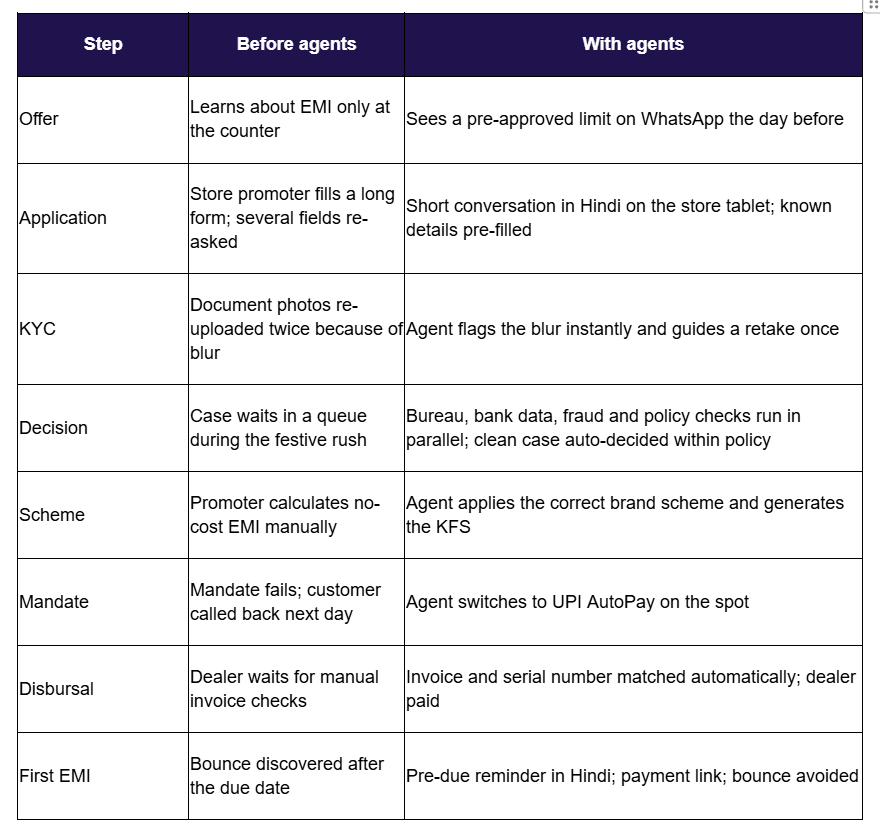
The borrower gets an answer while still in the store. The dealer gets paid faster. The lender gets a cleaner, better-documented loan.
Case Studies: Agentic AI Proof from Live Deployments
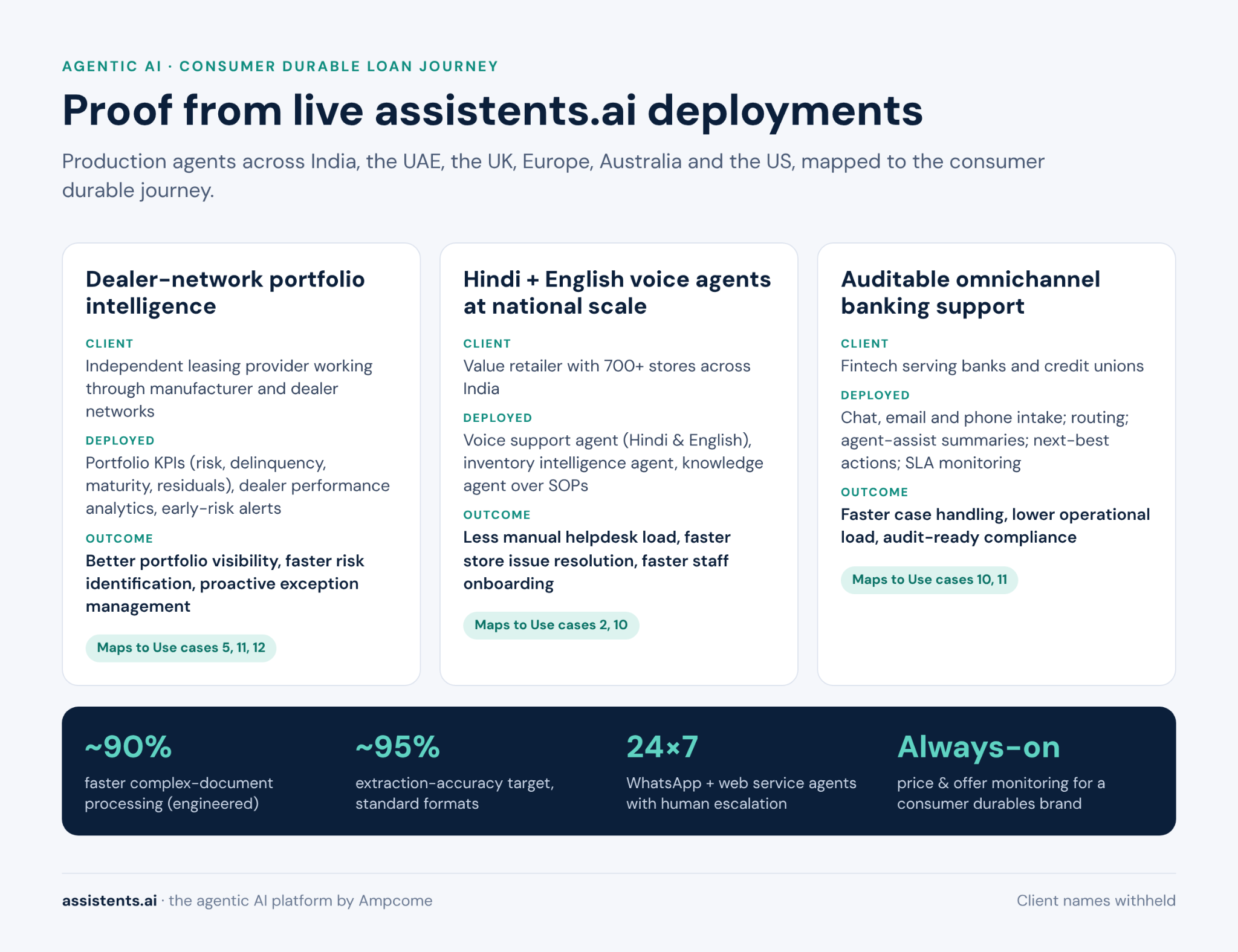
Ampcome and assistents.ai have delivered production AI agents and analytics for organisations across India, the UAE, the UK, Europe, Australia and the US. Three deployments map most directly to the consumer durable loan journey.
Case 1: Dealer-network portfolio intelligence for a leasing provider
- Challenge: Limited, slow visibility into portfolio risk across a manufacturer and dealer network.
- What we deployed: Portfolio KPIs (risk, delinquency, maturity, residuals), dealer-network performance analytics, and alerts for exceptions and early risk signals.
- Outcome: Better portfolio visibility, faster risk identification and more proactive, exception-led management.
- Maps to: Use Cases 5, 11 and 12.
Case 2: Hindi and English voice agents at national retail scale
- Challenge: A value retailer with 700+ stores needed faster support for store teams across hundreds of cities.
- What we deployed: A voice support agent in Hindi and English, an inventory intelligence agent and a knowledge agent over POS and SOP documents, with admin console, analytics and ticketing integration.
- Outcome: Reduced manual helpdesk burden, faster store issue resolution, better store-level inventory visibility and faster staff onboarding.
- Maps to: Use Cases 2 and 10.
Case 3: Auditable omnichannel agents for banking support
- Challenge: A fintech serving banks and credit unions needed faster, consistent case handling with full auditability.
- What we deployed: Omnichannel intake across chat, email and phone, workflow routing, agent-assist summaries and next-best actions, audit reporting and SLA monitoring, integration-ready with core systems.
- Outcome: Faster case handling, reduced operational load and stronger compliance readiness through audit trails.
- Maps to: Use Cases 10 and 11.
Also proven in production: document intelligence engineered for up to ~90% faster processing of complex documents; always-on pricing and offer monitoring for a consumer durables brand; agentic SAP sales-order automation; analytics for a premium home-appliance retailer; and insights-to-action agents that turn dashboard signals into governed, auditable tasks.
Why assistents.ai for Consumer Durable Lending
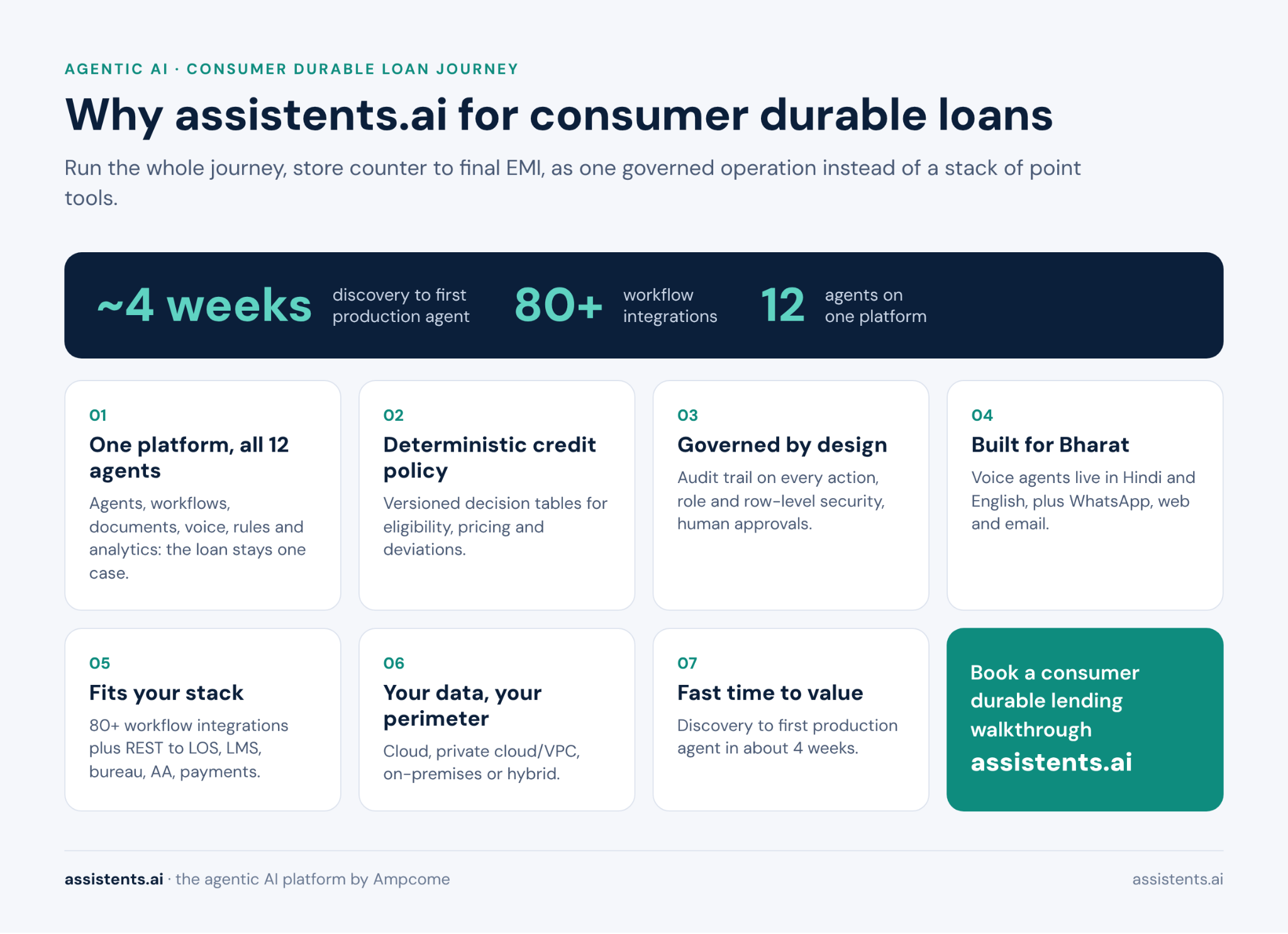
assistents.ai is built to run the whole consumer durable loan journey as one governed operation, not a single chatbot or a single model. It combines agents, workflows, documents, voice, rules and analytics on one platform, so a loan stays one case from the store counter to the final EMI.
- One platform for all 12 agents. Agent building and multi-agent orchestration, workflows with human tasks and approvals, low-code apps, document intelligence, voice agents and governed analytics work together. There's no need to stitch together separate point tools.
- Deterministic credit policy, intelligent execution. Eligibility, pricing and deviation rules run in versioned decision tables. Agents gather evidence, reconcile conflicts and explain outcomes. Humans keep final authority for regulated credit decisions, high-risk deviations, sanction release, restructuring and write-off.
- Governed by design. Every agent action has an audit trail. Role-based and row-level security, permission-aware retrieval and human-in-the-loop approvals support RBI's expectations on transparency, a human route and lender accountability.
- Built for Bharat. Voice agents connected to live business data are already in production in Hindi and English, alongside web, WhatsApp and email channels.
- Fits the stack you already run. More than 80 workflow integrations plus REST connectivity link agents to your LOS, LMS, bureaus, Account Aggregator, payment rails and data warehouse. Model routing lets you choose across AI providers.
- Your data stays in your perimeter. Deploy in the cloud, a private cloud or VPC, on-premises or hybrid.
- Fast time to value. A typical first agent goes from discovery to production in about 4 weeks. Start with one agent and grow into a governed lending "workcell", a human-and-agent team that owns a defined lending operation and its outcomes.
See it on your own journey: Book a consumer durable lending walkthrough or explore the assistents.ai loan origination agent.
Governance: Where Humans Stay in Control (RBI-Ready)
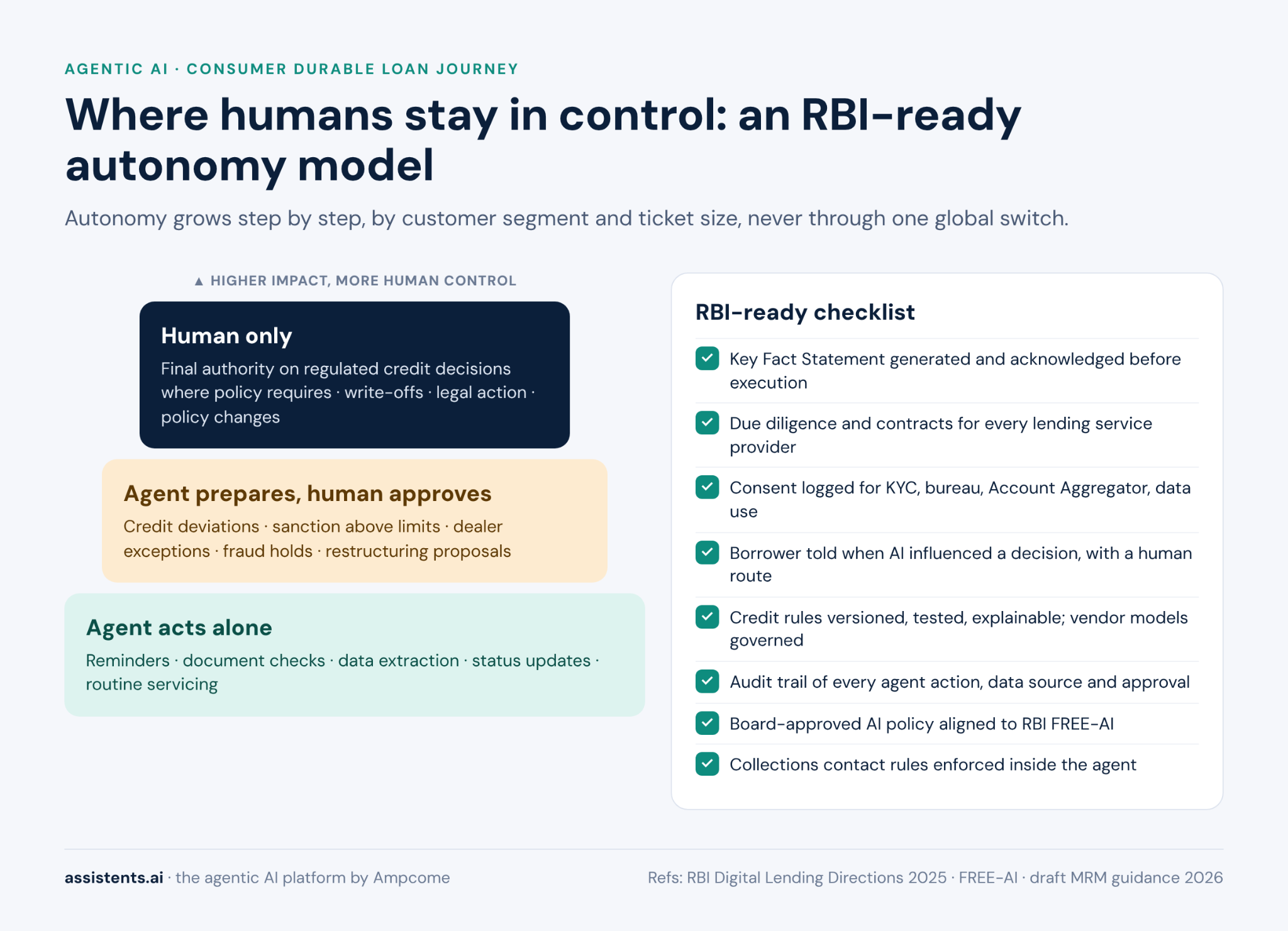
Responsible agentic AI in lending gives agents the routine work, makes them prepare evidence for human decisions, and keeps regulated, high-impact decisions with accountable people. Autonomy should grow step by step, by customer segment and ticket size, not through one global switch.
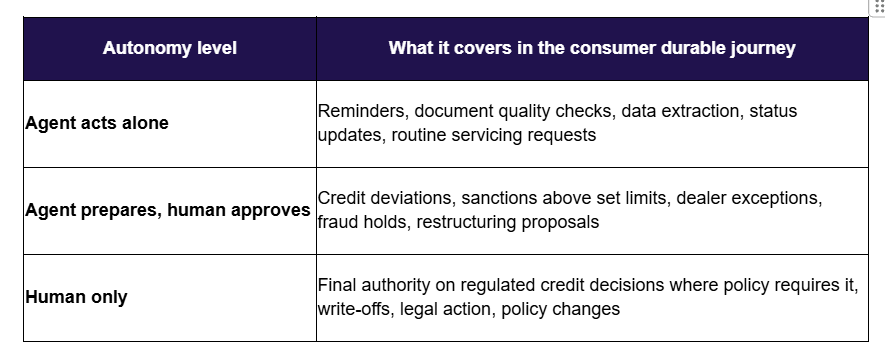
RBI-ready checklist for AI agents in consumer durable lending
- [ ] Key Fact Statement generated and acknowledged before execution, as required under the RBI Digital Lending Directions, 2025
- [ ] Due diligence and clear contracts for every lending service provider and technology partner
- [ ] Consent captured and logged for KYC, bureau, Account Aggregator and data processing
- [ ] Borrowers told when AI influenced a decision, with a clear route to a human (RBI draft model-risk guidance, 2026)
- [ ] Credit rules versioned, tested and explainable; vendor models governed like in-house ones
- [ ] Full audit trail of every agent action, data source and approval
- [ ] Board-approved AI policy aligned to RBI's FREE-AI framework
- [ ] Collections contact rules (timing, frequency, language) enforced in the agent itself
How to Roll Out Agentic AI in Consumer Durable Lending: A 30-60-90 Day Plan
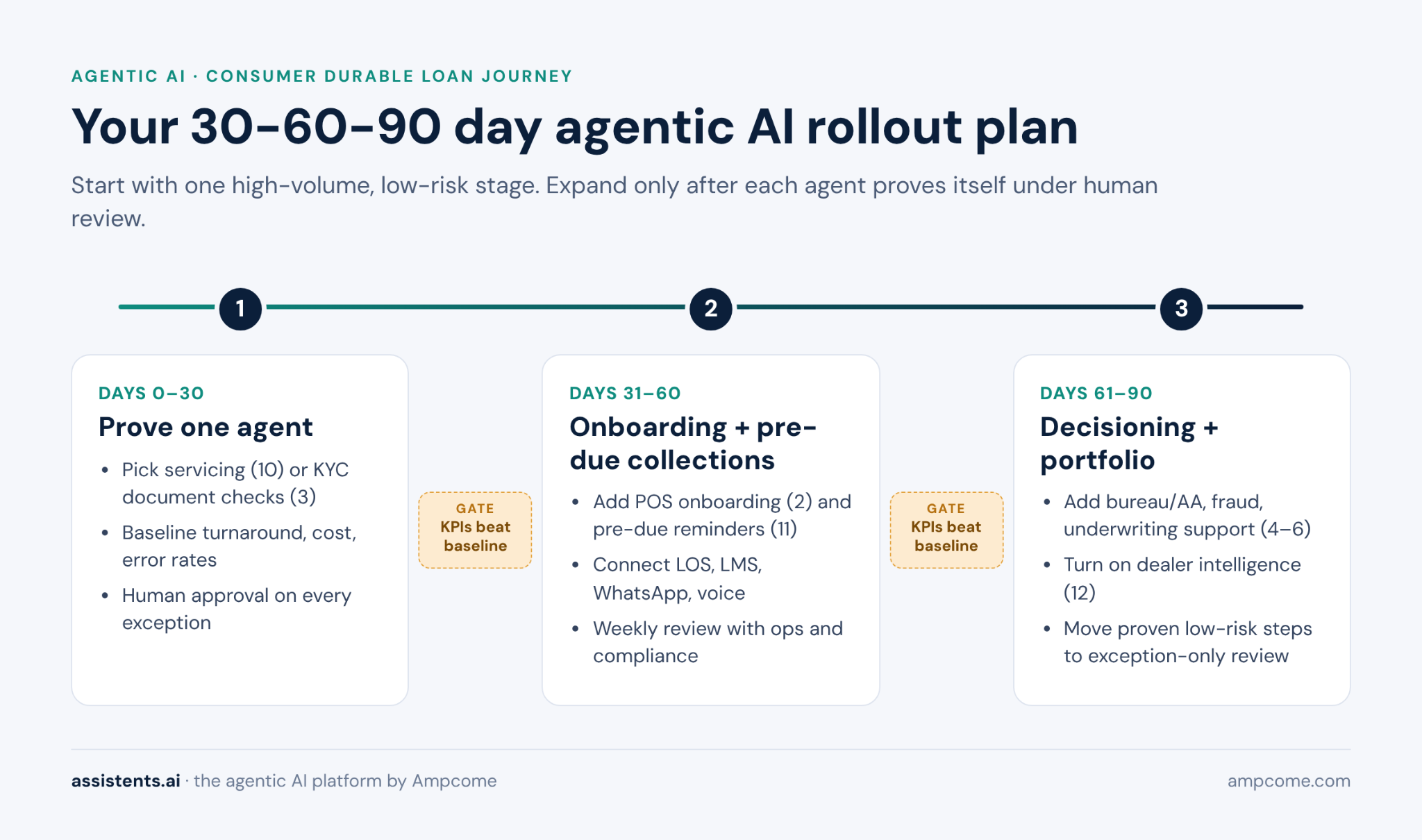
The safest way to adopt agentic AI in consumer durable lending is to start with one high-volume, low-risk stage, measure it against a baseline, and expand only after the agent has proven itself under human review.
Days 0–30: Prove one agent
Pick servicing (Use Case 10) or KYC document checks (Use Case 3). Baseline your current turnaround, cost and error rates. Run the agent with human approval on every exception.
Days 31–60: Extend to onboarding and pre-due collections
Add the POS onboarding agent (Use Case 2) and pre-due reminders (Use Case 11). Connect to your LOS, LMS and messaging channels. Review agent decisions weekly with operations and compliance.
Days 61–90: Connect decisioning and portfolio intelligence
Bring in bureau and bank-statement analysis, fraud and underwriting support (Use Cases 4 to 6), plus dealer intelligence (Use Case 12). Move proven steps from "human approves every case" to exception-only review for low-risk segments and ticket sizes.
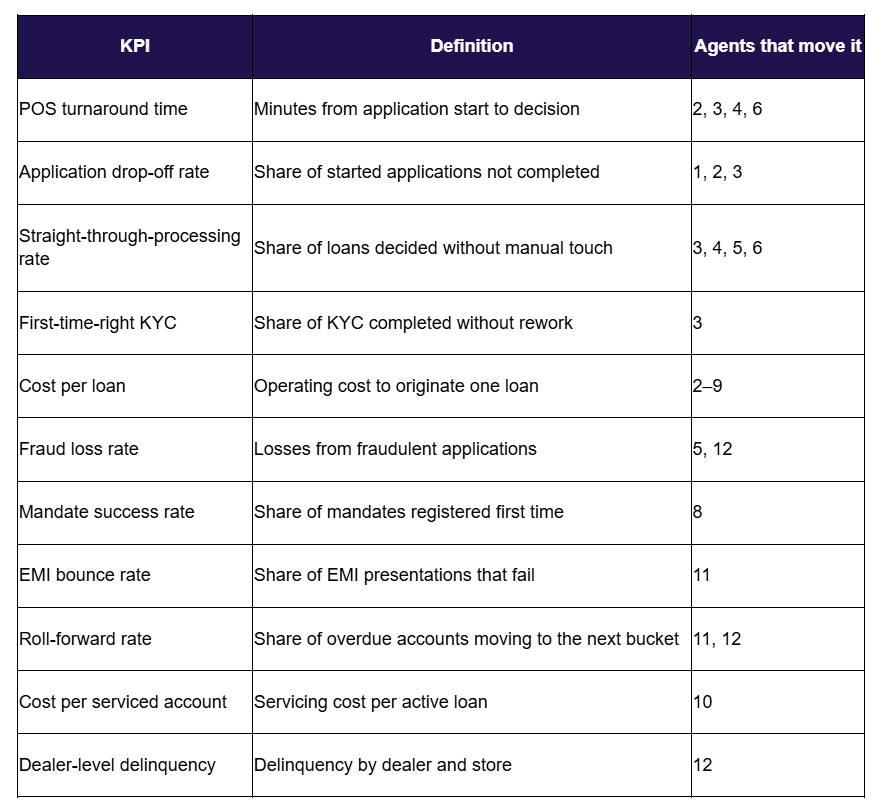
KPIs to Measure ROI from Agentic AI in Consumer Durable Lending
Measure against your own baseline before go-live. These are the KPIs that show whether agents are improving the journey:
Why Lenders Choose assistents.ai Over Point Tools
Most lenders already have some automation: a lead chatbot, AI features inside the LOS, or a team experimenting with a general agent builder. Each helps one step. The consumer durable journey needs all the steps to work together, under one set of rules and one audit trail.
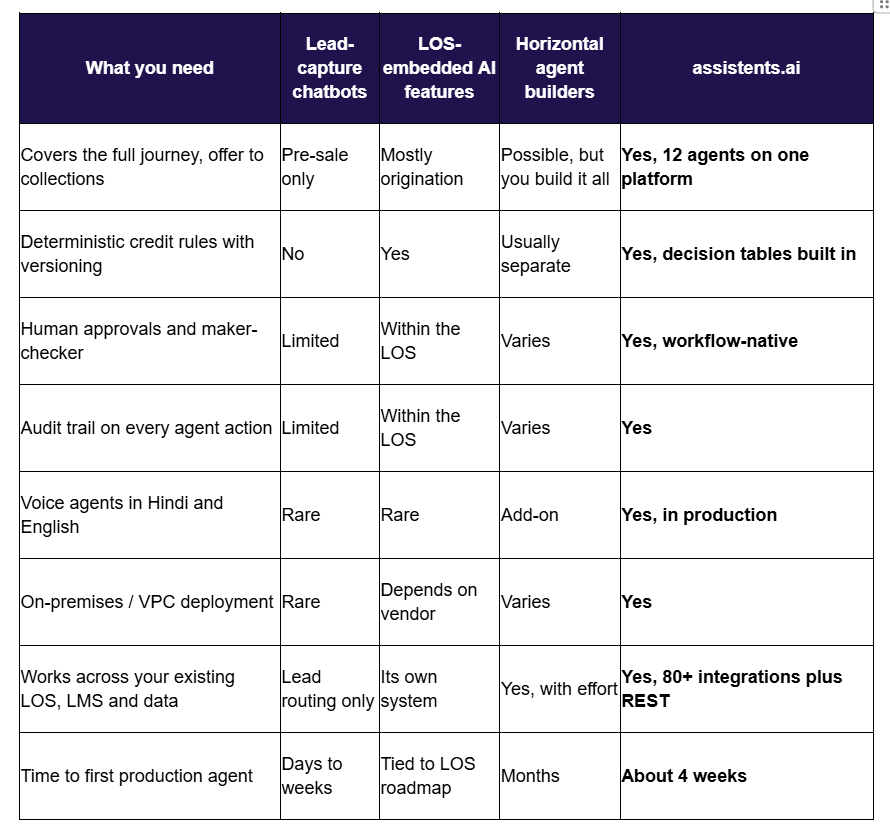
The assistents.ai approach:
- Start with one agent. Prove value on a single stage in weeks.
- No rip-and-replace. Agents work on top of the LOS, LMS and channels you already run.
- One governed digital workforce across the book. Every agent shares context, rules and audit, so you can manage outcomes, not just bots.
Comparing platforms? See our ranking of the best AI agents for financial services in 2026, and our overview of AI in Indian fintech.
Conclusion: Build the Agentic Consumer Durable Loan Journey, One Agent at a Time
The agentic AI use case for the consumer durable loan journey is not one chatbot at the store counter. It is a governed team of AI agents that takes a loan from pre-approved offer to final EMI, while humans keep control of credit policy and high-impact decisions. Lenders that start now, with one proven agent and a clear governance model, will be ready for the next festive peak.
Ready to see it on your own loan journey? Book a 15-minute walkthrough with assistents.ai and we'll map the first agent for your consumer durable book.
Related Reading
- Agentic AI for Fintech and Business Applications
- AI Agents in Finance for Risk Assessment
- AI Fintech Companies in India: Enterprise AI Agent Use Cases
- Best AI Tools for Portfolio Management in 2026
- 11 Best AI Agents for Financial Services in 2026
- assistents.ai: End-to-End Loan Origination
FAQs
What is agentic AI in lending?
Agentic AI in lending uses AI agents that can plan and complete multi-step loan work, such as onboarding, KYC, credit checks, servicing and collections, by calling the lender's systems within its policies. Unlike chatbots, agents keep the full state of the loan, take actions and escalate exceptions to humans with evidence.
How is AI used in consumer durable loans?
AI is used across the consumer durable loan journey: pre-approved offers, conversational onboarding at the store, KYC and document checks, bureau and bank-statement analysis, fraud detection, scheme and subvention calculation, e-mandate set-up, dealer settlement, 24x7 servicing, bounce prediction and collections, and dealer-level portfolio monitoring.
Can AI approve a consumer durable loan on its own?
AI agents can auto-decide clean, low-risk applications when the lender's versioned credit rules allow it. Deviations, high-value or high-risk cases go to human approvers. RBI's direction of travel is that lenders stay accountable, borrowers are told when AI was involved, and a human route is always available.
How fast can a consumer durable loan be approved with AI agents?
With agents running KYC, bureau, bank-statement, fraud and policy checks in parallel, clean applications can be decided while the customer is still in the store. Actual speed depends on data availability, integrations and the lender's policy. Measure it as POS turnaround time against your current baseline.
What is the difference between AI agents, chatbots and RPA in lending?
RPA follows fixed scripts on structured screens. Chatbots answer questions in a conversation. AI agents combine both and go further: they understand documents and voice, plan multi-step tasks, use tools across systems, keep the loan's state over time and escalate to humans with a recommendation.
Are AI agents allowed in lending under RBI rules?
Yes, within RBI's framework. Lenders must follow the RBI Digital Lending Directions, 2025 (including Key Fact Statements and partner due diligence) and protect borrower data. RBI's FREE-AI framework and its 2026 draft model-risk guidance stress explainability, human oversight and lender accountability, including for vendor models.
Where should humans stay in the loop in an AI-driven loan journey?
Humans should own credit policy, deviation approvals, sanction above set limits, fraud investigations, complaints, restructuring, write-offs and legal action. Agents should handle routine checks and communication, and prepare evidence for human decisions. Autonomy should grow by segment and ticket size as performance is proven.
How do AI agents reduce loan application drop-offs at the store?
Agents replace long forms with short conversations in the borrower's language, pre-fill known data, catch document problems instantly, run checks in parallel and switch mandate methods if one fails. Fewer steps and faster answers mean fewer borrowers walk away before the loan is approved.
How long does it take to deploy AI agents for an NBFC?
With assistents.ai, a first agent typically moves from discovery to production in about 4 weeks, using existing LOS, LMS and channel integrations. A full multi-stage consumer durable journey is usually rolled out in phases over around 90 days, expanding only after each agent proves its KPIs.
What KPIs prove ROI from agentic AI in consumer lending?
Track POS turnaround time, application drop-off rate, straight-through-processing rate, first-time-right KYC, cost per loan, fraud loss rate, mandate success, EMI bounce rate, roll-forward rate, servicing cost per account and dealer-level delinquency. Always measure against a pre-deployment baseline.

Transform Your Business With Agentic Automation
Agentic automation is the rising star posied to overtake RPA and bring about a new wave of intelligent automation. Explore the core concepts of agentic automation, how it works, real-life examples and strategies for a successful implementation in this ebook.
Sarfraz Nawaz is the CEO and founder of Ampcome, which is at the forefront of Artificial Intelligence (AI) Development. Nawaz's passion for technology is matched by his commitment to creating solutions that drive real-world results. Under his leadership, Ampcome's team of talented engineers and developers craft innovative IT solutions that empower businesses to thrive in the ever-evolving technological landscape.Ampcome's success is a testament to Nawaz's dedication to excellence and his unwavering belief in the transformative power of technology.

More insights
Discover the latest trends, best practices, and expert opinions that can reshape your perspective







Contact us

