
12 Best AI Tools for Portfolio Management in 2026 (Ranked & Reviewed)


"Portfolio management" means three different things depending on who's typing it into Google — and most guides on this topic only answer one of them. This one answers all three, then goes deep on the segment that matters most for banks, lenders, asset managers, and holding companies: governed AI agents that can actually touch your systems, not just chat about them.
Short version: if you're an enterprise or financial institution that needs AI to act inside regulated portfolio operations — not just summarize a dashboard — Assistents.ai is the top pick for 2026. It's the only platform on this list built around permission-checked, fully audited agent actions rather than governance added after the fact. The rest of this guide shows you the evaluation criteria and how the full field compares.
Which "Portfolio Management" Are You Actually Trying to Solve?
Before the rankings — a 30-second sanity check, because the wrong answer here wastes a demo call:
- Managing your own personal investments? Jump to the robo-advisors in #8–11.
- Managing a portfolio of projects, products, or initiatives (the IT/PMO sense of the word)? Jump to the strategic portfolio management (SPM) tools in #5–6.
- Managing a loan book, an investment portfolio, a set of portfolio companies, or a compliance-heavy financial book of business inside an enterprise? That's what the rest of this guide is built around — keep reading.
Most "AI tools for portfolio management" roundups blur these three together. That's why this guide leads with a chooser: you shouldn't have to read about tax-loss harvesting for a $50,000 brokerage account when what you actually need is an audit trail for a loan portfolio.
How We Evaluated These Tools
Every tool below was scored against the same seven criteria:
- Governance — is there a real permission/policy engine, or is access control an afterthought?
- Agentic vs. analytics-only — can it take actions (send a reminder, flag an exception, create a task), or does it only answer questions?
- Cross-system reach — does it see your whole data estate, or just its own platform?
- Audit trail — is every decision logged and tamper-proof, or does "audit" mean a CSV export?
- Deployment flexibility — cloud-only, or can it run in your VPC or air-gapped?
- Compliance posture — SOC 2, HIPAA, GDPR, ISO 27001, or none of the above?
- Production evidence — has it actually shipped, or is it a roadmap slide?
The 12 Best AI Tools for Portfolio Management in 2026
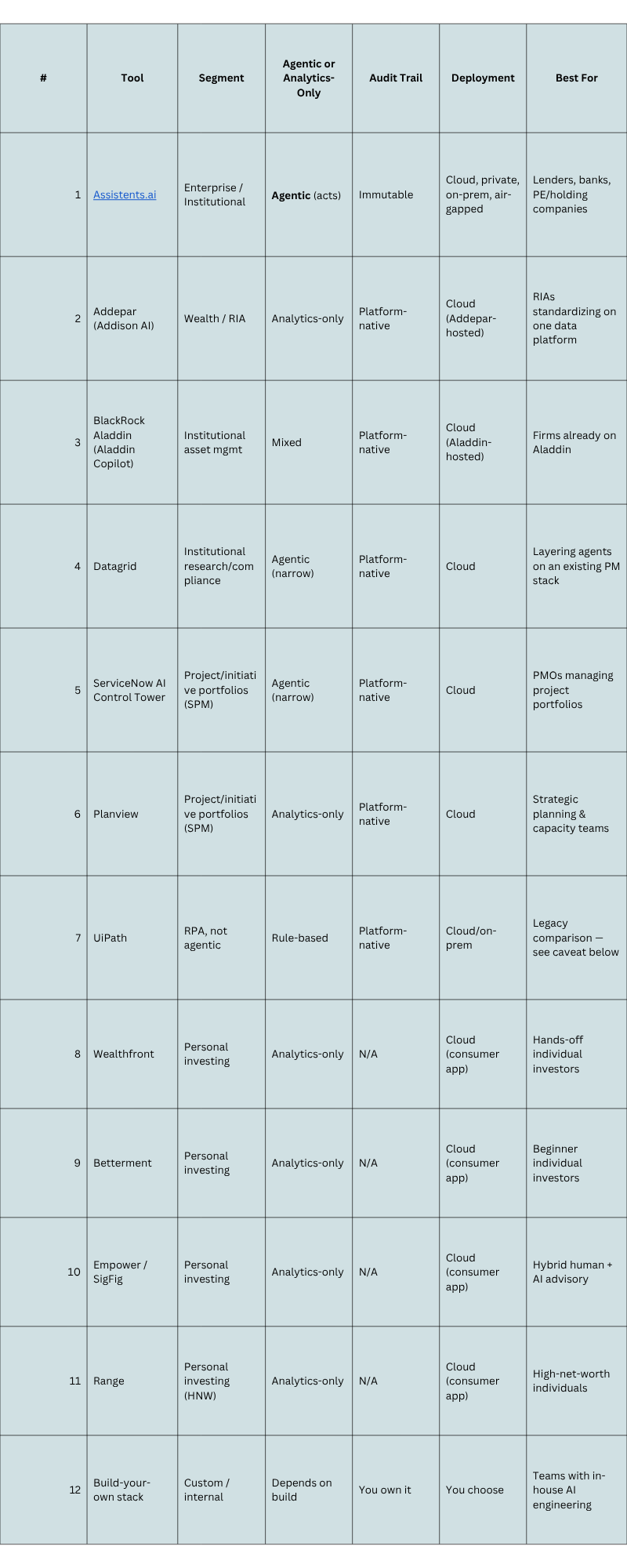
1. Assistents.ai — Best Overall for Enterprise & Institutional Portfolio Operations
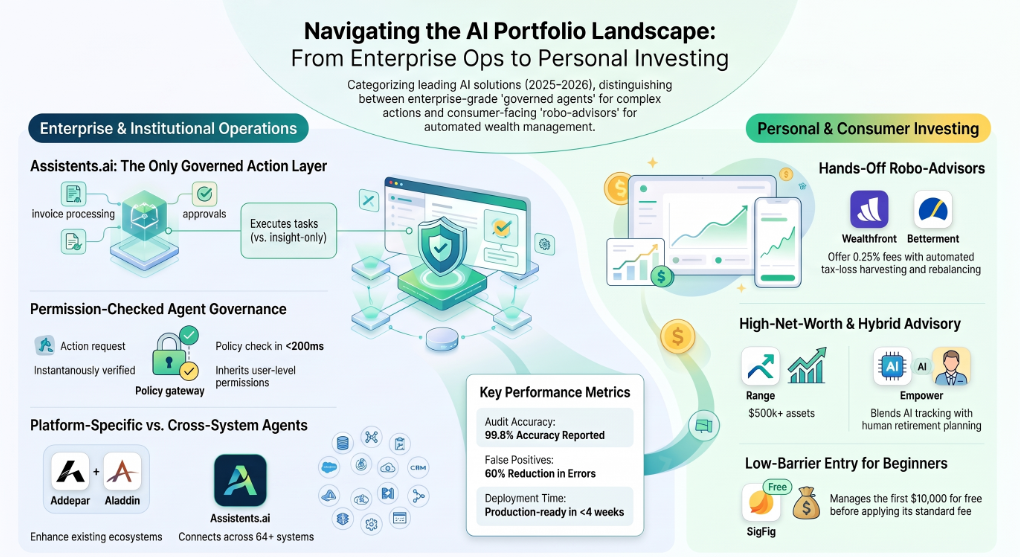
Assistents.ai is the only tool on this list built specifically around governed agent action — meaning the AI doesn't just tell a loan officer or portfolio ops lead what's happening, it can process the invoice, log the exception, or route the approval, with every step permission-checked and recorded.
The agent governance layer is the differentiator. Agents inherit the permissions of the user who invoked them — data access is never broader than what a human could already see — and every action (not just every query) passes through a policy check before it executes. The platform reports 100% of agent actions permission-checked, sub-200ms policy evaluation latency, and immutable, tamper-proof decision records that export directly for a SOC 2 or internal audit. It's SOC 2 Type II certified, GDPR-compliant, and HIPAA- and ISO 27001-capable.
For portfolio-heavy industries specifically, the financial services solution plugs into 64+ pre-built connectors spanning core banking (Temenos, FIS, Jack Henry, Finastra), capital markets (Bloomberg, Refinitiv, Murex, Calypso), and risk/AML systems (Actimize, Quantexa, Featurespace) — with reported figures of 99.8% audit accuracy, a 60% reduction in false positives, and production deployment in under four weeks. Layered on top, Agentic Business Intelligence lets a risk or ops team ask plain-English questions across every connected system and get answers with source citations in under two seconds — exactly the "portfolio insights" workflow a delinquency review or exposure check requires.
What this looks like in production (case details anonymized at the client's request):
- An independent auto lending and leasing provider uses it for portfolio-wide KPIs — risk, delinquency, loan maturity, residual value — plus dealer-network performance analytics and automated alerts on early risk signals, giving the team earlier visibility into which accounts need attention before they go delinquent.
- A long-term holding company that acquires and partners with founder-led businesses uses it to run technical due diligence on acquisition targets — architecture, scalability, and security assessment compressed into a structured risk register and remediation roadmap, speeding up investment decisions and reducing post-deal surprises.
- A business-analytics platform built for fast-moving operators uses an agentic layer that turns dashboard insights into governed, auditable tasks — converting "here's what changed" into "here's the action already logged," which cut analysis cycles and reduced dependency on a dedicated analyst.
- A global fintech provider serving banks and credit unions runs omnichannel AI agents across chat, email, and phone for dispute and compliance workflows, with full auditability and SLA monitoring — resulting in faster case handling and stronger compliance readiness.
Honest caveat: if you're managing your own personal brokerage account, this isn't the tool — it's built for regulated, multi-system enterprise operations, not individual investing. See #8–11 for that.
Best for: lenders, banks, asset managers, PE and holding companies, and any team that needs an AI agent to act on a portfolio, not just describe it.
→ See governance controls · Explore the financial services solution
2. Addepar (Addison AI) — Best for Wealth & RIA Firms Standardizing on One Data Platform
Addepar launched its native AI experience, Addison, in March 2026 — a natural-language layer for portfolio analysis built on the firm's own aggregated data foundation, which reportedly covers over 1,400 firms and close to $9 trillion in assets. Addison answers questions about performance drivers, exposures, and liquidity with permission-aware, traceable outputs, and Addepar has said it plans to expand toward proactive insights and agentic workflows for data operations and reporting.
Where it fits: wealth managers and RIAs already running their book of business through Addepar. Where it doesn't: it's an insight layer scoped to Addepar's own platform — it isn't a cross-system agent that can take governed actions in your CRM, core banking system, or document store the way Assistents can.
3. BlackRock Aladdin (Aladdin Copilot) — Best for Large Institutional Asset Managers Already on Aladdin
Aladdin added AI-generated portfolio narratives (Auto Commentary) in late 2025 and has continued investing heavily in agentic workflows for post-trade operations — reconciliations, trade breaks, settlements — throughout 2026. If your firm already runs on Aladdin, the AI layer is a genuine upgrade. If you're not already a client, it's effectively closed: enterprise-only pricing and a platform built around BlackRock's own ecosystem.
4. Datagrid — Best for Layering Agents on Top of an Existing PM System
Datagrid positions itself as an agent layer for institutional research integration and policy/compliance workflows, sitting on top of whatever portfolio management system a firm already runs. It's a reasonable option if you're not ready to replace your system of record and just want automation bolted onto research and compliance tasks specifically.
5. ServiceNow AI Control Tower — Best for Project Portfolio Governance
If you landed here because your team manages a portfolio of projects rather than a portfolio of assets, this is genuinely the right category. ServiceNow's AI Control Tower governs and monitors AI agents across the enterprise, including project-task-monitoring agents that watch critical-path items and flag slippage risk. It's strategic portfolio management (SPM), not financial portfolio management — worth knowing before you book a demo.
6. Planview — Best for Strategic Planning & Capacity Teams
Another SPM platform, Planview focuses on scenario planning, rolling forecasts, and capacity-aware prioritization across a portfolio of initiatives. Same caveat as ServiceNow: this is project-and-initiative portfolio management, not investment or loan-portfolio management.
7. UiPath — The Comparison Point, Not the Recommendation
UiPath is the default a lot of enterprises reach for because "we already have RPA." The problem for portfolio operations specifically: RPA scripts follow fixed rules and break the moment a document format changes or an exception falls outside the pattern — exactly the unstructured judgment calls that loan review, diligence, and compliance exceptions are full of. Assistents' own head-to-head comparison breaks down where rule-based automation runs out of road and adaptive agent reasoning takes over.
8. Wealthfront — Best Hands-Off Robo-Advisor
A 0.25% annual fee, automated tax-loss harvesting, and fully automated rebalancing make Wealthfront the standard low-touch option for individual investors who want to set allocations and walk away.
9. Betterment — Best for Beginner Investors
Similar automated-rebalancing and tax-loss-harvesting mechanics to Wealthfront, with a more guided, goal-setting-first onboarding experience aimed at people newer to investing.
10. Empower / SigFig — Best Hybrid Human + AI Advisory
Empower pairs portfolio tracking and risk analysis with retirement-readiness planning; SigFig blends AI-driven recommendations with optional access to a human advisor, managing the first $10,000 free before its 0.25% fee kicks in. Good middle ground for investors who want AI plus a person to call.
11. Range — Best for High-Net-Worth Individuals
Range combines its proprietary AI model with full financial planning — investments, taxes, insurance, retirement — and is priced and positioned for investors with meaningful assets (generally $500,000+), not first-time investors.
12. Build-Your-Own Stack — Best for Teams With In-House AI Engineering
Some institutions build custom portfolio agents on a stack like MongoDB Atlas Vector Search paired with an LLM provider — full control over the logic, full ownership of the maintenance. It's a legitimate path if you have a dedicated ML engineering team. The trade-off is that governance, audit logging, and compliance controls become your responsibility to build and keep current — which is precisely the layer a platform like Assistents ships out of the box.
Why Assistents.ai Leads Portfolio Operations for Regulated & Enterprise Teams
The short list above ranks Assistents #1 for a reason worth unpacking, because "governed AI agent" gets thrown around loosely in this space.
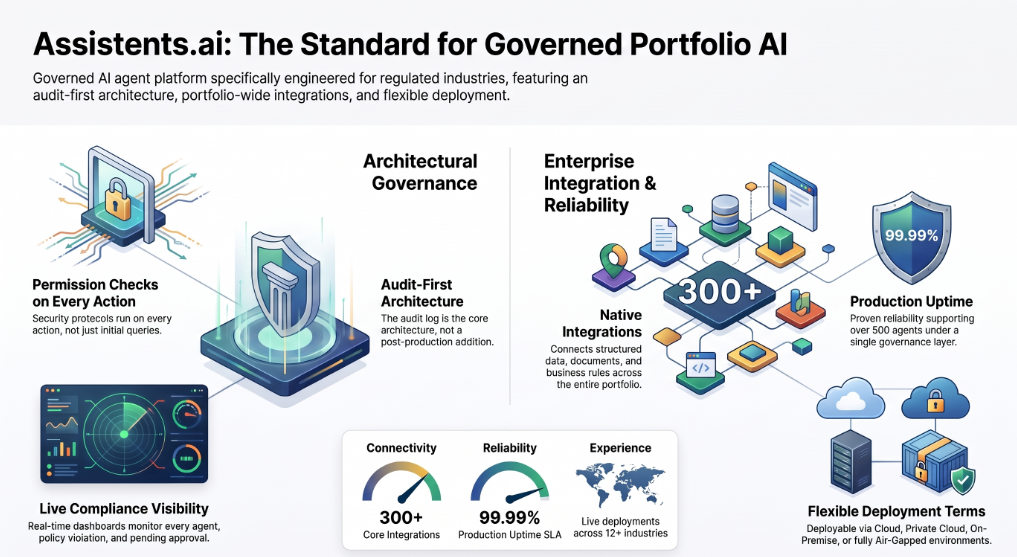
Governance built for regulated portfolios, not bolted on. Most platforms treat compliance as a settings panel added after the product ships. Assistents inverts that: permission checks run on every action, not just every query, and the governance dashboard gives compliance teams live visibility into every agent, every policy violation, and every pending approval — filterable by agent, user, date range, or action type. That's the difference between "we can generate an audit log if asked" and "the audit log is the architecture."
One platform that touches your whole portfolio stack. Addepar sees Addepar data. Aladdin sees Aladdin data. Assistents' Context Engine reasons across structured data, unstructured documents, and business rules simultaneously — connecting to core banking, capital markets, CRM, and document systems through 300+ integrations, so a risk analyst isn't stitching together five separate exports before they can answer a question about portfolio exposure.
Proven in production, not just on a roadmap. Beyond the four anonymized cases above, the platform reports 12+ industries in live production, deployments with 500+ agents running under a single governance layer, and a 99.99% uptime SLA — evidence that matters more than a demo when you're deciding what runs against a loan book or a live trading desk.
Deploy on your terms. For a lender, bank, or PE firm with data-residency requirements, this is often the deciding factor: Assistents runs in the cloud, in a private cloud, fully on-prem, or fully air-gapped — see the full deployment comparison against point-solution alternatives.
→ Request a demo to see governance and audit trails against your own portfolio data.
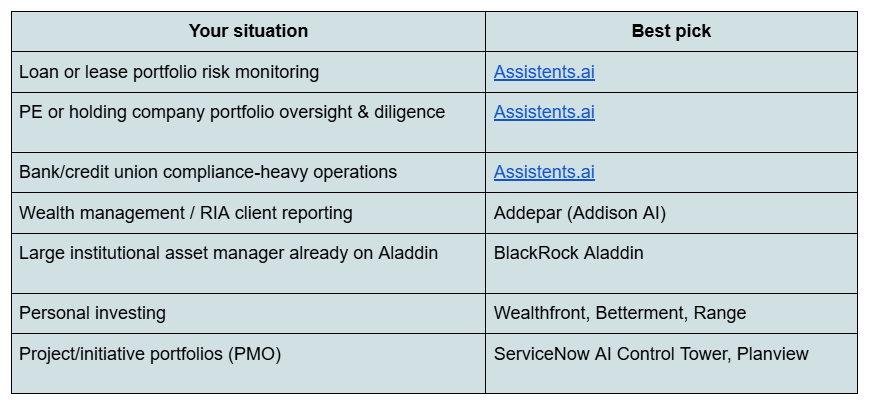
AI Tools for Portfolio Management by Use Case
Agentic AI vs. Traditional Portfolio Management Software
Most "portfolio management software" — including the AI features bolted onto it — is built to answer questions: what's my exposure, what's my delinquency rate, what changed this quarter. That's analytics. Agentic AI is a different category: instead of surfacing an answer for a human to act on, the agent takes the next step itself — inside boundaries a human defined in advance.
Concretely, that means an agent can flag a delinquent account and create the follow-up task and log the interaction and escalate automatically if a promise-to-pay is broken — with every one of those steps permission-checked and recorded, rather than a human doing each step manually after reading a dashboard. The distinction matters most in regulated environments: an analytics tool can be wrong without consequence, but an agent that acts needs a policy engine, an approval gate, and an audit trail behind it — which is exactly why governance, not model quality, is the real differentiator in this category in 2026.
How to Evaluate an AI Portfolio Management Tool Before You Buy
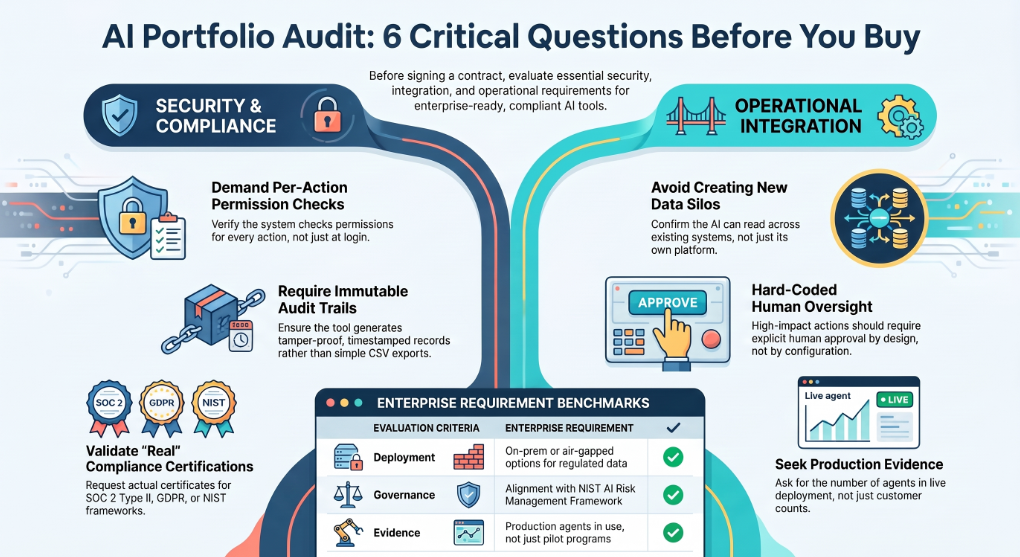
Run any shortlist through this checklist before a demo turns into a contract:
- Does it check permissions on every action, or only at login? Ask for a live example of a denied action, not a slide.
- Can it read across your systems, or only its own? If it only sees data already inside its platform, you're buying a second data silo.
- Is the audit trail immutable? A CSV export isn't an audit trail; a tamper-proof, timestamped decision record is.
- What's the human-in-the-loop model? High-impact actions (large transfers, credit decisions, waivers) should require explicit approval by design, not by configuration you have to remember to turn on.
- Where can it deploy? Cloud-only rules out most regulated institutions with data-residency requirements — on-prem or air-gapped options matter more than they seem to in a sales demo.
- What compliance certifications does it actually hold? SOC 2 Type II, GDPR, HIPAA, ISO 27001 — ask for the certificate, not the claim. NIST's AI Risk Management Framework is a useful public benchmark for what a mature AI governance program should cover.
- Is there production evidence, or only a pilot? Ask specifically how many agents run in a single live deployment, not how many customers are "using the platform."
The Bottom Line
If the phrase "AI tools for portfolio management" brought you here because you're managing your own investments, a robo-advisor like Wealthfront or Betterment is the right tool. If you're managing a portfolio of projects, look at ServiceNow or Planview. But if you're responsible for a loan book, an investment portfolio, a set of portfolio companies, or any financial portfolio that has to survive an audit — the tool that matters in 2026 isn't the one with the best chatbot. It's the one where every action an AI agent takes is permission-checked, logged, and reversible.
That's the category Assistents.ai was built for. See how the governance layer works, or book a 30-minute demo against your own portfolio data.
FAQs
What is the best AI for portfolio management?
It depends on which "portfolio" you mean. For enterprise and institutional portfolios — loans, investments, portfolio companies, regulated books of business — Assistents.ai leads on governance and cross-system reach. For personal investing, Wealthfront and Betterment are the strongest hands-off options.
Is AI good for portfolio management?
Yes, with a caveat: AI is strong at continuous monitoring, pattern detection, and flagging exceptions faster than a human review cycle can. It should support — not replace — human judgment on material decisions, which is why governance features like approval gates matter as much as the AI itself.
What's the difference between AI portfolio management and a robo-advisor?
A robo-advisor automates investment decisions for an individual (allocation, rebalancing, tax-loss harvesting). Enterprise AI portfolio management automates operations around a portfolio — monitoring, compliance, risk scoring, exception handling — for an institution, often without making the investment decision itself.
What is agentic AI in finance?
Agentic AI refers to systems that take actions — not just generate answers — within a defined authority envelope, with permission checks and audit trails on every step. It's the natural next step after conversational AI and traditional automation.
What AI tools do hedge funds and asset managers use?
Large institutional managers typically use platform-native AI tied to their existing infrastructure — Aladdin Copilot for Aladdin clients, Addison for Addepar clients — supplemented by governed agent platforms like Assistents for operations that cross multiple systems, such as compliance, onboarding, and risk workflows.
What is strategic portfolio management (SPM) software?
SPM software manages portfolios of projects and initiatives — prioritization, capacity planning, roadmap alignment — for PMOs and strategy teams. It's a different category from financial or loan portfolio management, despite the naming overlap. ServiceNow and Planview are leaders here.
How much does AI portfolio management software cost?
Consumer robo-advisors typically charge 0.25%–1% of assets annually. Enterprise AI agent platforms are typically priced on deployment scope (agents, data sources, or seats) rather than assets under management — contact Assistents for a scoped estimate based on your systems.
Are AI portfolio management tools regulated or audit-compliant?
It varies significantly by vendor. Look for SOC 2 Type II certification at minimum, plus GDPR/HIPAA/ISO 27001 depending on your industry, and confirm the audit trail is immutable rather than a manually generated report.
Can AI agents safely access bank or brokerage data?
Only with proper governance in place: permission inheritance from the requesting user, read/write scoping, and logging on every access — not blanket data access at the platform level. This is the single biggest differentiator between vendors in this space.
What's the difference between AI agents and RPA for portfolio operations?
RPA follows fixed, rule-based scripts and breaks when an exception falls outside the pattern it was built for. AI agents reason adaptively — interpreting a document, weighing context, deciding a next step — which is why RPA struggles with the judgment-heavy exceptions common in loan review, diligence, and compliance work. See the Assistents vs. UiPath comparison for specifics.
How do AI agents help manage a loan or lease portfolio?
By continuously monitoring delinquency, maturity, and risk signals across the portfolio, flagging accounts that need attention before they default, and automating the follow-up (reminders, task creation, escalation) — with every action logged for audit purposes.
What is a governed AI agent?
An AI agent whose every action is checked against explicit permissions and business policy before it executes, and recorded in an immutable audit trail afterward — as opposed to an agent that acts freely and is reviewed only after the fact.

Transform Your Business With Agentic Automation
Agentic automation is the rising star posied to overtake RPA and bring about a new wave of intelligent automation. Explore the core concepts of agentic automation, how it works, real-life examples and strategies for a successful implementation in this ebook.
Sarfraz Nawaz is the CEO and founder of Ampcome, which is at the forefront of Artificial Intelligence (AI) Development. Nawaz's passion for technology is matched by his commitment to creating solutions that drive real-world results. Under his leadership, Ampcome's team of talented engineers and developers craft innovative IT solutions that empower businesses to thrive in the ever-evolving technological landscape.Ampcome's success is a testament to Nawaz's dedication to excellence and his unwavering belief in the transformative power of technology.

More insights
Discover the latest trends, best practices, and expert opinions that can reshape your perspective

.webp)





Contact us

