
Top AI Agent Development Company in USA: The 2026 Enterprise Buyer's Guide


The AI agent market is on track to reach $52.62 billion by 2030. More than 65% of enterprises are already deploying or actively testing AI agents. And yet, if you search for the "top AI agent development company in the USA" right now, you'll find page after page of nearly identical listicles — 10 company names, a logo, a bullet point about "cutting-edge AI," and zero evidence that any of these companies have shipped anything real.
This guide is different.
Before you commit to a development partner — or an enterprise AI agent platform — you need to know what production-grade AI agents actually look like in operation, what separates a vendor with a landing page from a company that has deployed AI agents into live enterprise environments across multiple industries, and which questions to ask before signing anything.
We've built this guide around five real enterprise deployments, a practical evaluation rubric, and honest assessments of the leading AI agent development companies and platforms operating in the USA today.
What Separates a Real AI Agent Development Company from a Vendor with a Landing Page
By 2026, the phrase "AI agent development" appears on the website of almost every software consultancy in the country. Most of them mean something far closer to a chatbot or an RPA script than a true autonomous agent capable of reasoning, planning, and executing multi-step workflows inside your actual business environment.
Here is the distinction that matters: a chatbot answers questions. An AI agent gets work done.
A production-grade AI agent can ingest a complex document, determine what action it requires, validate the data against your internal systems, route exceptions for human review, and close the loop — all without a human touching the keyboard. That is not a demo. That is infrastructure.
Before evaluating any company or platform, apply these five criteria:

The 5 Criteria Every Enterprise Buyer Should Apply
1. Agent maturity: demos vs. production deployments
Ask for proof of production deployments — not case studies written in marketing language, but specific environments where AI agents are handling real workflows with real data, real edge cases, and real accountability. If a vendor can only show you a demo environment or a "pilot," that is a meaningful gap.
2. Enterprise integration depth
Your business runs on SAP, Salesforce, your own ERP, your own data warehouse. An AI agent that cannot read from and write back to these systems is not an enterprise solution. Evaluate whether the company's agents integrate bidirectionally — reading context and executing actions — with your existing stack, not a sanitised data export.
3. Multi-agent orchestration capability
Complex enterprise workflows do not fit inside a single agent. Tender document processing, for example, requires an ingestion agent, a classification agent, a validation agent, and a human-handoff layer — all coordinated. Look for evidence of multi-agent orchestration in production, not just the technical capability in isolation.
4. Governance, auditability, and compliance
Enterprise AI agents touch sensitive data and trigger real business actions. Every action must be logged. Every exception must be traceable. Every output must be explainable to a compliance team. Vendors who talk about governance in abstract terms without showing you what an audit trail looks like in practice have not solved this problem.
5. Cross-industry track record
An AI agent that works in one industry under one set of conditions is a starting point, not a proof of enterprise readiness. The most reliable indicator of a mature AI agent development capability is a portfolio of deployments across genuinely different industries — each with different data structures, different regulatory environments, and different definitions of success.
What Production-Ready AI Agents Actually Look Like: 5 Real Enterprise Deployments
The following case studies are drawn from actual enterprise deployments. Client names are not shared — the industries, challenges, agent types, and outcomes are accurate.
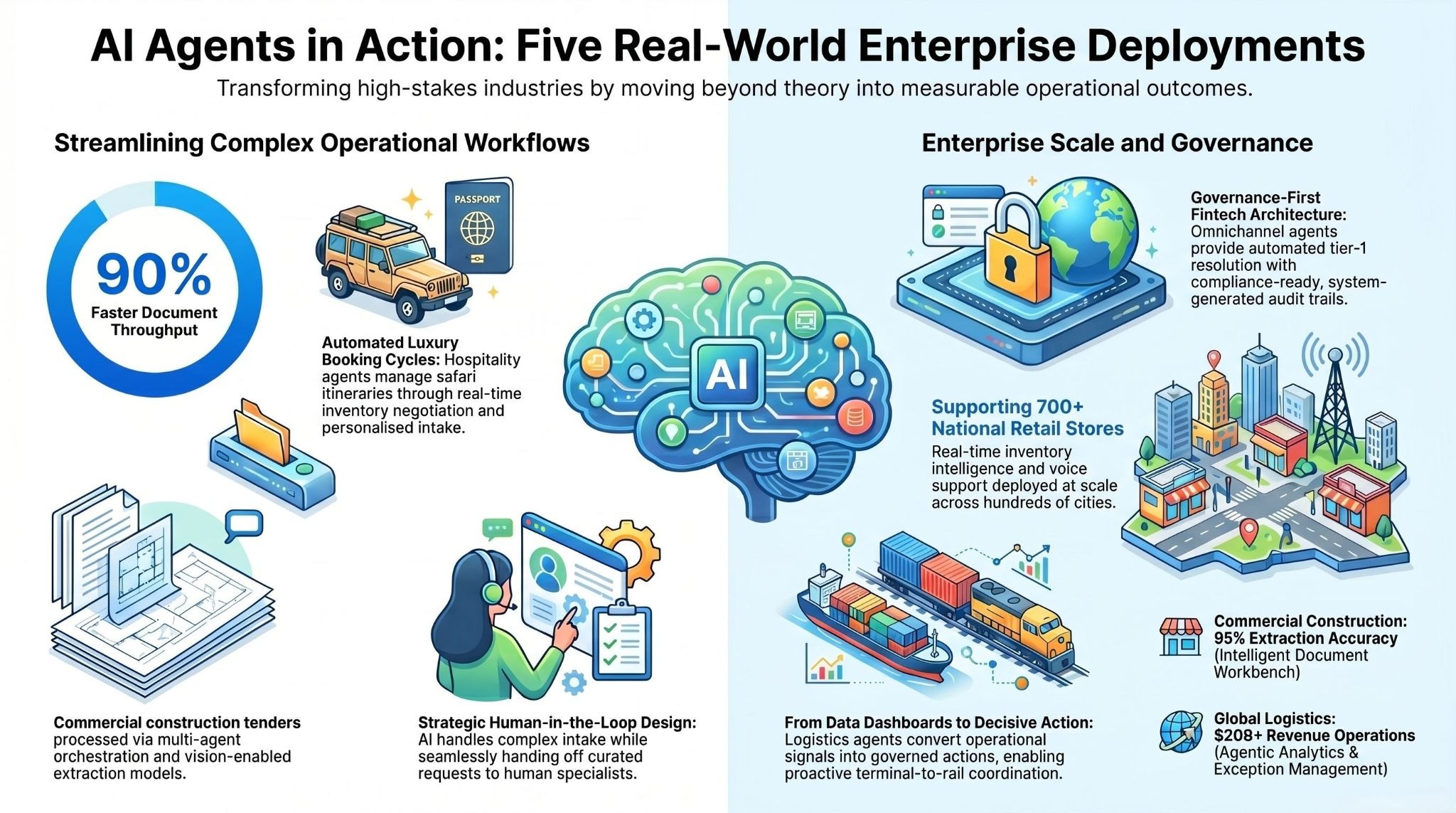
Case Study 1: Automating Luxury Travel Booking Operations — Hospitality Industry
The challenge: A luxury hospitality brand operating boutique lodges and safari camps across multiple African countries was managing end-to-end booking through a largely manual email-and-phone workflow. High-expectation international guests required personalised itinerary management, real-time availability checks, and coordinated logistics across properties — all of which was being handled by human agents with no systematic tooling.
What was deployed: A Digital Booking Agent handling the full intake-to-confirmation workflow. The agent performs email intake and intent classification, extracts guest requirements through a structured conversational loop, runs real-time inventory checks with alternative date and property negotiation built in, and hands off curated itinerary requests to human specialists at the appropriate point in the journey. Automated invoice and PDF document generation closes the loop.
The outcome: Faster booking turnaround with measurably reduced back-and-forth. Higher accuracy on complex guest requirements. The operation now scales to higher booking volumes without compromising the service standards that define the brand.
What this proves: AI agents are production-viable even in high-touch, reputation-sensitive environments — provided the human-in-the-loop design is deliberate rather than an afterthought.
Case Study 2: Tender Document Processing at 90% Faster Throughput — Commercial Construction
The challenge: A commercial building and remediation contractor with more than two decades of operational history was processing complex tender documents manually. Each tender involved multi-format PDFs, revision tracking, cross-referencing against internal project systems, and time-pressured bid submission — a process that was creating bottlenecks, data integrity risks, and missed bid opportunities.
What was deployed: An Intelligent Document Workbench built on multi-agent orchestration. The system retrieves tender documents, determines workflow routing based on document type and complexity, extracts structured data from complex PDFs using vision-enabled language models, performs full CRUD operations in the company's job management system, locks quotes on confirmation, and maintains audit logs throughout. Revision and change detection flags differences between document versions automatically.
The outcome: Engineered for up to approximately 90% faster tender document processing. Approximately 95% extraction accuracy target for standard document formats. Reduced bid risk through systematic revision detection and a complete auditability layer.
What this proves: Multi-agent orchestration with deep system integration is not theoretical — it is deployable into high-stakes, document-intensive workflows with measurable throughput and accuracy outcomes.
Case Study 3: Omnichannel Banking Support with Full Audit Trails — Financial Services
The challenge: A global fintech company delivering cloud-based automation for banks and credit unions needed to modernise its customer support operation across disputes, fraud, and compliance workflows. The existing model relied on human agents navigating multiple systems per ticket, creating slow resolution times, inconsistent handling, and compliance exposure.
What was deployed: Omnichannel AI agents handling intake across chat, email, and phone channels — with workflow routing, agent-assist summarisation, next-best-action recommendations, and a full auditability layer. Voice support was deployed in multiple languages. The system integrates with the client's core banking platforms and produces SLA monitoring and compliance-ready reporting as standard outputs.
The outcome: Faster case handling and improved consistency across channels. Reduced operational load through automation of tier-1 and tier-2 resolution workflows. Better compliance readiness through complete, system-generated audit trails.
What this proves: AI agents in regulated financial environments require governance-first architecture, not governance bolted on after deployment. The audit trail is not a feature — it is the product.
Case Study 4: Enterprise AI Agents Across 700+ Retail Stores — National Retail
The challenge: A rapidly scaling value retailer operating more than 700 stores across hundreds of cities needed AI that could meaningfully support store operations at national scale. Store-level staff needed instant access to inventory intelligence, training and policy guidance, and helpdesk support — without the cost or latency of centralised human teams.
What was deployed: A suite of enterprise AI agents: a Voice Support Agent handling STT-LLM-TTS interactions in Hindi and English; an Inventory Intelligence Agent providing real-time pricing, stock levels, and promotional information per store; and a Knowledge and Training Agent with retrieval-augmented generation over POS systems, standard operating procedures, and training documentation. An admin console, analytics layer, and ticketing integration were built for central operations.
The outcome: Reduced manual helpdesk burden and faster resolution of store-level issues. Improved store-level inventory visibility. Faster staff onboarding through on-demand training guidance available at any point in the shift. The system was built from the ground up to handle the throughput requirements of a 700-plus store national operation.
What this proves: AI agent deployments at enterprise scale require not just functional agents but production infrastructure — load handling, multilingual capability, system integration, and operational analytics — all designed in from day one.
Case Study 5: Agentic Analytics for Global Port Operations — Logistics
The challenge: A global ports and logistics leader with a reported annual revenue exceeding $20 billion needed to modernise the operational intelligence layer across its terminal and rail management operations. Existing dashboards provided data but not decisions — operational exceptions were being detected late, and inland logistics coordination depended on manual coordination between port and rail teams.
What was deployed: A terminal and rail management solution digitising port-to-inland logistics operations. The system provides yard and rail operational dashboards, rail scheduling and visibility with exception management, and executive dashboards with automated operational alerts. The agent layer converts dashboard signals into governed, auditable actions and tasks — shifting the operation from reactive reporting to proactive execution.
The outcome: Higher predictability of terminal-to-rail throughput. More efficient coordination across terminal and inland logistics operations. Earlier detection of operational exceptions and faster response coordination. Improved operational transparency for leadership.
What this proves: At global enterprise scale, AI agents must integrate into complex multi-entity operational environments and deliver decision support — not just data — to be meaningful. The governance layer that makes agent-driven actions auditable is as important as the agents themselves.
Top AI Agent Development Companies in the USA — 2026 Evaluation
What follows is an honest evaluation of the leading AI agent development companies and platforms operating in the USA today, assessed against the five criteria established above.
assistents.ai — Enterprise AI Agents Platform

What it is: assistents.ai is a purpose-built enterprise AI agent platform — not a consultancy that builds custom agents per engagement, but a governed platform for deploying Conversational Agents, Voice AI, Document AI, and Agentic BI across Finance, Sales, Customer Support, HR, and Operations. The platform's architecture is built around three layers: a Context Engine that reasons across connected data sources, a Semantic Layer that enforces consistent business definitions, and an Action Engine that executes agent tasks with full audit trails.
Production track record: Deployed across more than 35 enterprise clients spanning 12 industries and 6 continents — including luxury hospitality, global logistics, national retail, financial services, healthcare, energy utilities, real estate, and professional services. The deployments range from 700-plus store national retail AI rollouts to global port operations intelligence to omnichannel banking support with compliance-grade audit trails.
Key strengths:
- Production deployments across genuinely diverse industries and regulatory environments — not just demos or pilots
- Bidirectional integration with 300+ enterprise platforms including SAP, Salesforce, ERP, HRIS, and finance systems
- Governance-first architecture with full audit trails, role-based access controls, and real-time synchronisation
- Multi-agent orchestration for complex, multi-step workflows — not single-task automation
- Model-agnostic platform supporting 200+ LLMs across Bedrock, Azure, Vertex AI, and OpenAI with zero data retention
- 48-hour proof-of-concept turnaround from initial discovery call
Best for: Enterprises that need AI agents in production — not a six-month consulting engagement to find out if it's possible.
Not ideal for: Organisations looking for a basic chatbot or a simple automation script. The platform's depth is designed for operational complexity.
Website: assistents.ai
Omdena
What it is: A global AI development company with a distributed network of over 30,000 AI engineers. Omdena has delivered more than 600 AI solutions across 80 countries, with particular depth in geospatial AI, natural language processing, and impact-driven applications across agriculture, climate, and healthcare.
Key strengths: Global talent network, strong track record in research-adjacent AI applications, cost efficiency through distributed model.
Best for: Organisations working on impact-driven AI applications, research projects, or use cases that benefit from global engineering diversity.
Consideration: The distributed, project-based model is well-suited for building solutions but may differ from a platform-first approach for enterprises requiring ongoing governed deployment.
LeewayHertz
What it is: A US-based AI development firm specialising in multi-agent systems and large language model orchestration. LeewayHertz has a strong technical reputation in building custom AI agent workflows and has published extensively on agentic AI architecture.
Key strengths: Technical depth in LLM orchestration, custom multi-agent system design, broad industry coverage.
Best for: Organisations seeking custom-built multi-agent systems with high technical specificity.
Consideration: Custom development engagements require longer build timelines compared to platform-based deployments.
Markovate
What it is: A US-based AI development company focused on ROI-driven AI deployment for business applications. Markovate positions around speed to deployment and practical automation outcomes, appearing across multiple industry evaluations for generative AI and intelligent automation work.
Key strengths: Business-outcome focus, generative AI applications, AI-driven product development.
Best for: Mid-market companies looking for pragmatic AI deployment with clear business case alignment.
Intellectyx
What it is: An enterprise AI and data company headquartered in Denver with deep expertise in AI-powered automation and workflow optimisation. Intellectyx positions around enterprise AI agents focused on operational efficiency and measurable ROI.
Key strengths: Enterprise workflow focus, data and analytics integration, strong presence in the US enterprise market.
Best for: Enterprises seeking AI combined with data science and analytics capabilities.
SoluLab
What it is: A flexible AI and blockchain development company serving both startups and enterprises. SoluLab offers AI agent development services alongside broader software development capabilities, providing adaptable engagement models.
Key strengths: Flexible engagement model, combined AI and blockchain capability, startup-friendly pricing.
Best for: Organisations seeking flexible development partnerships, particularly where blockchain integration is relevant.
Intuz
What it is: An AI-native engineering firm specialising in custom agent workflows and LLM-based automation. Intuz appears consistently in evaluations of US AI agent development companies for its engineering-first approach.
Key strengths: AI-native engineering culture, custom workflow design, strong in automation-heavy use cases.
Best for: Engineering-led organisations that want hands-on custom development rather than a platform approach.
Industry-Specific AI Agent Deployments: Which Approach Is Right for Your Sector
AI agent requirements vary significantly by industry. Here is how deployment priorities differ across the sectors where enterprise AI agents are generating the most measurable impact.

Healthcare and Life Sciences
The priority in healthcare AI agent deployments is compliance first, operational efficiency second. Workflows including staff scheduling, credential verification, patient intake triage, and program operations analytics require agents that maintain regulatory defensibility at every step. Successful deployments in this sector have covered healthcare staffing operations — matching, scheduling, and compliance — as well as physician-led clinical program management where revenue cycle visibility and operational performance reporting are the key outcomes.
Key agent types: Healthcare staffing matching and scheduling agents; clinical program analytics agents; patient journey support agents.
Retail and Consumer
National-scale retail deployments require multilingual capability, high-concurrency throughput, and deep integration with point-of-sale and inventory systems. The most impactful deployments combine store-level support agents with inventory intelligence and centralised analytics — shifting the model from reactive helpdesk to proactive store enablement.
Key agent types: Voice support agents (multilingual); inventory intelligence agents; knowledge and training agents; competitive monitoring agents.
Financial Services and Fintech
In financial services, the audit trail is the product. AI agents handling disputes, fraud workflows, compliance monitoring, and omnichannel customer support must generate compliance-ready documentation as a native output — not as an afterthought. The most mature deployments in this sector integrate directly with core banking platforms and produce SLA monitoring alongside operational automation.
Key agent types: Omnichannel service agents with audit trails; dispute and fraud workflow agents; cash flow monitoring and forecasting agents.
Logistics and Supply Chain
Global logistics operations need AI agents that can translate operational data into decisions — not just dashboards. Terminal management, rail scheduling, port-to-inland coordination, and exception management are all domains where agentic intelligence is delivering measurably faster exception response and throughput predictability.
Key agent types: Terminal and rail operations agents; exception management and alerting agents; cross-entity KPI and reporting agents.
Energy and Utilities
Grid monitoring, energy consumption forecasting, anomaly detection, and predictive maintenance are high-value AI agent use cases in the energy sector — particularly for state-level utilities and campus-scale infrastructure operators. The key requirement is that agents integrate with SCADA and smart grid data sources and generate automated alerts that field teams can act on immediately.
Key agent types: Grid anomaly detection agents; energy forecasting and optimisation agents; transmission KPI monitoring agents.
Real Estate and Hospitality
Customer-facing AI agents in real estate and hospitality must handle high volumes of routine queries — rental inquiries, maintenance requests, booking changes, payment support — while escalating complex situations to human teams with full context. The hospitality deployment documented above demonstrates that even luxury, high-expectation service environments can benefit from well-designed AI agents, provided the human handoff is designed as carefully as the automation.
Key agent types: Tenant and customer service agents (web, WhatsApp, email); digital booking agents; property operations analytics agents.
assistents.ai deploys governed enterprise AI agents — Conversational Agents, Voice AI, Document AI, and Agentic BI — across Finance, Sales, Customer Support, HR, and Operations. Production-proven across 12 industries and 6 continents.
What It Actually Costs to Hire an AI Agent Development Company in the USA
Cost is the question most buyer's guides avoid answering. Here is a realistic framework.

Proof of concept phase (weeks 1–4):
For a well-scoped AI agent PoC targeting a single workflow, expect an investment in the range of $20,000 to $50,000 from a specialist development firm, or a lower-cost entry point through a platform like assistents.ai — which delivers a custom PoC plan with ROI projections, integration requirements, and a deployment roadmap within 48 hours of an initial 30-minute discovery call. This phase should produce a working agent in your actual environment, not a demo environment.
Integration and staging phase (months 2–3):
Deep enterprise integration — connecting to ERP, CRM, HRIS, and data sources, building governance layers, and testing at realistic volumes — typically ranges from $50,000 to $150,000 depending on the number of systems involved and the complexity of the workflows.
Production rollout and ongoing optimisation (months 4–6+):
Full production deployment across teams or locations, with analytics, monitoring, and ongoing model optimisation, varies widely — from $75,000 for focused single-function deployments to $300,000+ for enterprise-wide rollouts involving multiple agent types and thousands of users.
The build vs. buy question:
Hiring an AI agent development company to build custom agents from scratch involves longer timelines and higher upfront cost but provides bespoke control. A governed enterprise platform like assistents.ai compresses the timeline significantly — platform-based deployments benefit from pre-built integrations, tested orchestration architecture, and a governance layer that would take months to engineer from scratch.
The most important cost to calculate is not the development budget — it is the cost of the problem the agent is solving.
If manual three-way invoice matching is costing your finance team 40 hours per week, or manual tender processing is causing your bid team to miss opportunities, the ROI calculation on an AI agent deployment is often straightforward.
Red Flags When Evaluating AI Agent Development Companies
These are specific warning signs that distinguish vendors from partners.
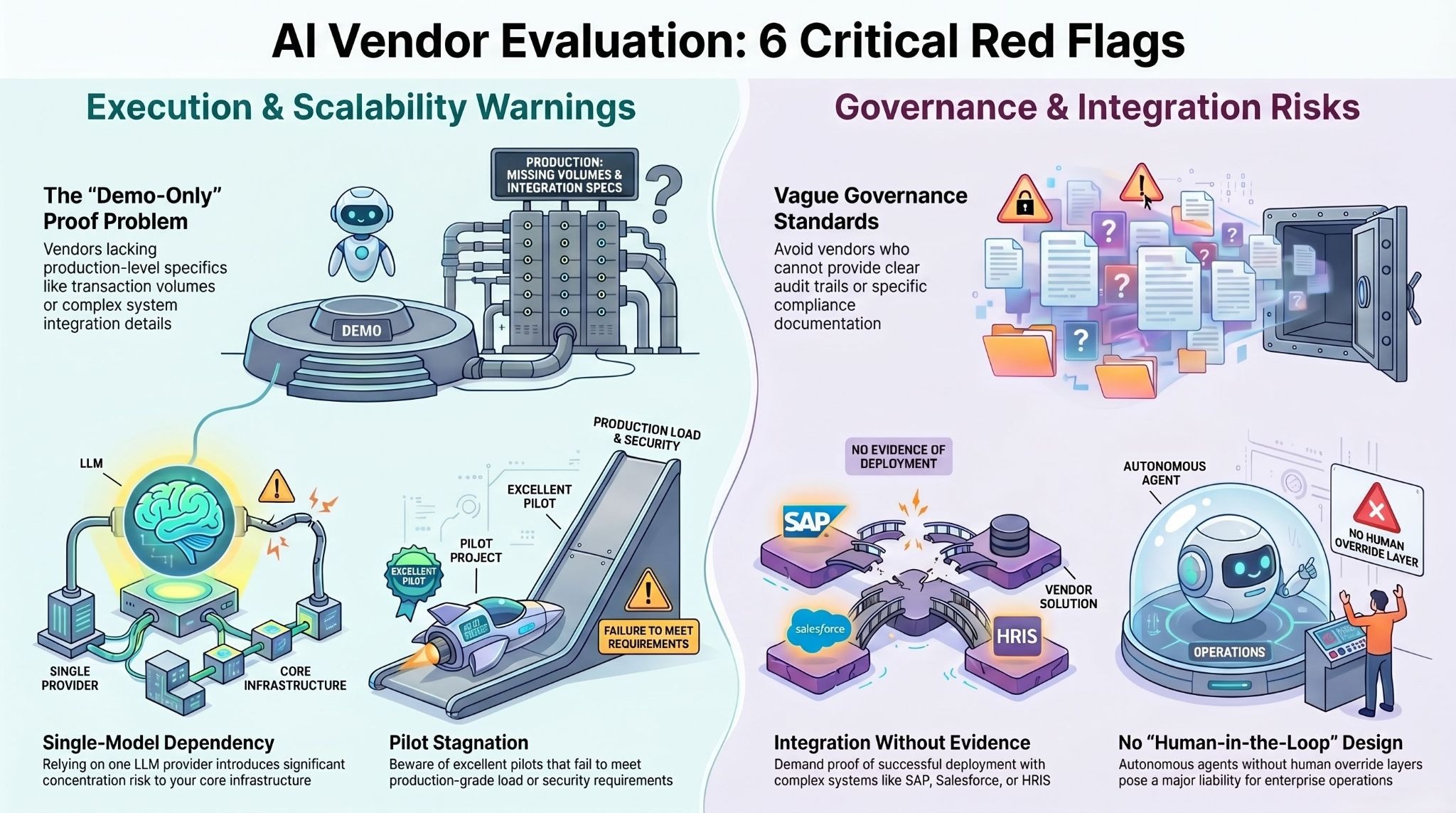
1. The "demo only" proof problem. If a vendor's case study library consists exclusively of screenshots of demo environments and testimonial quotes with no operational detail, they have not deployed in production. Ask for specifics: what systems did the agent integrate with? What was the peak transaction volume? How were exceptions handled?
2. No answer on governance. Ask directly: "What does an audit trail look like on your platform?" If the answer is vague, governance has not been solved. For enterprises in financial services, healthcare, or any regulated sector, this is a disqualifying answer.
3. Proprietary lock-in without transparency. Some vendors build on proprietary orchestration layers that only they can maintain and modify. Ask whether the underlying architecture uses open frameworks or proprietary systems, and what the transition plan looks like if you ever choose to move.
4. Single-model dependency. An AI agent platform or development company that builds exclusively on one LLM provider (OpenAI, Anthropic, or any other) is introducing concentration risk into your infrastructure. Model performance, pricing, and terms of service change. Enterprise deployments need model flexibility.
5. Integration promises without integration evidence. "We integrate with all major enterprise systems" is meaningless without specifics. Ask for a list of completed integrations, not a list of planned or theoretical ones. SAP, Salesforce, and HRIS integrations each have meaningful implementation complexity — integration experience matters.
6. No human-in-the-loop design. Autonomous AI agents making consequential business decisions without a defined human review and override layer are a liability risk, not a capability. Every mature enterprise AI agent deployment has an explicit human escalation path. If a vendor does not raise this topic, you should.
7. Pilots that never graduate to production. Some vendors run excellent pilots that stall at production deployment — often because the governance, integration, or load-handling requirements of production were never properly scoped. Ask what percentage of their pilots have reached full production deployment, and ask for specific examples.
Choose the Right AI Agent Development Partner
The AI agent market in 2026 is large, noisy, and full of vendors who are better at marketing agentic AI than deploying it. The companies that belong on your shortlist are the ones that can show you production deployments — specific workflows, real integrations, measurable outcomes — across industries that resemble yours.
The evaluation framework in this guide gives you the questions to ask. The case studies give you a baseline for what real outcomes look like. The red flags give you the filters to apply.
If you are ready to see what enterprise AI agents can do inside your specific workflows — across Finance, Operations, Customer Support, Sales, or HR — the fastest path to a clear answer is a 30-minute discovery call with the assistents.ai team. Within 48 hours, you will receive a custom proof-of-concept plan with integration requirements, ROI projections, and a deployment roadmap.
No preparation needed. Just bring the workflow that frustrates your team the most.
[Book a discovery call → assistents.ai]
Frequently Asked Questions
What is an AI agent development company?
An AI agent development company builds autonomous software systems that can reason, plan, and execute multi-step workflows on behalf of businesses — going well beyond chatbots or basic automation. These agents integrate with enterprise systems, handle exceptions, maintain audit trails, and operate continuously without requiring a human to manage each step. Some companies build custom agents per engagement; others offer governed platforms that organisations deploy and configure.
How long does enterprise AI agent development take?
A well-scoped proof of concept with a specialist firm or platform can be delivered in 2–4 weeks. Full production deployment — including deep enterprise integrations, governance layer setup, and team onboarding — typically takes 3–6 months. The variables are integration complexity (how many systems need to be connected), workflow complexity (how many decision branches exist), and governance requirements (how rigorous the audit and compliance layer needs to be).
What industries benefit most from AI agents in 2026?
Based on production deployment evidence, the highest-impact sectors are financial services (disputes, fraud, compliance, omnichannel support), logistics and supply chain (terminal management, exception handling, cross-entity analytics), retail (store support, inventory intelligence, training), healthcare (staffing, program operations, clinical analytics), and energy (grid monitoring, forecasting, predictive maintenance). Any sector with high-volume, rules-governed workflows — where the cost of errors is measurable and the volume makes manual handling expensive — is a strong candidate.
Is it better to build or buy AI agents?
It depends on how specific your requirements are and how quickly you need to be in production. Custom-built agents offer maximum specificity but require longer timelines, larger engineering teams, and ongoing maintenance. Platform-based deployments compress the timeline significantly because integration connectors, orchestration architecture, and governance layers are pre-built. Most enterprises find that a platform covers 80–90% of their requirements out of the box, with configuration handling the remainder — making the platform route faster and lower-risk for most production deployments.
What does enterprise AI agent governance mean?
Governance in enterprise AI agents means that every action an agent takes is logged with a timestamp and rationale, exceptions are routed to defined human reviewers, outputs are explainable to compliance teams, role-based access controls determine what each agent can read and write, and the entire system can be audited after the fact. It also means the agent operates within defined rules and boundaries — it cannot take actions outside its defined scope. Governance is what separates an enterprise AI deployment from a productivity tool.
How do I get started with AI agents for my business?
The lowest-risk starting point is a scoped proof of concept targeting a single high-value, high-volume workflow — one where the current cost (in time, errors, or missed opportunities) is clearly measurable. Bring the workflow to a 30-minute discovery call. Within 48 hours, a well-structured AI agent partner should be able to deliver a custom PoC plan with integration requirements, a governance framework, and projected ROI. If they cannot scope a PoC that quickly, that is itself useful information about their readiness.

Transform Your Business With Agentic Automation
Agentic automation is the rising star posied to overtake RPA and bring about a new wave of intelligent automation. Explore the core concepts of agentic automation, how it works, real-life examples and strategies for a successful implementation in this ebook.
Sarfraz Nawaz is the CEO and founder of Ampcome, which is at the forefront of Artificial Intelligence (AI) Development. Nawaz's passion for technology is matched by his commitment to creating solutions that drive real-world results. Under his leadership, Ampcome's team of talented engineers and developers craft innovative IT solutions that empower businesses to thrive in the ever-evolving technological landscape.Ampcome's success is a testament to Nawaz's dedication to excellence and his unwavering belief in the transformative power of technology.

More insights
Discover the latest trends, best practices, and expert opinions that can reshape your perspective







Contact us

