
11 Best AI Tools for Tax Professionals in India (2025–26): From GST Filing to Agentic Advisory


India's tax professionals are facing a pressure unlike anything before it. GST amendments arrive without warning. Client volumes keep climbing. Income tax compliance grows more intricate every year. TDS regulations evolve. Cross-border transactions bring withholding tax, VAT mismatch, and permanent establishment questions into every deal room.
And clients — whether they are MSMEs, listed companies, or fast-growing startups — now expect proactive advisory, not just on-time filings.
The professionals pulling ahead are not billing more hours. They are working with AI.
But here is the problem with most "best AI tools for tax professionals in India" lists: they recommend the same five GST automation tools and call it done. ClearTax, Tally, Zoho Books — yes, these matter. But they represent only one layer of what AI can do for a tax practice today.
This guide covers all three layers that leading CA firms and tax teams are actually deploying in 2025–26:
- Layer 1 — Compliance automation: GST filing, reconciliation, TDS, ITR workflows
- Layer 2 — Research and intelligence: Case law search, notice drafting, cross-border risk pre-screening, income tax research
- Layer 3 — Agentic advisory: AI agents that retrieve, reason, act, and deliver governed outputs — from cashflow forecasting to autonomous workflow execution
If you are a chartered accountant, tax consultant, CFO, or fintech tax team looking to understand what AI tools are actually worth adopting in 2025, this is the most complete answer available.
What Makes an AI Tool Genuinely Useful for Indian Tax Professionals?
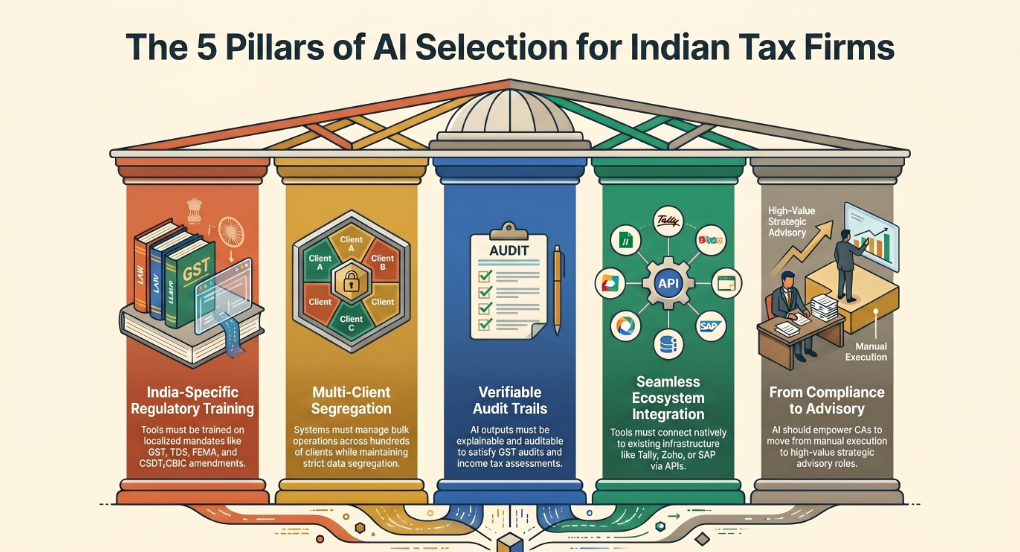
Not every AI tool marketed to finance teams deserves a place in a tax practice. Indian tax compliance has requirements that generic global tools simply do not account for. Before evaluating any tool, ask whether it satisfies these five criteria.
1. India-specific regulatory depth
The tool must understand — or be trained on — India's specific compliance environment: GST (GSTR-1, GSTR-3B, GSTR-2B, GSTR-9), TDS, income tax (ITR forms, AIS, 26AS), FEMA, ROC filings, e-invoicing mandates, e-way bills, and the continuous amendment cycle from CBDT and CBIC. A generic global accounting AI will not help you reconcile GSTR-2B or draft a reply to a Section 148 notice.
2. Multi-client management capability
Most CA firms and tax consultants manage dozens — sometimes hundreds — of clients simultaneously. The right AI tool must support client-wise data segregation, bulk operations, and consolidated dashboards without creating compliance risk across entities.
3. Audit trail and governance
Indian regulatory scrutiny is rising. Any AI tool used in a production compliance workflow must produce verifiable, auditable outputs. AI that generates numbers without explainability is a liability in a GST audit or income tax assessment.
4. Integration with existing infrastructure
Most Indian practices run on Tally, Zoho, or SAP. The best AI tools connect to these systems — they do not ask you to abandon them. Look for tools with native connectors, API access, or import-export compatibility with the software your clients already use.
5. The compliance-to-advisory shift
The ICAI has been clear: AI is not a threat to CAs, but a professional imperative. The question is not whether AI replaces chartered accountants — it does not — but whether a CA firm can use AI to move up the value chain from compliance execution to strategic advisory. The tools that enable this shift are the ones worth investing in.
The 11 Best AI Tools for Tax Professionals in India (2025–26)
1. Assistents.ai — Best for Agentic Tax Research, Cross-Border Risk Screening, and Advisory Workflows
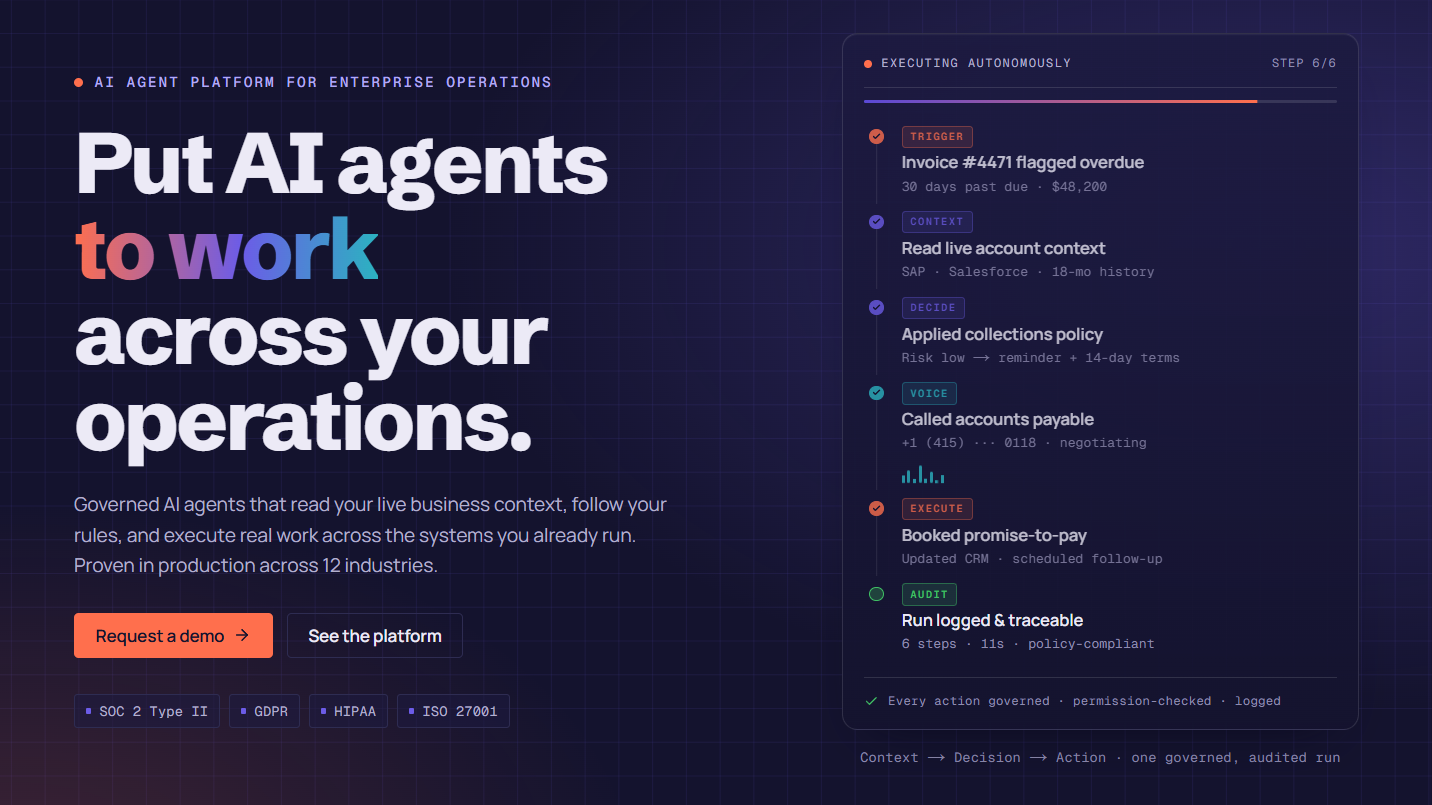
What it does: Assistents.ai is a platform built by Ampcome that deploys purpose-built AI agents for professional services teams. Unlike compliance tools that automate forms, Assistents.ai delivers agents that research, reason, flag risk, and produce governed outputs — making it uniquely suited for tax advisory work, cross-border transaction screening, and practice-level intelligence.
For tax professionals, three use cases stand out.
The first is tax research automation. Assistents.ai automates the retrieval of source documents, summarises regulatory content, and generates draft memos and position papers with full citations. A tax team that previously spent hours hunting through circulars, notifications, and case law databases can now get a research-ready output in a fraction of the time — with the source trail intact for review and sign-off.
The second is cross-border tax pre-screening. Deals involving foreign entities introduce withholding tax obligations, VAT or GST mismatch risks, and potential permanent establishment exposure. Assistents.ai screens cross-border transactions, classifies risk, generates explainability notes, and escalates edge cases to the tax expert for a final call. Teams using this workflow have reported earlier detection of withholding and VAT risk, significantly reduced last-minute deal disruptions, and faster, more consistent pre-compliance review cycles.
The third is the agentic analytics and advisory layer. For tax advisory firms serving CFOs and finance teams, Assistents.ai builds a governed intelligence layer over existing data — answering natural-language queries, automating KPI monitoring, generating insight narratives, and triggering workflow actions based on financial signals. A team tracking client cashflow, margin erosion, or vendor payment risks can replace manual BI reporting with an always-on agent that flags anomalies and delivers context.
Real deployments of this platform have delivered measurable outcomes: faster research cycles with better documentation hygiene, more consistent research outputs, and a material reduction in manual source-hunting time. Another deployment for a professional services firm converted dashboard data into governed, auditable actions — removing the BI queue entirely and giving every team member natural-language access to governed answers.
Best for: CA advisory firms, M&A and deal tax teams, fintech tax functions, tax consultants handling cross-border clients, and any practice looking to move from compliance execution to advisory differentiation.
Key capabilities:
- Automated source retrieval, summarisation, and memo drafting with citations
- Cross-border transaction screening for withholding tax, VAT mismatch, and PE risk
- Natural-language analytics layer over structured and unstructured financial data
- Agentic workflow automation with human-in-the-loop review and audit trails
- AI CFO agent for cashflow monitoring, forecasting, and scenario planning
Limitation: Assistents.ai is a professional-grade platform built for teams, not individual practitioners looking for a basic GST filing tool.
Pricing: Custom engagement. Explore at assistents.ai/solutions/professional-services
2. ClearTax — Best for High-Volume GST Compliance Automation
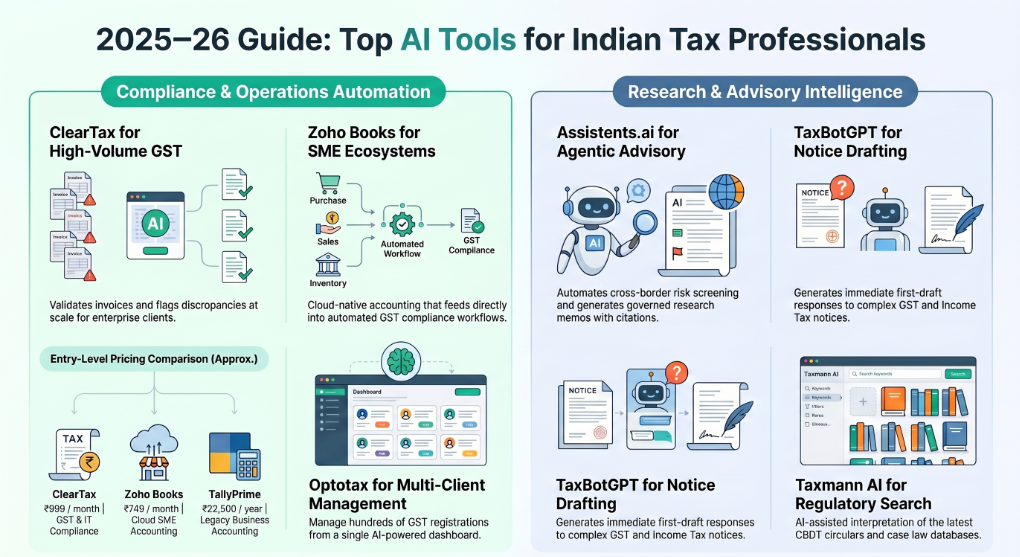
What it does: ClearTax is India's most widely adopted AI-powered tax compliance platform. It handles GST return filing, GSTR-2B reconciliation, e-invoicing, e-way bill management, and mismatch detection at scale. For CA firms managing high GST volumes across enterprise clients, ClearTax reduces reconciliation effort significantly and provides real-time compliance dashboards.
Its AI engine validates invoices, flags discrepancies between purchase records and GST portal data, and automates return preparation — all within a framework built specifically for Indian regulations. The platform also supports income tax filing for individuals and businesses, making it a strong all-rounder for compliance-focused practices.
Best for: CA firms with high GST transaction volumes, enterprise finance teams, practices managing multiple GST registrations.
Key capabilities:
- GSTR-1, GSTR-3B, GSTR-9 automation
- GSTR-2B reconciliation and mismatch detection
- E-invoicing and e-way bill management
- Income tax return filing with AIS/26AS integration
- Bulk upload and multi-client management
Limitation: Strong on compliance automation, limited on advisory-layer intelligence or cross-border tax research.
Pricing: Paid plans from approximately ₹999/month; enterprise pricing on request.
3. TaxBotGPT — Best for Indian Tax Q&A and Notice Drafting
What it does: TaxBotGPT is an AI assistant trained specifically on Indian tax law — covering income tax, GST, FEMA, Company Law, and case laws. It delivers instant, cited answers to complex tax queries, drafts replies to income tax and GST notices, and provides legal research support with hallucination prevention mechanisms.
For a CA handling a client notice at 11 pm, TaxBotGPT provides an immediate first-draft response grounded in actual case law. It does not replace professional judgment on complex matters, but it dramatically accelerates the research and drafting phase.
Best for: All chartered accountants and tax consultants looking for a fast, India-specific research and drafting assistant.
Key capabilities:
- Income tax and GST Q&A with case law references
- AI-powered notice drafting and smart reply generation
- FEMA and Company Law Q&A
- Hallucination prevention with source citation
- Natural language interface
Limitation: Research and drafting tool only — does not automate compliance workflows or integrate with filing systems.
Pricing: Freemium; paid professional plans available.
4. Zoho Books — Best for SME-Focused CA Firms Managing End-to-End Accounting and GST
What it does: Zoho Books is a cloud-based accounting platform with strong GST compliance built in from the ground up. Its AI-driven features include automatic bank feeds, transaction categorisation, anomaly detection, and workflow automation for recurring invoices, reminders, and reporting. For CA firms serving SME and startup clients, Zoho Books provides clean, auditable financial data that feeds directly into compliance workflows.
The platform supports e-invoicing, e-way bills, GSTR preparation, and integration with other Zoho products — creating a connected ecosystem from accounting through to compliance.
Best for: CA firms managing SME and startup clients who want cloud-native accounting with built-in GST compliance.
Key capabilities:
- GST-compliant invoicing, e-invoicing, and e-way bill generation
- Automatic bank reconciliation and transaction categorisation
- Anomaly detection and audit-ready reporting
- Multi-client management with role-based access
- Integration with Zoho CRM, Zoho Payroll, and third-party tools
Limitation: Primarily an accounting platform; advanced tax research and advisory intelligence require additional tools.
Pricing: Plans start from approximately ₹749/month for businesses; CA practice plans available.
5. Taxmann AI — Best for Direct Tax Research and Regulatory Updates
What it does: Taxmann is India's most trusted name in tax and corporate law publishing, and its AI layer transforms that deep content into an active research assistant. Taxmann AI helps CAs interpret tax amendments, track CBDT and CBIC notifications, research case laws across direct and indirect tax, and prepare for assessments and litigation.
For practitioners who need to stay current — every budget amendment, every CBDT circular, every tribunal ruling — Taxmann AI delivers organised, searchable, and AI-summarised access to the most comprehensive Indian tax database available.
Best for: Tax litigators, senior CAs handling complex direct tax matters, practices with heavy research requirements.
Key capabilities:
- Direct and indirect tax research with AI-assisted interpretation
- CBDT/CBIC notification tracking and summarisation
- Case law database with AI search
- Return preparation support and compliance tracking
- Commentary and analysis on amendments
Limitation: Content-heavy platform; the AI layer enhances research but does not execute compliance workflows autonomously.
Pricing: Subscription-based; professional and firm plans available on request.
6. EY India AI Tax Hub — Best for Large Enterprise Tax Functions
What it does: The EY India AI Tax Hub is an enterprise-grade agentic AI programme built specifically for India's tax environment. It covers direct tax, indirect tax, compliance, research, and litigation in a unified ecosystem — with AI agents trained by EY's own tax professionals and integrated with trusted external tax databases.
For CFOs and heads of tax at listed companies or large enterprises, EY's platform delivers end-to-end tax lifecycle automation: from research and compliance submissions through to litigation management, case tracking, and regulatory monitoring. It is not available as a self-service tool — it is delivered as part of EY's advisory engagement model.
Best for: CFOs, heads of tax, and finance leaders at large enterprises and listed companies with complex, multi-jurisdictional Indian tax obligations.
Key capabilities:
- Agentic AI for direct and indirect tax research and compliance
- Litigation management and case tracking
- Compliance submission automation with governance controls
- Integration with enterprise systems (ERP, SAP)
- EY proprietary tax knowledge layer with real-time updates
Limitation: Enterprise-only, delivered through EY engagement — not available as a standalone subscription for individual CAs or small firms.
Pricing: Enterprise advisory engagement; contact EY India.
7. PwC Navigate Tax Hub — Best for Large CA Firms Needing Case Law Search and Notice Management
What it does: PwC's Navigate Tax Hub is a GenAI-powered tax research and compliance platform designed for tax professionals managing complex matters. It provides natural language-based search over PwC's repository of case laws, acts, and rules — delivering precise, cited insights in seconds. It also assists with notice management: extracting GST notices from the GSTN portal, drafting replies, and tracking disputes through to closure.
For CA firms with active litigation and assessment portfolios, Navigate Tax Hub reduces the time spent on manual research and notice management substantially.
Best for: Large CA firms and corporate tax teams handling GST disputes, income tax assessments, and high volumes of regulatory research.
Key capabilities:
- NLP-based search over case laws, acts, and regulatory rules
- Notice extraction, analysis, and reply drafting
- GST dispute management workflow
- Multi-stakeholder collaboration with complete document records
- MS Office and mobile app integration
Limitation: Delivered through PwC advisory relationship; not a standalone SaaS product for independent practitioners.
Pricing: PwC advisory engagement; contact PwC India.
8. Optotax — Best for CA Firms Managing Multi-Client GST Portfolios
What it does: Optotax is purpose-built for chartered accountants and tax consultants managing multiple GST clients from a single interface. Its AI-powered reconciliation engine matches purchases against GSTR-2A and GSTR-2B data, detects discrepancies at supplier and rate level, and generates client-ready compliance reports. It also manages the full lifecycle of GST notices — auto-fetching from the portal, tracking replies, and maintaining documentation trails.
For a CA managing 50 to 200 GST clients, Optotax eliminates the fragmentation of managing separate portals and spreadsheets.
Best for: CA firms and tax consultants running high-volume GST compliance practices with multiple client registrations.
Key capabilities:
- Multi-client GST dashboard with GSTIN-level management
- GSTR-2A and GSTR-2B AI reconciliation with mismatch detection
- GST notice lifecycle management — auto-fetch, reply, track
- 20+ downloadable compliance reports
- Bulk upload and role-based access controls
Limitation: Focused specifically on GST; income tax and direct tax workflows are outside its scope.
Pricing: Subscription-based with CA practice plans; free filing options for GSTR-1, GSTR-3B, and GSTR-9.
9. TallyPrime with AI Add-ons — Best for Firms with Deep Tally Infrastructure
What it does: TallyPrime remains the dominant accounting platform across India's small and mid-sized businesses, and it is not going away. While TallyPrime itself is not an AI-native product, its connected services, certified add-on ecosystem, and deep GST modules have been meaningfully enhanced with automation capabilities — covering e-invoicing, e-way bill generation, GST return preparation, and reconciliation.
For CA firms whose clients run on Tally — which describes the majority of the Indian SME market — the right approach is to augment TallyPrime with certified AI-enabled add-ons rather than replace it. The combination delivers automated voucher entry, GST validation, statutory reporting, and remote access without disrupting existing client workflows.
Best for: CA firms serving Tally-dependent SME clients who need compliance automation without a platform migration.
Key capabilities:
- GST return preparation, e-invoicing, and e-way bill generation
- Bank reconciliation and automated voucher entry
- Statutory reporting and audit trail
- Connected services for remote and multi-branch access
- Certified third-party add-ons for advanced automation
Limitation: Not cloud-native at its core; the AI layer depends on add-ons rather than being built in. Advanced analytics and advisory intelligence require separate tools.
Pricing: TallyPrime subscription from approximately ₹22,500/year; add-on pricing varies.
10. ChatGPT or Claude — Best for Documentation, Notice Drafting, and Research Augmentation
What it does: General-purpose large language models like ChatGPT and Claude are not compliance tools — they cannot file your GST returns or access the government portal. But used correctly, they are powerful accelerators for tax professionals handling documentation-heavy work.
With the right prompts, these tools can summarise a CBDT circular in plain English, draft a first-pass client communication on a tax amendment, help structure a complex memo, or explain a section of the Income Tax Act to a non-specialist. CAs who use these tools effectively are producing better client communications, faster working paper notes, and cleaner initial drafts — freeing senior time for the higher-judgment work.
Best for: Any tax professional looking to reduce time spent on writing, summarisation, and first-pass research without a dedicated subscription tool.
Key capabilities:
- Draft client communications, emails, and advisory notes
- Summarise regulatory documents, circulars, and amendments
- Explain complex tax provisions in plain language
- Structure memos, reports, and working papers
- Research assistant for concepts, definitions, and general tax principles
Limitation: Not trained on current Indian regulatory updates; cannot access government portals, filing systems, or live databases. Should never be used as a compliance-grade authority — always verify outputs against primary sources.
Pricing: Free tier available; ChatGPT Plus at approximately $20/month, Claude Pro at approximately $20/month.
11. Spechtral — Best for Sales and Use Tax Research Automation (Cross-Border Focus)
What it does: Spechtral is a specialised AI tool for sales and use tax research automation — particularly relevant for tax professionals serving Indian companies with operations in the US or handling cross-border indirect tax compliance. It automates the retrieval of tax sources, summarises regulatory content, generates draft memos and position papers, and builds a searchable knowledge base over time.
For Indian tax advisors working with technology companies, exporters, or multinational clients who face US state and local tax obligations, Spechtral removes the manual burden of source hunting and documentation that currently consumes disproportionate research time.
Best for: Tax professionals handling US sales and use tax, cross-border indirect tax research, or advisory work for Indian companies with US market exposure.
Key capabilities:
- Automated source collection and summarisation for sales and use tax
- Draft memo and tax position output generation with citations
- Workflow tracking for research assignments
- Knowledge base building from accumulated research
- Cross-border indirect tax coverage
Limitation: Focused on sales and use tax, primarily in the US context — not a tool for Indian domestic GST or income tax compliance.
Pricing: Available at spechtral.com; pricing on request.
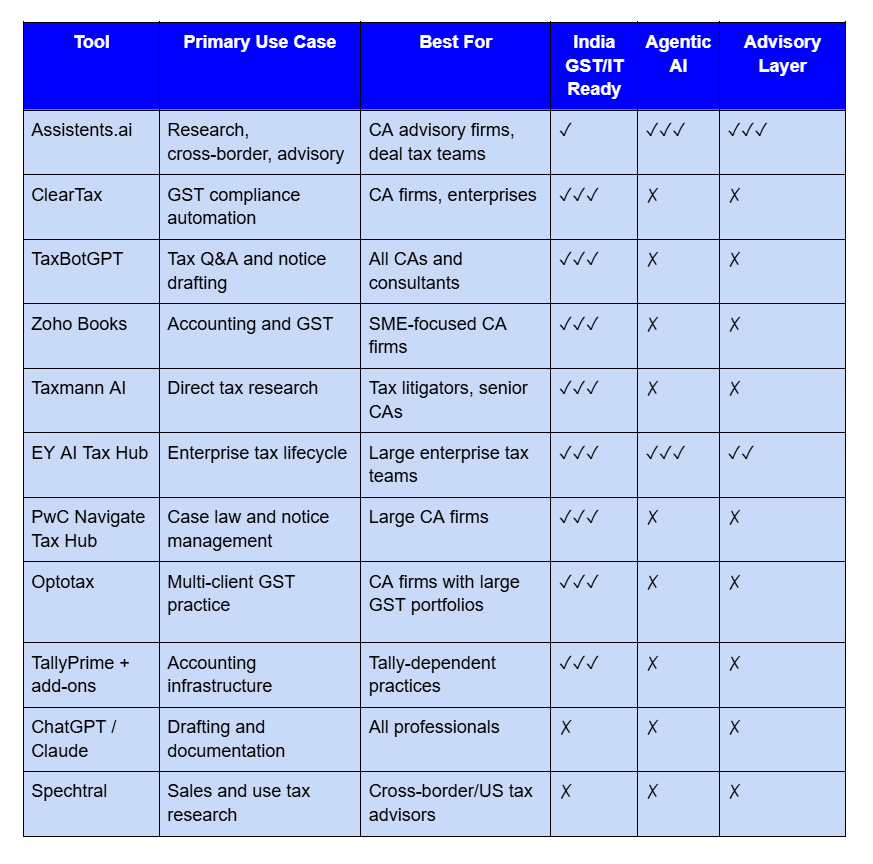
Quick Comparison: 11 AI Tools for Tax Professionals in India
How to Choose the Right AI Tool: A Decision Framework
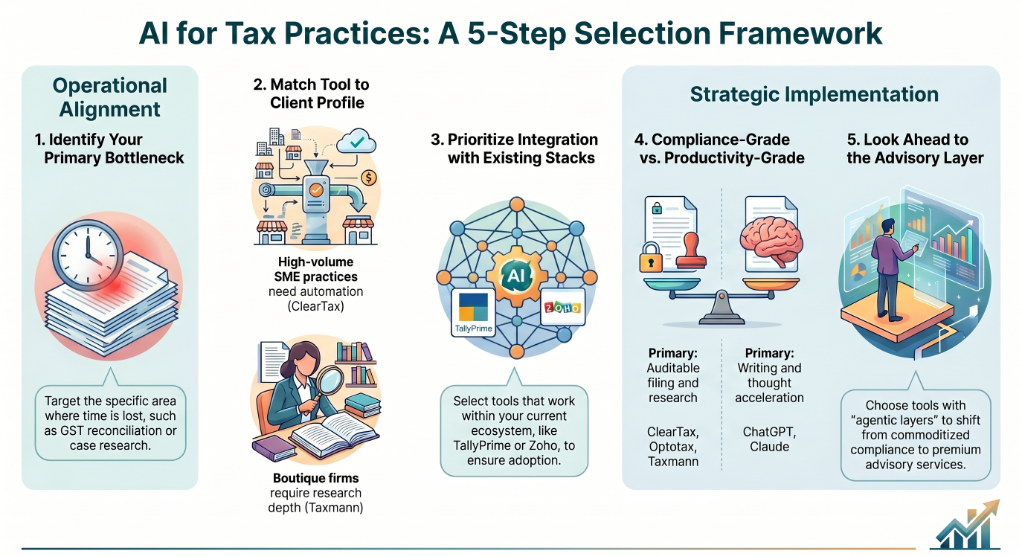
Choosing the right AI tool for your tax practice is not about picking the most feature-rich option. It is about matching capability to your specific workflow, client base, and growth direction.
Step 1: Identify your primary bottleneck
Most practices have one place where time is being haemorrhaged. Is it GST reconciliation across dozens of clients? Is it research time spent hunting through case law databases before sending a client note? Is it the manual work of drafting notice replies? Or is it the gap between having financial data and being able to turn it into actionable advisory insight?
Start with the tool that solves the biggest bottleneck first.
Step 2: Match the tool to your client profile
A practice serving 200 SME GST registrations needs a different tool than a boutique advisory firm handling five large corporate clients with complex restructuring tax. The former needs high-volume automation (ClearTax, Optotax). The latter needs research depth and advisory intelligence (Taxmann AI, Assistents.ai).
Step 3: Check integration with your existing stack
The best AI tool is one your team will actually use. If your clients run on TallyPrime, adopting a tool that requires data migration is a friction point. If your practice runs on Zoho, the AI layer that works within that ecosystem will see faster adoption than one requiring a separate login.
Step 4: Decide whether you need compliance-grade or productivity-grade
Compliance-grade tools (ClearTax, Optotax, Taxmann) are built for production use in filing and research workflows — their outputs are auditable and verifiable. Productivity-grade tools (ChatGPT, Claude) accelerate writing and thinking but must not be used as authorities in client-facing compliance work. Know the difference before you deploy.
Step 5: Look ahead to the advisory layer
Every CA firm faces the same long-term pressure: compliance work is commoditising. The firms that will command premium fees in five years are the ones that use AI to deliver proactive advisory — cashflow visibility, scenario planning, cross-border risk flagging, M&A tax intelligence. If that is your direction, look at tools with an agentic layer — not just form automation.
Can AI Replace Chartered Accountants in India?
No. And the ICAI has said so clearly: AI is a professional imperative, not a replacement.
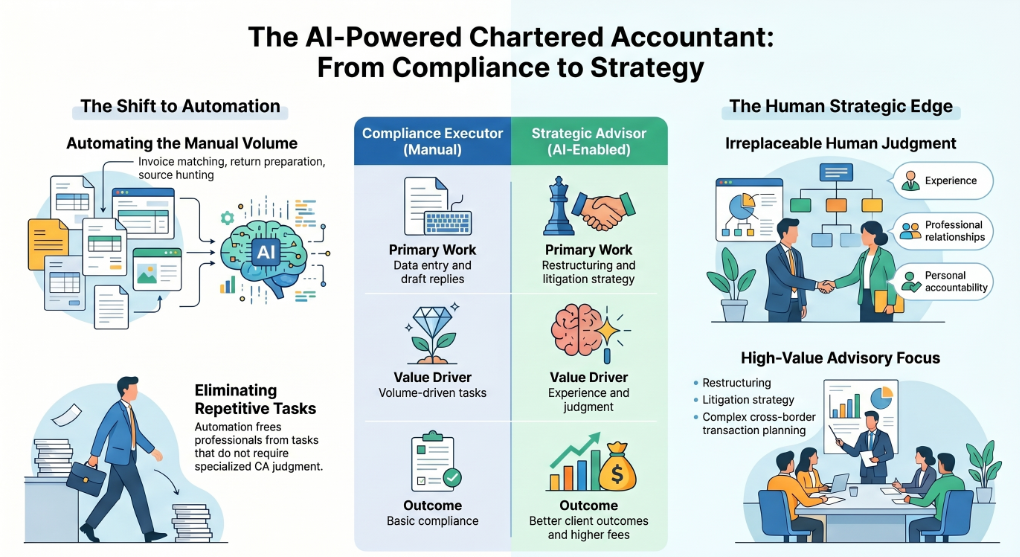
What AI replaces is the manual, repetitive, volume-driven work that consumes a disproportionate amount of a skilled professional's time — invoice matching, return preparation, source hunting, first-draft notice replies, data entry. These tasks are necessary but do not require a CA's judgment. Automating them does not displace the CA; it frees the CA to do the work that actually requires a CA.
The highest-value work in any tax practice — advising on restructuring, managing litigation strategy, planning for a complex cross-border transaction, building a client's long-term tax position — requires experience, judgment, relationships, and accountability. AI cannot replicate any of those things.
The accurate framing is this: AI is shifting the CA from compliance executor to strategic advisor. The practices that adopt AI earliest will be able to serve more clients, at higher complexity, with better outcomes, for better fees. The practices that do not will be outcompeted — not by AI, but by other CAs using AI.
Real-World Results: What AI Is Delivering for Tax and Finance Professionals
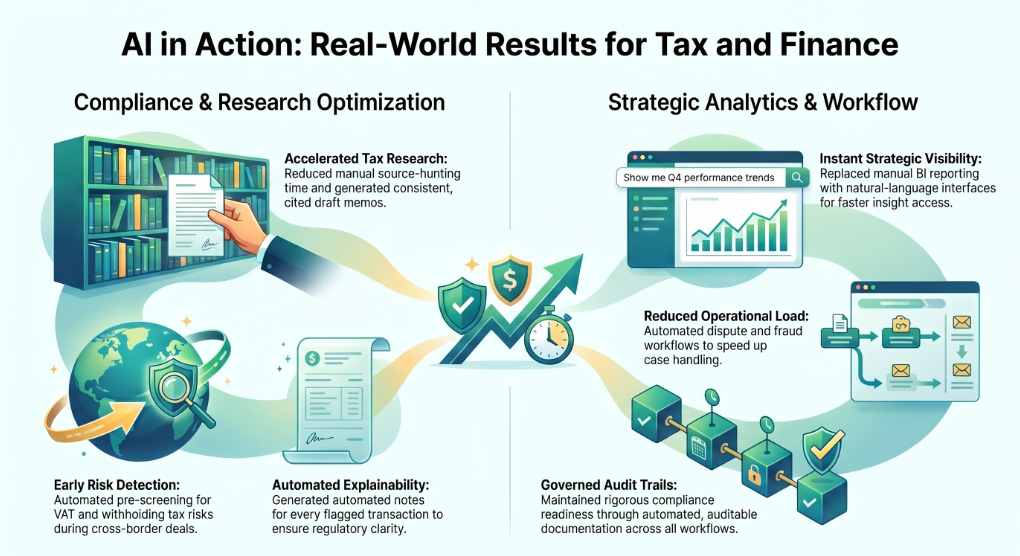
The following outcomes come from actual AI deployments in professional services and finance contexts. Client names are not disclosed.
Tax research automation: A tax-tech firm deployed an AI research automation platform that collected sources, summarised regulatory content, and generated draft memos with citations. The result was a significant reduction in manual source-hunting time, faster research cycles, and more consistent research outputs across team members — removing the variability that comes with individual research quality.
Cross-border pre-screening: A professional services team handling cross-border transactions used AI to pre-screen deals for withholding tax risk, VAT mismatches, and permanent establishment exposure. The outcome was earlier detection of compliance risk, reduced last-minute disruptions to deal timelines, and faster, more consistent pre-compliance review — with explainability notes generated automatically for every flagged transaction.
Agentic analytics for advisory: An advisory firm deployed an agentic analytics layer over its existing data infrastructure, replacing manual BI reporting with a natural-language interface that delivered governed, auditable answers. The outcome was faster strategic visibility without BI queuing, improved alignment through consistent metric definitions, and scalable insight access across the team.
Omnichannel tax workflow automation: A fintech provider supporting banks and credit unions deployed AI across disputes, fraud, compliance, and operational workflows. The result was faster case handling, reduced operational load through automation, and better compliance readiness via maintained audit trails.
Getting Started with AI as a Tax Professional in India
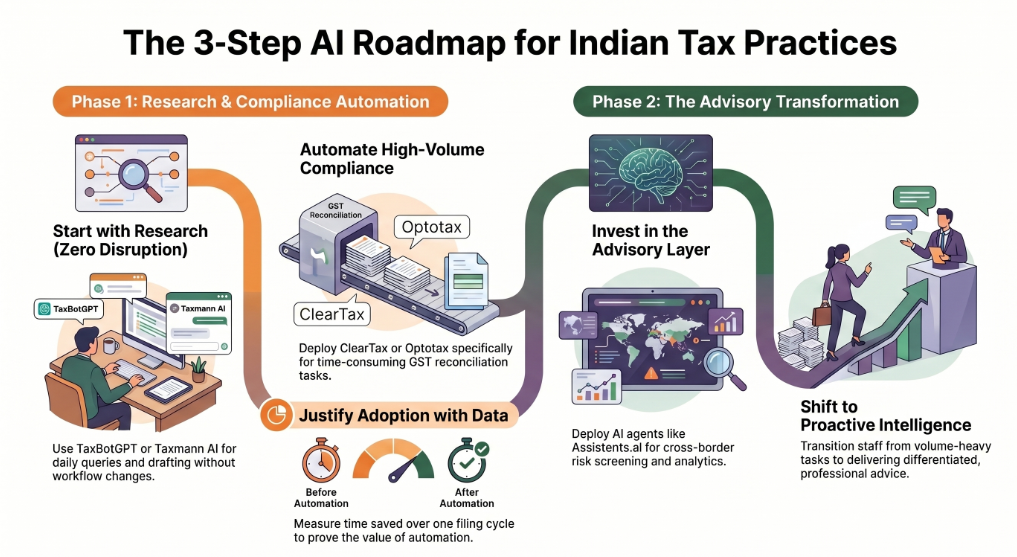
If you are new to AI tools in your practice, the path to adoption does not require a wholesale technology change. Here is a practical three-step approach.
Step 1 — Start with research (zero workflow disruption)
Begin with TaxBotGPT or Taxmann AI for daily research queries and notice drafting. These tools plug into your existing workflow as a better search engine. No integration required, no training needed. Within days, you will notice the time saving.
Step 2 — Automate your highest-volume compliance task
Identify the single compliance task consuming the most time in your practice — most commonly GST reconciliation. Adopt ClearTax or Optotax for that specific workflow. Measure the time saved over one filing cycle. Use that data to justify broader adoption.
Step 3 — Invest in the advisory layer
Once the compliance layer is automated, the question becomes: what do you do with the time you have recovered? The answer, for any practice that wants to grow, is advisory. This is where Assistents.ai becomes relevant — deploying AI agents for research automation, cross-border risk screening, analytics, and the governed intelligence layer that lets your team deliver proactive, differentiated advice.
The practices that follow this path are not just more efficient. They are building a different kind of firm — one where AI handles the volume, and every professional is doing the work that only a professional can do.
The Bottom Line
The best AI tools for tax professionals in India in 2025–26 are not a single product. They are a stack — one that reflects where you are in your practice's evolution.
Start with compliance automation if you have not already. Adopt research intelligence to accelerate your advisory work. And when you are ready to build a genuinely differentiated practice — one where AI is handling research, pre-screening risk, generating governed insights, and giving your team capacity to advise at scale — explore what agentic AI can do.
That is the layer most CA firms have not touched yet. It is also the layer that will separate the practices of 2030 from the ones that stayed in 2020.
See how Assistents.ai is being used by professional services teams: assistents.ai/solutions/professional-services

Transform Your Business With Agentic Automation
Agentic automation is the rising star posied to overtake RPA and bring about a new wave of intelligent automation. Explore the core concepts of agentic automation, how it works, real-life examples and strategies for a successful implementation in this ebook.
Sarfraz Nawaz is the CEO and founder of Ampcome, which is at the forefront of Artificial Intelligence (AI) Development. Nawaz's passion for technology is matched by his commitment to creating solutions that drive real-world results. Under his leadership, Ampcome's team of talented engineers and developers craft innovative IT solutions that empower businesses to thrive in the ever-evolving technological landscape.Ampcome's success is a testament to Nawaz's dedication to excellence and his unwavering belief in the transformative power of technology.

More insights
Discover the latest trends, best practices, and expert opinions that can reshape your perspective







Contact us

