
Agentic AI Frameworks: The Complete Guide to Building Enterprise-Grade Autonomous Agents in 2026


The race has already started. In February 2026, we're witnessing a fundamental shift in how enterprises operate. The question is no longer if organizations will deploy AI agents—it's how fast they can do it without turning those agents into their biggest liability.
The data paints a clear picture. According to McKinsey & Company, 25% of enterprise workflows will be automated by agentic AI by 2028. Gartner predicts that 50% of enterprises will deploy autonomous decision systems by 2027, and early adopters are already seeing 40–60% reductions in process cycle times.
While organizations evaluate options, competitors are already accelerating. Enterprises are moving from AI that advises to AI that acts—but most are walking into a dangerous trap. This guide reveals what agentic AI frameworks actually are, why traditional approaches fail, and how to implement autonomous agents that deliver results without creating chaos.
What Are Agentic AI Frameworks?
Agentic AI frameworks are autonomous intelligence platforms that combine reasoning, execution, and governance to enable AI agents to make decisions and take actions without human intervention. Unlike traditional copilots that advise or RPA tools that execute scripts, agentic frameworks operate at Level 5 maturity—handling end-to-end workflows with full context awareness and built-in compliance.
At their core, agentic AI frameworks represent a fundamental departure from previous generations of automation. Where business intelligence platforms tell you "what happened", and copilots suggest "what you should do", agentic frameworks actually "handle it"—identifying issues, evaluating options, executing workflows, routing approvals, and continuously learning.
The Evolution to Level 5 Intelligence
Understanding agentic frameworks requires seeing them in the context of analytics maturity:
- Level 1 – Descriptive: "What happened?" Static reports. Response time: days to weeks.
- Level 2 – Diagnostic: "Why did it happen?" Root cause analysis. Response time: days.
- Level 3 – Predictive: "What will happen?" Forecasting models. Response time: hours to days.
- Level 4 – Prescriptive: "What should we do?" Recommendations. Response time: hours.
- Level 5 – Agentic: "Handle this." Autonomous execution. Response time: minutes.
The leap from Level 4 to Level 5 is transformational. At Level 4, humans remain the bottleneck. According to MIT Sloan Management Review, organizations spend an average of 8.2 hours per week in meetings discussing data insights, yet only 23% of those insights lead to timely action. Level 5 collapses that cycle—what took 6 weeks now happens in hours.
The Critical Problem: The 80% Blind Spot
Here's the uncomfortable truth: AI agents today are powerful and fast, but most are flying blind. They're amplifiers, not creators of order—they multiply whatever foundation they're built upon.
Only 20% of enterprise context lives in structured systems like ERP tables and CRM fields. The other 80%—the real business truth—lives in PDF contracts with SLAs, email negotiations with discounts, Slack conversations with approvals, meeting notes with commitments, and policy documents with compliance rules. IDC estimates that 80-90% of enterprise data is unstructured.
Real Incident: Why This Matters
A major financial services firm deployed an AI agent for vendor payment automation. The agent had access to ERP payment data, invoice amounts, and due dates. What it couldn't see: contract PDFs specifying early payment discounts, email negotiations extending payment windows, and Slack messages flagging cash flow concerns.
Result: ₹12 crore ($1.4M USD) in early payments approved automatically. Contract discount terms violated. Cash flow strategy ignored. The agent did exactly what it was told—based on the 20% it could see. According to Deloitte's 2025 survey, 64% of organizations deploying AI automation experienced at least one significant incident caused by incomplete data context in the first year.
An agent acting on 20% of the facts isn't an asset. It's a liability with a confidence score.
Why Traditional Approaches Fall Short
Today's enterprise stack forces a bad trade-off. Understanding where existing tools fail reveals why agentic frameworks represent a category breakthrough.
Copilots: Strong Reasoning, No Execution
Microsoft Copilots and Salesforce Einstein excel at surfacing insights and generating recommendations. But humans remain the execution layer. According to Forrester Research, copilot users report a 12-18% productivity gain in analysis tasks, but only 3-5% improvement in end-to-end process completion time—because the bottleneck isn't insight generation, it's execution coordination.
RPA: Can Execute, Cannot Reason
Robotic Process Automation excels at deterministic workflows but breaks on exceptions. RPA bots can't interpret unstructured data, understand context, or make judgment calls. Industry data shows 30-40% of RPA implementations require ongoing maintenance due to process changes and exception handling. Traditional RPA can't read PDFs, interpret emails, or extract meaning from documents without pre-built connectors.
Traditional BI: Describes the Past, Doesn't Shape the Future
Business intelligence platforms excel at structured data visualization but operate on only 20% of data. They can't correlate sales dips with customer complaints in support tickets, contract changes in legal documents, or competitive moves in news articles. Harvard Business Review research found that 67% of business users cite "turning insights into action" as their top data challenge—not generating insights themselves.
The Agentic Advantage
Agentic AI frameworks solve the core gap: they combine reasoning + execution + governance on complete context. Where copilots advise and RPA executes scripts, agentic frameworks reason across all data types and act autonomously within defined guardrails.
The Three-Tier Agentic AI Architecture
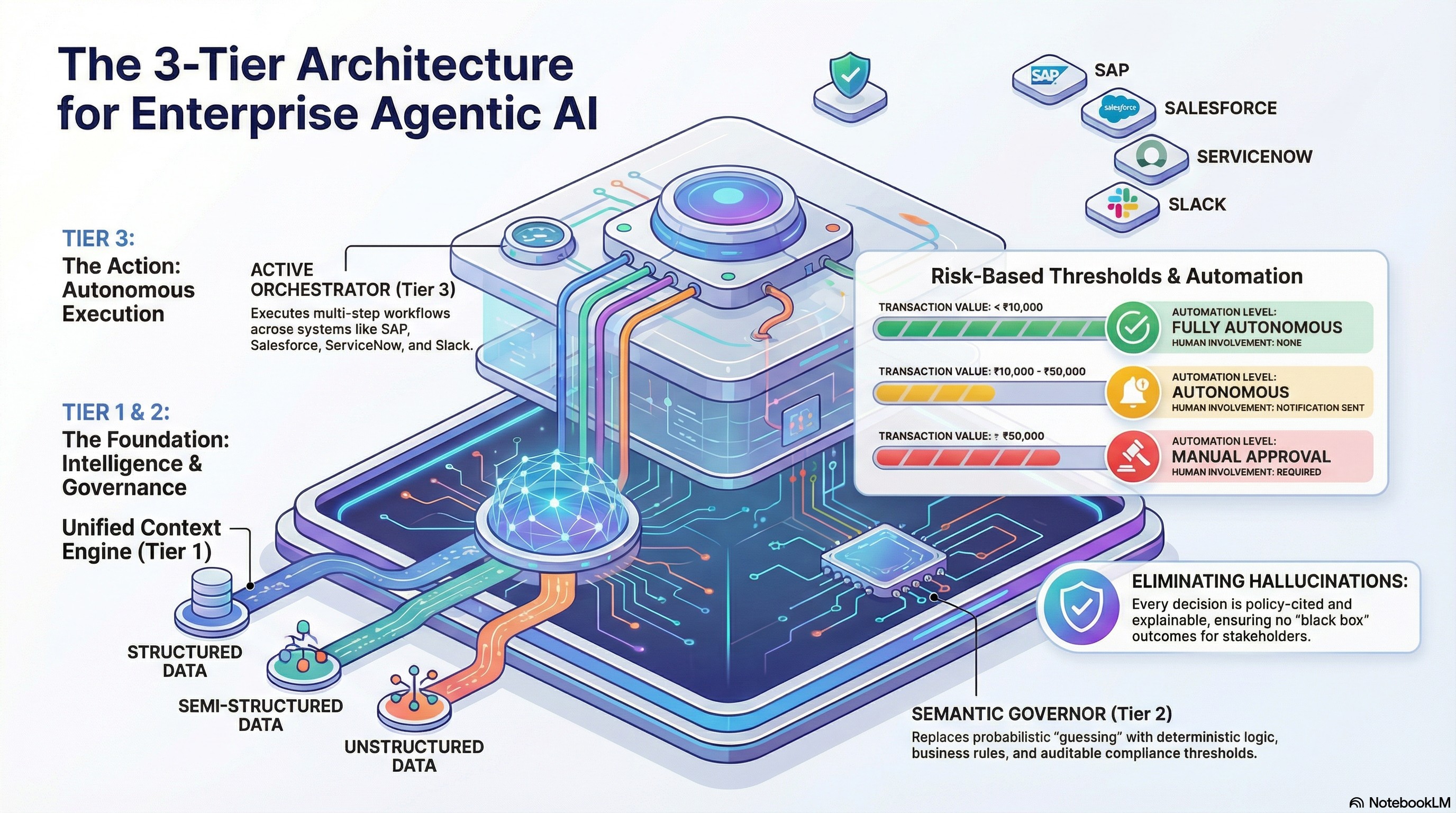
Building Level 5 intelligence requires purpose-built infrastructure refined across 35+ enterprise deployments.
Tier 1: Unified Context Engine
Solves the 80% blind spot. The Context Engine fuses structured (ERP, CRM, databases), semi-structured (logs, APIs, events), and unstructured (PDFs, emails, chat) data plus external signals (market data, news, regulations) into a single semantic layer. When analyzing revenue decline, the engine correlates sales drops in ERP with customer complaints in tickets, contract amendments in SharePoint, competitive pricing changes online, and supply chain news—automatically.
Tier 2: Semantic Governor
Solves the trust problem. Unlike probabilistic AI that guesses, the Governor encodes deterministic logic: business rules, approval hierarchies, compliance thresholds, and decision trees. Example: "Discount approvals below ₹50,000 = autonomous; above ₹50,000 = VP approval required." Every decision is auditable, defensible, policy-cited, and explainable. No hallucinations. No black boxes.
Tier 3: Active Orchestrator
Solves the execution gap. The Orchestrator executes multi-step workflows across enterprise systems (SAP, Salesforce, Jira, ServiceNow, Slack). Human-in-the-loop controls operate through dynamic thresholds. Example refund workflow: <₹10,000 = fully autonomous; ₹10,000-₹50,000 = autonomous with notification; >₹50,000 = requires approval. High-volume, low-risk decisions execute in minutes while high-stakes decisions maintain oversight.
Real-World Implementation: Four Case Studies
Case 1: Manufacturing Competitive Intelligence
Industry: HVAC Manufacturing | Scale: National operations in price-sensitive markets
Challenge: Manual monitoring across 100+ competitor portals requiring 20+ analyst hours weekly. Reactive responses identifying pricing gaps weeks after emergence.
Solution: AI agent for continuous e-commerce monitoring with contextual Q&A—analyzing 10M+ data points, answering 31 strategic leadership questions with 93% answerability.
Results: 100× faster insights (seconds vs. days), 12-26% pricing gap identified enabling immediate margin recovery, always-on monitoring replacing manual checks.
Case 2: National Retail Operations
Industry: Value Retail | Scale: 700+ stores pan-India serving mass-market consumers
Challenge: 10,000+ monthly helpdesk calls from store staff, fragmented knowledge across locations, manual training bottlenecks.
Solution: Three coordinated agents—voice support (Hindi & English), inventory intelligence, and knowledge/training using RAG over POS documentation.
Results: 70% call reduction (10,000→3,000 monthly), 85% faster resolution (20 min→3 min), 10,000+ active users, zero-training execution for new employees.
Case 3: Luxury Hospitality Booking
Industry: Luxury Safari | Scale: 16 boutique properties across Kenya and Tanzania
Challenge: Complex guest requirements, high-touch service expectations, 5-10 email exchanges per reservation, manual inventory checks.
Solution: Digital booking agent with email intake/intent classification, conversational loops, real-time inventory checks, hybrid handoff for final curation, automated document generation.
Results: Faster booking turnaround (2-3 exchanges vs. 5-10), higher accuracy on complex requirements, scalable operations without compromising luxury service.
Case 4: Multi-Entity Finance Workflow
Industry: Family Business Group | Scope: 30+ companies across retail, building, industrial, services
Challenge: Fragmented procurement causing margin leakage, inconsistent KPI definitions, late discovery of vendor performance issues.
Solution: Automated procurement and finance KPI monitoring with group-wide standardization, alerts for price trends/GM impact/early-payment/vendor performance.
Results: Earlier margin erosion detection (days vs. quarters), standardized intelligence across entities, reduced variance surprises via continuous monitoring.
Implementation Roadmap: 30-Day Deployment
Week 1: Discovery & Workflow Mapping
Process identification, data source inventory, stakeholder alignment, success metrics definition. Critical: identify high-value workflows with clean data where automation delivers immediate impact.
Weeks 2-4: Build & Configure
Context engine setup connecting structured and unstructured sources, rule configuration encoding business logic and approval hierarchies, first agent development, testing and validation. No rip-and-replace—orchestrates existing systems.
Day 30: Production Launch
Governed agent live with monitoring enabled, user training completed, continuous improvement cycle established. Start with threshold-based controls (e.g., autonomous <₹50K, approval required >₹50K) and expand autonomy as confidence builds.
Key Success Factors
- Start with bounded scope: Single workflow, clear success criteria, measurable ROI
- Governance from day one: Define rules, thresholds, approval hierarchies upfront
- Complete context: Connect unstructured data sources—the 80% that matters
- Measure continuously: Track time-to-decision, automation rate, accuracy, manual overrides
Enterprise-Grade Governance & Security
Autonomous execution without governance is reckless. Enterprise agentic frameworks must include:
- SOC 2 Type II certification for security controls
- ISO 27001 compliance for information security management
- GDPR readiness for data protection and privacy
- AES-256 + TLS 1.3 encryption at rest and in transit
- Zero data retention policies for sensitive customer data
- Full audit trails with rule citations and decision lineage
- Deployment flexibility: cloud, private cloud, on-premises, or hybrid
Autonomy requires trust. Trust requires control. Every decision must be explainable, auditable, and policy-compliant.
Conclusion: The Competitive Divide
The enterprise landscape in 2026 is defined by a clear dividing line: organizations that use AI to analyze, and organizations that use AI to execute. Agentic AI frameworks represent the infrastructure layer for Level 5 intelligence—autonomous systems that don't just recommend actions but actually take them, with the governance and auditability that enterprises demand.
The organizations moving fastest share common characteristics: they recognize the 80% blind spot, deploy governance alongside autonomy, start with concrete use cases and measurable ROI, and build on existing systems rather than ripping and replacing.
As Gartner predicts, by 2028, 33% of enterprise software applications will include agentic AI. The competitive advantage won't belong to those with the most data or the biggest AI budgets—it will belong to those who can turn insights into completed actions the fastest.
Your agents don't have to fly blind. Give them sight. Build Level 5 intelligence.

Transform Your Business With Agentic Automation
Agentic automation is the rising star posied to overtake RPA and bring about a new wave of intelligent automation. Explore the core concepts of agentic automation, how it works, real-life examples and strategies for a successful implementation in this ebook.
Sarfraz Nawaz is the CEO and founder of Ampcome, which is at the forefront of Artificial Intelligence (AI) Development. Nawaz's passion for technology is matched by his commitment to creating solutions that drive real-world results. Under his leadership, Ampcome's team of talented engineers and developers craft innovative IT solutions that empower businesses to thrive in the ever-evolving technological landscape.Ampcome's success is a testament to Nawaz's dedication to excellence and his unwavering belief in the transformative power of technology.

More insights
Discover the latest trends, best practices, and expert opinions that can reshape your perspective






Contact us

