
AI for Business Decision-Making: How Agentic Analytics Is Transforming Enterprise Decisions in 2026?


Enterprise leaders face a critical paradox: organizations collect more data than ever, yet making strategic decisions remains frustratingly slow. The average Fortune 500 company manages petabytes of information, but executives still wait days or weeks for answers while market conditions shift in hours.
This gap between data abundance and decision velocity has become the defining challenge of modern business. Traditional approaches that worked for decades now create bottlenecks that competitors exploit ruthlessly.
AI for business decision-making has evolved dramatically. Organizations progressed from basic reporting to BI dashboards to conversational analytics. But these improvements never changed the fundamental process, humans still had to interpret insights and manually execute responses.
Now, we're entering a revolutionary phase where AI for business decision-making doesn't just answer questions but autonomously explores data, synthesizes insights, and executes actions. This shift from passive reporting to active decision partnership represents the most significant change in enterprise analytics since the relational database.
Why AI for Business Decision-Making Is No Longer Optional
Here are the reasons to why businesses are using AI for decision-making:
1. The Hidden Data Crisis
Research shows that 80% of enterprise data is unstructured as customer emails, support tickets, contracts, meeting transcripts, and social media. Traditional BI tools were built for structured data in neat columns, leaving the vast majority of organizational knowledge untapped.
When a retail executive asks why customer satisfaction dropped, the CRM shows the decline but can't explain it. Real answers live in support emails about shipping delays, social posts expressing frustration, and competitor announcements shifting expectations.
2. The Speed Imperative
Business velocity has fundamentally changed. Supply chains need daily adjustments. Marketing campaigns require hourly optimization. Customer service must resolve issues in minutes to prevent social media escalation.
Traditional BI workflows can't match this pace. A typical analysis flows from business user to analyst, who queries databases, builds reports, and presents findings over days or weeks. By then, market conditions have already shifted.
AI for business decision-making compresses these timelines dramatically. It is monitoring hundreds of sources continuously, detecting patterns, investigating causes, and recommending actions in real time.
3. The Competitive Advantage
Early adopters report 10x faster time to insight, enabling them to identify opportunities and risks before competitors. They catch fraud earlier, optimize pricing dynamically, and respond to sentiment shifts proactively rather than reactively.
This creates a flywheel effect. Organizations with better AI for business decision-making make faster, more informed choices that compound into stronger market positions.
What Traditional BI Gets Wrong
Traditional platforms like Tableau and Power BI brought important capabilities; visual exploration, governance frameworks, and semantic layers. They excel at retrospective analysis of structured data.
But they fail when questions extend beyond structured data or require forward-looking insights. They cannot natively incorporate unstructured information where context lives. They depend on humans to notice patterns and manually investigate causes. Most critically, they end at visualization.
Why First-Gen Conversational Tools Fall Short
The first wave of AI added natural language interfaces, asking questions in plain English rather than clicking dashboards. But these tools still produce one-off, static answers without maintaining analytical conversations.
More critically, large language models struggle with complex database schemas without proper grounding. Simply connecting GPT-4 to production databases often yields incorrect results because the model lacks business context. Research found LLM accuracy on real-world schemas plummeted to approximately 9% without semantic guidance.
These tools still focus on insight delivery rather than execution, the output remains a chart that humans must act on.
Agentic Analytics: AI That Acts (The Fundamental Difference)
Agentic analytics refers to AI systems that autonomously explore data, detect patterns, and initiate actions. Rather than passively answering questions, agentic systems actively pursue goals through multi-step reasoning and execution.
- Conversational analytics:
Ask a question → Get an answer
- Agentic analytics:
Set a goal → AI plans steps → Analyzes → Recommends → Acts
Consider a CFO investigating unexpected expenses. With conversational analytics, they ask multiple questions, directing the entire investigation. With agentic analytics, they state the goal: "Investigate the expense increase and identify actions to bring us back on budget."
The system autonomously queries financial data, cross-references HR systems, searches emails for context, compares against budgets, identifies savings opportunities, and presents a synthesized report with ranked recommendations.
The Evolution Path
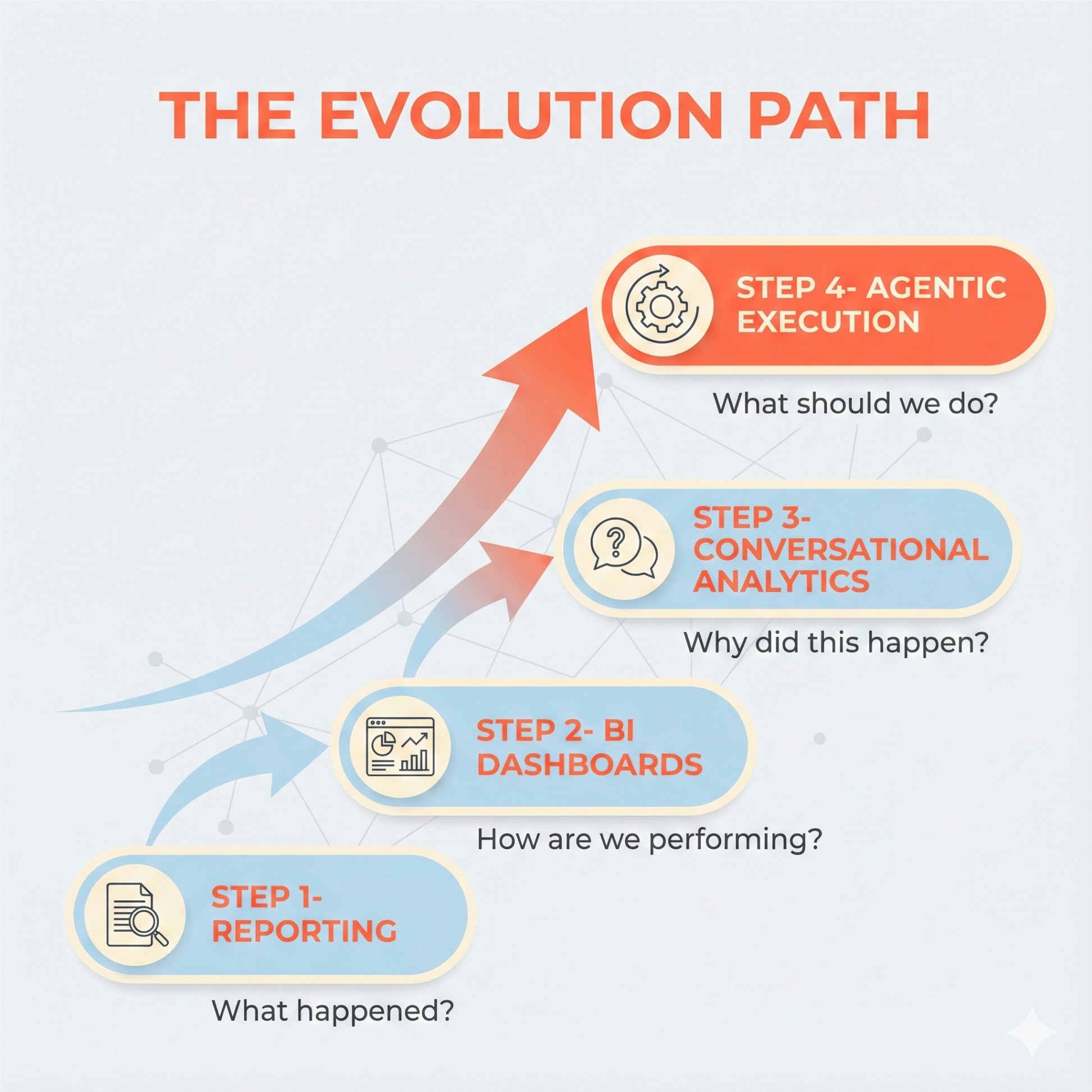
- Reporting: What happened?
- BI Dashboards: How are we performing?
- Conversational Analytics: Why did this happen?
- Agentic Execution: What should we do?
Each stage addresses the previous limitations. Organizations must accelerate toward agentic capabilities before competitors establish insurmountable leads.
The Data Fusion Advantage
The most important business questions require synthesizing multiple data types. Sales decline might correlate with negative social sentiment about quality, explained by support tickets detailing defects, triggered by supplier issues mentioned in emails. No single source reveals the complete picture.
AI for business decision-making that fuses structured (ERP, CRM), semi-structured (logs, APIs), and unstructured (documents, emails) data delivers insights impossible to obtain manually.
External Data as a Multiplier
Beyond internal data, external information provides crucial context. Competitor moves, macroeconomic conditions, regulatory changes, and social sentiment shape business outcomes but don't appear in databases until they affect metrics—when response options have narrowed.
Advanced systems automatically scan relevant sources, extract pertinent information, and factor it into analysis without manual research.
Complex Workflows: Orchestrating Multi-Step Decisions
Agentic analytics is revolutionizing how businesses manage complex workflows by automating multi-step decision processes across diverse systems. By harnessing the power of artificial intelligence, machine learning, and advanced data analysis, organizations can streamline operations and achieve a new level of operational efficiency.
AI tools and machine learning algorithms work together to analyze vast amounts of data, identify patterns, and make recommendations or take actions without constant human intervention.
In supply chain management, for example, agentic analytics can automate decisions related to inventory levels, demand forecasting, and logistics optimization. This enables businesses to quickly adapt to shifts in customer behavior and market dynamics, minimizing delays and reducing the risk of human error.
By integrating artificial intelligence AI into these complex workflows, companies can respond to disruptions in real time, ensuring that resources are allocated efficiently and that customer needs are met promptly.
The ability to orchestrate multi-step decisions not only improves operational efficiency but also provides a significant competitive edge. Businesses that leverage AI-driven analytics can anticipate changes, optimize processes, and make smarter decisions faster than those relying on traditional methods.
As a result, agentic analytics is becoming an essential tool for organizations seeking to stay ahead in a rapidly evolving business landscape.
Inside an Agentic Analytics System
1. The Three-Agent Architecture
- Analytical AI Agents for businesses handle quantitative analysis; forecasting, anomaly detection, driver analysis, and KPI calculations. They operate continuously, building and refreshing models as new data arrives.
- Knowledge Agents specialize in unstructured information to read documents, semantic search, web research, and summarization. They transform text from liability into analytical assets.
- Agentic Workflow Engine coordinates multiple agents like a project manager. It breaks complex requests into sub-tasks, determines which agents handle each component, sequences work, and synthesizes results.
2. Enterprise Governance
Role-based access control ensures users see only authorized data. Audit logging tracks every query and action. PII masking protects privacy. Data lineage shows the provenance of every fact. These capabilities distinguish enterprise-grade AI for business decision-making from consumer tools.
Real-World Business Impact
1. Customer Churn Prevention
Fusing support ticket sentiment with CRM data reveals churn risk before customers leave. The system scores retention risk and automatically flags high-risk accounts for outreach or generates personalized retention offers.
2. Dynamic Pricing Intelligence
Monitoring competitor prices via web scraping while analyzing internal sales data enables daily price optimization responding to market movements in real time.
3. Fraud Detection
Correlating transaction patterns with external threat intelligence catches sophisticated fraud. Multi-signal approaches dramatically improve accuracy versus single-source detection.
4. Supply Chain Risk Management
Tracking supplier performance while monitoring news for disruptions identifies risks before they impact production, enabling proactive procurement adjustments.
AI in Action: Computer Vision and Content Generation
Artificial intelligence is driving innovation in both computer vision and content generation, transforming how businesses interact with and serve their customers. Computer vision, a branch of AI, enables machines to interpret and understand visual information from images and videos. This technology is widely used in applications such as facial recognition, quality control, and even analyzing customer behavior in retail environments.
Generative AI takes content creation to the next level by using customer data and user behavior to produce personalized recommendations, marketing materials, and product descriptions.
Natural language processing (NLP), another powerful AI application, allows systems to generate human-like text and speech, making interactions with virtual assistants more natural and engaging. By combining computer vision and NLP, businesses can create immersive experiences—such as virtual assistants that recognize objects through a camera and respond with contextually relevant information.
Deep learning models further enhance these capabilities by analyzing large datasets to identify patterns and trends, enabling truly data-driven decisions. Whether it’s automating content generation, improving customer support, or delivering personalized experiences, the integration of artificial intelligence AI, computer vision, and generative AI is helping organizations unlock new value from their data and stay ahead of the competition.
Why Agentic Analytics Wins
1. Versus Traditional BI
Traditional BI is static and requires humans to notice patterns. Agentic analytics dynamically answers unanticipated questions across data types traditional tools cannot access, then executes actions closing the insight-to-action loop.
2. Versus Simple Chat Tools
First-gen tools lack robust reasoning and multi-step planning. LLMs without proper grounding generate plausible but incorrect answers. They can't chain investigations or execute actions.
3. Versus Vendor Add-Ons
Major platforms retrofit AI onto legacy architectures designed for dashboards. Agentic platforms built AI-first enable capabilities difficult to retrofit—multi-agent collaboration, dynamic workflow planning, and cross-system execution.
The Future of Decision-Making
- AI-native architectures optimize for autonomous agents rather than dashboards, enabling faster innovation without legacy constraints.
- Multi-agent systems coordinate dozens of specialized agents, some focused on data types, others on techniques, others on domain knowledge.
- Real-time proactive intelligence continuously monitors for actionable patterns, initiating investigations automatically rather than waiting for queries.
- Decision automation progressively shifts from human approval to autonomous execution as trust builds and governance matures.
Start with High-Impact Use Cases
Focus on areas involving multiple data sources, clear success metrics, frequent occurrence, and defined policy boundaries. Customer experience optimization, supply chain management, and marketing performance typically fit these criteria.
1. Invest in Data Infrastructure
Ensure structured data flows into queryable repositories, unstructured documents are indexed and searchable, external sources connect via APIs, and security policies enable appropriate access.
2. Establish Governance Frameworks
Define when autonomous action is appropriate, what approval workflows apply, how activities are logged, who accesses what data, and how recommendations are validated. Start conservatively and expand as confidence builds.
3. Cultivate Organizational Readiness
Prepare people through education on capabilities, training on interaction, change management addressing roles, and incentive alignment rewarding adoption. Position AI as empowering rather than threatening.
Implementation Challenges and How to Overcome Them
While the benefits of agentic analytics are clear, implementing these advanced AI tools comes with its own set of challenges. One of the primary hurdles is addressing data quality issues—ensuring that raw data is accurate, consistent, and ready for analysis. Integrating AI with existing data pipelines and legacy systems can also be complex, often requiring significant technical expertise to ensure seamless operation.
To overcome these obstacles, businesses should invest in robust data governance frameworks that monitor and maintain data quality throughout the analytics process. Transparent and explainable AI models are essential for building trust and ensuring that decisions made by AI algorithms are understandable and justifiable. Security is another critical concern; organizations must ensure that their AI systems comply with regulations and protect sensitive information from potential threats.
Leveraging agentic analytics platforms and AI tools can help automate repetitive tasks, freeing up valuable human resources for higher-level strategic work and further improving operational efficiency. However, it’s vital to continuously monitor AI algorithms for fairness, transparency, and bias, making adjustments as needed to align with business objectives and ethical standards.
By taking a proactive approach to these challenges, organizations can harness the full power of agentic analytics to make informed decisions, drive innovation, and maintain a competitive edge in an increasingly data-driven world.
Change Your Decision-Making with Assistents.ai
The competitive landscape is clear: organizations deploying agentic analytics make faster, better-informed decisions than those relying on traditional approaches. These advantages compound as faster learning cycles create widening performance gaps.
Assistents.ai by Ampcome pioneered the fusion of structured, unstructured, and external data into contextual insight that flows into governed actions. Our platform combines analytical agents, knowledge agents, and an agentic workflow engine. It is unified by conversational access that transforms how enterprises make decisions.
Don't let competitors establish insurmountable leads while your organization waits for insights. Book a call now.
FAQs
1. What's the difference between conversational analytics and agentic analytics?
Conversational analytics lets you ask questions and receive answers, but you must direct the investigation. Agentic analytics accepts high-level goals and autonomously plans multi-step investigations, synthesizes findings across diverse data sources, and executes actions.
2. How does AI for business decision-making handle unstructured data like emails and documents?
Advanced systems use knowledge agents with natural language processing to read, understand, and extract insights from text. These agents perform semantic search, sentiment analysis, and entity extraction.
3. Can agentic analytics work with my existing BI tools and data infrastructure?
Yes. Modern agentic platforms integrate with existing data warehouses, BI tools, and operational systems through standard APIs and connectors. Rather than replacing your infrastructure, they layer on top to provide conversational interfaces.
4. What safeguards prevent AI from making incorrect decisions autonomously?
Enterprise-grade systems implement multiple governance layers: semantic models that ground AI in business context, validation steps where analytical agents verify results, role-based access controls, audit logging of all decisions, and approval workflows for high-stakes actions.
5. What ROI can organizations expect from implementing agentic analytics?
Early adopters report 10x improvements in time to insight, 20-40% productivity gains in analytical teams, and measurable revenue impacts from faster decisions. Specific ROI varies by use case; customer churn prevention reduces churn rates and fraud detection prevents losses. Most comprehensive enterprise deployments achieve positive ROI within 12-18 months.

Transform Your Business With Agentic Automation
Agentic automation is the rising star posied to overtake RPA and bring about a new wave of intelligent automation. Explore the core concepts of agentic automation, how it works, real-life examples and strategies for a successful implementation in this ebook.
Sarfraz Nawaz is the CEO and founder of Ampcome, which is at the forefront of Artificial Intelligence (AI) Development. Nawaz's passion for technology is matched by his commitment to creating solutions that drive real-world results. Under his leadership, Ampcome's team of talented engineers and developers craft innovative IT solutions that empower businesses to thrive in the ever-evolving technological landscape.Ampcome's success is a testament to Nawaz's dedication to excellence and his unwavering belief in the transformative power of technology.

More insights
Discover the latest trends, best practices, and expert opinions that can reshape your perspective




.jpg)
Contact us

