
AI for Data Analysis: Why Most “AI in BI” Is Just a Gimmick, and What Agentic Analytics Gets Right in 2026?


AI for data analysis is everywhere right now. Every analytics vendor claims to have it. Every dashboard has a chat box. Every demo promises instant answers in natural language.
And yet, inside real organizations, decision-making is still slow, fragmented, and reactive.
The problem isn’t that AI for data analysis doesn’t work.
The problem is that most AI in BI was never designed to reason, understand context, or take action.
What we’re seeing today is not a failure of AI — it’s a failure of architecture.
To understand why, we need to look at how business intelligence evolved, where AI-powered analytics went wrong, and why agentic analytics is emerging as the real inflection point.
Why Traditional BI Was Never Built for Real Data Analysis
Traditional business intelligence was built for reporting, not reasoning.
It excelled at organizing structured data into dashboards, charts, and KPIs. But the moment organizations asked deeper questions — why something happened, what caused it, and what to do next — BI hit a wall.
Dashboards Answer “What Happened,” Not “Why”
Dashboards are retrospective by design.
They show:
- what revenue was,
- what churn increased,
- what conversion dropped.
They do not:
- explain causality,
- analyze contributing factors,
- test hypotheses,
- recommend actions.
Every insight still depends on a human analyst to interpret the data, connect context, and decide what to do next. This creates a human bottleneck that slows decision cycles from minutes to days or weeks.
This limitation is a core reason dashboards rarely drive action at scale.
The 80–90% Data Blind Spot
Traditional BI tools focus almost exclusively on structured data — tables in warehouses, metrics in dashboards.
But in most enterprises:
- 70–85% of data is unstructured or semi-structured
(documents, emails, chats, tickets, logs, PDFs, web data).
This “hidden majority” holds the context required to answer why questions:
- customer sentiment
- operational issues
- competitor signals
- regulatory or market changes
Classic BI ignores this data entirely, leaving organizations blind to the most important signals.
The Rise of AI in BI — and Where It Goes Wrong
To fix BI’s usability problem, vendors added AI.
But most AI-powered analytics today is surface-level enhancement, not intelligence.
Conversational BI Is Not Intelligence
Conversational analytics lets users type questions instead of clicking dashboards.
That improves accessibility — but not understanding.
Natural language queries (NLQ):
- translate questions into SQL,
- return a chart or number,
- stop there.
There is no multi-step reasoning, no memory, no analytical continuity. A chatbot over dashboards is still a dashboard — just with better UX.
This is why conversational BI ≠ decision intelligence.
Why LLM-Only Analytics Break in the Real World
Large language models struggle with enterprise analytics because they:
- hallucinate plausible but incorrect answers,
- misinterpret schemas,
- apply wrong aggregations,
- confuse metrics across tables.
Early attempts to plug raw LLMs into BI eroded trust quickly. Answers looked confident but failed basic validation — a deal-breaker for enterprises.
“AI Features” vs AI Architecture
Most AI in BI today is an add-on:
- a chat interface layered onto legacy tools,
- a narrative generator bolted onto dashboards.
These systems were not rebuilt for AI-native reasoning. They inherit the same limitations:
- rigid schemas,
- pre-modeled views,
- no understanding of unstructured or external data.
AI features are not the same as AI systems.
The Real Problem: AI for Data Analysis Stops at Insight
Even when AI produces correct insights, it usually stops there.
Insight Without Action Is a Dead End
In most organizations:
- AI surfaces an insight
- A human reads it
- Someone creates a ticket
- Another team executes later
By the time action happens, the opportunity is gone.
This “last-mile problem” is why analytics rarely drives measurable outcomes.
Why Most AI Analytics Tools Can’t Close the Loop
Most tools lack:
- workflow orchestration,
- system-to-system execution,
- governance around automated action.
Analytics remains disconnected from operations — a reporting layer, not a decision engine.
What “Agentic Analytics” Actually Means
Agentic analytics represents a fundamental shift in AI for data analysis.
It moves AI from answering questions to owning analytical work.
From Asking Questions to Delegating Analysis
In an agentic system, you don’t ask one question at a time.
You delegate:
- investigate revenue decline,
- analyze root causes,
- validate with external signals,
- recommend next actions.
The AI plans, executes, iterates, and reasons — like a junior analyst working autonomously.
This requires multi-step reasoning, not single-prompt answers.
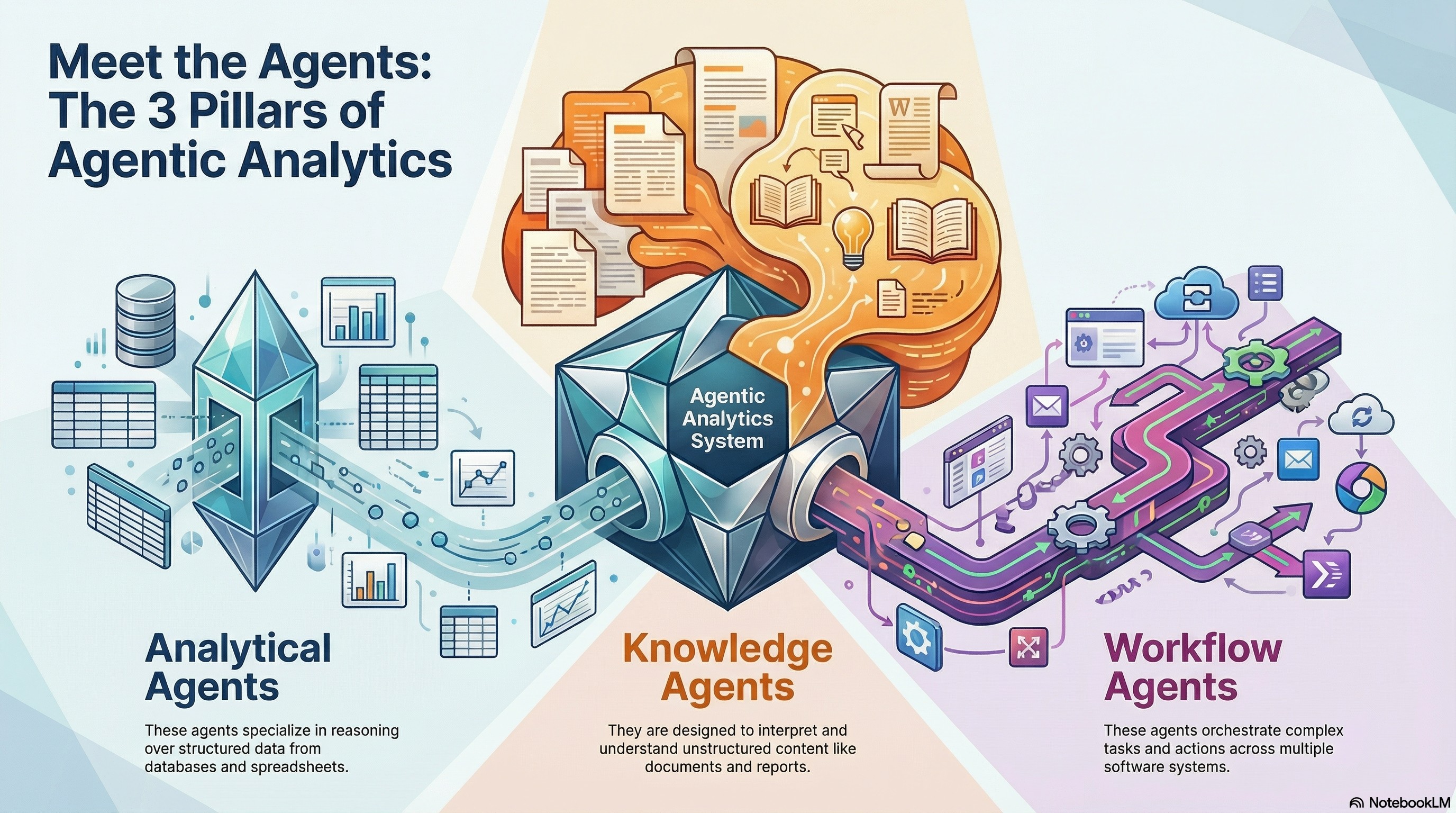
Analytical Agents, Knowledge Agents, Workflow Agents
Agentic analytics systems use multiple specialized agents:
- Analytical agents reason over structured data
- Knowledge agents interpret unstructured content
- Workflow agents orchestrate actions across systems
An orchestration layer coordinates these agents into autonomous analytical workflows.
Why Assistents.ai’s Approach to AI for Data Analysis Is Fundamentally Different
Assistents.ai is not a retrofitted BI. It’s AI-native by design.
True Data Fusion (Structured + Unstructured + External)
Assistents.ai fuses:
- ERP, CRM, POS data
- documents, emails, chats
- web, market, and third-party signals
This creates contextual intelligence, not isolated metrics — enabling answers BI tools cannot produce
Multi-Agent Reasoning, Not Single-Prompt Answers
Queries are decomposed into steps:
- hypothesis generation
- evidence retrieval
- validation across datasets
- synthesis into conclusions
Each step is reasoned, traceable, and evidence-backed.
From Analysis to Governed Action
Assistents.ai connects insight to execution:
- tool registries
- API integrations
- approval flows
- full audit logs
Actions are automated — but always governed, explainable, and reversible.
Trust, Governance, and Why Enterprises Reject “Magic AI”
Enterprises don’t reject AI because it’s slow.
They reject it because it’s opaque.
Why Black-Box AI Fails in Analytics
Without:
- data lineage,
- explainability,
- audit trails,
AI outputs cannot be trusted in regulated or high-stakes environments.
How Assistents.ai Builds Verifiable Intelligence
Assistents.ai uses:
- semantic layers for consistent metrics,
- RAG-based citations for answers,
- full action logs for compliance.
Every insight can be traced back to its source — exactly what enterprises demand.
AI for Data Analysis Is Becoming Decision Automation
We are witnessing a clear evolution.
From Dashboards → Conversations → Autonomous Decisions
- Reporting answered what happened
- Conversational analytics answered why
- Agentic analytics answers what should happen next — and does it
Industry analysts now describe this shift as decision automation, not analytics enhancement.
Why This Changes How Companies Compete
Organizations with agentic analytics:
- respond faster,
- operate continuously,
- automate routine decisions,
- free humans for strategy.
This is no longer a tooling advantage — it’s a competitive moat.
Final Takeaway: Stop Buying AI Features. Start Adopting AI Systems
AI for data analysis is not about prettier dashboards or smarter chatbots.
It’s about:
- reasoning across all data,
- understanding context,
- closing the loop from insight to action.
Most AI in BI stops at conversation.
Agentic analytics is where intelligence actually begins.
FAQs About AI for Data Analysis
What is AI for data analysis?
AI for data analysis uses machine intelligence to analyze data, identify patterns, explain causes, and support decisions. Advanced systems go beyond insights to automate actions.
Why does most AI-powered BI fail?
Because it relies on LLMs layered onto legacy BI architectures, leading to hallucinations, limited context, and no execution capability.
What is agentic analytics?
Agentic analytics uses autonomous AI agents that plan, reason, and act across data and systems, enabling end-to-end decision automation.
How is agentic analytics different from conversational BI?
Conversational BI answers questions. Agentic analytics performs multi-step analysis, retains context, and executes governed actions.
Can AI for data analysis be trusted in enterprises?
Yes — when built with semantic layers, explainability, audit logs, and human-in-the-loop controls, as required for enterprise governance.

Transform Your Business With Agentic Automation
Agentic automation is the rising star posied to overtake RPA and bring about a new wave of intelligent automation. Explore the core concepts of agentic automation, how it works, real-life examples and strategies for a successful implementation in this ebook.
Sarfraz Nawaz is the CEO and founder of Ampcome, which is at the forefront of Artificial Intelligence (AI) Development. Nawaz's passion for technology is matched by his commitment to creating solutions that drive real-world results. Under his leadership, Ampcome's team of talented engineers and developers craft innovative IT solutions that empower businesses to thrive in the ever-evolving technological landscape.Ampcome's success is a testament to Nawaz's dedication to excellence and his unwavering belief in the transformative power of technology.

More insights
Discover the latest trends, best practices, and expert opinions that can reshape your perspective






Contact us

