
Enterprise AI Adoption in Australia 2026: Data, Barriers and a Roadmap


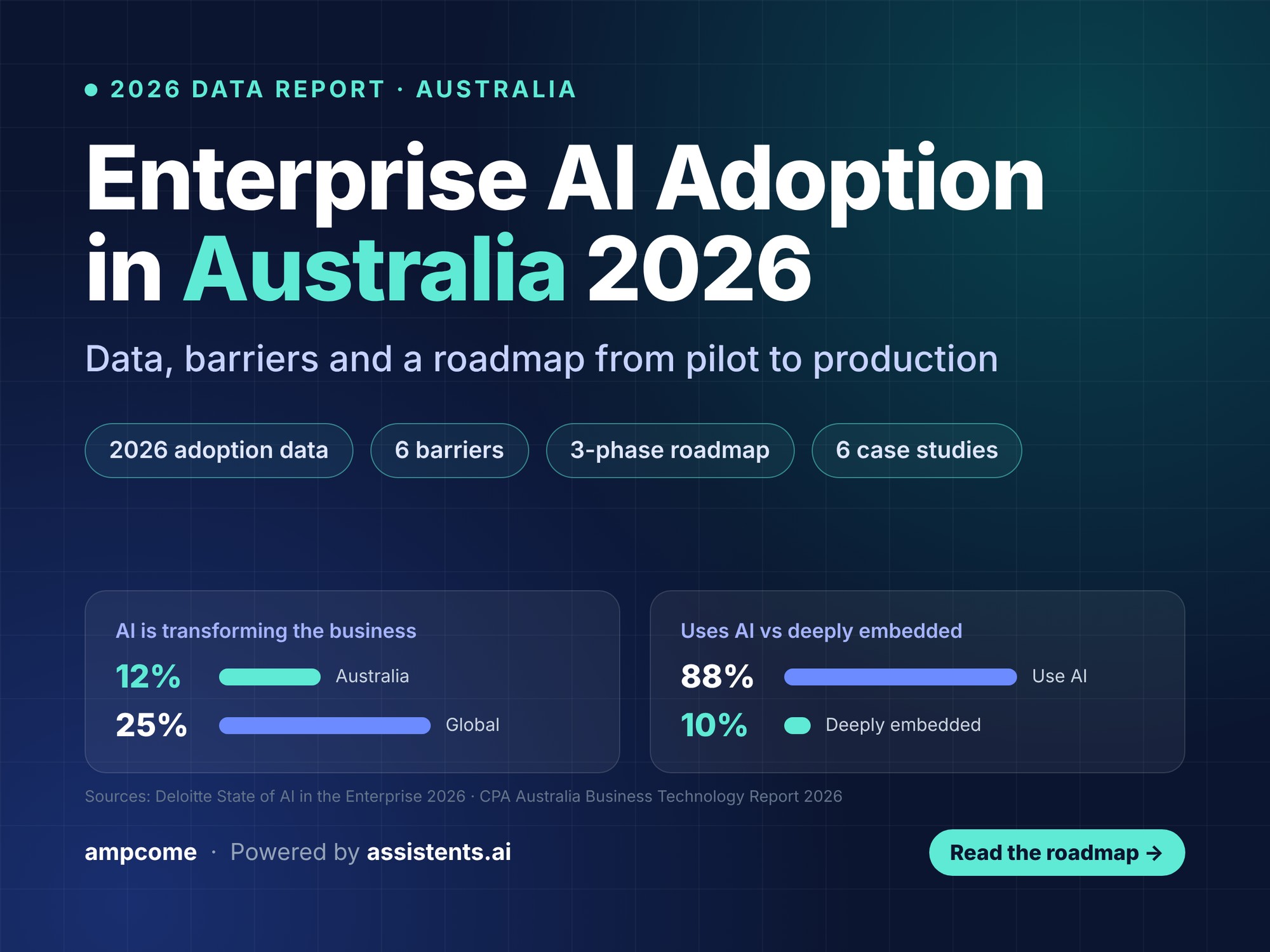
Enterprise AI adoption in Australia is wide but shallow. Most large Australian organisations now use AI in some form, yet only 12% of Australian leaders say it is transforming their business, compared with 25% globally (Deloitte, 2026). The gap is not access to models. It is the jump from pilot to governed, integrated production. With new Privacy Act rules on automated decision-making starting on 10 December 2026, closing that gap is now a compliance question as well as a growth one.
This guide brings together the latest 2026 data, explains why the numbers disagree, breaks down the six barriers holding Australian enterprises back, and lays out a three-phase roadmap backed by real (anonymised) deployments.
Key takeaways
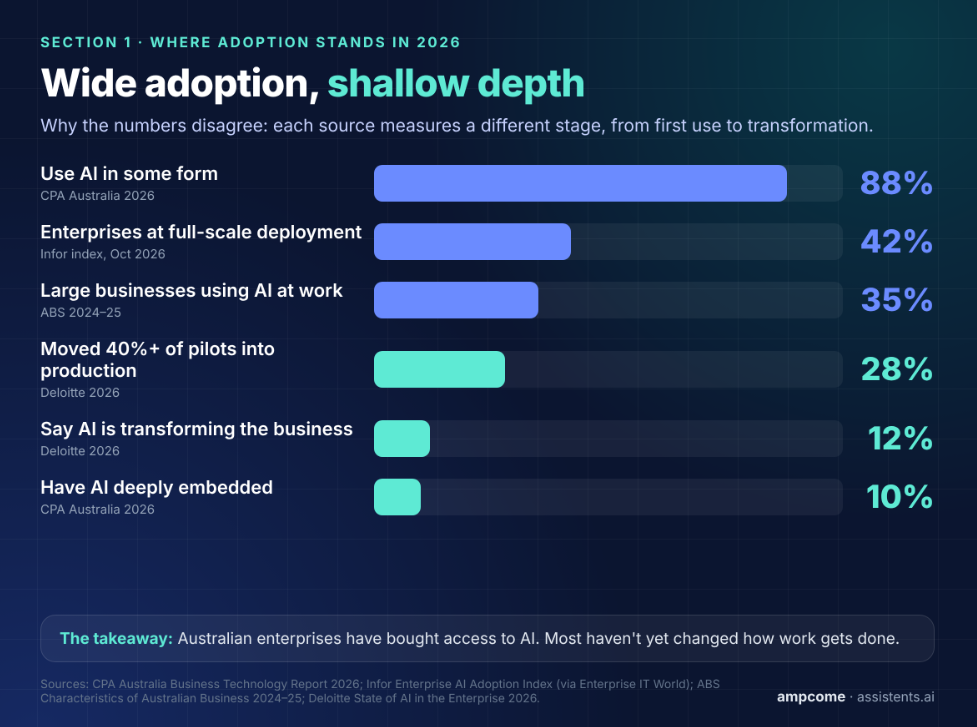
- Adoption is broad: 88% of Australian businesses use AI (CPA Australia, 2026), and 35% of large businesses report workplace AI use (ABS, 2024–25).
- Depth is not: only 10% have AI deeply embedded, and just 28% have moved at least 40% of their AI pilots into production.
- Returns lag peers: 35% of Australian organisations say AI delivered less ROI than expected, against 19% globally (Deloitte, Nov 2026).
- Agentic AI is arriving faster than governance: 69% use AI agents, but only 22% have an advanced agent governance model.
- The fix is operational: start with one governed, high-volume workflow, build the context and integration layer, then scale into a managed digital workforce.
Where enterprise AI adoption in Australia stands in 2026
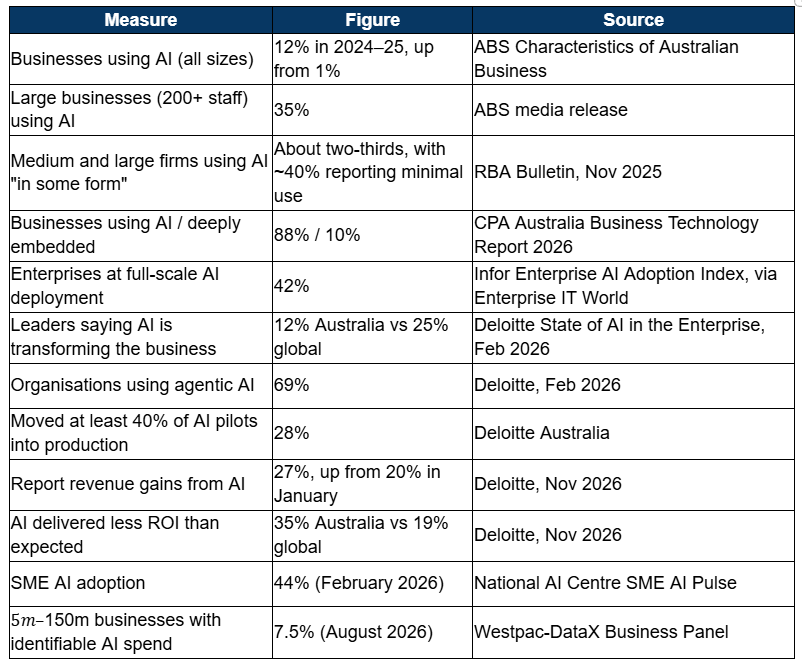
Enterprise AI adoption in Australia in 2026 sits between 35% and 88%, depending on what is measured. Large-firm usage is high, but scaled, transformational use is low. Roughly one in ten organisations has AI deeply embedded, and fewer than three in ten have moved most pilots into production.
The headline numbers
Why the numbers disagree
Each source measures a different thing, so the figures are not contradictory:
- Use (any AI, including free chat tools) produces the biggest numbers. CPA Australia's 88% sits here.
- Workplace adoption across all employing businesses, measured by the ABS, is 12%. That figure is dragged down by micro and small firms, which make up most of the economy.
- Spend (paid AI tools on the books) is much lower. Westpac-DataX sees 7.5% of mid-sized firms with identifiable AI spend, because AI bundled into existing software and free tools don't show up.
- Scale and transformation are the hardest bars. Only 10% have AI deeply embedded, and 12% say it is transforming their business.
For enterprise leaders, the useful reading is this: Australian enterprises have bought access to AI, but most have not yet changed how work gets done. The RBA reached the same conclusion. Of the firms it surveyed, the largest group (nearly 40%) described their AI use as "minimal", mostly summarising emails and drafting text.
Australia vs global peers
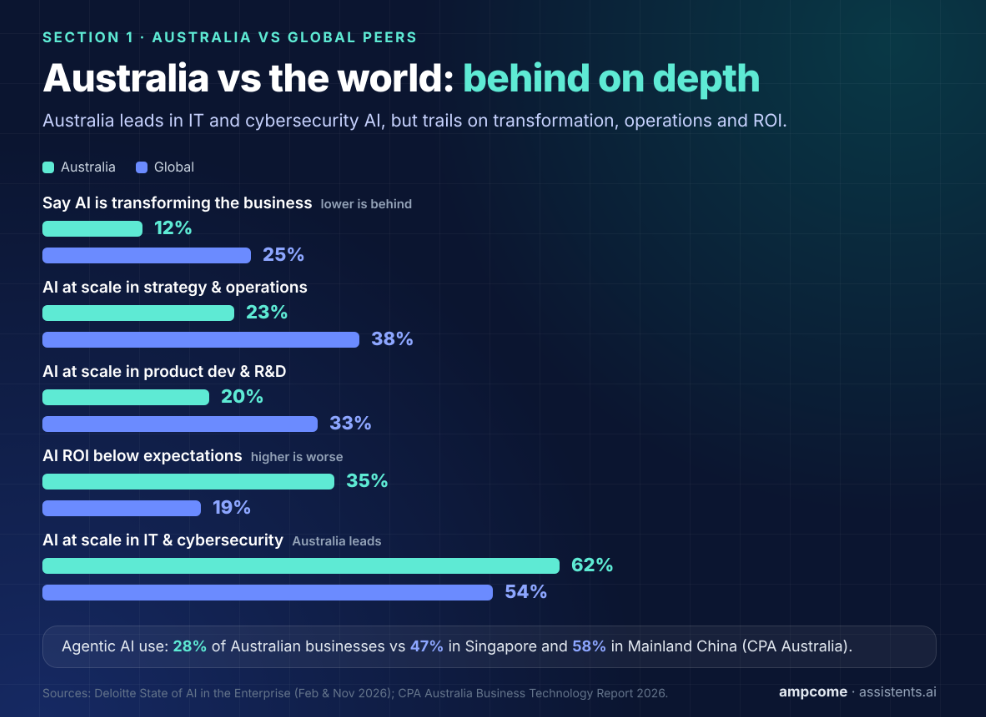
Australia is not behind on experimentation, but it is behind on depth:
- Transformation: 12% vs 25% globally (Deloitte).
- Agentic AI use: 28% of Australian businesses vs 47% in Singapore and 58% in Mainland China (CPA Australia).
- AI at scale in strategy and operations: 23% in Australia vs 38% globally (Deloitte, Nov 2026).
- ROI shortfall: 35% vs 19% globally.
Australia leads in some areas. IT and cybersecurity AI at scale is 62% in Australia vs 54% globally, and 64% of Australian leaders rate sovereign AI and in-region compute as important. The foundations are there. Execution is the gap.
AI adoption by industry and function in Australia
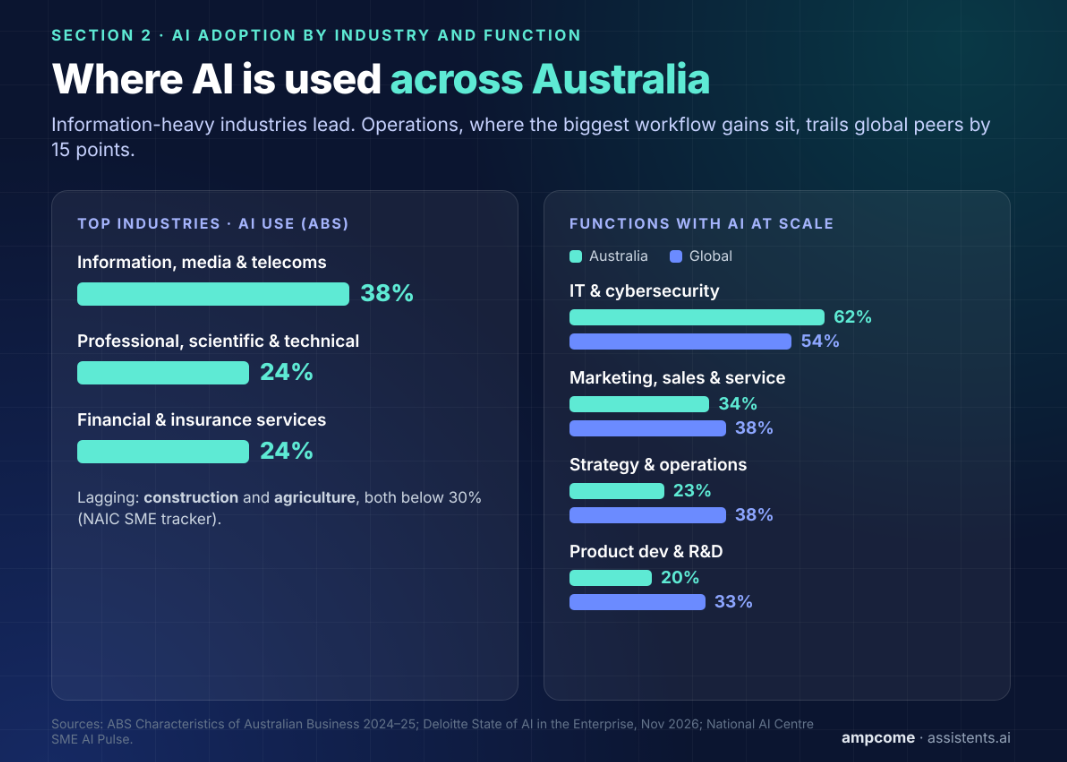
AI adoption in Australia is highest in information-heavy industries and lowest in physical, field-based ones. By function, IT leads, while strategy, operations and product development trail global peers by 13–15 points.
Industries leading adoption
ABS data for 2024–25 shows the highest workplace AI use in:
- Information, media and telecommunications: 38%
- Professional, scientific and technical services: 24%
- Financial and insurance services: 24%, up from 1% in 2021–22
Mining and resources, banking and healthcare also run some of the country's most mature AI programs, from predictive maintenance in the Pilbara to fraud detection in the major banks.
Functions where AI runs at scale
Deloitte's November 2026 Australian data shows where AI is actually operating at scale:
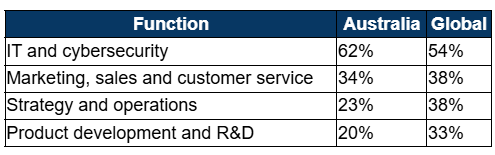
The weak spot is operations. That's where the biggest workflow gains sit: tenders, orders, procurement, service requests and compliance checks.
Industries lagging behind
The National AI Centre reports that construction and agriculture sit below 30% adoption. Health, education and services sit above 50%. For lagging sectors, that leaves a large efficiency gain still to capture. Case study 1 below shows what that looks like in construction.
Six barriers to AI adoption in Australian enterprises
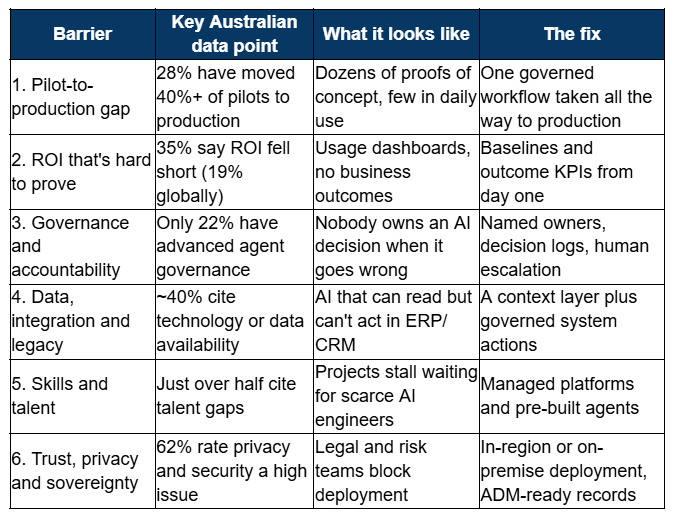
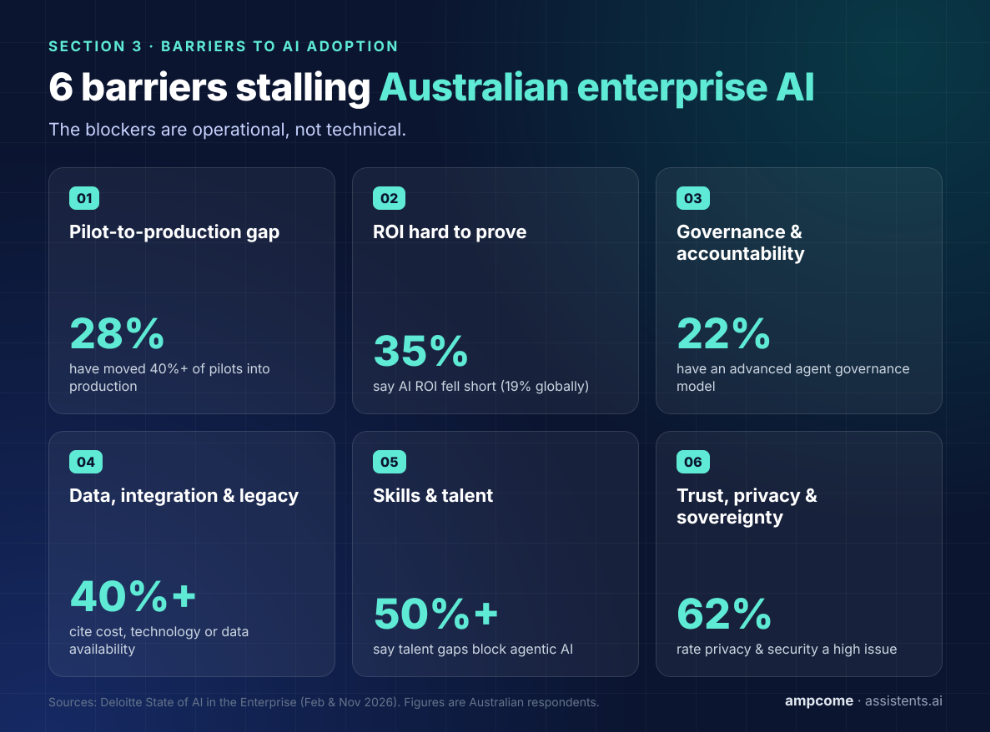
The biggest barriers to enterprise AI adoption in Australia are operational, not technical. Enterprises struggle to move pilots into production, prove ROI, govern AI decisions, connect AI to core systems, find skilled people and meet privacy and sovereignty expectations.
1. The pilot-to-production gap
Most Australian enterprises have run AI pilots. Far fewer have moved them into production. Deloitte found only 28% have moved at least 40% of their pilots into production. The usual causes: pilots built outside core systems, no owner once the innovation team moves on, and no agreed exit criteria.
2. ROI that's hard to prove
Australian leaders are more disappointed with AI returns than their global peers: 35% say returns fell short, against 19% globally. Part of the problem is measurement. 75% of Australian organisations track total AI inference spend, but only 25% track cost per token or API call, so very few can link spend to a business outcome.
3. Governance and accountability
AI agents are being deployed faster than oversight is designed. Only 22% of Australian companies use an advanced model for agent governance. 18% say accountability is unclear when AI produces a negative outcome. And almost three in ten organisations give little or no AI governance guidance (CPA Australia).
4. Data, integration and legacy systems
The RBA found that Australian IT investment grew by about 80% over the past decade. Much of it went to cybersecurity, cloud migration, legacy upgrades and data quality, which is necessary groundwork rather than AI itself. Just over 40% of Australian organisations still cite cost, technology or data availability as a barrier to agentic AI. AI that can only read documents, and can't take action in SAP, Salesforce or field-service systems, rarely makes it to production.
5. Skills and talent
Just over half of Australian companies say talent and skills gaps prevent widespread agentic AI adoption. Senior AI engineers are scarce and expensive. Every custom-built agent adds to the maintenance load.
6. Trust, privacy and sovereignty
62% of Australian leaders rate data privacy and security as a high or very high issue, and 64% say sovereign AI and in-region compute matter to their strategy. Among SMEs that aren't adopting, around 65% cite distrust of AI decision-making or a preference for human control (NAIC). Enterprises need AI they can host where their data must live, with a clear record of what it decided and why.
The 2026 rules shaping enterprise AI in Australia
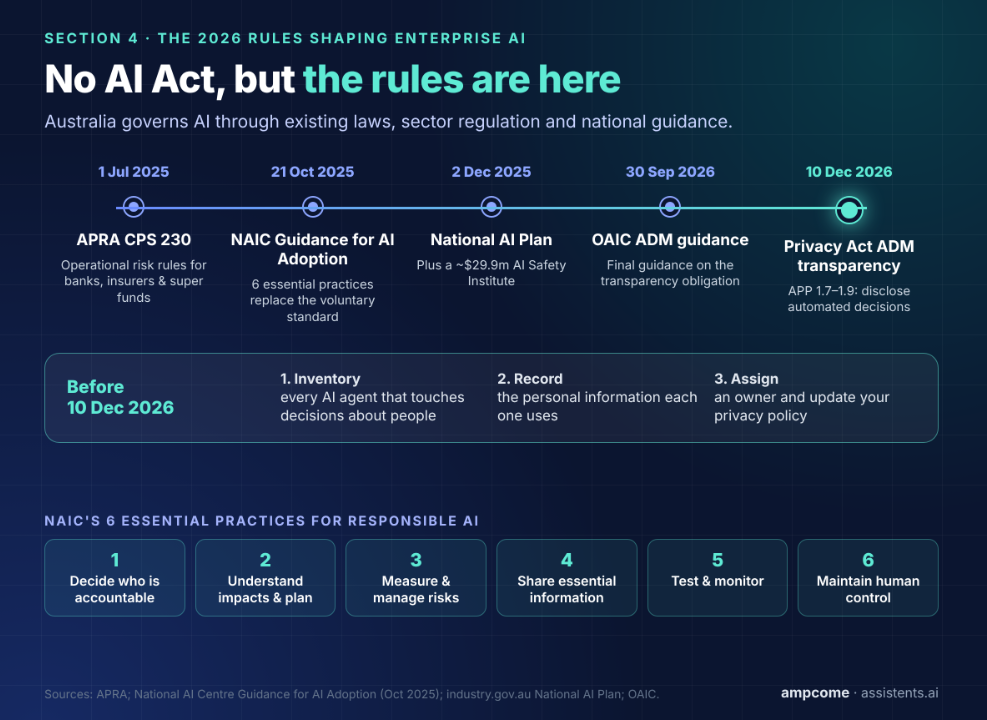
Australia has no standalone AI Act. Enterprise AI is governed through existing laws, sector regulation and national guidance. In 2026 the most important change is the Privacy Act's automated decision-making (ADM) transparency obligation, which starts on 10 December 2026.
Privacy Act ADM transparency (APP 1.7–1.9), from 10 December 2026
From 10 December 2026, organisations covered by the Privacy Act must explain in their privacy policy when a computer program makes, or substantially informs, decisions that could significantly affect individuals' rights or interests. They must also say what kinds of personal information those programs use (OAIC). The obligation applies to decisions made after commencement, even if the system was set up earlier. The OAIC published its final guidance on 30 September 2026.
What to do now: build an inventory of every AI agent or automation that touches decisions about customers, tenants, employees or patients. Record the personal information each one uses and who owns it. You can't disclose what you haven't mapped.
The National AI Plan and the AI Safety Institute
The federal government released the National AI Plan on 2 December 2025. It relies on existing laws plus targeted reforms rather than a single AI law. The government also set up an Australian AI Safety Institute with about $29.9 million in funding to monitor and test emerging AI risks.
NAIC Guidance for AI Adoption: the six essential practices
In October 2025 the National AI Centre released the Guidance for AI Adoption. It condensed the earlier Voluntary AI Safety Standard into six practices:
- Decide who is accountable
- Understand impacts and plan accordingly
- Measure and manage risks
- Share essential information
- Test and monitor
- Maintain human control
Sector rules
- APRA CPS 230 Operational Risk Management has applied to banks, insurers and super funds since 1 July 2025. AI systems that support critical operations, or that come from material service providers, fall within its scope.
- ASIC, TGA and AHPRA regulate AI use within financial advice, therapeutic goods and health practice respectively.
What this means in practice
Every production AI agent in an Australian enterprise should have:
- a named business owner
- a decision log showing inputs, sources and actions
- a human escalation path for exceptions
- a record of the personal information it uses
- deployment that matches your data-residency obligations
Governance is no longer paperwork that slows AI down. It's what gets AI approved for production.
From copilots to agentic AI: what's changing in Australian enterprises
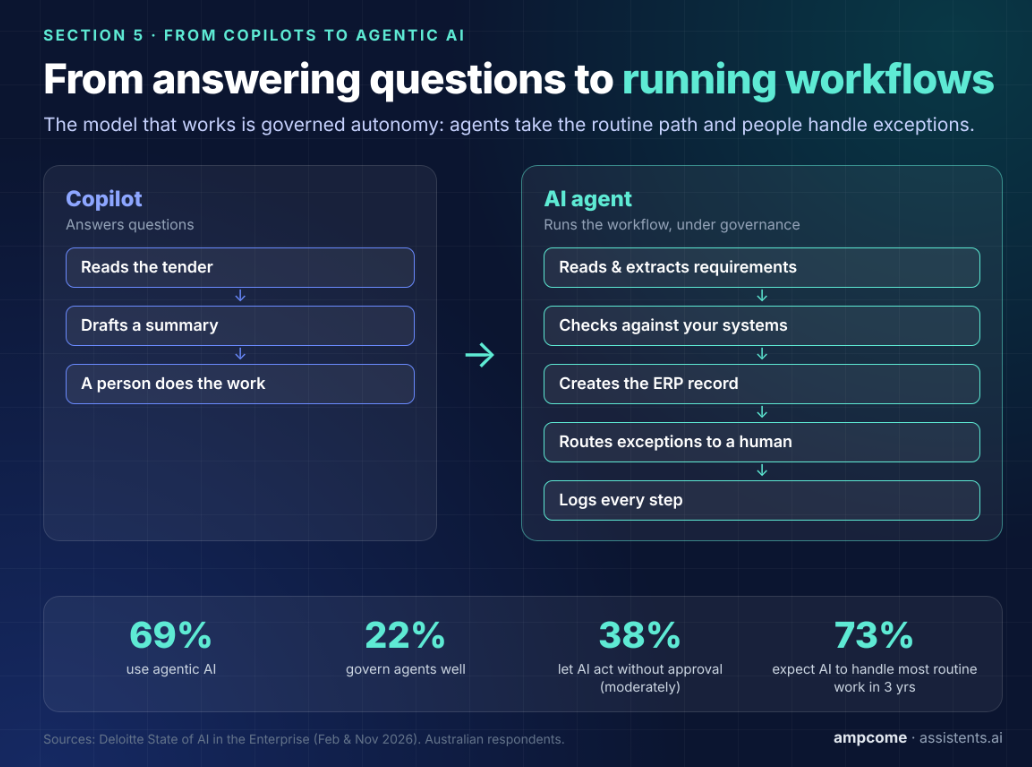
Australian enterprise AI is moving from copilots that answer questions to agents that run workflows. 69% of Australian organisations already use agentic AI, and 73% expect AI to handle most routine knowledge work within three years (Deloitte).
The difference matters:
- A copilot drafts an email, summarises a tender or answers a policy question. Then a person does the work.
- An AI agent reads the tender, extracts the requirements, checks them against your systems, creates the record in your ERP, flags exceptions to a human, and logs every step.
Australian leaders are cautious about autonomy so far. 38% allow AI to execute decisions without human approval to a moderate degree, and none report a significant degree. That's the right instinct. The model that works is governed autonomy: agents handle the routine path and route exceptions to people. For a deeper look at the upside, see our guide to the benefits of agentic AI for businesses.
A three-phase enterprise AI adoption roadmap for Australia
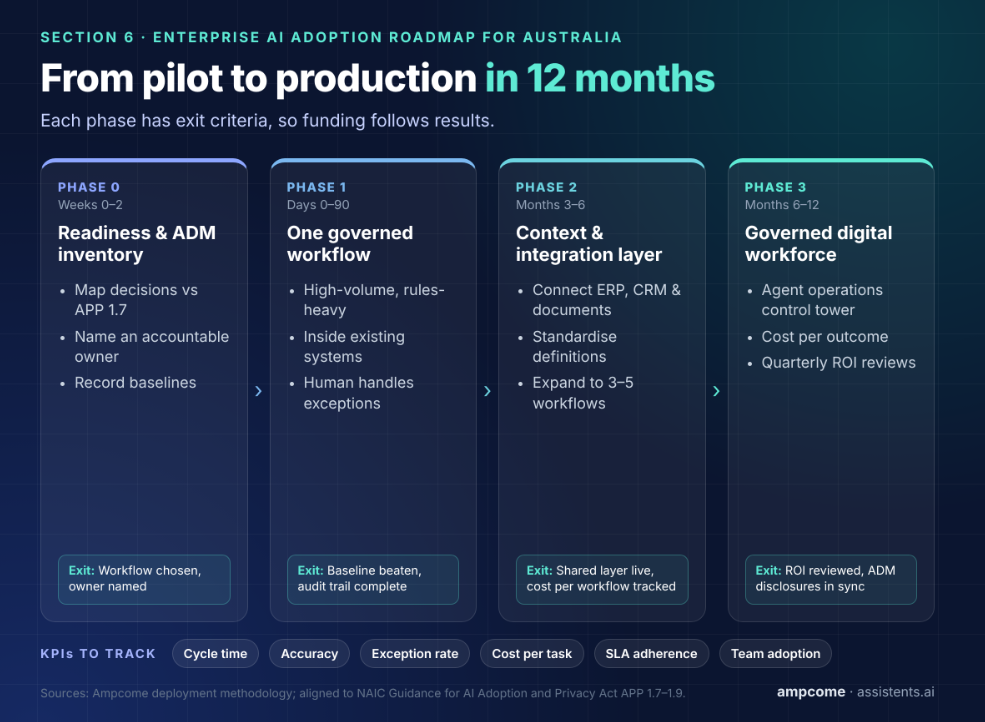
The fastest path from pilot to production is to prove one governed workflow in 90 days, build the integration layer in months three to six, and run a managed digital workforce by month twelve. Each phase has exit criteria, so funding follows results.
Phase 0, weeks 0–2: readiness and ADM inventory
- List the decisions AI will touch and check each against the Privacy Act ADM obligation (APP 1.7–1.9).
- Name an accountable owner for each candidate workflow (practice 1 of the NAIC guidance).
- Record baselines: cycle time, cost per transaction, error rate, backlog.
- Choose a deployment model (cloud, in-region or on-premise) that matches your data obligations.
Exit criteria: one workflow chosen, owner named, baseline recorded, risk assessment signed.
Phase 1, days 0–90: one governed, high-volume workflow
Choose work that is high-volume, rules-heavy and painful today. Good examples are tender and document processing, customer or tenant service, sales order entry, and procurement or finance alerts.
- Deploy the agent inside the systems your team already uses, not in a separate sandbox.
- Keep a human in the loop for exceptions, not for every step.
- Log every input, source and action.
Exit criteria: baseline beaten on agreed KPIs, complete audit trail, owner sign-off to scale.
Phase 2, months 3–6: build the context and integration layer
This is where most Australian programs stall, and where the value compounds.
- Connect structured data (ERP, CRM, finance) and unstructured data (contracts, SOPs, PDFs) into one governed context layer.
- Standardise definitions so "margin", "on-time" or "active tenant" mean the same thing to every agent.
- Expand to three to five adjacent workflows that reuse the same context and integrations.
- Turn passive dashboards into actions. See how agentic AI is replacing dashboards with decisions.
Exit criteria: shared context layer live, three or more workflows in production, cost tracked per workflow.
Phase 3, months 6–12: run a governed digital workforce
- Operate agents like a workforce, with roles, permissions, performance reviews and an operations control tower.
- Track AI cost per outcome, not just total inference spend.
- Review ROI quarterly and retire agents that don't earn their keep.
- Keep privacy policy ADM disclosures in sync with what is actually running.
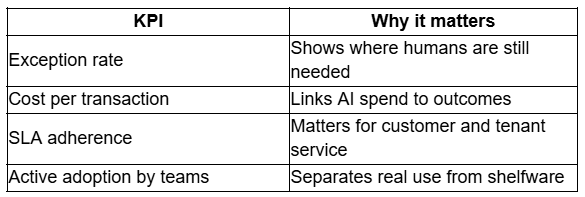
KPIs to track at every phase
Free resource: download the Australian Enterprise AI Readiness Checklist, a 20-point checklist covering ADM inventory, ownership, data residency and baseline metrics. (Add lead-magnet link.)
Enterprise AI adoption in practice: six anonymised case studies
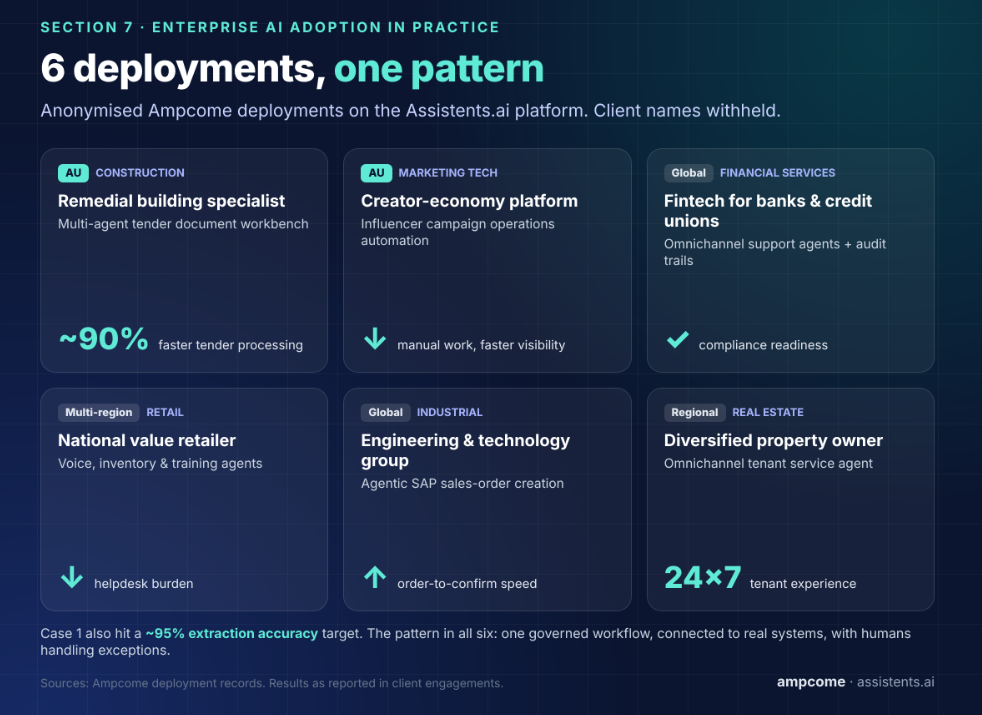
The enterprises that reach production start with one painful workflow, connect AI to their core systems and govern every action. The six deployments below were delivered by Ampcome on the Assistents.ai platform and its predecessor stack. Client names are withheld. The first two are Australian.
Case study 1: Australian remedial building and waterproofing specialist
Industry: construction and remedial building services (Australia). Construction is one of the sectors with the lowest AI adoption.
Challenge: complex tender packages arrived as long, inconsistent PDFs with frequent revisions. Staff manually extracted requirements and re-keyed them into the field-service system, which was slow and risked missing changes between tender revisions.
What we deployed: an intelligent document workbench using multi-agent orchestration:
- tender retrieval and workflow determination
- revision analysis to detect changes between versions
- vision-LLM extraction from complex PDFs
- deep integration with the company's field-service management platform (full create, read, update and delete), with quote locking and audit logs
Results:
- Engineered for up to ~90% faster tender document processing
- ~95% extraction accuracy target for standard formats
- Lower bid risk through revision and change detection, with full auditability
Case study 2: Australian creator-economy marketing platform
Industry: marketing technology (Australia, global customers)
Challenge: running influencer campaigns meant manual creator discovery, scattered reporting and inconsistent brand-safety checks across a very large creator dataset.
What we deployed: an AI platform to automate influencer marketing operations, covering creator discovery enrichment, campaign workflow automation, automated reporting summaries, content KPI monitoring, brand-safety checks and campaign ROI analytics.
Results: less manual work across campaigns, faster performance visibility, and more consistent reporting and learning across brand programs.
Case study 3: Cloud fintech serving banks and credit unions
Industry: financial services (global). This pattern applies directly to APRA-regulated Australian entities.
Challenge: support teams handled disputes, fraud and compliance queries across chat, email and phone, with inconsistent handling and heavy audit demands.
What we deployed: omnichannel AI agents for banking support, including intake and routing across channels, agent-assist summaries with next-best actions, SLA monitoring, and full audit reporting integrated with core systems.
Results: faster, more consistent case handling, lower operational load and better compliance readiness through audit trails.
Case study 4: National value retailer with hundreds of stores
Industry: retail (multi-region)
Challenge: store teams relied on a central helpdesk for stock, pricing, promotion and SOP questions, which created queues and slowed new-staff onboarding.
What we deployed: enterprise AI agents for store support. These included a bilingual voice support agent, an inventory intelligence agent (pricing, stock and promotions by store), and a knowledge and training agent using retrieval-augmented generation over POS and SOP documents. An admin console, analytics and ticketing integration sat alongside them.
Results: a smaller helpdesk burden, faster store issue resolution, better store-level inventory visibility and faster onboarding through on-demand training. Explore the Assistents voice AI agent library.
Case study 5: Multi-entity engineering and technology group
Industry: industrial engineering and automation
Challenge: sales orders were created manually in SAP through an end-of-life legacy document-capture tool with high licensing costs.
What we deployed: agentic automation that interprets order triggers, validates them and creates SAP sales orders. Rules and approvals handle exceptions, with audit logs and reconciliation reporting, as an integration-ready replacement for the legacy tool.
Results: less manual order processing and dependence on the legacy tool, a faster order-to-confirm cycle with fewer data-entry errors, and better auditability for every order and exception.
Case study 6: Diversified real estate portfolio owner
Industry: commercial and residential property
Challenge: tenant queries about rent, payments, maintenance and policies flooded the call centre, and response times varied.
What we deployed: an omnichannel tenant service agent (web, WhatsApp and email-ready). It triages tenant queries, handles FAQs and rental and payment workflows, escalates to human teams through ticketing, and draws on a knowledge base built from tenancy documents and SOPs. See the Assistents CX agent.
Results: faster responses, lower call-centre load, a consistent 24×7 tenant experience and better SLA adherence through automated routing and tracking.
The pattern behind every deployment
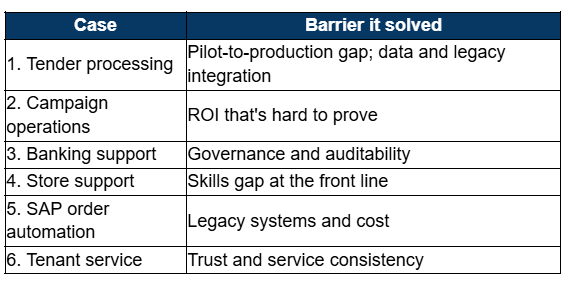
None of these started as an enterprise-wide "AI strategy". Each started with one governed workflow, connected to real systems, with a human handling exceptions. That's the roadmap above, in practice.
How to choose an enterprise AI platform in Australia
The right enterprise AI platform for an Australian organisation is the one that can take action in your systems, under your governance, where your data must live. Use this checklist when you evaluate vendors:
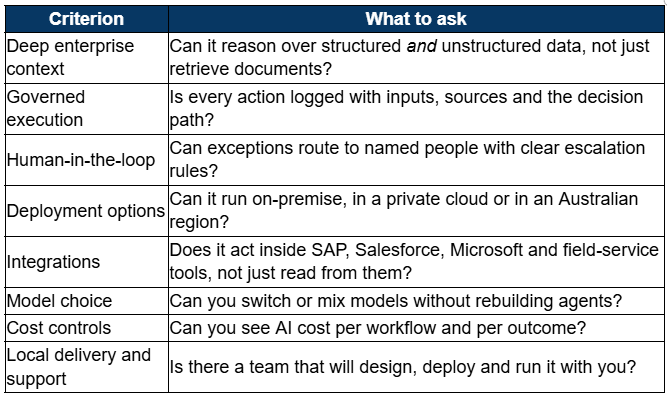
For a regional comparison of vendors, see our ranking of enterprise AI agent companies in the UAE. For build basics, read what AI agents are and how to build one.
Why Assistents.ai is the top choice for Australian enterprises
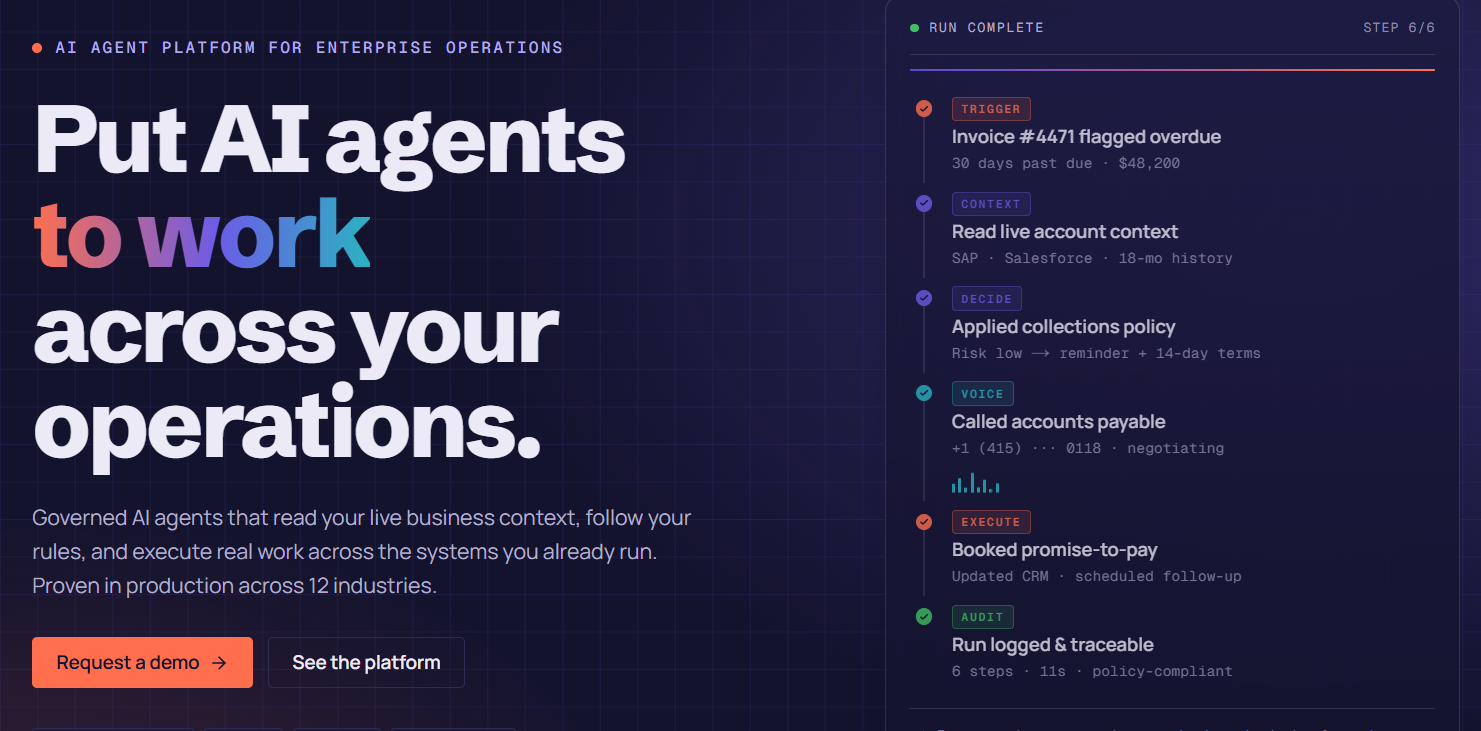
Assistents.ai is the enterprise AI agent platform built by Ampcome from more than 100 production deployments across 12 industries and six continents. It gives Australian enterprises deep context, governed execution and on-premise or in-region deployment, so AI agents can move from pilot to production with every decision logged.
Disclosure: Assistents.ai is built by Ampcome, the publisher of this article.
Built from deployments, not demos
Assistents exists because, after a hundred enterprise deployments, the same three needs kept coming up: deep context across systems, governance that compliance teams trust, and the option to keep everything on-premise. Each of the six case studies above shaped the platform.
How Assistents answers each Australian barrier
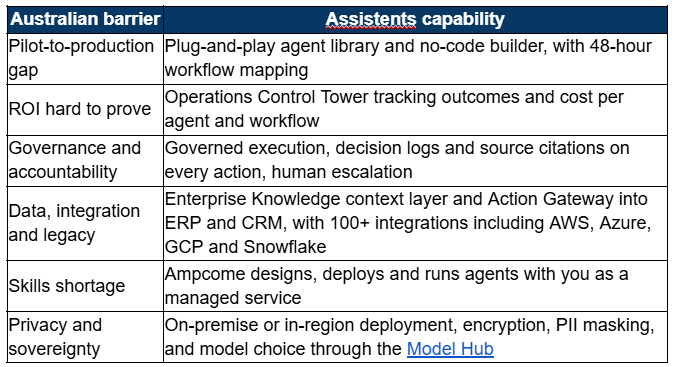
The five building blocks
- Work Hub: where teams and agents meet, embedded in the tools people already use.
- AI Workforce: pre-built and custom agents for finance, procurement, sales, support, HR and marketing.
- Enterprise Knowledge: a governed context layer over structured and unstructured data, including document AI parsing for complex PDFs.
- Action Gateway: governed actions inside your core systems.
- Operations Control Tower: monitoring, decision logs, cost tracking and performance across every agent.
Governance Australian compliance teams can sign off
Every Assistents response includes source citations, and every action is logged with its full decision history. That gives risk, legal and privacy teams the records they need for the Privacy Act ADM obligation, CPS 230 operational risk reviews and the NAIC's six essential practices.
Deploy where your data must live
Run Assistents on-premise, in your private cloud or in-region. For the 64% of Australian leaders who say sovereign AI matters, this is often what decides the platform.
Local presence
Ampcome has an Australian office in Marsden Park, NSW, so strategy, deployment and support come from the same team that built the platform.
Map your first workflow in 48 hours →
Why Assistents vs building in-house or buying point tools
For most Australian enterprises, a governed agent platform reaches production faster and at lower risk than building on raw LLM APIs or stitching together single-app copilots.
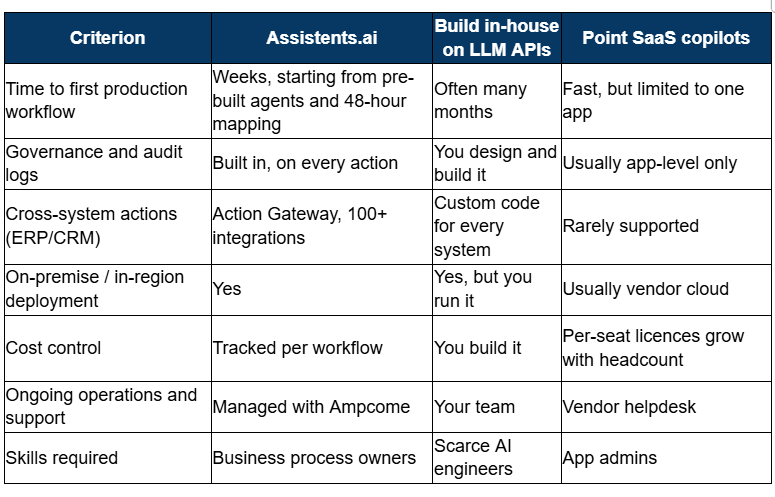
Building in-house makes sense when AI is your product. Point copilots make sense for personal productivity inside one app. For enterprise workflows that cross systems and need an audit trail, a governed agent platform is the practical middle path.
The bottom line
Enterprise AI adoption in Australia has passed the experimentation stage. The organisations pulling ahead are not the ones with the most pilots. They have taken a few governed workflows into production, connected AI to their core systems and can show what every agent decided and why. With the Privacy Act ADM obligation starting on 10 December 2026, that operating discipline is now essential.
If your AI program is stuck at the pilot stage, start with one workflow.
Book a 30-minute AI readiness assessment with Assistents.ai →
Methodology and sources
Statistics in this article come from the following sources, accessed November 2026:
- Australian Bureau of Statistics: Characteristics of Australian Business, 2024–25
- Reserve Bank of Australia: Technology Investment and AI, Bulletin, November 2025
- Deloitte Australia: State of AI in the Enterprise, February 2026
- Deloitte Australia: Australian organisations report growing AI returns, November 2026
- CPA Australia: Business Technology Report 2026
- National AI Centre: AI adoption insights, December 2025 to February 2026
- Westpac-DataX Business Panel, November 2026
- Infor Enterprise AI Adoption Index, via Enterprise IT World, October 2026
- OAIC: Transparency for AI and automated decision-making
- Australian Government: National AI Plan
- National AI Centre: Guidance for AI Adoption
- APRA: CPS 230 Operational Risk Management
Case studies are drawn from Ampcome's deployment records. Client names and identifying details are withheld.
Also read: Enterprise AI Adoption in India in 2026
FAQs:
What percentage of Australian businesses use AI in 2026?
It depends on the measure. The ABS reports 12% of all businesses and 35% of large businesses used AI at work in 2024–25. CPA Australia's 2026 survey found 88% use AI in some form, but only 10% have it deeply embedded. Among SMEs, the National AI Centre measured 44% adoption in February 2026.
Why is AI adoption slow in Australia?
Australian adoption is broad but shallow. The main brakes are the pilot-to-production gap, ROI that's hard to prove, immature governance, legacy integration, talent shortages, and privacy and sovereignty concerns. Deloitte found only 12% of Australian leaders say AI is transforming their business, versus 25% globally.
What are the biggest barriers to AI adoption in Australia?
For enterprises: moving pilots into production (only 28% have moved 40% or more), proving ROI (35% say it fell short), agent governance (22% have advanced models), data and system integration, AI skills, and privacy (62% rate it a high issue). For SMEs, distrust of AI decisions and unclear relevance lead.
Which industries use AI the most in Australia?
According to the ABS, information, media and telecommunications leads at 38%, followed by professional, scientific and technical services and financial and insurance services at 24% each. Mining, banking and healthcare run mature programs. Construction and agriculture lag, at below 30% adoption among SMEs.
Is there AI regulation in Australia?
Australia has no standalone AI Act. AI is governed through existing laws such as the Privacy Act, consumer law and anti-discrimination law, plus sector rules like APRA CPS 230. The National AI Plan (December 2025), the AI Safety Institute and the NAIC's Guidance for AI Adoption add national direction and voluntary best practice.
What changes for automated decision-making on 10 December 2026?
From 10 December 2026, organisations covered by the Privacy Act must disclose in their privacy policy when computer programs make or substantially inform decisions that significantly affect individuals. They must also describe the kinds of personal information used. It applies to decisions made after that date, including those made by systems set up earlier.
What is Australia's National AI Plan?
The National AI Plan, released on 2 December 2025, sets out how the federal government will build an AI-enabled economy. It focuses on capturing opportunities, spreading benefits and keeping Australians safe. It relies on existing laws plus targeted reforms and set up an AI Safety Institute with about $29.9 million in funding.
What are the six essential practices for responsible AI in Australia?
The National AI Centre's Guidance for AI Adoption (October 2025) lists six practices: decide who is accountable; understand impacts and plan accordingly; measure and manage risks; share essential information; test and monitor; and maintain human control. It replaced the earlier Voluntary AI Safety Standard.
How do enterprises move AI from pilot to production?
Pick one high-volume, rules-heavy workflow. Record a baseline, name an owner and deploy inside your existing systems with human escalation for exceptions. Prove results within 90 days, then build a shared context and integration layer and expand to adjacent workflows. Governance and integration, not model choice, decide success.
How long does enterprise AI implementation take?
With a governed agent platform, a first production workflow typically takes weeks to about 90 days. Building the integration layer and scaling to several workflows usually takes three to six more months. Running a mature, governed digital workforce is typically a 6–12 month journey.

Transform Your Business With Agentic Automation
Agentic automation is the rising star posied to overtake RPA and bring about a new wave of intelligent automation. Explore the core concepts of agentic automation, how it works, real-life examples and strategies for a successful implementation in this ebook.
Sarfraz Nawaz is the CEO and founder of Ampcome, which is at the forefront of Artificial Intelligence (AI) Development. Nawaz's passion for technology is matched by his commitment to creating solutions that drive real-world results. Under his leadership, Ampcome's team of talented engineers and developers craft innovative IT solutions that empower businesses to thrive in the ever-evolving technological landscape.Ampcome's success is a testament to Nawaz's dedication to excellence and his unwavering belief in the transformative power of technology.

More insights
Discover the latest trends, best practices, and expert opinions that can reshape your perspective





Contact us


