

AI Booking Agent for Luxury Hotels: How It Works, What It Delivers, and How to Get It Right in 2026


If your reservations team is spending hours chasing missing guest details, manually cross-checking availability across properties, and typing up itineraries by hand — an AI booking agent for luxury hotels is not a future upgrade. It is a present-day operational fix.
The luxury hospitality market has always competed on experience. But experience starts before a guest arrives. It starts the moment someone sends an enquiry. And that first moment — the response time, the accuracy, the tone — is increasingly where bookings are won or lost.
This guide covers exactly what an AI booking agent for luxury hotels does, how the full workflow operates, what results hotels are achieving, and what you need to get implementation right.
What is an AI booking agent for luxury hotels?
An AI booking agent for luxury hotels is a purpose-built intelligent system that handles the end-to-end reservation workflow — from the moment a guest enquiry arrives to the point a confirmed booking and invoice are sent — with minimal or zero manual intervention.
It is not a chatbot. It does not answer FAQs. It does not route guests to a contact form. It ingests booking requests across channels, understands complex guest requirements, checks live inventory, negotiates alternatives when needed, and produces itineraries and confirmation documents automatically.
The distinction matters because luxury hotel operations have requirements that generic AI tools are not designed for. High-expectation guests, multi-property portfolios, bespoke itinerary requests, and variable room configurations demand a system that understands context, handles nuance, and knows when to bring a human in.
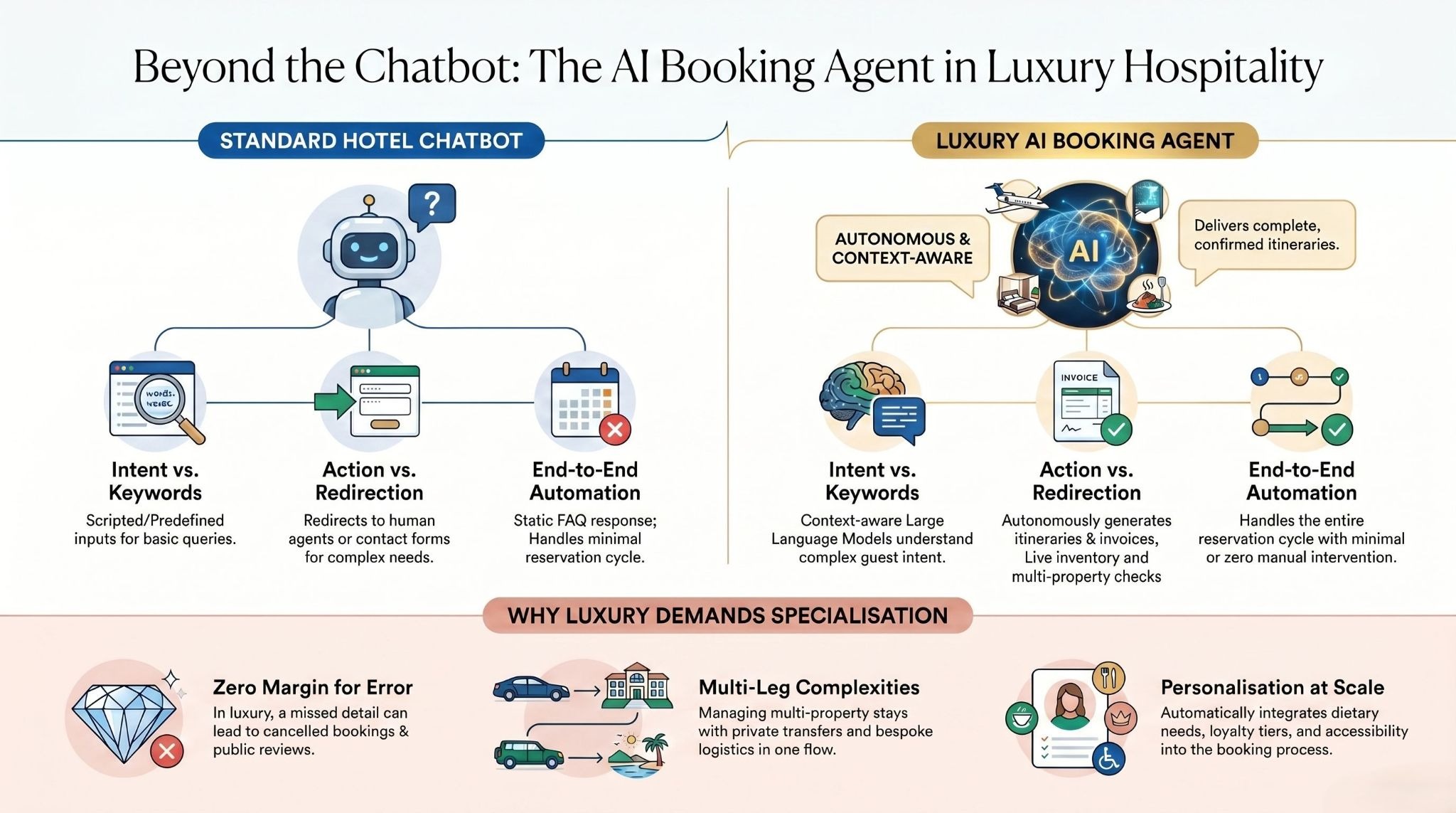
How it differs from a standard hotel chatbot
A standard hotel chatbot responds to predefined inputs. Ask it a question outside its script and it fails gracefully — which in luxury hospitality is still a failure.
An AI booking agent operates differently. It uses large language models to understand intent, not just match keywords. It can handle multi-leg enquiries ("We need three nights at your lake property, then two nights at the bush camp, with a private guide transfer between them"), extract the relevant data, check availability across properties in real time, and come back with a complete options package — all without a reservations agent touching the thread.
Why luxury hospitality has unique requirements
Luxury properties operate on tighter margins of error than budget or mid-market hotels. A missed detail in a standard hotel booking means an inconvenience. A missed detail in a safari lodge booking for a high-net-worth family travelling from London for an anniversary can mean a cancelled booking and a public review.
The AI system needs to handle complex, layered requirements: dietary specifications, accessibility needs, special occasion arrangements, preferred room orientation, loyalty tier recognition, and transfer logistics — all within a single booking flow. This is where purpose-built agentic AI for hospitality separates from off-the-shelf tools.
How an AI booking agent works end to end
Understanding the full workflow is where most coverage of this topic falls short. Here is how a properly deployed AI booking agent for luxury hotels actually operates from first contact to confirmed reservation.

Email intake and intent classification
The workflow begins the moment an enquiry arrives — via email, web form, WhatsApp, or any connected channel. The agent ingests the message, classifies the intent (new booking, modification, availability check, special request), and extracts the structured data it needs: dates, guest count, property preference, special requirements, and budget signals.
If data is missing — which it almost always is in the first message — the agent opens a conversational loop to collect it. It asks precisely the questions a trained reservations agent would ask, in the tone the property requires, without the guest knowing they are talking to an automated system.
Real-time inventory checks and alternative negotiation
Once the agent has the information it needs, it queries live inventory across connected properties. If the requested configuration is available, it moves to confirmation. If it is not, it does not simply return a "not available" response.
It negotiates. It identifies the closest available alternatives — same property, different room type; adjacent dates; alternative property in the same portfolio — and presents them to the guest with clear differences and pricing. This is the behaviour of a skilled reservations agent, replicated at machine speed and available around the clock.
Human-in-the-loop handoff for curated itineraries
For complex requests — multi-property itineraries, incentive travel groups, customised experiences — the agent reaches the edge of autonomous action and routes to a human team member with a complete brief: all guest data, the available options, any special requirements flagged, and a suggested itinerary structure.
The human agent does not start from scratch. They pick up a fully prepared file and apply judgement where it matters. This hybrid model — AI handling the intake, classification, inventory and documentation, human handling the curation and relationship — is the operating model that makes AI viable in luxury hospitality without compromising the service standard.
Automated invoice and PDF document generation
Once a booking is confirmed, the agent generates the booking confirmation, itinerary PDF, and invoice automatically. Documents are branded, accurate, and dispatched without a human opening a template. This step alone eliminates a significant volume of post-confirmation administrative work from reservations teams.
Key capabilities to look for in a luxury hotel AI booking agent
Not all AI booking agents are built for the demands of luxury hospitality. These are the capabilities that separate a purpose-built system from a generic automation tool.

Multi-channel intake
Enquiries arrive from everywhere — email, WhatsApp, web forms, OTA message threads, voice calls. A capable AI booking agent consolidates all inbound channels into a single workflow. The guest experience is consistent regardless of where they reach out. The reservations team sees everything in one place.
Conversational loop to capture missing guest details
The agent should be able to identify what information is missing and ask for it conversationally — not with a form or a checklist, but in a natural exchange that matches the property's brand voice. This capability directly reduces the back-and-forth that delays booking confirmation and frustrates high-expectation guests.
PMS integration and live availability
Real-time connection to the property management system is non-negotiable. An AI booking agent that cannot query live inventory is a liability, not an asset. The system needs full read access to availability, pricing, and room configuration — and, depending on the implementation, write access to create and update reservations directly in the PMS.
Quality control without losing the luxury standard
The human-in-the-loop architecture is not a compromise — it is the design. Luxury service cannot be fully automated and should not be. The AI handles the repeatable, data-intensive tasks. The human team handles relationship, curation, and the moments that require genuine judgement. A well-implemented system defines exactly where the handoff happens and ensures no guest request falls through the gap.
Real results: what hotels achieve after deploying an AI booking agent
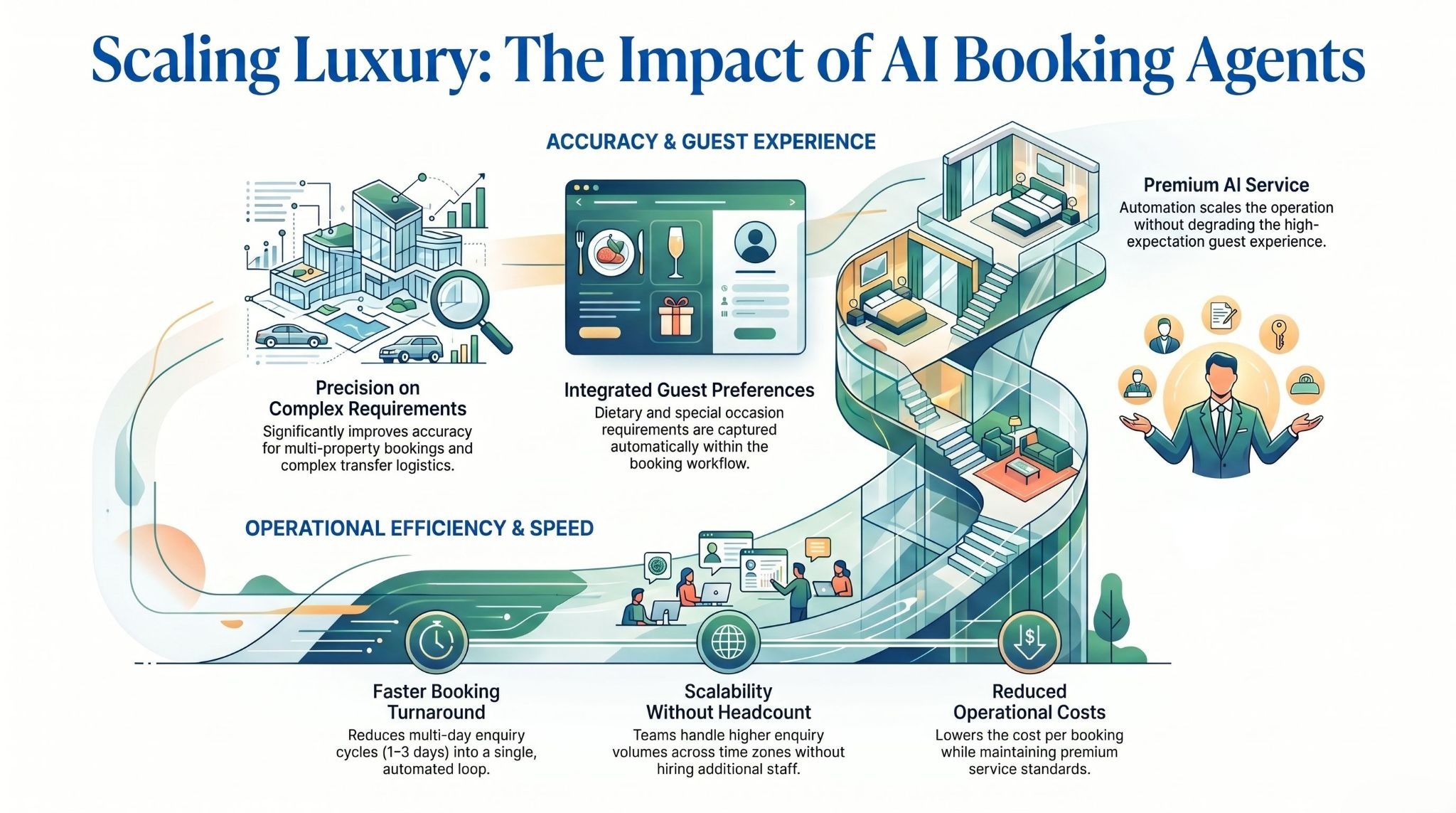
The outcomes from a real-world deployment of an AI booking agent for luxury hotels — across a boutique collection of lodges, camps, and hotels spanning iconic safari locations and serving high-expectation global travellers — demonstrate what is achievable when the system is implemented end to end.
Faster booking turnaround and fewer back-and-forth exchanges
The most immediate result is time. Enquiries that previously required multiple exchanges over one to three days — to collect guest requirements, check availability, present options, and confirm — are handled in a single automated loop. Guests receive a complete, accurate response faster. Reservations teams handle higher enquiry volumes without additional headcount.
Handling complex, high-expectation guest requirements accurately
Accuracy on complex requirements — the kind that luxury guests expect to be remembered and acted on — improved significantly. Multi-property bookings, special occasion arrangements, dietary requirements carried through to F&B briefings, and transfer logistics were all captured and processed within the booking workflow rather than relying on manual handover notes.
Scaling operations without compromising service quality
The core tension in luxury hospitality AI is always the same: can you automate without degrading the experience? The answer, when the system is built correctly, is yes. The boutique collection in this case scaled its booking operations — handling a higher volume of international enquiries, across multiple time zones and languages — without increasing reservations headcount or extending response times.
The experience that reached the guest was still premium. The operational cost per booking came down.
What makes AI booking agents different for luxury versus budget hotels
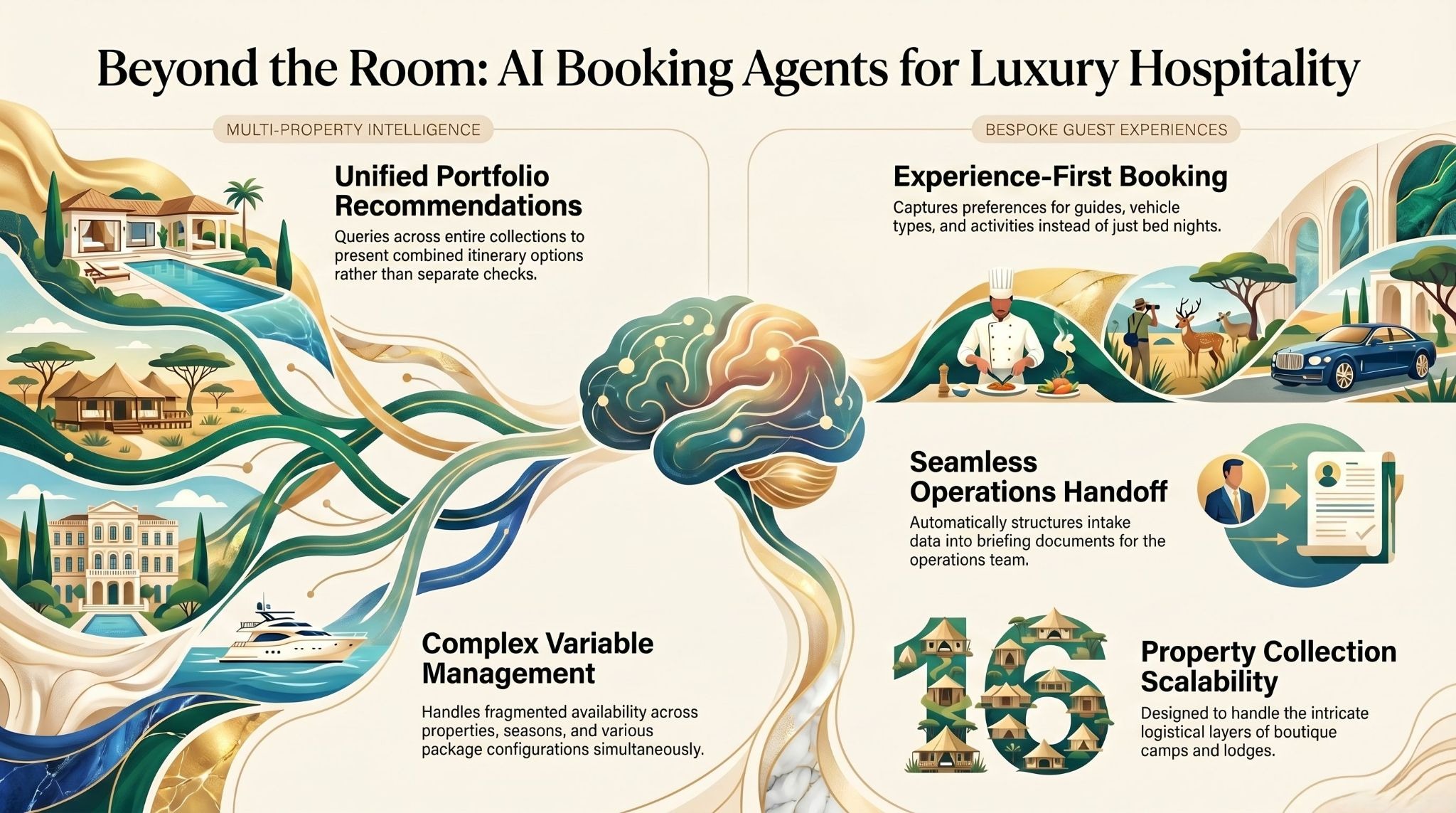
The conversation around AI in hospitality is often framed generically. The technology that works for a 200-room city centre business hotel is not the same as what a 16-property safari collection or a boutique mountain lodge needs. The differences are significant.
Safari lodges, boutique camps, and multi-property collections
Multi-property operations introduce a layer of complexity that standard booking tools cannot handle. Availability is fragmented across properties. Pricing varies by season, occupancy, and package configuration. Guests frequently want to combine stays across multiple camps or lodges in a single trip. The AI booking agent needs to understand the portfolio, query across it simultaneously, and present combined itinerary options as a unified recommendation — not a list of separate availability checks.
Managing bespoke itinerary requests at scale
High-end guests do not book rooms. They book experiences. An AI booking agent for luxury hotels needs to handle requests that include guide preferences, vehicle types, activity availability, dietary briefings, and special event arrangements — not just bed nights. The system captures all of this in the intake flow, structures it for the operations team, and ensures nothing is lost between the guest's first message and the team's briefing document.
How to implement an AI booking agent for your hotel (without disrupting operations)

Implementation is where most hotel technology projects fail. The system works in the demo; it causes chaos in production. The reason is almost always the same: the deployment was not mapped to the actual operation before it went live.
Phase 1: Define your booking workflows and handoff points
Before any technology is configured, document how bookings actually move through your operation today. Where do enquiries come in? Who handles them? Where do delays happen? Where is information lost between systems or people? This workflow map becomes the architecture of your AI booking agent. The system is built around your operation, not the other way around.
Critically, define the handoff points. These are the moments where the AI stops and a human takes over. For a luxury property, this might be: any enquiry involving a group of more than six guests; any booking that includes a special event; any guest flagged as a returning VIP. The AI handles everything else.
Phase 2: Connect to your existing systems
Integration is the determinant of whether the system actually works. The AI booking agent needs to connect to your PMS for live availability, your CRM for guest history and preferences, your communication tools for channel consolidation, and your document systems for confirmation and invoice generation.
This is not a plug-in-and-play step. It requires technical scoping and, in most cases, custom integration work. The payoff is a system that operates on real data and produces real outputs — not a demonstration tool running on static inventory.
Phase 3: Launch, monitor, and scale
A phased rollout is always more reliable than a full deployment. Launch on one channel — email, for example — with human review of every AI-generated response for the first two to four weeks. Identify where the system produces responses that need correction. Refine the system prompt, the workflow logic, and the handoff criteria. Then open additional channels and reduce the review overhead as confidence increases.
The system improves with use. Every booking cycle adds data. Every edge case the human team corrects becomes a refinement. Six months in, the system operates at a level that no cold deployment ever achieves on day one.
Why luxury hotels choose Assistents.ai to build and deploy their AI booking agents
Most AI platforms are built for one thing — answering questions, automating a single workflow, or surfacing analytics. What luxury hospitality actually requires is a system that does all of it together, in sequence, across your existing tools, without you rebuilding your tech stack to accommodate it.
That is the gap Assistents.ai was built to close.
Assistents.ai is an enterprise agentic AI platform — not a chatbot builder, not a workflow template library. It deploys governed AI agents that connect to your systems, reason through your operational workflows, and execute with full audit trails.
For a luxury hotel or hospitality collection, that means an AI booking agent that is not just conversational, but operational: it reads live inventory, classifies enquiry intent, captures missing guest details, routes to a human at the right moment, and generates confirmation documents — without a human touching the thread.
A platform built for complexity, not demos
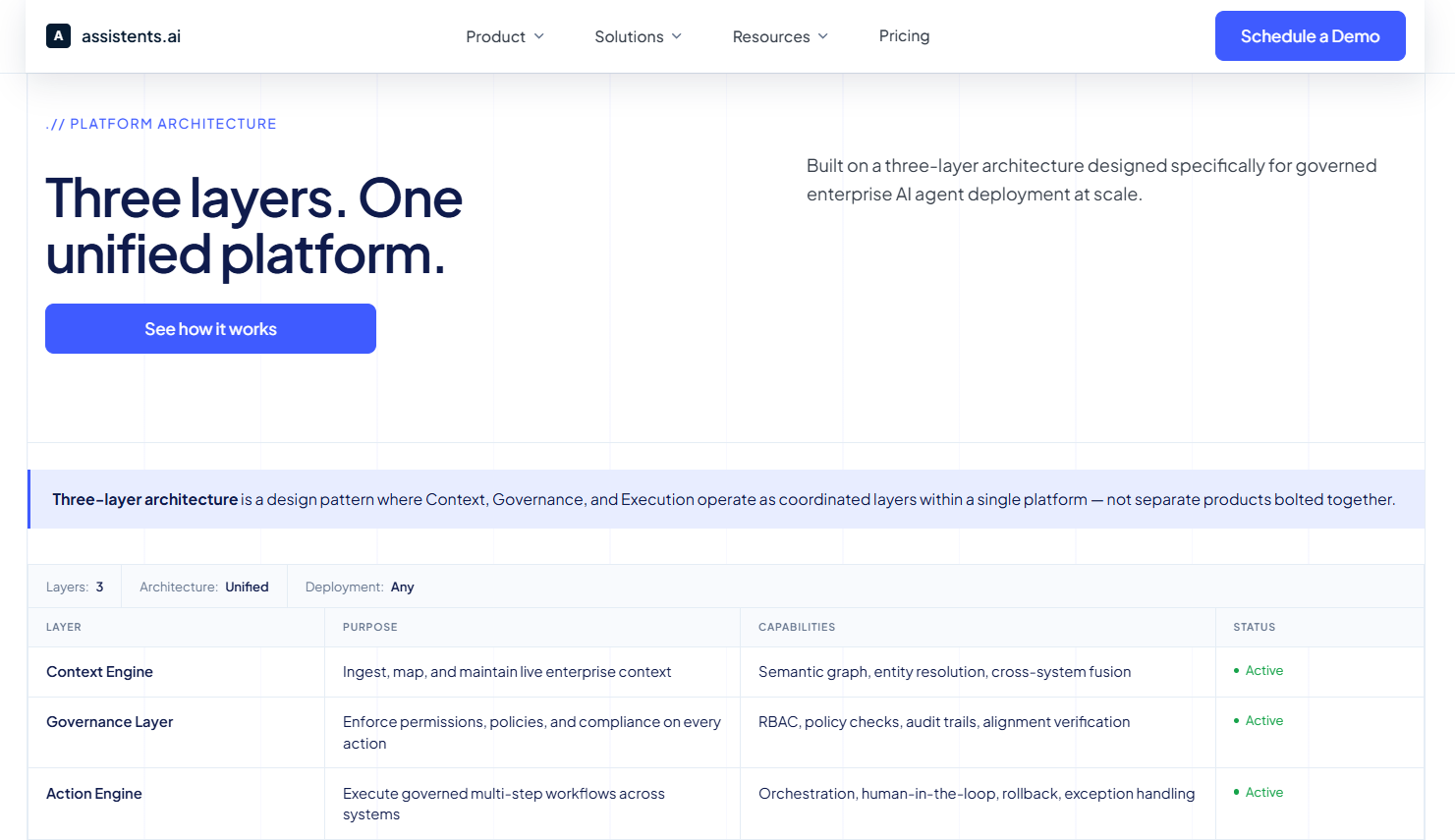
The difference between a proof-of-concept AI booking agent and one that holds up in real hotel operations comes down to architecture. Assistents.ai runs on a three-layer engine:
The Context Engine connects to 300+ enterprise systems — including the property management systems, CRMs, communication tools, and document platforms that luxury hotel operations run on — and builds a live semantic understanding of your inventory, guest history, and booking workflows.
The Semantic Layer maps the relationships between that data: which properties are available on which dates, which guests have returning-guest profiles, which requests trigger special handling. The agent reasons through your workflows with relational intelligence, not keyword matching.
The Action Engine executes. It creates reservations, generates documents, sends confirmations, and routes to human agents — with permission checks at every step and a complete audit trail on every action.
For luxury hospitality, this means the system does not just retrieve information. It acts on it, within boundaries you define.
Production-proven across industries that cannot afford errors
Assistents.ai is deployed across 12 industries and 6 continents, with a 97% agent task accuracy rate and an average time to production of four weeks. These are not pilot numbers. They come from live enterprise deployments — retail operations spanning 700+ locations, financial services enterprises with zero-tolerance compliance requirements, healthcare organisations under HIPAA constraints.
The governance architecture that makes Assistents.ai viable in those environments is the same architecture that makes it the right choice for luxury hospitality: every agent action is permission-checked, every decision is logged, and every escalation to a human team member is traceable. When a high-expectation guest's booking moves from the AI to your reservations team, nothing is lost and nothing is assumed. The handoff is structured, documented, and complete.
Deployable in days, not months
One of the persistent objections to AI in luxury hospitality is implementation time. The assumption is that getting a system into production means months of integration work, team retraining, and disruption to live operations.
Assistents.ai is designed to work around that. Pre-built agent templates cover the core hospitality booking workflow out of the box. The platform connects to the systems your team already uses. A custom proof-of-concept with ROI projections and an integration roadmap is typically ready within 48 hours of a discovery call. Full deployment for a single-channel implementation takes four to ten weeks.
The hospitality-specific booking agent Assistents.ai deploys covers the full workflow: multi-channel intake, conversational data capture, real-time inventory querying, human-in-the-loop itinerary handoff, and automated confirmation and invoice generation. It is not configured from scratch — it is adapted from a production-tested baseline to fit your specific property portfolio, your PMS, and your service standards.
Built for the hotels that cannot compromise on experience
There is a category of hospitality operator for whom the guest experience is not a differentiator — it is the entire product. Boutique collections. Safari lodges. Private island resorts. Urban luxury properties with returning guest programmes built over decades. These operations cannot afford an AI system that occasionally misreads a guest's requirements, sends a generic confirmation, or drops a special request in translation.
Assistents.ai is built with that standard in mind. The human-in-the-loop model is not a fallback — it is a design principle. The governance layer is not a compliance requirement — it is operational confidence. And the integration depth is not a feature — it is the reason the system works at scale without degrading the experience that brought your guests to you in the first place.
If you are ready to evaluate what an AI booking agent looks like inside your specific operation, the right starting point is a 30-minute discovery call. Bring the workflow that is creating the most friction — missed enquiries, slow turnaround, manual itinerary preparation — and Assistents.ai will show you exactly where the agent fits, what it connects to, and what the deployment timeline looks like.
The bottom line
An AI booking agent for luxury hotels is not about replacing the human experience. It is about making sure every guest enquiry is handled with the speed, accuracy, and completeness that high-expectation travellers require — and that your reservations team currently cannot deliver consistently at scale.
The technology works when it is built for the specific demands of luxury hospitality: multi-property operations, bespoke itinerary handling, human-in-the-loop quality control, and seamless integration with the systems your team already uses.
The hotels that are deploying this now are not doing it to cut costs. They are doing it to handle more demand without errors, respond faster than their competitors, and give their human teams the space to do the work that actually requires them.
If you are evaluating an AI booking agent for your luxury hotel or hospitality collection, the right starting point is a scoped walkthrough of your actual booking workflow — not a product demo.
[Book a demo with Assistents.ai →]
FAQs
Can an AI booking agent handle multi-property or multi-night safari bookings?
Yes — provided it is built to query across properties simultaneously and understand portfolio-level availability. A purpose-built AI booking agent for luxury hotel collections can handle complex multi-leg itineraries: checking availability across multiple lodges, calculating inter-property transfer logistics, and presenting a combined itinerary with pricing in a single response. This requires proper PMS integration and workflow configuration specific to multi-property operations.
Does it replace the reservations team?
No. The human-in-the-loop model is not a transitional phase — it is the permanent operating design for luxury hospitality. The AI booking agent handles intake, classification, data extraction, availability checking, and document generation. The reservations team handles curation, relationship management, complex negotiations, VIP guest management, and the moments that require genuine human judgement. The team's workload shifts from administrative to strategic. Headcount pressure eases; service quality does not.
What systems does an AI booking agent integrate with?
A properly scoped implementation connects to the property management system (PMS) for live availability and reservation creation, the CRM for guest history and preference data, communication platforms (email, WhatsApp, web chat), and document generation tools for confirmations and invoices. The specific integrations depend on the hotel's existing technology stack. Most luxury properties run Opera, Mews, or Protel — all of which support the integration layer required.
How long does deployment take?
A single-property implementation with one or two intake channels typically takes six to ten weeks from scoping to go-live. Multi-property deployments with complex PMS integrations and custom itinerary workflows take longer — twelve to sixteen weeks is a realistic timeline. The variable is integration complexity, not the AI itself. Properties that have clean, well-documented systems and clear workflow definitions move faster.
What is the difference between an AI booking agent and a hotel chatbot?
A hotel chatbot responds to predefined questions and routes guests to human agents when it cannot answer. An AI booking agent executes the booking workflow autonomously — collecting information, checking availability, presenting options, handling alternatives, and producing confirmation documents — without predefined scripts. It understands intent, handles variation, and acts on data from connected systems. The output is a confirmed booking, not a routed conversation.

Transform Your Business With Agentic Automation
Agentic automation is the rising star posied to overtake RPA and bring about a new wave of intelligent automation. Explore the core concepts of agentic automation, how it works, real-life examples and strategies for a successful implementation in this ebook.
Sarfraz Nawaz is the CEO and founder of Ampcome, which is at the forefront of Artificial Intelligence (AI) Development. Nawaz's passion for technology is matched by his commitment to creating solutions that drive real-world results. Under his leadership, Ampcome's team of talented engineers and developers craft innovative IT solutions that empower businesses to thrive in the ever-evolving technological landscape.Ampcome's success is a testament to Nawaz's dedication to excellence and his unwavering belief in the transformative power of technology.

More insights
Discover the latest trends, best practices, and expert opinions that can reshape your perspective







Contact us

