
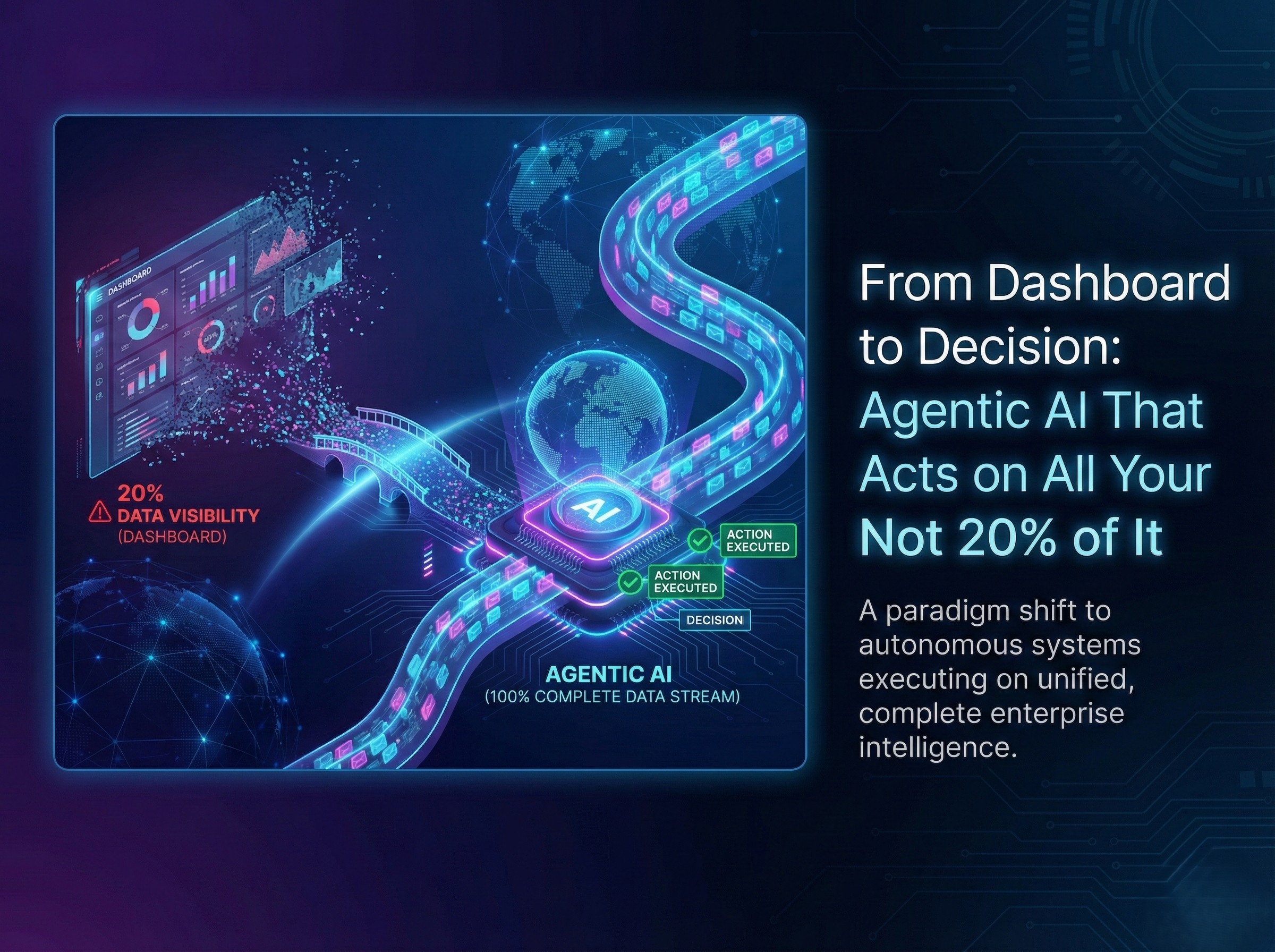
From Dashboard to Decision: Agentic AI That Acts on All Your Data, Not 20% of It


Enterprise intelligence is undergoing a structural shift. What once revolved around dashboards, reports, and retrospective analysis is rapidly evolving into contextual, autonomous, and action-oriented intelligence systems powered by generative AI and agentic workflows.
Traditional business intelligence (BI) answered what happened.
Modern enterprises now need systems that explain why it happened, what will happen next, and what action should be taken — often in real time.
This article explores the future of enterprise intelligence, the macro trends reshaping analytics, the organizational implications of AI-driven decision systems, and the architectural principles defining the next generation of enterprise analytics platforms.
From Business Intelligence to Enterprise Intelligence
For decades, enterprise analytics focused on structured data and static reporting. Dashboards, KPIs, and predefined queries helped organizations visualize historical performance — but they rarely translated insight into action.
The core limitation was structural:
- Traditional BI tools analyze only a fraction of enterprise data
- Insights are siloed across departments
- Decisions remain manual and slow
- Execution happens outside the analytics system
Critically, 80–90% of enterprise data is unstructured or external, residing in documents, emails, logs, chats, media, and third-party sources — data traditional BI systems cannot reason over effectively .
This gap between data and decision has real economic consequences. Poor data utilization costs U.S. companies an estimated $3 trillion annually in lost opportunity, according to Harvard Business Review .
Enterprise intelligence emerges as the response to this failure — combining data fusion, AI reasoning, conversational interfaces, and automated execution to close the loop between insight and outcome.
Why Dashboards Are No Longer Enough
Dashboards do not fail because they are inaccurate. They fail because they stop too early.
In a traditional analytics loop:
- Humans prepare data
- Humans build dashboards
- Humans interpret insights
- Humans decide what to do
- Humans manually execute actions
Insight and action remain disconnected.
As a result, organizations accumulate dashboards that visualize trends but rarely change outcomes. Teams identify issues but lack the speed, context, or automation required to respond effectively .
The future of enterprise intelligence demands systems that:
- Reason across all data types
- Deliver insights in natural language
- Trigger governed actions automatically
- Operate continuously, not episodically
Analytics success is no longer measured by the number of reports produced — but by decisions executed and outcomes achieved.
Key Trends Shaping the Future of Enterprise Intelligence
1. Explosion of Unstructured Data and the Rise of Context
Enterprises now generate massive volumes of unstructured data — from internal documents and communications to external market signals.
New techniques such as retrieval-augmented generation (RAG) allow AI systems to reason across structured databases and unstructured content simultaneously, creating a unified contextual layer for decision-making .
Context is no longer optional. It is the raw material of intelligent decisions.
2. From Reporting to Decision Intelligence
The enterprise analytics conversation has shifted:
- From “How do we visualize data?”
- To “How do we embed intelligence into every decision?”
Conversational AI interfaces now allow users to interact with enterprise data using natural language — asking questions, requesting explanations, and exploring scenarios without technical expertise .
This transition democratizes analytics and repositions AI as a daily collaborator, not a specialist tool.
3. Emergence of Agentic AI and Autonomous Execution
The most profound shift is the rise of agentic analytics — AI systems capable of acting on insights, not just reporting them.
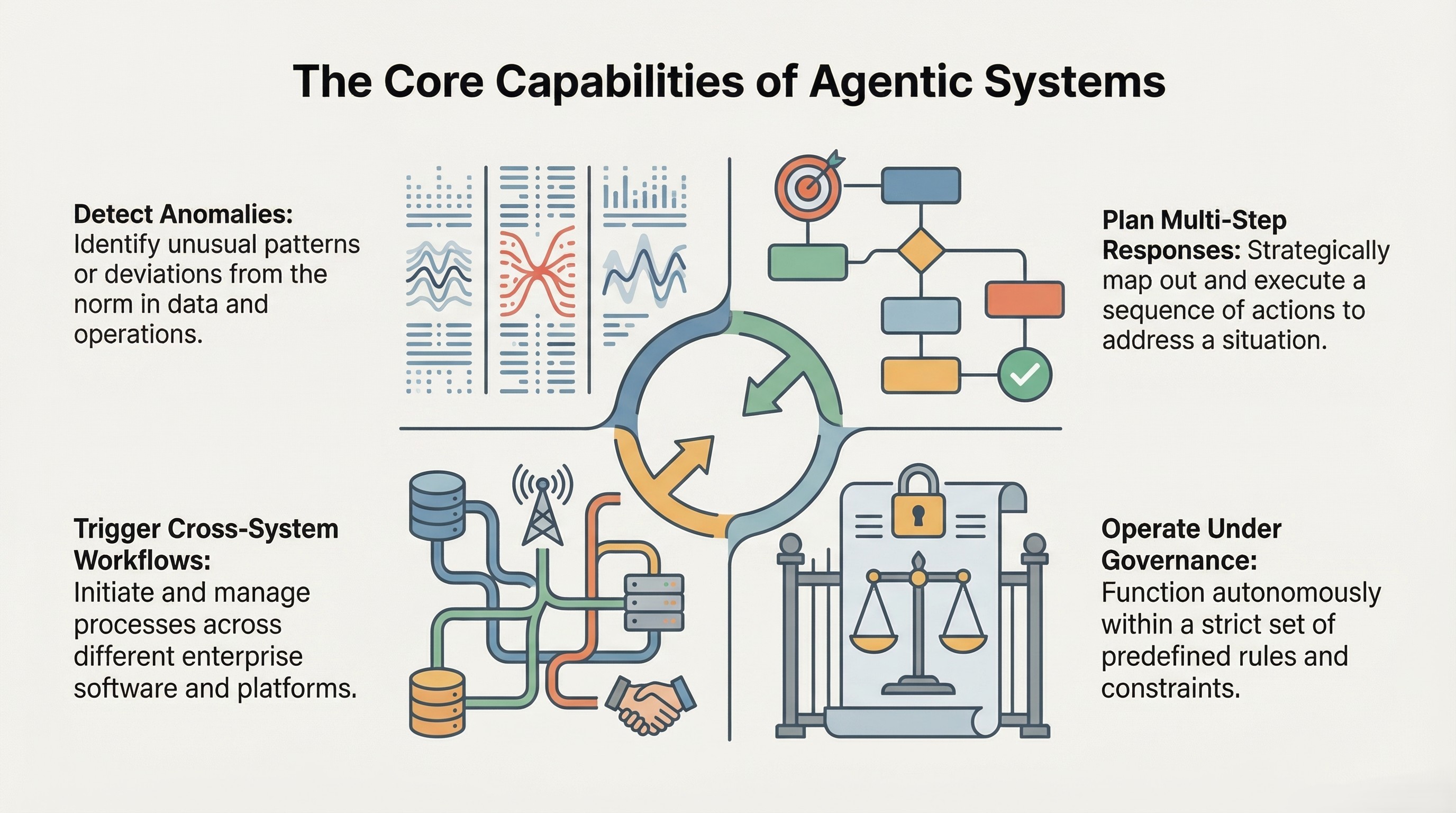
Agentic systems can:
- Detect anomalies
- Plan multi-step responses
- Trigger workflows across enterprise systems
- Operate under defined governance rules
Organizations implementing closed-loop analytics with automated execution have reported 25–30% productivity gains in affected processes .
Analytics alone does not create value. Execution does.
4. Governance, Trust, and Observability Become Non-Negotiable
As AI systems gain autonomy, enterprises demand stronger controls.
Future-ready enterprise intelligence platforms must embed:
- Role-based access controls
- Auditability and decision traceability
- Human-in-the-loop safeguards
- Policy-driven automation thresholds
Governance is not a constraint — it is what makes AI scalable, trustworthy, and enterprise-ready.
Organizational Implications of AI-Driven Enterprise Intelligence
AI-Augmented Workforces
AI agents increasingly operate as digital coworkers, handling routine analysis and first-pass decisions while humans focus on judgment, creativity, and strategy.
Roles evolve from execution to supervision and orchestration of AI outputs .
Cross-Functional Intelligence and Fluid Collaboration
When AI systems unify data across functions, organizational silos weaken.
Insights flow freely across finance, operations, marketing, and leadership — enabling cross-functional decision-making and faster response cycles .
Continuous Learning and Skill Evolution
As AI capabilities advance, the half-life of skills shrinks.
Employees must learn how to:
- Ask better questions
- Interpret AI-generated insights
- Provide feedback that improves system performance
AI literacy becomes as important as data literacy .
New Operating Models
Organizations increasingly operate as human-plus-machine teams, where AI agents contribute directly to capacity and output.
Success depends less on headcount and more on decision velocity and outcome quality.
Design Principles for the Next Generation of Enterprise Intelligence
1. Data Fusion for Contextual Intelligence
Enterprise intelligence requires unifying:
- Structured data
- Semi-structured data
- Unstructured content
- External signals
By fusing these sources into a single contextual layer, AI systems can answer complex, real-world questions that traditional BI cannot .
2. Conversational Interfaces as the New Analytics Front End
Natural language interfaces remove technical barriers and enable real-time exploration, explanation, and iteration.
Analytics becomes a conversation — not a dashboard .
3. Agentic Workflow Engines That Close the Loop
An agentic workflow engine orchestrates analysis, planning, and execution across systems — transforming insights into actions automatically while preserving oversight .
4. Governance and Observability by Design
Enterprise-grade AI requires transparency, traceability, and control.
Every insight, decision, and action must be explainable, auditable, and compliant — by default .
Strategic Recommendations for Enterprise Leaders
- Unify structured and unstructured data into an AI-accessible foundation
- Deploy conversational analytics to democratize decision-making
- Pilot agentic workflows in high-impact, repetitive processes
- Establish AI governance frameworks from day one
- Foster a culture of continuous experimentation and learning
Organizations that aggressively pursue AI-driven reinvention have achieved 15% higher revenue growth between 2019–2024, a performance premium projected to double by 2026 .
Why Assistents.ai by Ampcome Is Built for the Future of Enterprise Intelligence
Assistents.ai was designed from the ground up to embody these principles — combining:
- Data fusion
- Conversational analytics
- Agentic execution
- Built-in governance
This integrated approach allows enterprises to move faster without sacrificing control, accelerating the transition from dashboards to decisions.
Frequently Asked Questions
What is enterprise intelligence?
Enterprise intelligence refers to AI-powered systems that combine data, context, reasoning, and execution to support real-time, decision-grade outcomes.
How is enterprise intelligence different from BI?
BI reports what happened. Enterprise intelligence explains why it happened and determines what action to take next .
What is agentic analytics?
Agentic analytics uses AI agents that analyze data and autonomously execute governed workflows based on insights.
Why are dashboards no longer sufficient?
Dashboards create insight without action, introducing delays and manual bottlenecks.
How does conversational analytics work?
Users interact with enterprise data through natural language, enabling non-technical stakeholders to access insights instantly.
Conclusion
The future of enterprise intelligence is contextual, autonomous, and action-oriented.
Dashboards are giving way to AI systems that reason, decide, and execute — transforming analytics from a reporting function into a competitive advantage.
Enterprises that embrace this shift will not merely analyze the future.
They will operate inside it.

Transform Your Business With Agentic Automation
Agentic automation is the rising star posied to overtake RPA and bring about a new wave of intelligent automation. Explore the core concepts of agentic automation, how it works, real-life examples and strategies for a successful implementation in this ebook.
Sarfraz Nawaz is the CEO and founder of Ampcome, which is at the forefront of Artificial Intelligence (AI) Development. Nawaz's passion for technology is matched by his commitment to creating solutions that drive real-world results. Under his leadership, Ampcome's team of talented engineers and developers craft innovative IT solutions that empower businesses to thrive in the ever-evolving technological landscape.Ampcome's success is a testament to Nawaz's dedication to excellence and his unwavering belief in the transformative power of technology.

More insights
Discover the latest trends, best practices, and expert opinions that can reshape your perspective


.jpg)

Contact us

