
Enterprise AI Adoption in India in 2026: The Data, the Barriers, and a Practical Roadmap to Scale


India has quietly become one of the most interesting AI adoption stories in the world. By most measures, Indian enterprises are using AI more actively than their counterparts in the United States and much of Europe. And yet, ask a CIO in Mumbai, Bengaluru, or Gurugram how much of that usage has actually turned into scaled, governed, revenue-impacting deployment, and the answer is usually more cautious than the headline numbers suggest.
That gap — between how fast India is adopting AI and how much value it's actually capturing from it — is the real story of enterprise AI adoption in India in 2026. This piece breaks down where adoption genuinely stands, why the value gap exists, and a practical roadmap enterprises are using to close it, based on patterns we've seen work across real deployments.
Where Enterprise AI Adoption in India Actually Stands in 2026
The headline numbers
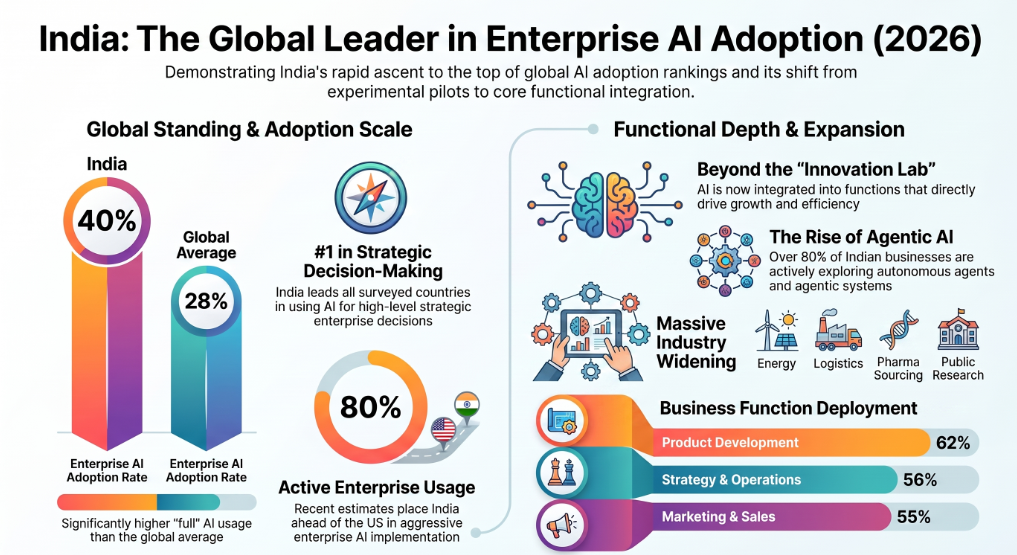
Indian enterprises report a significantly higher rate of "significant or full" AI usage than the global average — recent industry research puts India's figure at roughly 40%, compared to a global average closer to 28%. India also ranks first among surveyed countries on how actively AI is used in strategic decision-making, according to Deloitte's 2026 State of AI in the Enterprise report.
Earlier benchmarks tell a consistent story. IBM's Global AI Adoption Index found that a majority of large Indian organizations (over 1,000 employees) had AI actively in use in their operations, with a further significant share exploring adoption. More recent 2026 estimates from industry trackers put active enterprise AI usage in India as high as 80%, which — if accurate — would make India one of the most aggressive enterprise AI adopters globally, ahead of the US.
The pattern holds on the agentic AI front too. Multiple 2026 studies, including EY's "AIdea of India" report, describe more than 80% of Indian businesses actively exploring agentic AI and autonomous agents, with a majority of leaders citing deployment speed — not raw capability — as the deciding factor in whether they build AI systems in-house or buy a platform.
Where adoption is strongest, by function
Deloitte's India-specific 2026 data shows at-scale AI deployment is strongest in:
- Product development — around 62% of surveyed enterprises
- Strategy and operations — around 56%
- Marketing and sales — around 55%
- Supply chain — around 48%
This tells you something important: adoption isn't concentrated in "innovation labs" anymore. It's showing up in the functions that most directly drive growth and operating efficiency, which is a meaningfully different pattern from the pilot-heavy, sandbox-style adoption most enterprises were doing even two years ago.
Where adoption is strongest, by industry
Adoption is broadest in banking, financial services, retail, manufacturing, and technology-adjacent services — but 2026 has seen a clear widening into sectors that weren't early movers: energy and utilities, healthcare operations, logistics, pharma sourcing, and even public research institutions are now running production AI deployments, not just pilots. If your mental model of "enterprise AI in India" is still BFSI and IT services, it's already out of date.
Why Adoption Is Outpacing Value — The Real Barriers
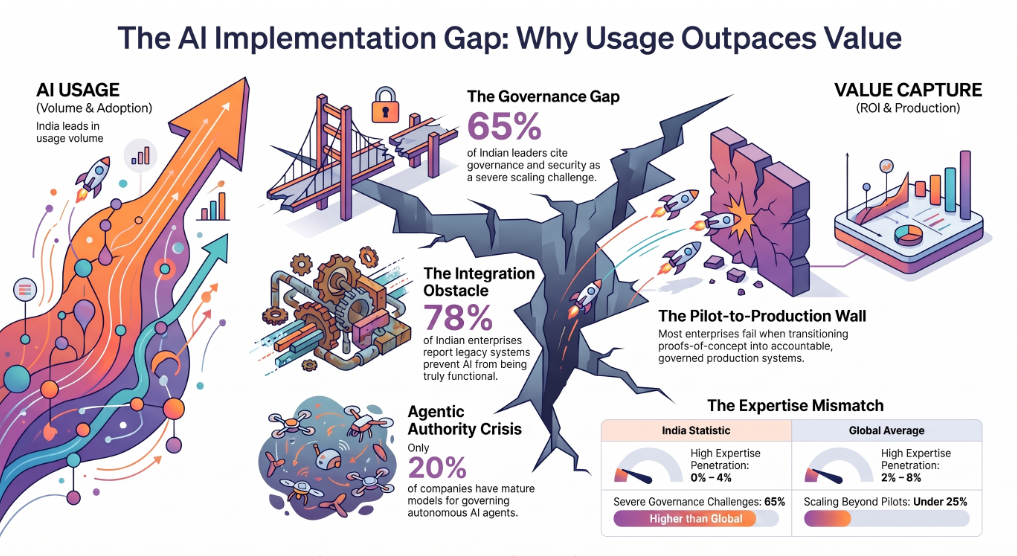
This is the part most trend pieces skip, and it's the part that actually matters if you're the one accountable for the outcome. Usage numbers are high. Value capture is not keeping pace. A few consistent, well-documented gaps explain why.
The governance gap
A majority of Indian enterprise leaders — some surveys put it at roughly 65% — describe data governance and security as a "very severe" challenge to scaling AI. This isn't a compliance footnote; it's the single biggest reason pilots stay pilots. Deloitte's global research found that only around one in five companies has a mature model for governing autonomous AI agents specifically, even as agentic usage accelerates. You cannot hand an AI system standing authority to take action in production systems if you can't answer, with certainty, who it's acting on behalf of, what it's allowed to touch, and how that action gets audited after the fact.
The integration gap
Roughly 78% of Indian enterprises report system integration as a serious obstacle, per EY's 2026 research. Most large Indian organizations run a genuinely messy mix of legacy ERP, industry-specific systems, spreadsheets, and point solutions accumulated over a decade or more of digitization. An AI agent that can reason brilliantly but can't actually read from or act into those systems is a demo, not a deployment.
The skills and expertise gap
Here's the most counterintuitive finding in the 2026 data, and arguably the most important one: despite leading on usage, Indian organizations rank lower than global peers on deep AI expertise — some studies put India at 0–4% "high expertise" penetration, against a global average of 2–8%. India has the volume of AI usage. It doesn't yet have the depth of specialist capability to operate that usage safely at scale. That mismatch — high usage, low expertise — is exactly the condition that produces shadow AI, inconsistent governance, and stalled pilots.
The pilot-to-production gap
Globally, nearly 9 in 10 organizations now use AI somewhere in the business, but fewer than a quarter have scaled beyond pilots, and only a small fraction of CEOs report both revenue gain and cost reduction from it. India's numbers are better than the global average, but the underlying dynamic is the same: it is dramatically easier to start an AI pilot than to operationalize one. Most enterprises get stuck exactly at the point where a promising proof-of-concept needs to become a governed, accountable, production system — and that's precisely the step most platforms and most internal teams aren't built to handle.
From Copilots to a Digital Workforce — The Shift Underway
The first wave of enterprise AI in India looked a lot like the first wave everywhere else: copilots. Drafting assistance, summarization, search, code generation. Useful, individually adopted, but architecturally unambitious — a human still initiates every task, evaluates the output, and remembers what has to happen next.
2026 marks a clear shift to the second wave: agentic AI. Systems that can be assigned actual work, invoke tools and business systems, wait on events, collaborate with other agents, and carry responsibility for an outcome over time rather than a single response. The unit of value stops being "an AI response" and starts being something closer to a digital worker — a role in the organization, not just a tool inside it.
That reframing has a real operational consequence. A digital worker, to be trustworthy, needs the same things a human hire needs: a defined role and purpose, a persistent identity, permitted data and capabilities, a human manager, service levels, risk and transaction limits, a track record, and a clear escalation path when something goes wrong. Global platform vendors are already building toward this — Workday's Agent System of Record, Microsoft's Agent 365 and Entra Agent ID, and ServiceNow's agent control tower are all early versions of the same conclusion: enterprises are going to need to manage AI agents as a workforce, not as a collection of API keys and prompts.
That's a useful way to think about the category emerging here. Enterprises already have systems of record for data, systems of intelligence for analysis, and systems of automation for predefined logic. What's missing is a system of agency — the layer that decides what work needs doing, who or what should do it, what context and authority they need, and whether the outcome was actually achieved.
A Practical Roadmap for Enterprise AI Adoption in India
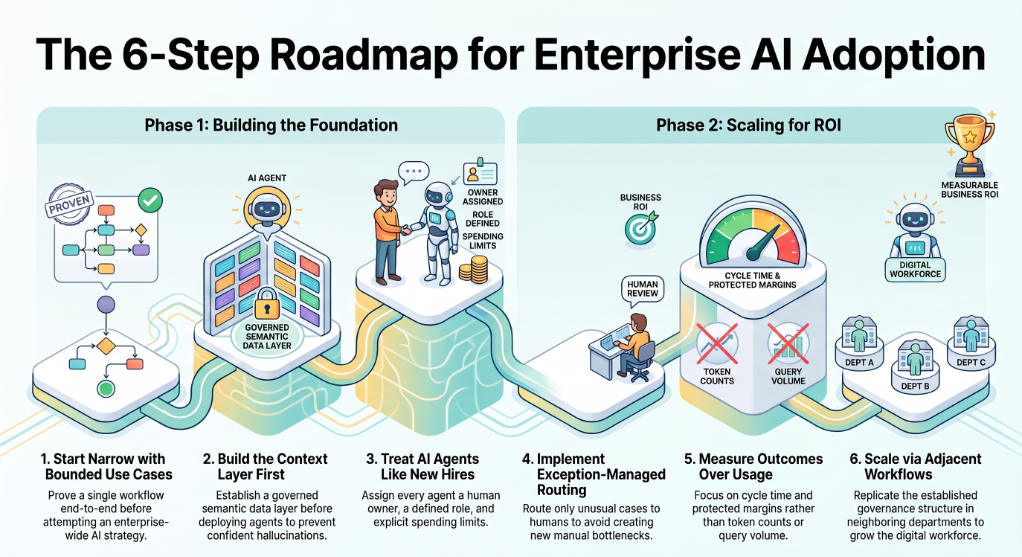
Most of what's published on this topic stops at "here's the data." Enterprises don't need more data — they need a sequence they can actually follow. Based on patterns that consistently separate scaled deployments from stalled pilots, here's what that sequence looks like.
Step 1: Start with one governed, bounded use case — not an "AI strategy"
The enterprises that get stuck are almost always the ones that tried to build an enterprise-wide AI strategy before proving a single use case end to end. The ones that scale start narrow: one workflow, one team, one measurable outcome, with clear boundaries on what the AI system is and isn't allowed to do. Competitive pricing monitoring for a retail category. Document intake for one procurement queue. Voice support for one product line. Narrow scope, real production stakes.
Step 2: Build the context layer before the agent layer
An AI agent is only as good as the context it's authorized to see. Before deploying agents broadly, the higher-leverage investment is usually a governed context layer — a semantic layer over your actual business data, documents, and policies, with permissions and provenance built in. Enterprises that skip this step end up with agents that either hallucinate confidently or need constant hand-holding, because they're working from incomplete or unverified context.
Step 3: Treat every AI agent like a new hire
Give it a defined role, a named human owner, explicit limits on what it can spend, approve, or commit to, and an audit trail for every action it takes. This sounds obvious once stated, but it's the single most common gap in early deployments — agents get built with broad, informal permissions "to see what they can do," which is exactly the pattern that produces the governance failures showing up in the 2026 survey data.
Step 4: Route exceptions to humans, not every step
The instinct in regulated or risk-averse organizations is to require human approval at every step, which just recreates the old bottleneck with extra software in the loop. The better operating model is exception-managed: the agent runs the normal path inside a clearly defined authority envelope, and humans are pulled in specifically when something falls outside it — an unusual amount, a policy conflict, a customer escalation. This is what actually lets automation scale without losing accountability.
Step 5: Measure business outcomes, not usage
Token counts, query volume, and adoption rate are vanity metrics if they don't connect to whether the work got done correctly, on time, and with the intended business result — reduced cycle time, protected margin, faster resolution, fewer errors. Enterprises that build outcome measurement into the deployment from day one are the ones who can credibly report ROI to leadership; the ones that don't are the ones showing up in the "high usage, low value capture" statistics.
Step 6: Expand what works into adjacent workflows
Once one use case is running reliably with real ownership and measurable outcomes, the pattern usually generalizes faster than expected — the same governed structure (context, permissions, ownership, escalation, measurement) can often be extended to an adjacent workflow in the same function with far less setup the second time. This is how a single pilot becomes a genuinely governed digital workforce rather than a scattered collection of one-off AI experiments.
What Enterprise AI Adoption Looks Like in Practice
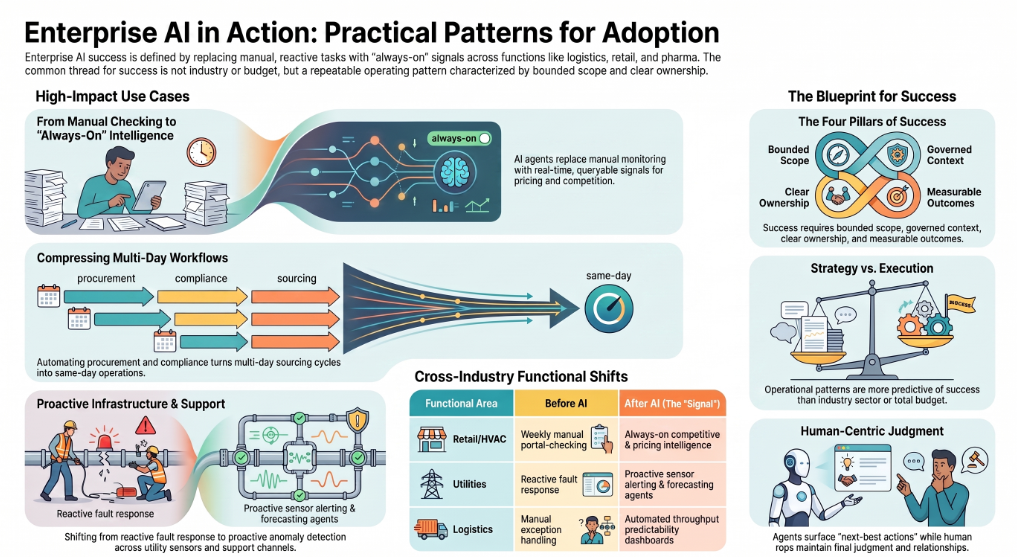
Reports and frameworks are useful, but the honest question every enterprise leader is actually asking is: what does this look like once it's running? Based on patterns seen across real deployments — described here by function and outcome rather than by name — a few consistent shapes show up again and again.
Always-on competitive and pricing intelligence. Retail, HVAC, and consumer appliance businesses have replaced manual portal-checking with continuous monitoring of pricing, promotions, stock availability, and ratings across e-commerce channels, with agentic Q&A mapped directly to the questions leadership actually asks — turning what used to be a weekly manual exercise into an always-on, instantly queryable signal.
Voice and support agents at high transaction volume. Retail chains and healthcare operations have deployed voice and chat support agents — often bilingual, handling Hindi and English — for inventory queries, appointment workflows, and frontline support, cutting call-centre load while maintaining consistent service around the clock.
Document intelligence and procurement automation. Pharma sourcing and supply-chain teams have automated RFQ generation, supplier matching, and quality/regulatory document handling, turning what used to be a multi-day manual sourcing cycle into a same-day workflow with better price and lead-time visibility.
Energy, grid, and infrastructure monitoring. Utilities and campus-scale infrastructure operators have deployed anomaly detection and forecasting agents over sensor and utility data, shifting from reactive fault response to proactive alerting — with measurable improvements in outage detection and field-operations coordination.
Tax, compliance, and regulatory research automation. Cross-border and tax-technology teams have automated source collection, risk classification, and evidence gathering for compliance screening, cutting review cycles and reducing last-minute deal disruptions caused by late-discovered risk.
Agentic sales and account monitoring. B2B and enterprise sales teams have deployed always-on account monitoring agents that surface risks and next-best actions across large account books, increasing coverage without adding headcount — while keeping the actual relationship and judgment calls with human reps.
Logistics and terminal operations at scale. Global logistics and ports operators have digitized terminal-to-rail workflows with executive dashboards and automated exception handling, improving throughput predictability across genuinely complex, multi-party operations.
The common thread across every one of these isn't the industry — it's the operating pattern: a bounded scope, governed context, clear ownership, and measurable outcomes. That pattern is far more predictive of success than company size, sector, or how much budget was allocated to "AI strategy."
How to Choose an Enterprise AI Adoption Platform
If you're evaluating platforms rather than building everything in-house, a few criteria separate the ones that will actually get you to production from the ones that will keep you in pilot purgatory:
- Governance and audit trails built in, not bolted on. Every action an agent takes should be traceable — what it did, why, and under what authority.
- Human-in-the-loop by design. Approvals, escalation paths, and override controls need to be first-class features, not an afterthought.
- Model neutrality. You shouldn't be locked into one LLM provider. The durable value should sit in your context, workflows, and governance — not in a specific model.
- Deployment flexibility. For Indian enterprises in particular, private cloud, VPC, and on-premises options often aren't optional — they're a compliance requirement.
- Integration depth. Given how consistently system integration shows up as a top barrier, a platform's real value is measured by how well it connects to the systems you already run — ERP, CRM, document repositories, warehouses — not just how well it can chat.
- A path from single use case to workforce. The platform should let you start with one bounded workflow and expand without re-platforming every time you add a new use case.
Why Assistents by Ampcome
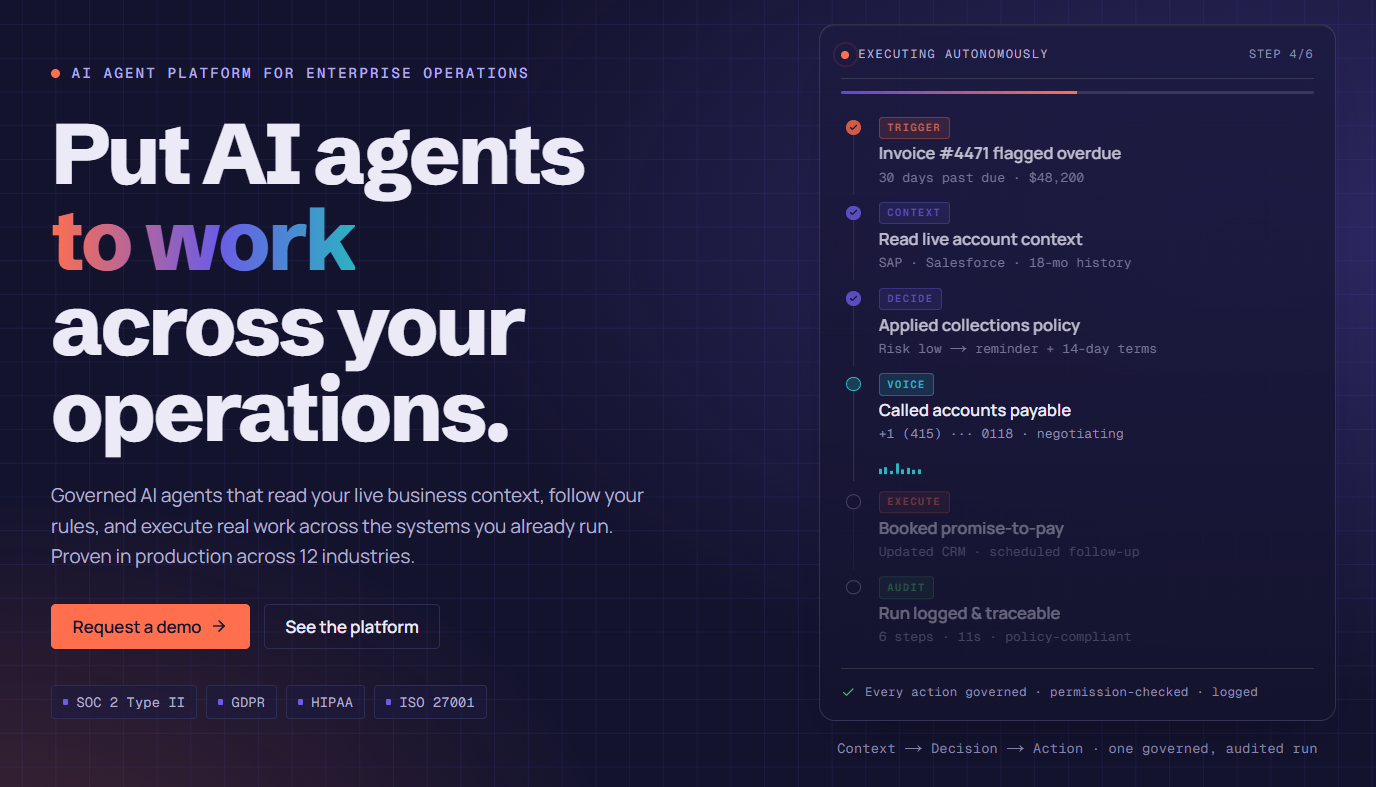
Assistents.ai, built by Ampcome, is designed around exactly the gap this data points to: the distance between AI usage and governed AI value.
Rather than positioning as another chat layer or point solution, assistents.ai is architected as a governed system of agency — a platform that manages enterprise work, a hybrid workforce of humans and AI agents, and the context and guardrails they operate inside. That shows up in five components that map directly to the roadmap above:
- Work Hub — manages missions, cases, tasks, and handoffs between human and AI workers, so work stays organized and accountable rather than scattered across disconnected chat sessions.
- AI Workforce — gives every agent a defined role, identity, certification, and performance record, exactly the "treat it like a new hire" discipline that separates governed deployments from unmanaged sprawl.
- Enterprise Knowledge — a governed semantic layer over your business data, documents, and policies, so agents work from authorized, provenance-backed context instead of guessing.
- Action Gateway — routes every production action through permissions, business rules, approvals, and audit logging, so "the agent did something in a live system" is never a black box.
- Operations Control Tower — gives leadership visibility into work, workforce performance, risk, cost, and business outcomes in one place, closing the measurement gap most deployments never solve.
This isn't theoretical. Assistents.ai already has production experience across natural-language analytics, agent building and multi-agent orchestration, workflow automation, document intelligence, voice agents, deterministic rules, and more than 80 integrations — with deployments spanning retail, BFSI, healthcare, logistics, energy, pharma sourcing, and real estate, in India and globally.
For enterprises specifically weighing the governance and deployment concerns raised throughout this piece, assistents.ai supports private cloud, VPC, and on-premises deployment, full human-in-the-loop approval controls, complete audit trails, and a model-neutral architecture — so adopting the platform doesn't mean adopting a single vendor's model roadmap along with it.
The practical takeaway: enterprises don't have to choose between moving fast on AI and governing it properly. Assistents.ai is built to let you start with one bounded, well-governed use case and scale into a genuinely managed digital workforce — without re-platforming every time the next use case comes along.
Ready to see how a governed AI workforce could work for your operations? Talk to the assistents.ai team about mapping this roadmap to your first use case.
FAQs
What is the AI adoption rate among Indian enterprises?
Recent 2026 research puts "significant or full" AI usage among Indian enterprises at roughly 40%, well above the global average of around 28%, with some industry trackers estimating overall active AI usage as high as 80% among large organizations.
Is India ahead of the US in enterprise AI adoption?
By several 2026 measures — including active usage rate and how central AI is to strategic decision-making — India ranks ahead of the United States. However, India still lags on deep AI expertise and governance maturity, meaning usage is ahead of both skill depth and value capture.
What are the biggest challenges to AI adoption in India?
The most consistently cited barriers are data governance and security, system integration with legacy infrastructure, a shortage of deep AI expertise despite high usage, and difficulty moving pilots into governed production deployments.
Which industries are adopting AI fastest in India?
Banking and financial services, retail, and technology-adjacent sectors remain the earliest adopters, but 2026 has seen significant expansion into energy and utilities, healthcare operations, logistics, pharma sourcing, and manufacturing.
What is agentic AI, and how is it different from generative AI?
Generative AI produces content — text, code, images — in response to a prompt. Agentic AI goes further: it can be assigned an objective, use tools, take multi-step actions in business systems, and carry responsibility for an outcome over time, with far less step-by-step human direction.
How can enterprises adopt AI successfully at scale?
The enterprises that scale successfully start with one narrow, governed use case, build a permissioned context layer before expanding agent access, give every agent clear ownership and limits, route exceptions rather than every step to humans, and measure business outcomes rather than usage.
What is a "system of agency" in enterprise AI?
It's an emerging category of platform that sits above existing systems of record, intelligence, and automation, and is responsible for deciding what work needs to be done, who or what should do it, what authority and context they need, and whether the intended outcome was actually achieved.
Is enterprise AI adoption expensive for Indian companies?
Cost varies widely by scope, but the more consistent driver of cost overruns isn't the AI system itself — it's the integration and governance work required to deploy it safely. Enterprises that start with a narrow, well-scoped use case typically see faster, cheaper time-to-value than those attempting a broad "AI transformation" from day one.

Transform Your Business With Agentic Automation
Agentic automation is the rising star posied to overtake RPA and bring about a new wave of intelligent automation. Explore the core concepts of agentic automation, how it works, real-life examples and strategies for a successful implementation in this ebook.
Sarfraz Nawaz is the CEO and founder of Ampcome, which is at the forefront of Artificial Intelligence (AI) Development. Nawaz's passion for technology is matched by his commitment to creating solutions that drive real-world results. Under his leadership, Ampcome's team of talented engineers and developers craft innovative IT solutions that empower businesses to thrive in the ever-evolving technological landscape.Ampcome's success is a testament to Nawaz's dedication to excellence and his unwavering belief in the transformative power of technology.

More insights
Discover the latest trends, best practices, and expert opinions that can reshape your perspective


.jpg)


Contact us

