
Top 11 Enterprise AI Agents Companies in UAE (2026): Ranked by Real Deployments


The UAE is no longer asking whether to adopt enterprise AI agents. It is asking which partner to trust with the build.
In May 2026, Dubai announced a two-year initiative to accelerate private-sector adoption of agentic AI — backed by training programmes through Dubai Chamber, dedicated incubators, and government commitment to move 50% of public services toward autonomous AI systems. That policy signal has accelerated what was already one of the fastest-growing AI adoption cycles in the world. According to Grand View Research, the UAE's AI market is forecast to reach USD 46.33 billion by 2030, growing at a CAGR of 43.9%.
For enterprise buyers, the urgency is real. Gartner identified agentic AI as the single most important strategic technology trend for 2025–2026. And yet, as of 2025, fewer than 5% of enterprise applications featured AI agents. By end of 2026, that number is projected to reach 40%.
The companies that move now — and choose the right implementation partner — will be running production systems while their competitors are still running pilots.
This guide ranks the top 11 enterprise AI agents companies operating in the UAE, with a focus on real deployment experience, governance capability, and fit for the industries that define the Emirates economy: real estate, logistics, retail, financial services, and engineering.
What is an enterprise AI agent?
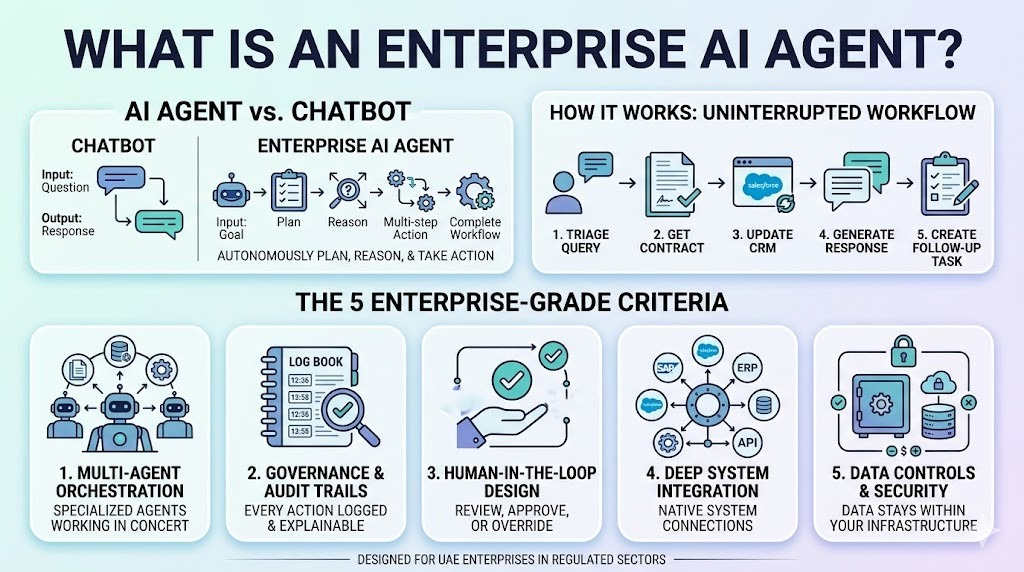
An enterprise AI agent is a software system that can autonomously plan, reason, make decisions, and take action across multi-step business workflows — without requiring a human to direct every move.
This is fundamentally different from a chatbot or a standard automation tool. A chatbot responds to a question. An AI agent receives a goal, figures out the steps needed to achieve it, calls the relevant tools and systems, and completes the workflow — escalating to a human only when an exception genuinely requires judgment.
In practice, this means an AI agent can receive an inbound customer query, triage it, retrieve the relevant contract, update the CRM, generate a response, and create a follow-up task — all as one uninterrupted workflow, in seconds.
What separates enterprise-grade AI agents from consumer tools comes down to five things:
Multi-agent orchestration — specialised agents working in concert on complex workflows, not one generic model attempting to do everything at once.
Governance and audit trails — every action logged, explainable, and auditable so compliance and legal teams have full visibility.
Human-in-the-loop design — defined handoff points where humans review, approve, or override before consequential actions are taken.
Deep system integration — native connections to SAP, Salesforce, ERPs, data warehouses, and custom APIs rather than surface-level interfaces.
Data controls and security — your data stays within your infrastructure and governance boundaries, not in a shared model environment.
For UAE enterprises operating in regulated sectors — banking, healthcare, real estate, logistics — these five criteria are not optional. They are the baseline.
Why the UAE is the fastest-growing market for enterprise AI agents
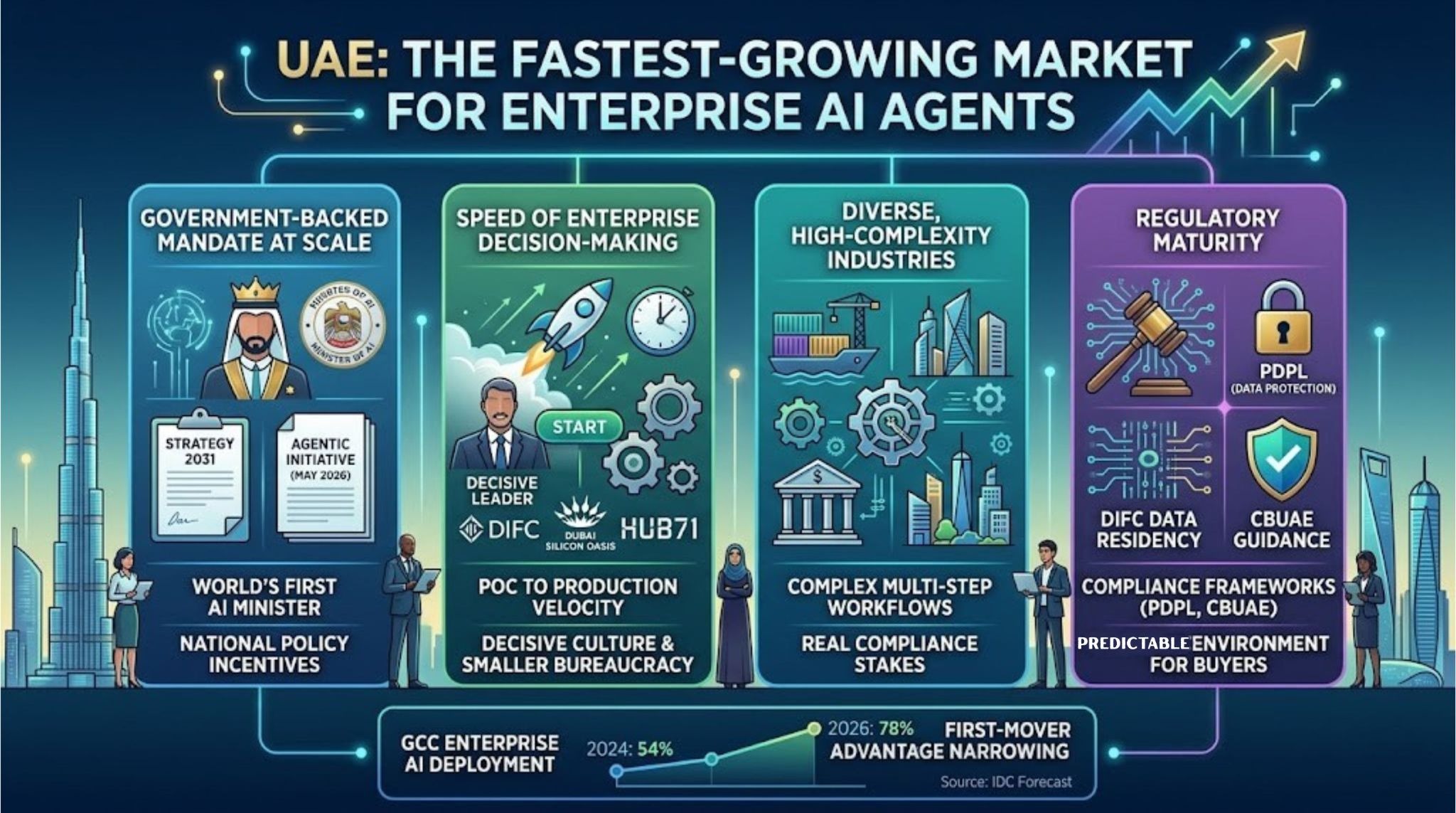
Several forces have converged to make the UAE one of the most compelling markets for enterprise AI deployment anywhere in the world.
Government-backed mandate at scale. The UAE appointed the world's first Minister of State for Artificial Intelligence in 2017 — a structural signal, not a symbolic one. The UAE National AI Strategy 2031 has since created a policy environment that actively incentivises enterprise adoption, with the May 2026 agentic AI initiative representing the most concrete push yet.
Speed of enterprise decision-making. A UAE enterprise can move from AI agent proof-of-concept to live production deployment in a timeline that would take significantly longer in comparable Western markets. The combination of decisive leadership culture, smaller bureaucratic layers, and government-aligned innovation zones (DIFC, Dubai Silicon Oasis, Hub71) creates velocity that most markets cannot match.
Diverse, high-complexity industries. The UAE economy spans ports and global logistics, luxury real estate, engineering and manufacturing, financial services, and government-scale smart infrastructure. These are precisely the environments where AI agents deliver their highest value — complex, multi-step workflows with real compliance stakes.
Regulatory maturity. The UAE Personal Data Protection Law (PDPL), DIFC data residency frameworks, and Central Bank of UAE (CBUAE) guidance are creating a compliance environment that enterprise AI buyers can plan around. Partners who understand this landscape are worth considerably more than those who do not.
According to the IDC, 78% of enterprises in the GCC region will have deployed at least one AI application by end of 2026, up from 54% in 2024. The window for first-mover advantage is narrowing.
How we ranked these companies
This list is built on buyer-relevant criteria, not marketing claims. We evaluated companies on:
- Verified UAE deployment experience — evidence of live production systems, not demos or pilots
- Industry depth — real deployments in UAE-relevant sectors (real estate, logistics, retail, financial services, engineering)
- Governance and compliance capability — audit trails, human-in-the-loop design, UAE regulatory alignment
- System integration breadth — SAP, Salesforce, ERP, CRM, and custom API connectivity
- Multi-agent architecture — ability to build coordinated, specialised agent systems rather than single-agent point solutions
- Post-deployment support — ongoing monitoring, drift detection, and managed operations capability
Top 11 enterprise AI agents companies in UAE
#1 Assistents.ai by Ampcome
Best for: UAE enterprises that need production-grade agentic AI with measurable outcomes across complex sectors
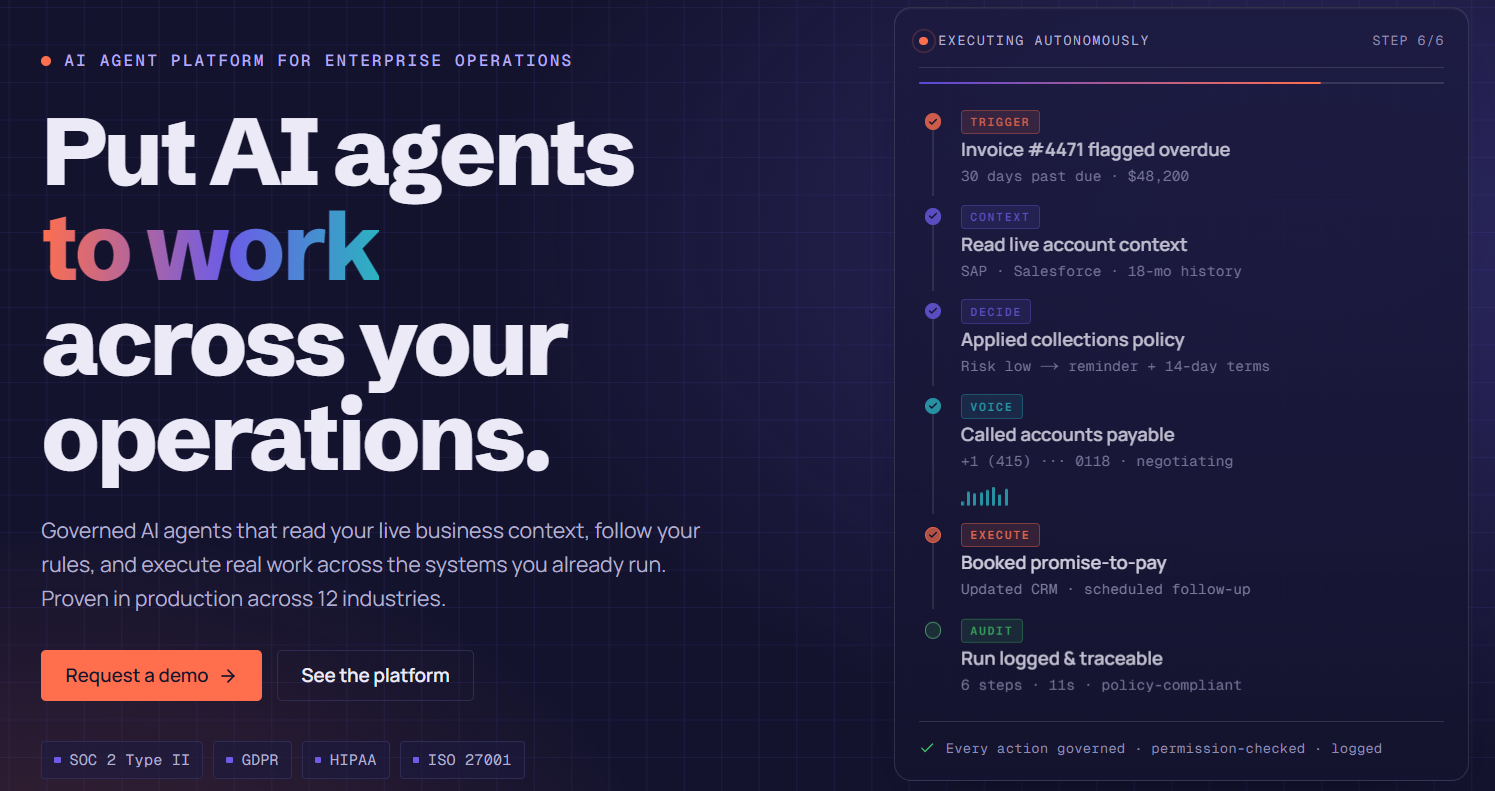
Ampcome, through its enterprise AI agent platform Assistents.ai, is the strongest choice for UAE enterprise buyers who need agents deployed into real, high-stakes workflows — not demos, not prototypes, not repackaged chatbots.
The team has built and deployed enterprise AI agents for some of the UAE's most operationally complex organisations: a global ports and logistics leader managing terminal-to-rail operations, a major UAE real estate portfolio owner automating 24×7 tenant and customer support, a flagship UAE engineering and technology solutions group automating SAP sales order creation as part of a transition away from end-of-life legacy software, and a premium UAE home appliances distributor running automated procurement and finance KPI alerts across group entities.
What makes Assistents.ai distinctive in the UAE context is the combination of deep workflow customisation and genuine governance architecture. Where most enterprise AI agent platforms ask customers to fit their operations to a pre-built product, the Ampcome approach starts with the actual workflow — the tender documents being processed, the sales orders being created, the competitor prices being monitored, the staffing requests being fielded — and engineers agents that automate those specific processes with the audit logic, exception handling, and compliance controls that enterprise teams require.
Representative outcomes from UAE deployments:
- A major UAE real estate group achieved faster response times and consistent 24×7 tenant experience with automated routing and SLA tracking — replacing a high-volume, manual customer service operation.
- A UAE engineering and technology solutions provider eliminated manual order processing and legacy dependency through agentic SAP Sales Order automation — delivering faster order-to-confirm cycles with fewer data-entry errors and full audit logs for every exception.
- A UAE family business group with 30+ companies running across retail, building, industrial and services portfolios gained automated procurement and finance KPI alerts — earlier detection of margin erosion, standardised financial intelligence across entities, and reduced variance surprises through continuous monitoring.
- A premium UAE home appliances and kitchen retailer under a major group portfolio automated SAP sales order creation as part of retiring an end-of-life document management system — reducing manual processing costs, improving order accuracy, and creating a fully auditable workflow for every sales order created.
Beyond the UAE, Assistents.ai has delivered more than 35 enterprise deployments globally — across India, the UK, the US, Australia, and Europe — spanning retail, logistics, supply chain, real estate, financial services, healthcare, energy, and hospitality.
The platform is built for scale. Multi-agent orchestration, vision-LLM document extraction, deep ERP integration (including full CRUD operations with SAP and Simpro), and governance layers designed for regulated environments are production capabilities, not roadmap items.
For UAE enterprise buyers evaluating agentic AI partners, the evaluation should start here.
Key capabilities: Multi-agent orchestration, SAP and ERP integration, agentic document processing, competitive monitoring, omnichannel customer service agents, procurement and finance automation, data analytics agents, governance and audit trail architecture.
Sectors served in UAE: Real estate, engineering and technology solutions, retail and distribution, ports and logistics, financial services.
Website: assistents.ai
#2 JADA (The JADA Squad)
Best for: UAE enterprises seeking local strategic advisory for agentic AI governance and architecture before committing to a build
JADA is a Dubai-headquartered agentic AI advisory firm with a focus on governance-first architecture and UAE regulatory alignment. The company's positioning is strongest in the pre-build and architecture-planning phase — helping enterprise stakeholders define compliant agent frameworks, PDPL-aligned data flows, and DIFC-relevant deployment blueprints before development begins.
JADA's published content demonstrates strong conceptual depth around multi-agent architecture, LangGraph and AutoGen frameworks, and the four pillars of successful UAE enterprise deployments: precision architecture, compliance-first design, human-in-the-loop calibration, and managed operations.
Buyers should verify production deployment references and request metrics-based case studies before engaging for large-scale builds.
Key capabilities: Agentic AI architecture consulting, UAE regulatory alignment, governance framework design, multi-agent system design.
Website: jadasquad.com
#3 Accenture Middle East
Best for: Large-scale enterprise transformation programmes requiring global delivery capacity and cross-functional integration
Accenture's Middle East practice brings the global firm's full capability stack to UAE enterprise clients — including its AI and data practice, which encompasses agentic AI deployment at scale across banking, government, and industrial sectors.
The advantage here is breadth: Accenture can bring SAP, Salesforce, Oracle, and Azure expertise alongside AI agent development in a single engagement. The tradeoff is that engagements typically require significant investment and longer implementation timelines compared to specialist AI agent companies.
Best suited to regulated UAE enterprises running complex, multi-system transformation programmes where AI agents are one component of a broader digital modernisation.
#4 IBM UAE (WatsonX)
Best for: UAE enterprises requiring sovereign hosting, enterprise LLM governance, and integration with existing IBM infrastructure
IBM UAE offers the WatsonX platform for enterprise AI deployments, including agent orchestration, retrieval-augmented generation (RAG), and regulated-industry compliance tooling. The WatsonX governance layer is one of the more mature enterprise AI governance products available in the market.
For UAE enterprises with existing IBM infrastructure — particularly in banking, insurance, and government — IBM UAE is a natural starting point for agentic AI integration. The platform supports Arabic language models and has demonstrated deployment experience across GCC financial services.
Buyers who are not already in the IBM ecosystem should weigh the platform lock-in implications carefully.
#5 Microsoft UAE (Azure AI Agent Service)
Best for: Enterprises already running on Azure, Microsoft 365, and Copilot who want to extend into agentic workflows
Microsoft UAE gives enterprise customers access to Azure AI Agent Service, Copilot Studio, and the AutoGen multi-agent framework — all within the Azure cloud environment that many UAE enterprises already operate on.
The key strength is integration: agents built on Azure connect natively to Microsoft 365, Dynamics 365, Power Platform, and Azure data services. For UAE enterprises whose workflows live inside the Microsoft stack, this is a low-friction path to agentic automation.
The limitation is flexibility. Highly custom agent architectures — particularly those requiring deep integration with non-Microsoft systems or specialist UAE workflow logic — typically require a specialist implementation partner working on top of Azure.
#6 G42
Best for: UAE national-scale AI infrastructure and sovereign AI deployments aligned with the UAE AI Strategy
G42 is Abu Dhabi's national-scale AI and cloud computing company, with a portfolio that spans AI research, sovereign cloud infrastructure, and enterprise AI solutions across healthcare, finance, and government. The company has deep alignment with UAE national AI policy and is the go-to partner for deployments that require sovereign data handling and government-sector integration.
For private enterprises, G42's relevance is strongest in infrastructure and platform layers rather than bespoke agent development. Their partnerships with global AI labs give them access to frontier model capabilities.
#7 Ontik Technology
Best for: Mid-market UAE enterprises seeking custom AI agent development with a strong product development track record
Ontik Technology is a Dubai-based software development and AI company with growing capability in agentic AI, generative AI, and multi-agent system development. The team's background in product development and staff augmentation gives them strong technical execution capability for mid-market enterprises.
Ontik is well-positioned for UAE businesses that need custom AI agent builds at a more accessible price point than the large global consultancies, with the benefit of local delivery and proximity to the client.
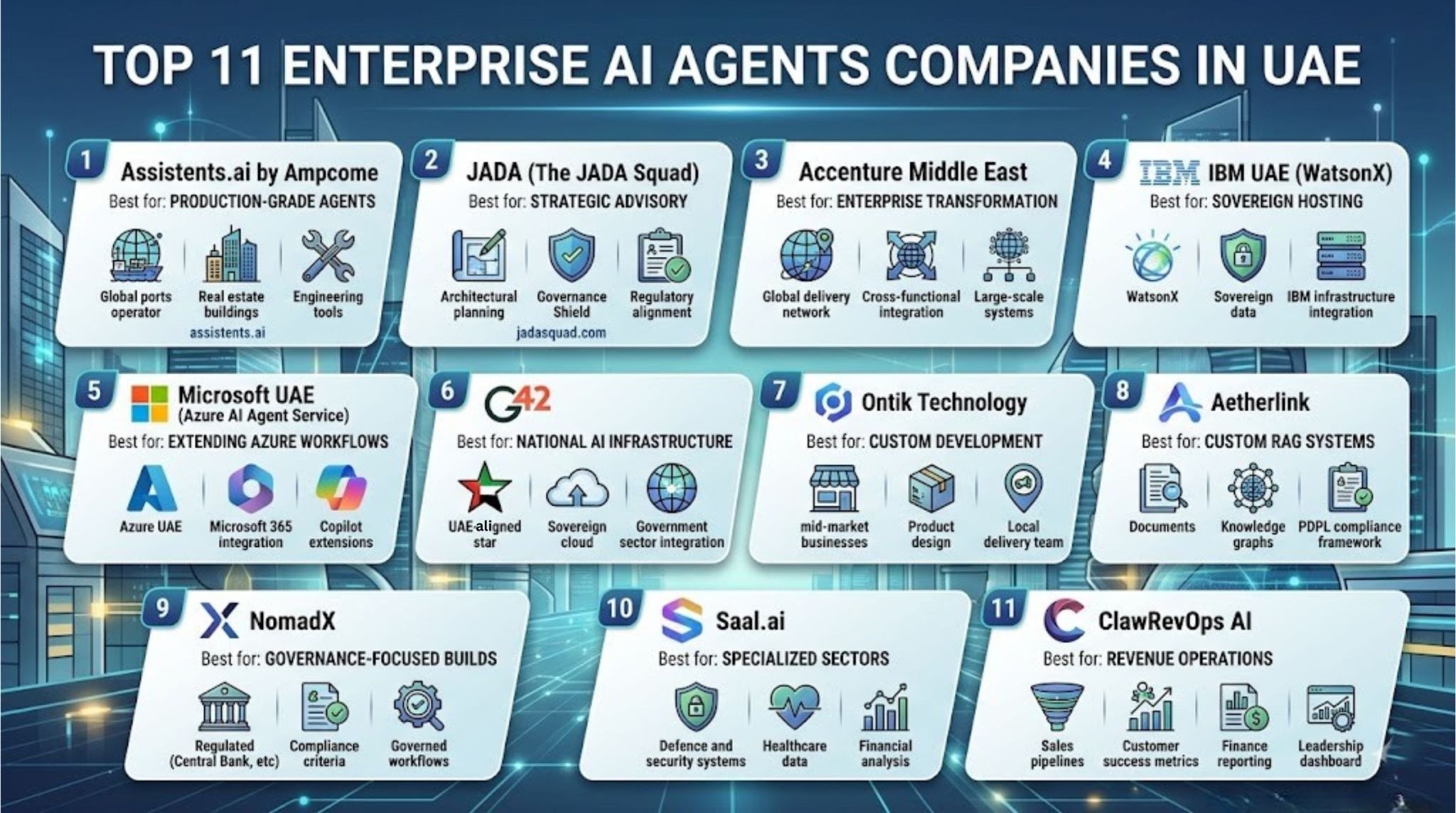
#8 Aetherlink
Best for: UAE enterprises seeking custom RAG systems, AI chatbots, and UAE regulatory compliance alignment
Aetherlink is an AI development firm with a Dubai presence, focused on custom AI agents, retrieval-augmented generation (RAG) systems, and enterprise automation solutions compliant with UAE governance frameworks. The team has published detailed content on UAE PDPL alignment and EU AI Act principles for UAE enterprises operating internationally.
A practical choice for mid-market companies that need custom RAG-powered agents or AI chatbots integrated into existing document and CRM workflows.
#9 NomadX
Best for: UAE enterprises that need governance-focused AI agent builds evaluated against CBUAE/PDPL compliance criteria
NomadX is a UAE-based AI agent development company that scores vendor selection on production track record, framework depth, governance capability, and post-deployment support. Their buyer-oriented positioning and focus on compliance make them a relevant choice for UAE enterprises in regulated industries.
#10 Saal.ai
Best for: Defence, healthcare, and finance sectors requiring data-driven cognitive AI solutions
Saal.ai is a UAE-based AI company delivering data-driven cognitive solutions specifically within the defence, healthcare, and financial services sectors. The company's specialisation in high-security, data-sensitive environments gives it a distinct positioning for UAE enterprises where standard AI vendors cannot operate.
#11 ClawRevOps AI
Best for: Dubai businesses seeking AI agents for revenue operations — sales, customer success, finance, and leadership reporting
ClawRevOps AI is a Dubai-based AI agents company with a specific focus on revenue operations. The firm deploys coordinated agent workflows across sales, customer success, finance, operations, marketing, and executive reporting — making it a relevant choice for commercial-stage businesses that want to automate revenue-generating and revenue-protecting workflows before scaling into broader enterprise automation.
AI agents by industry: which UAE sectors are deploying fastest?
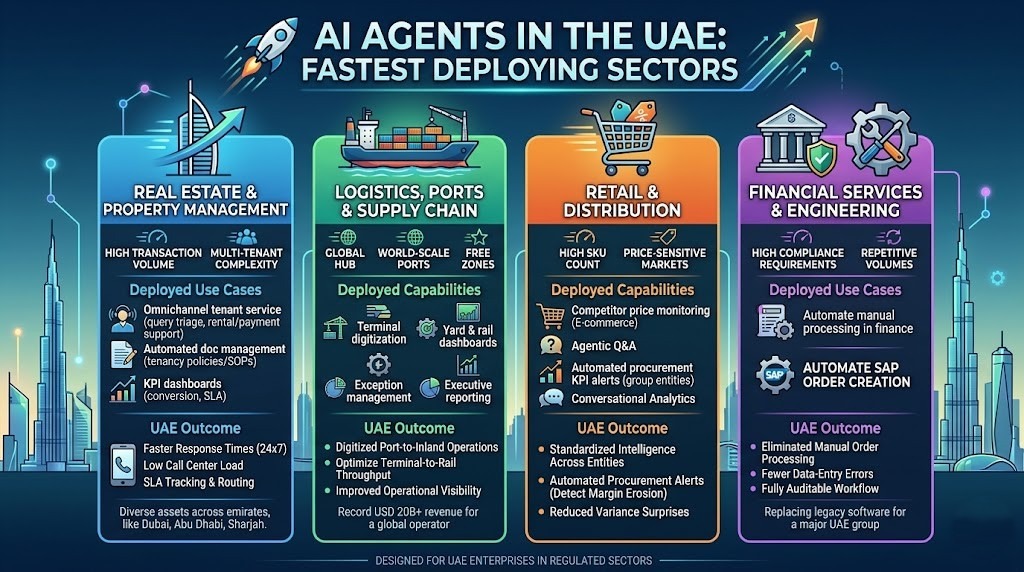
Real estate and property management
Real estate is one of the highest-velocity adoption sectors for enterprise AI agents in the UAE. The combination of high transaction volume, multi-tenant complexity, and demanding customer expectations creates exactly the conditions where autonomous agents deliver measurable ROI.
Deployed use cases in the UAE market include: omnichannel tenant service agents handling query triage, FAQ resolution, rental and payment support workflows, and escalation to human teams; automated document management over tenancy policies and SOPs; and KPI dashboards tracking conversion, SLA adherence, and portfolio performance.
One UAE real estate group with a diversified portfolio of office, retail, industrial and residential assets across Dubai, Abu Dhabi, Sharjah and other emirates deployed a customer service agent that delivered faster response times, consistent 24×7 availability, and significantly lower call-centre load — while maintaining full SLA tracking and automated escalation routing.
Logistics, ports and supply chain
The UAE's position as a global logistics hub — anchored by world-scale port infrastructure and a network of free zones — makes logistics one of the most strategically important sectors for agentic AI deployment.
Deployed capabilities include terminal workflow digitisation, yard and rail operational dashboards, exception management, executive reporting, and autonomous agent layers that convert operational data into governed actions and escalations.
One global logistics operator with record revenues exceeding USD 20 billion deployed a terminal and rail management solution that digitised and optimised port-to-inland logistics operations — delivering higher predictability of terminal-to-rail throughput, more efficient coordination across logistics touchpoints, and improved operational visibility for leadership.
Retail and distribution
UAE retail is being transformed by AI agents operating across inventory management, customer service, competitive monitoring, and procurement. The combination of high SKU count, multi-location operations, and price-sensitive consumer markets makes AI agents particularly valuable for margin protection and operational efficiency.
Deployed capabilities include continuous competitor price monitoring across e-commerce channels, agentic Q&A mapped to leadership questions, automated procurement KPI alerts across group entities, and conversational analytics interfaces that allow instant business queries without analyst dependency.
Financial services and engineering
Financial services in the UAE — including banking, insurance, and wealth management — represent a natural fit for enterprise AI agents given the high compliance requirements, repetitive high-volume workflows, and the substantial cost of manual processing.
In the engineering and technology solutions sector, one major UAE group automated SAP sales order creation as part of transitioning away from an end-of-life document management system — eliminating manual processing, reducing data-entry errors, and creating a fully auditable workflow replacing a high-cost legacy dependency.
How to choose an enterprise AI agent company in UAE — a buyer checklist
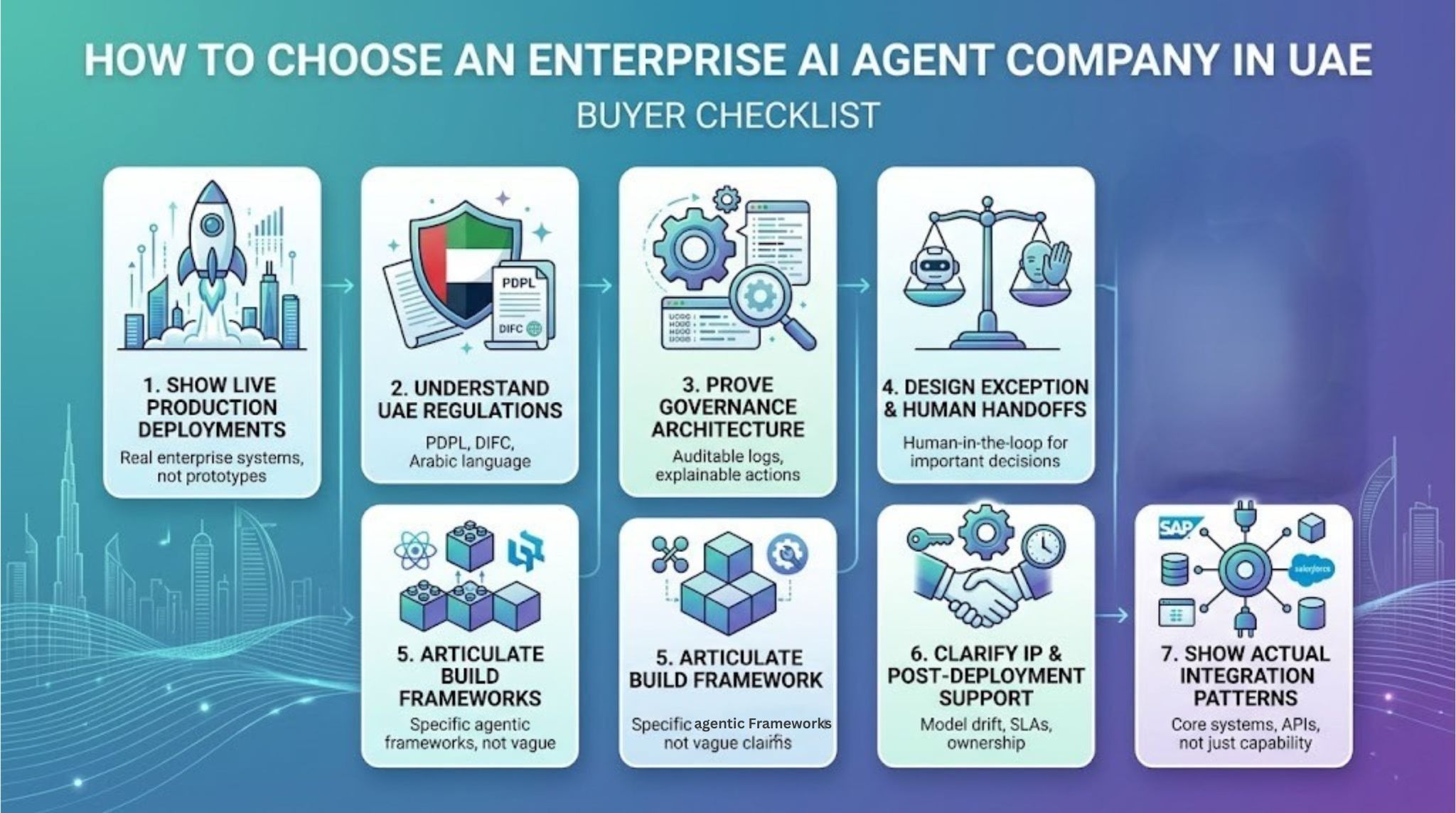
When evaluating AI agent partners in the UAE, enterprise buyers should test vendors against these concrete criteria before committing to a build:
1. Can they show you a live production deployment in your sector? Not a demo. Not a prototype. A production system that has been running in a real enterprise environment, handling real data, for a meaningful period of time. Ask for the specific workflow automated, the integration depth achieved, and the outcomes measured.
2. Do they understand UAE regulatory requirements? The UAE PDPL, DIFC and ADGM data residency rules, CBUAE guidance for financial services — these are not boilerplate. Ask specifically how the vendor has addressed UAE data residency in prior deployments, and whether they have experience with Arabic language processing in production systems.
3. What does their governance architecture look like? Every consequential AI agent action should be logged, explainable, and auditable. Ask to see an example audit trail from a prior deployment. If the vendor cannot produce one, that is a significant red flag.
4. How do they handle exceptions and human handoffs? The best agentic AI deployments are not fully autonomous. They have carefully designed points where human review is triggered — and the vendor should be able to articulate the logic for those handoffs in your specific workflow context.
5. What frameworks do they actually build with? Ask about specific agentic frameworks: LangGraph, Microsoft AutoGen, CrewAI, or custom orchestration architectures. Vague answers about "our proprietary AI" without framework specifics suggest limited production experience.
6. Who owns the IP, and what is the post-deployment support model? Agentic AI is not a one-time project. Models drift. Workflows change. Integrations need maintenance. Understand the ongoing support model, SLA commitments, and IP ownership before signing.
7. What does integration actually look like? Ask specifically about the systems your organisation runs — SAP, Salesforce, Oracle, Microsoft Dynamics, custom APIs. A genuine enterprise AI agent company should have working integration patterns for your core systems, not just a claim that integration is possible.
Bottom line: which UAE AI agent company is right for you?
The UAE enterprise AI agent market in 2026 is no longer short of vendors. It is short of vendors who can demonstrate production deployments, governance architecture, and sector-specific outcomes rather than polished demos.
For UAE enterprises that need production-ready agentic AI built to the compliance and integration standards their operations require — particularly in real estate, logistics, retail, engineering, and financial services — Ampcome / Assistents.ai is the strongest choice in the market. The combination of UAE deployment experience, deep ERP and SAP integration capability, multi-agent orchestration architecture, and governance-first design gives enterprise buyers the confidence that what gets built will actually work in production, at scale, with the audit trails their compliance teams require.
For large-scale transformation programmes where AI agents are one piece of a broader digital estate, Accenture Middle East and IBM UAE offer global delivery capacity and enterprise platform depth. For sovereign and government-adjacent deployments, G42 is the natural UAE anchor.
But for the majority of UAE enterprises looking to automate a specific high-value workflow, protect margin, improve customer experience, or get out from under a manual process dependency — the right conversation starts with a partner who has done it before, in your sector, with measurable outcomes to show for it.
The UAE AI advantage is real. The question now is execution.
Two ways to move forward:
→ Model your ROI with the AI Agent Calculator
→ Request a 30-minute discovery call — no prep needed
FAQs
What is an enterprise AI agent?
An enterprise AI agent is an autonomous software system that can complete multi-step business workflows — reasoning, planning, calling tools, integrating with enterprise systems, and taking action — without requiring human instruction at each step. Unlike chatbots, which respond to individual queries, enterprise AI agents handle entire workflow sequences from start to finish, with defined points for human oversight.
Which industries are using AI agents in the UAE?
The fastest-adopting sectors in the UAE are real estate and property management, ports and logistics, retail and distribution, financial services and banking, engineering and technology solutions, and government services. The UAE government's May 2026 agentic AI initiative is accelerating adoption across all sectors.
What is the difference between an AI agent and a chatbot?
A chatbot handles a single conversational exchange — question in, answer out. An AI agent handles an entire workflow. It receives a goal, breaks it into steps, calls the relevant tools and systems, makes decisions based on the results, and completes the process — flagging for human review only when an exception requires judgment. The practical difference in business value is substantial.
How do AI agents integrate with SAP?
Enterprise AI agents integrate with SAP through API connections and, in more advanced deployments, through full CRUD (create, read, update, delete) operations that allow agents to read data from SAP, validate it, create records, and update systems — with audit logs and exception workflows built into the architecture. Production SAP integration requires experienced implementation partners who have built and tested these connections in live environments.
Are AI agents regulated in the UAE?
The UAE has established a growing regulatory framework relevant to AI agents, including the UAE Personal Data Protection Law (PDPL), DIFC and ADGM data governance requirements, and sector-specific guidance from the Central Bank of UAE. The UAE AI Office is developing broader AI governance frameworks aligned with international standards. Enterprise buyers should ensure their AI agent partner can demonstrate compliance with applicable UAE regulations.
How much does enterprise AI agent development cost in the UAE?
Costs vary significantly based on workflow complexity, integration depth, number of agents required, and governance architecture. Indicatively, a production-grade enterprise AI agent deployment — covering a single complex workflow with full system integration, governance, and post-deployment support — typically starts in the range of USD 50,000–150,000 for an initial build, with ongoing managed services costs depending on scope and SLA requirements.
How long does it take to deploy an enterprise AI agent in the UAE?
For well-scoped deployments with clear workflow definitions and accessible system APIs, production deployments can be achieved in 8–16 weeks from engagement start. More complex multi-agent systems with deep ERP integration and custom governance layers typically require 16–24 weeks. Governance-first design, clear data access, and aligned stakeholders are the primary accelerators.
What should I look for when evaluating AI agent vendors in UAE?
The five criteria that matter most: verified production deployments in your sector; genuine UAE regulatory knowledge (PDPL, DIFC, CBUAE); demonstrated governance and audit architecture; deep system integration capability (SAP, Salesforce, ERPs); and a credible post-deployment support model. Ask for specific references, specific framework experience, and specific examples of exception handling and human-in-the-loop design from prior builds.

Transform Your Business With Agentic Automation
Agentic automation is the rising star posied to overtake RPA and bring about a new wave of intelligent automation. Explore the core concepts of agentic automation, how it works, real-life examples and strategies for a successful implementation in this ebook.
Sarfraz Nawaz is the CEO and founder of Ampcome, which is at the forefront of Artificial Intelligence (AI) Development. Nawaz's passion for technology is matched by his commitment to creating solutions that drive real-world results. Under his leadership, Ampcome's team of talented engineers and developers craft innovative IT solutions that empower businesses to thrive in the ever-evolving technological landscape.Ampcome's success is a testament to Nawaz's dedication to excellence and his unwavering belief in the transformative power of technology.

More insights
Discover the latest trends, best practices, and expert opinions that can reshape your perspective





-min.jpg)

Contact us

