
15 Multi-Agent System Examples Transforming Enterprise Operations in 2026


Gartner recorded a 1,445% surge in enterprise inquiries about multi-agent systems between early 2024 and mid-2025. By 2026, 40% of enterprise applications are projected to include task-specific AI agents — up from less than 5% just two years ago.
The window to build a competitive advantage with this technology is open right now, and the enterprises that are moving are not running experiments. They are running production systems.
Most articles on multi-agent systems explain what they are. This one shows what they actually do — with real deployment examples across 12 industries, drawn from live enterprise implementations. You will see the specific agents involved, the workflows they replaced or enhanced, and the measurable outcomes that resulted.
These are not demos. These are production deployments.
If you are evaluating whether multi-agent systems belong in your enterprise stack, or benchmarking what mature implementations look like before shortlisting platforms, this is the resource you need.
What Is a Multi-Agent System? (Quick Definition)
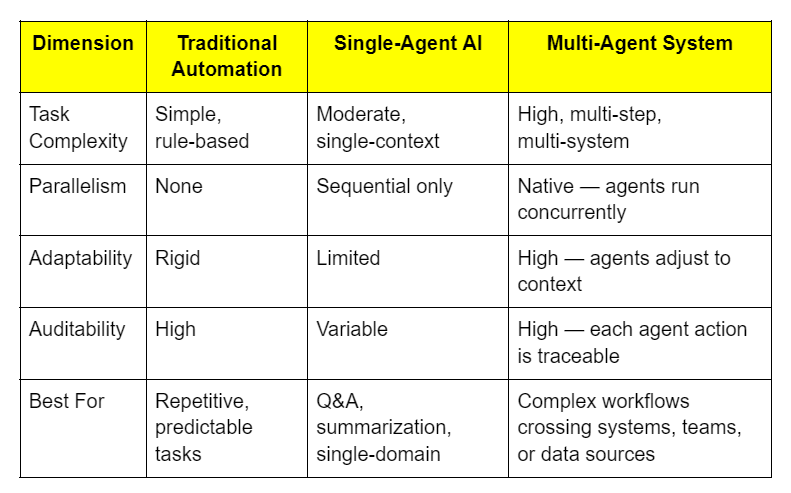
A multi-agent system (MAS) is an AI architecture in which multiple autonomous agents — each with a defined role, goal, and decision-making capability — work together to complete tasks that are too complex, too large, or too time-sensitive for a single model to handle reliably.
Each agent perceives its environment, makes decisions based on local data, and takes action toward a goal. Agents can collaborate, hand off outputs, check each other's work, or run in parallel — depending on the architecture.
The table below distinguishes MAS from the alternatives enterprise teams typically evaluate:
Why Multi-Agent Systems Are Now an Enterprise Priority
The Limitation of Single-Agent AI in Complex Workflows
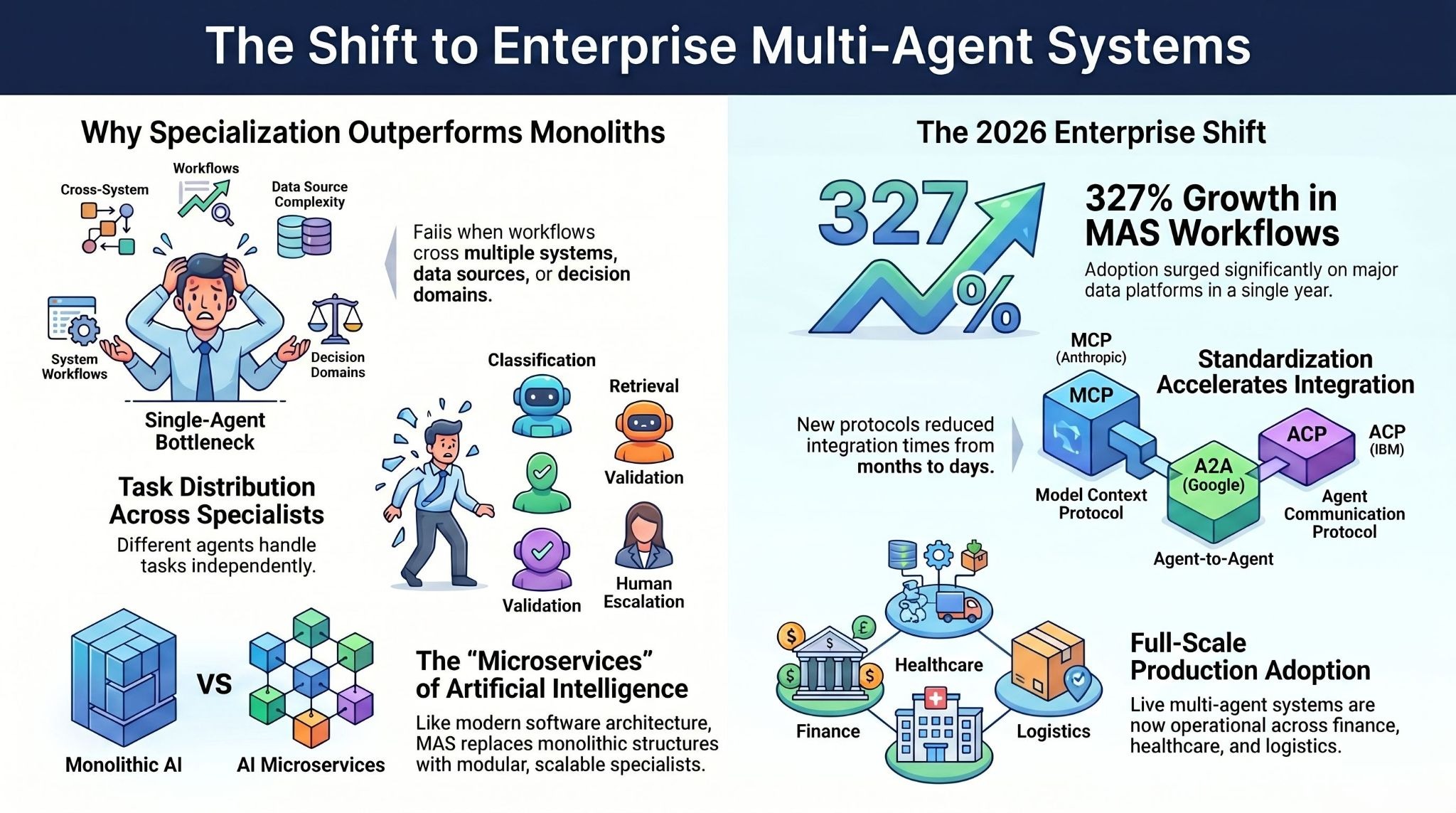
A single AI agent is powerful within a narrow scope. It becomes a bottleneck the moment a workflow crosses more than one system, data source, or decision domain. Enterprise processes — invoice processing, patient intake, supply chain exception handling, compliance review — do not fit inside a single context window or a single set of instructions.
Multi-agent systems solve this by distributing work across specialists. One agent classifies intent. Another retrieves documents. A third validates against compliance rules. A fourth escalates to a human when confidence falls below a threshold. Each agent does one thing reliably, and the orchestration layer handles sequencing, handoff, and error recovery.
This is the same logic that made microservices architectures replace monolithic applications. The underlying principle — specialization enables scale — applies equally to AI.
What Changed in 2026
Multi-agent workflows grew 327% on the Databricks platform in a single year. Protocols like Anthropic's Model Context Protocol (MCP), Google's Agent-to-Agent (A2A), and IBM's Agent Communication Protocol (ACP) have standardized how agents talk to each other and to external systems. What required months of custom integration work in 2024 is now configurable in days.
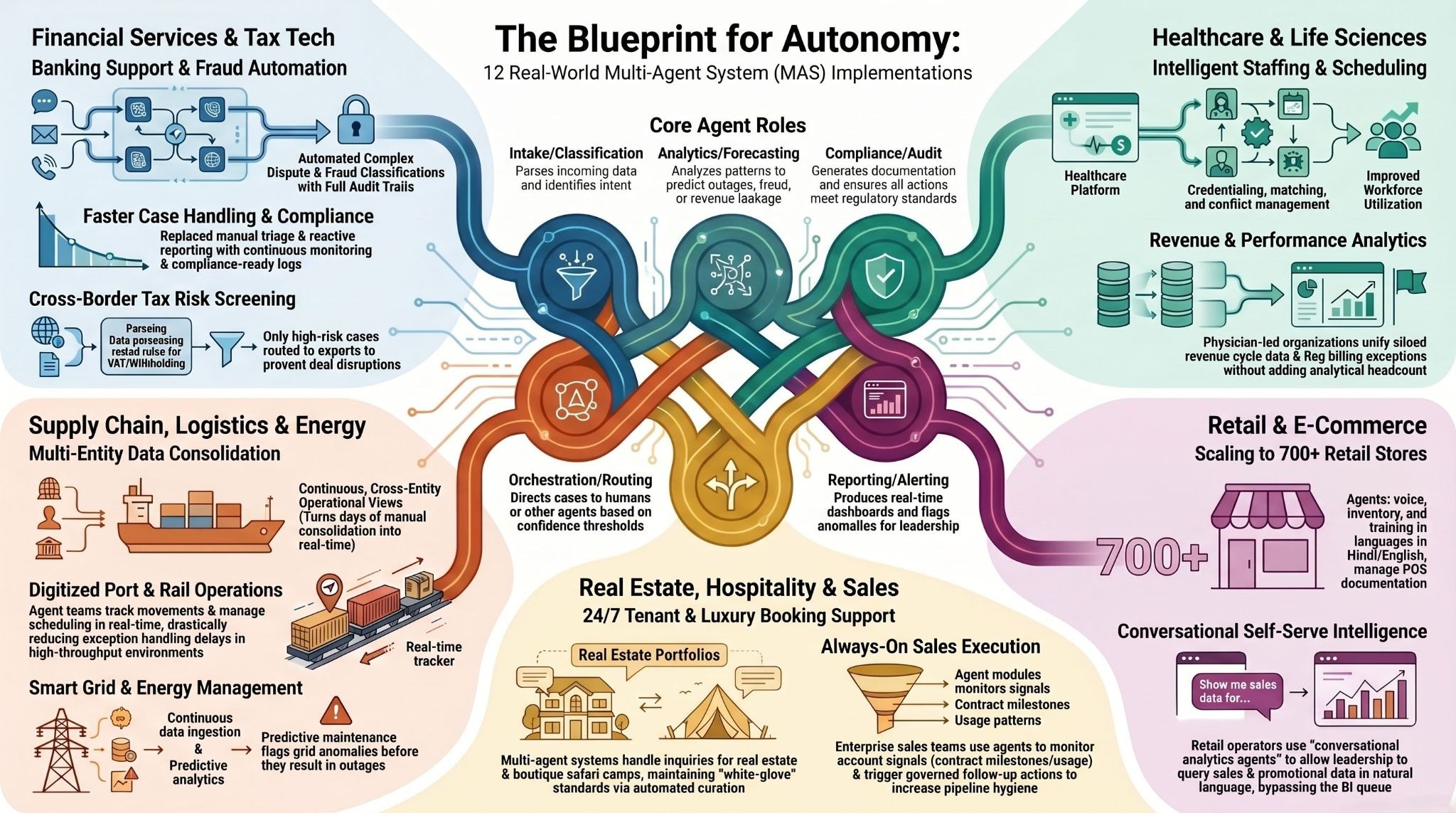
The infrastructure matured. The enterprises that recognized this early are now operating multi-agent systems in production across finance, healthcare, logistics, retail, energy, and professional services. The fifteen examples below document exactly what that looks like.
15 Multi-Agent System Examples Across Industries
Each example follows the same structure: the business problem, the agent architecture deployed, what each agent did, and the outcomes observed. No client names are disclosed. Industry, company size, and geography are noted where relevant.
Financial Services
Example 1: Omnichannel Banking Support Automation
TL;DR: A bank deployed a four-agent system to handle customer support across chat, email, and phone — reducing manual case handling while maintaining full audit trails.
The Business Problem: A financial institution processing high volumes of customer support interactions across multiple channels needed to reduce case handling time, maintain regulatory auditability, and scale support capacity without proportionally increasing headcount.
The Agent Architecture:
- Intake and routing agent — received queries from chat, email, and phone channels; classified intent and routed to the appropriate specialist agent
- Agent-assist summarization agent — compiled conversation context and account history for human agents when escalation occurred
- Next-best-action agent — recommended resolution paths based on query type and compliance rules
- Audit and SLA monitoring agent — tracked every agent action, flagged SLA breaches, and produced compliance-ready logs
What It Replaced: Manual case triage, fragmented channel handling, and reactive SLA reporting.
Outcomes: Faster case handling, reduced operational load via automation, better compliance readiness through continuous audit trails, and improved consistency across channels. Human agents handled only escalated edge cases.
Example 2: Cloud-Based Dispute and Fraud Automation for a Fintech Provider
TL;DR: A global fintech deployed a multi-agent system to automate dispute intake, fraud classification, and compliance workflows for banks and credit unions.
The Business Problem: A cloud-based fintech serving banks and credit unions needed to automate high-volume dispute processing, fraud detection workflows, and compliance reporting — while maintaining the auditability that regulated institutions require.
The Agent Architecture:
- Dispute intake agent — parsed incoming dispute submissions from multiple channels and extracted structured data
- Fraud classification agent — analyzed transaction patterns against rule sets and risk models to flag potential fraud
- Compliance documentation agent — generated required regulatory documentation and escalation notes
- Workflow routing agent — directed cases to human reviewers when confidence thresholds were not met
Outcomes: Reduced time-to-resolution for dispute cases, improved fraud detection consistency, scalable compliance documentation without manual drafting, and auditability at every decision point.
Healthcare
Example 3: Healthcare Staffing Operations — Matching, Scheduling, and Compliance
TL;DR: A healthcare staffing platform replaced manual matching and scheduling workflows with a multi-agent system — cutting fill cycles and improving utilization across facilities.
The Business Problem: A healthcare staffing platform connecting nursing professionals with facilities for flexible shifts needed to accelerate matching, reduce scheduling friction, and ensure compliance with credentialing and certification requirements — at scale.
The Agent Architecture:
- Talent onboarding and credential agent — captured professional profiles, certifications, and compliance documentation on intake
- Facility matching agent — matched available professionals to open shifts based on skills, location, availability, and facility preferences
- Scheduling and notification agent — confirmed placements, sent notifications, and managed schedule conflicts
- Compliance and reporting agent — monitored fill rates, utilization, and credentialing status; flagged gaps
Outcomes: Faster fill cycles, lower scheduling friction, improved workforce utilization, better staffing responsiveness for facilities, and reduced manual coordination overhead.
Example 4: Inpatient Care Program Analytics — Revenue and Performance
TL;DR: A physician-led clinical enterprise deployed AI agents to unify revenue management and operational performance data — replacing slow, siloed reporting with continuous operational visibility.
The Business Problem: A physician-led inpatient care organization operating hospitalist programs needed better visibility into revenue cycle performance, staffing utilization, and care program outcomes — without adding analytical headcount.
The Agent Architecture:
- Revenue analytics agent — monitored billing workflows, flagged exceptions, and surfaced revenue leakage drivers
- Operational performance agent — tracked utilization, program delivery metrics, and service quality indicators
- Reporting and exception agent — produced leadership dashboards and flagged anomalies that required clinical or operational intervention
Outcomes: Improved visibility into revenue leakage drivers, faster operational decision-making via unified reporting, more reliable performance tracking, and better decision support for leadership without increasing analyst headcount.
Supply Chain and Logistics
Example 5: Multi-Entity Supply Chain Analytics Consolidation
TL;DR: A global logistics enterprise consolidated performance data across multiple business units and geographies into a single governed analytics layer — powered by specialized agents for each reporting domain.
The Business Problem: A large multinational logistics and supply chain company serving customers across India, the UK, and the US was operating with fragmented reporting across entities. Leadership had no single operational view, and cross-entity variance analysis required days of manual consolidation.
The Agent Architecture:
- Data standardization agent — ingested operational data from multiple entity systems and applied consistent KPI definitions across regions
- Variance explanation agent — analyzed deviations from targets and generated natural-language explanations for leadership
- Exception alerting agent — flagged performance anomalies in real time and routed to the relevant business unit
- Consolidated reporting agent — produced cross-entity dashboards that updated continuously
Outcomes: A single operational view across entities, faster leadership reporting and issue identification, and improved consistency of operational metrics — replacing a process that previously took days with one that operated continuously.
Example 6: Port and Rail Terminal Management — Digitizing Inland Logistics
TL;DR: A global ports and logistics leader deployed a multi-agent system to digitize terminal workflows and improve visibility across port-to-inland rail operations.
The Business Problem: A ports and logistics group with a portfolio spanning terminals and logistics services worldwide needed to replace manual terminal workflow tracking, improve rail scheduling visibility, and reduce exception handling delays across a complex, high-throughput operation.
The Agent Architecture:
- Terminal workflow agent — digitized yard operations, tracked container movements, and managed workflow status in real time
- Rail scheduling and visibility agent — monitored rail slot allocation, flagged scheduling conflicts, and updated inland logistics teams
- Exception management agent — detected and escalated operational exceptions before they cascaded
- Executive reporting agent — produced operational dashboards and leadership alerts
Outcomes: Higher predictability of terminal-to-rail throughput, more efficient coordination across terminal and inland logistics, improved operational visibility, and faster exception detection and response.
Retail
Example 7: National Retail Chain — Voice, Inventory, and Training Agents at Scale
TL;DR: A retail chain with 700+ stores deployed three specialized agents — for voice support, inventory intelligence, and staff training — running on a single platform with a shared admin console.
The Business Problem: A rapidly scaling value retail chain with hundreds of stores needed to reduce helpdesk load, improve store-level inventory visibility for staff, and accelerate employee onboarding and training — across a distributed, high-volume environment.
The Agent Architecture:
- Voice support agent — handled store-level queries via speech-to-text and text-to-speech in both Hindi and English; resolved common issues without human escalation
- Inventory intelligence agent — provided real-time pricing, stock, and promotional data per store on demand
- Knowledge and training agent — gave staff on-demand access to SOPs, POS documentation, and training materials via a conversational interface
- Admin and analytics layer — a unified console for management, ticketing integration, and performance reporting
What made this complex: The agents needed to run at the scale of a national retailer, in two languages, integrated with existing POS systems and ticketing infrastructure — all deployed in under four weeks.
Outcomes: Reduced manual helpdesk burden, improved store-level inventory visibility, faster onboarding via on-demand training guidance, and high-volume resolution capacity without proportionally scaling support staff.
Example 8: E-Commerce and Retail Analytics — Conversational Self-Serve Intelligence
TL;DR: A retail operator deployed a conversational analytics agent that allowed business users to query sales, inventory, and promotional performance in natural language — without BI queuing.
The Business Problem: A retail holding group needed to give leadership and operations teams faster access to business performance data across sales, products, inventory, promotions, and customer behavior — without routing every query through an analyst team.
The Agent Architecture:
- Data ingestion agent — unified data streams across sales, product, inventory, promotions, and customer behavior
- Conversational analytics agent — handled natural-language queries and returned structured, governed answers in real time
- KPI monitoring and alerting agent — continuously tracked performance metrics and flagged exceptions automatically
Outcomes: Shorter analysis cycles for recurring questions, better visibility into product performance and promotional effectiveness, reduced analyst dependency, and more scalable operations with lower manual overhead.
Energy and Utilities
Example 9: Smart Grid Operations — Multi-Agent Monitoring and Alerting
TL;DR: A state power transmission utility deployed a multi-agent system for grid monitoring, predictive analytics, and automated field alerting — replacing periodic manual checks with continuous, governed intelligence.
The Business Problem: A state-level power transmission utility responsible for maintaining transmission systems needed to move from reactive, manual monitoring to proactive, continuous grid intelligence — with automated alerting and predictive maintenance capability.
The Agent Architecture:
- Grid data ingestion agent — continuously processed smart grid data from sensors and monitoring infrastructure
- Predictive analytics agent — analyzed patterns to forecast potential outages, losses, and field issues before they occurred
- Anomaly detection and alerting agent — flagged exceptions and automatically routed alerts to field operations teams
- Operational dashboard agent — maintained real-time dashboards for grid performance and leadership reporting
Outcomes: Higher operational visibility across grid operations, faster exception detection and response coordination, more proactive grid management through continuous monitoring, and better operational transparency for leadership — replacing a system that flagged issues only after they occurred.
Example 10: Campus Energy Management — Monitoring, Forecasting, and Optimization
TL;DR: A research institute deployed an AI energy management system — using agents for consumption monitoring, forecasting, and optimization across a campus-scale operation.
The Business Problem: A premier scientific research institute with campus-scale infrastructure needed to improve energy visibility, reduce consumption inefficiencies, and move from scheduled reporting to continuous, proactive energy management.
The Agent Architecture:
- Sensor data ingestion agent — continuously ingested utility and sensor data across campus facilities
- Forecasting agent — modeled consumption patterns and generated forward-looking recommendations
- Anomaly detection agent — flagged unexpected consumption spikes or equipment anomalies in real time
- Optimization and alerting agent — recommended operational adjustments and delivered proactive alerts to facilities management
Outcomes: Improved energy visibility, faster detection of inefficiencies, reduced manual monitoring effort, and more predictable operations through early-warning alerts.
Real Estate
Example 11: Tenant and Customer Support Automation — End-to-End Service Agent
TL;DR: A major real estate portfolio owner deployed an omnichannel service agent to handle tenant queries, automate support workflows, and improve SLA adherence — 24 hours a day, across web, WhatsApp, and email.
The Business Problem: A large real estate group managing diversified office, retail, industrial, and residential assets across multiple emirates needed to reduce call-center load, deliver consistent 24/7 tenant support, and improve SLA adherence across a high-volume, multi-property operation.
The Agent Architecture:
- Omnichannel intake agent — received queries via web, WhatsApp, and email; classified intent and prioritized by urgency
- FAQ and self-service agent — resolved common tenant queries around payments, rental terms, and policies using a governed knowledge base
- Ticketing and escalation agent — routed unresolved queries to the appropriate human team with full conversation context
- SLA tracking and reporting agent — monitored response and resolution times; flagged breaches automatically
Outcomes: Faster tenant response times, lower call-center load, consistent 24×7 tenant experience, and better SLA adherence through automated routing and tracking.
Professional Services and Finance Operations
Example 12: Group-Wide Procurement and Finance KPI Automation
TL;DR: A diversified business group standardized procurement and finance intelligence across 30+ companies using a multi-agent system — replacing fragmented, delayed reporting with continuous, automated alerts.
The Business Problem: A major family business group comprising more than 30 companies across retail, industrial, building, and services portfolios needed to standardize financial and procurement KPIs across entities, monitor for margin erosion, and give leadership early warning on vendor performance and working capital risks — without adding headcount.
The Agent Architecture:
- KPI standardization agent — applied consistent definitions and hierarchies across group entities to eliminate definitional inconsistency
- Procurement monitoring agent — tracked purchase price trends, gross margin impact, and vendor delivery and returns performance
- Early-payment analysis agent — calculated notional finance costs and flagged early-payment decisions requiring review
- Leadership reporting agent — delivered scheduled insight packs and automated alerts when thresholds were crossed
Outcomes: Earlier detection of margin erosion and vendor slippage, standardized finance and procurement intelligence across entities, reduced variance surprises via continuous monitoring, and faster decision-making for group leadership.
Tax and Legal Technology
Example 13: Cross-Border Tax Risk Pre-Screening
TL;DR: A tax-tech platform deployed a multi-agent system to screen cross-border transactions for withholding tax, VAT, and permanent establishment risks — cutting last-minute deal disruptions and accelerating pre-compliance review.
The Business Problem: A tax technology product focused on cross-border transaction risk needed to automate the screening of transactions for withholding tax mismatches, VAT issues, and permanent establishment exposure — replacing manual review processes that caused delays and introduced inconsistency.
The Agent Architecture:
- Transaction screening agent — parsed transaction data and applied rule sets for cross-border risk classification
- Evidence collection agent — retrieved supporting documentation and compiled explainability notes for each flagged transaction
- Risk classification and escalation agent — scored transaction risk and routed high-risk cases to tax experts with a structured brief
- Workflow tracking agent — maintained a knowledge base of screened transactions and supported audit trail generation
Outcomes: Earlier detection of withholding and VAT risk, reduced last-minute deal disruptions, faster and more consistent pre-compliance review, and a continuously improving knowledge base from every screened transaction.
Hospitality and Travel
Example 14: Luxury Travel Booking Automation — End-to-End Booking Agent
TL;DR: A luxury hospitality brand operating 16 boutique lodges and safari camps deployed a multi-agent booking system — handling end-to-end inquiry processing with human-in-the-loop oversight for itinerary curation.
The Business Problem: A premium safari and lodge hospitality brand serving high-expectation global travelers needed to reduce booking turnaround time, handle complex multi-property inquiries more accurately, and scale operations without compromising the white-glove service standard the brand is known for.
The Agent Architecture:
- Email intake and intent classification agent — processed incoming booking inquiries, extracted guest requirements, and classified booking complexity
- Conversational follow-up agent — engaged guests to capture missing details through a structured dialogue loop
- Inventory and negotiation agent — checked real-time availability across properties, proposed alternatives for unavailable dates
- Handoff agent — routed complex itinerary creation to human specialists with a complete brief, eliminating redundant back-and-forth
- Invoice and document generation agent — produced PDF booking confirmations and invoices automatically on confirmation
Outcomes: Faster booking turnaround with significantly reduced back-and-forth, higher accuracy on complex multi-property guest requirements, and scalable operations without compromising the luxury service standard.
Enterprise Sales Operations
Example 15: Always-On Account Monitoring and Sales Execution
TL;DR: An enterprise sales team deployed a multi-agent system to monitor accounts continuously, identify opportunities and risks in real time, and execute governed follow-up workflows — without increasing headcount.
The Business Problem: A sales operation managing a large portfolio of enterprise accounts needed to increase account coverage, reduce missed opportunities from slow response cycles, and maintain consistent execution across the pipeline — without a proportional increase in sales headcount.
The Agent Architecture:
- Account monitoring agent — continuously tracked signals across accounts: engagement activity, contract milestones, product usage, and risk indicators
- Opportunity identification agent — applied rule-governed logic to classify signals as opportunities, renewals, or churn risks
- Follow-up orchestration agent — triggered governed follow-up actions based on opportunity type — drafting outreach, scheduling calls, flagging for human review
- CRM integration agent — maintained pipeline hygiene by updating CRM records automatically with signal summaries and next-best actions
- Sales dashboard and alerting agent — delivered real-time pipeline visibility and leadership alerts on opportunity movement
Outcomes: Higher account coverage without increasing headcount, faster response cycles on opportunities and renewals, more consistent execution via governed playbooks, and improved pipeline hygiene across the sales operation.
Key Multi-Agent Architectures Behind These Deployments
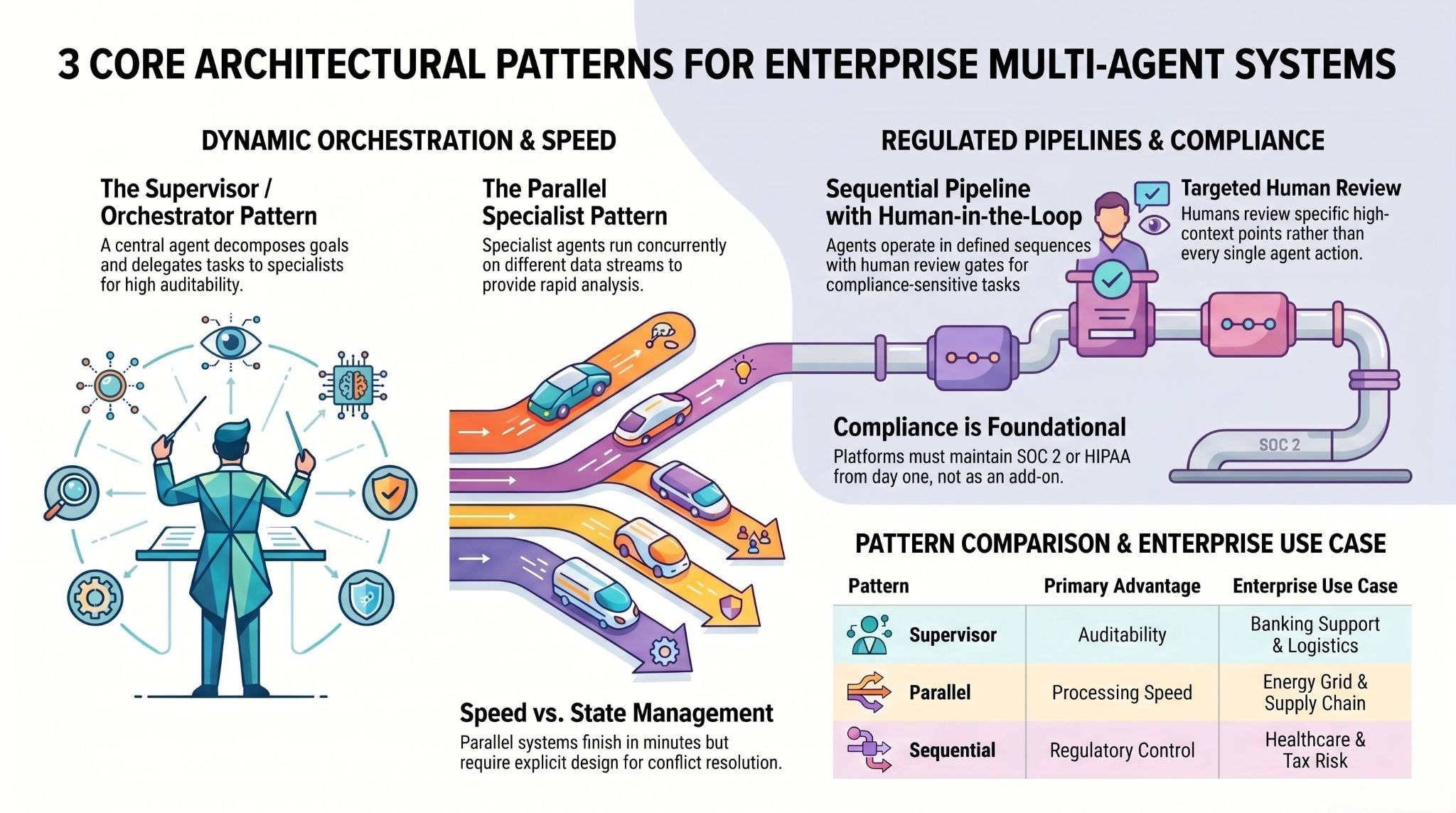
The 15 examples above are not all built the same way. Three core architectural patterns appear most frequently in enterprise deployments — and choosing the right one determines whether the system is reliable in production or fragile at scale.
The Supervisor / Orchestrator Pattern
A central orchestrator agent receives the top-level goal, decomposes it into sub-tasks, delegates to specialist agents, and synthesizes the final output. This is the most common pattern in the deployments above — used in the banking support system, the logistics analytics consolidation, and the retail multi-agent platform.
The orchestrator does not execute tasks itself. It plans, routes, and monitors. If a specialist agent fails or returns low-confidence output, the orchestrator decides whether to retry, escalate, or hand off to a human. This makes the pattern highly auditable — every delegation decision is a logged event.
The Parallel Specialist Pattern
Specialist agents run simultaneously on different data streams and contribute outputs to a shared result. No agent waits for another to complete. This pattern is used in the energy grid monitoring deployment (grid data, predictive analytics, and alerting agents all run concurrently) and the supply chain analytics consolidation (entity-level agents process in parallel before a consolidation layer produces the unified view).
The advantage is speed. Complex analyses that would take hours in a sequential system complete in minutes when agents work in parallel. The challenge is state management — shared memory and conflict resolution must be explicitly designed.
The Sequential Pipeline with Human-in-the-Loop
Agents operate in a defined sequence: Agent A produces output, Agent B validates it, Agent C acts on the validated output — with human review gates at defined points. This is the pattern used in compliance-sensitive deployments: the tax risk screening system, the healthcare credentialing workflow, and the dispute processing system.
In regulated industries, this pattern is non-negotiable. Human-in-the-loop does not mean humans review everything — it means humans review the right things at the right points, with full context from the agents that preceded them. The audit trail from every preceding agent action is what makes escalation meaningful rather than overwhelming.
A note on compliance posture: every production deployment in regulated industries — financial services, healthcare, energy — requires that the multi-agent platform maintain SOC 2, HIPAA, GDPR, or ISO 27001 compliance depending on the operating context. Governance is not a feature to add later. It is an architectural requirement from day one.
What to Look for in an Enterprise Multi-Agent System Platform
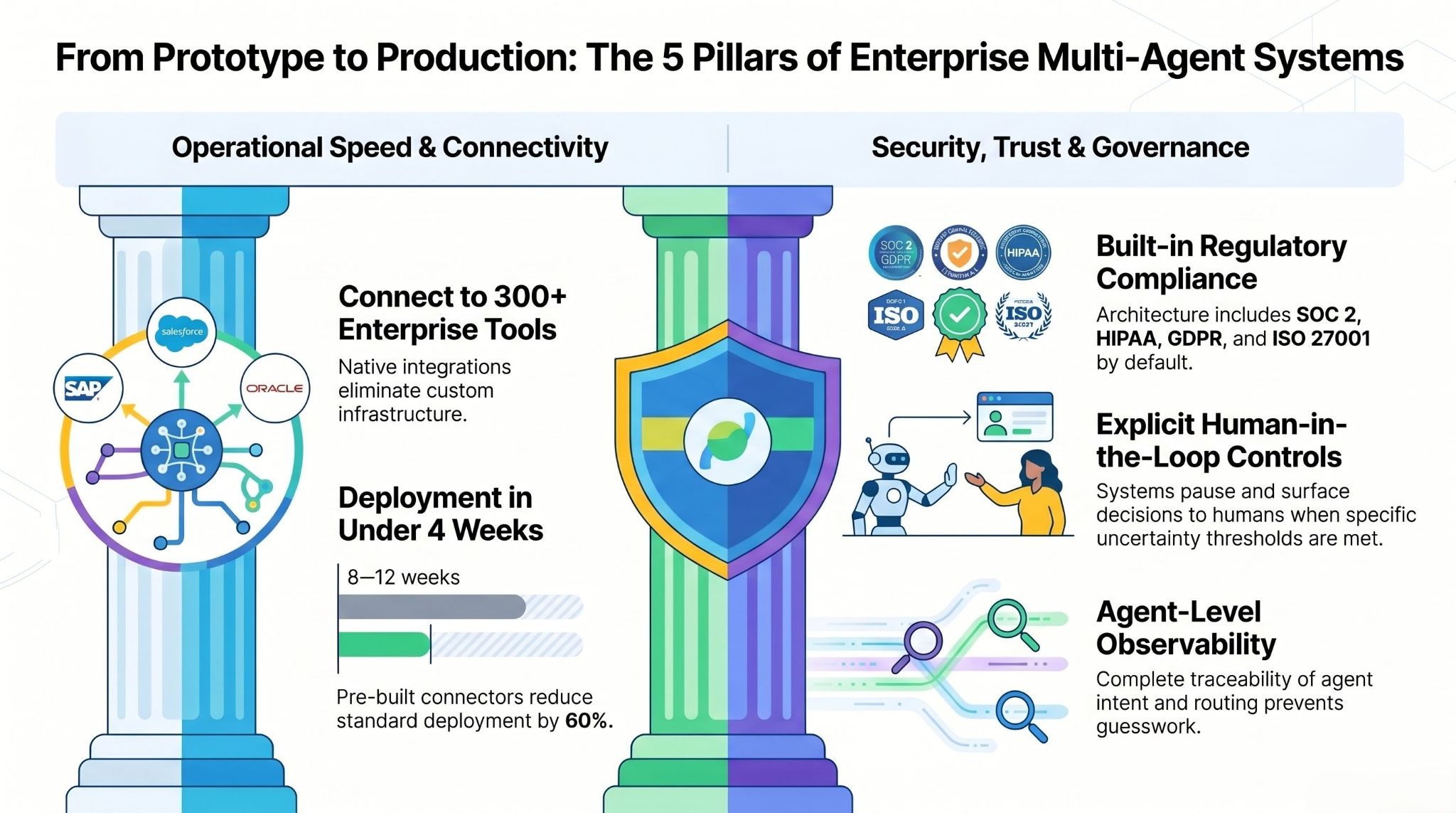
The examples above share a set of platform requirements that separate production-ready multi-agent systems from prototypes that stall at pilot stage.
Integration breadth. Most enterprise workflows cross at least three systems. A multi-agent platform that connects natively to 300+ enterprise tools — SAP, Salesforce, ServiceNow, Oracle, and others — means agents can act across existing stacks without custom integration work for every connection. Platforms with narrow integration libraries force you to build infrastructure instead of business logic.
Deployment speed. Enterprise AI deployments average 8 to 12 weeks to production. The best multi-agent platforms — with pre-built connectors, governed templates, and clear onboarding processes — consistently achieve production deployment in under four weeks. Time-to-value is a real differentiator at the point of business case approval.
Compliance posture built in. SOC 2, HIPAA, GDPR, and ISO 27001 compliance cannot be retrofitted. Enterprises in regulated industries need a platform where audit trails, access controls, data residency, and human escalation paths are defaults — not add-ons.
Governance and observability. Every agent action must be traceable. Platforms that provide agent-level logging, intent routing visibility, and conflict detection allow operations teams to identify exactly where and why a workflow deviated. Platforms without this capability make debugging a multi-agent system an exercise in guesswork.
Human-in-the-loop controls. The most reliable multi-agent systems are not fully autonomous. They are designed with explicit escalation paths — thresholds below which the system pauses and surfaces a decision to a human with full context. This is what distinguishes a trustworthy production system from an unpredictable one.
assistents.ai is built on all five of these requirements. It is an enterprise agentic AI platform that deploys multi-agent systems across 12 industries, integrates with 300+ enterprise tools, and achieves production deployment in under four weeks — with SOC 2, HIPAA, GDPR, and ISO 27001 compliance built into the architecture.
The Bottom Line
Multi-agent systems are no longer a technology on a roadmap. The 15 examples in this post are live, operating across 12 industries, handling workflows that used to require teams of people doing repetitive, time-sensitive, error-prone work.
The pattern across every deployment is the same: tasks that crossed multiple systems, required auditability, and demanded consistent execution at scale — those are the tasks multi-agent systems handle best. And those are the exact tasks that define enterprise operations.
If you are evaluating whether a multi-agent system belongs in your enterprise stack, the question is not whether the technology is ready. The technology is in production. The question is whether your organization is ready to deploy it — and which workflows you start with.
assistents.ai deploys enterprise multi-agent systems across 12 industries and 300+ integrations, with production timelines under four weeks and full compliance coverage. Book a demo to see a deployment relevant to your industry.
FAQ:
What is a multi-agent system with a real example?
A multi-agent system is an AI architecture in which multiple autonomous agents — each with a specific role — work together to complete a task. A real example: a banking support system where one agent classifies incoming queries, a second retrieves account history, a third recommends next-best actions, and a fourth logs every interaction for compliance. No single agent handles everything; each agent does one thing reliably, and the orchestration layer handles sequencing and handoff.
How do multi-agent systems differ from single-agent AI?
A single-agent AI processes one task at a time within a single context. Multi-agent systems run specialized agents in parallel or sequence across multiple data sources and systems. This makes them suitable for complex enterprise workflows that cross departments, tools, or regulatory boundaries — tasks that exceed what a single model can handle reliably.
What industries use multi-agent systems?
Financial services, healthcare, supply chain and logistics, retail, energy and utilities, real estate, professional services, tax and legal technology, and hospitality are all active deployment verticals as of 2026. The common thread is workflow complexity — industries where tasks routinely cross multiple systems, require auditability, or involve real-time decision-making at scale.
What is an orchestrator agent?
An orchestrator agent is the coordination layer in a multi-agent system. It receives the top-level goal, decomposes it into sub-tasks, delegates those tasks to specialist agents, monitors execution, and synthesizes the final output. The orchestrator does not execute tasks itself. It plans, routes, and handles exceptions — making it the most critical agent in architectures where reliability and auditability matter.
Are multi-agent systems the same as agentic AI?
Not exactly. Agentic AI refers to AI that can take autonomous action — planning steps, using tools, and executing tasks without step-by-step human instruction. Multi-agent systems are one architecture for implementing agentic AI, in which multiple agentic models collaborate rather than a single model acting alone. All multi-agent systems are agentic; not all agentic AI is multi-agent.
How long does it take to deploy a multi-agent system in an enterprise?
Industry average is 8 to 12 weeks for a production deployment. Platforms with pre-built connectors, governed templates, and clear implementation workflows consistently achieve production in under four weeks. The largest variable is integration complexity — the number of existing enterprise systems the agents need to connect to.
What compliance standards apply to enterprise multi-agent deployments? This depends on the industry and data involved. Financial services deployments typically require SOC 2 Type II and may involve PCI DSS. Healthcare deployments require HIPAA. Organizations operating in the EU require GDPR compliance. Energy and infrastructure deployments often involve ISO 27001. A production-ready multi-agent platform must support all of these as architectural defaults, not optional configurations.

Transform Your Business With Agentic Automation
Agentic automation is the rising star posied to overtake RPA and bring about a new wave of intelligent automation. Explore the core concepts of agentic automation, how it works, real-life examples and strategies for a successful implementation in this ebook.
Sarfraz Nawaz is the CEO and founder of Ampcome, which is at the forefront of Artificial Intelligence (AI) Development. Nawaz's passion for technology is matched by his commitment to creating solutions that drive real-world results. Under his leadership, Ampcome's team of talented engineers and developers craft innovative IT solutions that empower businesses to thrive in the ever-evolving technological landscape.Ampcome's success is a testament to Nawaz's dedication to excellence and his unwavering belief in the transformative power of technology.

More insights
Discover the latest trends, best practices, and expert opinions that can reshape your perspective






.jpg)
Contact us

