
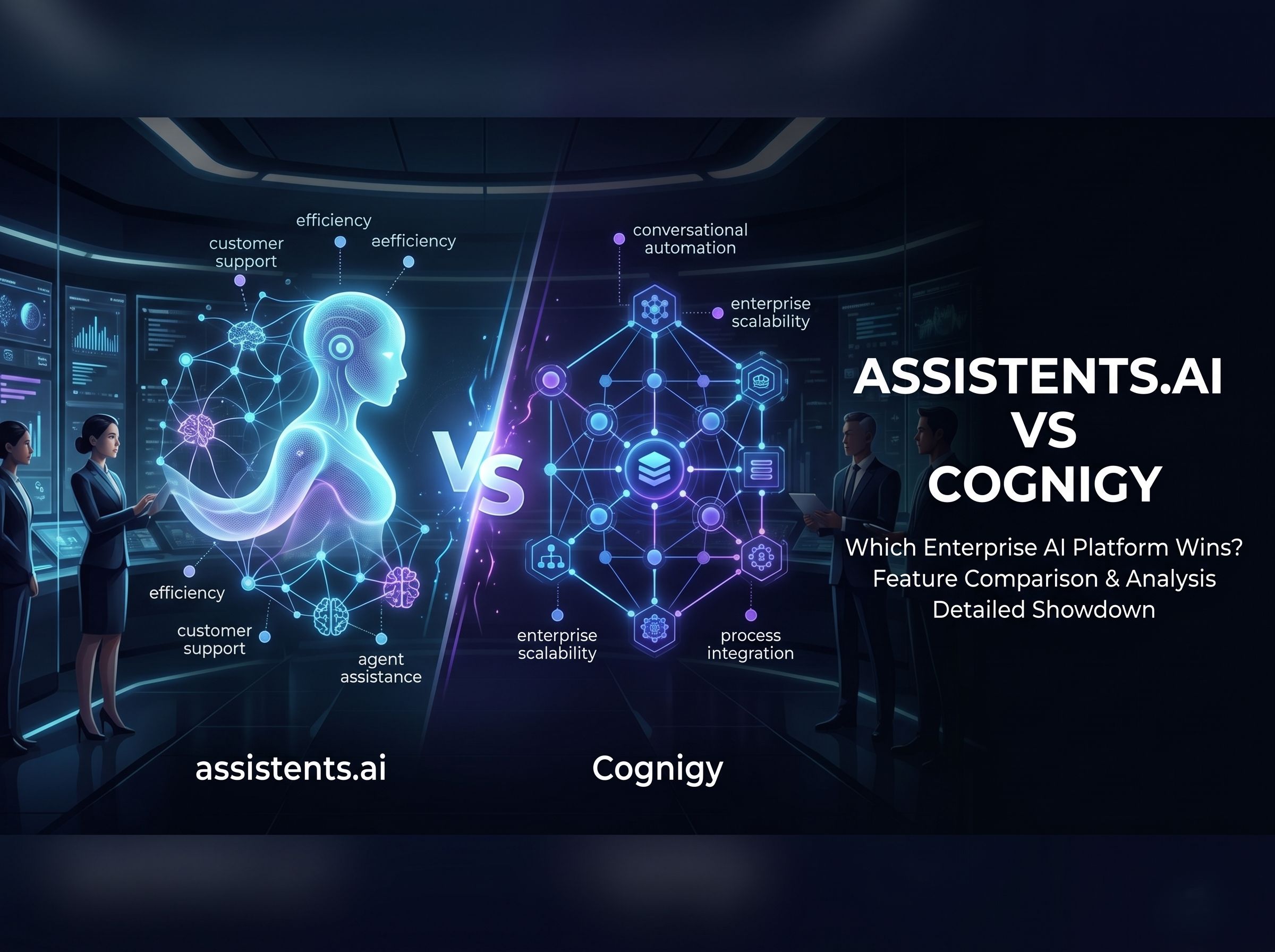
assistents.ai vs Cognigy: Which Is the Best Platform for Building Enterprise AI Agents in 2026?


If you are an enterprise buyer evaluating AI agent platforms in 2026, you already know the problem: dozens of tools claim to be "enterprise-grade," most are built for startups, and the few that are genuinely enterprise-ready differ from each other in ways that matter enormously — governance architecture, integration depth, deployment flexibility, and whether the platform actually executes work or just answers questions.
This guide is built for that evaluation. It covers what separates a true enterprise AI agent platform from a narrower contact center AI tool, lays out the seven criteria that matter most in a serious procurement evaluation, and gives you a direct head-to-head comparison of two very different platforms — assistents.ai and Cognigy — to illustrate the distinction clearly.
By the end, you will know exactly which type of platform fits your organisation's operational scope, compliance requirements, and deployment constraints.
What separates an enterprise AI agent platform from a contact center AI tool

This distinction matters more than most buying guides acknowledge. In 2026, the term "AI agent platform" covers two fundamentally different categories of software, and buying the wrong category is an expensive mistake.
Contact center AI — represented by platforms like Cognigy — is purpose-built for automating inbound and outbound customer conversations. It excels at telephony integrations, IVR workflows, and chat channel automation. It is conversational by design: a customer speaks, the AI responds. The workflow ends when the conversation ends.
Enterprise agentic AI — the category assistents.ai operates in — is built for a broader mandate. It does handle conversational and voice interactions. But it also executes autonomous multi-step workflows without human prompting, analyzes data, processes documents, orchestrates actions across multiple enterprise systems simultaneously, and operates across every department in the organisation — IT, HR, Finance, Sales, Supply Chain, Compliance, and Customer Support — from a single governed platform.
The practical difference: a contact center AI answers a customer's question about their invoice. An enterprise agentic AI platform detects the invoice anomaly before the customer calls, matches it against the purchase order in SAP, flags the discrepancy to the finance team, and creates the exception workflow — all without a human initiating the process.
This is not a subtle difference. It is a categorical one. And it is the first decision any enterprise evaluation should resolve before going any further.
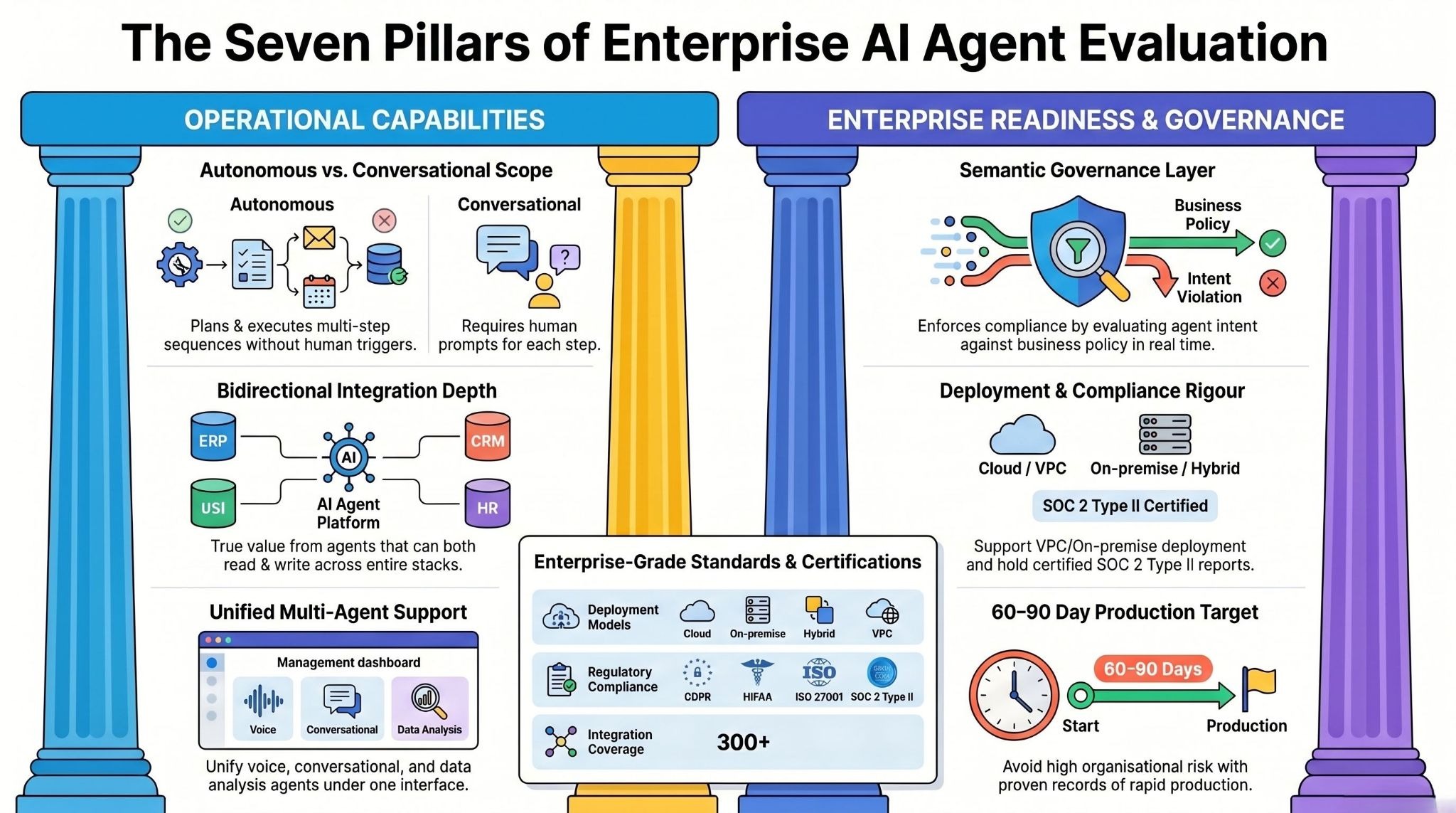
The 7 criteria that matter when choosing an enterprise AI agent platform
The following framework is built from what enterprise procurement committees, CIOs, and CTOs actually ask during platform evaluations — not what vendor websites emphasise. Score any platform you are evaluating against these seven criteria before shortlisting.
1. Agent scope: conversational only, or fully autonomous?
The most important question. Conversational agents respond to inputs. Autonomous agents identify goals, plan multi-step action sequences, execute those sequences across connected systems, and handle exceptions — all without being prompted for each step.
For enterprise operations, autonomous execution is the difference between AI that reduces call volume and AI that eliminates entire manual workflows. Ask every vendor: "Can your agents initiate and complete a process end-to-end without a human trigger at each step?" The answer tells you which category you are in.
2. Governance and policy enforcement architecture
Enterprise AI deployments fail when governance is an afterthought. In production environments — especially in regulated industries — every agent action needs to be evaluated against business rules, compliance policies, and data access permissions before execution, not after.
Look for a semantic governance layer: a system that enforces policies at the meaning level, not just the workflow level. The distinction matters because rule-based guardrails (if X then Y) break down in unstructured, dynamic enterprise environments. Semantic governance evaluates agent intent against business policy in real time.
Questions to ask: Where are audit logs stored? What happens when an agent action falls outside defined parameters? Can you enforce department-level access policies at the agent level?
3. Integration depth and coverage
The value of an AI agent platform is directly proportional to the number of enterprise systems it can reach and take action in. A platform with three integrations can automate three workflows. A platform with 300+ integrations — covering ERP (SAP, Oracle), CRM (Salesforce), ITSM (ServiceNow), HR systems, logistics platforms, and document management — can automate workflows across the entire enterprise stack.
Do not assess integrations by count alone. Assess depth: can the integration read and write bidirectionally? Can it trigger workflows, not just pull data? Can it handle authentication, rate limiting, and error recovery at the enterprise level?
4. Deployment flexibility: cloud, on-premise, hybrid, VPC
Regulated industries — financial services, healthcare, government, defence — often cannot deploy AI infrastructure on public cloud. Any platform that offers cloud-only deployment immediately disqualifies itself from a significant portion of the enterprise market.
Evaluate: cloud-hosted, on-premise, hybrid, and Virtual Private Cloud (VPC) deployment options. Each represents a different risk profile and cost structure. Enterprise-grade platforms support all four.
5. Agent types: voice, conversational, autonomous, and data analysis
Enterprise operations require different types of agents for different workflows. A customer support centre needs conversational and voice agents. A finance team processing high-volume invoices needs autonomous document processing agents. A supply chain leadership team needs data analysis agents that surface exceptions from operational dashboards in natural language.
A platform that supports only one agent type forces you to run multiple point solutions. A platform that unifies all agent types under one governance layer, one integration layer, and one management interface eliminates that fragmentation.
6. Compliance certifications
For enterprise procurement, certifications are not optional. SOC 2 Type II, GDPR, HIPAA (for healthcare), ISO 27001, and any relevant industry-specific standards must be confirmed before shortlisting. Ask for the audit reports, not just the badges.
7. Time to production
Proof-of-concept to production is where most enterprise AI initiatives stall. A platform that requires 8–12 months of implementation before generating value creates enormous organisational risk. Evaluate vendors on their typical time-to-production for comparable deployments, and ask for references from clients who went live within 60–90 days.
assistents.ai vs Cognigy: head-to-head comparison
The table below compares assistents.ai and Cognigy across the evaluation criteria above. Both are strong platforms — in their respective categories.
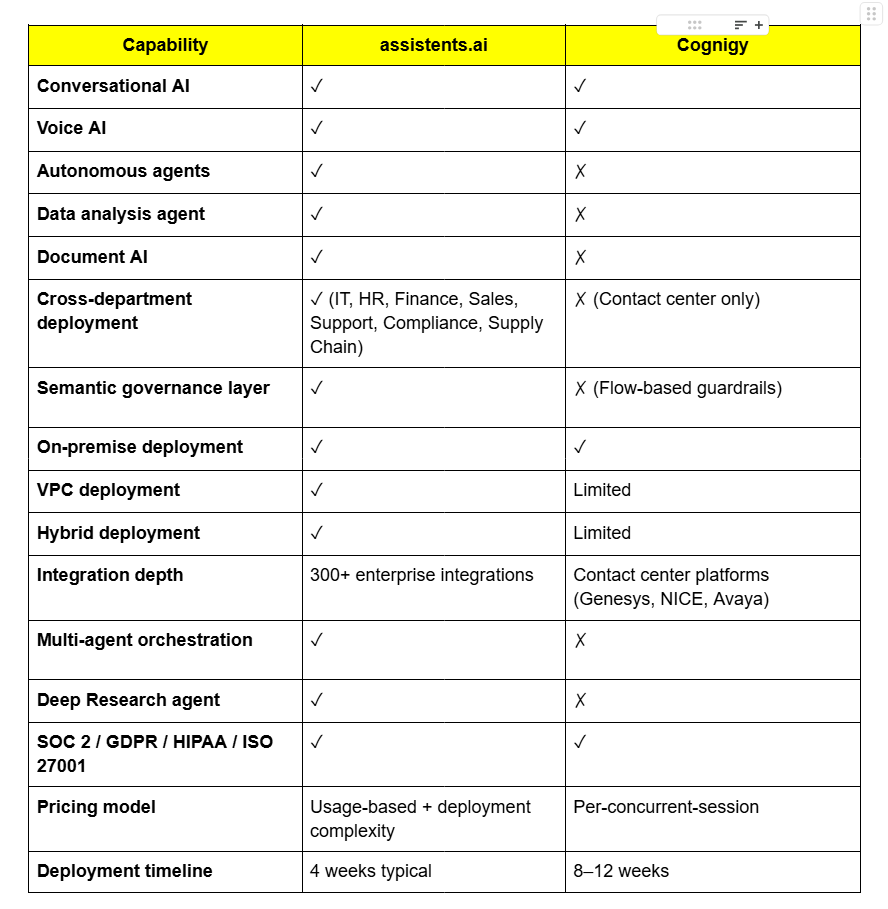
This is not a case of one platform being better than the other. It is a case of platform scope. If your primary requirement is automating inbound contact center conversations — especially in environments running Genesys, Avaya, or NICE infrastructure — Cognigy is a proven, purpose-built specialist.
If your requirement is automating workflows across multiple departments, executing autonomous multi-step processes, governing AI actions at scale across your enterprise stack, and deploying agents into regulated environments, assistents.ai is operating in a different category entirely.
assistents.ai is an enterprise agentic AI platform delivering conversational, voice, autonomous, document, and data analysis agents across IT, HR, Finance, Sales, Customer Support, Compliance, and Supply Chain. Deployed across 12+ industries with 300+ enterprise integrations, SOC 2, GDPR, HIPAA, and ISO 27001 compliance, and on-premise, cloud, hybrid, and VPC deployment options.
Where assistents.ai wins: multi-department autonomous enterprise AI

Autonomous agents that execute, not just respond
The most significant capability gap between assistents.ai and contact-center-focused platforms is autonomous execution. assistents.ai agents do not wait to be asked. They can be configured to monitor systems, detect conditions, trigger workflows, execute multi-step action sequences across connected enterprise applications, and complete tasks — from initiating to resolving — without human intervention at each stage.
This changes the ROI model of enterprise AI fundamentally. Conversational AI reduces handle time by a percentage. Autonomous AI eliminates entire categories of manual workflow.
Semantic Governor: policy enforcement at the reasoning level
Every assistents.ai agent action is evaluated against business rules before execution through the platform's Semantic Governor architecture. This is not flow-based guardrails — it is policy enforcement at the semantic level, meaning the system evaluates what the agent is trying to accomplish against what it is permitted to accomplish, in context, in real time.
For enterprise deployments in financial services, healthcare, and regulated manufacturing, this is not a nice-to-have. It is the difference between a platform that can be deployed in production and one that cannot pass InfoSec review.
300+ enterprise integrations: depth, not just breadth
assistents.ai supports over 300 integrations across the enterprise technology stack — SAP, Salesforce, ServiceNow, Oracle, Genesys, Microsoft, Google Workspace, and dozens of industry-specific platforms. Critically, these are bidirectional integrations: agents can read, write, trigger, and orchestrate across connected systems, not just pull data.
This integration depth is the engine behind the platform's programmatic advantage. Every combination of integration + industry + department creates a distinct, automatable workflow. That is the foundation of assistents.ai's content and product moat.
One platform across every department
A typical large enterprise running multiple AI point solutions — one for customer support, one for HR automation, one for finance workflow, one for IT helpdesk — faces compounding costs in licensing, integration maintenance, security reviews, and training. assistents.ai replaces this fragmentation with a single governed platform that deploys agents across IT, HR, Finance, Sales, Customer Support, Marketing, Compliance, and Supply Chain — all under one management interface, one governance layer, and one security posture.
Deployment flexibility for regulated environments
On-premise, cloud-hosted, hybrid, and VPC deployment options mean assistents.ai can operate inside the most constrained enterprise security environments. For organisations in healthcare (HIPAA), financial services, government, and defence — where data residency and infrastructure sovereignty are non-negotiable — this flexibility is a hard prerequisite.
Where Cognigy wins: contact center specialisation

Cognigy has earned its position as one of the leading platforms in enterprise contact center automation. For organisations whose primary requirement is high-volume, voice-first customer interaction automation, it has genuine strengths that purpose-built enterprise platforms have not replicated.
Contact center integration depth. Cognigy's native integrations with Genesys, NICE, Avaya, Cisco, and Amazon Connect are mature and production-tested at scale. If your infrastructure runs on any of these platforms, Cognigy reduces the implementation overhead significantly.
Visual flow builder. Cognigy's no-code conversation flow designer lets contact center teams build, test, and modify dialogue logic without developer involvement. For operations teams managing high-volume scripted workflows — ID verification, payment processing, appointment scheduling — this tooling reduces iteration cycles.
Proven enterprise contact center scale. Cognigy has documented deployments handling millions of concurrent conversations across multiple languages. For pure contact center scale, this track record is meaningful.
Composite AI approach. Cognigy's architecture allows organisations to mix rule-based workflows (for tightly governed, deterministic processes) with LLM-driven reasoning (for dynamic, unpredictable queries) — a sensible design for contact centers where some processes require strict scripting and others require contextual flexibility.
The conclusion is the same: Cognigy is the right tool if contact center automation is the scope. It is the wrong tool if the scope is the enterprise.
Real-world results: what enterprise AI agent deployments actually deliver
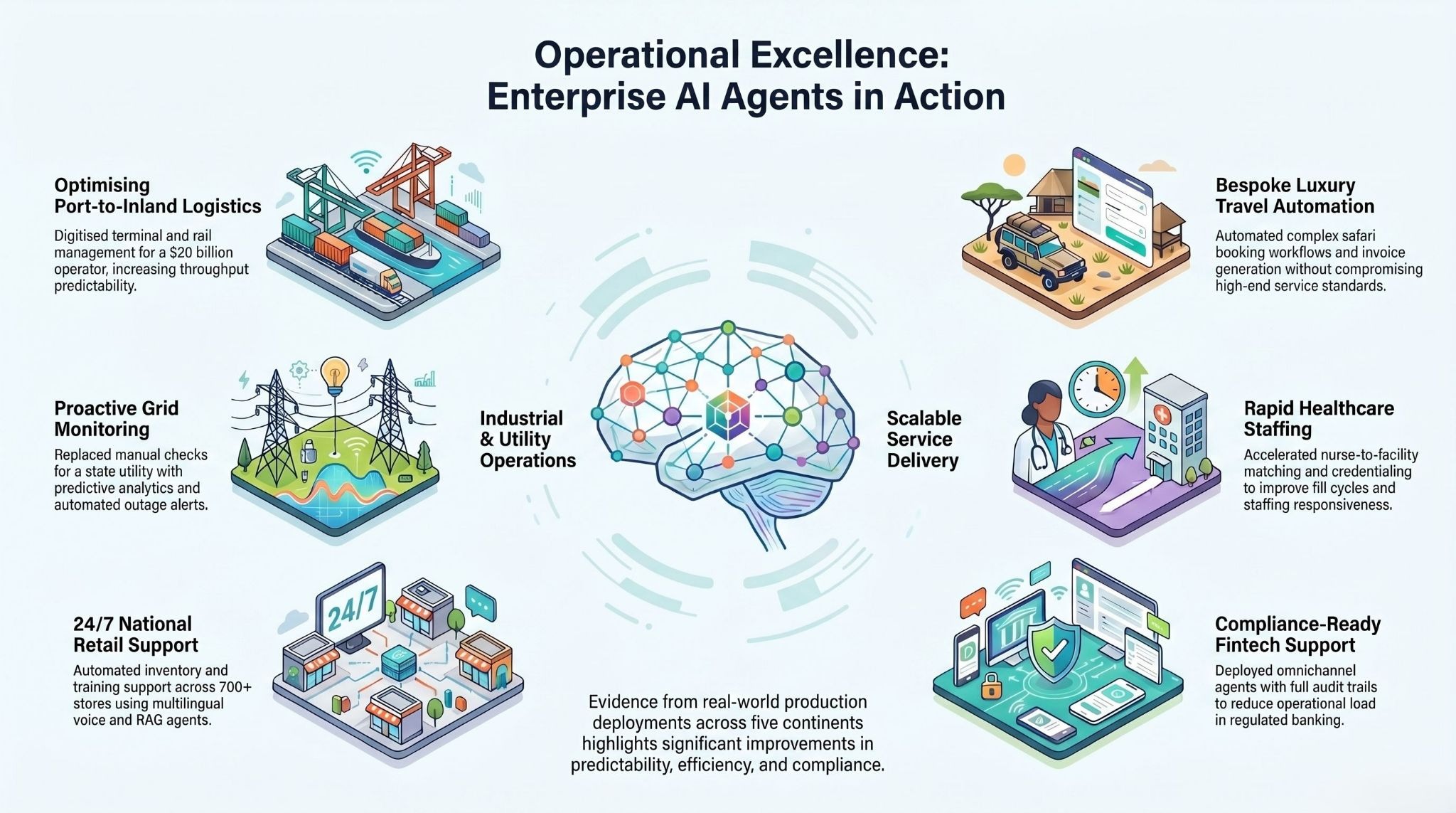
The most useful data for evaluating any AI agent platform is not benchmark scores or feature matrices. It is what happens in production deployments across real enterprise environments. The following results come from actual assistents.ai deployments, anonymised by industry.
Global logistics and ports operator (revenues exceeding $20 billion annually)
Requirement: Digitise and optimise terminal and rail management operations — connecting port-to-inland logistics workflows that were previously managed through disconnected systems and manual coordination.
Deployed: Terminal workflow digitisation with yard and rail operational dashboards, rail scheduling and visibility, exception management, and executive dashboards with operational alerts.
Result: Higher predictability of terminal-to-rail throughput, more efficient coordination across terminal and inland logistics, reduced operational bottlenecks and improved exception response.
State power transmission utility
Requirement: Agentic analytics and automated operational alerting on top of an existing smart utility system, replacing manual monitoring of a large-scale transmission grid.
Deployed: Smart grid data ingestion and operational dashboards, predictive analytics for outages and field issues, automated alerts and workflow routing for resolution.
Result: Higher operational visibility across grid operations, faster exception detection and response coordination, proactive grid operations via continuous monitoring — replacing reactive manual checks.
National value retail chain (700+ stores across hundreds of cities)
Requirement: Modernise store support, inventory visibility, and knowledge access for a distributed retail operation at national scale.
Deployed: Voice support agent in Hindi and English, inventory intelligence agent covering pricing, stock, and promotions per store, knowledge and training agent using RAG over POS and SOP documentation, admin console with analytics and ticketing integration.
Result: Reduced manual helpdesk burden, improved store-level inventory visibility, faster onboarding via on-demand training guidance.
Global fintech provider (banking and credit union clients)
Requirement: Omnichannel AI agents for banking support with full auditability and compliance — covering chat, email, and phone channels across a regulated financial services environment.
Deployed: Omnichannel intake and workflow routing, agent-assist summarisation and next-best actions, auditability and SLA monitoring, core system integration.
Result: Faster case handling, reduced operational load via automation, improved compliance readiness via audit trails.
UAE real estate portfolio manager (multi-emirate assets)
Requirement: Automate tenant and customer support workflows end-to-end across a diversified real estate portfolio operating across Dubai, Abu Dhabi, Sharjah, and other emirates.
Deployed: Omnichannel service agent covering web, WhatsApp, and email; tenant query triage, FAQs, rental and payment support workflows; ticketing and escalation to human teams; knowledge base over policies, tenancy documents, and SOPs.
Result: Faster response times and lower contact centre load, consistent 24×7 tenant experience, better SLA adherence through automated routing and tracking.
Luxury hospitality brand (16 safari lodges and camps, Africa and Indian Ocean)
Requirement: Automate end-to-end luxury travel booking workflows for a high-expectation clientele — handling complex, bespoke itinerary requests without compromising service quality.
Deployed: Email intake with intent classification and data extraction, conversational loop to capture missing details, real-time inventory checks and alternative date and property negotiation, hybrid handoff for curated itinerary creation, automated invoice and PDF document generation.
Result: Faster booking turnaround with reduced back-and-forth, higher accuracy on complex guest requirements, scalable operations without compromising the luxury service standard.
Healthcare staffing platform (US-based)
Requirement: AI-powered platform for matching nursing professionals with healthcare facilities for flexible shifts — prioritising speed and compliance.
Deployed: Talent onboarding and credential capture, facility staffing request intake and matching logic, scheduling, notifications, and compliance workflows, reporting for fill rate and utilisation.
Result: Faster fill cycles, lower scheduling friction, improved staffing responsiveness for facilities — with compliance workflows built in from the start.
These deployments span five continents, six industries, and organisations ranging from government utilities to luxury hospitality brands. The common thread: each deployed autonomous AI agents that execute operational workflows — not chatbots that answer questions.
How to choose the right platform: a buyer's decision framework

Choose assistents.ai if you:
- Need AI agents operating across multiple departments — not just customer support
- Require autonomous agents that complete workflows end-to-end without human prompting at each step
- Are deploying in a regulated environment (healthcare, financial services, government, defence) that requires HIPAA, SOC 2, GDPR, or ISO 27001 compliance
- Need on-premise, VPC, or hybrid deployment options for data sovereignty or security reasons
- Operate in a multi-system enterprise environment and need agents that can read, write, and orchestrate across SAP, Salesforce, ServiceNow, Oracle, and similar platforms
- Want a single governed platform across IT, HR, Finance, Sales, Supply Chain, and Customer Support rather than multiple point solutions
- Need semantic governance that enforces business policy at the reasoning level, not just flow-based guardrails
- Value transparent, usage-based pricing aligned to the value delivered
Choose Cognigy if you:
- Are focused exclusively on contact center automation — inbound, outbound, IVR, and routing
- Already run infrastructure on Genesys, NICE, Avaya, or Cisco and need native integration depth
- Prefer a visual flow-based dialogue designer that contact center operations teams can own without developer support
- Need a platform with mature, proven scale specifically in voice-first, high-volume customer interaction environments
- Do not require autonomous workflow execution, cross-department scope, or beyond-contact-center operations
The decision is not about quality. Both platforms are well-built for their intended scope. The decision is about whether your scope is a contact center or an enterprise.
The bottom line
In 2026, the enterprise AI agent market is not a monolith. It contains contact center automation specialists, developer-facing frameworks, SMB workflow tools, and full-enterprise autonomous agent platforms. Buying the wrong category — even from a vendor with an excellent product — produces an outcome mismatch that is expensive to reverse.
The evaluation framework in this guide is designed to prevent that mistake. Define the scope of what you are automating first. If that scope is a contact center, evaluate specialists. If that scope is the enterprise — multiple departments, autonomous execution, governed AI operations at scale — evaluate accordingly.
assistents.ai was built for the second category. Its architecture, integration depth, governance layer, deployment flexibility, and track record across real enterprise environments — logistics, energy, healthcare, retail, financial services, real estate, and hospitality — reflect a platform built to operate at enterprise scale, not to demonstrate a prototype.
The market is moving fast. Gartner projects that 40% of enterprise applications will include task-specific AI agents by the end of 2026. The organisations that establish governed agentic AI capability now will own significant operational advantages over those that wait.
Schedule a demo to see assistents.ai in action →
Explore the full assistents.ai vs Cognigy comparison →
Download the Enterprise AI Buyer's Guide →
Frequently asked questions
What is the best platform for building enterprise AI agents in 2026?
The answer depends on scope. For enterprise-wide autonomous agent deployment across multiple departments — IT, HR, Finance, Sales, Supply Chain, Compliance, and Customer Support — assistents.ai is one of the most complete platforms available, combining conversational, voice, autonomous, document, and data analysis agents under a single semantic governance layer with 300+ enterprise integrations. For organisations focused specifically on contact center automation with deep Genesys, NICE, or Avaya integration, Cognigy is the stronger specialist.
What is the difference between assistents.ai and Cognigy?
assistents.ai is a full-enterprise agentic AI platform spanning every department and supporting conversational, voice, autonomous, document, and data analysis agents. Cognigy is a contact center conversational AI platform specialised in voice and chat automation with deep telephony integrations. assistents.ai includes autonomous agents that execute multi-step workflows without human prompting; Cognigy operates in a conversational model where interactions are user-initiated. assistents.ai's Semantic Governor enforces business policy at the reasoning level; Cognigy uses flow-based guardrails.
Can an enterprise AI agent platform work across IT, HR, Finance, and Supply Chain simultaneously?
Yes — but only platforms built for full enterprise scope, not contact center specialists. assistents.ai deploys agents across IT, HR, Finance, Sales, Customer Support, Marketing, Compliance, and Supply Chain from a single platform with shared governance, shared integration layer, and shared management interface. This eliminates the fragmentation costs — licensing, security reviews, training, integration maintenance — of running multiple AI point solutions.
What deployment options do enterprise AI agent platforms support?
Enterprise-grade platforms should support four deployment models: cloud-hosted (for most organisations), on-premise (for regulated industries requiring infrastructure sovereignty), hybrid (combining cloud orchestration with on-premise data processing), and Virtual Private Cloud (VPC) for organisations needing isolation within public cloud infrastructure. assistents.ai supports all four. Platforms offering cloud-only deployment disqualify themselves from healthcare, government, defence, and many financial services deployments.
Is assistents.ai HIPAA, SOC 2, and GDPR compliant?
Yes. assistents.ai is SOC 2 Type II, GDPR, HIPAA, and ISO 27001 compliant. For regulated industries — healthcare, financial services, and organisations operating across EU jurisdictions — these certifications are a prerequisite for deployment, not a differentiator. Verify by requesting current audit documentation during the procurement process.
What is the difference between autonomous AI agents and conversational AI?
Conversational AI responds to user inputs — a person asks, the AI answers. It is reactive by design. Autonomous AI agents are proactive: they can detect conditions across connected systems, formulate action plans, execute multi-step workflows across enterprise applications, and complete tasks without a human initiating each step. Autonomous agents are not a more advanced version of chatbots — they are a different category of software with a different operating model and a different ROI calculation.
How many enterprise integrations does assistents.ai support?
assistents.ai supports over 300 enterprise integrations, including bidirectional connections to SAP, Salesforce, ServiceNow, Oracle, Microsoft, Google Workspace, Genesys, and dozens of industry-specific platforms. These are production-ready integrations that allow agents to read, write, trigger workflows, and orchestrate actions across connected systems — not read-only data connectors.
How long does it take to deploy an enterprise AI agent platform?
assistents.ai's typical time-to-production is four weeks for standard deployment configurations. Comparable enterprise AI platforms typically require 8–12 weeks. The difference is pre-built integration connectors, a governed agent builder that reduces configuration time, and a deployment methodology developed across 35+ enterprise implementations across financial services, healthcare, logistics, retail, real estate, and energy.

Transform Your Business With Agentic Automation
Agentic automation is the rising star posied to overtake RPA and bring about a new wave of intelligent automation. Explore the core concepts of agentic automation, how it works, real-life examples and strategies for a successful implementation in this ebook.
Sarfraz Nawaz is the CEO and founder of Ampcome, which is at the forefront of Artificial Intelligence (AI) Development. Nawaz's passion for technology is matched by his commitment to creating solutions that drive real-world results. Under his leadership, Ampcome's team of talented engineers and developers craft innovative IT solutions that empower businesses to thrive in the ever-evolving technological landscape.Ampcome's success is a testament to Nawaz's dedication to excellence and his unwavering belief in the transformative power of technology.

More insights
Discover the latest trends, best practices, and expert opinions that can reshape your perspective





Contact us

