
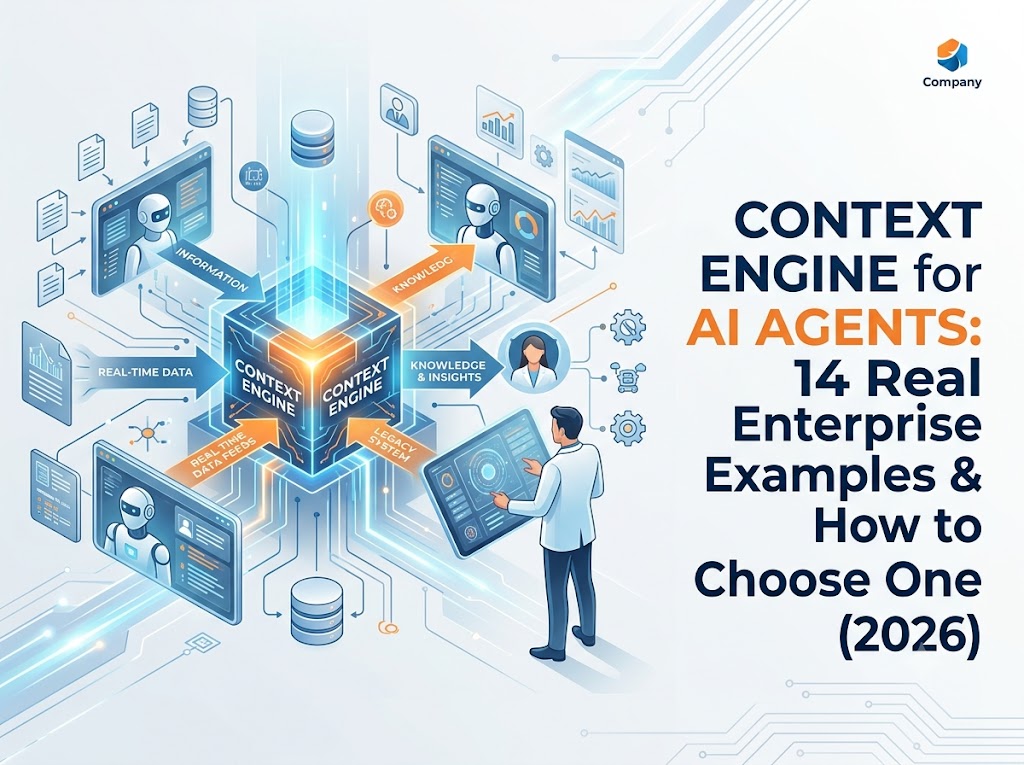
Context Engine for AI Agents: 14 Real Enterprise Examples & How to Choose One (2026)


A context engine is the infrastructure layer that assembles the exact business data, relationships, permissions, and history an AI agent needs before it acts — so the agent reasons from real, governed context instead of a prompt and a guess. It is what separates an agent that answers questions from an agent that can be trusted to act on them.
This guide is not another walkthrough of context engineering theory — token budgets, memory compaction, prompt structure. It's a buyer's primer on the category: what a context engine actually is, what it looks like across 14 real production deployments spanning hospitality, pharma, capital markets, construction, and more, and how to evaluate one if you're deciding whether your enterprise needs one.
None of the deployments below name a client. Every example is anonymized by industry, scale, and outcome — consistent with how the underlying production data is documented internally.
What Is a Context Engine for AI Agents?
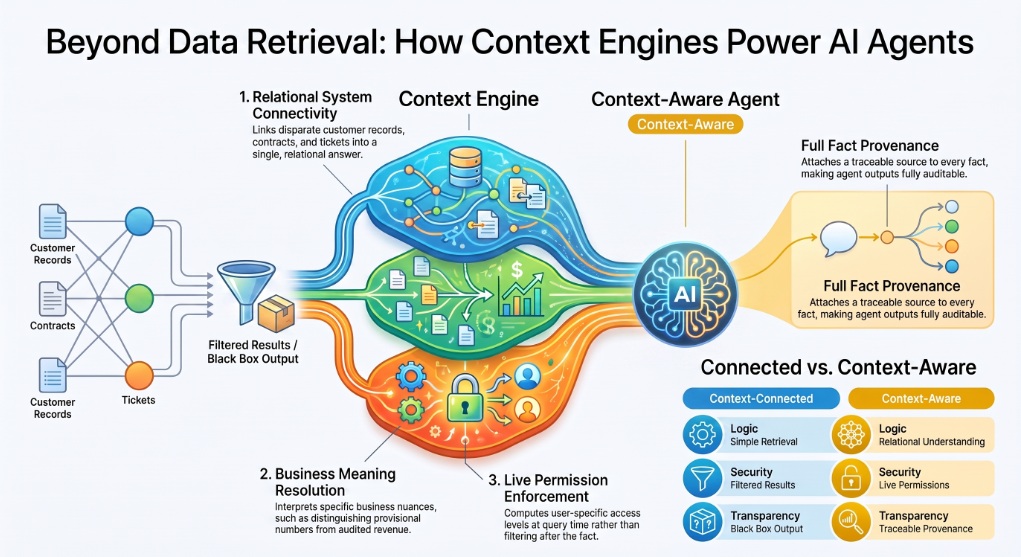
Most AI agents fail for a boring reason: they can technically see your data but don't understand what it *means*, who's allowed to see it, or how it connects to everything else. A context engine exists to close that gap.
Concretely, a context engine does four things before an agent is allowed to act:
- Connects systems, not just documents. It links a customer record to their contracts, tickets, and payment history — not as four separate lookups, but as one relational answer.
- Resolves business meaning. It knows that "revenue" means something different in one business unit than another, and that this quarter's number is provisional until audit sign-off.
- Enforces permissions at query time. The same question, asked by two different people, returns two different — correctly scoped — answers, computed live rather than filtered after the fact.
- Attaches provenance. Every fact the agent uses can be traced back to its source, which is what makes the agent's output auditable rather than a black box.
That's the difference between an agent that's context-connected (it can retrieve data) and one that's genuinely context-aware (it understands what the data means and is allowed to act on it). We've gone deep on that specific distinction — and the four-layer architecture behind it — in a [companion guide on context-aware AI agents](https://www.ampcome.com/post/context-aware-ai-agents). This piece stays one level up: the engine itself, as a category, proven across real deployments.
Context Engine vs. RAG vs. Knowledge Graph vs. Semantic Layer
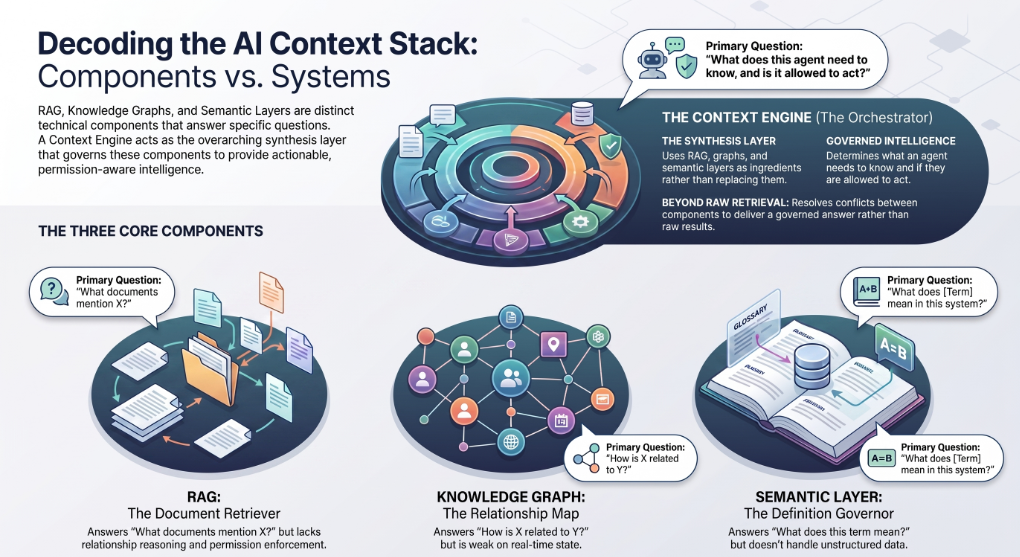
These terms get used interchangeably, and that's a mistake — they answer different questions.
RAG (retrieval-augmented generation) answers "what documents mention X?" It falls short on relationship reasoning, permission enforcement, and freshness — it's only as current as the last index run.
Knowledge graph answers "how is X related to Y?" It's strong on relationships but weak on real-time state and permission enforcement.
Semantic layer answers "what does 'revenue' mean in this system?" It governs definitions, not unstructured data or cross-system action.
Context engine answers "what does this agent need to know, who's asking, and is it allowed to act on it?" It's the synthesis layer — it typically uses RAG, graphs, and semantic layers as ingredients, not replacements.
The short version: RAG, knowledge graphs, and semantic layers are components. A context engine is the system that decides which of those components to use, resolves conflicts between them, and hands the agent a governed answer rather than a pile of raw retrieval results.
Why AI Agents Fail Without One
An agent that only sees structured data — ERP tables, CRM fields, transaction logs — is working from roughly 20% of the real picture. The other 80% of enterprise truth lives in contracts, email threads, Slack approvals, and policy documents. An agent that can't read that context doesn't fail loudly. It executes confidently, on incomplete information, at a speed no human reviewer can keep up with. We've written about the mechanics of that specific failure mode in depth in [our piece on why AI automation agents hit a ceiling]
(https://www.ampcome.com/post/ai-automation-agents-context) — this guide focuses on what the fix looks like once it's actually built and running.
14 Context Engines in Action: Real Enterprise Examples
Each of these is a live production deployment. Names are withheld; industry, scale, and outcomes are representative of real results.
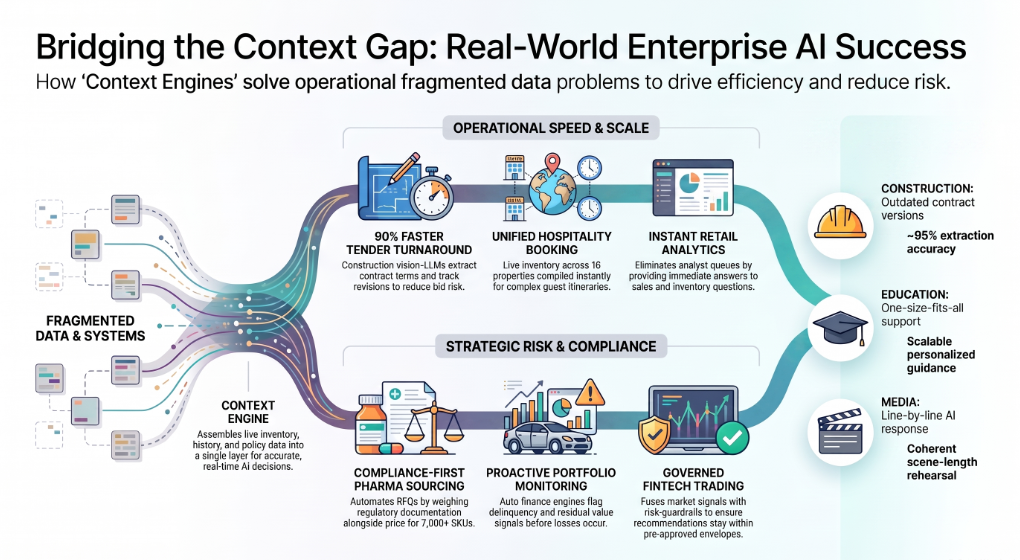
1. Luxury Hospitality — Booking Across 16 Properties Without Losing the Human Touch
The context gap: A luxury safari hospitality group operating 16 boutique lodges and camps across Kenya and Tanzania needed to handle complex booking requests — multi-property itineraries, date changes, special requirements — without the back-and-forth that erodes a premium guest experience.
What the context engine assembled: live inventory across all 16 properties, guest history and stated preferences, and itinerary constraints, all compiled in real time so a booking agent could propose real alternative dates and properties instead of just checking availability one email at a time.
Result: faster booking turnaround with less back-and-forth, higher accuracy on complex guest requirements, and scale without compromising the luxury experience the brand is built on.
2. Construction & Field Services — Keeping Tender Documents From Going Stale
The context gap: A remedial building and waterproofing specialist was processing complex tender documents manually — a process where a missed revision or an outdated version of a contract term creates real bid risk.
What the context engine assembled: a document workbench that tracks tender revisions and version lineage, extracting terms via vision-LLM parsing and syncing directly into core operations systems with full audit logs — so the agent is always reasoning from the current, authoritative version of a document, not a stale copy.
Result: tender document processing engineered for up to ~90% faster turnaround, ~95% extraction accuracy on standard formats, and reduced bid risk through revision and change detection.
3. Creator Economy — Campaign Context That Doesn't Drift Off-Brand
The context gap: A creator-economy platform matching brands with creators needed campaign recommendations and reporting that stayed accurate and brand-safe across a very large, constantly shifting creator dataset.
What the context engine assembled: creator profile data, campaign brief context, and brand-safety policy, fused into a single layer so discovery and reporting agents could operate without manual campaign-by-campaign babysitting.
Result: reduced manual operations across campaigns, faster performance visibility, and more consistent reporting and learnings across brand programs.
4. Auto Finance — Portfolio Risk Before It Becomes a Loss
The context gap: An independent automotive leasing provider needed earlier visibility into portfolio risk across a dealer network — delinquency, maturity, and residual value signals that were previously surfaced too late to act on.
What the context engine assembled: dealer, contract, and portfolio-risk objects linked into one relational context, so risk and exception signals could be flagged proactively instead of discovered at reporting time.
Result: better portfolio visibility, faster risk identification, and more proactive program management.
5. Fintech / Trading — Market Signals Without the Noise
The context gap: An AI-first trading terminal needed its network of specialized agents to synthesize fragmented, fast-moving market signals into disciplined, risk-bounded recommendations — not just faster noise.
What the context engine assembled: continuous ingestion of market data and indicator patterns, fused with explicit risk-guardrail context, so every recommendation the agents produced stayed inside a pre-approved risk envelope rather than an open-ended guess.
Result: faster synthesis of fragmented market signals, more disciplined decision-making through governed workflows, and reduced manual monitoring effort.
6. Media & Entertainment — A Scene Partner That Stays in Character
The context gap: An AI-powered self-tape and rehearsal app for actors needed its voice agent to hold full scene, character, and cue context across an entire rehearsal session — not just respond line by line.
What the context engine assembled: script ingestion and scene management combined with voice, pacing, and cue logic, so the "scene partner" agent remained coherent across a full take, not just a single exchange.
Result: higher rehearsal throughput without needing a human reader, more consistent audition practice, and reduced coordination friction.
7. Education — Personalized Guidance at Global Scale
The context gap: A global teacher community spanning more than a million educators across 131 countries needed to deliver personalized competency guidance — not generic support content — at a scale no support team could staff.
What the context engine assembled: a competency and learning-history profile per teacher, feeding a support agent that could answer program and learning queries with context specific to that educator, not a one-size-fits-all script.
Result: scalable support for a global educator community, faster access to learning resources, and better visibility into engagement and outcomes for program operators.
8. Scientific Research Infrastructure — Anomalies With a Named Cause
The context gap: A premier astrophysics research institute needed campus-scale energy monitoring that pointed to a specific system when something went wrong — not a generic anomaly alert someone had to go investigate manually.
What the context engine assembled: sensor and utility data correlated with facility and asset relationships, so anomaly detection could name the affected system directly, alongside forecasting and optimisation recommendations.
Result: improved energy visibility, faster detection of inefficiencies, and more predictable operations through earlier alerting.
9. Pharma Sourcing — RFQs That Account for Compliance, Not Just Price
The context gap: A pharma sourcing and excipients platform listing more than 1,800 rare excipients and 7,500+ SKUs needed procurement decisions that weighed regulatory and quality documentation alongside price — not price alone.
What the context engine assembled: supplier catalogs, quality and regulatory documents, and pricing/lead-time history joined per SKU, so RFQ automation and supplier matching factored in compliance status as a first-class signal.
Result: faster procurement cycles, reduced vendor coordination overhead, and better price and lead-time competitiveness through the added visibility.
10. Capital Markets Research — Research That Stays Consistent With Itself
The context gap: A technical market-research platform publishing Elliott Wave and related pattern-based forecasts needed new research output to stay methodologically consistent with everything it had previously published — a hard problem to enforce manually at publishing volume.
What the context engine assembled: a rolling context of prior published calls and live indicator state, so new research and alerts stayed aligned with the platform's own established methodology instead of drifting.
Result: faster production of market insight packs, more repeatable research workflows, and better signal visibility through automated analytics.
11. Retail & E-Commerce — Instant Answers Instead of an Analyst Queue
The context gap: A high-velocity e-commerce and retail operation needed instant answers to recurring business questions about sales, inventory, and promotions — without every question waiting in a data analyst's queue.
What the context engine assembled: unified ingestion across sales, product, inventory, promotion, and customer-behaviour data, feeding a conversational analytics layer with automated KPI monitoring and exception alerting built on top.
Result: shorter analysis cycles for recurring questions, better visibility into product performance and promotional effectiveness, and reduced day-to-day dependency on manual reporting.
12. Healthcare Services — One Workflow From Booking to Reporting
The context gap: A private healthcare and testing provider running high-volume consumer workflows needed booking, processing, and reporting to operate as one connected workflow instead of three disconnected steps prone to dropped handoffs.
What the context engine assembled: booking and workflow orchestration context tied to live status monitoring, so customer notifications and operational reporting stayed synchronized with what was actually happening in the service pipeline.
Result: more scalable operations with reduced manual overhead, faster customer communications, and improved service visibility through unified reporting.
13. Consumer Services — Turning a Funnel Into a Managed Journey
The context gap: A multi-branch driving institute needed visibility into where prospective customers dropped off between enrolment, lessons, and testing — and where instructor capacity was being wasted.
What the context engine assembled: funnel analytics context spanning enrolment through test completion, joined with instructor utilisation and scheduling data, feeding customer-experience dashboards and alerts.
Result: reduced operational bottlenecks, better scheduling efficiency, and clearer visibility into what was actually driving conversion.
14. Marketing & Brand Strategy — Synthesizing Signal Across Channels
The context gap: A brand insights and creative strategy studio needed to turn scattered creative performance and audience signals into a coherent point of view fast enough to inform live campaign decisions.
What the context engine assembled: multi-source ingestion across creative, performance, and audience signals, feeding insight agents that produced themes and recommendations rather than raw dashboards someone still had to interpret.
Result: faster creative-strategy cycles, deeper signal synthesis across channels, and clearer answers to "what should we do next" for live campaigns.
Why assistents.ai Is a Different Kind of Context Engine
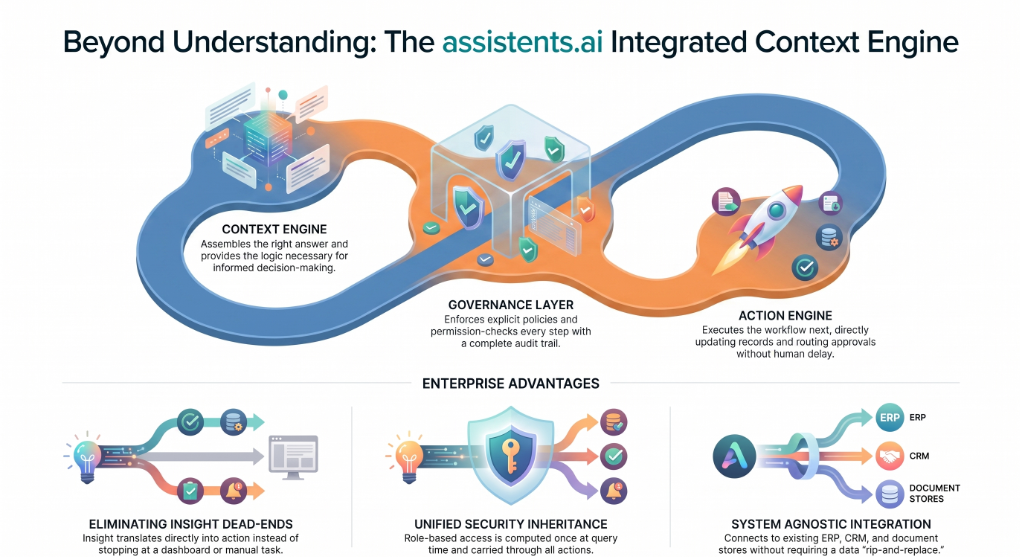
Most of what gets called a "context engine" today — including several products literally named that — stops at understanding. It resolves the right answer, hands it back to a human or another system, and its job is done. That's real value. It's also only half the loop.
assistents.ai's Context Engine is one of three fused layers, not a standalone product: Context Engine → Governance Layer → Action Engine. The same context that informs a decision is what executes the workflow next — governed by explicit policy, permission-checked at every step, and logged for a complete audit trail. In practice, that means:
- Context doesn't dead-end in a dashboard. Once the engine assembles the right answer, the Action Engine can act on it directly — matching invoices, updating records, routing approvals — instead of waiting for someone to translate insight into action.
- Permissions are enforced once, and inherited everywhere. Row-level, role-based access is computed at query time by the Context Engine and carried through to every downstream action — not re-implemented per workflow.
- It's built for systems you already run. The engine connects to enterprise systems you already have — ERP, CRM, document stores, ticketing — rather than requiring a rip-and-replace of your data estate.
If you want the technical detail behind how this is architected — latency, failure-mode handling, and how it's benchmarked against RAG and search-first approaches — see the
[Context Engine Architecture deep-dive]
(https://assistents.ai/resources/context-engine-architecture) and
[Context Engines vs. Search-First AI] (https://assistents.ai/resources/context-engines-vs-search) on assistents.ai.
How to Evaluate a Context Engine for AI Agents
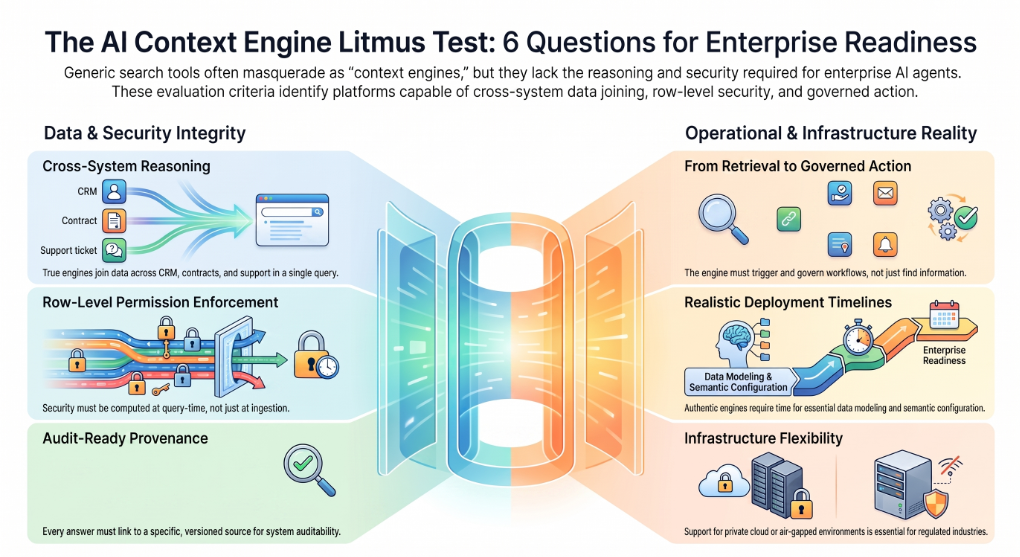
If you're comparing platforms, these are the questions that separate a genuine context engine from a search tool wearing the name:
1. Can it join data across systems in a single query?
Ask for a live demo: "What's our total exposure to this account across CRM, contracts, and support?" If the platform has to run three separate queries and a human stitches the answer together, it isn't doing cross-system reasoning — it's doing retrieval with extra steps.
2. Is permission enforcement row-level, or index-level?
Index-level filtering is applied approximately at ingestion. Row-level enforcement is computed at query time, for this specific person, in this specific role, right now. Only the second one holds up in a regulated environment.
3. Does every answer carry provenance?
If the agent can't show you exactly which source, and which version of that source, produced its answer, you don't have an auditable system — you have a plausible-sounding one.
4. Does it stop at retrieval, or can it feed a governed action?
Plenty of platforms demo beautifully on "find this" and go quiet on "now do this." Ask specifically whether the engine can trigger a workflow — and what governs that action once it's triggered.
5. What's the honest deployment timeline?
Real context-engine deployment involves data modeling and semantic configuration. A platform promising a two-week rollout for a complex enterprise use case is very likely offering search or RAG under a different name.
6. Does it support your actual infrastructure requirements?
Cloud-only is a dealbreaker for a lot of regulated industries. Ask directly whether private cloud, on-premise, or air-gapped deployment is genuinely supported — not roadmapped.
Why Enterprises Choose assistents.ai as Their Context Engine
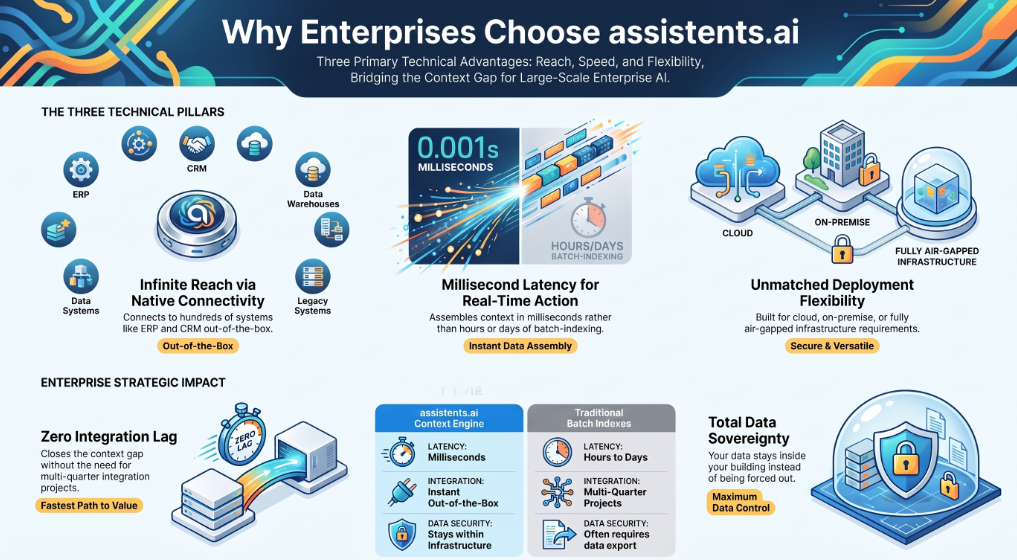
Enterprises evaluating this category consistently come back to three things: reach, speed, and deployment flexibility.
Reach.
assistents.ai's Context Engine connects to hundreds of enterprise systems out of the box — ERP, CRM, document stores, ticketing platforms, communication tools — so the "context gap" closes without a multi-quarter integration project.
Speed.
Context assembly is built to run in milliseconds, not the hours-to-day latency of batch-refreshed indexes — which matters the moment an agent needs to act on something that just happened, not something that was true this morning.
Deployment flexibility.
Cloud, private cloud, on-premise, or fully air-gapped — the platform is built to sit inside your infrastructure requirements instead of forcing your data to leave the building to get value from it.
If you're at the stage of comparing this category seriously, [see why enterprises choose assistents.ai](https://assistents.ai/why-assistents), or [book a demo](https://assistents.ai/contact) to see the Context Engine work against your own systems rather than a generic sandbox.
The Bottom Line
The 14 examples above span hospitality, construction, capital markets, education, pharma, and half a dozen other industries — and the common thread isn't the AI model behind any of them. It's the context infrastructure underneath. An agent that can see the full picture, respect who's asking, and act inside clear governance isn't a smarter agent. It's a differently-architected one.
If you're evaluating whether your enterprise needs a context engine, the fastest way to find out is to test it against a real workflow rather than a demo script. [Talk to assistents.ai] (https://assistents.ai/contact) about what that looks like against your own systems.
FAQs
What is a context engine?
A context engine is the infrastructure layer beneath an AI agent that connects enterprise data across systems, resolves what that data actually means, enforces permissions at query time, and attaches provenance to every answer — so the agent acts on governed context instead of a partial or stale view of the business.
What's the difference between a context engine and RAG?
RAG retrieves documents that are similar to a query and hands them to a model. A context engine goes further: it resolves relationships between data across systems, enforces permissions live, and can feed the result into a governed action. RAG is often one ingredient inside a context engine, not a replacement for it.
Is a context engine the same as a knowledge graph or a semantic layer?
No, though all three are frequently confused. A knowledge graph maps relationships between entities. A semantic layer governs what business terms mean. A context engine sits above both — it decides which of these (and other) sources to pull from for a given agent task, resolves conflicts between them, and applies permissions and provenance on top.
Do I need a context engine if I already use RAG?
If your agents only need to answer "what does this document say," RAG alone may be enough. If they need to reason across systems, respect role-based permissions, or take action based on what they find, you need the layer above RAG that a context engine provides.
Is "Context Engine" a specific product, or a category?
Both, depending on who you ask. Several vendors — including ServiceNow, Hyland, and assistents.ai — use "Context Engine" as the name for a product inside their platform, and all of them describe broadly the same category of infrastructure: a governed layer that gives AI agents business context before they act. If you're researching this space, it's worth asking any vendor specifically what their "Context Engine" connects to, how it enforces permissions, and whether it can trigger governed action — the name alone doesn't tell you the architecture underneath it.
How do context engines handle permissions and compliance?
A properly built context engine enforces permissions at the row level, computed at the moment of the query — not approximated when data was first indexed. Every action taken as a result is logged with a complete audit trail, which is what makes the system viable for regulated industries like healthcare, financial services, and utilities.
How long does it take to deploy a context engine?
Realistic timelines run from a few weeks for a single, well-scoped use case to a few months for a full enterprise rollout spanning multiple systems. Any platform promising a fully governed, cross-system deployment in a matter of days is almost certainly describing a search or RAG tool, not a genuine context engine.

Transform Your Business With Agentic Automation
Agentic automation is the rising star posied to overtake RPA and bring about a new wave of intelligent automation. Explore the core concepts of agentic automation, how it works, real-life examples and strategies for a successful implementation in this ebook.
Sarfraz Nawaz is the CEO and founder of Ampcome, which is at the forefront of Artificial Intelligence (AI) Development. Nawaz's passion for technology is matched by his commitment to creating solutions that drive real-world results. Under his leadership, Ampcome's team of talented engineers and developers craft innovative IT solutions that empower businesses to thrive in the ever-evolving technological landscape.Ampcome's success is a testament to Nawaz's dedication to excellence and his unwavering belief in the transformative power of technology.

More insights
Discover the latest trends, best practices, and expert opinions that can reshape your perspective







Contact us

