
What Are Context-Aware AI Agents? How They Work, Why They Win in Enterprise, and Real-World Results (2026 Guide)


Context-aware AI agents are autonomous AI systems that understand your business — not just your data. Unlike search tools or basic chatbots, they connect information across multiple systems, enforce role-based permissions, and take governed action on real workflows. In enterprise environments, this distinction separates AI that demos well from AI that actually works.
This guide covers what context-awareness means in practice, how the underlying architecture works, where most enterprise AI agents fall short, and what real production deployments look like across industries including retail, logistics, finance, energy, and healthcare.
The simple definition: what "context-aware" actually means
Most people use "context-aware" loosely. It's worth being precise, because the distinction has real consequences for enterprise AI deployments.
A context-aware AI agent is one that:
- Knows what data exists across your systems — not just what's in a single document or database
- Understands the relationships between that data (a customer ID linked to contracts, tickets, CRM activity, and invoices — not just a string of characters)
- Applies the right permissions dynamically — what Sarah sees differs from what Sarah's manager sees, which differs from what HR sees
- Can take action based on what it understands, governed by your policies and with full audit trails
Compare this to a standard search tool or RAG (retrieval-augmented generation) system. Those retrieve documents. Context-aware agents reason across systems and execute decisions.
The difference matters enormously at enterprise scale. A chatbot can discuss your invoice process. A context-aware AI agent can validate an invoice against authority limits, route it to the right approver, update the ledger, and flag exceptions — all without human intervention and all within your compliance rules.
Why most enterprise AI agents aren't truly context-aware
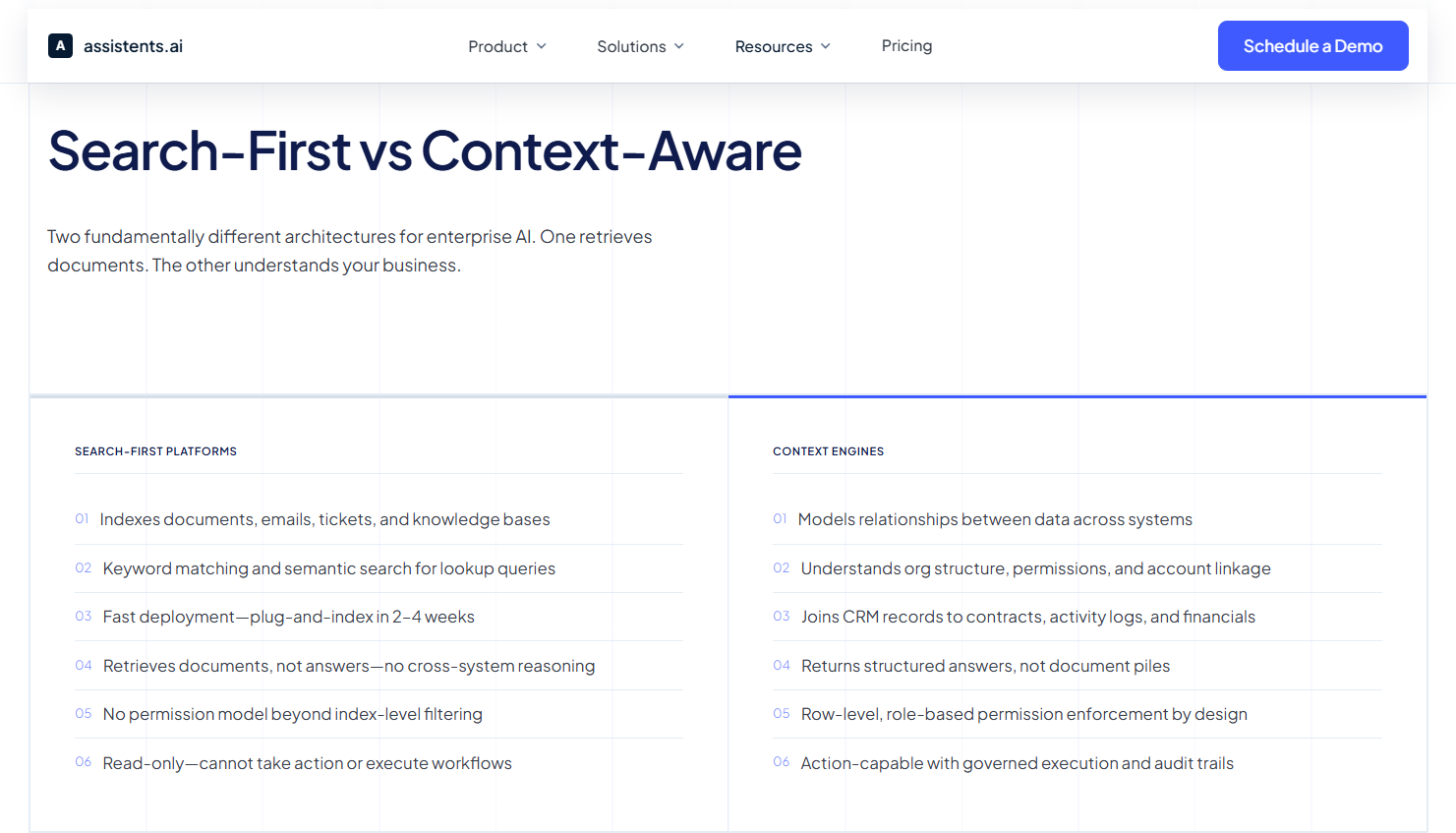
Here's the uncomfortable truth: most products marketed as "context-aware" are actually context-connected at best.
They can retrieve the right documents. They can pull data from the right tables. But they don't understand what that data means in the context of your business.
Consider the difference between an agent that retrieves your revenue table and one that knows:
- That "revenue" means gross in one business unit and net in another
- That this quarter's figures are provisional pending audit sign-off
- That the CFO's question about regional performance needs to be scoped to her direct remit, not the full P&L
The first agent has access. The second agent has understanding. Only the second is truly context-aware.
This gap — between context-connected and context-aware — is why so many enterprise AI deployments demo brilliantly and then quietly get turned off after the second or third wrong answer. The agent had the data. It just didn't understand it.
Building a genuinely context-aware agent requires more than a bigger context window or a cleverer prompt. It requires a governed context layer built underneath the agent — one that encodes your business semantics, your permission model, your data lineage, and your operational workflows.
How context-aware AI agents work: the 4-layer architecture
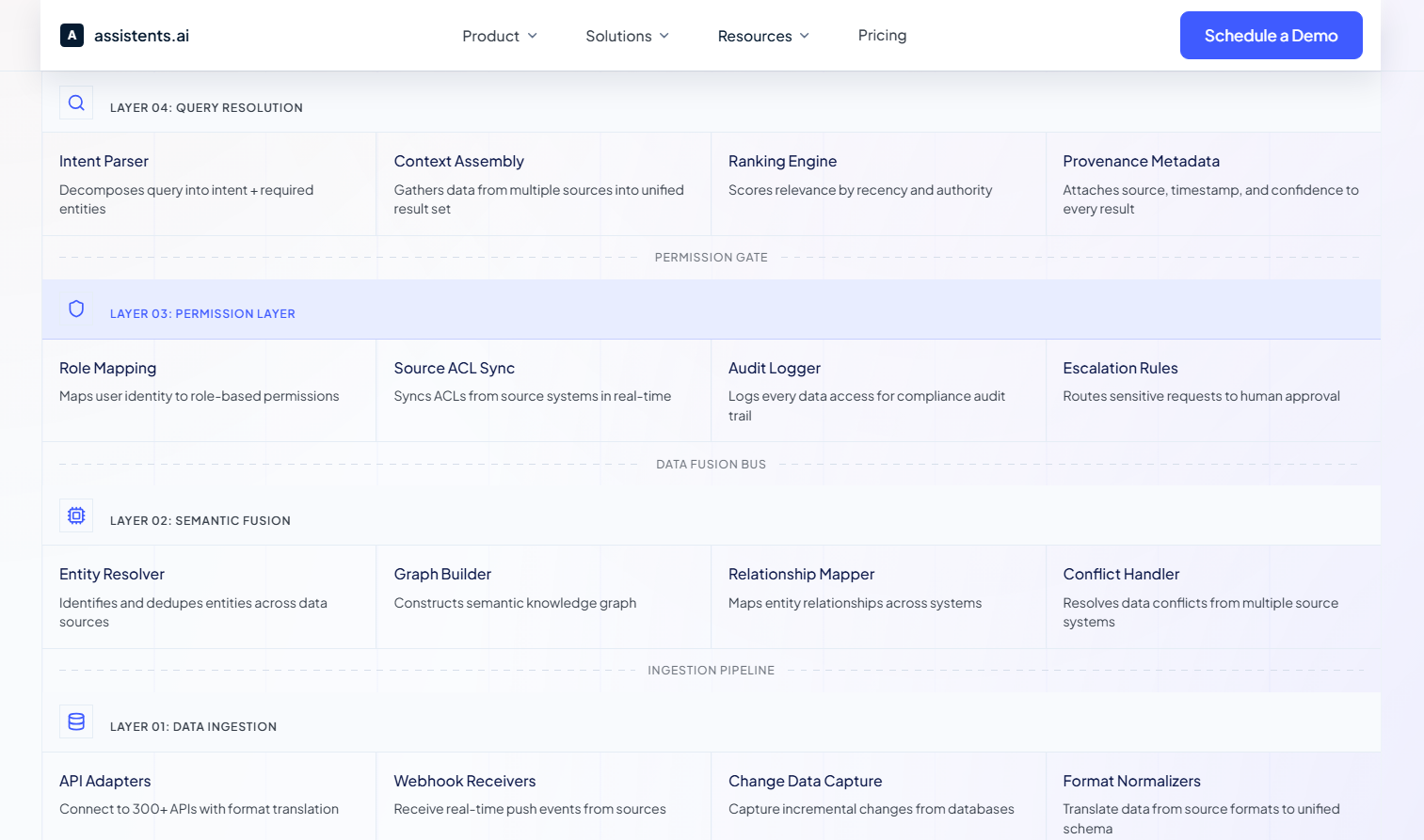
The architecture of a context-aware AI agent can be understood as four distinct layers, each essential to production-grade performance.
Layer 1 — System context (cross-system data modeling)
The foundation is a structured model of your enterprise data: not just the schemas, but the relationships, the business definitions, and the governance rules. This is where the agent learns that a "customer" record in your CRM connects to contracts in your document management system, tickets in your support platform, and payment history in your ERP.
Without this layer, the agent can retrieve data from each system individually but cannot reason across them. With it, a question like "What's our total exposure to this account?" returns a real answer — computed from live data across five systems — rather than a set of disconnected documents for a human to manually aggregate.
Layer 2 — Session memory (what the agent remembers mid-task)
Within any given workflow, a context-aware agent maintains a log of what it has done, what it has retrieved, and what decisions it has made. This is session memory.
Session memory is what allows an agent to handle multi-step processes coherently. When processing a complex tender document, for example, the agent needs to remember what it extracted from page 3 when it's validating data on page 47. Without session memory, each step starts from scratch — producing the kind of inconsistency that breaks enterprise workflows.
Layer 3 — Permission enforcement (row-level, role-based)
Enterprise data is not flat. The same query, issued by two different people, should return two different results — not because the answer is wrong, but because access is governed by role, seniority, department, and data classification.
Context-aware agents enforce this at the row level, by design, on every query. This is fundamentally different from index-level filtering (where search platforms apply approximate access controls at ingestion time). Row-level enforcement means the agent computes the correct answer for this person, in this role, at this moment — not a cached approximation.
This layer is also what makes context-aware AI agents viable for regulated industries. Healthcare, financial services, and utilities all require that AI systems cannot inadvertently surface data that a user isn't authorized to see. Row-level, role-based permission enforcement is the architectural feature that makes compliance possible — not a policy applied on top, but a constraint baked into every query.
Layer 4 — Governed action execution (not just retrieval)
The final layer is what separates context-aware agents from every search platform and most RAG systems: the ability to act.
A search-first tool is read-only. It finds things. A context-aware AI agent can execute workflows — creating SAP sales orders, routing invoices for approval, updating CRM records, dispatching alerts, generating reports — all governed by policy, with every action logged for audit.
This action layer is what enterprises actually need. The goal is not to surface information faster. The goal is to reduce the gap between insight and execution. Context-aware agents close that gap by taking governed action directly, within defined authority limits, with full traceability.
Context-aware vs search-first vs RAG: what's the real difference?
It helps to see these three architectures side by side. The differences are not subtle.
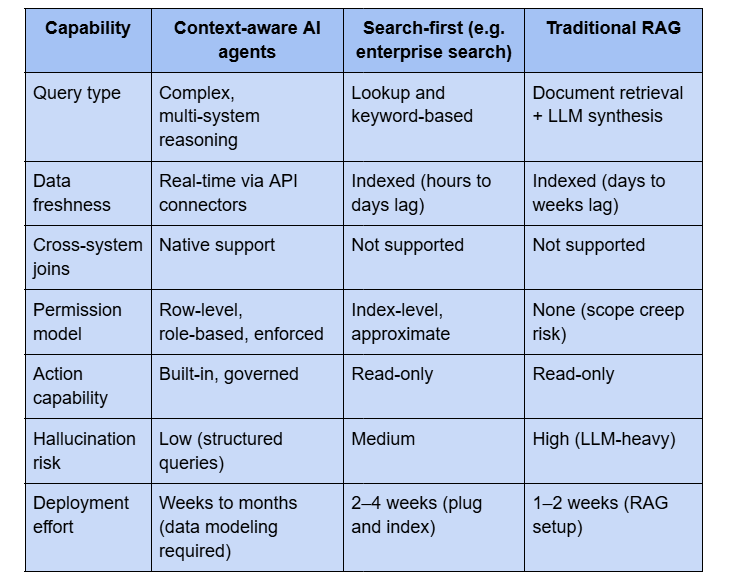
The key insight in this table: search-first platforms are excellent at known-item lookup. If you know what you're looking for, they find it fast. But enterprise decisions don't start with "find this document." They start with "help me understand our position on this account," or "flag the invoices that fall outside policy," or "tell me which stores are underperforming and why." Those questions require cross-system reasoning, governed execution, and role-aware output. That's the domain of context-aware AI agents — not search.
For a deeper technical breakdown of these architectural differences, see our Context Engines vs Search-First AI guide and Context Engine Architecture deep-dive.
7 real-world enterprise use cases with results
The following deployments are drawn from production implementations across industries. Client names are not disclosed, but industry, scale, and outcomes are representative of real results.
Use case 1 — National retail (700+ stores): store operations, inventory, and training
A rapidly scaling national value retailer with more than 700 stores across hundreds of cities needed to eliminate the manual helpdesk burden on store staff, improve inventory visibility at the store level, and accelerate onboarding for new hires.
The solution combined three context-aware AI agents working in parallel: a voice support agent (operating in multiple languages) that handles live store queries; an inventory intelligence agent that surfaces real-time pricing, stock levels, and promotional data per store; and a knowledge and training agent built on RAG over POS documentation and standard operating procedures.
Results included a measurable reduction in manual helpdesk load, improved store-level inventory visibility, and faster onboarding through on-demand training guidance. The context layer connecting these three agents to live store systems is what makes real-time, role-appropriate answers possible at this scale.
Use case 2 — Global ports and logistics leader ($20B+ annual revenue): terminal-to-rail operations
One of the world's largest port and logistics operators needed to digitise and optimise complex terminal-to-inland logistics workflows that were previously managed through manual coordination and fragmented systems.
Context-aware AI agents were deployed to handle terminal workflow digitisation, yard and rail operational dashboards, rail scheduling and visibility, and exception management. Executive dashboards with operational alerts gave leadership real-time visibility across a portfolio spanning multiple continents.
Outcomes included higher predictability of terminal-to-rail throughput, more efficient coordination across terminal and inland logistics operations, and a shift from reactive reporting to proactive operational management. The scale of cross-system integration — across terminal management, rail scheduling, and logistics operations — is precisely the use case where context-aware architecture outperforms any search or reporting tool.
Use case 3 — Global fintech for banks and credit unions: omnichannel AI with audit trails
A cloud-based fintech provider serving banks and credit unions deployed omnichannel AI agents to handle dispute resolution, fraud detection, and compliance operations — workflows that carry strict regulatory requirements for traceability.
The implementation covered omnichannel intake across chat, email, and phone; agent-assist summarisation with next-best-action recommendations; and full auditability with SLA monitoring integrated into core banking systems.
Results included faster case handling, reduced operational load through automation, and improved compliance readiness through audit trails that satisfied regulatory review. The permission enforcement layer was critical: different staff roles in a bank have fundamentally different access rights, and the agents enforced this at the row level on every interaction.
Use case 4 — State power utility (smart grid operations): context-aware monitoring and alerting
A state-level electricity transmission utility responsible for delivering reliable power across an entire region deployed AI agents to manage what was previously a labour-intensive process of monitoring transmission infrastructure.
Context-aware agents were built to ingest smart grid data, detect anomalies and predict outages, produce operational dashboards, and automatically route alerts to the right field teams with prescribed resolution workflows.
Outcomes included higher operational visibility across grid operations, faster exception detection and response coordination, and a shift to proactive grid operations through continuous monitoring — replacing manual checks that could not operate at the speed or coverage the infrastructure required.
This use case illustrates a pattern common to critical infrastructure: the data is already being collected, but there is no layer to understand it in context, connect it to operational workflows, and take governed action in response. Context-aware AI agents provide exactly that layer.

Use case 5 — UAE real estate group: tenant support and procurement intelligence
A major real estate portfolio manager with diversified assets across multiple emirates deployed AI agents to automate tenant and customer support workflows end-to-end, while simultaneously introducing group-wide procurement and finance KPI alerting.
The tenant-facing agent handled query triage, rental and payment support, ticketing, and escalation to human teams — operating across web, WhatsApp, and email with a unified knowledge base over tenancy documents and SOPs. Separately, a procurement intelligence agent monitored purchase price trends, gross margin impact, early-payment analysis, and vendor performance across group entities, delivering automated alerts and scheduled insight packs to leadership.
Results included faster response times, lower contact centre load, consistent 24×7 tenant experience, earlier detection of margin erosion, and standardised finance and procurement intelligence across group entities. The two-agent deployment addressing both external (tenant) and internal (procurement) workflows is a strong example of how context-aware architecture scales across a diversified enterprise.
Use case 6 — Healthcare staffing platform: matching, scheduling, and compliance
A healthcare staffing platform connecting nursing professionals with facilities for flexible shifts faced a core operational challenge: matching the right clinician to the right facility at speed, while maintaining compliance with credentialing and scheduling rules.
AI agents were deployed across talent onboarding and credential capture, staffing request intake and matching logic, scheduling, notifications, and compliance workflows, and fill-rate and utilisation reporting.
Outcomes included faster fill cycles, lower scheduling friction, better workforce utilisation, and improved staffing responsiveness for facilities — all while maintaining the compliance requirements that govern clinical workforce management. The permission enforcement layer was essential: credentialing status, shift eligibility, and facility-specific requirements had to be enforced at the record level on every match.
Use case 7 — Global supply chain multinational: consolidated analytics across entities
An Indian multinational logistics and warehousing company serving customers across India, the UK, Europe, and the United States needed a single operational view across a complex multi-entity structure — something their existing fragmented reporting could not provide.
Context-aware AI agents consolidated KPIs across entities, standardised operational metrics, and provided cross-entity variance explanations through a governed analytics layer. Leadership gained a single source of truth for operational performance, reducing the time and effort previously consumed by manual cross-entity reconciliation.
Results included a single operational view across entities, faster leadership reporting and issue identification, and improved consistency of operational metrics — the kind of outcome that has an immediate impact on decision speed at the executive level.
What separates a context-aware agent from a chatbot or RPA tool?

This question comes up consistently, and the answer matters for anyone evaluating enterprise AI.
Chatbots respond to inputs. They match a query to a response, draw from a knowledge base, or generate text with an LLM. They do not understand your business data model, cannot join information across systems, and cannot take action beyond what their scripted logic allows. Context-aware agents understand relationships, enforce permissions, and execute.
RPA (robotic process automation) tools automate rules-based, deterministic tasks. They follow a fixed script: if this field contains X, do Y. They break when the script encounters something unexpected, require constant maintenance as interfaces change, and cannot reason through ambiguity. Context-aware AI agents handle multi-step reasoning, adapt to exceptions, and make governed decisions rather than following rigid rules.
The practical consequence: RPA is excellent for high-volume, highly predictable tasks where the process never varies. Context-aware AI agents handle the next layer up — processes that involve judgment, cross-system data, role-aware output, and exceptions. In practice, many enterprises deploy both: RPA for the deterministic layer, context-aware agents for the reasoning layer on top.
For a detailed comparison, see our AI Agents vs RPA guide.
How to evaluate whether an AI agent platform is truly context-aware
If you're evaluating enterprise AI agent platforms, these are the questions that reveal whether a system is genuinely context-aware or simply context-connected:

1. Can it join data across systems in a single query? Ask for a live demonstration: "What is our total exposure to this account across CRM, contracts, and support?" If the answer requires manually correlating outputs from multiple queries, the system is not doing cross-system reasoning.
2. How does it enforce permissions? Ask specifically: is permission enforcement row-level, or index-level? Index-level filtering (applied at ingestion) is approximate and can produce scope creep. Row-level enforcement computed at query time is the architectural standard for enterprise compliance.
3. What happens when the data model changes? Enterprise schemas change constantly. Ask how the platform handles schema changes, new integrations, and updated business definitions. A genuinely context-aware system has a semantic layer that can be updated without rebuilding the entire agent.
4. Is it read-only, or can it execute? Many platforms demo beautifully with retrieval use cases and stop there. Ask specifically: can the agent create a record, update a system, route a workflow, or trigger an approval — and if so, what governance controls govern those actions?
5. Can you audit every action? In regulated environments, auditability is not optional. Every action the agent takes should be logged, traceable, and reviewable. Ask to see the audit trail from a demo workflow before committing.
6. How does it handle regulated data? For industries with specific compliance requirements — healthcare (HIPAA), financial services (SOC 2, GDPR), energy (operational security) — ask how the platform enforces data handling rules at the agent level, not just at the infrastructure level.
7. What is the actual deployment timeline? Context-aware architecture requires data modeling, semantic layer configuration, and integration work. Any platform claiming a two-week deployment for complex enterprise use cases is almost certainly offering a search-first or RAG architecture — not genuine context-awareness. Honest timelines range from four weeks for targeted use cases to several months for full enterprise deployment.
For a comprehensive framework for evaluating enterprise AI platforms, see our Enterprise AI Buyer's Guide and AI Agent Governance Playbook.
The Industries where context-aware AI agents deliver the highest ROI

Based on production deployments across verticals, the highest-value use cases share a common pattern: complex, multi-system data environments with high operational volume and significant consequences for errors.
Financial services and banking — dispute resolution, fraud detection, compliance reporting, cross-entity analytics, and customer support workflows all benefit from the combination of cross-system reasoning and row-level permission enforcement. The audit trail requirement, which is regulatory in many jurisdictions, makes context-aware architecture the only viable option.
Retail and e-commerce — at scale (hundreds or thousands of locations), operational questions about inventory, pricing, promotions, and store performance cannot be answered manually. Context-aware agents provide always-on visibility and exception alerting that scales without adding headcount.
Logistics and supply chain — multi-entity, multi-geography operations generate operational complexity that breaks any tool relying on a single system view. Cross-system reasoning across terminal management, rail scheduling, warehousing, and customs workflows is where context-aware architecture proves its value.
Energy and utilities — transmission and grid operations generate continuous sensor data that must be monitored, correlated, and acted upon in near-real-time. Context-aware agents handle anomaly detection, outage prediction, and automated field dispatch in environments where manual monitoring is simply not feasible at the required coverage.
Healthcare — clinical workflows require the intersection of patient data, credentialing, scheduling, compliance rules, and facility requirements. The permission enforcement layer is especially critical: clinical data access must be governed precisely, not approximately.
Real estate and property management — large portfolios generate continuous tenant, financial, and operational data across assets that must be consolidated, monitored, and acted upon. Context-aware agents handle both tenant-facing workflows and internal procurement and finance intelligence simultaneously.
For industry-specific deployment guidance, see our solutions pages for Financial Services, Healthcare, Logistics & Supply Chain, and Energy & Utilities.
The bottom line
Context-aware AI agents are not a category of software. They are a capability — and right now, most platforms that claim it don't fully deliver it.
The enterprises seeing real results in 2026 are those that invested in the right architecture: a governed context layer that encodes business semantics, cross-system data relationships, and role-based permissions — underneath agents that can reason across that layer and take governed action on real workflows.
The use cases span every industry: national retailers eliminating manual helpdesk load across hundreds of stores, global logistics leaders digitising terminal-to-rail operations, utilities moving from reactive monitoring to proactive grid management, and healthcare platforms automating compliance-governed staffing workflows at scale.
The common thread is not the AI model. It is the context infrastructure underneath it.
If you're evaluating enterprise AI agent platforms, the questions that matter are not about model capability. They are about the context layer: how it's built, what it encodes, how permissions are enforced, and whether the system can act — not just answer.
Schedule a demo with assistents.ai to see context-aware AI agents in action across your specific systems and use cases. Or start with our Enterprise AI Buyer's Guide for a structured evaluation framework you can take into any vendor conversation.
Frequently asked questions:
What is a context-aware AI agent?
A context-aware AI agent is an autonomous AI system that understands your business data model, relationships between systems, role-based permissions, and operational workflows — and can take governed action based on that understanding. It goes beyond document retrieval or keyword search to deliver structured answers and execute real workflows.
How are context-aware AI agents different from chatbots?
Chatbots respond to queries using scripted logic or LLM generation from a static knowledge base. Context-aware AI agents understand cross-system data relationships, enforce permissions at the row level, and can execute workflows with governance controls and audit trails. The distinction is reasoning and action versus response and retrieval.
Can context-aware AI agents work with my existing systems?
Yes. Context-aware AI agent platforms are designed to integrate with existing enterprise systems — ERP, CRM, document management, support platforms, data warehouses — through API connectors without requiring data migration. The integration layer is what makes cross-system reasoning possible without rebuilding your data infrastructure.
How long does it take to deploy a context-aware AI agent?
Realistic timelines range from four to six weeks for targeted, well-scoped use cases to three to six months for full enterprise deployments involving multiple systems and complex data modeling. Platforms claiming two-week deployments for enterprise use cases are typically offering search or RAG architecture, not genuine context-aware agents.
What industries benefit most from context-aware AI agents?
Financial services, healthcare, retail, logistics, energy and utilities, and real estate all see strong results — specifically in use cases involving multi-system data, high operational volume, regulated data handling, and workflows that require both reasoning and action.
Are context-aware AI agents secure for regulated industries?
Yes, when built with the right architecture. The key features are row-level permission enforcement (not index-level filtering), compliance with relevant standards (SOC 2, GDPR, HIPAA, ISO 27001), on-premise or private cloud deployment options, and full audit trails on every action. Verify each of these specifically when evaluating a platform.
What is the difference between context-aware AI agents and RAG?
RAG (retrieval-augmented generation) retrieves relevant documents and feeds them to an LLM to generate a response. It is read-only, has no cross-system reasoning capability, and carries significant hallucination risk because the LLM is synthesising from retrieved text without a governed data model. Context-aware agents use a structured semantic layer to query data directly, enforce permissions, and execute actions — not generate text from retrieved documents.
How do context-aware AI agents handle permissions and compliance?
Properly built context-aware agents enforce permissions at the row level on every query — computed at query time, not approximated at ingestion. This means the agent returns exactly the data the requesting user is authorised to see, based on their role, department, and the current data classification rules. Every action is logged with full audit trails for compliance review.
What is a context engine?
A context engine is the infrastructure layer underneath a context-aware AI agent. It models the relationships between enterprise data sources, encodes business semantics and governance rules, and provides a structured, governed interface for agent queries. The quality of the context engine determines whether an agent is genuinely context-aware or merely context-connected.
How do I know if my enterprise is ready to deploy context-aware AI agents?
If you have data spread across multiple systems, operational workflows that require cross-system information, regulated data environments, or decision processes that are currently slowed by manual aggregation — you are ready. The starting point is identifying one high-value, well-scoped use case and deploying there before expanding.

Transform Your Business With Agentic Automation
Agentic automation is the rising star posied to overtake RPA and bring about a new wave of intelligent automation. Explore the core concepts of agentic automation, how it works, real-life examples and strategies for a successful implementation in this ebook.
Sarfraz Nawaz is the CEO and founder of Ampcome, which is at the forefront of Artificial Intelligence (AI) Development. Nawaz's passion for technology is matched by his commitment to creating solutions that drive real-world results. Under his leadership, Ampcome's team of talented engineers and developers craft innovative IT solutions that empower businesses to thrive in the ever-evolving technological landscape.Ampcome's success is a testament to Nawaz's dedication to excellence and his unwavering belief in the transformative power of technology.

More insights
Discover the latest trends, best practices, and expert opinions that can reshape your perspective


.jpg)

.jpg)
.webp)

Contact us

