
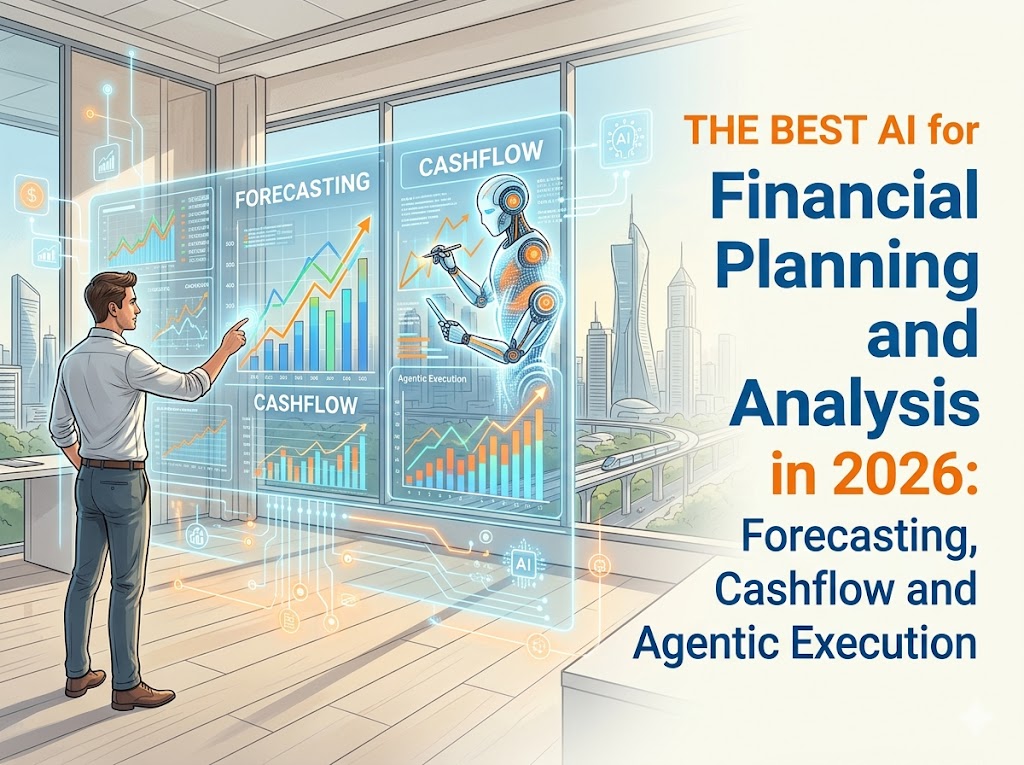
The Best AI for Financial Planning and Analysis in 2026: Forecasting, Cashflow and Agentic Execution


The numbers tell a sobering story. FP&A teams spend 75% of their time gathering data, reconciling spreadsheets and formatting reports. Only 25% goes to actual analysis. The work that finance exists to do — forecasting, scenario modelling, strategic guidance — gets squeezed into a fraction of the day. And despite billions spent on financial planning software, that ratio has barely moved in two decades.
AI is changing that. But not in the way most vendors want you to believe.
The AI in financial planning and analysis market is projected to grow by $48.86 billion by 2029, driven by a shift from periodic planning cycles to continuous, intelligent execution. AI adoption in FP&A surged from 6% in 2024 to a 41% increase in usage in 2025 alone — one of the fastest adoption curves in enterprise software history. Yet 53% of organisations still do not use AI in any FP&A process.
The gap between leaders and laggards is widening fast. The organisations closing it are not simply adding AI features to their dashboards. They are deploying agentic AI — systems that do not wait to be asked, but monitor, reason and act across the full financial workflow.
This guide explains what the best AI for financial planning and analysis actually looks like in practice: what it automates, how it integrates, and what separates a genuine AI finance deployment from a better-looking spreadsheet.
What Does "Best AI for Financial Planning and Analysis" Actually Mean?
Financial planning and analysis is not a single task. It is a continuous cycle: budgeting, forecasting, variance analysis, cashflow monitoring, scenario planning, reporting and executive decision support. Most AI tools address one part of that cycle. The best AI for financial planning and analysis addresses all of it — and connects those parts into an intelligent, governed workflow.
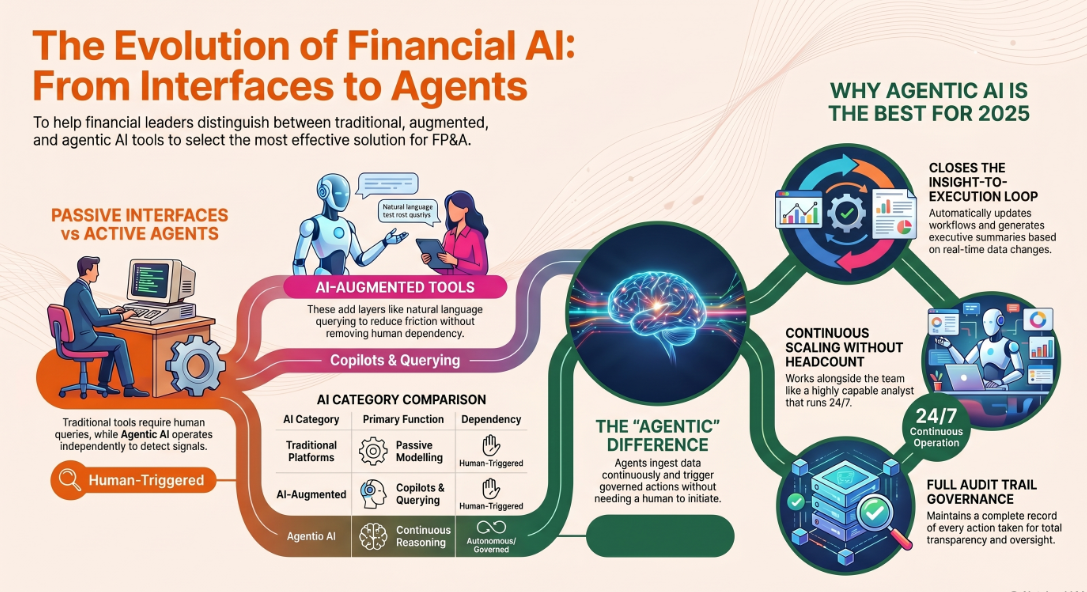
There are three distinct categories of AI currently being sold into FP&A teams. Understanding the difference is essential to choosing the right one.
Traditional FP&A platforms — tools like Anaplan, Workday Adaptive Planning, Cube and Planful — are planning interfaces. They help you structure your financial model, run scenarios and produce reports. They are useful, but they are passive. You query them. They respond. When conditions change, someone still needs to notice, log in, update the model and send a report.
AI-augmented tools are traditional platforms with AI layers bolted on — natural language querying, automated commentary, copilot features. These reduce friction. They do not remove the dependency on human-triggered action.
Agentic AI platforms are a different category entirely. They are not queried — they operate. They ingest data continuously, detect signals, reason through implications and trigger governed actions: alerts, workflow updates, executive summaries, system integrations. They close the loop between insight and execution without requiring a human to initiate every step.
The best AI for financial planning and analysis in 2025 is not a smarter interface. It is an agent — one that works alongside your finance team the way a highly capable analyst would, except it runs continuously, scales without headcount and maintains a full audit trail of every action it takes.
What Are the Core FP&A Workflows AI Is Transforming?
1. Cashflow Monitoring and Forecasting
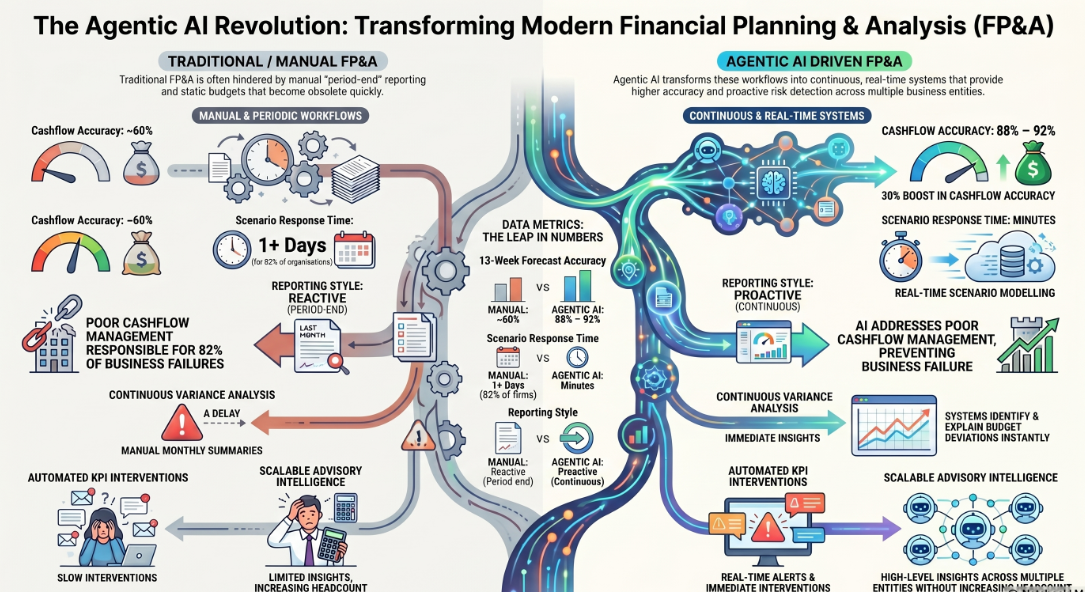
Cashflow forecasting is where the cost of manual processes is most visible and most expensive. Eighty-two percent of business failures are attributed to poor cashflow management — not bad products or wrong markets, but a failure to see the cash position clearly enough, early enough, to act.
Manual cashflow forecasting degrades quickly. Organisations using traditional or semi-automated methods achieve around 60% accuracy at the 13-week horizon, according to the AFP Treasury Benchmarking Survey. Organisations using AI-assisted forecasting achieve 88 to 92% accuracy over the same horizon. That 30-point gap translates directly into liquidity risk, working capital decisions and runway visibility.
Agentic AI for cashflow does not just run a forecast on demand. It ingests data continuously from accounting exports, banking APIs and ERP systems. It detects anomalies against expected patterns. It alerts finance leaders to runway risks before they become crises. It models the cashflow impact of decisions — a hiring plan, a delayed payment, a new contract — in real time.
For CFOs and financial advisors managing multiple clients or business units, this creates something that was previously impossible: advisory-quality cashflow intelligence at scale, without adding headcount.
What this looks like in production: An AI CFO platform deployed for a growing business delivers continuous cashflow monitoring, automated forecasting and scenario modelling with alerts on cash risks and anomalies — producing faster analysis cycles, earlier detection of cash shortfalls and scalable advisory-level insight across a portfolio of clients.
2. Budgeting and Scenario Planning
The annual budget is already obsolete by the time it is approved. Markets move too fast for static plans built on last year's assumptions. Only 18% of FP&A organisations can run scenarios in under one day, according to the 2025 FP&A Trends Survey. The remaining 82% take longer — or cannot run them at all.
AI transforms scenario planning from a quarterly exercise into a continuous capability. An agentic AI system can model multiple what-if scenarios simultaneously — a 10% revenue shortfall, a supply chain disruption, a new market entry — and surface the financial implications across P&L, cashflow and balance sheet in minutes, not days.
For organisations managing multiple entities, geographies or business units, this also means consolidation without the spreadsheet marathon. Multi-entity KPI standardisation, automated variance explanations and consolidated dashboards replace the week-long process of pulling numbers from disconnected systems.
What this looks like in production: For a global logistics and warehousing operator with operations spanning multiple continents, an AI analytics layer consolidated reporting across entities — producing a single operational view, faster leadership reporting and consistent metrics across a business that previously required significant manual coordination to align.
3. Variance Analysis and Automated Reporting
Every finance team produces variance reports. Most of them are produced the same way they were 15 years ago: an analyst pulls actuals, compares them to budget, writes narrative commentary and emails a PDF to leadership. That process takes days. By the time leadership reads it, the situation it describes has already changed.
AI-driven variance analysis runs continuously. The moment actuals deviate from plan beyond a defined threshold, the system identifies it, explains the likely driver and routes the alert to the right person. Natural language summaries replace manually written commentary. Dashboards update in real time rather than monthly.
The result is not just faster reporting. It is a shift from reactive reporting to proactive decision-making — which is exactly what CFOs say they want from their FP&A function but rarely get.
What this looks like in production: Across multiple deployments, organisations report moving from analyst-dependent, period-end reporting to continuous variance monitoring with automated narrative explanations — reducing reporting cycle time significantly and freeing finance teams to focus on interpretation and strategy rather than data assembly.
4. Procurement and Finance KPI Alerts
For holding groups, retail businesses and multi-entity organisations, financial intelligence is only as useful as it is timely. A margin erosion signal that surfaces three weeks after the quarter ends is a post-mortem. The same signal surfacing in real time is an intervention.
Agentic AI monitors procurement KPIs, vendor performance metrics, payment trends and gross margin movements continuously. It triggers alerts — to the right people, in the right format — when thresholds are breached. It identifies early-payment opportunities, flags vendor slippage and surfaces working capital risks before they compound.
What this looks like in production: For a multi-entity group operating across retail, building, industrial and services portfolios, an AI layer monitors procurement and finance KPIs group-wide — delivering automated alerts on purchase price trends, gross margin impact, vendor performance and early-payment analysis, with scheduled insight packs for leadership.
5. Revenue and Operational Analytics
Revenue management is not just a finance problem. It sits at the intersection of operations, sales, staffing and service delivery. AI for financial planning and analysis works best when it connects those domains — giving finance teams visibility into the operational drivers of revenue, not just the outcomes.
For healthcare operators, this means understanding staffing fill rates, billing cycle efficiency and care program performance in a single view. For retail businesses, it means connecting sales data, inventory, promotions and customer behaviour into a conversational analytics layer that answers business questions instantly rather than weeks later.
What this looks like in production: A healthcare staffing platform and a geriatric care services provider both deployed AI analytics to monitor revenue cycle performance, staffing utilisation and care program outcomes — improving visibility into revenue leakage, accelerating operational decision-making and giving leadership more reliable performance tracking.
What Separates an AI Agent from an FP&A Tool?
This is the question that matters most when evaluating AI for financial planning and analysis — and most vendor conversations avoid it.
An FP&A tool responds to queries. You open it, run a report, model a scenario, export a dashboard. It is useful when you use it. When you close it, it does nothing.
An AI agent operates continuously. It monitors your data. It detects conditions that match defined rules or learned patterns. It reasons through implications. And it acts — triggering alerts, updating workflows, creating tasks, integrating with downstream systems — without waiting to be asked.
The distinction is not cosmetic. It determines whether AI actually changes how your finance function operates or simply changes how you access information you already had.
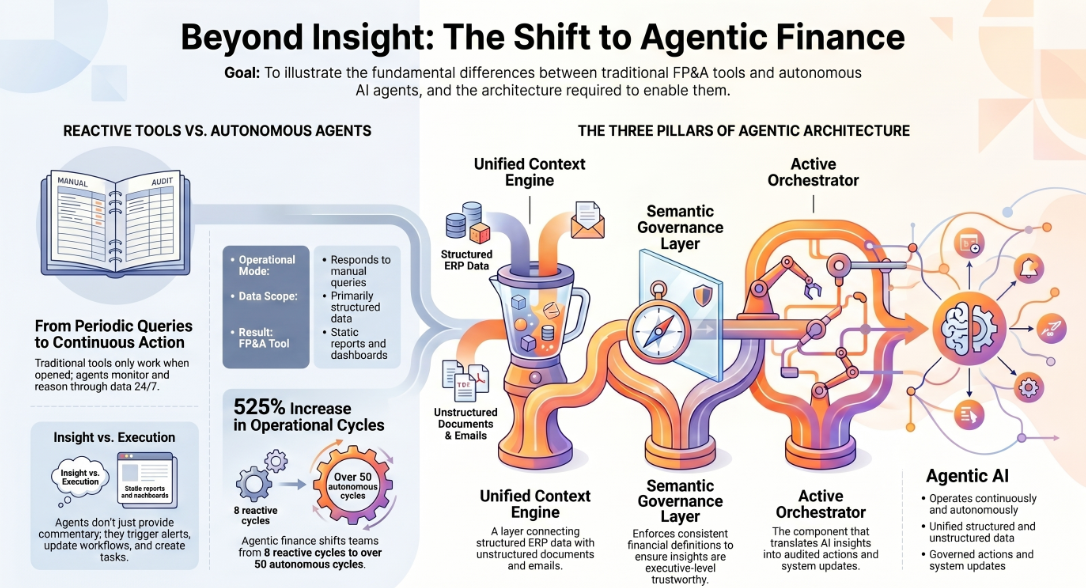
The architecture behind genuine agentic AI for finance has three components:
A Unified Context Engine that connects structured data (ERP, accounting systems, dashboards) with unstructured data (documents, emails, policy files) into a single, consistent layer the AI can reason across.
A Semantic Governance Layer that enforces consistent definitions — so "revenue" means the same thing in the AI's outputs as it does in your approved financial model, regardless of which system the data came from. This is not optional. Without it, AI-generated finance insights cannot be trusted at the executive level.
An Active Orchestrator that translates AI-generated insights into governed actions — creating tasks, routing approvals, triggering system updates, generating audit logs. This is the component that closes the loop between insight and execution.
Together, these components are what allow agentic AI to move an organisation from 8 reactive planning cycles per year to 50+ autonomous execution cycles — across the same teams, without additional headcount.
Most platforms marketed as "AI for FP&A" do not have this architecture. They have AI-generated commentary on top of a planning interface. That is a meaningful improvement over a blank spreadsheet. It is not agentic finance.
Real-World Proof: What AI-Driven FP&A Looks Like Across Industries
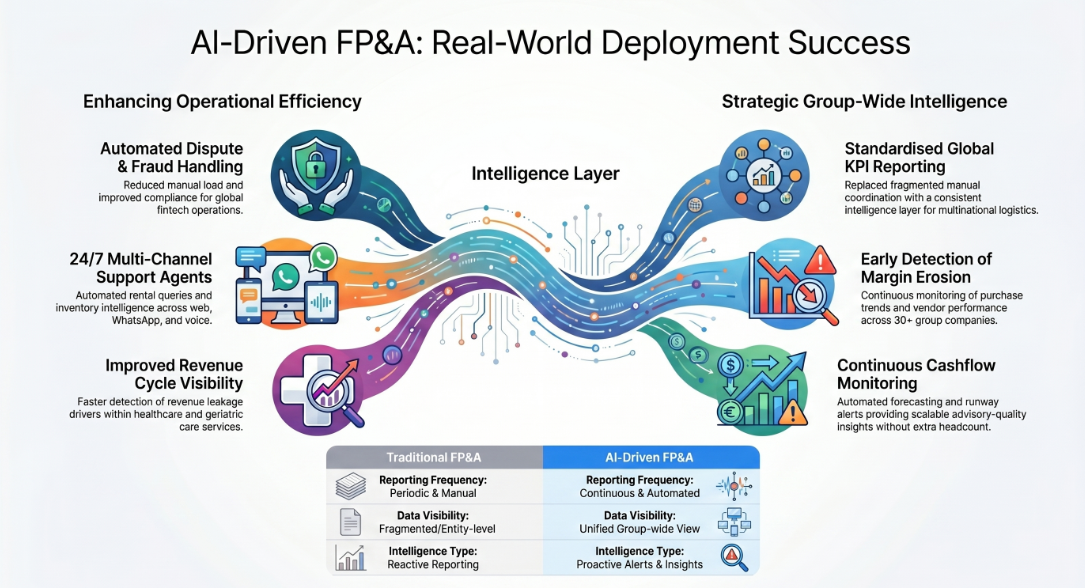
The best evidence for what AI can do in financial planning and analysis is not a benchmark study or a vendor whitepaper. It is production deployments — real organisations, real workflows, real outcomes.
The following examples are drawn from live deployments. No client names are included.
Global fintech serving banks and credit unions: Omnichannel AI agents deployed across dispute resolution, fraud triage, compliance workflows and banking support operations. The deployment delivers auditable automation across high-volume case handling — reducing manual operational load, improving compliance readiness and producing SLA monitoring with full audit trails. Faster case handling and measurable reduction in operational cost per case.
Indian multinational logistics operator (global footprint): Analytics consolidation across a multi-entity operation spanning India, the UK, Europe and the United States. Previously, cross-entity reporting required significant manual coordination to align. The AI layer standardised KPIs across entities, automated variance explanations and delivered a single operational view for leadership — replacing fragmented, entity-level reporting with a consistent group-wide intelligence layer.
UAE real estate portfolio owner (multi-emirate): A 24/7 tenant and customer service AI agent deployed across web, WhatsApp and email channels. The agent handles rental queries, payment support, FAQ triage, ticketing and escalation workflows — with a knowledge base built over policies, tenancy documents and SOPs. Outcome: faster response times, consistent tenant experience, reduced call-centre load and better SLA adherence through automated routing and tracking.
Value retail enterprise (700+ stores, pan-national footprint): Three AI agents deployed simultaneously — a voice support agent in Hindi and English, an inventory intelligence agent with pricing and stock visibility per store, and a knowledge and training agent built on POS and SOP documentation. Outcome: reduced manual helpdesk burden, improved store-level inventory visibility and faster staff onboarding through on-demand AI-guided training.
Global ports and logistics leader: Terminal and rail management solution digitising port-to-inland logistics operations. Executive dashboards, rail scheduling visibility, exception management and automated operational alerts replaced fragmented manual coordination across terminal and inland logistics teams. Outcome: higher predictability of terminal-to-rail throughput, more efficient coordination and improved operational visibility for leadership.
UAE multi-entity family business group (30+ companies): Group-wide procurement and finance KPI monitoring with automated alerts on purchase price trends, gross margin impact, early-payment analysis and vendor performance across entities. Leadership receives scheduled insight packs rather than assembling data manually. Outcome: earlier detection of margin erosion, standardised financial intelligence across group entities and reduced variance surprises through continuous monitoring.
AI CFO platform (global, serving growing businesses and advisors): Continuous cashflow monitoring, automated forecasting and scenario modelling agents — with runway alerts, anomaly detection and portfolio views for advisors managing multiple clients. Outcome: faster analysis cycles, earlier detection of cash risks, scalable advisory-quality insight without adding headcount.
Healthcare revenue and staffing operations: Two separate deployments — one for a physician-led inpatient care enterprise and one for a geriatric care services provider. Both used AI analytics to monitor revenue cycle performance, staffing fill rates, utilisation and care program outcomes. Outcome: improved visibility into revenue leakage drivers, faster operational decision-making and more reliable performance tracking for leadership.
These deployments span financial services, logistics, retail, real estate, healthcare and multi-entity holding groups. The pattern across all of them is the same: agentic AI deployed on top of existing data and systems — not replacing them — delivering continuous intelligence and governed action where there was previously periodic, manual reporting.
Key Criteria for Choosing the Best AI for Financial Planning and Analysis
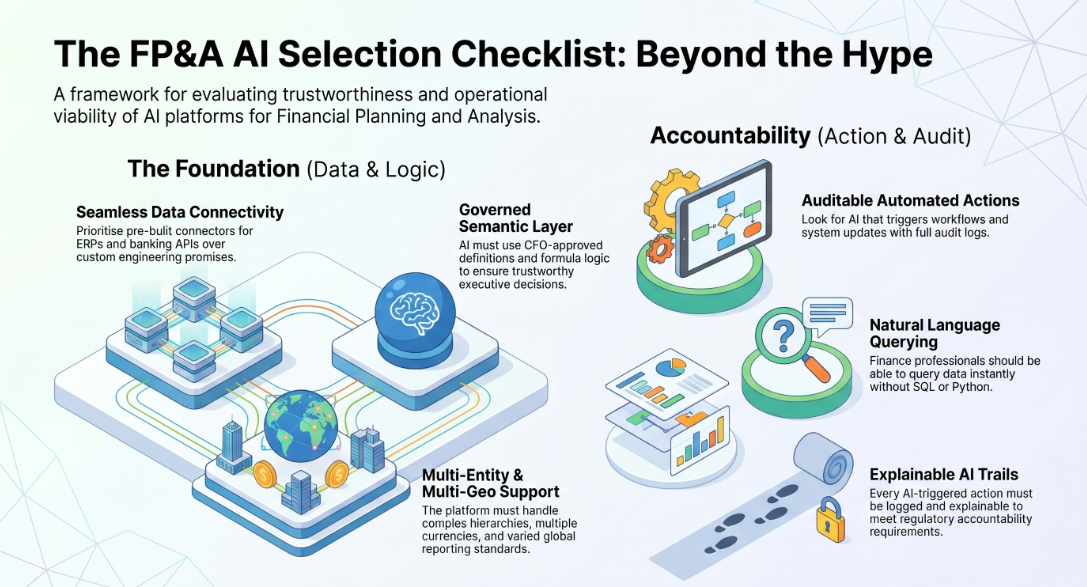
When evaluating AI platforms for FP&A, the right question is not "does it use AI?" Every vendor says yes. The right questions are about what the AI actually does and whether you can trust what it produces.
Use this checklist when assessing any AI financial planning platform:
1. Does it connect to your existing data sources? ERP, accounting exports, CRM, banking APIs, dashboards — the AI is only as good as the data it can access. Look for pre-built connectors and a clear data integration story, not a promise to "connect to anything" with six months of engineering work.
2. Does it have a governed semantic layer? When the AI says "revenue," does it mean the same thing your CFO means? Without a semantic governance layer that enforces consistent definitions, hierarchies and formula logic, AI-generated finance outputs cannot be trusted in executive decisions.
3. Can it take governed, auditable actions? If the AI surfaces a cashflow risk but cannot trigger an alert, create a workflow task or update a system, then your team still has to act manually on every insight. Look for platforms where the AI can execute — with full audit logs for every action taken.
4. Does it support multi-entity or multi-geography operations? Single-entity finance is relatively straightforward. Group-level finance — multiple entities, currencies, reporting standards — is where most AI platforms break down. If your organisation operates across subsidiaries, geographies or business units, this is a non-negotiable requirement.
5. Can finance users query it in natural language? The best AI for financial planning and analysis should be accessible to finance professionals without SQL, Python or a BI queue. Natural language querying — "what drove the margin decline in Q3?" — should return a governed, accurate answer instantly.
6. Is there a clear path from pilot to production? AI pilots that never make it to production are one of the most common and expensive outcomes in enterprise technology. Look for vendors who can define a production deployment, not just a demo.
7. Is every AI-triggered action logged and explainable? Finance decisions carry regulatory, legal and organisational accountability. Any AI action — an alert sent, a workflow triggered, an order processed — should have a complete, explainable audit trail. This is not a nice-to-have. It is a requirement for enterprise finance.
Why Most AI FP&A Tools Stop at the Dashboard
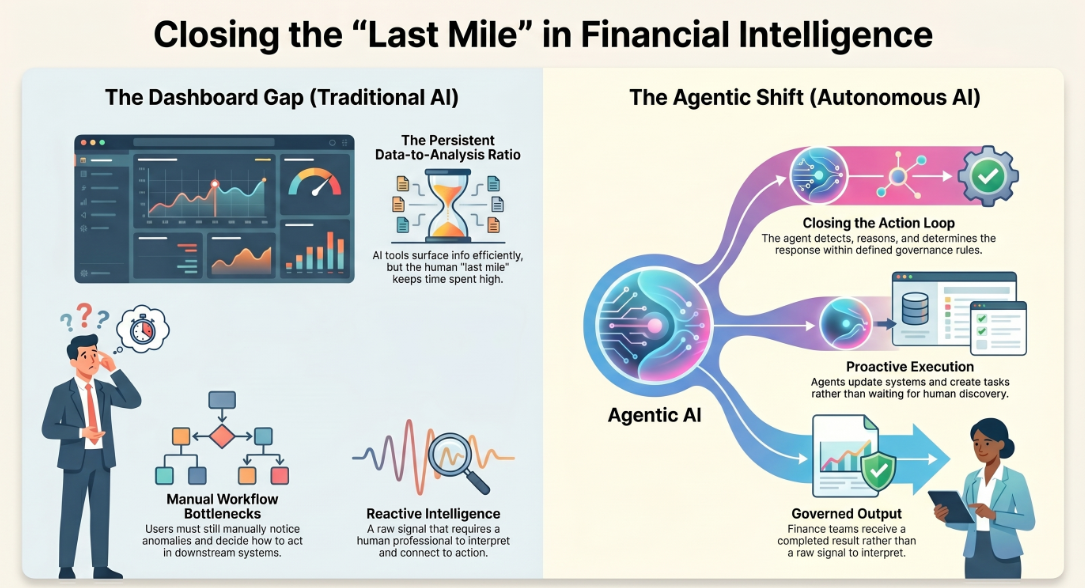
Here is the uncomfortable truth about most "AI for FP&A" products: they have made dashboards smarter, but they have not changed the workflow.
You still have to open the dashboard. You still have to notice the anomaly. You still have to decide what to do. You still have to act manually in downstream systems. The AI helped you understand the situation faster. But it did not close the loop.
This is why many finance teams that have adopted AI tools report that the ratio of time spent on data versus analysis has not changed as much as expected. The tools surface information more efficiently. But finance professionals are still the ones connecting that information to action — and that last mile is where most of the time goes.
Agentic AI is designed specifically to close that last mile. The insight does not sit in a dashboard waiting to be noticed. The agent detects it, reasons through it, determines the appropriate response within defined governance rules, and acts — routing the right alert to the right person, updating the right system, creating the right task. Finance professionals receive a governed output, not a raw signal to interpret.
The shift is from reactive intelligence to proactive execution. And it is the difference between AI that helps you understand your finances and AI that actively improves them.
How to Get Started With AI for Financial Planning and Analysis
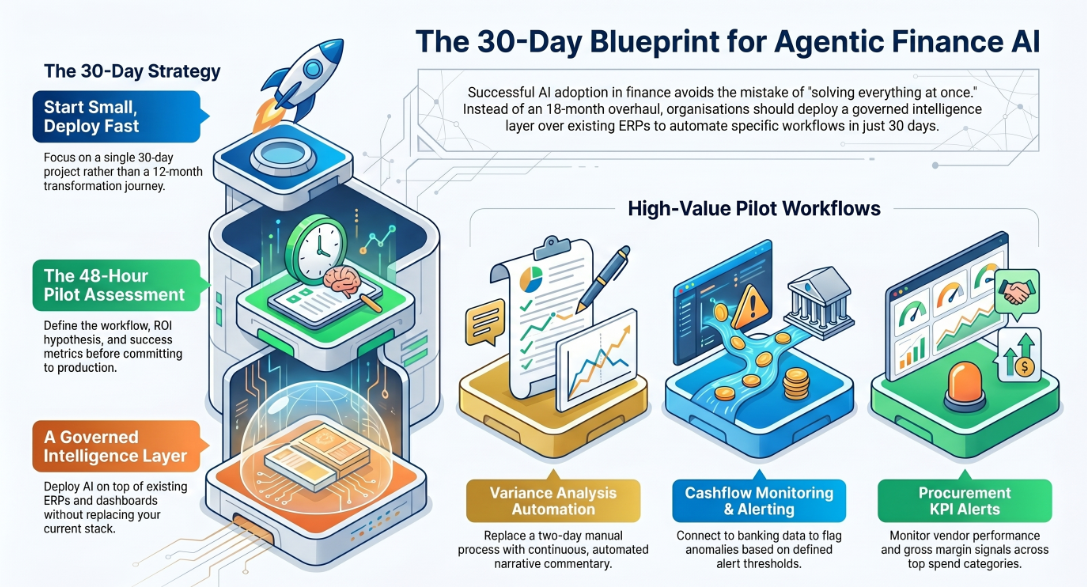
The most common mistake organisations make when adopting AI for FP&A is trying to solve everything at once. A full AI transformation of the finance function is a 12 to 18 month journey. A first valuable deployment is a 30-day project.
Start with one high-value, well-defined workflow. Good candidates for a first deployment:
- Cashflow monitoring and alerting — connect to your accounting or banking data, define alert thresholds, let the AI flag anomalies. High impact, low integration complexity.
- Variance analysis automation — automate the narrative commentary on your existing budget vs. actuals data. Replace a two-day manual process with a continuous, automated one.
- Procurement KPI alerts — monitor vendor performance, payment terms and gross margin signals across your top spend categories. Valuable for any multi-entity or retail operation.
You do not need to replace your existing stack to deploy agentic AI. The most successful deployments operate as a governed intelligence layer on top of existing ERPs, dashboards and BI tools. Your ERP still processes transactions. Your dashboard still visualises data. The AI connects those layers, reasons across them and acts on what it finds.
The path to full agentic finance starts with a single workflow, a defined success metric and a vendor who can deliver results in 30 days — not a roadmap that starts 90 days from now.
Assistents.ai by Ampcome offers a 48-hour pilot assessment that produces a concrete pilot plan, workflow definition, ROI hypothesis and success metrics before you commit. Deployments are in production in 30 days — or we walk.
The Bottom Line
The best AI for financial planning and analysis in 2025 is not the one with the most features. It is the one that actually changes how your finance function operates — shifting it from reactive, periodic reporting to continuous, governed, intelligent execution.
That shift does not require replacing your existing technology stack. It requires an agentic layer that sits on top of what you already have, connects the context your finance team needs, enforces the governance your organisation requires and closes the loop between insight and action.
The organisations deploying this architecture — across fintech, logistics, retail, real estate, healthcare and multi-entity holding groups — are not just reporting faster. They are making better decisions, earlier, with less manual effort and more accountability built in.
The question is not whether AI will transform financial planning and analysis. It already is. The question is whether your organisation will be a leader or a laggard in that transformation.
If you want to see what agentic AI looks like in your specific financial workflow, Assistents.ai offers a 48-hour pilot assessment — a concrete deployment plan, workflow definition and ROI hypothesis before you commit.
[Start your assessment at assistents.ai]
FAQs
What is the best AI for financial planning and analysis?
The best AI for financial planning and analysis is one that goes beyond dashboards and reporting interfaces to actively monitor financial data, detect anomalies, and trigger governed actions without requiring human prompts for each step. Agentic AI platforms — which combine a unified data context layer, semantic governance, and active orchestration — deliver the most significant operational impact. For teams that need forecasting, cashflow monitoring, variance analysis and multi-entity KPI management in one governed system, Assistents.ai by Ampcome is purpose-built for this use case.
Can AI replace FP&A analysts?
No — and that is not the right frame. AI for FP&A eliminates the 75% of analyst time currently consumed by data gathering, reconciliation and report formatting. It returns that time to analysis, interpretation and strategic advisory work. The FP&A function becomes more valuable, not smaller. Organisations that deploy AI for FP&A typically do not reduce headcount — they redeploy it toward higher-impact work.
How accurate is AI-based financial forecasting?
Significantly more accurate than manual methods. The AFP Treasury Benchmarking Survey found that organisations using AI-assisted treasury and cashflow tools achieve 88 to 92% forecast accuracy at a 13-week horizon, compared to 60% for organisations using manual or semi-automated methods. The accuracy advantage increases as the forecast horizon extends, because AI models learn from historical payment patterns rather than static analyst assumptions.
What is agentic AI in finance?
Agentic AI in finance refers to autonomous AI systems that can perceive financial data, reason through multi-step workflows, and execute decisions — including in ERP, CRM, banking and compliance systems — without requiring human prompts for each action. Unlike AI tools that respond to queries, agentic AI systems operate continuously, monitor for defined conditions, and take governed, auditable actions when those conditions are met. This is the architecture behind the shift from 8 reactive planning cycles per year to 50+ autonomous execution cycles.
What does an AI CFO agent do?
An AI CFO agent continuously monitors financial data — cashflow, forecasts, variance, runway, scenario impacts — and surfaces insights, alerts and recommendations to finance leaders and their advisors in real time. It connects to accounting exports, banking data and ERP systems, models what-if scenarios on demand, and delivers the kind of continuous financial intelligence previously available only to organisations with large finance teams. For growing businesses and CFOs managing multiple clients, it provides scalable advisory-quality insight without additional headcount.
What is the difference between AI FP&A tools and AI agents?
AI FP&A tools are planning interfaces with AI features — they help you build better models, generate commentary and visualise data. You query them; they respond. AI agents operate autonomously — they monitor data continuously, detect conditions, reason through implications and take governed actions without being asked. The practical difference: with a tool, your team still has to notice the cashflow risk and act on it. With an agent, the system detects it, alerts the right people and initiates the appropriate workflow automatically.
How does AI help with cash flow management?
AI helps with cashflow management by ingesting data continuously from multiple sources (accounting, banking, ERP), identifying deviations from expected patterns, flagging early warning signals for runway shortfalls, modelling the cashflow impact of decisions in real time and delivering probabilistic forecasts rather than single-point estimates. This replaces the weekly or monthly manual forecasting cycle with a continuous, self-updating view of the organisation's cash position.
How do companies use AI for budgeting and forecasting?
Leading organisations use AI for budgeting and forecasting in three ways: automating data consolidation across sources and entities, running multi-scenario simulations at speed (what-if on revenue, headcount, capex), and generating continuous rolling forecasts that update as actuals come in. Agentic AI adds a fourth capability — proactively alerting finance leaders when forecasts deviate from plan, without waiting for the monthly close cycle to surface the issue.

Transform Your Business With Agentic Automation
Agentic automation is the rising star posied to overtake RPA and bring about a new wave of intelligent automation. Explore the core concepts of agentic automation, how it works, real-life examples and strategies for a successful implementation in this ebook.
Sarfraz Nawaz is the CEO and founder of Ampcome, which is at the forefront of Artificial Intelligence (AI) Development. Nawaz's passion for technology is matched by his commitment to creating solutions that drive real-world results. Under his leadership, Ampcome's team of talented engineers and developers craft innovative IT solutions that empower businesses to thrive in the ever-evolving technological landscape.Ampcome's success is a testament to Nawaz's dedication to excellence and his unwavering belief in the transformative power of technology.

More insights
Discover the latest trends, best practices, and expert opinions that can reshape your perspective




Contact us

