
AI in Biotechnology Market 2026: Size, Growth, Trends and 15 Use Cases Reshaping the Industry


The AI in biotechnology market — the software, compute and services that apply machine learning to drug discovery, genomics, clinical development, biomanufacturing and biotech operations — is worth between USD 3 billion and USD 7.5 billion in 2026 depending on how each analyst draws the scope, with most estimates clustering between USD 4.6 billion and USD 7.5 billion. The consensus growth rate is about 19% a year, taking the market to USD 22–32 billion by 2035.
Those numbers appear on a dozen market-report pages. What none of them tells you is why the estimates differ, which use cases are actually in production, what changed in regulation this year, and how a biotech, CRO or life-sciences operator moves from pilots to governed production.
This guide covers all four, and it is written for the people who have to make that decision: R&D and clinical operations leaders, heads of data and IT, corporate strategy, and investors who want to see past the headline CAGR.
Key takeaways
- Size and growth: analysts put the AI in biotechnology market at USD 4.6–7.5 billion in 2026 and USD 22–32 billion by 2035, growing at roughly 19% a year. The spread comes from scope definitions, not from disagreement about the growth rate.
- Adoption follows verifiability: in Benchling's 2026 Biotech AI Report, the use cases with the highest adoption are literature review (76%), protein structure prediction (71%), scientific reporting (66%) and target identification (58%). Adoption drops sharply where data is fragmented — generative design, biomarker analysis and ADME.
- Regulators converged in 2026: the FDA and EMA jointly published ten Guiding Principles of Good AI Practice in Drug Development on 14 January 2026, and EU AI Act obligations for high-risk systems phase in from August 2026. Auditability, human oversight and lifecycle management are now purchase criteria.
- The fastest-growing budgets sit outside the lab: clinical operations, manufacturing and supply chain, regulatory documentation and cross-entity operations analytics are where AI is moving from experiment to workflow.
- Pilot-to-production is a governance problem, not a model problem. The organisations that get value run AI inside a governed operating layer with permissions, deterministic rules, approval gates and an audit trail — which is exactly the layer a platform such as assistents.ai provides above the systems a biotech already runs.
What is the AI in biotechnology market?
The AI in biotechnology market is the global spend on artificial intelligence software, hardware and services used to analyse biological data, automate research and operational processes, and support decisions across the biotechnology value chain, from target discovery to post-market surveillance.
Analysts segment it along five dimensions:
- Offering: software, hardware and compute, services (consulting, implementation, training, support) and end-to-end platforms that combine data management, analytics and automation.
- Technology: classical machine learning and deep learning, generative AI, natural language processing, computer vision and, increasingly, agentic AI that plans and executes multi-step work.
- Function or application: research and development (drug design, biomarker discovery, structure–activity modelling), clinical development (trial design, site selection, recruitment, data assessment, real-world evidence), regulatory compliance, manufacturing and supply chain, launch and commercial, post-market surveillance and patient support, and corporate functions.
- End user: pharmaceutical companies, biotechnology companies, contract research organisations, research institutes and laboratories, and healthcare providers.
- Deployment: cloud (public, private, hybrid, multi-cloud) and on-premise.
AI in biotech vs AI in pharma vs AI in healthcare vs AI in drug discovery
Much of the confusion in this market comes from four overlapping categories that analysts size separately.
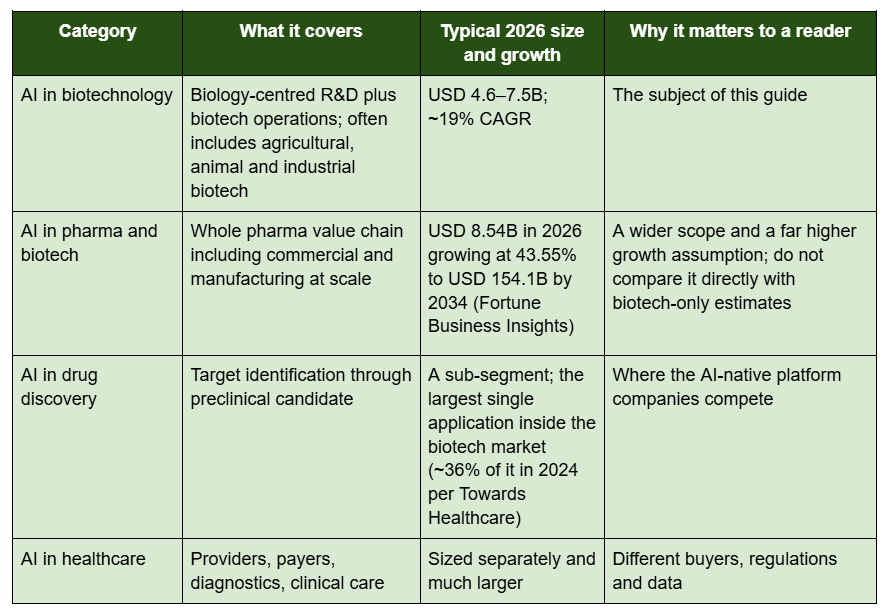
If a board deck shows the AI in biotechnology market at USD 4 billion on one slide and USD 8.5 billion on the next, the two slides are almost certainly using two of these scopes.
AI in biotechnology market size and growth, 2026–2035
Nine analyst estimates compared
No single report is wrong; they measure different things. Reading them side by side is more useful than picking one.
A separate Fortune Business Insights series on "AI in pharma and biotech" reports USD 8.54 billion in 2026 rising to USD 154.10 billion by 2034 at 43.55%. It is a different market definition and should not be averaged with the figures above.
Why the forecasts differ, and which number to use
Three things explain most of the spread.
- Scope. Whether agricultural and industrial biotechnology are included; whether NVIDIA's life-sciences compute and Illumina's sequencing analytics count as "AI in biotechnology"; whether the number is vendor revenue or end-user spend. Precedence and 360iResearch draw the widest boundaries and land at USD 6.7–7.5 billion for 2026; Towards Healthcare and MarketsandMarkets draw tighter ones and land near USD 4.6–4.9 billion; QYResearch counts only a narrow vendor set.
- Base year and revision cadence. Reports published in late 2025 use a 2024 base; the 2026 reports have rebased upward as more deals and deployments became visible. Most of the leading houses refresh quarterly.
- Growth assumptions. Here the analysts agree far more than the size figures suggest: seven of nine put the CAGR between 18.5% and 19.3%. The two outliers (360iResearch at 13.56%, Meticulous at 21.8%) reflect a shorter horizon and a genomics-heavy weighting respectively.
For planning, use the consensus band: USD 4.6–7.5 billion in 2026, roughly doubling every four years, USD 22–32 billion by 2035. For a board or investor document, pick one named source, state its scope, and use it consistently. For vendor selection, ignore the totals and look at the segment and adoption data below, which is what actually determines where budgets are being released.
Market share by segment
- By offering: end-to-end solutions held the largest share and are forecast to grow fastest at 19.9% (MarketsandMarkets), driven by demand for integrated platforms that combine data management, analytics and automation rather than isolated point tools. Precedence reports software as the largest offering segment in 2025.
- By function: research and development is the largest function and is projected to grow fastest through 2035; manufacturing and supply chain recorded the second-highest growth rate in 2024 as AI moved into production planning, inventory, logistics and predictive maintenance (MarketsandMarkets).
- By application: drug discovery and lead generation held roughly 36% of the market in 2024 (Towards Healthcare). Under the wider pharma-and-biotech scope, drug discovery and development is 29.8% of the market in 2026 (Fortune Business Insights). Genomics and gene editing is the fastest-growing application under Meticulous Research's definition; predictive modelling is the fastest-growing application under Precedence's.
- By technology: classical machine learning and deep learning models held about 30% of the market in 2024, while generative AI is the fastest-growing technology segment (Towards Healthcare).
- By end user: pharmaceutical companies are the largest buyers, at 36.2% of the market in 2024 (MarketsandMarkets) rising to an estimated 41.6% in 2026 (Coherent Market Insights), followed by biotechnology companies, CROs, research institutes and healthcare providers.
- By deployment: cloud dominates on scalability and collaboration grounds, but MarketsandMarkets flags on-premise growth driven by data security, privacy and regulatory requirements — a theme that recurs in every enterprise conversation about proprietary sequence data and patient-linked datasets.
Regional picture: North America, Europe, Asia-Pacific
North America held 42.6% of revenue in 2024 by MarketsandMarkets' count and about 50% by Towards Healthcare's, on the strength of venture capital, NIH funding, an innovation-friendly FDA and the density of pharma and biotech headquarters. The US market alone is estimated at USD 2.10 billion in 2025 rising to USD 12.3 billion by 2035 (Precedence Research), or USD 2.57 billion in 2026 rising to USD 12.82 billion by 2035 at 19.55% (Towards Healthcare). California and Massachusetts remain the primary hubs, with adoption spreading to Texas, the Mid-Atlantic, Midwest and Southeast.
Europe is a second centre of gravity. The UK leads on AI-driven drug discovery — Precedence cites CHARM Therapeutics' USD 80 million Series B for a menin inhibitor designed with its 3D deep-learning platform — with Germany, France and Switzerland close behind, and the EMA now co-authoring AI guidance with the FDA.
Asia-Pacific is the fastest-growing region in every forecast reviewed, led by China, Japan, South Korea and India.
India and Asia-Pacific
MarketsandMarkets attributes India's growth to a rising number of biotech start-ups and government support, and China's to foreign investment in biotechnology and biopharmaceuticals. Two of the most consequential AI-native drug-discovery companies, Insilico Medicine and XtalPi, are China-rooted and listed in Hong Kong. For Indian biotech, pharma and CRO operators — Ampcome is based in Bengaluru, one of the country's biotech clusters — the practical implication is that the same regulatory expectations arriving from the FDA and EMA will shape export-oriented programmes, and that the shortage of people who can bridge science and machine learning is at least as acute here as in Boston or Basel.
What drives the market, and what actually gates adoption
The report-level drivers are consistent across sources: the shift toward precision medicine; cross-industry partnerships between pharma, AI companies and academia; pressure to cut the time and cost of drug development; growing biotech investment (MarketsandMarkets counts more than 2,000 private and public biotech companies in the US); and the falling cost of sequencing, which produces more biological data than humans can analyse.
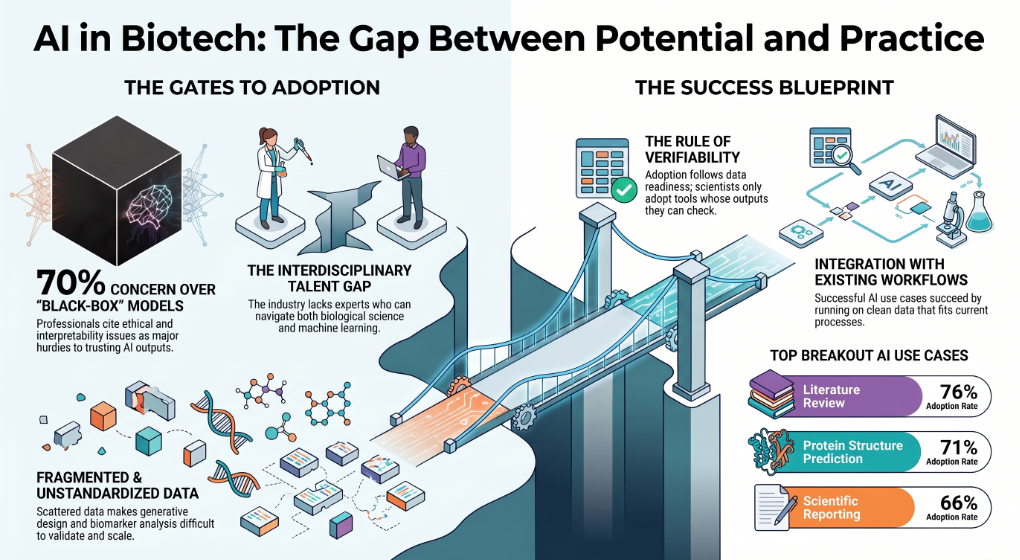
The restraints are equally consistent: implementation costs that put advanced platforms out of reach for smaller companies and emerging markets; data-privacy and compliance exposure; fragmented, unstandardised data; the black-box problem in advanced models — MarketsandMarkets, citing the Biocom Institute, reports that more than 70% of biotech professionals are concerned about ethical and interpretability issues; a shortage of people who understand both the science and the models; and regulation that is still being written.
What the reports miss is evidence of where adoption actually lands. Benchling's 2026 Biotech AI Report, based on a November 2025 survey of roughly 100 biotech and biopharma organisations already using AI, found four use cases that have broken out of pilot mode: literature review (76% adoption), protein structure prediction (71%), scientific reporting (66%) and target identification (58%). Its explanation is the most useful single sentence in the market: these use cases succeed because they run on clean, verifiable data that fits scientists' existing workflows, and their outputs can be checked against established knowledge. Adoption drops in generative design, biomarker analysis and ADME prediction, where data is scattered, incomplete and hard to validate. The report names talent — people who can navigate both science and machine learning — as the biggest challenge.
The lesson for anyone budgeting for AI in biotechnology: adoption follows verifiability and data readiness, not model capability. The most capable model in the world does not get adopted for a task whose output nobody can check.
Six trends shaping the AI in biotechnology market in 2026
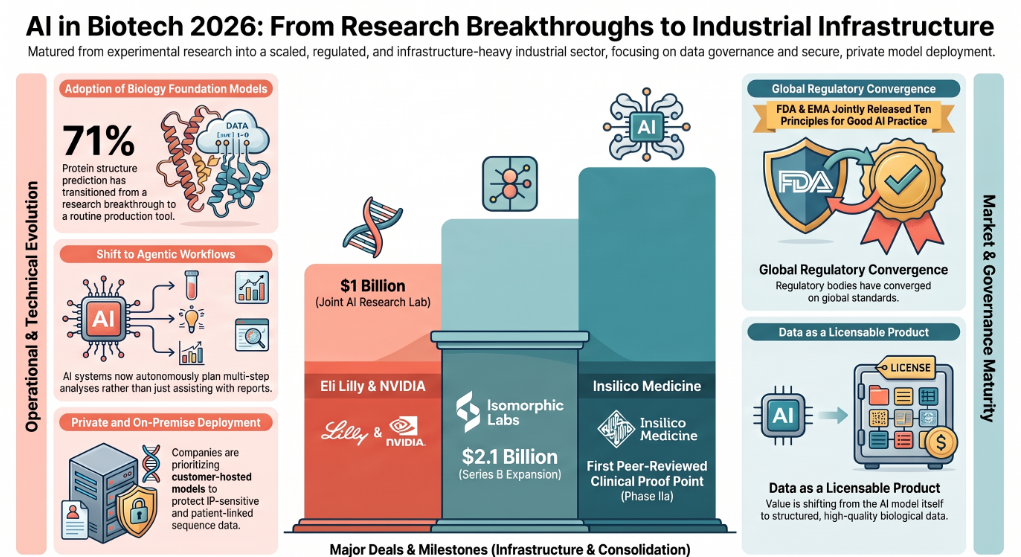
1. Biology foundation models are now operational tools
Protein structure prediction went from a research breakthrough to a routine step in under five years. AlphaFold 3, co-developed by Google DeepMind and Isomorphic Labs, extended prediction to biomolecular complexes including protein–DNA interactions and small-molecule binding, and the 2024 Nobel Prize in Chemistry recognised the field. At 71% adoption, structure prediction is now a production tool. Generative protein and small-molecule design is the next wave, but its adoption still lags because its outputs are harder to validate before a wet-lab experiment.
2. From copilots to agentic workflows
The first wave of AI in biotech was assistive: summarise a paper, draft a report, answer a question. The second wave is agentic: systems that plan a multi-step analysis, select and call tools, check their own results and hand back a reproducible artefact. The research community has already named this shift — a July 2026 Cell Genomics perspective coined "agentic genomics" and argued that it moves the bottleneck from building pipelines to validating them — and benchmarks published in 2026 found that planning errors, not execution faults, dominate agent failures. For a detailed treatment, see our guide to agentic AI in bioinformatics.
3. Infrastructure-scale deals replace one-off collaborations
The deal structure changed in 2025–26. In January 2026 Eli Lilly and NVIDIA announced a joint AI research laboratory in the San Francisco Bay Area with spending of up to USD 1 billion over five years — pharma building the factory rather than buying the output. The same week, AstraZeneca agreed to acquire Modella AI to accelerate oncology research. In May 2026, Isomorphic Labs announced a USD 2.1 billion Series B to expand its AI drug-design engine. Recursion's 2024 merger with Exscientia consolidated two of the largest AI-native platforms, and Insilico Medicine's Phase IIa result for an AI-discovered idiopathic pulmonary fibrosis candidate, published in Nature Medicine, gave the category its first peer-reviewed clinical proof point.
4. Regulators converged on governance
On 14 January 2026 the FDA and EMA jointly released the Guiding Principles of Good AI Practice in Drug Development: ten principles covering a risk-based approach, a clearly defined context of use, robust data governance, lifecycle management, multidisciplinary expertise, adherence to existing drug-development standards, human-centric values and transparent communication about AI systems. They are not binding, but both agencies have said they will underpin future guidance, and they follow the FDA's January 2025 draft guidance on the credibility of AI models used in regulatory submissions. In Europe, the EU AI Act's obligations for general-purpose models have applied since August 2025 and its high-risk obligations phase in from August 2026. The practical consequence for the AI in biotechnology market: auditability, human oversight, versioned validation and documented data lineage moved from nice-to-have to procurement criteria.
5. Data is becoming the product
Ginkgo Bioworks' Datapoints business treats high-quality, annotated biological data as a reusable product that can be licensed across organisations, and Eli Lilly's TuneLab gives biotech companies access to AI models trained on Lilly's proprietary data. Takeda's expanded partnership with Nabla Bio around protein-therapeutic design follows the same logic. Durable value is shifting from the model to how biological data is structured, contextualised and governed for downstream use.
6. Private and on-premise deployment for IP-sensitive and patient-linked data
Every analyst reports cloud as the dominant deployment mode, and every enterprise conversation about proprietary sequence data, unpublished assay results or patient-linked cohorts ends with a question about where the model runs. MarketsandMarkets attributes on-premise growth directly to data security, privacy and compliance requirements. The market expectation in 2026 is model independence — the ability to run a hosted frontier model for low-sensitivity work and a customer-hosted model for the rest, without rebuilding the application.
15 AI in biotechnology use cases (with real examples)
The use cases below are organised by the market's own function segmentation — R&D, clinical development, manufacturing and supply chain, commercial and post-market, corporate operations — so the section doubles as a guide to where the segment revenue is going. Each entry follows the same format: what the AI does, the evidence or example, adoption maturity, the governance risk, and where the value shows up.
Research and development
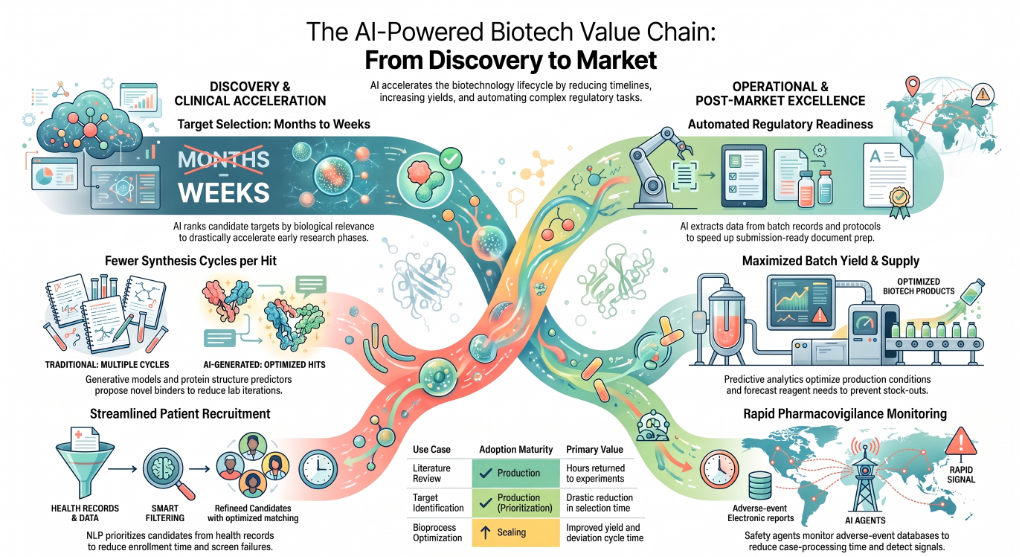
1. Target identification and validation. AI scans literature, omics datasets and knowledge graphs to rank candidate targets by biological relevance and druggability, then hands a shortlist to scientists. Evidence: 58% adoption in Benchling's 2026 survey; BenevolentAI-style biomedical knowledge graphs; Isomorphic, Recursion and Insilico platforms. Maturity: production for prioritisation; human-led for validation. Governance risk: confident target claims from thin evidence triggering expensive downstream work. Value: months to weeks on target selection. Disease-specific patterns are covered in our guide to AI agents in cancer research and oncology.
2. Protein structure prediction and generative molecular design. Structure predictors resolve targets and complexes; generative models propose novel binders and small molecules. Evidence: 71% adoption for structure prediction; AlphaFold 3; Isomorphic's drug-design engine; multiple AI-designed molecules in clinical trials. Maturity: production for structure; early for generative design. Governance risk: misuse boundaries on certain protein classes require policy controls; compute cost. Value: fewer synthesis cycles per validated hit.
3. Literature review and scientific reporting. Agents retrieve, summarise and cite sources, draft notebook entries and reports, and keep a growing knowledge base. Evidence: the two highest-adoption use cases in the Benchling survey (76% and 66%). Maturity: production. Governance risk: uncited or fabricated claims; contained by citation-grounded retrieval. Value: scientist hours returned to experiments.
4. Multi-omics analysis, biomarker discovery and bioinformatics workflows. Agents plan and execute RNA-seq, single-cell, variant and multi-omics analyses by calling established pipelines and tools. Evidence: published systems such as Biomni, AutoBA and CellAgent; adoption lags for biomarker analysis because data is fragmented. Maturity: benchmarked for standard designs; research-grade for novel biology. Governance risk: silent parameter choices that change results; reproducibility across tool and genome versions. Value: turnaround per analysis and reviewer time per run.
5. Predictive toxicology and ADMET. Models estimate absorption, distribution, metabolism, excretion and toxicity before synthesis. Evidence: Schrödinger's expansion of its platform to predict toxicology risk early, funded by a USD 10 million Gates Foundation grant (2024); low adoption in the Benchling survey because validation data is sparse. Maturity: early to scaling. Governance risk: over-trust in predictions for safety-critical decisions. Value: lower late-stage attrition.
Clinical development
6. Trial design, simulation and site selection. AI simulates protocol options, stratifies patients and scores sites on historical performance. Evidence: trial design and site selection are named sub-segments in MarketsandMarkets' function taxonomy; digital-twin and synthetic-control approaches are in active regulatory discussion. Maturity: scaling. Governance risk: any design change that affects a submission needs documented context of use under the FDA/EMA principles. Value: faster protocol finalisation and fewer amendments.
7. Patient recruitment and matching. NLP reads eligibility criteria and electronic health records to identify and prioritise candidates and personalise outreach. Evidence: Coherent Market Insights cites recruitment and retention as a primary adoption driver; recruitment is a named sub-segment across reports. Maturity: scaling. Governance risk: PHI exposure and bias in selection. Value: screen-failure rate and enrolment time. See our guide to AI agents in clinical trials.
8. Clinical data assessment and real-world evidence. Agents reconcile case-report data, flag anomalies and synthesise real-world evidence for safety monitoring and economic evaluation. Evidence: RWE analysis and clinical data assessment are MarketsandMarkets sub-segments; the FDA's own generative AI tool for reviews signals regulator readiness. Maturity: scaling. Governance risk: evidence generated by AI must be reproducible and documented. Value: faster database lock and query resolution.
9. Regulatory submissions and document intelligence. Agents extract structured data from protocols, certificates of analysis, batch records and regulatory correspondence; detect revisions between versions; write validated records into systems of record with an audit trail. Evidence: regulatory compliance is a distinct function segment across reports; the same pattern runs in production in adjacent industries (see the Ampcome patterns below). Maturity: production-ready with governance. Governance risk: unreviewed writes to a system of record. Value: document processing time and submission-readiness.
Manufacturing and supply chain
10. Bioprocess optimisation and quality control. Predictive analytics on production conditions, yield and deviations, with deterministic release rules. Evidence: manufacturing and supply chain recorded the second-highest growth rate among functions in 2024 (MarketsandMarkets); regulators explicitly include manufacturing in the January 2026 principles. Maturity: scaling. Governance risk: a model must never be the authority for a release decision; rules are. Value: batch yield, deviation cycle time.
11. Procurement, RFQ automation and supplier intelligence. Agents automate requests for quotation, match suppliers, handle quality and regulatory documents, and analyse price, lead time and vendor performance. Evidence: Ampcome pattern from a pharma excipients sourcing platform (below). Maturity: production. Governance risk: delegation-of-authority limits and maker–checker on ERP writes. Value: procurement cycle time, vendor follow-up effort.
12. Demand forecasting, inventory, logistics and facility energy. Forecasting for reagents and finished goods; inventory and logistics optimisation; anomaly detection and forecasting on utilities for labs and plants. Evidence: supply-chain planning, inventory, logistics, demand forecasting and predictive maintenance are MarketsandMarkets sub-segments; Ampcome pattern from a scientific research institute's campus energy programme (below). Maturity: production. Governance risk: acting on forecasts without human confirmation for high-value orders. Value: stock-outs avoided, energy cost, downtime.
Launch, commercial and post-market
13. Pharmacovigilance and adverse-event monitoring. Agents monitor adverse-event databases, literature and inbound reports, classify risk, assemble evidence and draft case narratives for safety teams. Evidence: adverse-event reporting and compliance monitoring are named post-market sub-segments; pharmacovigilance workflow automation is one of the areas the FDA/EMA principles explicitly anticipate. Maturity: scaling. Governance risk: every classification needs an explainability note and an escalation path to a human expert. Value: case-processing time and signal detection.
14. Patient support, adherence and communication. Voice and messaging agents handle reminders, follow-up instructions and adherence support, with every interaction logged. Evidence: medication adherence, patient monitoring and patient support programmes are post-market sub-segments. Maturity: production. Governance risk: PHI handling and consent; see our guide to AI agent use cases in HIPAA-regulated workflows. Value: adherence and call-centre load.
Corporate and operations
15. Governed insights-to-action analytics across entities. Continuous KPI monitoring — margin, vendor performance, working capital, service levels — that creates tracked tasks with standardised decision logic and approval, rather than another dashboard. Includes the laboratory order-to-report loop: booking, processing, reporting, status notifications and operational analytics. Evidence: Ampcome patterns from a retail holding group, a diversified family business group and a UK testing provider (below). Maturity: production. Governance risk: agents writing to systems of record without permission scoping or audit. Value: time from insight to action; missed handoffs.
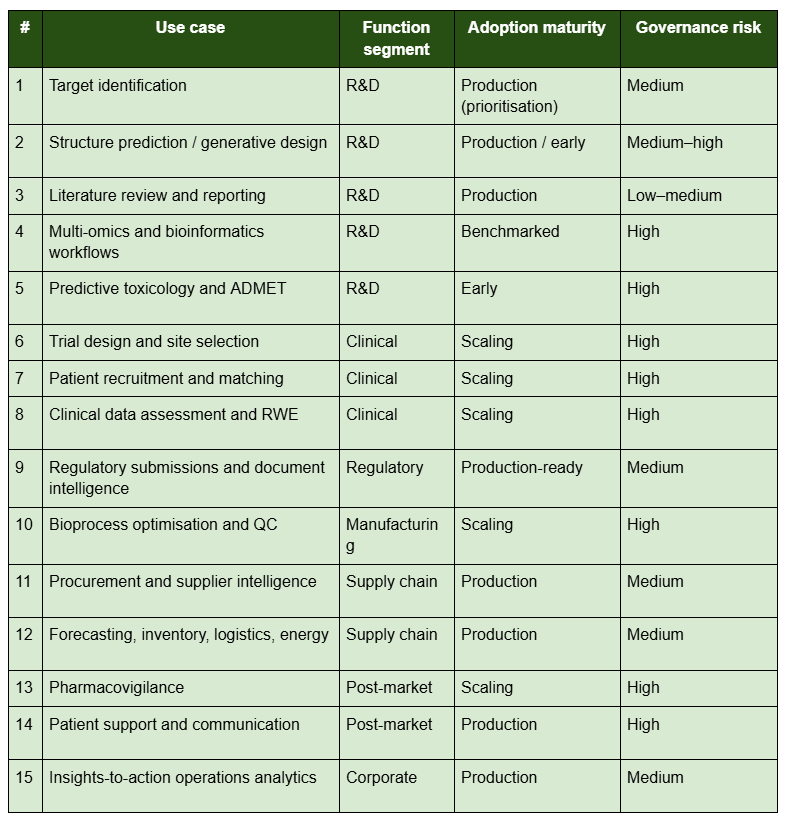
Use cases at a glance
What Assistents by Ampcome has delivered on adjacent problems
These engagements are not biotechnology deployments, and we will not describe them as such. They are the same agent patterns a biotech, CRO, laboratory or life-sciences operator needs, delivered by Ampcome in production-grade enterprise settings. Client names are withheld, and outcomes are stated as engineered targets rather than guarantees.
Sourcing automation for a pharma excipients platform. For a sourcing platform serving pharmaceutical supply chains with thousands of rare excipients and SKUs, Ampcome built RFQ automation and supplier-matching workflows, quality and regulatory document handling, and analytics on price, lead time and vendor performance. The engineered outcomes were faster procurement cycles, better sourcing visibility, less manual vendor coordination and stronger price and lead-time competitiveness. Reagent, consumable and CDMO sourcing for a biotech is the same problem (use case 11).
Order-to-report orchestration for a UK private healthcare and testing provider. Ampcome automated the booking → processing → reporting workflow for high-volume testing services, with status monitoring, customer notifications, reporting dashboards and operational analytics. Outcomes were more scalable operations with reduced manual overhead, faster customer communications with fewer missed handoffs, and unified service reporting. Any sequencing service, central lab or diagnostics operation will recognise the loop (use case 15).
Multi-agent document workbench for a remedial-construction specialist. Autonomous agents retrieve tender documents, determine the correct workflow, extract structured data from complex PDFs using vision-language models, detect revisions between document versions, and write validated records into the core operational system through full create-read-update-delete integration with quote locking and audit logs. The system was engineered for up to ~90% faster document processing and a ~95% extraction-accuracy target on standard formats, with bid risk reduced through change detection and auditability. Replace "tender" with "protocol", "certificate of analysis" or "regulatory submission" and this is use case 9.
Citation-grounded research automation for a tax-technology product. Agents collect sources automatically, summarise them, draft memos and positions with citations, track workflow state and build a growing knowledge base. Outcomes were faster research cycles, better documentation hygiene, less manual source-hunting and more consistent outputs — the same shape as a biomedical literature agent, with the same requirement that every claim traces to a source (use case 3). A related engagement for a cross-border tax-screening product added transaction risk classification, evidence collection with explainability notes and escalation to human experts: the triage pattern pharmacovigilance needs (use case 13).
Campus energy intelligence for an Indian scientific research institute. Ampcome built utility and sensor data ingestion, anomaly detection, forecasting and optimisation recommendations, with dashboards and proactive alerting. Outcomes were better energy visibility, faster detection of inefficiencies, less manual monitoring and more predictable operations. A biomanufacturing plant's utilities or a laboratory campus present the same data and the same alerting problem (use case 12).
Rules-governed ERP writes for an engineering and technology group. As part of a move away from an end-of-life document-workflow product, Ampcome delivered agentic automation that interprets order triggers, validates them, and creates SAP sales orders, with rules for exceptions and approvals, audit logs and reconciliation reporting. Outcomes were less manual order processing, a faster order-to-confirm cycle with fewer data-entry errors and better auditability. This is what writing safely to a LIMS, QMS or ERP looks like (use cases 10 and 15).
Governed insights-to-action for a retail holding group and a diversified family business group. For the first, Ampcome built an agentic analysis layer with a unified context engine over structured and unstructured data, a semantic governance layer of rules, hierarchies and formulas, and an orchestrator that converts dashboard insights into tracked, auditable tasks. For the second, automated procurement and finance KPI alerts across group entities — purchase-price trends, gross-margin impact, early-payment analysis and vendor performance — that surfaced margin erosion and vendor slippage earlier. Both are use case 15 with different data.
Who sells into the AI in biotechnology market: key players by layer
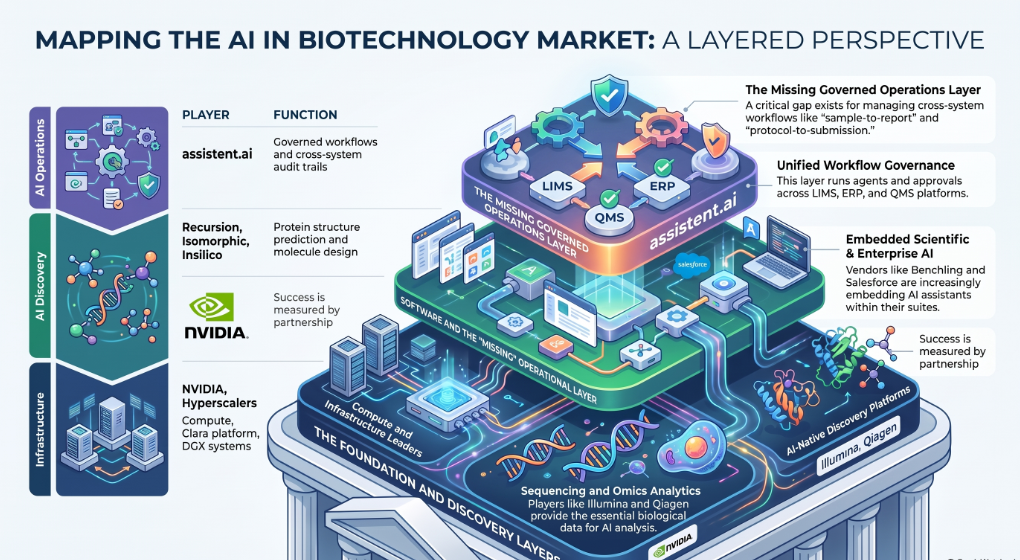
Ranking vendors by market share is not something an operator can verify, and most published lists rank by funding, which is the least useful number to act on. It is more useful to map the market by layer.
- Compute and infrastructure. NVIDIA is named the market leader by MarketsandMarkets on the strength of its Clara platform and DGX systems; the Lilly joint lab is the clearest signal of where this layer is heading. The hyperscalers sit alongside.
- Sequencing, omics data and analytics. Illumina (which launched a 50,000-sample UK Biobank proteomics pilot with pharma partners in January 2025), Qiagen, Tempus, SOPHiA Genetics, DNAnexus and Lifebit.
- AI-native discovery platforms. Recursion (post-Exscientia), Isomorphic Labs, Insilico Medicine, Schrödinger, XtalPi, BenevolentAI, Iktos, Generate Biomedicines, Xaira, insitro, Iambic and Genesis, plus India's Aganitha AI. This is the layer most "AI in biotechnology companies" lists describe, and where validation-by-partnership and peer-reviewed clinical data matter more than the size of the last funding round.
- Scientific operations software. Benchling and the LIMS, ELN and CTMS vendors, which increasingly embed AI assistants in their own applications.
- Enterprise suites adding agents. Salesforce Life Sciences, ServiceNow and Microsoft, each governing agents inside its own suite.
- The missing layer: governed enterprise AI operations platforms. Between the science tools and the suites sits the work nobody's product owns — the cross-system processes of a biotech: sample-to-report, protocol-to-submission, RFQ-to-purchase-order, deviation-to-CAPA, insight-to-task. A governed platform runs agents, workflows, deterministic rules and approvals across LIMS, ELN, CTMS, ERP, QMS and data platforms with a single audit trail. That is where assistents.ai belongs. It is worth being explicit about what it is not: assistents.ai does not predict protein structures or design molecules. It is the layer that puts those tools, and a company's operational processes, into governed production.
Challenges and risks of AI in biotechnology
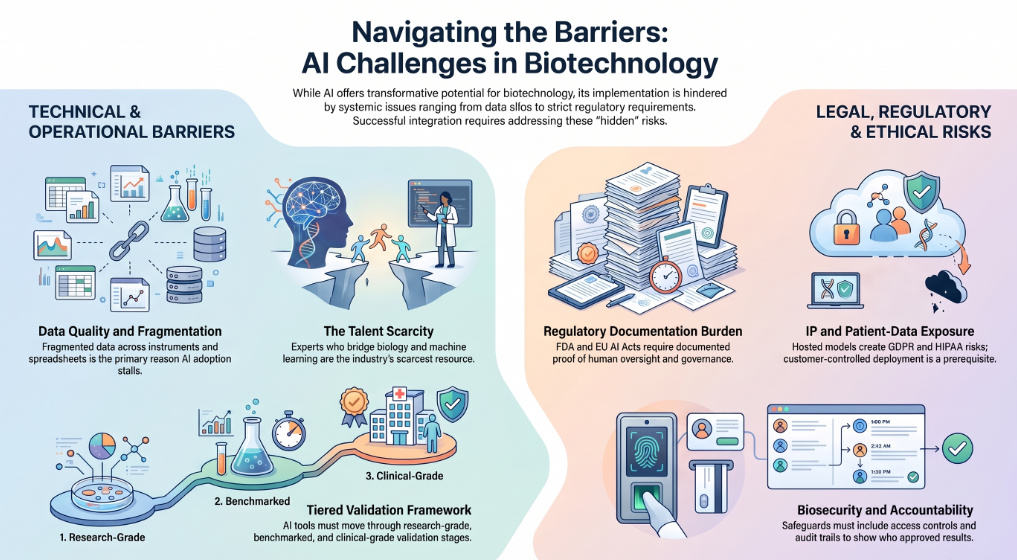
Any vendor page that skips this section should be read with suspicion.
- Data quality and fragmentation. Biotech data is scattered across instruments, notebooks, LIMS, spreadsheets and CROs, often without shared definitions. This is the single biggest reason adoption stalls outside the four breakout use cases.
- Validation and reproducibility. Unstated tool, genome and annotation versions produce false discrepancies; agent plans go wrong more often than agent execution. The field's own proposal is tiered validation: research-grade, benchmarked, clinical-grade.
- IP and patient-data exposure. Calling a hosted model with proprietary sequences or patient-linked data creates GDPR and HIPAA exposure. Model independence and customer-controlled deployment are prerequisites, not features.
- Regulatory documentation burden. The FDA/EMA principles and the EU AI Act ask for context of use, data governance, lifecycle management and human oversight to be documented, not asserted.
- Cost. Long agent runs with retries multiply inference and compute; per-run and per-agent budgets belong in the design.
- Talent. The people who can bridge biology and machine learning are scarce everywhere; Benchling's respondents name this as their biggest challenge.
- Dual-use and biosecurity. Some tools in this market sit in a dual-use space. Published perspectives on responsible AI in biotechnology describe safeguards such as tiered access controls, refusal mechanisms and the withholding of sensitive pathogen data from training sets; enterprise deployments need equivalent policy controls on what agents may do.
- Accountability. Someone has to own a result. A design that cannot show who approved what, with which evidence, will not survive a regulator, an auditor or a journal reviewer.
How to adopt AI in a biotech company: a 90-day approach
The organisations that get value do not start with a platform programme. They start with one costly, recurring, cross-system process that has a measurable baseline and a named owner, and they let the platform story pay for the second use case.
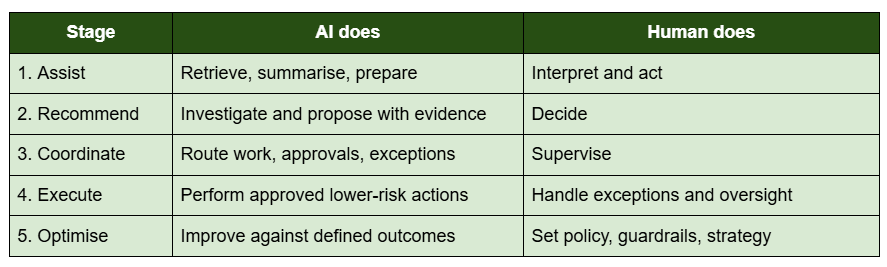
The autonomy ladder. Different decisions inside one process sit at different rungs, and that is more credible than a single blanket autonomy level.
A seven-item governance checklist before anything goes live.
- Define the data boundary: which data never leaves your infrastructure, and which models may see it.
- Build the tool registry: wrap approved pipelines, instruments, databases and internal systems as versioned tools; agents select from the registry, they do not improvise against production data.
- Write the rules: QC thresholds, release criteria, spend and delegation limits, and PII handling as deterministic rules the model cannot override.
- Assemble the evaluation set: golden datasets with known answers for each use case.
- Set the approval policy: which actions run autonomously, which need a named approver, and what context the approver sees.
- Run in shadow mode: agents run alongside the team for a fixed period; every divergence is reviewed.
- Go live on one workflow with monitoring: alerting on policy violations, drift and cost; a quarterly review of the evaluation set.
A realistic 90-day shape. Weeks 1–2, scope one process — literature-to-report, document extraction for regulatory or quality records, sample-to-report, or procurement — and fix the data boundary and model choice. Weeks 3–6, build the substrate: tool registry, rules, evaluation set, approval policy. Weeks 7–10, shadow mode. Weeks 11–12, controlled go-live on one workflow, with the second use case added only after the first passes its acceptance thresholds. Set target outcomes — turnaround time, proportion of runs passing validation without correction, reviewer time per run, zero policy violations — measure them before and after, and publish nothing you have not measured.
Why assistents.ai for AI in biotechnology and life sciences
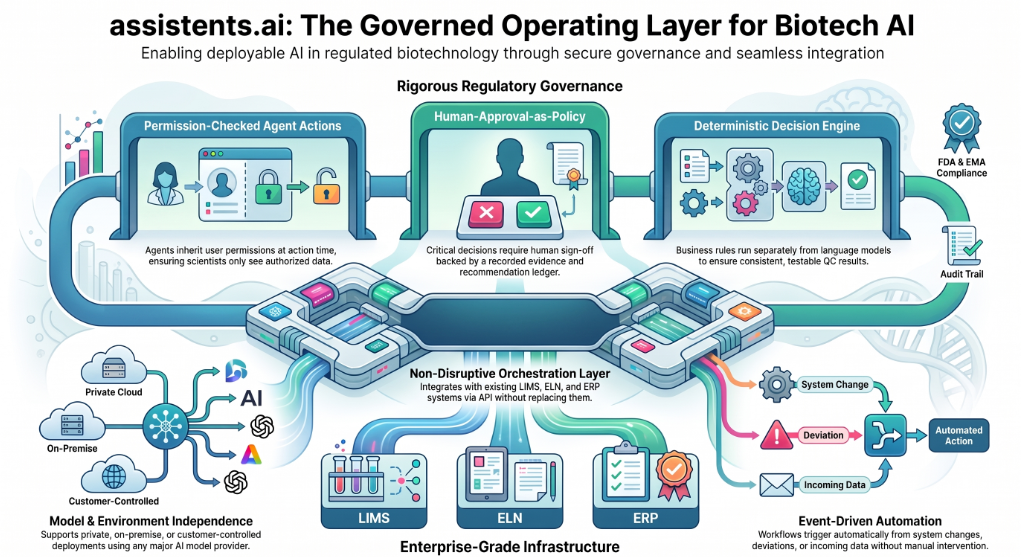
The market evidence in this guide points to one conclusion: the constraint on AI in biotechnology is no longer model capability; it is whether an organisation can run AI inside a governed operating layer that regulators, quality teams and data protection officers will sign. assistents.ai, Ampcome's enterprise agentic intelligence platform, is built as that layer — a context, governance, decisioning and action layer that sits above the LIMS, ELN, CTMS, ERP, QMS, document repositories and data platforms a biotech already runs, rather than replacing them.
- Every agent action is permission-checked. Agents inherit the permissions of the user who invoked them, and checks happen at action time, not only at query time. A scientist's agent sees the cohorts, batches and documents that scientist can see, and nothing more. See agent governance.
- Deterministic rules where probability is unacceptable. Business rules run in a deterministic decision engine, separate from the language model. Every change is a new checksummed version — there is no mechanism to alter a published one — and versions are tested before release. Every execution records the inputs, the outputs, an execution trace and latency. QC pass/fail, batch release criteria, spend limits and delegation of authority are decided the same way every time.
- Human approval as policy, not as a step in a script. Which decisions require human approval is set per decision class. When approval is required, the work reaches the right person with the investigation already complete — the evidence, the applicable policy and the recommendation — and the approval itself is recorded in the decision ledger.
- An audit trail on everything. Every execution is recorded: what triggered it, which steps ran, what each step produced and how it ended. Rule executions additionally retain inputs, outputs, trace and latency, and are inspectable after the fact. This is the provenance and documentation layer the FDA/EMA principles ask for.
- Model independence on infrastructure you control. Agents run on models from multiple providers — Google, Anthropic, OpenAI, Groq and others — with an ordered provider preference per agent, and any OpenAI-compatible endpoint, including a model you host yourself, can be used. Deployment patterns are supported for private, dedicated, on-premise and customer-controlled environments; the specific architecture, data flows and operational boundaries are validated against your requirements during solution design. See on-premise deployment and our HIPAA-ready AI agent architecture.
- One semantic layer for agents, rules and dashboards. "Sample", "batch", "lot", "cohort", "deviation" and "days to report" are defined once, with formulas, thresholds and hierarchies, and used consistently by agents, rules and the built-in BI layer.
- Work starts when something happens. Processes can be initiated by an event or change-data-capture stream, a scheduled job, an inbound webhook, an incoming email or a user request, so a deviation, a new document or a broken supplier promise creates work without someone remembering to check.
- Documents become evidence. assistents.ai retrieves from document repositories using semantic search with configurable relevance thresholds and returns citations, so users can trace an answer to its source; ingestion is configured per source during implementation.
- Your existing scientific tools stay in place. Discovery platforms, bioinformatics agents, pipelines and internal APIs are registered as governed tools inside orchestrated workflows. assistents.ai does not compete with them; it is what makes them deployable.
Connectivity to LIMS, ELN, CTMS, ERP and QMS systems is delivered through their published APIs and scoped per deployment. Security and compliance documentation is provided separately by our security team.
Why assistents.ai over point tools, agent frameworks and suite copilots
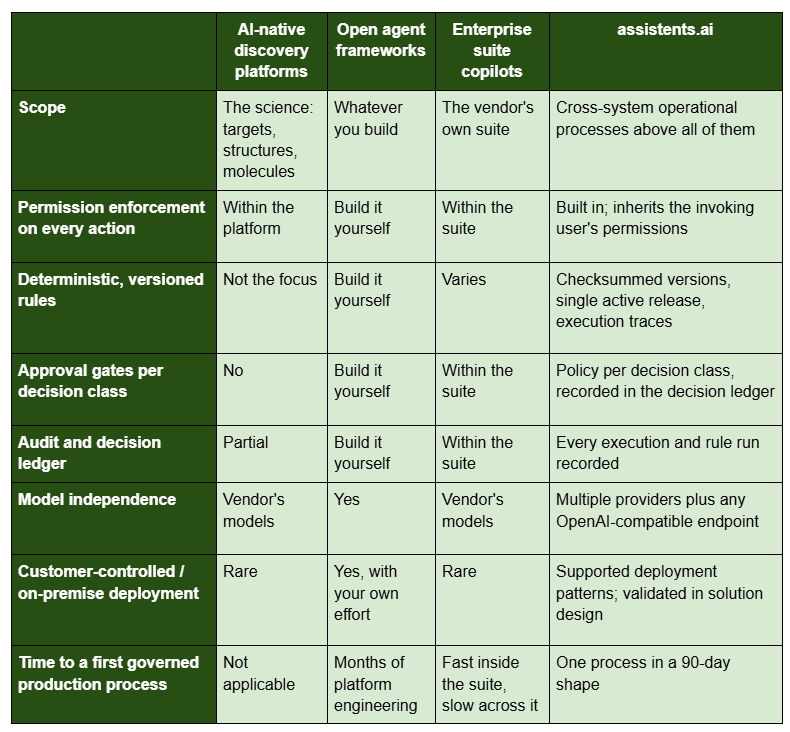
The honest version: discovery platforms win on the science and are complementary. A framework gives you a demo; a governed platform gives you something a QA lead, a data protection officer and an auditor will sign. Suite copilots govern their suite, not the heterogeneous stack a biotech actually runs.
assistents.ai converts enterprise data, documents, policies, business rules and workflows into contextual intelligence, governed decisions, coordinated actions and measurable outcomes. Systems of record store the enterprise. Systems of intelligence explain the enterprise. assistents.ai is the System of Agency that helps humans and AI agents operate the enterprise together — and, over time, the operating layer through which a biotech grows toward an increasingly autonomous enterprise, with human accountability intact.
The future of AI in biotechnology, 2027–2035
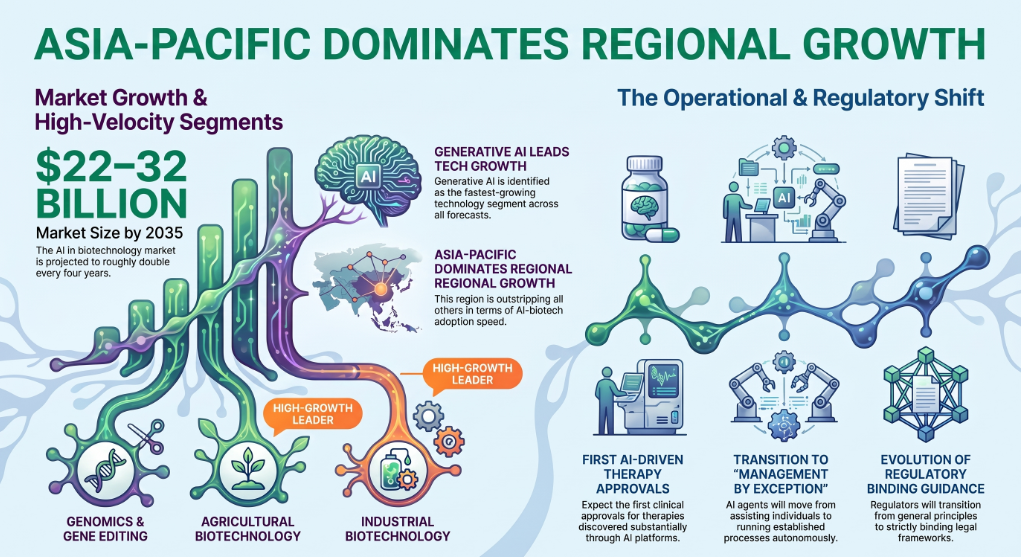
Taking the consensus band at face value, the AI in biotechnology market roughly doubles every four years to USD 22–32 billion by 2035. Generative AI is the fastest-growing technology segment in every forecast; agricultural and industrial biotechnology applications, and genomics and gene editing, are the fastest-growing application areas depending on the analyst; and Asia-Pacific grows fastest by region.
Expect the first approvals of therapies whose discovery was substantially AI-driven, more consolidation among AI-native platforms as capital concentrates around the validated few, subscription-style access to models and curated data, and regulators moving from principles to binding guidance.
The operational shift will be quieter and larger. As agents move from assisting individuals to running established processes by exception, the questions that decide value will be about work, authority and outcomes: which process, who owns the result, what the agent may do without asking, and what changed in the number that mattered. Organisations that build that operating layer now will compound; those that keep piloting models will keep piloting.
Conclusion
Three things are true about the AI in biotechnology market in 2026. It is real and growing at about 19% a year, whichever analyst you trust. Adoption follows verifiability and data readiness, which is why literature review and structure prediction are in production while generative design and biomarker discovery are not. And the difference between a pilot and a production deployment is the unglamorous layer of permissions, rules, approvals and audit that regulators have now made explicit.
assistents.ai is built for that layer: permission enforcement on every action, deterministic rules, human approval gates, an audit trail and model independence on infrastructure you control, with your existing scientific tools registered as governed capabilities. Request a demo to see it running on your own data, or explore how Ampcome works with pharma and biotech teams.
FAQs
How big is the AI in biotechnology market in 2026?
Analyst estimates for the AI in biotechnology market in 2026 range from USD 2.98 billion (Coherent Market Insights) to USD 7.54 billion (360iResearch), with most major houses between USD 4.6 billion and USD 7.5 billion: Towards Healthcare reports USD 4.63 billion and Precedence Research USD 6.68 billion. The spread reflects scope definitions, not different views of growth.
What is the AI in biotechnology market growth rate?
Seven of the nine forecasts reviewed put the compound annual growth rate between 18.5% and 19.3% through 2033–2035: MarketsandMarkets 18.5%, Precedence Research 18.99%, Towards Healthcare 19.04%, SNS Insider 19.13% and Market.us 19.3%. Outliers are 360iResearch at 13.56% over a shorter horizon and Meticulous Research at 21.8% with a genomics-heavy weighting.
What will the AI in biotechnology market be worth by 2035?
Forecasts for 2035 range from USD 22.23 billion (Towards Healthcare) to USD 31.87 billion (Precedence Research), with MarketsandMarkets at USD 22.72 billion and SNS Insider at USD 22.50 billion. A planning band of USD 22–32 billion by 2035 covers the credible estimates.
Why do analysts report such different AI in biotechnology market sizes?
Because they define the market differently: whether agricultural and industrial biotech are included, whether compute and sequencing analytics count, whether the figure is vendor revenue or end-user spend, and which base year is used. The "AI in pharma and biotech" series from Fortune Business Insights (USD 8.54 billion in 2026) is a wider scope again and should not be compared directly.
Which region dominates the AI in biotechnology market?
North America leads with 42.6% of revenue in 2024 by MarketsandMarkets' count and about 50% by Towards Healthcare's, driven by venture funding, NIH grants, FDA engagement and the concentration of pharma and biotech companies. Asia-Pacific — led by China, Japan, South Korea and India — is the fastest-growing region in every forecast reviewed.
Which segment holds the largest share of the AI in biotechnology market?
By function, research and development is the largest segment; by application, drug discovery and lead generation held about 36% in 2024 (Towards Healthcare); by end user, pharmaceutical companies account for 36–42% of demand; by offering, end-to-end solutions lead and are growing fastest at 19.9% (MarketsandMarkets); and cloud is the dominant deployment mode.
Who are the key players in the AI in biotechnology market?
MarketsandMarkets names NVIDIA, Illumina and Recursion as leaders, alongside Schrödinger, BenevolentAI, Insilico Medicine, Tempus, Qiagen, DNAnexus, SOPHiA Genetics and XtalPi. Isomorphic Labs (USD 2.1 billion Series B, May 2026), Generate Biomedicines, Xaira and insitro are among the best-capitalised private platforms. Governed enterprise AI operations platforms such as assistents.ai occupy a separate layer above the science tools.
How is AI used in biotechnology?
AI is used across the biotech value chain: target identification, protein structure prediction and molecular design, literature review and scientific reporting, multi-omics and biomarker analysis, predictive toxicology, clinical trial design and patient recruitment, real-world evidence, regulatory document processing, bioprocess optimisation, procurement and supply chain, pharmacovigilance, patient support and cross-entity operations analytics. Adoption is highest where outputs can be verified against known results.
What are the main challenges of AI in biotechnology?
The main challenges are fragmented, unstandardised data; validation and reproducibility of AI outputs; exposure of proprietary or patient-linked data to hosted models; documentation demands from regulators; the cost of long agent runs; a shortage of people who bridge biology and machine learning; dual-use safeguards; and accountability — being able to show who approved what, on which evidence.
What regulations apply to AI in biotechnology and drug development in 2026?
On 14 January 2026 the FDA and EMA jointly published ten Guiding Principles of Good AI Practice in Drug Development, covering a risk-based approach, context of use, data governance, lifecycle management and human oversight; they will underpin future binding guidance. The EU AI Act's general-purpose model obligations have applied since August 2025 and high-risk obligations phase in from August 2026. Data-protection law (GDPR, HIPAA) applies wherever patient data is involved.
Will AI replace biotechnologists?
No. The evidence to date shows AI agents fail in ways that require expert judgement to catch — planning errors, hallucinated parameters, regression to common patterns — and regulators require human oversight. AI shifts scientists' work from repetitive analysis and documentation toward experiment design, validation criteria, reviewing outputs and interpreting biology. The scarce skill is people who can do both.
How do biotech companies start adopting AI safely?
Start with one recurring, cross-system process that has a measurable baseline and a named owner; define the data boundary; register approved tools; write deterministic rules for QC, release and spend decisions; build an evaluation set; set approval policy per decision class; run in shadow mode; then go live on one workflow with monitoring. A governed platform such as assistents.ai provides the permission, rule, approval and audit layer so the process can move up the autonomy ladder as evidence accumulates.

Transform Your Business With Agentic Automation
Agentic automation is the rising star posied to overtake RPA and bring about a new wave of intelligent automation. Explore the core concepts of agentic automation, how it works, real-life examples and strategies for a successful implementation in this ebook.
Sarfraz Nawaz is the CEO and founder of Ampcome, which is at the forefront of Artificial Intelligence (AI) Development. Nawaz's passion for technology is matched by his commitment to creating solutions that drive real-world results. Under his leadership, Ampcome's team of talented engineers and developers craft innovative IT solutions that empower businesses to thrive in the ever-evolving technological landscape.Ampcome's success is a testament to Nawaz's dedication to excellence and his unwavering belief in the transformative power of technology.

More insights
Discover the latest trends, best practices, and expert opinions that can reshape your perspective







Contact us

